When asked if Lutheran theology and ethics has anything distinctive about it, my usual response—general but accurate—is that Lutheran thinking is above all else governed by a dialectical vision. Reaching back to Paul and Augustine, Luther’s thought is thoroughly dialectical. Polarities such as Law and Gospel, Two Kingdoms, and Freedom and Bondage, are the driving dynamic force behind Luther’s powerful Reformation theology. Paul Santmire’s address to Capital University delivered on November 14, 1997, clearly embodies that tradition both in form and in content. Because they seem so well rooted in the normative traditions of our Lutheran liberal arts heritage, his suggestions offer the prospect of authentic guidance for the Lutheran college serious about its past—and its future.
Santmire’s vision for the Lutheran liberal arts college in an environmental age is clearly dialectical. Formally, Santmire articulates three mandates, each of which is expounded in terms of its strengths and weaknesses, or as Santmire puts it, “skeletons in our closets and riches in our own vaults.” This formal mode of presentation seems to me very important, for it articulates a basic insight of Lutheran thought on institutional structures. Namely, those strengths which enable an institution to thrive can often lead to the same institutions’ decay, either through complacency and even hubris, or through blindness. While Lutheran liberal arts colleges need to draw upon their historical strengths, yet they also need to evolve as institutions to respond to the prospects and dangers of a dynamic world. In effect, they need to identify their social functions historically and serve those same functions today, yet do so under quite different societal conditions. In other words, they must do things differently in order to continue to do what they have always done.
On the content level, Santmire identifies three themes. The first theme is responsibility for spiritual particularity. Addressing a theme Santmire is uniquely qualified to assess, he calls for an honest owning up to the ambiguity of the Christian tradition toward the environment. Clearly, there are skeletons in the closet of the Christian tradition on this account. But there are also profound resources both historically and in the prolific, contemporary field of ecotheology and ethics. Likewise I think Santmire is on target when he warns against a premature flight to alternative religious traditions because of a putative greater sensitivity to the environment. I would point out that the historical record of the actual behaviors of these traditions is rarely critically assessed. At the very least, it must be emphasized that theoretical environmental sensitivity in either the Christian or the non-Christian traditions is no guarantee of ecologically responsible behavior in practice.
The theme of ambiguity is carried over to comments on the distinctively Lutheran tradition of Two Kingdoms. Here again, I think Santmire is fundamentally on target. Yet while he is quite specific about the deficits of typical Lutheran social ethics, he is strangely mute on what the strengths might be. At issue, I think, is whether one views Luther’s ethics as dualistic or dialectical. On the one hand, classical Lutheran ethics has been, and often still can be, very quietistic. On matters of social justice, Lutherans often regard the church as unqualified to enter into worldly political and social struggles. At the very most, it has sought to convert the individual conscience for higher standards of behavior in their secular offices. In this day and age, where we recognize the power of social structures to shape and mold character and individual behavior, such a stance is clearly inadequate. But, on the other hand, Lutheran ethics at its best is dialectical, recognizing the interpenetration of church and world, Law and Gospel, eschatological Kingdom and present day realities. History, as in St. Augustine, for example, can be regarded as salvation history, as the dynamic struggle for the birthing forth in bits and pieces of a redeemed world. While Lutherans will always be clear that the world is not the Kingdom of God—the Lutheran emphasis on sin will preclude that—yet they may also look for and cooperate with the signs of the in-breaking of God’s glorious New Age, the New Heavens and the New Earth. Such a vision was clearly at the root of the Lutheran Hegel, or the Lutheran theologian Ritschl. Bonhoeffer and Reinhold Niebuhr certainly fit in this camp, as does the contemporary Lutheran ecotheologian Larry Rasmussen. At its best, the dialectical patterns of Lutheran social ethics grants us a sensitivity—hopeful yet realistic—to the relative approximations of ecological and social justice possible in our various historical moments. It seems to me that Santmire could have done more to point out these qualities.
The other two mandates of responsible social criticism and the promotion of a responsible environmental ethos can be taken together. Clearly, the objective of the liberal arts tradition is to promote liberal thinkers, liberal in the classical sense of liberated from excessive parochialism. The question only remains, to what extent are Lutheran liberal arts colleges still doing this. Two remarks: First, my experience of many Lutheran colleges and universities is that their liberal arts dimensions have been progressively on the retreat in favor of more marketable vocational training in the areas of business, education, computer science, and the like. It is a matter of considerable debate as to what degree our graduates have managed to imbibe some of the liberal arts ethos, even as they have concentrated on their vocational choices. At least, that is often the rationale one hears for this institutional drift. Second, a brief glance at the promotional materials of our Lutheran colleges and universities will raise doubts as to whether Lutheran higher education promises to lead students deeper into the complexities of modern, urban life, as Santmire calls for. Indeed, I often have the impression that students and their families select private liberal arts colleges because they promise a safe and sheltered learning experience, not one of exposure. Are the products of such educational experiences prepared to enter our complex and wounded world equipped with the critical resources of a liberally educated individual?
Finally, in my opinion, if there is an issue toward which contemporary liberal arts education ought to gravitate, it is environmental responsibility and responsible social criticism of ecologically unsustainable practices. Here, I believe Santmire places his finger on exactly the three dimensions of institutional reform required of contemporary institutions, namely, curricular reform, a pedagogy directed toward creative social imagination, and the practices of reverence and respect before life and its mysteries. Because ecology is the science sine qua non of interrelationships, it constitutes the best available option for a capstone integration experience. Debates have been circulating on the inclusion of an environmental studies component in our core curriculum here at Capital, yet without much success to date. As the world, its populations, civilizations, and ecosystems become increasingly interdependent, I believe that some form of environmental studies component in every educational experience will be an inevitability. A step in that direction would be in keeping with the creative, liberal thinking of our heritage, a sign that our imaginations are already reaching into the future, anticipating an age of greater ecological sanity. Until that time, liberal arts colleges can practice creative workshops known as “liturgies” where a new reality is pronounced, attended to, and dramatized into reality. Worship is a form of resistance to the compulsions of instrumentalism and the false necessities in our age. Worship creates a space in which human potential can be unleashed, where creative imagination can be exercised, and where a fortitude of will can be developed to enter the world, in Santmire’s phrase, daring to be “irrelevant” to its insanity and thereby offering an alternative that may promise a brighter future.
Liberal arts colleges have a tough road ahead. In the face of all these suggestions, many administrators and professors will be quick to point out that competition is stiff and that institutions must strike compromises. Could an institution like Capital really survive if it sought to embody what has been outlined in Santmire’s article and my response? Indeed, in my own dialectical view, with its bent toward realism, I am willing to go some distance in this conversation. And yet, realism cuts two ways. Is it realistic to believe that we can continue to function in a business-as-usual mode in the face of looming ecocrisis? Is it realistic to believe that liberal arts colleges can shove their liberal arts orientations to the periphery and still be liberal arts colleges with something distinctive to offer the educational world? Is it realistic to believe that we can equip students for responsible citizenship by training them to be articulate members of a global economy whose vision of a good society is an acre of suburban bliss, plenty of horsepower in the driveway, and recreational trips to Martha’s Vineyard, Mt. Rushmore, or Club Med? So will the real realism please stand up? Where do you stand?
-
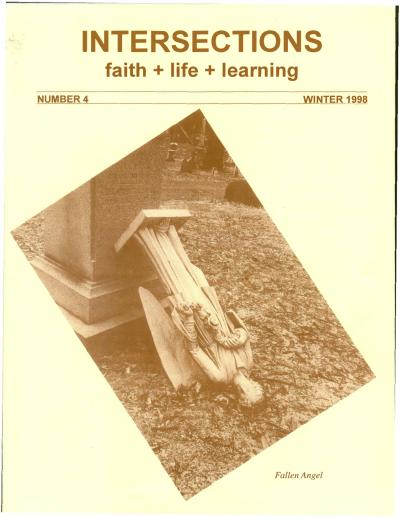 Editorial
The Vocation of a Lutheran College: Some Transitional Thoughts
James M. Unglaube
Unglaube offers final reflections on thirty years in Lutheran higher education as he leaves the ELCA Division for Higher Education and Schools to join Carthage College, his alma mater. He recalls colleague Richard Solberg’s influence, the closing of Upsala College in 1995, the Higher Education and Namibia program shared with Naomi Linnell, the growth of endowments from $70 million to $1 billion in 25 years, and the Vocation of a Lutheran College project he credits Paul Dovre with inspiring. He likens the twenty-eight ELCA colleges to flowers on a rose bush—same Lutheran tradition, each blossom different—requiring constant nurture if the partnership between church and college is to thrive.
-
Editorial
From the Editor
Tom Christenson
Christenson thanks the departing Jim Unglaube, recommends Ronald A. Wells’s Keeping Faith: Embracing the Tensions in Christian Higher Education (Eerdmans) as both an interesting collection of essays and a model worth imitating at ELCA institutions, previews the issue’s pieces by Richard Hughes, Carl Skrade and Spencer Porter, Gregory Clark, and Karla Bohmbach, and introduces three new features of the journal: “What I Have Learned” (an essay by a senior or emeritus faculty member, inaugurated by Richard Ylvisaker), “Reviews” (initiated by Karla Bohmbach), and a “Bulletin Board” for cross-campus announcements.
-
Article
Our Place in Church-Related Higher Education in the United States
Richard Hughes
Adapting his 1997 Vocation of a Lutheran College Conference address, Hughes asks how the Lutheran heritage can sustain the life of the mind in church-related higher education. He compares Reformed, Mennonite, and Catholic traditions in turn—the Reformed integration of faith and learning around a Christian worldview, the Mennonite priority of discipleship over cognition, and the Catholic sacramental affirmation of the secular as bridge—before arguing that the Lutheran heritage’s particular gifts (justification by grace, theology of the cross, two kingdoms, paradoxical sensibility, vocation, and openness to ambiguity) uniquely support rigorous inquiry, genuine pluralistic conversation, and critical analysis. Drawing on Arthur Holmes, John Howard Yoder, Mark Schwehn, Alasdair MacIntyre, and Lutheran writers including Bob Benne and Tom Christenson, Hughes contends that Lutheran finitude grounds an unusually open and self-critical academic posture.
-
Article
The Skeptical Theologian's Dictionary
Carl Skrade, Spencer Porter
Porter and Skrade offer selections from a mock-lexicon of theological terms: answer, church, faith, God, grace, hope, justification, love, prayer, sin, soul, and theology, among others. Each entry begins with a standard definition and then unsettles it—answer reminds the reader that in theology and poetry the questions matter more than their answers; church alternates between “the mystical Body of Christ” and ordinary human gatherings whose machinery often obscures the gospel; God is the One whose name we are told not to take in vain and yet whose name we keep using; prayer is communion with God yet often degenerates into a list of demands. The form’s irony exposes the gap between the language of theology and its lived realities—a sober, witty corrective for Lutheran classrooms and chapels alike.
-
Article
The University in the City of God: Beyond Dialectics and Rhetoric
Gregory A. Clark
Clark, drawing on Alasdair MacIntyre’s Three Rival Versions of Moral Enquiry, distinguishes the preliberal, liberal, and postliberal university and argues that the liberal university’s pretense of dialectical neutrality has masked a particular rhetoric of its own. Following John Milbank’s Theology and Social Theory, he holds that every philosophy and institution is finally a rhetoric and that the church’s task is not to win on the secular university’s terms but to proclaim and embody an alternative city. The Christian college, then, should give up the apologetic pose of meeting secular reason halfway and instead practice the rhetoric of the gospel: a proclamation of Jesus, an enactment of Christian friendship and peace, and a willingness to be vulnerable to the violence of the world as Jesus was vulnerable to his own. Clark commends this stance to colleges related to the church.
-
Article
A God of Peace and Love? Reflections From a Biblical Scholar
Karla G. Bohmbach
Bohmbach responds to Gregory Clark’s call to proclaim Jesus on Lutheran campuses with biblical-scholar reservations. Israel’s sacred texts also include the herem ban, the conquest narratives, and a God who fights for Israel; the Christian canon includes the apocalyptic violence of Revelation. To proclaim Jesus is therefore to proclaim a particular and contested figure within a tradition that has its own internal violence—not a generic God of peace and love. Bohmbach asks what it would mean for staff, administrators, and teachers on a college campus to take seriously the Jesus who made himself vulnerable to the violence of his world, even to the point of suffering for it, and whether Lutheran colleges are prepared for such a vocation.
-
Article
What I Have Learned: Maybe Plato Was Right
Richard Ylvisaker
Inaugurating the new “What I Have Learned” column, Ylvisaker reflects on a career of teaching philosophy at Luther College and offers four hard-won “preliminary examples” in which Plato turned out to be more right than fashionable criticism allowed: (1) communities are not necessarily better off by becoming more diverse—diversity needs a unity of purpose if it is to enrich rather than fragment; (2) politics, to be more than a struggle for power by competing interests, must rest on a moral basis that transcends those interests; (3) the much-derided body-soul dualism contains a measure of truth about the cognitive and moral limitations of embodied life; and, deepest of all, (4) reason itself depends on a community of discourse in which doctrinaire pronouncement gives way to disciplined inquiry. Athens and Jerusalem, he concludes, should meet at the college of the church.
-
Article
A Response to Paul Santmire: The Lutheran Liberal Arts College and Care for the Earth
Arthur A. Preisinger
Preisinger commends much of Paul Santmire’s earlier essay—the critique of the “back-to-nature” cult, the call for a holistic environmental ethos, the suggestion of a cosmic liturgical praxis—but takes issue with Santmire’s reading of classical Lutheran social ethics. He argues that the two kingdoms doctrine was not a systematic Lutheran treatise (the term itself became common only in the 1930s), that the doctrine’s misuse by some twentieth-century German theologians does not condemn its proper use, and that the South African Council of Churches actually deployed the doctrine (correctly interpreted) against apartheid. Drawing on Karl Hertz, Ulrich Duchrow, Tom Strieter, and F. Edward Cranz, Preisinger defends the doctrine as complementary duality—left hand and right hand of God, governances to be distinguished but never separated—and concludes with Bill Lazareth that the skeletons in the Lutheran closet are not Luther but departures from Luther.
-
Book Review
In Search of a Calling: The College's Role in Shaping Identity
Karla G. Bohmbach
Bohmbach reviews Thomas O. Buford’s In Search of a Calling: The College’s Role in Shaping Identity (Mercer University Press, 1995), which diagnoses a meaning-crisis among college students and traces two historical aspects of “calling”: the biblical, communitarian aspect rooted in the Hebrew Bible and the practical, individualistic aspect rooted in the Renaissance. She praises Buford’s reconstruction of imago dei as imagination rather than copy of God’s rationality, his broad disciplinary range (biblical studies, theology, educational psychology, business management), and his identification of the tension between freedom and limitation as the field of calling. She is sharply critical, however, of his final chapter’s wariness of canon-revisionists and multiculturalists, his caricature of “special-interest groups,” and his presumption of a homogeneous student body—a presumption that, she argues, never matched American college reality and matches it less today.
-
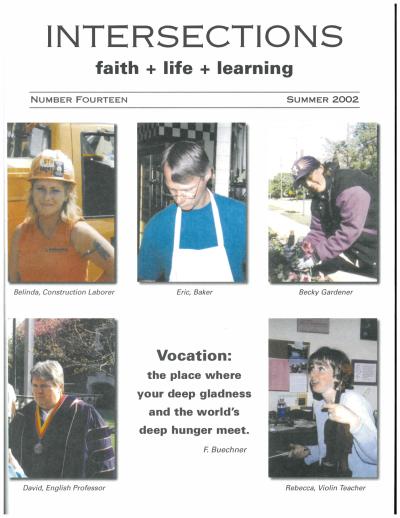 Book Review
Alister McGrath: Glimpsing the Divine: The Search for Meaning in the Universe
Don Braxton
No. 14 · Summer 2002
Braxton reviews Alister McGrath’s Glimpsing the Divine (Eerdmans, 2002), commending its twelve articulate, lavishly photographed meditations as a fine introduction to Western spirituality but criticizing its conservative neo-Barthian confessionalism, its Eurocentric treatment of non-Western traditions as “taillights” to Christianity’s “headlights,” its one-sided host-guest engagement with the natural sciences, and its metaphysical dualism. In a section added for ministerial readers, he contrasts McGrath’s self-contained confessionalism with H. Richard Niebuhr’s call to respond to all things as if to God’s actions upon us, and argues that in an era of rival fundamentalisms exclusivity must become a thing of the past.
-
 Article
Honesty of Mind: On the Uses and Abuses of Socratic Ignorance in Environmental Studies, Religion, and the Classroom
Don Braxton
No. 15 · Winter 2002
Braxton, taking his cue from David James Duncan’s defense of ignorance as a fly-fisher’s most crucial tool and from Socrates’ midwife’s art in the Theaetetus, defends a doctrine of “honesty of mind” resting on four premises—knowledge is constructed, judgments are wagered amid imperfect knowledge, expertise can disable learning, and we are encumbered by other ways of knowing. He field-tests the disposition against three domains: the climate-change and creationism debates in environmental studies, the post-September 11 turn toward religious pluralism (engaging Union Seminary’s Joseph Hough and Hauer and Young’s “three-world” approach to the Bible), and the liberal arts classroom where students “become democrats of the mind” through Reinhold Niebuhr’s balance of conviction and contrition.
-
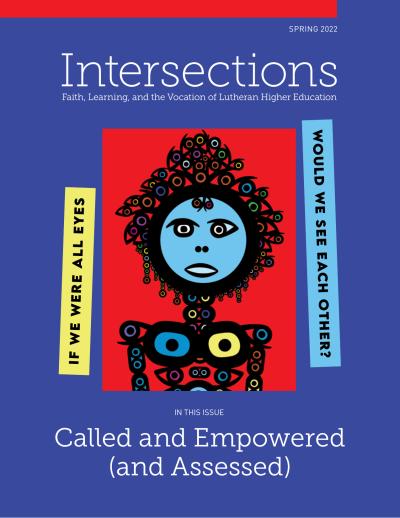 Institutional Focus
Serving and Building Community at Concordia College
Larry Papenfuss
No. 55 · Spring 2022
Papenfuss, director of the Dovre Center for Faith and Learning, frames eight ways Concordia College serves the world by building community — from quality teaching and liberating liberal learning to interfaith cooperation and modeling “diversity with particularity” as a Lutheran “third path” institution.
-
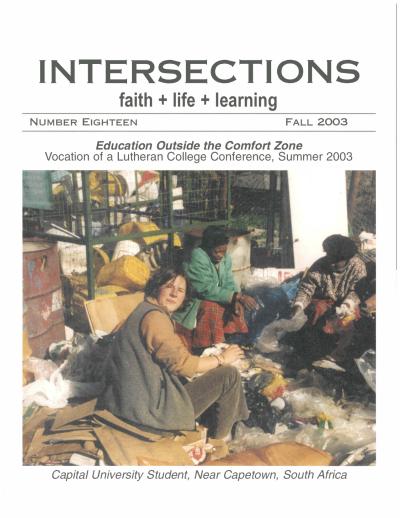 Editorial
From the Publisher
Arne Selbyg
No. 18 · Fall 2003
Selbyg reports that the ELCA Church Council’s new strategic directions include the charge to “assist this church to bring forth and support faithful, wise, and courageous leaders whose vocations serve God’s mission in a pluralistic world,” and assures readers that Intersections, the Vocation of a Lutheran College conferences, and related programs will remain among the tools by which the churchwide organization reaches its strategic goals.
-
 Editorial
From the Publisher
Mark Wilhelm
No. 35 · Spring 2012
Wilhelm describes the “four-legged stool” supporting ELCA higher education—the annual Vocation of a Lutheran College Conference, the Lutheran Academy of Scholars, the Thrivent Fellows program, and Intersections—and argues that the conversation about Lutheran mission and identity must now be extended beyond college and university personnel to the larger church and community before the gains of a generation are lost.
-
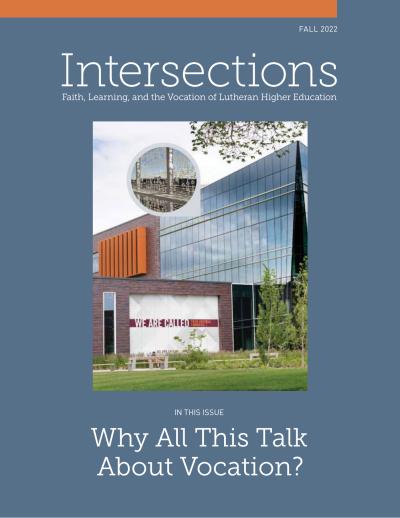 Editorial
From the Editor: Why All This Talk About Vocation?
Colleen Windham-Hughes
No. 56 · Fall 2022
Windham-Hughes introduces the Fall 2022 issue built around Mark Wilhelm’s keynote “Why all this talk about vocation?” and previews five panel responses, two first-time conference reflections, and companion pieces on Womanist theology — framing vocation as a call not to privilege but to constructive and corrective work that undoes unjust systems.
-
 Article
Gen Z is Made for Lutheran Higher Education
W. Kent Barnds
No. 51 · Spring 2020
Barnds argues that Generation Z’s defining traits — socially responsible, purpose-driven, cost-conscious, culturally open, and tech-expectant — align almost perfectly with the missions of NECU institutions, and offers concrete suggestions (from replacing “vocation” with “purpose” to embracing Gen X parents as co-pilots) for Lutheran colleges seeking to attract and serve this generation.
-
 Article
Faith, Understanding, and Action
Paul J. Dovre
No. 10 · Fall 2000
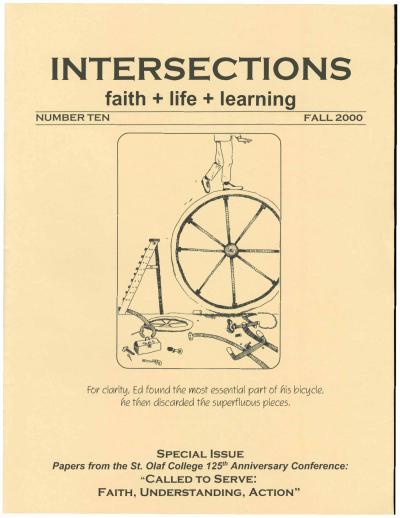
Dovre frames the St. Olaf 125th anniversary—originally read as part of a presentation with the St. Olaf Cantorei and organist Paul Manz—around T.F. Gullixson’s story of an immigrant woman who “turned her face to the west wind” and the 1874 gathering at the Holden parsonage of B.J. Muus, Harold Thorson, O.K. Finseth, K.P. Haugen, and O.O. Osmondson. He weaves Anselm’s “faith seeks understanding,” Harold H. Ditmanson on the universal relevance of Christian faith, and the music of Venatius Honorius Fortunatas, John Rutter, Herbert Brokering, Ralph Vaughan Williams, and John Tavener into a meditation on faith as motive, understanding as modus, and action as consequence, against the “ill winds” of poverty, child homicide, AIDS, and consumer gluttony.