Three Prayers for Three Souls
I am a bow in your hands, Lord. Draw me lest I rot.
Do not overdraw me, Lord. I shall break.
Over draw me, Lord, and who cares if I break.—Nikos Kazantzakis, Report to Greco
Introduction
The topic of this discussion is well introduced by the question, “How can we make non-Lutherans more welcome at Lutheran colleges and universities?” This topic was offered to me with the proviso that it was only a suggestion and I was free to alter it any way I desired. In point of fact I had every intention of abandoning it as soon as I could come up with a good reason for doing so. After all, my expertise in the area is exhausted by the fact that I am a non-Lutheran at a Lutheran institution. Still, I never came up with that good reason. In fact I found that once one gets beneath the public relations and human resources surface, this question presents a formidable challenge to institutional identity. That may not be immediately apparent. We need to take the question apart.
First of all, the question intimates, not very subtly I might add, that non-Lutherans are not welcome enough at Lutheran colleges. I am in no position to speak for any institution other than my own, but I have a strong suspicion that the intimation is correct. A great deal, of course, hangs on the meaning one attaches to the notion of being welcome. Care must be used in defining this term to ensure that one neither trivializes nor mystifies the question it poses. I shall be arguing for a particular way of understanding and defining the term, a way that I believe avoids these pitfalls; but it is by no means the only way to do so.
Secondly, I should like to restrict my remarks to the issues surrounding faculty members’ sense of being welcomed. Obviously no less significant issues surround the sense of welcome felt by staff and students. Students are probably the most important and complicated of the three groups, as the well being of tuition dependent colleges is directly tied to such things as enrollment growth and retention rates. Welcomed students are a given in any successful educational experience. Although it is beyond the scope of this paper to argue so, I strongly suspect that the results for the case of faculty could be generalized, mutatis mutandis to the cases of staff and students as well.
Finally, my concern is not with all Lutheran colleges and universities but with those that are intent for whatever reason to maintain their Lutheran “character.” I will be the first to admit that I have no criteria necessary and sufficient for distinguishing this subset of Lutheran institutions. There are, however, several traits and policies that mark something like a family resemblance that they share. These institutions tend to have closer relationships with their supporting synods. They tend to be led by people of the clergy. They tend to assess the composition of their faculty in terms of some notion of a “critical mass” of professed Lutherans. They tend to favor Lutheran candidates in hiring, though not necessarily in tenure and promotion decisions. They conduct worship services with varying degrees of regularity. And they will occasionally, either formally or informally, refer to themselves as either “a college of the church” or “church-related.” This later trait is often used to mark fine-grained distinctions within Lutheran higher education. Such distinctions are often based on historical roots and denominational mergers rapidly fading from memory. So also the distinctions are rapidly losing their usefulness to all but church historians.
It is not particularly important to my case that this impressionistic picture of Lutheran self-conscious institutions is perfectly accurate. A family resemblance will do. What is important is that we ask our initial question with these sorts of institutions in mind. Without some significant degree of commitment to Lutheran character, an institution’s responsibility to be welcoming does not extend very far beyond civility and helpfulness. It is straightforward and comparatively easy, as it involves no significant relationship to the identity of the institution. But when an institution is overt about its Lutheran character and covetous of its traditions, the question becomes an interesting and challenging one.
Faculty Identity and Institutional Fit
It is a daunting task to even imagine what makes a non-Lutheran faculty member feel welcome and comfortable in the context of a Lutheran college of the church. After all, comfort would seem to be among the most personal and relative of human values. Very often one of the most surprising responses we encounter in our concourse with colleagues and family is the objection that someone is not comfortable with a statement we have made or practice we have followed. Sources of discomfort are apparently deeply held and rarely disclosed. Consequently, they are difficult to analyze. The restrictions posed in the preceding section, however, offer some hope. Comfort, as we are considering it here, is not a matter of civility or helpfulness—it is not a smile or a dinner invitation. It is more subtle and basic than that. It has to do with being outside of an important institutional commitment and wanting to be a part of it, or at the very least, to be related to it in a meaningful way. In addition, it is imperative that this relationship be structured in a way that preserves integrity and honors personal principles. But how are we to have both institutional commitment and personal integrity in the case of those who do not share the institutions central values. Moreover, this ostensibly dilemmatic situation is not incidental to the identity of self-consciously Lutheran colleges but integral to it. The need to be more welcoming to non-Lutherans issues from the nature of these colleges. It will come as no surprise, therefore, that the proper response to this challenge and need is an invitation—a surprising invitation, it would seem. What is needed to make non-Lutheran faculty feel welcome at Lutheran institutions is an invitation to actively participate in the central religious project of the college.
Aristotle taught us that the goal of an organism cannot be understood apart from its function. And its function cannot be understood apart from its nature. Basic lessons perhaps, but lessons often neglected. Faculty members are highly educated, aggressive, ambitious intellectuals. They can be conventional or radical, creative or plodding, reclusive or gregarious; but they are rarely avaricious and almost always dutiful. They take responsibilities seriously and often see responsibilities where others do not. Without these qualities they would not have PhD’s and would not hold professorships. Consequently when a faculty member assumes a new post, it is with a complicated mix of hopes, and responsibilities that she or he does so. We feel a responsibility to our disciplines and hope to make significant contributions to their scholarly activity. We feel a responsibility to our departments and hope to be good colleagues and dedicated teachers. We also feel a responsibility to our institutions and hope to further their missions in whatever way we can. All of this is well and good when the institutional missions are vaguely coincidental with our own ambitions and expertise. It is problematic, however, when the mission of the institution draws upon a tradition and a set of commitments that are not shared by the faculty member. These situations arise predominantly in church related colleges and universities, so the issues predictably involve religious belief at best and church dogma at worst. Dutiful faculty will see their obligation to the religious mission of the college while at the same time they will feel the acute need to be one thing—to preserve their integrity.
On the other end of the spectrum, the self-conscious Lutheran institution is concerned to further its mission as a college of the church. That mission is diverse, too diverse by some lights. It includes educating students in the most accomplished way possible; relating effectively and faithfully to a constituency of donors and supporters; contributing to the growth of knowledge through research and development; and maintaining a robust Lutheran identity. Not much digging is required to appreciate the potential for conflict that lies close by the surface of this landscape. A provincial understanding of Lutheran identity may qualify and downsize research projects making them “safe for Lutherans,” as the saying goes. An extensive and energetic research program may very well cause ill ease among the constituency who have found comfort in easy dichotomies such as the sacred and the secular. So also, an accomplished education will require that students question their traditions and open themselves up to the possibility of adopting the traditions of others. This goal is often pursued by welcoming the most diverse body of students possible, establishing educational missions in other cultures and encouraging study abroad. All these can be threats to an institution’s identity if they are not pursued in a proper fashion. The threat is “temporary and remediable” to some extent in the case of students and programs. The situation is more difficult in the case of faculty. An institution’s commitment to a faculty member is for a considerably longer period of time, very often for the length of a career. It is also the product of a logically heroic prediction that faculty attitude and behavior will, thirty years hence, mirror attitude and behavior evidenced during the first six years at the institution. Consequently, institutions that are self-conscious about their Lutheran identity are cautious in hiring new faculty. Such caution may be justified by the landscape just described; but it may also be seen as alienating, meddlesome and suspicious. Allow me an example from my own institution.
At Concordia the process of hiring is referred to as finding “the Concordia fit.” All that is involved in “the fit” is not clear to me, even after 25 years. But in a genuine attempt to be forthright, every candidate is asked to respond to a boilerplate consisting of three questions. The third question gets to the heart of the issue and reads as follows:
One criterion for teaching at Concordia is sympathy with the mission of the college. To be in sympathy with the basic character and aims of the college means to demonstrate active rather than passive support of its purposes and to uphold and nurture the Christian values and beliefs on which the college is founded. From your perspective, how do you believe you would contribute to the college’s mission?
Now, even if one is philosophically inclined, and even if one believes there is a difference between active and passive sympathy, and even if one believes one can make a contribution to the college’s mission, what is abundantly clear is that you will not be able to contribute from your perspective. The whole point of the exercise, the cynic might argue, is to divine the perspective of the college and speak energetically from it. In other words, the name of the game is Get the Fit. Whether one gets it or not, the essay is not very welcoming and makes it very clear that you must be altered in order to fit.
I seriously doubt that Concordia is alone in this rather clumsy attempt to preserve its identity. The end is not so much the problem as the means. One might quibble over verb choice and suggest that sustaining or fostering the identity of the church-related college are more appropriate notions than preserving, but it seems right that colleges of the church attempt to do this. The real question is whether or not this “fitting” relation is sufficient for the task. I believe it is not. Here the verb choice makes a difference. If the goal of a Lutheran institution is to preserve an identity somewhat like the preserving of a pickle, then looking for institutional fits is fine. That will not, however, readily sustain an identity in a rapidly changing culture. Nor will it serve to encourage the development of a vibrant new Lutheran identity from the roots of a valued tradition. I really do not think that there is very much choice in this matter, as I have little confidence that the notion of preserving an identity is even conceptually cogent. An identity must be sustained and developed and the notion of an institutional fit is ill fitted to that task.
So the situation is roughly this: Faculty will most often feel welcome in a church related institution by being able to participate in a significant but non-hypocritical way in the religious identity and mission of the college. Self-conscious religious colleges want their institutions to be welcome to all but do not want to sacrifice their identity to do so. Lacking any more manageable notion of identity than preservation, they envisioned no more creative notion of welcoming than institutional fit. With the adoption of the more dynamic notions of developing identities comes the need for an insightful notion of what it is to belong and participate in the religious identity and mission of the college. I think there is such a notion, but since it comes from a rather unlikely source, it will take a little explaining.
Welcomed Faculty: Belonging to the Project
A debate about the relationship of faith and reason is a natural focal point of institutional identity and central to the mission any self-conscious college of the church. Any non-Lutheran faculty member that is genuinely welcomed to such an institution will be utilized as a valuable part of the debate. Other roles will also be important to a robust sense of welcome, but none more important than this. In my experience, however, these discussions are often very provincial and non-inclusive, employing a language and argument pattern available only to the initiates. Clearly such institutionalized discussions will not provide ease of entry for the non-Lutheran. There is, however, a more welcoming model of the relationship of faith and reason to be found in the writings of the Cretan novelist Nikos Kazantzakis.
A careful reading of Kazantzakis’ works will impress even the tyro with the depth of his religiosity. He may have been heterodox but he was never indifferent. He was heterodoxical because he could not be indifferent to religion. Kazantzakis denied that he was a religious man but hoped he was a profoundly religious one. Religion is about comfort and reward. Profound religion is about struggle. It is following “the bloody trail”, “the thin red line of ascent”, as he so often described it. The roots of the struggle are everywhere but nowhere more evidently placed than in the lives of profoundly religious people.
The profoundly religious person, God’s struggler, is marked by three traits.1 First of all, such a person is committed to the truth—the truth about the world, about ourselves, and the truth about God. This truth is uncomfortable and it cannot be made more palatable by fashioning accommodating lies or self-satisfying idols. Knowing the truth is dangerous and it produces wounds, the wounds of doubt, as Kazantzakis calls them. In his own case these wounds were suffered in adolescence upon discovering that the earth is not the center of the universe and that humans are not the crowns of creation, the darlings of God.
The first secret, the truly terrible one, was that the earth, contrary to our belief, is not the center of the universe. Our planet is nothing but a small and insignificant star indifferently tossed into the galaxy, and it slavishly circles the sun….The royal crown had tumbled from the head of the Earth, our mother.
I was overcome with bitterness and indignation. Together with our mother, we too had fallen from our place of precedence in heaven…. In short, what was this fairy tale our teachers had shamelessly prated about until now—that God supposedly created the sun and the moon as ornaments for the earth, and hung the starry heavens above as a chandelier to give us light.
This was the first wound. The second was that man is not God’s darling, his privileged creature. The Lord God did not breathe into his nostrils the breath of life, did not give him an immortal soul….If you scratch our hide a little, if you scratch our soul a little, beneath it you will find our grandmother the monkey.2
The truth may ultimately set you free but first it produces conflict in your life. This conflict is genuine and clearly the result of taking seriously one’s commitment to the truth. These wounds are intellectual in character but they are all the more grievous for that fact. They are never healed, they always fester yet they must be ignored in order to continue the struggle. They remain and they constantly draw our attention, but they cannot divert our will.
Secondly, the profoundly religious person is committed to the power of the spirit. This commitment is evident in the struggle to put faith into knowledge. Faith put into knowledge does not heal the wounds. That would replace knowledge with easy religion, an all too common mistake. Faith is rather the will to struggle despite the wounds and to believe in the power of the spiritual to transform knowledge into understanding, which might be characterized as the wedding of knowledge to proper action. This relationship of struggling is difficult to describe in the language of knowledge and it is trivialized in the ossified language of religion. Consequently, one must employ art. Only art, the creation of images, metaphors and myths can point to the struggle and inspire us to fight on. This then is the third mark of the profoundly religious person. Such a person understands the necessity of myth or systems of metaphors, in bringing faith into reason, or in transforming flesh into spirit by the process Kazantzakis called metousiosis or transubstantiation. We need to recognize this process, I would suggest, as a very different, even profoundly model of the relationship of faith and reason.
That the relationship between faith and reason is properly seen as a struggle may at first blush appear commonplace. Of course it is a struggle, that is why we are still discussing it and differentiating ourselves by the positions we take in it and the results we bring from it. But that commonplace is directly antithetical to Kazantzakis’ position. The relationship between faith and reason is not a struggle that is resolved by a theory triumphant—no matter which denominationally sanctioned theory one extols. Championing the virtues of the systematic integration of faith and learning, or the dynamic tension between the two kingdoms of God, or the doxastic character of the life of faith, is like preaching to a bloodless choir. Living the life of faithful reason is not a matter of mastering a creed, adopting a contentious simplification or sleep stumbling through a series of “Jesus-encounters.” Kazantzakis believes it is a battle; a battle that we hope, but cannot know that we will win; a battle wherein winning amounts to reporting that one has fought the good fight, never flagging despite many wounds.
Now Kazantzakis’ language of battles and wounds may be rather too idiosyncratically Cretan for those of us who have not experienced centuries of occupation and oppression. But it would be wrong to miss the message for the messenger. The relationship between faith and reason and the debate about its understanding have become rigidly fixed in our traditions and codified by our institutions. We have replaced an organism with a fossil and mistaken a process for a product. Our efforts have gone into marketing and validating the premature and shabby products of a cursory investigation while they should have been directed toward invigorating the investigation. We may want to understand the struggle in different images than those of wounds and battles, but the contention that it is a process, a constant struggle is ultimately liberating.
Kazantzakis insisted that a struggle is only so noble as its participants. A cheap Tertullian-like victory for faith is no victory worth having. Consequently, the debate over the relationship between faith and reason, which is central to the religious identity of a college is ennobled by strengthening our commitment to the truth, by our renewing our commitment to the power of the spirit to transubstantiate knowledge into understanding and by improving our ability to animate our beliefs in myths and images. All of the marks of the profoundly religious need our attention. It seems to me that we do not strengthen and renew for the battle unless we are made to deeply feel the wounds of truth and genuinely trust the power of faith. But the more grievous the wounds are the more important the struggle will be. Those who conduct the struggle differently from us can help us. Non-Lutherans are essential to continuing the struggle. They help us see with our eyes and hear with our ears the truth about the world and ourselves—truths that may have been comfortably avoided or institutionally domesticated. They help us see the transubstantiating power of spirit where we may only see ritualized activity. And clearly they play a great role in showing Lutherans that there are many ways to utilize myths, metaphors and images in the pursuit of metousiosis.
To briefly recapitulate: It seems to me, therefore, that if the proper understanding of the relationship of faith and reason is most perspicuously expressed as a struggle, and if that struggle is central to the Lutheran identity of educational institutions, then non-Lutherans will feel welcomed in Lutheran institutions in direct proportion to their being encouraged to join the struggle as valuable and active participants. It is important to remember that Kazantzakis perceived the struggle as having no preconceived end, no winning or losing, only struggling. In the closing pages of Report to Greco, he reports on his own life.
All wood is from the true cross because all wood can be made into a cross. Similarly, all bodies are sacred because all bodies can be made into a bow. My entire life I was a bow in merciless, insatiable hands. How often those invisible hands drew and overdrew the bow until I heard a creak at the breaking point! “Let it break,” I cried each time. After all you had commanded me to choose [which prayer I would make] grandfather, and I chose.
I chose. Now the twilight casts its haze upon the hilltops. The shadows have lengthened, the air has filled with the dead. The battle is drawing to a close. Did I win or lose? The only thing I know is this: I am filled of wounds and still standing on my feet.
Full of wounds, all in the breast. I did what I could, just as you directed. I did not want you to feel ashamed of me. Now that the battle is over I come to rest at your side….3
His report is given, but there is no intimation that the process of spiritualizing matter is complete; correspondingly there is no point when we can say we have successful related faith to reason. We often speak as if Luther or Calvin or St. Thomas solved the problem leaving only the task of indoctrinating the workers. If the argument presented here is correct the task is impossible to complete. The path, which it will follow, is not known. All who are willing to engage in the struggle, to toil on the project are welcome. Even strangers. Especially strangers. These strangers can help all of us stay committed to the truth about the world, stay open to the many ways of spiritualizing matter (of “driving” faith into reason) and expressing our hopes and fears in motivating myths and metaphors. What better welcome could there be than participating as a prized member of a group working at something so central to the identity of the college. This should be the end of the story. We have found a significant welcome for non-Lutherans. But it isn’t the end of the story for two reasons.
Welcomed Faculty: Safeguarding the Struggle
If non-Lutheran faculty are to feel welcome in self-consciously Lutheran colleges and universities, welcome to perform the essential function of generating authentic inquiry and debate from a perspective outside of the tradition, there must be an institutional commitment to the faith and reason struggle. That means that institutions must acknowledge the recurrent and indeterminate nature of the struggle. That can be a very intimidating step for even the most confident institution. I have tried to present an initial set of arguments for the benefits of such a commitment, but there is a great deal more to be done. Kazantzakis’ model of the life of struggle needs to be made more pointed by being particularized to individual colleges and traditions. If the model is worthwhile, the particularization will be rewarding work.
The second reason is closely related to the first but much more extensively documented. If it is intimidating for institutions to make this commitment, it is even more intimidating for a faculty member to perform this role in the context of a tradition that is not shared with the institution. The only way the struggle can be safeguarded is with the strongest possible affirmation of academic freedom. There has been a disturbing and relatively widespread trend in religious institutions to label academic freedom a secular value and therefore subsumable under a higher set of sacred values. This situation is inimical to all that has been proposed here. Not only does it make the struggle impossible, since it does not encourage the strong commitment to the truth essential to the model of faith and reason, there is ample evidence that it has disastrous effect in religious institutions of higher education. It is, in the last analysis, a matter of respect for the intellectual life. Martha Nussbaum in Cultivating Humanity sums up her study of Notre Dame and Brigham Young:
The examples of Notre Dame and BYU challenge the claim that religious institutions of higher education are in peril because they have followed the norms of academic freedom and merit-based promotion that are current in the secular academy. In fact they are in peril to the extent that they do not do so. …Notre Dame is vital, and able to attract fine young Catholic scholars away from secular universities, precisely because it respects their minds and gives them freedom, following both Jesus and Socrates. …The Mormon commitment to education and to the arts, long a great strength of the Latter-Day Saints is in jeopardy—precisely because standards of freedom that are derided in some quarters as “liberal” and “secular” have not been taken seriously enough as essential elements of human respect in a democratic society.4
I do not believe that the situation Nussbaum describes is particular to research institutions. The same peril exists in liberal arts colleges. The most important task of an institution intent on fostering a vibrant identity with an engaged and loyal faculty is an unswerving devotion to academic freedom. Hospitality and survival both depend upon it.
Endnotes
1. A similar point is to be found in Darren J. N. Middleton and Peter Bien “Spiritual Levendia: Kazantzakis’s Theology of Struggle,” in God’s Struggler: Religion in the Writings of Nikos Kazantzakis, Middleton and Bien (eds.) (Macon: Mercer University Press), 8.
2. Nikos Kazantzakis, Report to Greco trans. P.A. Bein (London: Faber and Faber, 1973), 115.
3. Ibid., 512.
4. Martha C. Nussbaum, Cultivating Humanity: A Classical Defense of Reform in the Liberal Education (Cambridge: Harvard University Press, 1997), 291.
-
 Editorial
From the Publisher
Arne Selbyg
Selbyg announces that the 2001 ELCA Churchwide Assembly has commissioned a new social statement on education, placing it alongside the economy, the environment, abortion, sexuality, health, and peace, and invites Intersections readers to submit input on which topics within the field of education the statement should address.
-
Editorial
From the Editor
Tom Christenson
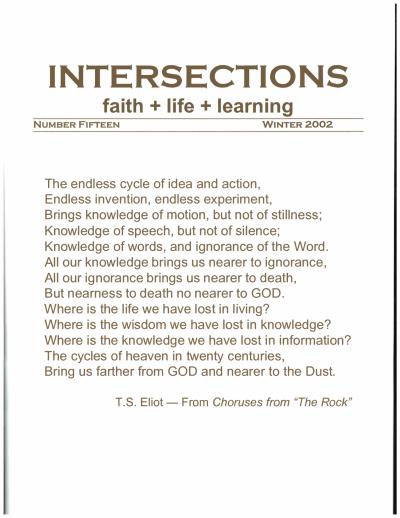
Christenson introduces an issue of varied voices—bishops and university presidents, philosophers and poets, students and their teachers—and defends the T. S. Eliot cover selection (“Where is the wisdom we have lost in knowledge?”) against the charge of being too depressing, arguing with cover artist Ida that Lutherans are realists about human accomplishments and that there is a huge difference between optimism and hope.
-
Article
The Marks of an ELCA College: One Bishop's Reflections
Stanley Olson
Olson, speaking as a bishop and “Harness Boy” whose job is to keep the church’s connections working, replaces his original four-noun outline (fealty, ingenuity, insouciance, focus) with eight marks the ELCA should be able to observe in its colleges: intentional Lutheran identity, significant Lutheran presence, Christian faith at every table, freedom of inquiry, coaching toward vocation, gravity and grace, nurtured community, and excellence by its own standards. Drawing on his survey of all twenty-eight ELCA college mission statements (two tables) and on Darrell Jodock and Mark Edwards, he argues that the Lutheran connection must be made explicit in mission, marketing, and faculty searches, and closes with six reciprocal expectations the colleges should hold of the ELCA—commissioner, mature parent, supporter of adventurous teenagers, advocate, steward of graduates, and a church faithful to its own Lutheran mission.
-
Poem
Drunks in a Midnight Choir
Kevin Griffith
A pantoum-like Christmas-season poem in which red-robed choristers, flasks clinking and hands trembling, mangle the words of carols beneath “the midnight sky, your endless dark coat,” trusting that “it’s the season to forgive what’s vile” and that even wise men praise the humble and make glad.
-
Poem
The Etiology of Eschatology
Kevin Griffith
A wry meditation on end-times and beginnings in which the last trumpet is only a prelude to the longest dawn, newly handmade animals grow fat waiting for caretakers to name them, dark-robed cryptologists fret over the end of everything, and once everyone has solved the great conundrum the big man simply hits rewind.
-
Article
The Identity, Mission, Vision, and Goals of a Lutheran College vis a vis Bacon's "Of Studies" and Newman's "The Idea of a University"
Cora Lazor, Mary Theresa Hall
Hall, an Associate Professor of English at Thiel, and Lazor, a Thiel junior and 2002 ELCA Division for Higher Education summer intern, read Thiel College’s Statements of Identity, Mission, Vision, and Goals alongside Sir Francis Bacon’s “Of Studies” (1625) and John Henry Cardinal Newman’s The Idea of a University (engaging Azade Seyhan’s May 2002 PMLA essay along the way). They argue that Bacon’s “Read…to weigh and consider” and Newman’s defense of liberal over technical training underwrite Thiel’s new Writing-Intensive Course requirement, its ten institutional objectives, and its commitment to “service to society” in the Judeo-Christian tradition.
-
Article
Honesty of Mind: On the Uses and Abuses of Socratic Ignorance in Environmental Studies, Religion, and the Classroom
Don Braxton
Braxton, taking his cue from David James Duncan’s defense of ignorance as a fly-fisher’s most crucial tool and from Socrates’ midwife’s art in the Theaetetus, defends a doctrine of “honesty of mind” resting on four premises—knowledge is constructed, judgments are wagered amid imperfect knowledge, expertise can disable learning, and we are encumbered by other ways of knowing. He field-tests the disposition against three domains: the climate-change and creationism debates in environmental studies, the post-September 11 turn toward religious pluralism (engaging Union Seminary’s Joseph Hough and Hauer and Young’s “three-world” approach to the Bible), and the liberal arts classroom where students “become democrats of the mind” through Reinhold Niebuhr’s balance of conviction and contrition.
-
Book Review
Paul Dovre, ed.: The Future of Religious Colleges
Baird Tipson
Tipson, president of Wittenberg University, reviews Paul Dovre’s edited proceedings of the October 2000 Harvard Conference on the Future of Religious Colleges (Eerdmans, 2002), summarizing essays by Douglas Sloan on the failure of the “two-realm theory of truth,” George Marsden on faith-shaped scholarship, DeAne Lagerquist, Father David O’Connell, Mark Noll, Robert Benne, Mark Roche on Notre Dame, Joel Carpenter on neo-Calvinist Kuyperianism, and Mark Schwehn on a Lutheran “college-related church” and the centrality of vocation. Against Benne’s suggestion that only two or three robustly Lutheran colleges can be sustained, Tipson defends a less robust but still authentically Lutheran model embodied at places like Wittenberg, Gettysburg, and Roanoke, arguing for the enlightenment commitment to subjecting all truth claims to rigorous criticism and for hiring Marsden-style faith-shaped scholars rather than counting Lutheran heads.

-
 Article
An Apostolate of Hope
David L. Tiede
No. 32 · Spring 2010
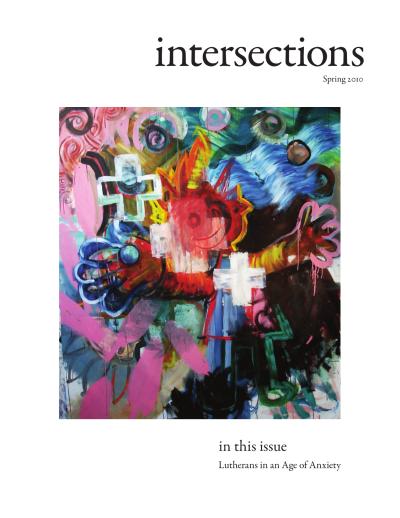
Tiede argues that the vocation of a Lutheran college is to be “an apostolate of hope” oriented by three metrics of our time: 12,000 (the Dow), 350 (parts per million of CO2), and $1.25 (the daily income of 1.4 billion people in extreme poverty). Drawing on Darrell Jodock’s “third path” for church-related colleges, Larry Rasmussen’s Batalden lectures, Mark Tranvik, Douglas John Hall, Bill McKibben, Stephen Privett, Peter Singer, and Augsburg’s Center for Global Education, he proposes that justification by faith, critical pluralism, stewardship of God’s earth, and love and justice for our students together prepare wise leaders to renew the future.
-
 Reflection
The Long Pilgrimage of 2020-21
Kara Baylor
No. 52 · Fall 2020
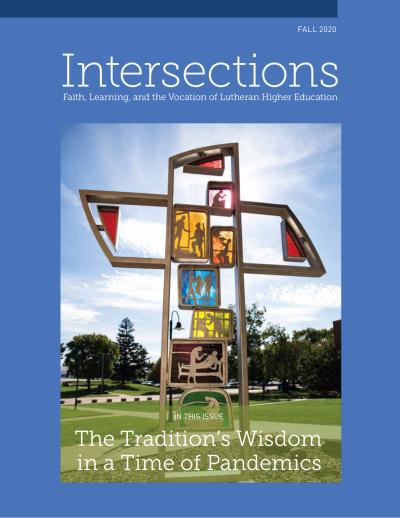
Drawing on Martha Stortz’s definition of pilgrimage as “intentional dislocation, for the sake of transformation, where the body teaches the soul,” Baylor invites students and educators worn out by the 2020-21 academic year to ask what is essential, to listen to what their bodies are telling their souls, and to be more open to the transformations the dislocation might still yield.
-
 Article
Why Martin Luther and the Reformation Matter 500 Years Later
Kathryn A. Kleinhans
No. 46 · Fall 2017
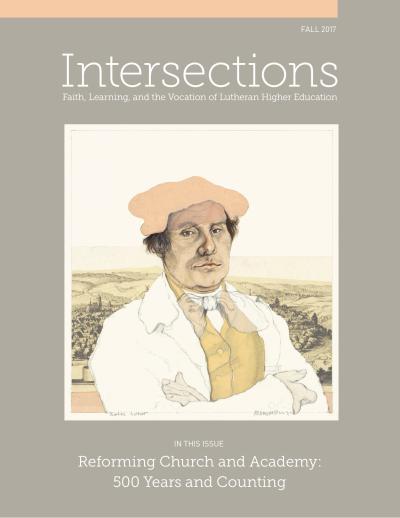
Adapted from a 2017 address to Wartburg College’s entering class, Kleinhans surveys Luther’s lasting impact in vocation, education, social service, and the necessary work of repentance — closing with the Lutheran World Federation’s Windhoek assembly and the Reformation World Exhibition’s call to live reform forward into the next 500 years.
-
 Editorial
From the Editor
Tom Christenson
No. 4 · Winter 1998
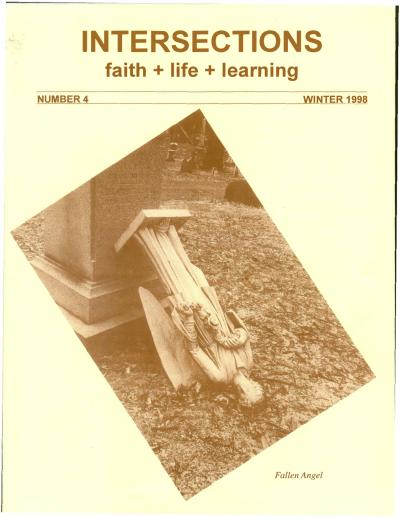
Christenson thanks the departing Jim Unglaube, recommends Ronald A. Wells’s Keeping Faith: Embracing the Tensions in Christian Higher Education (Eerdmans) as both an interesting collection of essays and a model worth imitating at ELCA institutions, previews the issue’s pieces by Richard Hughes, Carl Skrade and Spencer Porter, Gregory Clark, and Karla Bohmbach, and introduces three new features of the journal: “What I Have Learned” (an essay by a senior or emeritus faculty member, inaugurated by Richard Ylvisaker), “Reviews” (initiated by Karla Bohmbach), and a “Bulletin Board” for cross-campus announcements.
-
 Article
Staff Governance at St. Olaf College, Northfield, MN
Don Ezra Cruz Plemons
No. 58 · Fall 2023
Cruz Plemons describes how staff at St. Olaf, in the wake of a decade of difficult events, have built a three-year, glacier-paced effort toward a Staff Governance model — through affinity groups, the Council for Equity and Inclusion, and the Task Force to Confront Structural Racism — that gives staff a voice alongside faculty and students.
-
 Editorial
From the Publisher
James M. Unglaube
No. 2 · Winter 1997
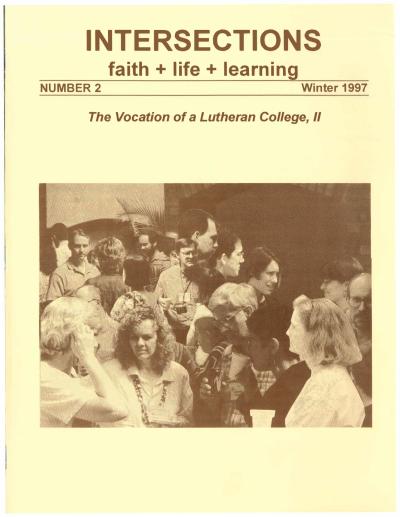
Unglaube reports on the second annual Vocation of a Lutheran College conference of August 1996, where Walter Bouman of Trinity Lutheran Seminary addressed “What is Lutheran; What is the Lutheran Tradition” (biblical, catholic, evangelical, sacramental, world-affirming—the world “received, enjoyed, served as God’s Gift”). He previews presentations by Wendy McCredie of Texas Lutheran and Baird Tipson of Wittenberg on how the Lutheran tradition is embodied in its colleges, and Bob Vogel’s challenge in “Coherence—And Now what?” that the tradition comes to life in how faculty give expression to their beliefs and values in the classroom and with colleagues.