When I was asked to make this presentation, my first thought was to construct a well-organized and integrated response to Luther’s idea of the freedom of the Christian from my perspective as a musician and to amplify this with my own anecdotes which would lead to wise conclusions. During further deliberations and reading (including Tom Christenson’s clear and stimulating paper) I discovered more and more topics. These, in turn, were multiplied by ideas from other readings and personal reflections until I was finally left with a jumble that resembled the condition of my school office. After several days of procrastination, pulling weeks, and finding creative energy to do other easier tasks, I decided to follow Luther’s directive, sin boldly, and get on with a paper that will offer opinions and raise some interesting questions (I hope), drawing on my experience as a musician of over fifty years and a college teacher of thirty-two years, thirty of them spent in a Lutheran environment at St. Olaf College and two at the South Baptist Campbell College (now University) in Buis Creek, North Carolina.
Before continuing, I need to tell you that I decided to limit this discussion to the area of music within the fine arts. Although one can group the fine arts together and find much in common, each of them is also distinct, and I have less expertise in those other than music. Besides, this decision cleared out a small portion of that pesky jumble of ideas. I hope that people here who teach or enjoy the other arts will find at least some parallels to my responses as a musician.
An additional problem for me is that I am a “jack of many (if not all) trades” in music (and master of few, perhaps), and I would like to respond to Tom’s paper in all of those capacities. Briefly, I am a composer and arranger, a choral conductor, singer, church musician, a teacher of music history (choral literature), a theorist and analyzer, a student aesthetics, a preparer of music educators (especially in the conducting course where specific techniques are discussed and practiced), a teacher of singing and vocal performance, and a researcher with a published historical edition of a Pachelbel Magnificat of significant size and forces. (I am not a great improviser or ethnomusicologist, and I play only keyboard instruments.) I mention these activities mostly to let you know that as you question me later, I can try to answer from those perspectives.
As I contemplated what I do at St. Olaf, I realized that at the heart of it all was making music, and that lecturing and the teaching of skills were largely aimed at that end. [At this point, Scholz played a tape of a Nunc Dimittis he wrote for the St. Olaf Christmas festival.]
Does this work for you as a piece of music? Is it good music? (You don’t have to answer out loud.) In an intuitive sense, you know the piece even before I tell you things about it which may cause you to listen to it more perceptively.
Here are some ways I could try to help you understand more about the music. First of all, I could talk about myself, the composer, and give you background about the attitudes, training, listening, relating to people, teaching, and faith that might influence the music I write. Secondly, I could remind you about the text of the Nunc dimittis: the response of Simeon to the presentation of the baby Jesus in the temple. Liturgically, it is used at Compline, the last service of the day, or at Evensong in the Anglican tradition, or as a hymn of thanksgiving for communion in the Lutheran service. All of these traditions combine to make it a fitting text for the end of the Christmas Festival.
I could explain the compositional process: in this case, first a melody for the chosen text, then harmony, then added choral parts, then orchestral parts, all with an attempt to remain unified in style (late 19th-early 20th C. English plus John Rutter) while honoring the flute trio which ends the work).
I could point out that the second choral phrase inverts the first, that the reprise has a canon between women and men instead of that inversion, that the tonic chord at rest is avoided until the final chord on the word “peace,” and that the chord parts at that place are arranged in the natural overtone series. The final chord in the flutes adds the unresolved major seventh, which is meant to enhance the mood of anticipating the future in eternity. I could mention the grouping of phrases in a/a’/b form.
I could describe how the choirs worked on it and how it gradually unfolded in clarity and emotion. I could tell you what I discovered as I rehearsed it — what the other musicians involved (my directing colleagues and the members of the choir and orchestra) taught me.
I could share the audience’s immediate response (quiet and enraptured) or their comments later to suggest that it “worked” for musicians and average audience alike.
If I replayed the “Nunc dimittis” for you with all of that information, you might hear it differently, but it would not explain everything you perceived and felt about the piece the first time. The fact one can describe a piece of music in such great detail does not guarantee its status as a strong and valuable work.
The experience of good music to a perceptive listener is always more profound and specific than words can completely describe. The best music is rooted in the deepest meaning of what it is to be human and has a connecting, wholesome power, both within the self and in the community on many levels. Science is providing us with studies that point to the special place music has in the brain, to its connective powers, and to its influence on the whole creative process, even outside of music itself (i.e., the so-called Mozart connection). I have heard that the governor of Georgia is having the state provide a tape of music by Mozart for every newborn child.
In music, composing, performing, and listening are to analyzing, describing, and evaluating as worship, prayer, and faith are to theology and creeds in religious activities. The latter verbalization can never do justice to the experience of the former. The joy of making music or worshiping is at least in part of the joy of the free to be whole and imaginative and connected to others in the community, whether it be the choir, the congregation or an audience.
Along the same lines, if we are free in the Spirit, we place more value on what cannot be graded. For example, a person’s faith in Christ and change of heart are ultimately more important than a grade in religion class. A mind that can be imaginative in math or science is ultimately more valuable than someone who delivers correct answers in tests and receives an “A.” The creative composer is more valuable to society than the student who can write a perfect theory assignment by the rules. The artist who can move an audience with a beautifully sung Schubert song is more valuable to that audience than the person who describes the song in the program notes. All of these people may be valuable as God’s children, but we must also honor the special gifts with which we can serve God and our neighbor and do for others what they cannot do themselves. In turn, these gifted people can teach others by word or experience or mentoring to experience their own gifts. The students’ gifts might never be as powerful in the community as those of the teacher, or they might actually surpass them. In either case, the service of teaching with self-discovery as a goal is the joyful response of a free person who does not define his or her own worth by a student’s success or lack thereof.
By way of illustration, I taught a week of Elderhostel this summer during which I was to create a choir out of 34 people, aged 60 to 95, most of whom had never met or sung with each other. Many had sung all of their lives. Some treasured their days as members of one of the famous Lutheran College choirs. Others had been silenced as young children by insensitive teachers and parents who thought that they couldn’t carry a tune or that they didn’t have nice enough voices — a great disservice indeed! A few had discovered “their voice” when they retired and subsequently sought out every opportunity to sing — and especially choral art music — since that discovery.
At the end of the week we presented a short concert with music ranging from chant and movements of Vivaldi Gloria to the Nunc dimittis you just heard. It was not stellar by the highest standards of music and aesthetic criticism, but it was great in terms of their learning about music, the singing process, rehearsing, and community. One participant declared several times in rehearsal during the week how wonderful it was to have so many people from all over the country join in their diversity to make music.
Being free in the Spirit also allows us to teach more intuitively. We can teach singing, conducting, and even music theory by connecting to life experiences and working from the emotion of the moment. For example, the conducting student might imagine bouncing a ball, tapping on a drum, or dancing with the upper body rather than slavishly conforming to a set pattern abstracted from a conducting book. The emotional response to the music could be allowed to flow into a natural gesture and communication with face and eyes. Conducting becomes less a right or wrong motion but more a language and a freeing and inspiring communication between director and the choir or other music organization members as individuals and not as sound-producers molded into some idealized tone or musical line.
The discussion of the Elderhostel experience leads to the question: “Whom are we serving in our colleges?” Most obviously, we intend to serve the young adults who are recruited to be a paying part of our learning communities. We design our curricula to help them learn in breadth and depth. However, our whole institution of faculty, administrators, and staff, from secretaries to cafeteria workers and custodians, as well as trustees and regents (not necessarily in descending or ascending order!), is important in the learning process in the broader Christian sense as described by Christenson.
Before commenting on who else might be included in a more expansive view of whom the college serves, I would like to offer several observations about Christenson’s liberating arts and how they are or can be included in the music curriculum designed for college-age students. I am not going to deal with cross-discipline possibilities, although these are important. (We have a Fine Arts concentration at St. Olaf, for instance.) I will proceed with this discussion of the liberating arts in reverse order from that presented by Christenson because, in my view, it seems to make better sense when thinking about how music works and is best taught.
1) The Arts of Enablement and Change: Changes in culture will always be reflected in the best of new compositions. New electronic instruments and computers, awareness of music from all over the globe, new discoveries by other composers, and performances of jazz, folk, and pop artists can influence how a composer (student included) thinks and writes. Texts chosen can deal with contemporary issues, or those issues can influence settings of old and traditional texts. Benjamin Britten’s War Requiem is a prime example with its intermix of poetry by World War I soldier and pacifist Wilfred Owen and the Latin Requiem text. Music chosen by teachers of solo performance for their students, by directors for their music organizations, and by teachers of music classes can honor these trends of change and artistic expression of modern cultures as well.
2) The Melioristic/Creative Arts: “Can we make something good out of what we are given?” Within the narrower discipline of music, this question is raised as we choose the members of our organizations, surely a mix of all kinds of voices, instruments, musical talents, training, and attitudes. It is raised again as we program and rehearse music and them, and then perform it. The bassoon player may be weaker than the string sections. Do we skip that Beethoven symphony as a result? The basses may not be the strongest section in the choir. Do we therefore avoid all Russian music? The singers and players also must compromise their own work in ensemble. Can a singer and her pianist agree on how to interpret that Brahms song? Can the teacher help to raise the appropriate questions that will point towards possible solutions?
For the composer, the discipline of having to write for a specific person or group or for a particular occasion and type of audience can actually be freeing and stimulating. Having to deal with real people in a real place can broaden the way the composer may usually think. Too often we think of a composer only as a person creating something completely new, drawn purely from the imagination on his or her own terms. The call of the community through commissions can be much more inspiring at times.
3) The Embodying/Connecting Arts: I will repeat Tom Christenson’s statement: “The musician who can play one instrument has more freedom than the person who has heard them all but can play none.” Within a music department there is sometimes tension between the demands of so-called music educators and state regulators who want future music teachers in the public schools to know everything, play all instruments, etc., and the goals of musicians who as educators know that skilled and meaningful expression on one instrument (or through one’s own voice) is more worthwhile. Students can be encouraged to explore other instruments and forms of artistic expression as long as those journeys do not lead them too far from developing the skills needed to sing or play sufficiently well to communicate in their primary performance area.
To connect with the world outside of the college campus, music education students spend many hours observing and practicing in the classroom and meeting with mentors and each other to discuss those experiences. Some of those students go abroad to practice-teach as well. The students who are interested in arts management can spend a semester working with professional arts groups.
For many students, including non-majors, the preparation of recitals and concerts play a large role in this connecting of doing, deciding, and becoming. Often these rehearsals and performances result in some of the most memorable experiences of their lives because they are so powerfully moved, both personally and socially.
4) The Critical/Deconstructive Arts: In music, these tasks are carried out in a formal way mainly in history and theory course work where music is analyzed and discussed. Why does this progression work? Why is Mozart considered so great a composer? Are some of his works more profound than others? Why? What does a work say about the culture from which it springs? Does John Cage’s framing of silence or the sounds of a city street corner really count as music worth listening to? Is the ultra rationalism of Karlheinz Stockhausen too complex to be understood aurally? Do some of the popular minimalists achieve length by cheap repetition, or are they speaking to us from a different non-Western aesthetic? Performances can also be criticized.
The evaluation of the place of fine arts and the folk and popular arts in the education system belongs here, and it deserves argument and dialogue. My own belief is that the fine arts and folk traditions have much richer possibilities in terms of understanding culture and the human spirit and aspirations than do the popular arts. The latter need not be ignored, but should college courses really spend equal time with, or focus on Hallmark card verses rather than the poetry of T.S. Eliot, velvet paintings of sad-eyed children rather than masterworks or the Renaissance, and tin-pan alley tunes rather than Benjamin Britten operas? Is a study of disco and 1980’s rock more important than a course in African folk styles? To further expose myself to the criticism of elitism, I will repeat this rating of folk and art music over the popular later when I discuss music in worship.
Returning now to the question of whom do we serve, we need to move beyond the confines of the usual college faculty and students.
In ever-enlarging circles we can include those Elderhostel “seniors” in Continuing Education programs or the children and youth brought to campus, such as those in Northfield Youth Choirs directed by my wife, Cora, or the High School Summer Music Camp at St. Olaf. These programs are not merely recruiting tools or even primarily recruiting tools but they also reflect a willingness to serve a wider community, often for little or relatively low salary.
What do we do for the towns or states in which we live as individuals and colleges? In music we can provide free and open concerts, workshops, and lectures that enrich the lives of citizens. We can provide community choirs such as the Northfield Choral with directors who can work for free or for a small honorarium because they are paid well enough by the college. We can have rooms available for them to rehearse and give concerts. We can support broadcasting of important news, ideas, plays, and music by radio and television. St. Olaf has its own high-quality radio station, the oldest listener-supported station in the country, and it needs to keep it on campus as part of the community. It also supports the occasional taping of the Christmas Festival to be televised locally and nationwide.
Our famous Lutheran College touring choirs can keep their focus on performing the best music available from those cultures which have a choral tradition without forgetting the centrality of the message of God’s saving grace. They can exhibit the genuine humility of singing to the glory of God and service of the neighbor, not to their own glory and service of the director. The conductors I know do well at keeping this goal of serving in their work.
We might ask how we can serve the Church, both visible institution and invisible body of believers, in addition to being good stewards of our church-related colleges. Of course, all of the work directed toward previously mentioned groups is an attempt to be Christ to our neighbor when it is done in love and gratitude. However, we could also combine proclamation of the Gospel with that ministering in special ways. For example, our St. Olaf Christmas Festival can proclaim the deeper meanings of the incarnation in its themes: Dawn of Redeeming Grace, And the Desert Shall Blossom, Set the Captive Free, Before the Wonder of This Night Go Tell It on the Mountain, Wonder Anew. The directors are committed to those themes in text and music for the choirs, orchestra, and congregation/audience. Also included in the program is a beautifully written introduction to the theme by the College Pastor. It is a Festival that is worship for many.
For the annual Spring Concert of the Chapel Choir and Orchestra, the other musicians and I present a Chapel service which attempts to make connections between the composer’s work, our performance, and the sacred texts and contexts of the music in the culture from which it arose — a large task to accomplish in twenty minutes, especially for something as profound as Britten’s War Requiem. It does help the audience to listen in different ways, however.
Very important, too, is the way we model how music is a part of worship on our campuses and what kind of music we use. This serves the college community and wider church of present and future as well.
Let me return briefly to the Christmas Festival as a symbol of the Christian freedom we have been focusing on this week. Although we receive many letters of gratitude and enthusiasm, negative criticism arrives in the mail as well:
“F. Melius would roll over in his grave.” (The past haunts us.)
“We should know all the music at a Christmas program.” (Nostalgia rules. We would like to challenge the listeners as well as affirm the tradition.)
“Where was the Norwegian carol?” (We sang it in English this year!)
“You have to do ‘your’ kind of music,’ but don’t forget us.” (Some good white folk are having trouble with a black Gospel-tradition expression.)
“YOU are not inclusive enough.” (Some wonderful poetry of the Renaissance refers to God as “He.”)
“You are doing great music but are not preparing our young people for service in the church.” (We did Handel, Britten, Rutter, etc., instead of so-called contemporary praise songs.)
“By doing all that esoteric music, you are just serving your own egos.” (Ouch! Untrue, I hope.)
“I drove 400 miles to hear ‘Beautiful Savior.’ How dare you cut it to one stanza?” (In the 35 Festivals I have experienced, it was never sung in its entirety except for last year.)
As Christians, freed from being servant to all, we planners of the Festival can listen to these criticisms, let them inform us about some people in our audience, scrutinize their ideas in the full light of what we perceive to be true and best for the audience and performers at the Festival, and go on from there, free to grow and change while respecting tradition and varying opinions.
Finally, we need to consider the place of worship on our college campuses in light of Christian freedom and the call to serve God and human beings. If it is true that Lutheran Colleges are defined in part by what they do and how they act within the community, they need to have worship and the sacraments available for participation. It is one way that God comes to us, and it is one expression of how we love God with all our heart, soul, mind, and strength and our neighbor as ourselves.
It is especially important that our musicians be involved with worship planning and in the worship service in light of Luther’s view of the importance of music:
“Next to the Word of God, music deserves the highest praise. She is a mistress and governess of those human emotions … which … govern human beings or more often overwhelm them … For whether you wish to comfort the sad, to terrify the happy, to encourage the despairing, to humble the proud, to calm the passionate, or to appease those full of hate … — what more effective means than music could you find?” (Preface to Georg Rhau’s Symphoniae iucundae, 1538)
Luther may have understood the importance of music in life in a way that has become more difficult since the Enlightenment and its stress on reason.
How much worship is enough for the college campus? Daily chapel, Sunday services, Feast Days, weekly convocations? How much participation is enough to be significant? A majority, a strong minority, occasional “seekers,” one or two gathered together in Christ’s name?
Enough of the community needs to participate so that it hears and experiences the good news which gives us our Christian freedom. If the message is too distant and second-hand, no series of conferences of this sort will be able to fill the space. Popular, secular culture will have its way instead with its own familiar ultimacies. We all need to be challenged and reassured by a ritual that does not waver from the truth and profundity of God’s presence with us.
It is especially important for the college musician to assist in finding the most appropriate musical voice for the proclamation, prayer, praise, and sacrament that are part of worship. Luther himself set up helpful criteria by his choices of music for the new church: traditional chant, hymns already sung by choirs and congregation, motets and other liturgical music already in use with occasional changes in text, tunes from the secular Meistersinger songs (the art songs of his day), newly composed hymns of the highest craftsmanship, often based on Meistersinger forms, and motets, Magnificats, chorale settings, etc. in imitation of the finest Catholic composers of the day, written for the new Lutheran school choirs.
Notice that I did not mention tavern and street songs, the popular music of the day. “Why should the devil have all the good tunes?” does not appear in any of Luther’s writings, nor in the Table Talk, where one might expect it. Luther knew better. Popular music, with its aim towards entertainment and escape, does not have the strength and profundity to carry the message of God or the depth of the congregation’s response.
Good art or folk music sung well by congregations and/or choir opens people to the truth instead of encouraging them to escape into some passive comfort zone. Most so-called contemporary Christian songs have weak texts as well and should be thrown out for their sentimentalism or vapidity of ideas.
I really object to the terminology “contemporary Christian” to describe a narrowly conceived soft pop-rock genre to the exclusion of all other contemporary musical styles — folk, jazz, or classical. What kind of music do you expect to hear at the Ohio State Fair during the 6:00 pm “Christian Music Shows”? Is the music “Christian”? I believe that is not possible for any kind of music. Or is the show “Christian” because the performers will be singing texts that mention Jesus?
In many of our churches the song leader on microphone and his or her back-up band have taken over the place of the sung liturgy and hymns. The weaker the congregation sings, the louder the sound system. Who can compete with that artificially amplified sound? This leads to my next point.
The most recent degradation of the community of Christ is the substitute of the electronic media for human actions and interaction. A few years ago my Viking Chorus arrived to sing at a suburban-type church on a Sunday morning. As we walked in to find our places, a woman in charge of music for the day slipped a tape of New Age music into the tape player, and this set the mood as a prelude to the service. Where were people’s minds and strength in that kind of worship? Also, since taped accompaniments to hymns and choral liturgical music are not flexible, they cannot respond to the spontaneity and expression needed for live worship.
TV evangelists and Crystal Cathedrals of the air provide only a passive virtual community. A message may be preached and a mood may be established, but where is the serving community needed at life’s moments of sadness and despair (death, divorce, depression, failed subjects) as well as joy and exultation (baptism, marriage, great spiritual moments, academic honors)? Can you imagine having a “virtual” human family instead of a real family?
The family of God surely needs to interact in spite of and because of all its warts, disagreements, oddballs, and sinners. One of these interactions occurs in the singing of humans and participation in the liturgy. Our college communities benefit from this activity as well.
To avoid a longer diatribe, let me refer you to three books I especially recommend to leaders of worship who are struggling with the media, pop culture, and so-called contemporary services:
[The list of three recommended books appears to be cut off in the source.]
-
 Editorial
From the Publisher
Arne Selbyg
Selbyg celebrates the popularity of the previous issue—the first to draw on papers from the annual “Vocation of a Lutheran College” conference—and announces a new Lutheran Brotherhood Foundation grant that will fund the inaugural Lutheran Academy of Scholars in Higher Education, a two-week seminar at Harvard led by Ronald Thiemann on “Finding Our Voice: Christian Faith and Critical Vision.”
-
Editorial
From the Editor
Tom Christenson
Christenson introduces the issue’s contents—papers from the 1998 Vocation conference by Cheryl Ney and Robert Scholz, a response by Jennifer Sacher Wiley, an interview with four Capital University faculty about Cuba, a meditation by St. Olaf senior Erik Haaland, and the journal’s first letter to the editor—and commends the Mount Mary College volume Wagering on Transcendence as a model of a faculty community sustained by Friday-afternoon conversation over a glass of wine.
-
Article
Rooting Science in Empathy: Growing Towards a Sustainable Science Practice for the 21st Century
Cheryl L. Ney
Ney, a DNA biochemist turned feminist science educator at Capital University, traces her own search for the “grounding” of teaching from Ernest Boyer’s scholarship of teaching through Cathleen Loving’s Scientific Theory Profile, Evelyn Fox-Keller’s critiques of science as “truly masculine philosophy” and her biography of Barbara McClintock (“A Feeling for the Organism”), and Arnold Pacey’s definition of science as a web of technical, organizational, and cultural practice. Drawing on the Dutch Science Shops, the Loka Institute’s community-based research, and academic service learning, she calls for “sustainable science practice” rooted in empathy and asks whether Lutheran institutions have the courage to claim an institutional freedom of vision rather than reduce themselves to preparation for the job market.
-
Reflection
Some Personal Reflections on the ELCA Vocation of a Lutheran College Conference, 1998
Jennifer Sacher Wiley
Sacher Wiley, a Unitarian Universalist with one Jewish parent and a first-year music faculty member at Susquehanna, reflects on common-ness and other-ness at the 1998 conference—Tom Christenson’s weaver’s warp and Charles Ives’s essay on American music—and proposes four markers of group identity. Against the fear of secularization expressed by some attendees, she suggests that “Christian” might be defined less by belief in Christ as Savior than by living a vocation as Jesus lived, with Cheryl Ney offered as an example of a “working prophet,” or “little Christ,” regardless of specific belief in the Trinity.
-
Article
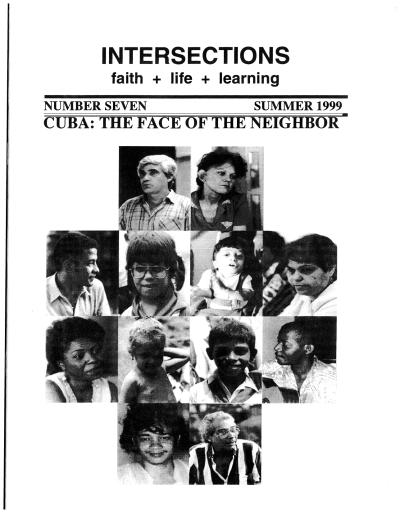
The Face of the Neighbor: An Interview with Four Capital University Faculty About Their Recent Visit to Cuba
Brian Forry Wallace, Michael Yosha, Reg Dyck, Susan Narita
Four Capital University faculty—political scientist Brian Wallace (returning to Cuba a third time after the 1994 boat lift), English professor Reg Dyck, ESL teacher Susan Narita, and political scientist Michael Yosha—recount their summer 1998 trip with Pastors for Peace, describing Cuban priorities of education, health care, and military (in that order), the cultural richness of Havana from sixteenth-century cloisters to Miramar, the Cuban Foreign Service’s vision of a Scandinavian-style democratic socialism, the counter-productive U.S. embargo (including its effect on kidney dialysis machines), Castro’s 1991 reconciliation with religious communities, and a recurrent image of a little girl named Marguerite singing at a school for amputee and terminally ill children. The interview was conducted by Capital senior Jessica Brown and Tom Christenson.
-
Reflection
Meditation—Band Chapel Service, St. Olaf College
Erik Haaland
Haaland, a St. Olaf senior, offers a brief Band Chapel meditation that defines art as “the expression of what is deeply human through the manipulation of the physical world” and defends worship—architecture, stained glass, music, eloquence—as an art form requiring our best and most sincere efforts. When the God we worship and the salvation we proclaim do not seem near, artful worship offers not propositions but something real and tangible to hold on to.
-
Institutional Focus
Letters to the Editor
The journal’s first letter to the editor: Pastor John L. Vaswig of Spokane, a Pacific Lutheran University alumnus and member of the PLU Board of Regents, writes after reading James Tunstead Burtchaell’s The Dying Light: The Disengagement of Colleges and Universities from Their Christian Churches to ask whether church-related institutions, in their effort to be open and tolerant, have abandoned a compelling word of hope and forgiveness in Jesus Christ.
-
 Response
A Call for Creative Education
Wendy McCredie
No. 3 · Summer 1997
McCredie of Texas Lutheran responds to Reichenbach by reframing the four ideas embedded in his claim that “the entire college community should be knowledgeably committed to the college’s mission”—community, knowledge, commitment, mission—and argues that the Lutheran tradition’s unwillingness to be separate from the world should lead us to educate the public about the Lutheran tradition rather than interrogate prospective employees about their faith. She questions whether agreement on “Christian values” is possible (or even Lutheran), and reads Reichenbach’s “creative education” as the dialectical tension between gospel and law, God’s love and our human limits, that members of communities related to the Lutheran church are uniquely positioned to inhabit.
-
 Response
Response to Mark Wilhelm: Vocation—Wide Perspective Questions
Mary-Paula Cancienne
No. 56 · Fall 2022
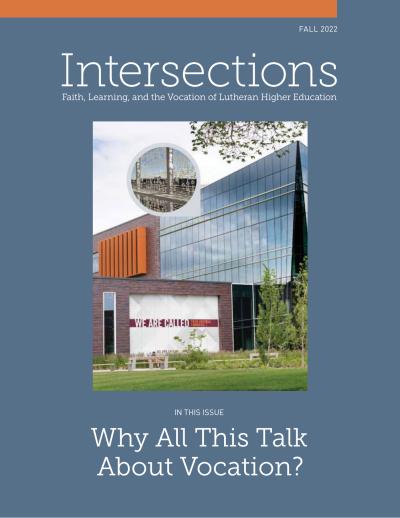
Cancienne, drawing on Iain McGilchrist, asks whether higher education has prioritized micro lenses at the expense of the macro view, and invites educators to hold the drama of individual vocation stories within a wider plot that includes James Webb Telescope wonder, climate grief, the long shadow of enslavement, and the resilience of native populations.
-
 Response
Feeling at Home: Dimensions of Faculty Life
Jane Hokanson Hawks
No. 2 · Winter 1997
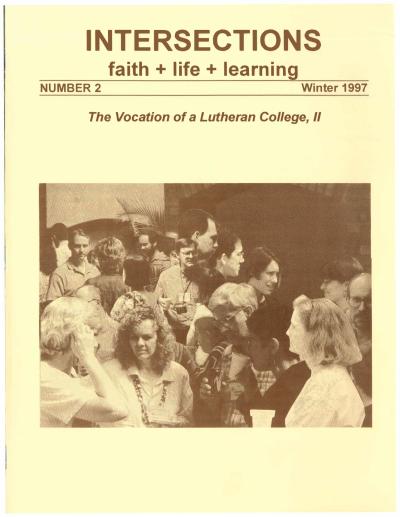
Hawks of Midland Lutheran College responds to Bouman by reflecting on her path from a Lutheran childhood through the BSN at St. Olaf and thirteen years at four non-church-related institutions to her present home at Midland, where teaching at a Lutheran institution finally feels “right.” Bouman’s framing of the five themes as the Lutheran argument about what it means to be human helped her ad-hoc committee articulate the spiritual role in Midland’s new faculty mentoring program (recently funded by the Lilly Foundation), and grounds her work as a nurse educator confronting the daily humanness of grief, joy, ethical dilemmas, and care across cultural and religious difference.
-
 Reflection
Sweet on My Lips
Corin Wesner
No. 13 · Winter 2002
A passage from Wesner’s travel journal during the same South Africa workshop. Walking into a wood-and-tin shack church where raindrops fall on already-soaked carpet and the service is in Xhosa, she remembers her painted, carpeted home church and her adolescent argument with her mother about wearing a dress to worship, and finds herself engulfed in warmth as the few women sing—welcomed by a stranger’s smile and opened up.
-
 Article
The Literature of Spiritual Reflection and Social Action
Shirley Hershey Showalter
No. 10 · Fall 2000
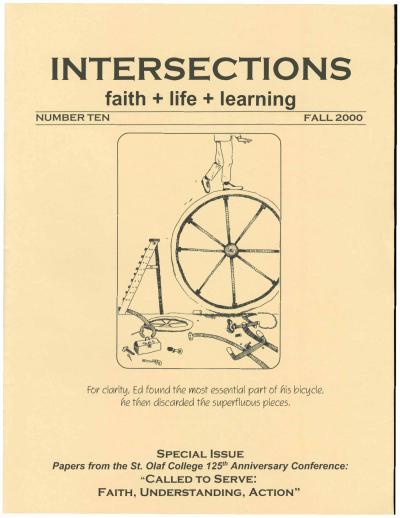
Showalter, president of Goshen College, opens with Garrison Keillor’s “Singing with the Lutherans” and Walter Sundberg’s account of the Anabaptist “radical reformers” to locate Mennonite identity in a theology of suffering, humility, narrative, and song—tracing it through John S. Coffman’s 1904 “The Spirit of Progress,” Harold S. Bender’s 1944 “Anabaptist Vision,” John Howard Yoder’s The Politics of Jesus, and J. Lawrence Burkholder. She uses her Senior Seminar “Pedagogy of the Holy Spirit” reading of Viktor Frankl’s Man’s Search for Meaning, Madeleine L’Engle’s “Be a namer” and Walter Wink on the angels of institutions, and a Goshen Study-Service Term (SST) journal entry by student David Roth returning from Haiti—closing with two poems by Sarah Klassen—to argue for naming as the redemptive practice of church-related education.
-
 Article
Civic Engagement, "Baylor In Deeds," and Engaged Learning
Rebecca Flavin
No. 63 · Spring 2026
6 min audio
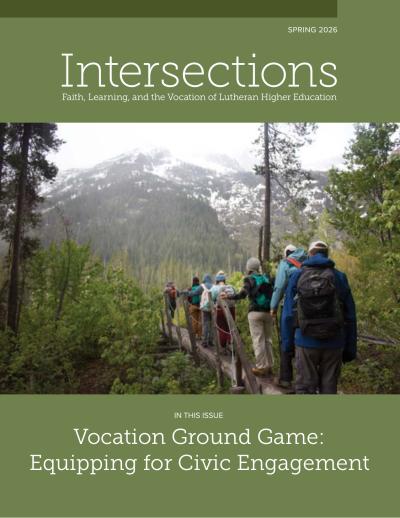
Flavin describes how Baylor’s strategic plan “Baylor in Deeds” and its Office of Engaged Learning are building civic engagement into the Arts & Sciences core curriculum, with early Global Engagement Survey data showing gains in civic efficacy and global civic responsibility.