The Religious Genealogy of College: Interrogating the Ambivalence of Delbanco's College
Intersections No. 39 · Spring 2014
Andrew Delbanco opens his College: What It Was, Is, and Should Be with a bold statement of five “qualities of heart and mind” that all colleges should instill in their students. At the top of Delbanco’s list stands “a skeptical discontent with the present, informed by a sense of the past”. That phrase holds as an apt epigram for Delbanco’s work as a whole, which devotes almost half its length to telling the story of the development and then partial eclipse of college as a distinctly American educational institution. On the basis of the ideals articulated in an opening philosophical chapter (“What is College For?”) and two historical chapters (“Origins,” which traces the American college from the founding of Harvard in 1636 to the Civil War, and “From College to University,” chronicling the rising dominance of research universities following the Morrill Act of 1862), Delbanco subjects contemporary higher education to considerable “skeptical discontent.” While his critiques are sharp, they are those of a committed insider. In the name of what he calls “the college idea” (what college was and should be), Delbanco calls the higher learning (what college now is) to account, challenging readers to recover a sense of what is “precious” (171) about this distinctive if vulnerable educational arrangement.
Delbanco, Nussbaum, and Concordia’s Vision Statement for Humanities
As a statement and defense of liberal education, Delbanco’s book retraces familiar apologetic pathways. During Spring Semester of 2012, I led a discussion and drafting process leading to a Vision Statement for the Humanities Division at Concordia.1 As we prepared our statement, I saw advance publicity for Delbanco’s book and preordered it, hoping to find fresh ways to articulate our shared sense of the enduring importance of liberal arts in general and the humanities in particular. The book arrived late in our drafting process, and I felt a mix of confirmation and disappointment when I saw that Delbanco organizes his opening chapter in terms of the familiar tripartite apologia that we had adopted to frame our statement. Our statement speaks of preparing students for Lives of Vocation, for Lives as Responsible Citizens, and for Lives as Whole Persons. Delbanco speaks directly of the first two lines of argument, labeling them respectively Economic (which he frames in much narrower terms than our notion of preparing students for lives of vocation) and Democratic (which closely parallels our notion of responsible citizenship). But he is much more oblique in speaking of the third line of argument, saying that it is “harder to articulate without sounding platitudinous and vague” (31). He variously describes this third rationale as learning “how to enjoy life,” achieving “the fulfilled life,” and, quoting Judith Shapiro, making “the inside of your head to be an interesting place to spend the rest of your life” (32-33). In our Vision Statement, we frame this as preparing students to flourish as whole persons, which we explicate in terms of freedom, wisdom, self-awareness, humility, moral conscience, curiosity, aesthetic delight, quality of attention, connection, and reverence. Readers of Delbanco’s College will find celebrations of each of those traits in his picture of the liberally educated person.
Martha Nussbaum identifies the same three lines of argument in her Not for Profit, but as indicated by her subtitle, Why Democracy Needs the Humanities, she heavily emphasizes the significance of liberal arts to civic education. In essence, Nussbaum argues for the usefulness of liberal education by pressing us to expand our understanding of utility beyond the narrow categories of profit and loss to include establishment and maintenance of a democratic social order. Delbanco, more than Nussbaum, defies the spirit of the times by refusing to focus on social and economic benefit, making his case rather by articulating how “learning in the broad and deep meaning of that word” (24) enriches individual lives. Like Cardinal Newman, Delbanco ultimately justifies liberal education in terms of the type of person it gestates.
Nussbaum is well-aware of the power of such a line of argument, but sets it aside for a telling reason:
Education is not just for citizenship. It prepares people for employment and, importantly, for meaningful lives. Another entire book could be written about the role of the arts and humanities in advancing those goals. All modern democracies, however, are societies in which meaning and ultimate goals of human life are topics of reasonable disagreement among citizens who hold many different religious and secular views, and these citizens will naturally differ about how far various types of humanistic education serve their own particular goals. (Nussbaum 9)
I quote Nussbaum to highlight what strikes me as most distinctive about Delbanco’s College. Where Nussbaum shies away from the third type of argument for the value of liberal education so as to avoid potentially divisive religious issues and commitments, Delbanco robustly engages the religious genealogy of “the college idea.” Though he not only endorses but also assumes the modern college as a secular institution (“all colleges, whatever their past or present religious orientation, now exist in a context of secular pluralism that properly puts inculcation at odds with education” [16]), Delbanco says it is “a pity and a waste” that so many academics have such an “uneasy relation” (65) with the religious origins of college as an educational institution and ideal that they evade and ignore that background. In these passages, we see Delbanco’s striking ambivalence about the religious dimensions of the college idea. As he sees it, religion is both the defining source of the college idea and now an anachronistic irrelevancy to the operation of contemporary colleges.
“Delbanco says it is ‘a pity and a waste’ that so many academics have such an ‘uneasy relation’ with the religious origins of college.”
The Religious DNA of the American College
At the close of his chapter on the first 230 years of American college education, from the founding of Harvard in 1636 to the Civil War, Delbanco summarizes his message concerning the centrality of religion in that venture:
To anyone glancingly acquainted with the history of American education, it is hardly news that our colleges have their origins in religion, or that they derive their aims, structure, and pedagogical methods mainly from Protestantism, and, more particularly, from the stringent form of Protestantism whose partisans are called…Puritans. (64)
In the following chapter, tracing the rise of the research university as the paradigm of American higher education, Delbanco describes the gradual retreat of religion from centrality to the point that only “vestiges” such as neo-Gothic architecture and campus chapels remain, especially at the elite institutions that define American academic culture.
But, as Delbanco reads it, genetic material from the religious origins of American college remain within the modern university’s genome, shaping its “aims, structure, and pedagogical methods” in ways that few appreciate. The very idea of college as a place of “lateral learning,” is based on the Puritan concept of church as “a voluntary gathering of seekers who come together for mutual support” (53). The goal of comprehensive, unified knowledge enshrined in the term “university” derives from the conception of all reality as the creation of the one God. Delbanco directly connects lecture as a pedagogical format to the Protestant sermon as well as saying that dialogic pedagogies have their origins in Puritanism’s “proto-democratic conception of truth emerging through discussion and debate among human beings who are inherently equal”(60). Perhaps most strikingly, Delbanco expresses the need to reach back to what he regards as anachronistic terminology to speak of the magical, mysterious moments that make college precious. He writes, “Every true teacher…understands that, along with teacher and students, a mysterious third force is present in every classroom…Sometimes the spoken word is nothing but noise that evaporates into air…Sometimes it can have surprising and powerful effects—yet it is impossible to say why or when this will happen for some students and not for others” (48). The only term Delbanco finds that is adequate to this mystery is grace.
Delbanco acknowledges that his own case for college in terms of character-formation, as gestating an intrinsically valuable way of being in the world, is a secular version of an originally religious project: “College, more than brain-training for this or that functional task, should be concerned with character—the attenuated modern word for what founders of our first colleges would have called soul or heart” (43). This sentence takes us to the heart of Delbanco’s ambivalent relation to the religious roots of American colleges. As a secularist, he celebrates the movement from theologically particular conceptions of the college mission to more general, “thinner” notions. That attenuation makes room for much more diversity among students and faculty, releases the institution from doctrinizing agendas, and allows college to be “true to itself” as a place where students ask and answer fundamental questions for themselves. But Delbanco doesn’t want to simply cut loose the religious past. In speaking of “the continuing pertinence of [college’s] religious origins” (171), he affirms that the religious founders of America’s colleges were addressing deep human realities, realities we are losing touch with as college becomes “the anxious pursuit of marketable skills in overcrowded, underresourced institutions”(7). Delbanco appeals to the religious origins of America’s colleges as a “usable past” whose ideals can be translated into a secular idiom. He speaks of common “educational aspirations…[w]hether expressed in Hebrew, Greek, Roman, or Christian, or the secular terms of modernity” (45).
“The religious founders of America’s colleges were addressing deep human realities, realities we are losing touch with as college becomes ‘the anxious pursuit of marketable skills in overcrowded, underresourced institutions.’”
Questions from and for Delbanco
While it was not his goal in writing College, Delbanco effectively poses fundamental questions for those of us who live out our professional lives within institutions that still affirm denominational affiliation. First, to what extent does Delbanco name our reality? To what extent is he correct when he says that “all colleges, whatever their past or present religious orientation, now exist in a context of secular pluralism that properly puts inculcation at odds with education” (16)? His assumption here and throughout the book is that a college can only sustain the centrality of its religious identity by taking on a catechizing agenda, an agenda that subverts diversity and the autonomy of students and faculty and that claims “spiritual authority” on behalf of the institution (15). Is that assumption warranted or are there non-authoritarian, non-catechizing ways to be a college of the church?
Second, he implicitly asks us whether the things we care deeply about in our Lutheran colleges can be translated effectively into thinner, “attenuated” vocabularies that potentially win wider affirmations. Concordia, for example, has translated the resolutely Lutheran theme of vocation into the idiom of “becoming responsibly engaged in the world,” otherwise known as BREW. Many students and faculty who couldn’t make an affirmation of confessional Lutheranism are enthusiastic supporters of BREW as Concordia’s signature theme.
Delbanco’s questions to those of us who continue to affirm our colleges’ religious identities solicit us to question him in return. To what extent can the concepts and values that grew out of religious conviction and commitment remain effective when cut off from that rootstock? Nietzsche challenged the right of secular liberals to affirm what amounted to Christian ethical commitments apart from Christian religious beliefs. Can “the college idea” that Delbanco celebrates survive apart from the context in which it developed? As I have shown, Delbanco is himself deeply anxious about the condition of “the college idea” in contemporary circumstances. This relates, in part, to the regnant utilitarianism of our day that increasingly demands that education justify itself in terms of cost-benefit analysis. To what extent is the transcendent horizon of a religious worldview an essential context for Delbanco’s “college idea” in which education is more than job preparation? Further, Delbanco bemoans the way higher education has come to legitimate gross inequalities in American life. The meritocratic ideology of the admissions process at elite colleges effectively states that elites deserve their elite status. Delbanco ties this development to the eclipse of religious identity when he writes, “our oldest colleges have abandoned the cardinal principle of the religion out of which they arose: the principle that no human being deserves anything based on his or her merit” (138)—a rather nicely Lutheran point, that.
Christian Colleges after Christendom
At the end of College, Delbanco abruptly turns toward Nussbaum’s stratagem of looking to democracy rather than religion as the source of inspiration for liberal education: “If an old, and in many respects outmoded, religion seems an improbable touchstone for thinking about education today, perhaps a more plausible one is democracy” (172). But that parting denigration doesn’t erase Delbanco’s spending goodly portion of his book calling higher education back to “the college idea” by invoking the religious origins of that idea.
What if, instead of appealing to religiously-identified higher education as a “usable past,” we look to it instead as a “usable present?” In The Soul of the American University, George Marsden surveys in much more detail the same arc leading from “Protestant Establishment” to “Established Disbelief.” And yet, unlike Delbanco, Marsden makes a plea for the continuing existence of colleges that dare to depart from homogenized national norms to offer distinctive, religiously-informed higher education. Even if such institutions are in a definite minority, and even if they aren’t numbered among the elite institutions on which Delbanco focuses, they may and I believe they do serve a disproportionate role in keeping Delbanco’s “college idea” vibrant. The challenge, of course, is figuring out how to be a Christian college after Christendom, that is, in conditions of pluralism, skepticism about authority, declining denominational affiliation, and pervasive anxiety about finding one’s place in a “winner-take-all” economy.
Works Cited
Delbanco, Andrew. College: What it Was, Is, and Should Be. Princeton: Princeton University Press, 2012.
Marsden, George. The Soul of the American University: From Protestant Establishment to Established Nonbelief. New York: Oxford University Press, 1994.
Nussbaum, Martha. Not for Profit: Why Democracy Needs the Humanities. Princeton: Princeton University Press, 2010.
-
 Editorial
From the Publisher
Mark Wilhelm
Wilhelm interrogates the widely used phrase “the model is broken,” arguing that it blames the victim, masks the demographic and public-funding pressures actually facing ELCA higher education, and distracts from the work of modifying—rather than discarding—a model of educating the whole person that has successfully adjusted across the centuries.
-
Editorial
From the Editor
Jason A. Mahn
Mahn reports on the working group “People of Wondrous Ability: Introducing Faculty and Staff to Lutheran Higher Education,” shares creative ways campuses are introducing colleagues to the charisms of the Lutheran tradition, and frames the issue as a set of reflective reviews that move from national trends to homegrown conversations about the state of college.
-
Book Review
A College Degree or a College Experience? Reflecting on Selingo's College (Un)Bound
Laurie Brill
Brill reads Jeff Selingo’s College (Un)Bound from inside the Lutheran Educational Conference of North America, drawing on LECNA’s alumni research with Hardwick-Day and on Brandon Busteed’s Gallup data to argue that, in an age of competency-based degrees and college-as-commodity, Lutheran colleges must speak more clearly about the transformational, vocational impact of a college experience that develops the whole person.
-
Book Review
Types, Methods, and Sagas in Lutheran Higher Education: Learning from Childers
Lake Lambert
Lambert situates Eric Childers’ College Identity Sagas within the older tradition of the 1977 Association of Lutheran College Faculties volume The Church-Related College in an Age of Pluralism, working through Burton Clark’s “saga” and Robert Benne’s typology of church-related colleges. He commends Childers’ socio-scientific approach while questioning whether a typology can do justice to institutions that resist easy classification.
-
Book Review
Post-Secular Religion on Campus: Conversing with Jacobsen and Jacobsen
L. DeAne Lagerquist
Lagerquist guides readers through Douglas and Rhonda Hustedt Jacobsen’s No Longer Invisible: Religion in University Education and its companion volumes, unpacking the authors’ three-act story of campus religion (Protestant, Privatized, Pluriform), their three-by-two framework of historic/public/personal religion in belief and behavior, and the six questions they pose for campus conversations. She lifts up interfaith etiquette and vocation as especially fruitful zones for Lutheran campuses.
-
Book Review
The Prophetic Vocation and the Nature(s) of College: Reimagining College with Jim Farrell
Peder Jothen
Jothen reads the late Jim Farrell’s The Nature of College as a prophetic critique of the dual nature(s) of college—its socio-cultural “normal” and its ecological habitat—and argues that Farrell’s call to model an “Anthropocene Responsibility” resonates with the prophetic dimension of Lutheran higher education. He proposes a re-imagined “About St. Olaf” that names vocation, ecological dependence, and personal involvement as the operative goods of college.
-
Book Review
The Courage to Change: Creating New Hearts with Palmer and Zajonc
Martha E. Stortz
Stortz reads Parker Palmer and Arthur Zajonc’s The Heart of Higher Education from the landscape of Lent and notes that the book’s strategies all target students, not their professors. Drawing on her own Faculty Formation Group at Pacific Lutheran Theological Seminary and the Ignatian Colleagues Program at Jesuit institutions, she asks what a Lutheran analogue might look like that would form the educators who teach for transformation.
-
Book Review
Learning Across Campus: Hearing Bok's Call to Conversation
David Ratke
Ratke reads Derek Bok’s Our Underachieving Colleges from Lenoir-Rhyne and argues that Bok’s call to think holistically about undergraduate education and to dialogue across disciplinary boundaries names the work already underway at ELCA colleges. He weighs faculty attitudes, the role of skills in the core curriculum and the major, and the importance of the extracurriculum for student formation.
-
Book Review
The Information Deluge: Navigating the Digital Age with Recent Scholars
Virginia Connell
From the reference desk at Concordia’s Carl B. Ylvisaker Library, Connell navigates Ann Blair’s Too Much to Know, Nicholas Carr’s The Shallows, Viktor Mayer-Schönberger’s Delete, and Howard Gardner and Katie Davis’ The App Generation, then describes information-literacy work at Concordia—primary-source assignments, Omeka and TimelineJS exhibits—that helps students move from app-dependent to app-enabled in the Lutheran tradition of reform.
-
 Article
Say Something Theological: A Meditation on the Vocation of Lutheran Colleges and Universities to Serve the Common Good
Paul C. Pribbenow
No. 42 · Fall 2015
Pribbenow expands Luther’s “priesthood of all believers” into a meditation on doing theology with the Bible in one hand and the New York Times in the other — reading Luke 14 alongside walls, immigration, and hunger in his Minneapolis neighborhood — and argues that the leadership of Lutheran colleges demands a willingness to engage the theological issues at the heart of their public vocation.
-
 Article
An Aristotelian Twist to Faith and Learning
Gregg Muilenberg
No. 3 · Summer 1997
Muilenburg, chair of Philosophy at Concordia, surveys the four traditional models for faith and reason—conflict, independence, dialogue, and integration—and argues that the Lutheran dialogical model is insufficient for wholeness. Drawing on the post-foundationalist epistemology of perspective and Aristotle’s account of knowing as desire-driven action, he proposes that faith is an ultimate value (an assessment belief of the form ‘x is better than y’), that learning is desire-directed action, and that the core of Christian education is the education of Christian desire—requiring both reflection and commitment, both integration and diversity.
-
 Article
The Diversity Dilemma: Dealing With Difference
Kathy Fritz
No. 8 · Winter 2000
Fritz reports from Newberry College—83% Caucasian, 16% African-American, 22% Lutheran, the smallest college in NCAA football—on a 1998–1999 year of crisis in which the Board of Trustees Executive Committee asked the president to resign over financial issues, the president fired three vice presidents, four trustees including the chair and treasurer resigned, and the controversial “veterinary technology” major became a flashpoint between the president’s recruitment-driven vision and the faculty’s commitment to “preparation for LIFE.” Turning to ethnic diversity, she frames three sociological approaches—“feed them all” to reduce conflict, the “3 A’s” (academics, athletics, arts) to create common identity, and Aguirre and Turner’s case for “weak ethnic identification” against the post-Yugoslavia failures of strong pluralism—and grounds the search for institutional unity in St. Paul’s body-of-Christ imagery from 1 Corinthians 12 and Ernest Simmons’s claim that diversity yields “creative adaptations that assist mutual survival.”
-
 Article
Vocational Leadership
Darrell Jodock
No. 41 · Spring 2015
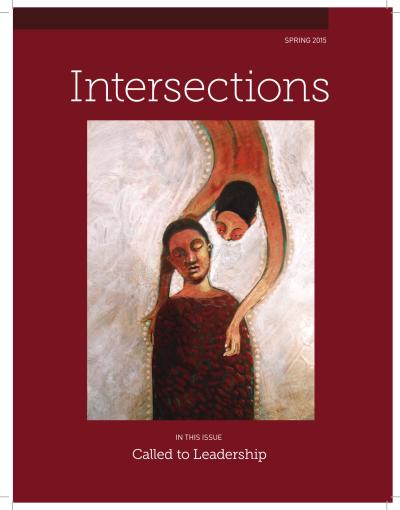
Jodock proposes “vocational leadership” as a name for a distinctive educational value at the heart of a Lutheran college — one that seeks to benefit the neighbor and the community, inspires and invites others to participate in that service, and is institutionally anchored in the Lutheran concept of vocation. He unpacks twelve facets of vocational leadership and ties them to Luther’s own leadership around indulgences, public schooling, and beggary.
-
 Article
Low-Hanging Fruit, Moonshots, and Coffee: Dreaming Big Within and Beyond Our Limitations
Jeremy Myers
No. 59 · Spring 2024
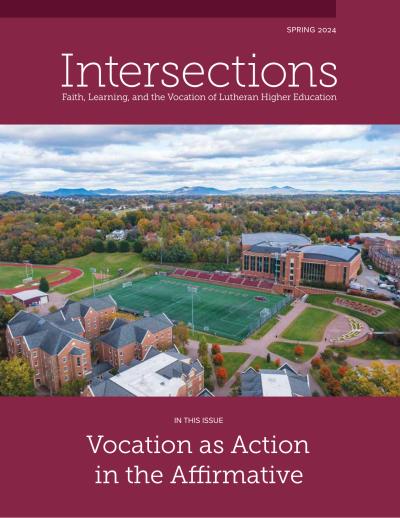
Myers shares the process used by Augsburg’s Christensen Center for Vocation to help teams move from a shared experience to next steps — an Ignatian-rooted Awareness Examen followed by naming low-hanging fruit, moonshots, and the coffee conversations that build the coalition to make it all happen.
-
 Article
The Marks of an ELCA College: One Bishop's Reflections
Stanley Olson
No. 15 · Winter 2002
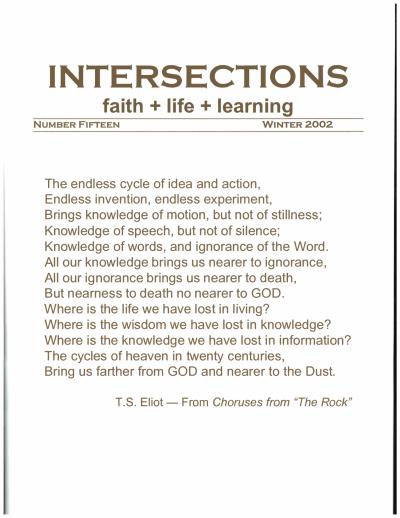
Olson, speaking as a bishop and “Harness Boy” whose job is to keep the church’s connections working, replaces his original four-noun outline (fealty, ingenuity, insouciance, focus) with eight marks the ELCA should be able to observe in its colleges: intentional Lutheran identity, significant Lutheran presence, Christian faith at every table, freedom of inquiry, coaching toward vocation, gravity and grace, nurtured community, and excellence by its own standards. Drawing on his survey of all twenty-eight ELCA college mission statements (two tables) and on Darrell Jodock and Mark Edwards, he argues that the Lutheran connection must be made explicit in mission, marketing, and faculty searches, and closes with six reciprocal expectations the colleges should hold of the ELCA—commissioner, mature parent, supporter of adventurous teenagers, advocate, steward of graduates, and a church faithful to its own Lutheran mission.