I would like to respond to two articles in the Winter 2002 issue of Intersections, which I found to be even more helpful than usual. All the articles are worthy of response but there is no space for such an expansive effort. The first article I want to grapple with is “The Marks of an ELCA College” by former Bishop Stanley Olson. I found his marks very helpful and I especially appreciated his examination of ELCA college mission statements. However, the section on “Christian Faith at Every Table” had some troublesome assertions. Though Olson says that “insights and questions spawned by the Christian faith can be welcomed in all discussions and forums,” he later obliterates the epistemological grounds for a Christian voice in such conversations. In an unhelpful—but not unusual—interpretation of the two kingdoms teaching, he cedes all genuine epistemological claims to secular “knowledge of people and the world in which we live.” This suggests that the academic life of an ELCA college is totally in the left hand kingdom and therefore not open to the insights and claims of faith. Olson takes away in his theological statements what he affirms in his earlier pedagogical ones.
While I agree that there is no such thing as a Lutheran biology or Lutheran economics, the Christian faith (Lutheranly construed) certainly ought to have insights and claims that can enter the conversation at the biological and economic tables. There is a Christian intellectual tradition that makes claims about human nature and action. Those claims ought to be given voice in a church-related college; they are unlikely to be taken seriously in a public college. For example, Reinhold Niebuhr’s explication of the biblical/Christian view of the nature and destiny of humankind is a profound reading of human nature that can and should enter discussions in psychology, sociology, economics, or any of the other social sciences and humanities. Christianity has a view of human nature that can offer wise insight in every conversation. Niebuhr’s writings are in fact a debate with views of human nature that dominated the thought of the time.
The problem in Olson’s understanding of the two kingdoms doctrine is that he narrowly limits the Gospel to the proclamation of justification. Rather, the Gospel has to be taken as the whole Trinitarian faith which includes many magnificent Christian insights into the whole of human existence. That whole vision (the Right Hand Kingdom) then engages the secular insights and claims of the Left Hand Kingdom, much in the way that Muilenberg describes in his “Welcome Strangers.” Ceding all intellectual input to secular sources in the Left Hand Kingdom is a disaster for Christians who want to be thinking Christians. Such an interpretation of the Two Kingdoms will aid in the secularization of church-related colleges, as it has in the past.
I also welcome President Tipson’s long and serious grappling with the book The Future of Religious Colleges: The Proceedings of the Harvard Conference on the Future of Religious Colleges, as well as his more general engagement with my work, part of which I have had a chance to share at Wittenberg. His description and analysis of the book are exemplary. Then, however, he reflects on issues that continue to occupy his concerns. I would like to respond to his reflections.
First, Tipson suggests that I believe that “more is better” regarding the institutional church’s control of its colleges. I really don’t believe that. Rather, I believe that the college itself has to commit itself to a lively relation to the vision and ethos of its sponsoring tradition, which will obviously mean the recruitment of people who know the vision and embody the ethos. It is much more impressive when colleges do that on their own and for their own intrinsic reasons than when colleges submit to more church control, which isn’t very likely anyway. I, for one, was happy that Roanoke was an independent Lutheran college when St. Olaf College’s nominations for board membership had to be submitted to the ELCA churchwide assembly, where a coterie of activists kept raising questions about the nominees. More formal control is not something I promote, assuming of course, that there is decent representation for the church on the college’s board.
However, I do think “more is better” with regard to the college making the vision and ethos of its parent tradition more publicly relevant to its own academic and social life. One could perhaps reach a saturation point where the tradition’s contributions became suffocating or oppressive, but such is not the problem at our ELCA colleges. Many have so marginalized the presence of Christian intellectual and moral claims that little is left. In such a situation I think “more is better,” with the proviso that that “more” be well done and intellectually persuasive.
Later on he seems to take me a bit to task for suggesting that it is important that at least two or three Lutheran colleges maintain a robust—or what I call a “critical mass”—relation to their Lutheran heritage. Well, if you grant (and I’m not sure that Tipson would grant this) that a sponsoring Christian tradition—its vision, ethos, and the persons who bear them—might in principle have a noticeable and positive effect on a cooperating college or university, then it would behoove us to have at least a handful that are recognizably Lutheran. We will have many Wittenbergs and Roanokes who assure a certain kind of Lutheran/Christian voice and presence in their educational enterprises. I, like Tipson, find these kinds of colleges attractive and worthy of the name “church-related colleges.” But I also believe that several more pervasively Lutheran colleges of quality will indeed “represent a gain for the church and for higher education.”
Tipson also raises the question of rather we protest too much against the secularization process. There were great gains in that process, he argues and I would agree. He asks whether anyone in his or her right mind would suggest that the USA would be better off “if Harvard had remained committed to its Puritan roots.” When we denounce the secularization process Tipson thinks we are at the same time “overstating the gains and minimizing the deficits of education at religious colleges.” These are good points. We do not want to go back to some golden age where the engagement of faith and reason were presumably done right. In most cases there wasn’t such a time.
But I would hazard the opinion that Harvard would be better off if it hadn’t completely jettisoned its Christian heritage. If Harvard’s enlightenment would not have been so militant and its Christians so inept perhaps the university could have more soul with its current quality. I can envision a Harvard that actually might have been better. There is some wisdom in William Buckley’s dictum that he would rather be governed by the first hundred persons in the Boston telephone directory than by the Harvard faculty. A bit more soul may have mitigated some of the elitist arrogance of that university.
President Tipson shies away from the more “robust” relation of a college to its Christian heritage that many of us commend. He worries about too much religious intensity. He likes the rigor, critical capacities, and objectivity of Enlightenment models of education that might be threatened by stronger role for Christian intellectual claims. He thinks a Baylor and especially a Calvin are as much to be shunned as models of higher education as Ohio State.
I detect here a rather unchastened Enlightenment spirit. True, like Tipson, I do not want to reject some of the important gifts of the Enlightenment—a commitment to reasonable criteria for scholarship and research, an effort at objective inquiry, and a devotion to excellence in following those criteria and efforts. The Enlightenment project has offered the world a great gain in knowledge. But in recent days it has become clear that it has unwisely rejected other ways of knowing and has overestimated its transcendence over historical traditions. Indeed, it is a limited tradition with a history of its own, in spite of its claims to universality. It smuggles into its methods and claims many philosophical and religious assumptions that are not fully justified; those assumptions are often based on a faith of its own. For example, if a church follows biblical studies based solely on the historical critical method that church will soon find its convictions about the Incarnation and Resurrection severely undermined. That does not mean we should not use the historical critical method; it simply means that we recognize its dangers and limitations.
We should not be supine before the claims of the social sciences and humanities. Their methods and claims are loaded with philosophical and religious assumptions. John Milbank characterizes the grand social sciences as “anti-theologies,” explicitly offered as world hypotheses radically different than the Christian. Again, we do not want to construct Christian social sciences but we do want to critique the current versions, and discern which are more or less compatible with Christian claims. At the very least, we want to engage them from a Christian perspective.
Lutherans have been charged with being quietist toward the political world on account of their flawed interpretations of the two kingdoms. Those flawed interpretations can operate in the educational sphere so that Lutherans—and many other Christians—simply accept the secular claims of the day as sacrosanct. That is nonsense. An alert Lutheran college should engage in mutual critique between the claims of faith (which are intellectual) and the claims of secular approaches to college. Respect for the accomplishments of the Enlightenment, yes!; uncritical acceptance, no!
Not every faculty member need do such engagement, but on the whole the Lutheran college should recruit a significant number of faculty who are interested in and support it. Further, not every class or course need be characterized by such engagement. Indeed, too much would prevent the educator from getting at the recognized knowledge of the field. But there are many opportunities for the secular claims to dialogue with Christian claims. Students wonder about questions that are conducive to such a dialogue. The methodological foundations of almost every intellectual endeavor need to be scrutinized critically, and Christian claims can be a part of that process. For example, texts in business ethics often operate without religious perspectives. But many business people are serious religious people who want their faith to be relevant to their life in the world. A business ethics course in a Lutheran college ought to incorporate those religious perspectives. Rather than asking for a privilege for religious perspectives, as Tipson suggests, I’m asking for the inclusion of such. And it would seem reasonable to include that sort of perspective in many areas of inquiry. That would indicate to students and parents alike that their faith is being taken seriously, not that it is being privileged.
I want to end on a point of agreement. Tipson laments the lack of interest in and support for the colleges and universities by the parent churches themselves. I couldn’t agree more, though I am aware—as is Tipson—of how important the indirect support from wealthy Lutheran donors remains for our schools. But the bishops and pastors of the church will have to get serious about our schools, for if they are not serious it is unlikely that the schools themselves will indefinitely remain connected to their religious heritage.
Finally, I think it just great that so many Presidents of our Lutheran schools are thoughtfully grappling with these important questions. They are too important to be left to the church.
-
 Editorial
From the Publisher
Arne Selbyg
Selbyg reports that “vocation” is surely among the top three words in Intersections’s history and congratulates nine ELCA institutions—Augsburg, Augustana (Rock Island), Concordia (Moorhead), Gustavus Adolphus, Luther, Pacific Lutheran, St. Olaf, Valparaiso, and Wartburg—on receiving roughly two-million-dollar Lilly Endowment grants for the “Programs for the Theological Exploration of Vocation,” while reminding readers that for Lutherans the priesthood of all believers means callings to be accountants, nurses, police officers, and home makers count as fully as callings into ministry.
-
Editorial
From the Editor
Tom Christenson
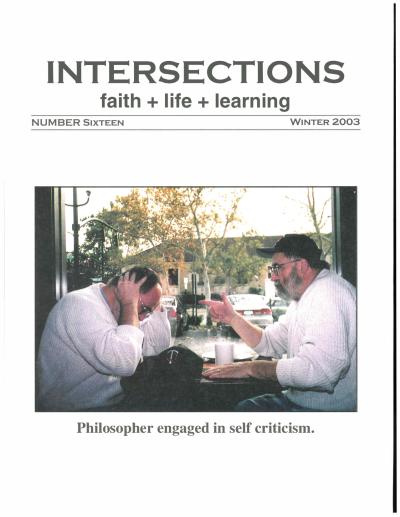
Christenson previews this issue’s papers from the Vocation of a Lutheran College Conference—Curt Thompson on “the Lutheran knot,” Carol Gilbertson on the creative dimensions of language, Bruce Heggen on theological vocabulary in the state university, Susan Poppe on the boundaries of campus freedom, and Sig Royspern’s oracular gems—welcomes Robert Benne’s response to the previous issue as a sign that Intersections is becoming a locus of continuing conversation, and confesses his reluctant consent to appear on the cover.
-
Article
Do You Teach in a Different Manner at a Lutheran College? Unraveling the Lutheran Knot and Highlighting the Glory in the Theology of the Cross
Curtis L. Thompson
Thompson argues that being Lutheran means having a “knot in the stomach”—a dialectical “Yes and No” tension between law and gospel, two kingdoms, Word and world—and that this knot is held together by Luther’s theology of the cross supplemented by an under-appreciated theology of glory in which God shines through human beings and creation. He then traces how the Lutheran knot shapes his teaching at Thiel College in the Religion department, the first-year team-taught “History of Western Humanities,” the second-year “Science and Our Global Heritage,” and his work as Co-Director of Thiel’s Global Institute, concluding that only such “dialectical doublespeak” leaves him with the “at-once dreaded and delightful dis-ease of the Lutheran knot.”
-
Article
Honoring the Word: Lutherans and Creative Writing
Carol Gilbertson
Gilbertson argues that “honoring the Word” in Lutheran colleges means cherishing the sacred power of human language as God’s gift across three sites—the chapel talk, the classroom of wonder, and the poem—and illustrates her argument by reading aloud her own poems: “The Refiner’s Fire and Leaping Calves,” “Late June,” “Early June,” “Sweet July,” “Good Friday,” “Pondering These Things,” “The Limbs of Words,” and “Night Rising,” drawing on Darrell Jodock, John Updike, Martha Nussbaum, George Steiner, and T. S. Eliot’s “The Dry Salvages” to claim writing as a Christian vocation that “incarnate[s] the unseen sacred.”
-
Article
Writing Toward the Night Complete: Teaching and Working at the Public, Secular Institution
Bruce Allen Heggen
Heggen, Lutheran Campus Ministry pastor and adjunct English professor at the University of Delaware, builds on a freshman’s essay closing line—“All in all our night was complete”—to argue that even in the secular public university one can “teach hope” as a critical principle by drawing on Douglas John Hall’s Heideggerian distinction between calculative and meditative thought, the Frankfurt School’s instrumental versus substantialist reason, Luther’s theology of the cross, Parker Palmer’s “obedience to truth,” bell hooks, Lionel Basney, Shelley Shaver, and Donald Sheehan’s Frost Place “principle of compassion.” The classroom and Lutheran campus ministry together can become “communities of memory and hope” that, like the artist student’s Fourth of July, hold together danger, people getting together, explosions, and lots of fun.
-
Article
The Impropriety of Jesus' Teaching: The Woman at the Well and The Vagina Monologues
Susan M. O'Shaughnessy
O’Shaughnessy Poppe dedicates her message to those who worked to put on Eve Ensler’s The Vagina Monologues against administrative resistance and reads the Samaritan woman at Jacob’s well alongside the testimony of a Bosnian rape survivor whose story Ensler asked to tell, arguing that the “impropriety” of Jesus—his scandalous recognition of those silenced by sexism, racism, war, custom, and the church—is the model for the mission of a college of the church to defend academic freedom and to break the chains of oppression by inflicting discomfort on the proper and pure.
-
Poem
A Rainfall of Questions Collected in the Form of a Poem
Sig Royspern
Royspern offers fourteen oracular questions on aging, addiction to possessions, water striders, magnolias, slippery fish, moths and the moon, priests and leaf-rakers, weeds and flowers, the price of education, abandoned groceries, spiritual pilgrimage, melons and oats, similes, and the impossibility of finding a store that sells a spring wind.
-
 Article
Point / Counterpoint: What It Means to be a "College of the Church"
Robert Benne, Tom Christenson
No. 28 · Fall 2008
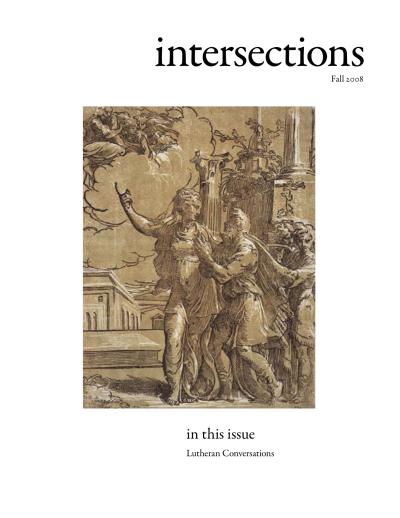
Moderated by Wartburg College pastor Larry Trachte and introduced by Kathryn Kleinhans, this Wartburg campus conversation between Robert Benne (Roanoke College) and Thomas Christenson (Capital University) probes what it means to be a college of the church—Benne emphasizing ethos, vocation, and the Christian intellectual tradition over against secularization and generic education, and Christenson lifting up persistent vocational questions, the gift of difference, and induction into a community of discourse—and finds large common ground around hiring for mission, pedagogy that asks deep questions, and the courage to claim a living religious tradition while inviting everyone to the banquet.
-
 Article
What Could the Lutheran Colleges and Universities Contribute to the ELCA Discussion of Sexuality—But What Would They Actually Contribute?
Robert Benne
No. 22 · Spring 2006
Benne hopes that Lutheran colleges might model fair moral discourse on sexuality by gathering a balanced mix of what James Davison Hunter calls “orthodox” and “progressive” voices from religion and social-science faculties, with the Great Tradition treated as the default position. He doubts this is what would actually happen: citing Klein, Stern, and Western’s research showing a ten-to-one liberal-to-conservative ratio in social-science and humanities associations, he suspects Lutheran faculties skew further left than other private colleges and would simply reinforce the ELCA’s already-progressive seminary and churchwide leadership.
-
 Article
Toward an Adequate Theology of Christian Higher Education
Robert Benne
No. 10 · Fall 2000
Drawing on his forthcoming Eerdmans volume Quality With Soul—Thriving Ventures in Christian Higher Education, which studies St. Olaf, Valparaiso, Notre Dame, Baylor, Wheaton, and Calvin, Benne argues that these schools have kept their souls because a critical mass of boards, administrators, faculty, and students treat the Christian account as comprehensive, unsurpassable, and central. He critiques four inadequate theologies of Christian higher education—pietism, liberal theology (Whitehead, Henry Nelson Weiman, the “values” turn, and accommodation to diversity and multiculturalism), “First Article” approaches (including Merrill Cunninggim’s Methodist version and a Lutheran two-kingdoms quietism), and reactionary/triumphalist theology—and contrasts the Catholic (Notre Dame), Reformed (Calvin, Wheaton, Baylor), and Lutheran (St. Olaf, Valpo) ways of relating faith and learning, calling Lutherans to recover “Christ and culture in paradox” as serious extended conversation rather than as a lazy excuse.
-
 Article
Integrity and Fragmentation: Can the Lutheran Center Hold?
Robert Benne
No. 8 · Winter 2000
Benne answers the conference’s question pessimistically—“the Lutheran center cannot hold in many, if not most of our colleges, because it was never there in an articulated form in the first place”—and distinguishes “Christ of culture” colleges like the Midland Lutheran of his youth (Lutheran by ethno-religious ethos rather than by articulated theology) from James Burtchaell’s “confessional colleges” that operated from a theologically distilled Lutheran humanism. Drawing on Alasdair MacIntyre and Mark Schwehn’s First Things essay on Christian universities, he sketches what a Lutheran center looks like (unity, universality, integrity, a tradition of thought) and how its distortion—reducing the Gospel to justification and ceding everything else to autonomous reason—splits Christ and culture as dangerously as the German church separated Gospel and politics. For colleges that have lost their center, he proposes an “intentional, robust pluralism” that guarantees a Lutheran voice in every department and an “affirmative action for Christians” in hiring.
-
 Response
Response to Mark Wilhelm: Vocation, Mission and Privilege
Marit Trelstad
No. 56 · Fall 2022
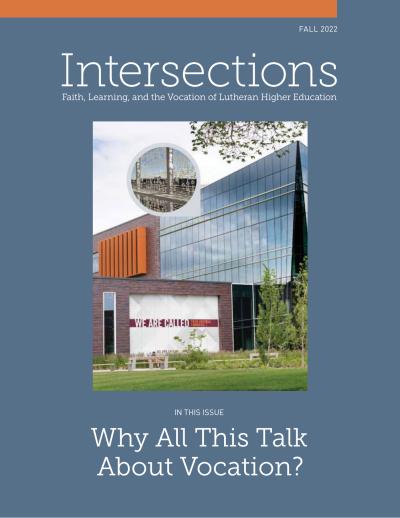
Trelstad affirms Wilhelm’s claim that vocation is the foundational shared mission of Lutheran higher education rather than one program among many, and presses the critique that calls to “vocational reflection” can mask privilege — arguing that an intersectional lens shows vocational discernment is in fact a matter of survival and flourishing for students from marginalized communities.
-
 Article
Attentional Commons and the Common Good: Technology and Higher Education
Amy Weldon
No. 42 · Fall 2015
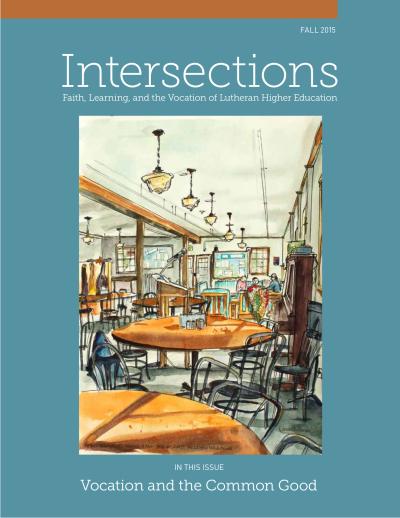
Weldon argues that the electronic devices our students (and we) reach for are designed to monetize attention and fragment the very capacities — tolerance for complexity, sustained focus, real conversation — that build lives of meaning and service to the common good. Drawing on Crawford, Lanier, Arendt, and Palmer, she sketches practical tech-mindfulness for the small-college classroom as a defense of the “attentional commons.”
-
 Editorial
From the Editor
Tom Christenson
No. 13 · Winter 2002
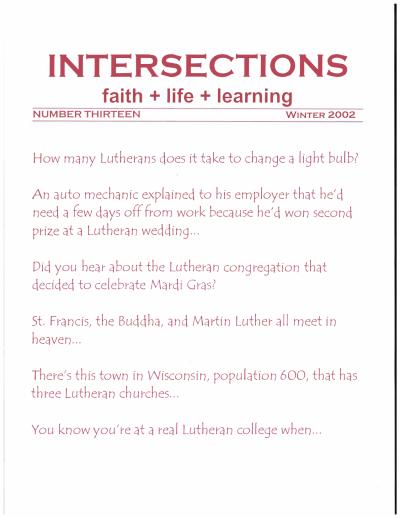
Christenson previews a varied issue—Darrell Jodock’s Bernhardson inaugural lecture, Ernie Simmons’ Valparaiso conference talk on student/parent attitudes, two South Africa travel pieces by Brian Wallace and Corin Wesner, and reviews of Richard Hughes’s and Robert Benne’s recent books—and tells the story of “the church lady from hell,” a mid-fifties returning student who condemned everyone in the class with “God and I think…,” to ask what a religious tradition without a sense of humor would look like.
-
 Reflection
Some Personal Reflections on the ELCA Vocation of a Lutheran College Conference, 1998
Jennifer Sacher Wiley
No. 7 · Summer 1999
Sacher Wiley, a Unitarian Universalist with one Jewish parent and a first-year music faculty member at Susquehanna, reflects on common-ness and other-ness at the 1998 conference—Tom Christenson’s weaver’s warp and Charles Ives’s essay on American music—and proposes four markers of group identity. Against the fear of secularization expressed by some attendees, she suggests that “Christian” might be defined less by belief in Christ as Savior than by living a vocation as Jesus lived, with Cheryl Ney offered as an example of a “working prophet,” or “little Christ,” regardless of specific belief in the Trinity.
-
 Article
Diversity and Dialogue: Twenty Years and Counting
Florence D. Amamoto
No. 43 · Spring 2016
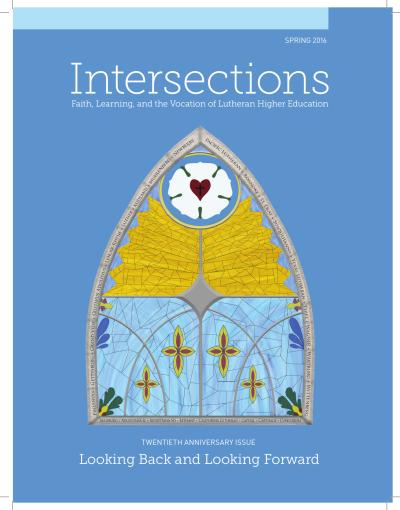
Twenty years after her essay “Diversity and Dialogue” in the first issue of Intersections, Amamoto returns to Gustavus Adolphus College to reflect on what has changed and what has not: rising numbers of students of color and international students, faculty turnover and increased publication pressures, the disappearance of the Center for Vocational Reflection, and the renewed importance of articulating Gustavus’s Swedish Lutheran heritage and inclusive sense of community in a tuition-dependent, cost-cutting environment.
-
 Article
Impelled to Pluralism: Thoughts About Teaching in a Lutheran University
Jim Huffman
No. 17 · Summer 2003
Huffman traces his personal journey through three stages of faith—the “comfortable Christ” of his Midwestern Christian childhood, Clark Pinnock’s “faith principle” of accessible salvation, and finally Christ as the “humble teacher”—to a pluralism that rejects religious triumphalism without abandoning Christian commitment. Drawing on Diana Eck, Wesley Ariarajah, John Cobb, the Catholic novelist Endo Shusaku, and the histories of Confucian China and imperial Japan, he then describes how this commitment shapes his teaching of East Asian religion and nationalism at Wittenberg University: insisting on respectful language, working sympathetically through doctrines like Buddhist non-attachment, and helping students see the pernicious effects of triumphalism in both religious and political life.