Woe to those who go down to Egypt for help
And rely on horses,
Who trust in chariots because they are many
And in horsemen because they are very strong,
But do not look to the holy one of Israel
Or consult the Lord!—Isaiah 31: 1
Blessed are the peacemakers, for they shall be called the sons of God.
—Matthew 5: 9
Overgrown military establishments are under any form of government inauspicious to liberty, and are to be regarded as particularly hostile to Republican liberty.
—George Washington, Farewell Address, September 17, 1796
The conjunction of an immense military establishment and a large arms industry is new in the American experience…. In the councils of government, we must guard against the acquisition of unwarranted influence, whether sought or unsought, by the military-industrial complex. The potential for disastrous rise of misplaced power exists and will persist. We must never let the weight of this combination endanger our liberties or democratic processes. We should take nothing for granted.
—Dwight D. Eisenhower, Farewell Address, January 17, 1961
160 million people died in wars during the 20th century.
—Peter Scaruffi [Since then the pace is picking up, spurred on by American policies.]
Death is god. That is this generation’s
Thought of thoughts.—Saul Bellows
Introductions
I once heard Dick Gregory take a whack at the flaccid and hypocritical piety of bourgeois honkies by saying that “God don’t like no nasty.” Gregory said this ironically, satirizing not only racism but also the insubstantial and unquestioning middle class acceptance of militarism and its fruits. This acceptance has become a prime support for the American worship of Mars and Mammon for which Fox News et al. are more symptom than cause. To probe the nature, extent and costs of this militarism and to offer alternatives are the purposes of this writing.
I want to make clear from the beginning that I am not a neutral observer—nor is this an option for anyone else. I am diametrically opposed to militarism and the wars it engenders, not because “God don’t like no nasty,” but for a whole complex of reasons, especially two simple and basic ones. First, I think it is incredibly unrealistic. Second, I think it is unbelievably destructive and wasteful of good things. And rather than draft God to be on my side as Isaiah appears to be doing, I would ask instead what it might mean to be on the side of a God opposed to Mars.
What is Militarism?
A dictionary definition of militarism is “an undue prevalence of the military spirit or ideals” (Oxford Illustrated Dictionary). For starters I’ll go with this definition. The difficulty is not, however, in finding a suitable definition of militarism; the difficulty is in exposing the roots, the realities and the costs. Without exposing these there is no hope of a meaningful consideration of alternatives. But such exposure faces an uphill battle. As James Carroll of the Boston Globe has said, “We wage war without knowing war.” When we go so far as to seek to exclude from public purview even a photo of a flag-draped coffin we have gone to considerable lengths to insure that the American ignorance of war is maintained. This is not only the goal of our corporate, media and political lords but also requires the willing complicity of the ordinary citizens who will go to considerable lengths to shelter and defend their ignorance. The public, that anonymous mass of undifferentiated humanity, seek out, elect and re-elect leaders who help them maintain the shelter their ignorance supposedly provides. However, Karl Marx’s bromide, “Ignorance never helped anybody yet.” remains true.
It is necessary to distinguish the military from militarism. Militarism is simply one of the possible ways of having and using a military. For a country to have a military, that is, to have armed forces, does not automatically mean that either the people or the military have succumbed to militarism. A person in the military does not have to be a militarist nor does one have to be a member of the military in order to be a militarist. Notably, as chronicled by The New Hampshire Gazette’s account entitled “Chickenhawks,” a marked characteristic of the overwhelmingly militaristic Bush administration is the distinct lack of military experience.
Chalmers Johnson in his profound and critical study, The Sorrows of Empire identifies the military as “all the activities, qualities and institutions required by a nation to fight a war in its defense” (p. 23). I believe that the military can also have other legitimate functions. These could include such activities as humanitarian aid during natural or man-made disasters and research under a variety of circumstances such as the rigors of Antarctica and so on where the expertise and resources of the military may be invaluable. None of these functions need be aspects of nor controlled by militarism.
Johnson defines militarism as “the phenomenon by which a nation’s armed services come to put their institutional preservation ahead of achieving national security or even a commitment to the integrity of the governmental structures of which they are a part” (pp. 23f.). According to such criteria the U.S. is currently a prime examplar of militarism.
Identifying characteristics of contemporary U.S. militarism I believe include the following:
- a chain of command carrying out activities supervised by the Pentagon and the White House without any significant oversight by the citizens
- the submission of the military to the will and machinations of global capitalism
- ignoring and over-riding the Geneva Conventions and other international law
- rejection, whether through ignorance or otherwise, of the rubrics of just war
- violations of personal freedom and of national independence, whether our own or others
The Evidence of American Militarism
Since this is an essay and not a book, I will be brief.
Consider this list:
1. Budget allocations
In 2005 according to the figures of the War Resistors League, 51 percent of the federal budget went to military expenditures. The only expenditure approaching the military budgets is the interest on the national debt—and much of this is attributable to military expenditures and thus are included in the War Resisters League calculations of 51 percent. Both military expenditures and the national debt have risen dramatically under George W. Bush.
Approximately 15 percent of the allocation of the military expenditures is clandestine; that is, without civilian oversight of the nature and consequences of this funding, much of this goes to manipulation of foreign governments for American imperialistic purposes.
Expenditures for health, education, the environment and welfare have been cut as the military and “intelligence” budgets have risen.
2. U.S. armament sales
The armament industry in the United States is big business, one of the biggest. For decades the U.S. has been the leader in global arms sales. The website, “Not In Our Name,” notes that the USA was “the leader in total worldwide sales in 2002, with about $13.3 billion, or 45.5 percent of global conventional weapons deals, a rise from $12.1 billion in 2001. [These figures continue to rise.] Of that, $8.6 billion was to developing nations….” About 49 percent of conventional arms deals are concluded with developing nations. Money the U.S. gives out in aid to finance the purchase of these armaments goes directly into the coffers of the U.S. arms industries. Add to this the reality that the Bush administration since 9/11 has attained the lifting of restrictions of arms-export controls so that today we sell/give arms to countries formerly denied because of their poor record on human rights and democracy. We now even sell arms to countries formerly denied for their alleged participation in terrorism. Pakistan, Tajikistan, Uzbekistan, Azerbaijan and Turkmenistan are examples of countries which have “benefited” from this loosening of controls. The diversion of these armaments via evasion of end-user agreements enables the possibility that, as was the case in Afghanistan during the 1980s and 1990s, these armaments may come back to haunt us. Mercenaries notoriously go to the highest bidder.
3. The Military-Academic complex
More than thirty years ago Senator J. William Fulbright warned against the rapidly increasing connections between the American military funding apparatus and academia, saying “in lending itself too much to the purposes of government, a university fails at its higher purposes.” That rather mild statement scarcely conveys the extent or the threat of the militarization of academia. The connections are multi-faceted and include the following:
- The military academies themselves, West Point, Annapolis, the Air Force Academy, the Merchant Marine Academy, the Coast Guard Academy, private military schools such as VMI and the Citadel, and the scores of ROTC programs on scores of campuses.
- The education and training organizations of the military and the Department of Defense. Included are the National Defense University System, the National War College, The Industrial College of the Armed Forces, the School for National Security Executive Education, the Joint Forces Staff College, the Information Resources Management College, the Defense Acquisition University, the Joint Military Intelligence College, the Naval Postgraduate School, the Naval War College, Air University, the Air Force Institute of Technology, the Marine Corps University, the Uniformed Services University of the Health Sciences and others. In The Sorrows of Empire, Johnson notes that there are about 150 military-educational institutions in the U.S. See also Nicholas Turse’s essay, “The Military-Academic Complex.” Most Americans are unaware of the existence of these organizations.
- Military funding of military-oriented research at American institutions of higher learning. The Association of American Universities in a 2002 report noted that almost 350 colleges and universities receive substantial monies for military-oriented research. What this might mean for the lives of these schools may be indicated by reference to the rapid growth of the enormous amounts of money which this funding involves. “In 1958, the Department of Defense spent an already impressive $91 million in support of academic research. With the DoD’s budget for research and development skyrocketing, so to speak, to $66 billion for 2004—an increase of $7.6 billion over 2003—it doesn’t take a rocket scientist to figure out that the Pentagon can often dictate the sorts of research that get undertaken and the sorts that do not. [In 2003] MIT raked in a whopping $512,112,618 [and] John Hopkins’ a positively puny $300,303,097….Today, the Pentagon not only runs a massive educational apparatus of its own, but with enormous budget and arm-twisting ability, it can increasingly bend civilian higher education to its will” (Turse, cited above).
4. Military intervention in other countries
Since 1945, American military power, particularly as directed by the CIA, has supported brutal and repressive attacks on personal freedoms in over forty countries. The average American knows nothing of this. For detail, see for example, William Blum’s Killing Hope where you can also check a list of over 120 U.S. military interventions overseas since 1798. We are not “hated” by other peoples because of our wealth, freedoms and power, as Bush would have it, but because of our abuses of power.
For the sake of brevity, I will limit myself to three references to this brutality.
Pre-eminent is the American support of Israeli repression and killing of Palestinians. Since 1948 the U.S. has given over 98 billion dollars, most in military aid, to Israel. This has climaxed with the current administration’s blank check to Ariel Sharon. For detail on what this means for Palestinians see, for example, Amira Hass’s Drinking the Sea at Gaza or The New Intifida, edited by Roane Carey. If you are like most Americans you will avoid such information like the black plague.
On the purposes and wisdom of the American entanglement in Vietnam from 1950-1973 see Barbara Tuchman’s The March of Folly. On the nature of that involvement your choices are legion. For starters you might try Jonathan Shay’s Achilles in Vietnam. Or you might meditate on some facts: nearly 60,000 American dead and some 3,000,000 Vietnamese dead. Then go on to think on the wounded—physically and emotionally—of both nationalities.
Let’s turn now to Iraq and the Gulf Wars. Our president all dolled up in uniform on the decks of The Abraham Lincoln proclaiming “Mission Acomplished” not withstanding, this conflict is obviously still in vigorous process. Think back also to the first Gulf War. According to the common consensus of many agencies from several nations, about 500,000 Iraqi children died between the first and second Gulf wars as a result of the calculated American destruction of the infrastructure and the American-led embargo. When reminded of this figure by Leslie Stahl in a 60 Minutes interview, then Secretary of State Madeleine Albright claimed that it was worth it. Why? And why are most Americans totally ignorant of this blase abuse of power? Why?
5. The presence of U.S. military abroad
At the time of the 9/11 attacks, the U.S. had some 285,000 military personnel and some 189,000 dependents stationed abroad in over 150 countries. This, of course, does not count the clandestine presences. These personnel were stationed on 725 foreign bases valued at $118 billion. For these figures you can go to Johnson’s Sorrows of Empire—or to U.S. Department of Defense Directorate for Information/Operations. Again Americans are not even aware of this.
6. The overt and belligerent militarism of the Bush administration
The public stance of the current administration is overtly and belligerently militaristic—from the deceptive drive for pre-emptive war, through the constant sabre-rattling, including the threat to deploy nuclear weapons, to the reported presence of a placard on the desk of the Secretary of Defense, Donald Rumsfeld’s desk stating that war is the greatest sport mankind has ever invented.
7. The burgeoning of the military-industrial complex
The Star Wars program is but the most egregious example of the fattening of the public trough for the military-industrial complex. Foregoing competitive bidding and allowing enormous cost over-runs has allowed those corporations which arm and sustain the military to radically increase their profits over the past several decades and particularly under the second Bush administration. For examples of amounts and potential for abuses involved consider the following:
Bechtel’s contract, worth up to $680 million, to rebuild Iraqi roads, schools, sewers and hospitals drew a lot of media attention, but it was chump change compared with the deal greased through by Vice President Cheney’s old oil-services firm, Halliburton. The Army Corps of Engineers told Representative Henry Waxman that a Pentagon contract awarded without competition to Halliburton subsidiary Kellog Brown & Root to fight oil well fires is worth as much as $7 billion over two years. The Halliburton subsidiary has been authorized to take profits up to $490 million. (“War Profiteering,” The Nation, May 12, 2003)
For further detail see William D. Hartung’s recent study, How Much Are You Making On The War Daddy? A Quick and Dirty Guide to War Profiteering in the Bush Administration.
Why Militarism? Roots and Causes, Connections and Attractions
The thorough studies of militarism such as Alfred Vagts’ classic, History of Militarism, and Johnson’s previously mentioned work give the depth and detail not possible in this essay. However I do want to sketch out what I see as the origins and sustenance of U.S. militarism.
Roots of Militarism
We have a very small proportion of the world’s population (less than six percent). However we are vastly disproportionate users of natural resources while we are at the same time vastly disproportionate polluters of the earth, the oceans and the atmosphere. Militarism is the enforcer which allows these greedy abuses to continue.
Militarism is used to gain and maintain control of supplies, particularly of scarce resources. The most dramatic illustrations of this, of course, is our presence in the Gulf, not only in our Iraq wars but in our interventions throughout the region. Examples include our meddling in the Iraq-Iran war and our support for the reactionary and oppressive regimes in Saudi Arabia and Kuwait.
Control of supply is accompanied by the quest for control of markets. For this, militarism works much better than relying on the invisible hand of the marketplace. For further discussion of this, see my essay, “Pop Capitalism, Whinny-Moor and the Bottom Line.”
Right-wing religiosity in the U.S. also vigorously supports militarism. This well-healed, well-organized complex of movements has pushed for unlimited support for the brutal Sharon government, which, in their warped exegesis of the Bible, is supposedly setting the stage for the apocalypse. For Bush and his religious born-againers the God of the Jewish-Christian scriptures has been transmuted into a kind of Marx brothers version of Mars—and Jesus is no longer the Prince of Peace but the Prince of the AC 30 Gunship.
Not to put too fine an edge on it, but simple greed for wealth and/or power are primary roots of militarism. While Lyndie Englund may have used a leash and her digital camera, the political and financial elite uses the law and the banks.
Racism is also instrumental in creating and sustaining militarism. Honkies look around, see a world in which they are outnumbered by the non-honkies who would like to have the honkie feet off their necks. They see militarism as a necessary and invaluable tool for maintaining their privileged position.
The word “sin” has been reduced to moralistic babble, but one may get at what that term is about by coming through the back door via Augustine’s phrase, incurvatus in se ipsum, which means curved in on one’s false self, that which one pretends to be or desires to be but is not. Incurvatus in se ipsum is the fundamental lie about one’s own being which one tells one’s self about one’s self. Who does this? We all do, but not all have the means or the will to do obeisance to Mars to express and sustain this self-centeredness.
When the mainstream of a culture becomes absurd and ugly and meaningless most individuals are not willing/able to contest that culture. Quite naturally they follow the line of least resistance and look for leaders, both religious and secular, who will assure them of the validity of their leadership, supposedly absolving the “individuals” of responsibility. Faced with their weakness and the consequent guilt which is compounded by a dim awareness of the costs of militarism, the masses (inert matter) become increasingly defensive and hostile to any opposition and increasingly submissive to their leaders. Both lives and things are denied their sacredness. For examples, observe Bush’s devotees during the Iraq war and the 2004 campaign. In such a setting demagoguery is not difficult.
The false self competes, hopelessly, with its own mortality. That is, it is engaged in endless hero projects which are intended either to make mortality disappear or at least lose its bite. The competing immortality projects which are regularly developed also are source and sustenance for militarism as people become convinced that they must defend their immortality project against all comers. There develops the mentality that “The only good al Qaeda is a dead al Qaeda.” The domestic counterpart of this is the belief that Americans must give up civil liberties in order to defend civil liberties. Don’t you wish that the attorney general were not such a staunch advocate of diminishing civil rights?
Advocates of militarism tend to see it not as a choice but as a necessity, as realpolitik, hard-nosed, necessary realism in this supposedly dog-eat-dog world. No small number of the advocates of militarism, including the Bush administration in general, argue that their opponents are sentimentalists engaged in dangerous wishful thinking. Some have argued that only the silly have any grounds for disagreeing with them. In addition to the arrogance involved in these claims, we get repeated illustrations of how unrealistic they are. Bush and his handlers actually believed that the Iraqis would welcome U.S. occupation, domination, ignorant abuse of their culture, and theft of their resources. However, one man’s realpolitik is another man’s silliness. Ultimately the issue is not that of who is more intelligent or more perceptive or more clear-sighted or more “realistic.” Rather, the issue is that of the goals and preconceptions of the perceiver. These are what must be examined and debated; no one’s preconceptions are guaranteed, not even those of an “uncomplicated” personality like President Bush.
Costs and Consequences of Militarism
1. Financial Costs
You may have noticed that militarism is not exactly a free ride. I believe that the costs seriously outweigh any possible benefits. Bringing these costs to the surface and carefully considering them might possibly bring more people to call for significant change.
We are wired into thinking of money whenever we think of costs. This is indicative of the materialism/consumerism of our country, but the financial expenditures for militarism as we will see are far from a true and only indication of the costs. However, even registering these more evident financial expenditures, let alone hold them up for accounting of any kind, is extremely difficult.
According to the reckoning of the War Resistors League, the military expenditures account for some 49 percent of the overall federal budget for 2005; this does not include the presidential requests for extra money to meet “additional” expenditures for Iraq.
How much of this $420 billion goes for intelligence and how much of it is “black budget” is clandestine, and not held up for any public or citizen scrutiny, is even harder to determine. The argument given is that we don’t want to let the “enemy” know how much we are dedicating to these efforts because…. Because why? The lowest estimate I’ve found is $9.6 billion; the highest, 15 percent of the total military budget, is $63 billion.
Reading and analyzing the budget and deciding how much goes to militarism as distinguished from defense is difficult and disputed. The glossary developed by the National Priorities Project to help with understanding the terminology used in the federal budget runs to some length. In this glossary one can learn, maybe, about distinctions, having more to do with politics than accounting, such as “on budget” and “off budget” expenditures, “discretionary” and “mandatory” items, etc., etc., etc.
As one would imagine, analyzing the federal budget is an art rather than a science and there are many different views and claims. Perhaps the most deceptive is that of the federal government itself, apparently prepared by accountants trained at the same school as Enron’s. For understandable reasons, the federal government does not seem eager to have the citizens get a glimpse of the actual cost of military imperialism. For further discussion of how the budget is allocated, in addition to federal sites see also www.costofwar.com and the Web sites of The Center for Strategic and Budgetary Assessments, Council for a Livable World, Pew Research, Center for Defense Information, Center for Budgetary and Policy Priorities, National Priorities Project, and World Policy Institute.
2. Human Costs
What precedes in this essay is preliminary; what is more important follows. The financial expenditures for defense do not begin to indicate the costs of militarism. Far greater are the spiritual and moral, the mental and emotional costs. To speak of these I will drop graphs and statistics and go instead to the personal and poetic. In doing so I will offer and comment briefly on some fairly lengthy quotes, lengthy because the thoughts need room to develop. One-liners won’t do the job.
Militarism is not an impersonal fate but is a choice some persons impose on others. The advocates of militarism have chosen to impose by force their will and ways both on foreigners and on their own citizens. This choosing is as true of the state terrorism practiced by the U.S. and Israel as it is by any lone Palestinian suicide bomber on a bus in Tel Aviv or the nineteen (fifteen of whom were Saudis) who accomplished the death and destruction on 9/11. Ultimately the causes are personal choices and the costs are borne by persons. We need to pay much greater attention to their personal testimonies of human costs endured, something from which Americans are carefully shielded by the government and the mainstream media. Most of these personal testimonies are raw, abrasive, frightening—and generally avoided. To avoid them is to take a giant step toward obscuring and accepting the true costs of militarism.
The human costs are, of course, borne by victimizers as well as victims.
What price?
I was eighteen years old. And I was like your typical American boy. [And] a virgin. I had strong religious beliefs. For the longest time I wanted to be a priest when I was growing up. You know, I didn’t just go to church on Sundays; it was everyday of the week. I’d come home from school and go right down to the church, and spend an hour in the church. And I was into athletics, sports. I was nothing unique. I was just a typical American boy—High School, Class of 1965…. It was the way you were taught, like, “Whenever you’re alone, make believe God’s there with you. Would he approve of what you’re doing?” I wasn’t no angel either. I mean, I had my little fistfights and stuff. I was, you know, only human. But evil didn’t enter it ’till Vietnam.
I mean real evil. I wasn’t prepared for it at all.
Why I became like that? It was all evil. All evil. Where before, I wasn’t. I look back, I look back today, and I’m horrified at what I turned into. What I was. What I did. I just look at it like it was someone else. I really do. It was somebody else. Somebody had control of me.
War changes you, changes you. Strips you, strips you of all your beliefs, your religion, takes your dignity away, you become an animal. I know the animals don’t—the animal in the sense of being evil. You know, its unbelievable what we do to each other.
I never in a million years thought I would be capable of doing that. Never, never, never. (Jonathan Shay, Achilles in Vietnam, pp.32f.)
This veteran emphasizes “All evil.” A consuming change came over him which stripped him of his humanity and left him a danger to himself and to those around him.
I carried this home with me. I lost all my friends, beat up my sister, went after my father. I mean I just went after anybody and everything. Every three days I’d explode, lose it for no reason at all. I’d be sitting there calm as could be, and this monster would come out of me with a fury that most people didn’t want to be around. So it wasn’t just over there. I brought it back here with me.
Shay’s book is an excellent, extensive look at “combat trauma” and the undoing of character.
Both the first and now the second Gulf wars have brought home numerous similar stories, not featured on Fox nor the other mainstream networks. The impact of combat experiences are reflected in the unusually high numbers of emotional problems and suicides among veterans.
Combat veterans within the hierarchies of the belligerent, militaristic Bush administration are scarcer than hen’s teeth. To document this, check out the essay, “Chickenhawks” on The New Hampshire Gazette Web site. From such cozy confines as the White House or Crawford, Texas—where the police prevent any demonstrations of dissent against presidential policies—, the inexperienced, poorly informed and unimaginative Bush administration, often against the advice of the military, makes decisions for pre-emptive war and forces millions to encounter directly what they know only second-hand. So we have people who, given no indications of any high degree of intelligence, creativity, compassion or spiritual acumen, declare a crusade to eliminate evil. In reality, “evil” for this administration appears to mean anything which challenges their authoritarian rule or poses a hindrance to corporate profits.
Shay’s rigorous and careful study of Post Traumatic Stress Disorder is by no means a sensationalist diatribe. Rather it is an attempt to increase awareness of what we are inflicting on the persons we send into combat. He notes that “35.8% of male Vietnam combat veterans met the full American Psychiatric Association diagnostic criteria for PSTD” and that “more than 70% of combat veterans had experienced at least one of the cardinal symptoms.” Out of a half million men this would amount to some 350,000. These are not trivial figures to be shrugged off either by an administration or a public who as James Carroll said, “…wage war without knowing war.”
What was experienced which shatters the lives of those who experience war first hand?
The place was a wreck, still smoldering two weeks later, still reeking sweetly of corpses. The corpses were everywhere, lying on the streets, floating in the reservoir, buried and half-buried in collapsed buildings, grinning, blackened, fat with gas, limbs missing or oddly bent, some headless, some burned almost to the bone, the smell so thick and foul we had to wear surgical masks scented with cologne, aftershave, deodorant, whatever we had, simply to move through town. (Samuel Hynes, The Soldier’s Tale, p.180)
There were three penises, two complete faces, which looked like masks they were so complete, five soles of feet, three hands, and a few other parts. The largest body part was a section of rib cage with four parts of four rib bones connected to a small section of the shoulder. (Hynes, p.191)
The accounts from the Vietnam war alone can be multiplied by hundreds without adding in any of the literally hundreds of other wars which have been fought in the past century and continue today. These stories can be gathered from all sides, all countries, particularly from our recent wars in Grenada, Panama, Kosovo, Afghanistan and Iraq. The realities of none of these wars have been communicated to the American people.
So why is it that “We make war without knowing war?” There are, I believe two primary reasons, equally important. One is that to a large degree the power elite leading the country into war does not want the public to face the human costs of war. The second is that to a large degree the public does not want to acknowledge that they are in any case dimly aware already of the human costs of war. As an acquaintance of mine, a former Green Beret from the Vietnam era, says, “Anyone over age twelve who still holds romantic ideas about war is seriously and permanently retarded.” So in reality we DO know the human costs of war but will do whatever is necessary—claim innocence, demonize the “enemy,” claim no choice, claim the inevitability of war, claim “everybody’s doing it,” and so on and on, in order to avoid acknowledging what any damn fool can see. The power elite and the majority of the public share the concern that it is absolutely necessary not to admit to knowing the human cost, knowledge of which is well-nigh impossible to ignore. In our heart of hearts we are not tremendously concerned about the costs as long as they do not immediately and personally touch us, become our personal costs. A nation nearly void of spirituality has no substantial grounding for genuine compassion of wide-ranging scope. This, I fear, is the abysmal side of “human nature” and of the contemporary American reality. But there is a “better nature,” albeit one not nurtured in our age.
The next selection about the costs of war I have taken from fiction. I have had to take it from fiction because those individuals in the condition of the man in this passage are in no position to tell their own story. The selection is from Dalton Trumbo’s Johnny Got His Gun. At the point where we meet Johnny he has already learned that his arms have been blown off. He tries to continue an inventory of his condition.
He had no arms and no legs.
He threw back his head and started to yell from fright. But he only started because he had no mouth to yell with. He was so surprised at not yelling when he tried that he began to work his jaws like a man who has found something interesting and wants to test it. He was so sure the idea of no mouth was a dream that he could investigate it calmly. He tried to work his jaws and he had no jaws. He tried to run his tongue around the inside of his teeth and over the roof of his mouth as if he were chasing a raspberry seed, But he didn’t have any tongue and he didn’t have any teeth. There was no roof to his mouth and there was no mouth. He tried to swallow but couldn’t because he had no palate and there weren’t any muscles left to swallow with.
He began to smother and pant. It was if someone had pushed a mattress over his face and was holding it there. He was breathing hard and fast now but he wasn’t really breathing because there wasn’t any air passing through his nose. He didn’t have a nose. He could feel his chest rise and quiver and fall but not a breath of air was passing through the place where his nose used to be.
He got a wild panicky eagerness to kill himself. He tried to calm his breathing entirely so he would suffocate. He could feel the muscles at the bottom of his throat close tight against the air but the breathing in his chest kept right on. There wasn’t any air in his throat to be stopped. His lungs were sucking it in somewhere below his throat.
He knew now that he was surely dying but he was curious. He didn’t want to die until he had found out everything. If a man has no nose and no mouth and no palate and no tongue why it stands to reason he might be shy a few other parts as well. But that was nonsense because a man in that shape would be dead. You didn’t lose that much of yourself and still keep on living. Yet if you knew you had lost them and were thinking about it why then you must be alive because dead men don’t think. Dead men aren’t curious and he was sick with curiosity so he must not be dead yet.
He began to reach out with the nerves of his face. He began to strain to feel the nothingness that was there, Where his mouth and nose had been there must now be nothing but a hole covered with bandages. He was trying to find out how far up that hole went. He was trying to feel the edges of the hole. He was grasping with the nerves and pores of his face to follow the borders of that hole and see how far up they extended.
It was like staring into complete darkness with your eyes popping out of your head. It was a process of feeling with his skin of exploring with something that couldn’t move where his mind told it to.
The nerves and muscles of his face were crawling like snakes toward his forehead,
The hole began at the base of his throat just below where his jaw should be and went upward in a widening circle. He could feel his skin creeping around the rim of the circle. The hole was getting bigger and bigger. It widened out to the base of his ears if he had any and then narrowed again. It ended somewhere above the top of what used to be his nose.
The hole went too high to have any eyes in it.
He was blind.
It was funny how calm he was. He was quiet just like a storekeeper taking spring inventory and saying to himself I see I have no eyes better put that down in the order book. He had no legs and no arms and no eyes and no ears and no nose and no mouth and no tongue. What a hell of a dream. Of course sweet god it’s a dream. He’d have to wake up or he’d go nuts. Nobody could live like that. A person in that condition would be dead and he wasn’t dead so he wasn’t in that condition. Just dreaming.
But it wasn’t a dream. (pp.59ff)
There are a couple of common responses to accounts, fictional or otherwise, like Trumbo’s. One is that such things don’t happen; God don’t like no nasty and won’t let it happen. So we warehouse these victims out of sight. A second common response is that if such things do happen it’s better not to hear of them because they are simply part of the price of maintaining peace freedom justice etc., the old Lie. In short, to avoid such all-too-common realities as Trumbo describes we will muster whatever avoidance mechanisms we can, resorting if nothing else works to mindless blather which is supposed to sound patriotic. But what Trumbo describes is part of the reality of war and the reality is that it is more likely in modem war to be visited on the non-combatant.
Necessary reflections
What we as Americans must think about at the cost of our avoidances and fiercely defended innocence are questions like these:
- What is our militarism doing, both to our citizens and to the rest of humanity?
- What are the costs of our militarism, financial and personal?
- Who profits from our militarism?
- Who pays the costs, including mutilation madness and death?
Which is greater for the combatants?—the physical costs or the mental? Neither is risked by someone on a plush chair in an air-conditioned Washington office. Neither is imagined, let alone admitted, by the multitudes of arm-chair “patriots” muttering to their drinking buddies their unelected president’s refrain, “Bring ’em on.”
In the aftermath of every war, not just Vietnam, the pseudo-patriots who made it happen are quite ready to forget/deny as soon as possible those who actually fought the war, typically about 10 percent of those in theater. The most forgotten of the forgotten are the wounded, already some 6,000 and rising from Gulf II. Beyond these forgotten of the forgotten are those broken mentally and emotionally by their combat experiences.
In considering the costs of militarism, we must go beyond those who have themselves experienced the rigors of being combatants and think also and especially of those civilians who suffered the horrors of combat as its recipients. As lines from a Serbian folksong from our Kosovo fiasco reminds us, our fraudulent claims to be minimizing civilian casualties and our dishonest dismissal of them as “collateral damage” do not suffice. The lines, in memory of a twenty-six year old bride of two weeks, read “Her name was not ‘Collateral damage.’ Her name was ‘Anna.’” In every war in the 20th and 21st centuries the numbers of civilian casualties have far, far outnumbered the number of combatant casualties. So, I believe, has the suffering.
Mainstream U.S. media coverage of the realities of the American war in Iraq, in complicity with the Bush administration, present to the American people a near-total propagandistic picture of our activities there, a picture which furthers the smug, self-righteous ignorance which has become to be so characteristic of so much of our populace. Dissent is squelched before it begins—even to the extent of forbidding photos of American caskets returning from Iraq. When something like the total lack of WMDs or of a connection of Iraq to 9/11 or the Abu Ghraib atrocities are outted, jingoism and stone-walling cover the administration’s backside.
However, the realities are readily available from the alternate American media and from both foreign and American Web sites which are readily accessible for anyone who might be interested in learning the truth. From scores of stories from which the American people—unlike everyone else on the globe—are sheltered, what is happening may be found and seen on any number of Web sites. For a list of good sources, see the appendix to Carey’s The New Intifida. The appendix includes several Jewish organizations strongly opposed to Sharon’s policies. The following is from www.informationclearinghouse.info.
April 1-2, 2003—In the morning, Hilla, a small town south of Baghdad, was hit by air raids. According to eyewitness accounts recorded by MATW doctors Colette Moulaert and Geert Van Moorter, some 20 to 25 bombs were dropped on poor, residential neighborhoods. In the next half hour, the hospital of Hilla received 150 seriously injured patients. According to one of the hospital’s doctors, Dr. Mahmoud Al-Mukhtar, the wounds were probably caused by cluster bombs. The use of cluster bombs in Hilla was also confirmed by the international media. The AFP counted at lest 73 civilian deaths in Hilla over several days and their correspondent reported that at the scene of the bombing dozens of parts of cluster bombs were peppered over a large area.
April 6-7, 2003—Laurent Van der Stockt, a Belgian photographer who followed the advancing Third Marine Battalion, testified in the French newspaper Le Monde that American snipers were ordered to kill anything coming in their direction when they were attacking a bridge in the outskirts of Baghdad on April 6 and 7. “With my own eyes I saw about fifteen civilians killed in two days,” he says, “I’ve gone through enough wars to know that it’s always dirty, that civilians are always the first victims. But the way it was happening here, it was insane.”
March 28, 2003—At least 55 civilians died when the Shula district of Baghdad was hit. MATW doctor Geert Van Moorter was at a nearby hospital a few hours after the incident. He reported: “The hospital was a scene from hell. Complete chaos. Blood was everywhere. Patients were shouting and screaming. Doctors heroically trying to save their patients. In that one small, 200 bed hospital they counted 55 dead, 15 of them children. The pictures I made are too horrifying to send.” He added that the market is located in one of the poorest neighborhoods of Baghdad and that there are no military targets, not even big buildings within several kilometers.” Both the U.S. and the UK governments suggested that the explosion was “probably” caused by an ageing Iraqi anti-aircraft missile. However according to the [London] Independent newspaper, the remains of a serial number of a missile were found at the scene, identifying it as one manufactured in Texas, the USA, by Raytheon, the world’s biggest producer of “smart armaments,” and sold to the U.S. Navy. The missile is believed to have been either a HARM (High Speed Anti-Radiation Missile) device, or a Paveway laser guided bomb. Although the U.S. authorities acknowledged that one of their jets fired at least one missile in the area today, an official U.S. source claimed that the shrapnel could have been planted at the scene by Iraqi officials.
However these kinds of explanations are in accordance with a study of a document made in 1992 by U.S. Colonel Henderson. He explained how the U.S. should deal with “bad news” by: (1) Trying to restrain access. (2) Exposing that different hypotheses should be presented. (3) And that “investigation would be conducted,” delaying the impact of the “bad news” on the public. Adverse forces are often accused by the U.S. militaries for their own breaches of international law.
The Information Clearing House adds that “According to the Statute of the International Criminal Court, [and the Geneva Conventions]” war crimes include:
- Intentionally directing attacks against the civilian population as such or against individual civilians not taking direct part in hostilities;
- Intentionally launching an attack in the knowledge that such an attack will cause incidental loss of life or injury to civilians or damage civilian objects or widespread, long-term and severe damage to the natural environment which would be clearly excessive in relation to the concrete and direct overall military advantage anticipated.
Violations against humanity began on the first day of the American invasion of Iraq in this pre-emptive war, trumped-up on the basis of lies long since exposed as such. These violation have continued steadily ever since and are going on today, August 26, 2004, in the area of Najaf, sacred to Shiite Muslims. The costs to American integrity at home and abroad are massive, the costs to the U.S. in the Muslim world irreparable. As many have noted, the Iraq war has become a spawning ground for “terrorists.” American policy is not even nominally intelligent.
In an interview on May 16, 2004 with Paul Rockwell of the Sacramento Bee, Staff Sergeant Jimmy Massey explains why after 12 years in the Marines he left the service after coming home from duty in Iraq.
Rockwell: What experience turned you against the war and made you leave the Marines?
Massey: I was in charge of a platoon that consists of machine gunners and missile men. Our job was to go into certain areas of the town and secure the roadways. There was this one particular incident—and there’s many more—the one that really pushed me over the edge. It involved a car with Iraqi civilians. From all the intelligence reports we were getting, the cars were loaded down with suicide bombs or material. That’s the rhetoric we received from intelligence. They came upon our checkpoint. We fired some warning shots. They didn’t slow down. So, we lit them up.
Rockwell: Lit up? You mean fired machine guns?
Massey: Right. Every car that we lit up we were expecting ammunition to go off. But we never heard any. Well, this particularly vehicle we didn’t destroy completely, and one gentleman looked up at me and said: “Why did you kill my brother? We didn’t do anything wrong.” That hit me like a ton of bricks….
Massey: On the outskirts of Baghdad. Near a military compound. There were demonstrators at the end of the street. They were young and had no weapons. And when we rolled onto the scene, there was already a tank that was parked on the side of the road. If the Iraqis wanted to do something, they could have blown up the tank. But they didn’t. They were only holding a demonstration. Down at the end of the road, we saw some RPGs (rocket-propelled grenades) lined up against the wall. That put us at ease because we thought: “Wow, if they were going to blow us up, they would have done it.”
Rockwell: Who gave the orders to wipeout the demonstrators?
Massey: Higher command. We were told to be on the lookout for civilians because a lot of the Fedayeen and the Republican Guards had tossed away their uniforms and put on civilian clothes, and were mounting terrorist attacks on American soldiers. The intelligence reports that were given to us were basically known by every member of the chain of command. The rank structure that was implemented in Iraq by the chain of command was evident to every Marine in Iraq. The order to shoot the demonstrators, I believe, came from senior government officials, including intelligence communities within the military and the U.S. government.
Rockwell: What kind of firepower was used?
Massey: M-16s, 50 caliber machine guns.
Rockwell: You fired into six or ten kids? Were they all taken out?
Massey: Oh, yeah. Well, I had “mercy” on one guy. When we rolled up, he was hiding behind a concrete pillar. I saw him and raised my weapon up, and he put up his hands. He ran off. I told everybody, “Don’t shoot.” Half his foot was trailing behind him. So, he was running with half his foot cut off.
Massey then goes on to talk about the common U.S. use of depleted uranium and cluster bombs.
Rockwell: What changed you?
Massey: The civilian casualties taking place. That was what made the difference. That was when I changed.
Rockwell: Did the revelations that we didn’t find any proof about Iraq’s weapons affect the troops?
Massey: Yes. I killed innocent people for our government. For what? What did I do? Where is the good coming out of it? I feel like I’ve had a hand in some sort of evil lie at the hands of our government. I just feel embarrassed, ashamed about it.
Massey is to be sincerely thanked for speaking out. The mass media did not publicize his story. By and large we again see illustrated that the government and the media do not want to tell and the public does not want be informed.
Also no need to wonder why the belligerent warmongers in and about the Bush administration who have never seen combat, including Dubya Bush, Dick Cheney, Paul Wolfowitz, Richard Perle, Douglas Feith, Rush Limbaugh, Roger Ailes, William Bennett, Newt Gingrich, Sean Hanitty, Bill Kristol, Jeb Bush, Tom DeLay, Trent Lott, Don Nickles, Spencer Abraham, Eliot Abrams, Gary Baur, John Bolton, John Ashcroft, Scooter Libby, Antonin Scala, Clarence Thomas, Judith Miller, Anne Coulter and Karl Rove [this is but a partial list], can have so little compunction about sending others off to fight their perpetual war to “eliminate evil” and make the world safe for Corporateman. These are prime Chickenhawks; that is, “persons enthusiastic about war, provided someone else fights it; particularly when that enthusiasm is undimmed by personal experience with war; most emphatically when that lack of experience came in spite of ample opportunity in that person’s youth” (New Hampshire Gazette). Isn’t it curious how these primary leaders of American militarism have avoided picking up at least a wee bit of combat experience since they so avidly advocate it? It has been reliably reported that Donald Rumsfeld has/had on his desk a placard with a sentiment borrowed from Teddy Roosevelt, a placard with a quote to the effect that war is the greatest sport mankind ever invented. Perhaps if our leading militarists did have some modicum of combat experience they just might be a bit less bellicose. Or if they had the imagination and concern to empathize with the stories of those who have experienced the trauma of combat, soldiers and civilians, they might rethink their policies and their costs.
There Is an Alternative to Mars and Mammon
One of the strongest and most active bases of support for the Bush administration is the American religious right. I will not call it right-wing Christianity because I see in it not a faithfulness to basic Christian sources and teachings but a combination of ignorant and cynical manipulation of one of the world’s great religions. For details on this see, among other materials, my essays (9/11 sermon, Xmas letters, Spring 2003, two kinds of Christianity, revelation as deconstruction, gaiety of being, etc., etc.).
The majority of Americans fit into one of the following three groups: (1) Those who have bought in on right-wing religiosity including members of mainstream denominations who are fundamentally ignorant of what it means to be a Roman Catholic, a Lutheran, a Presbyterian, a Methodist, an Episcopalian and so on. Those who have bought in on right-wing religiosity appear to believe that to disagree with their teachings is to reject God, Jesus, the Bible and their mom. Vague and unsubstantiated claims about “born-againness” (What is this? Born from what to what?) often accompany right-wing religiosity. (2) The secularists, often innocent of any knowledge of religion of any kind, Christianity or otherwise. Rationalism often serves in place of a deity but any particular form of rationalism is little more than a reflection of one’s ordering preconceptions. (3) The devotees of civil religion, the worship of the state and its prevailing ideologies of corporatism and militarism who have the power and the cynicism to manipulate members of the other two groups. This group includes the American power elite, both those in business and in politics.
This piece is a part of a series of essays I’ve written on pop capitalism, on the environment, on grounding and so on. One of my primary purposes is to offer an alternative to those three groups mentioned above; This is a lengthy interconnected process; this essay is but one piece of it. What I am asking for throughout this series is a reconsideration and revitalization of religion, particularly including historic Christianity, with a selective re-examination of its basic sources such as the Bible and materials from the history of Christian thought. I wish also to indicate avenues of commonality for dialogue with other religious and philosophical thought. I do not believe in the need for Christian exclusivism; I do not believe that authentic Christianity is an exclusivistic religion. Dialogue with other traditions can help to enrich—and correct—Christianity.
Just War?
Over against the militarism discussed in the previous part of this essay I want to bring from the history of Christian thought the long-standing and historic Christian teaching, going back to Augustine and earlier, about “just war” and use this to critique Gulf II. The principles of the just war have been stated by many persons and groups, religious and otherwise, with only minor variations. For a clear and concise statement of these principles I am borrowing from Vincent Ferraro, Ruth C. Lawson Professor of International Politics at Mount Holyoke College.
Principles of Just War
- A just war can be waged only as a last resort. All non-violent options must be exhausted before the use of force can be justified. A pre-emptive war is never a war of last resort. Since the reign of George I, the Bush administration has been dedicated to war against Iraq and has pursued this course without serious consideration of other alternatives. Current works such as, Richard Clarke’s book, Against All Enemies, make this clear.
- A war is just only if it is waged by a legitimate authority. Even just causes cannot be served by actions taken by individuals or groups who do not constitute an authority sanctioned by whatever society and outsiders to the society deem legitimate. Bush did not win an election but stole it, then with lies about weapons of mass destruction in Iraq and Iraqi connections to al Qaeda manipulated American support for the war. Also as Michael Moore and others have pointed out, the majority of Americans still were opposed to a pre-emptive war. In spite of lies, bribery and other forms of manipulation the Bush administration was unable to gain UN support for a pre-emptive war. Unprecedented, massive global opposition to the war made clear that the international community did not legitimize this war.
- A just war can only be fought to redress a wrong suffered. For example, self-defense against an armed attack is always considered to be a just cause (although the justice of the cause is not sufficient—see point four). Further, a just war can only be fought with “right” intentions: the only permissible objective of a just war is to redress the injury. Via vicious and cynical lies, the Bush administration and its media whores were able to manipulate that most easily manipulable mass, the American public, to believe that Saddam Hussein’s Iraq was the cause of 9/11. It was the Iraqi people who suffered, not only under Hussein but particularly under the American destruction of Iraqi infrastructure and the ten-year American embargo which, according to several studies, resulted in the premature death of some 500,000 Iraqi children—a number which, remember, former Secretary of State, Madeleine Albright claimed was an acceptable figure.
- A war can only be just if it is fought with a reasonable chance of success. Deaths and injuries incurred in a hopeless cause are not morally justifiable. The present chaos in Iraq, in spite of billions of dollars and thousands of deaths, indicates that the success of American goals in Iraq, let alone peace, are most unlikely.
- The ultimate goal of a just war is to re-establish peace. More specifically, the peace established after the war must be preferable to the peace that would have prevailed if the war had not been fought. An administration which is talking in terms of perpetual war is not interested in peace, but in perpetual control. Also since there were no serious efforts to find alternatives to war the Bush administration has precluded the possibility of finding out what kind of peace might have been possible.
- The violence used in the war must be proportional to the injury suffered. States are prohibited from using force not necessary to attain the limited objective of addressing the injury suffered. An administration which ignores national and international opinion against the war, boastfully terrorizes others by publicizing its incursion as SHOCK AND AWE, uses such weapons as cluster bombs and depleted uranium, threatens the use of nuclear weapons, repeatedly bombs and shells civilian targets and has never really made clear publicly what its objectives are has not even given a nod to this principle.
- The weapons used in a war must discriminate between combatants and non-combatants. Civilians are never permissible targets of war, and every effort must be taken to avoid killing civilians. The deaths of civilians are justified only if they are unavoidable victims of a deliberate attack on a military target. See my comments under the preceding principle. See also above the account of former Marine Staff Sergeant Massey on the deliberate and repeated targeting of civilians in Iraq. See also the war on sacred sites such as in Najaf. Consider how westerners would respond to Muslim infringement on the Vatican.
It is very doubtful that Bush and his handlers are aware of or interested in the historic principles of just war—all that unseemly bleating about “born-againness” not withstanding. It is clear that their war does not meet, even partially, any of the criteria for a just war.
Have you met any just wars lately?
Biblical Sources—Matthew 5:43-48 and Others
I remind you of the words of Isaiah and Matthew quoted at the beginning of this essay. For an additional text I now quote and comment on Matthew 5:40-48.
You have heard that it was said, ‘You shall love your neighbor and hate your enemy.’ But I say to you, Love your enemies and pray for those who persecute you, so that you may be sons/daughters of your Father who is in heaven; for he makes his sun rise on the evil and on the good and sends rain on the just and the unjust. For if you love those who love you, what reward have you? Do not even the tax-collectors do the same? And if you salute your brethren, what more are you doing than others? Do not even the Gentiles do the same? You, therefore, must be perfect, as your heavenly Father is perfect.
In addition to common ignorance about the teaching of Jesus and the history of thought, Christian and otherwise, many cultural predilections get in the road of the hearing of this text. For beginners there is the use of the word, “perfect.” In popular usage, “perfect” conjures up images of absolute faultlessness—getting all ‘As’ on one’s report card, scoring a 10 in gymnastics, violating no laws, flossing one’s teeth four times a day, etc. In the context of right-wing American religiosity, “perfect” is apt to have moralistic overtones with accompanying vague notions about the ten commandments and eternal and fiery punishments. Because of all this, the closing verse, “You, therefore, must be perfect, as your heavenly Father is perfect.” is apt to be dismissed as impossible or feared as a source of unlimited guilt or avoided via the popular escapist theology of glory teaching that Jesus has paid off all one’s moral indebtedness if only one believes that God killed Jesus to pay off my moral debts and give me a free ticket to unending time in a heavenly la-la land. Not only does this become a prime support for self-centeredness, incurvatus extended even beyond the grave, but it is used to absolve the self of the responsibility for the given realities of the actual world within which one lives and moves and has their being. This theology of glory is the darling of the American religious right, so much so that any other theology is rejected out of hand. Thus the biblical sources, the history of Christian thought and everyday actualities are avoided. To the charge that one must be perfect as the heavenly Father is perfect is attached an automatic “just kidding.” It seems most unlikely that is the sort of response the Matthaean text envisions in its use of this word.
In the text itself the word, “perfect” is attached to the heavenly Father, a common image of God in Matthew’s paternalistic first century setting. The text states with some clarity that one is supposed to be perfect as the heavenly Father is perfect. And of what does the heavenly Father’s perfection consist within this text? The heavenly Father in this text is the one who makes the sun rise on the evil and the good and who sends rain on the just and the unjust. That is a pretty good way of expressing that the heavenly Father practices indiscriminate care, love, without regard to the qualifications of the recipients of that care. That is a pretty good way of telling us what we are to live toward as we are conformed to the perfection of this heavenly Father. Without having to sort out the good and the evil as the Manichean Bush administration is want to do in its mighty power-mongering efforts to eliminate what/whom they deem evil as opposed to their own most questionable and self-righteous assumptions about their own goodness, the charge is clear. What the text calls us to, tells us we must live toward, is indiscriminate care, meted out to friend and enemy alike.
There is an inherent and enduring conflict between war and peace which can be stated in the pungent Vietnam era anti-war slogan, “Fighting for peace is like fucking for chastity.” There is also an inherent conflict between war and freedom as is once again demonstrated not only at Abu Ghraib but also for the U.S.-chosen Iraqi elite; not only for American dissidents but also for the U.S. power mongers and their subservient followers.
What Jesus calls for in Matthew’s text is, as in Buddhism, the indiscriminate care of all sentient beings. This is not pious idealism but a realism more realistic for the well-being of all is dependent on the well-being of each. The choices are simple and exceedingly difficult. We must learn to live toward the indiscriminate care of life or we die. “We must learn to love or die,” Auden says. “Was aus Liebe gethan wird, geschieht immer jenseits von Gut und Bose,” Nietzsche rightly says. This indiscriminate care will be most costly for us both individually and corporately. It will cost us our bloated poverty of affluence. This kind of care will cost our defensive self-righteousness. It will cost us the assumed superiority of our religion and of our form of government. It will cost us our pretense of having the world’s highest standard of living and it will cost us the pretense that a high standard of living is determined by the level of consumerism. It will cost us a system of education regulated by meaningless and destructive standardized testing which churns out mindless automatons programmed to do the bidding of whatever authority figure is encountered. It will cost us the dissipation of spending some 50 percent of our budget on the arts of war and require us to learn/relearn the arts of peace grounded in simple kindness and civility and compassion, Mitgefuhl.
The concern for the other is not to be done because the Bible—or any other religious text—or supposed authority says to do so, but simply because a realistic look at the interdependence of all of reality, including the good and the evil, the just and the unjust, makes meaning and security contingent on the ongoing process of the practice of the care of all being. I want to emphasize that I am not using the Bible as a source of “proof texts,” supposedly guaranteed answers of some supernatural origin. If biblical thought cannot stand the same scrutiny as any other thought it’s not worth much and is not going to be of any enduring value. Also I want to emphasize that I believe that all worthwhile texts are polyvalent, have many possible values. The interpretations and uses of texts which I am offering is done with due deliberation but I would never claim that all other interpretation of these texts are invalid. Finally, in addition to the biblical texts I’m using there are a variety of other texts in the Bible, some of which differ radically from, for example, Matthew 5:43-48. Right-wing religiosity tends to hide behind a view of the Bible as a compendium of guaranteed proof texts, capable of only one interpretation and in fundamental agreement with all other texts in this idolized compendium. I disagree.
Arts of Peace, Personal and Corporate
The question which must be asked is this: In this bent and painful world is such a charge realistic? Won’t all us lambs soon be devoured by the lions? Won’t chaos overwhelm us if even the undeserving receive our care. Isn’t the text utterly unrealistic?
The claims to realpolitik are a constant refrain of the advocates of militarism. But all countries purportedly maintain their military and fight all their wars on the grounds of their own realpolitik claims about necessity and national security. It is on such a basis that the Bush administration not only justifies this current war but also is suggesting the possibility of perpetual war, even threatening the use of nuclear weapons in order to “eliminate evil” and maintain national “security.” People who believe this are also apt to believe in the Easter Bunny, the tooth fairy and the likelihood of a flat earth. In a world where 24,000 die daily from malnutrition, 14,000 die daily for lack of clean water, 300,000 U.S. veterans go homeless each year, 53 percent of Europeans—let alone third world peoples—in a recent poll believed that the U.S. is a threat to world peace, 48 percent of Americans—let alone the rest of the globe—believe the U.S. is less secure because of the Iraq war, and so on ad infinitum, how is it possible for even a badly deteriorated fence post to believe that militarism and war bring security?
Other peoples do not hate the U.S. because of our supposed democracy or freedoms or our wealth or our power but because of the long-standing and continuing U.S. abuse of power. For discussions and illustrations of this, see, for starters, William Blum’s Killing Hope or Chalmers Johnson’s Blowback and Sorrows of Empire. What we are doing is not realistic but will take us, deservedly, the way of the dinosaur. Neither the right wing religiosity of the likes of the Grahams and Robertsons and Falwells nor the secular rationalism of defense department analysts, nor the brutal worship of Mars and Mammon so dear to the hearts of Bush, his handlers and followers strike me as realistic. What we have is religiosity not so religious and realpolitik most unrealistic. The road we are on is a bloody road to a bloody dead end, for ourselves and for many, many others. The ancient words of Amos are frighteningly pertinent:
Woe to those who are at ease in Zion
and to those who feel secure on the mountain of Samaria,
the notable men of the first of the nations….
O you who put far away the evil day,
And bring near the seat of violence…
…who trample upon the needy,
And bring the poor of the land to an end….
I will turn your feasts into mourning
And your songs into lamentation…. (Amos 8:1ff.)
He who lives by the sword, perishes by the sword. Power and the arrogance of power can only postpone, not eliminate this reality, so often illustrated historically.
As an alternative many texts, many thinkers have argued for “the care of all sentient beings,” for “sending rain on the just and the unjust.” As Gandhi says, if we follow the alternative of “an eye for an eye…soon the whole world’s blind.” Mercy, on others and on one’s self, is an alternative to Mars and Mammon.
A Modest Proposal
I guess it is possible to call a koala bear a Humvee if you are of a mind to do so. I also guess that would be rather like calling the religious right in the U.S. either religious or right—let alone Christian.
The religious right has created a second Babylonian Captivity for Christianity. With rare exceptions, the mainline denominations have done very little to oppose this bondage. In fact, most members of most mainline churches alone with their designated leaders have either acquiesced to the religious right or actively joined it.
What I am suggesting is that we try to do something about this sorry state of affairs. While many avenues of opposition and action are open, what I am proposing here is the creation of a website with an address something like www.religiousleft.org. This Web site will serve as a place of public dialogue concerning the worth and the application of convictions such as the following:
- The Christian ethic is an ethic of love, the lived recognition of the worth and giftness of all life, not an ethic of moralistic legalisms.
- A fundamental task of religion is to provide tools for living within the dialogue of life and death, not escaping from it.
- Incarnational theology is pre-eminently this-worldly.
- Human rights must be given preference over property rights.
- American civil religion is the religion of Mammon and Mars. As such it is incompatible with authentic religion.
- Authentic religion is incompatible with hyper-commercialism.
- Authentic religion must be engaged constantly in open dialogue with the arts. The arts and story have priority over concepts and dogmas.
- The history of religious thought still offers hopes and possibilities, even within the current debacles.
-
 Editorial
From the Publisher
Arne Selbyg
Selbyg reports that during 2004 a task force appointed by the ELCA Division for Church in Society has been laying the groundwork for a Social Statement on Education, with a draft to be debated in congregations and educational forums in 2006 and considered for adoption at the 2007 Churchwide Assembly. He urges Lutheran educators to obtain and study the new Task Force study document from the Division for Church in Society and submit their reactions so that the drafters know what those with ties to Lutheran educational institutions think is important.
-
Editorial
From the Editor
Tom Christenson
Christenson introduces an issue featuring “young and old, angry and encouraging, prophetic and hopeful” voices unified by the assumption that Christians engaged in thinking and educating will ask hard questions: how to raise concerns about militarism and the new American “imperialism,” what a Lutheran law school will say about training a new generation of attorneys, and what Lutheran colleges communicate to undergrads about vocation. Such faithful criticism, he argues, is part of who Lutheran institutions are.
-
Article
Leading Students to Distinguish Between Career and Vocation: Reflections from a Lutheran Law School
Steven C. Bahls
Bahls, writing as former dean of the Capital University Law School, argues that most law students and many legal educators confuse vocation with career—asking “what kind of lawyer do you want to be?” rather than “who do I want to be?” Drawing on John O. Mudd’s five attributes of a well-prepared lawyer and Susan Daicoff’s empirical research on lawyer dissatisfaction and the “amoral professional role,” he turns to Ernest L. Simmons’s and Darrel Jodock’s articulations of Luther’s understanding of vocation and proposes five steps—reflection, assessment, vision, integrative thinking, and reassessment—along with explicit leadership from law school deans, engagement of career services offices, and leadership within the profession (illustrated by Capital’s joint venture with the Columbus Bar Association).
-
Article
Luther's Theology of Learning: Discovering the Vocation of Today's Small Lutheran Liberal Arts College
Eric Childers
In an excerpt from his Wake Forest University Divinity School senior thesis, Childers profiles six students hand-picked by presidents and chaplains at Concordia College (Moorhead), Lenoir-Rhyne College, and Muhlenberg College—Nathan Gossai, Amy Nelson, Alison Schmidt, Ryan Sigmon, Julie Christianson, and Jeffrey Slotterback—as a living testament to Luther’s theology of learning. He then draws on Solberg, Mark R. Schwehn (in Paul J. Dovre’s The Future of Religious Colleges), Robert Benne, Ernest Simmons, Mark Noll, Richard Hughes, and James Burtchaell to argue that Lutheran colleges have not yet fully articulated their own theology of education and that their vocation is to embrace, engage, and galvanize a Lutheran tradition of learning rooted in the liberal arts, Scripture, the Confessions, and confident ecumenism.
-
Book Review
Review of Educating for Shalom: Essays on Christian Higher Education
Tom Christenson
Christenson reviews Nicholas Wolterstorff’s Educating for Shalom: Essays on Christian Higher Education (Eerdmans, 2004), edited by C.W. Joldersma and G.G. Stronks. After recounting his own early prejudice against Wolterstorff’s Reason Within the Bounds of Religion and his subsequent conversion through Art in Action, he focuses on two threads: Wolterstorff’s expansive reading of shalom—not merely peace but justice, community, communal responsibility, and delight—as the overall goal of Christian collegiate education, and the influence of Abraham Kuyper’s claim of “privileged cognitive access” for Christian inquirers, which Wolterstorff demonstrates rather than declares.

-
 Article
Risky Speech–Gifted Friendships
Sonja Hagander
No. 44 · Fall 2016
Augsburg College Pastor Sonja Hagander reflects on pastoral care across faith traditions — from a campus chapel service after the 2008 murder of Muslim student Achmednur Ali, to her decade-long friendship with Jewish colleague Barbara Lehmann — and reads the Gospel of John as a roadmap for interfaith friendships marked by love, free speech, public space, and a willingness to risk being changed.
-
 Article
Beyond Deep Gladness: Coming to Terms with Vocations We Don’t Choose
Deanna Thompson
No. 58 · Fall 2023
Thompson, living with incurable cancer, expands Frederick Buechner’s definition of vocation to make room for deep sadness — drawing on Arthur Frank, Shelly Rambo, Beverly Wallace, and Ross Gay to argue that practices of lament, including the public lament of Friday Flowers at St. Olaf, open space for gladness, joy, and even flourishing to emerge.
-
 Article
Why Did the Chicken Cross the Road? A Homily on Liminality and Vocation
Lori Brandt Hale
No. 45 · Spring 2017
Drawing on Wes Moore’s The Other Wes Moore, Warren St. John’s Outcasts United, Victor Turner’s anthropology of liminality, and Dietrich Bonhoeffer’s poem “Who Am I?”, Hale considers how Hmong, Muslim, Latinx, LGBTQ+, non-traditional, and other students live in “double liminal” spaces — and asks whether liminality might itself be a place of transformation in conversations about vocation.
-
Article
Religious Diversity and the Vocation of a Lutheran College
Darrell Jodock
No. 44 · Fall 2016
Jodock argues that a college which takes its Lutheran values seriously is well positioned to foster inter-religious relations along a “third path” that is both religiously rooted and inclusive. He traces the relational and communal character of Lutheran theology, develops a Lutheran understanding of deeper freedom, the theology of limits, and human complexity, and shows how a down-to-earth image of God offers theological resources for overcoming the anxiety and fear that block interfaith engagement.
-
 Article
Bringing Core Values to Life through Civic Engagement
Austin Trantham
No. 63 · Spring 2026
5 min audio
Trantham shows how Saint Leo University’s Benedictine Core Values shape his civic engagement work — from advising a “Why Vote?” campaign and Constitution Day panels to engaging students in the Unify Challenge for respectful cross-institutional discourse.
-
 Article
Uneasy Partners? Religion and Academics
Storm Bailey
No. 11 · Spring 2001
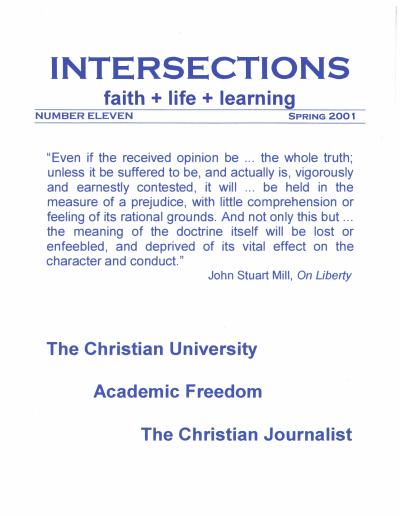
Bailey, a philosopher at Luther College, takes up the reflex of describing church-related colleges as “pretty good in spite of the religion” and argues instead that religious commitment serves academic goals on three fronts: service as central academic purpose (Richard Hughes on Mennonite colleges in Models of Christian Higher Education), educational community (Plato’s dialogues, Parker Palmer, and Mark Schwehn’s Exiles from Eden), and integration of knowledge across disciplines against Nelson and Watt’s “entrepreneurial disciplinarity.” He then defends academic freedom on Christian grounds by drawing on Mill’s On Liberty argument from fallibilism, the centrality of epistemic weakness in the Christian tradition, and Wolterstorff’s claim that to infringe academic freedom is to desecrate an image of God—making personal and institutional religious commitment a foundation, not a foe, of the liberal academic ideal.