A popular view of Plato holds that his world view has had a great and largely detrimental influence while being transparently false. I have not been immune to this oddly dismissive attitude. It is with no little surprise, in fact, that I have gradually come to see that Plato may have been right. About everything? No. About some important things, however, clearly yes. I want to fix on one point in particular, a point which reverberates in a special way for those who inhabit the academic world. But first a brief consideration of some other points where Plato had an insight that merits preserving.
Of particular interest is his worry about the impact of embodiment on our cognitive life. For embodied creatures awareness of the world is mediated by organs which register and transmit sensory data. This leads to diverse points of view, depending on species nature, on individual physiology and psychology, on space-time location, and on cultural factors carried by language. The hope of liberating rational consciousness from such dependence may strike us as fanciful if not preposterous. As may the idea that we can aspire to a form of consciousness which is without any point of view and thus god-like. But bridging differences in point of view is a cognitive (and moral) imperative for us. So also, then, is discovering a process which in some way makes this possible. Plato saw all of this with great clarity. The point here is related to the earlier ones about morality and politics and unity in diversity, and it brings us to the idea that I have come to see as Plato’s deepest.
PRELIMINARY EXAMPLES
(1) Communities Are Not Necessarily Better Off By Becoming More Diverse.
We do not have to accept the vision of social differentiation and hierarchy idealized in the Republic to see the truth in Plato’s view that a good society requires unity in diversity. Diversity may be necessary, but it is not sufficient. It contains the seeds of discord and disintegration along with the potential for enriched life, as homogeneity brings unity while threatening loss of vitality and decay. Everything depends on the wedding of diversity to some unity of purpose. We may accept Charles Taylor’s notion that a “presumption” of value is owed to any deeply rooted culture, but this presumption has to be tested in an encounter of cultures whose outcome is uncertain.1 This requires a commitment to such encounter on the part of the community, and this commitment is the unity of purpose which constitutes the community. If we were to turn our attention to the call for increased diversity at colleges of the church, creating the necessary unity in diversity would be a major task. It is not a matter of simple addition.
(2) If Politics Is To Be More Than A Struggle For Power By Competing Interests, It Has To Be Assumed That There Is A Moral Basis For Politics Which Transcends Special Interests.
Indeed, even the rightful pursuit of power on behalf of a particular interest assumes this. In our commitment to democratic politics we may reject some or all of the extreme measures to which Plato is led by this assumption. But the challenge of constructing a democratic process consistent with it is great. This may not mean, as it did for Plato, that the challenge is unmeetable. But the reduction of democracy to a naked or thinly disguised struggle for power parades itself daily.2 Plato knew a difficult problem when he saw one.
(3) The Much-Derided Dualism of Body And Soul Contains A Measure Of Truth.
Even if we take the radical dualism in Phaedo at face value, there is more to be said for it than fashionable criticism allows. We want to say, of course, that the very idea of disembodied existence is both unappealing and barely conceivable (if conceivable at all). But this does not remove the problems of embodied life which rightly concerned Plato.
TOWARD A COMMUNITY OF DISCOURSE
Another surprise for me over the years has been discovering the strength of the penchant for doctrinaire pronouncement among academic people. Our fondness for mere opinion, in other words. Deconstructionists and Foucaultians will smile knowingly at my belated loss of innocence. But we needn’t be deterred by their deflation of rational discourse as an illusion masking some will to power or fear of the free play of interpretation. Either they must defend their deflationary strategy incoherently (with an appeal to reasoned argument) or they offer us no reason to accept it. So we are free to reconsider Plato’s commitment to the dynamics of reason.
The distinction between knowledge and opinion is central to the Republic. It was Plato’s way of repudiating the reduction of knowledge to power or to groundless interpretation. Without this distinction the search for solid moral judgment is meaningless and the good life therefore impossible. Surely Plato was right about this. If personal or collective opinion is the last word, the true and the good are defined simply by our assent and thus become dispensable notions, except as tools of persuasion which work only until they are unmasked.
On the other hand, Plato’s use of this distinction is problematic. Taking it as a given epistemically, he makes it call for a parallel and equally sharp distinction between the objects of knowledge and opinion: they cannot be distinct purchases on reality unless they are about different realities. Epistemology thus entails metaphysics. In this way the original distinction produces a fundamental divide between stable, mind-transcending models or exemplars (the Forms) and the space-time particulars which are their images.
We are rightly suspicious of the claim that knowledge and opinion cannot be about the same objects, even if we agree that epistemically there is a qualitative difference between them. But Plato’s mistake is not the blatant one it is often taken to be. Crucial marks of knowledge cannot be detached from metaphysical considerations. For example, legitimate claims to know must be supported by good reasons, by “reasoned discourse” or “a reasoned account of reality” which can “survive all refutations,” as Socrates puts it in Republic VII. If we grant this, we cannot avoid the question: About what sort of reality is it possible to have “reasoned discourse”? Which puts us firmly on the path of metaphysics. So Plato’s attempt to harvest metaphysical hay from the field of common-sense epistemology has something to be said for it.
More important, however, is the way questions about the links between knowledge, reasoned discourse, and reality are embedded for Plato in questions about the good community. Epistemology and metaphysics are inseparable from ethics. Even if we are skeptical about his metaphysical enterprise and suspicious of the social and ontological hierarchies to which it leads, we do well to ponder his insistence on the link between reasoned discourse and community. For the larger society his vision of a community built on reasoned discourse may be utopian; for an academic community it should not be. It matters—especially in such a community—how the views we hold are supported and defended. Being right is not enough: better to be wrong with good reason than right with bad (or no) reasons. So I have slowly learned. This may seem obvious, too obvious to have to be learned. But in my experience tough-mindedness about the pedigree of your own beliefs, especially the ones you hold dear, is not easy to come by.3
TWO CASES
Possible examples of the difficulty are legion. I choose two which are of particular interest to me. In each case the choice reflects my confidence both about an important truth and about the negligence of a particular defense of it.
(1) The Death Penalty Is Wrong And Should Be Abolished.
I have little doubt about the truth of this, though the tide in our country is running the other way. However, I have even less doubt about bad defenses of this truth. I pick one such defense, though a variety is ready to hand; and I pick it because it is close to home.
The E.L.C.A. is in the practice of issuing social statements on major public issues. These statements become the basis for continued discussion in the church and for public policy advocacy. A minimal requirement is that the positions they adopt be defended carefully and honestly, that no shortcuts be taken to make them appear self-evident. An egregious failure to meet this requirement is provided by the church’s 1991 statement on the death penalty.4 Anyone who has really thought about this issue knows that the strongest case for retaining the death penalty is based on the demand for just retribution. It presses such questions as these: What penalty “fits” or is “deserved by” the uniquely heinous crime of first degree murder? What punishment adequately upholds the community’s consensus about the depth of the wrong committed by a brutal taking of innocent life? This case for the death penalty needs to be taken seriously by any convincing case against it: Can the demand for just retribution be met without recourse to the death penalty? If so, how? Is that demand itself misguided? If so, why? There is more than one way of minimizing this challenge. A common one is to equate just retribution with vengeance.
For the E.L.C.A.’s social statement, however, the challenge hardly exists. Though it repeatedly cites justice as a goal of the church’s social action, the statement shows scant understanding of distinctions which are crucial to understanding this goal. In the brief section on “Doing Justice,”5 we find the following:
Violent crime is, in part, a reminder of human failure to ensure justice for all members of society. People often respond to violent crime as though it were exclusively a matter of the criminal’s individual failure. The death penalty exacts and symbolizes the ultimate personal retribution.
Yet, capital punishment makes no provable impact on the breeding grounds of violent crime. Executions harm society by mirroring and reinforcing existing injustice. The death penalty distracts us from our work toward a just society… It perpetuates cycles of violence.
The statement then calls for “an assault on the root causes of violent crime” and asserts without argument that problems of fairness in the administration of the death penalty are insurmountable. Finally, we are told that
The practice of the death penalty undermines any possible moral message we might want to “send.” It is not fair and fails to make society better or safer. The message conveyed by an execution… is one of brutality and violence.6
In a few lines the demand for just retribution is first slighted, then confused with different concerns, and finally obliterated. It is hard to imagine less regard for reasoned discourse. The presupposition of the argument, if there is an argument, is that the primary agent of crime is society, the alleged criminal being more a victim than a perpetrator of injustice. This presupposition is not self-evident; it needs to be argued. And it needs to be argued case by case—unless we fall back on a social determinism which removes all responsibility and with it any role for the notions of justice and injustice. This, too, would need to be argued.
(2) We Must Extend The Boundaries Of Moral Concern Beyond Humanity To Encompass All Of The Natural World.
I find this imperative as compelling as the one about the death penalty. It certainly is unproblematic within a theocentric ethic: “The earth is the Lord’s and the fulness thereof.” But how make it compelling to resistant non-theists?
Consider a recent attempt in this direction: Larry Rasmussen’s Earth Community Earth Ethics.7 Though there is much to admire in Rasmussen’s book, it provides another example of the failure to offer compelling reasons for a strongly held position. We may agree with Rasmussen’s judgment that a way of life tied to a consumption-driven, globally expanding market economy is unsustainable and that its threat to ecological well-being is growing exponentially, and agree as well that the urgency of the situation calls for a paradigm shift in our moral thinking. But how are we to ground the necessary shift? Showing its utility is one thing; grounding it is something else. Rasmussen attempts to ground it in two ways. One is by expanding the realm of sentient life, life capable of experiencing pain; the other, as his title suggests, is by enlarging our view of community. Each fails even moderately stringent tests of rationality. The unintended result is to turn Rasmussen’s brief for a non-homocentric ethic on its head.
There is no phrase more often repeated in his book than “earth’s distress.” The less dramatic variants include “creation’s pain,” “the cry of the earth,” “nature’s suffering.” Sometimes God is the one who is said to suffer as a result of nature’s degradation. More typically, however, “earth,” “nature,” or “creation” itself is viewed as the subject of suffering. This way of speaking serves to make all of creation the focus of moral regard and to awaken compassion for it. But what is the basis for adopting such language? Rasmussen offers only constant use of the language, intimating that refusal to adopt it is a sign of homocentric arrogance. Emphatic reassertion, in other words, rather than argument. It would indeed be arrogance to deny suffering to nature where observable behavior displays it. But where there is no such behavior, the attribution of suffering becomes moralizing sentimentality.
Rasmussen’s other attempt to ground a radical revision of our moral framework fails similarly: the natural world is characterized in a way which encourages the revision, but little rationale is offered for it beyond the characterization itself. This time the language is that of “cosmic community,” “earth community,” “the community of life,” “creation as a genuine community,” “nature as both the aboriginal and comprehensive community.” Such phrases are used again and again as the basis for a “comprehensive communitarian ethic.”8
The thinness of Rasmussen’s argument is revealed as soon as we ask how “community” is to be understood. The difficulty he faces is that this concept must have moral import and yet be comprehensively applicable. The latter requirement is satisfied by explicating “community” in broad relational terms. We hear about the “internal relatedness and interdependence of creation,” the “interconnectedness…among all things,” and the “intricate togetherness of things.” Talking this way is convincing as long as we understand it in causal terms. It is no accident that Rasmussen appeals to the discoveries of natural science to ground his communitarian view of nature. But causal interdependence, simply as such, lacks moral import. Rasmussen unwittingly exposes the crucial non-sequitur: “The goodness of life together and the reciprocity learned in genuine community create moral agency and responsibility.”9 A community in which reciprocity is learned is indeed a moral community; but the interdependence which holds it together is more than causal, a kind of interdependence we have been given no reason to apply to the cosmos.
Aldo Leopold fell into the same error in his classic expression of this communitarian vision.
All ethics so far evolved rest upon a single premise: that the individual is a member of a community of interdependent parts. His instincts prompt him to compete for his place in that community, but his ethics prompt him also to co-operate… The land ethic simply enlarges the boundary of the community to include soils, waters, plants, and animals, or collectively: the land.10
Ethics requires the context of community and community requires an interdependence of cooperating members. But the land (in Leopold’s sense) is not such a community. The mutuality essential to cooperation and hence to moral community is absent.
Rasmussen and Leopold take a concept whose moral pregnancy derives from a human context and extend it beyond that context without supporting evidence. Equivocating on the word “community,” they end up attacking a homocentric bias in ethics with a conceptual move which is itself deeply homocentric. Ironically, reconceiving the natural world in our image has become the basis for reconceiving ourselves in nature’s image.11 The result is an expanded moral vision supported by no good reason. Little more than mere opinion, Plato would have said. And he would have been right.
THE DIFFERENCE IT MAKES
Why should we care about having good reasons for our beliefs?12 Well, the likelihood of having true beliefs is enhanced by good reasons. That is, good reasons make it more likely that my beliefs reflect the way things really are and not merely the way I want them to be. Suppose, however, that we reject the very idea of “the way things really are”; or we say that what matters about a view of the cosmos is not whether it is objectively true but whether it supports a preferred moral vision, or that moral visions do not need grounding in the way things really are.
Plato, of course, would demur on all of these suppositions. But assume that there is something to be said for them. Even then Plato would continue to defend the demand for good reasons since reason is linked to the possibility of a community of discourse. Disdain good reasons and you risk losing this possibility.13 Reason fosters such a community because it is by nature dialectical. Provoking us to discover incoherence in our beliefs, it leads us to uncover the assumptions on which they rest and to subject these assumptions to critical scrutiny. In this way it pulls us toward the vision of a ground which can compel the assent of all who reach it and thus bind us together. But this movement has to be governed by the mutuality it seeks; hidden contradictions and underlying assumptions do not yield readily to a solitary mind. The dialectic of reason is of necessity dialogical.
Here, then, is the fundamental insight: Offering reasons to support our beliefs and caring about the best possible reasons is a way of exposing ourselves to others and reaching out to them in the name of a community of discourse, a way of inviting them to join us in building this community. Refusing to provide reasons or to care about them is a rejection of community, an attempt to get others to accept our word as the last word. It is the will to power at work, which needs argument and thus reasons.
Each of the ideas for which I earlier claimed Platonic ancestry points to this final one. For me its essential rightness has taken a long time to sink in. Teaching for many years is what made it possible. Largely by happenstance, I stumbled into a way of teaching which involved taking positions in class—real positions, positions to which I was seriously if provisionally committed—and urging students to come at them with their probing criticism. My initial motivation was to get them thinking by making myself vulnerable in this way. But what I discovered was a dialectic in which, on the good days, we pushed each other into thinking in new ways and doing this together for the sake of deeper understanding. I rediscovered Plato.
How can there be academic community without something like this as the controlling ethos, in the conversations not only of faculty with students but among students themselves and even—the biggest challenge—within the faculty? How (even more) can it fail to be the controlling ethos at a college of the church, with its confession of faith in the creative Word and trust in a Holy Spirit moving among us? Here, at least, Athens and Jerusalem should meet.
-
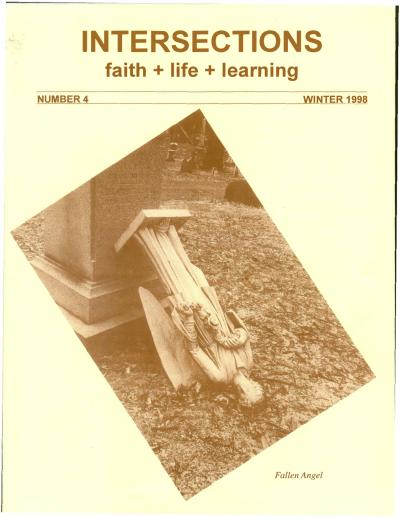 Editorial
The Vocation of a Lutheran College: Some Transitional Thoughts
James M. Unglaube
Unglaube offers final reflections on thirty years in Lutheran higher education as he leaves the ELCA Division for Higher Education and Schools to join Carthage College, his alma mater. He recalls colleague Richard Solberg’s influence, the closing of Upsala College in 1995, the Higher Education and Namibia program shared with Naomi Linnell, the growth of endowments from $70 million to $1 billion in 25 years, and the Vocation of a Lutheran College project he credits Paul Dovre with inspiring. He likens the twenty-eight ELCA colleges to flowers on a rose bush—same Lutheran tradition, each blossom different—requiring constant nurture if the partnership between church and college is to thrive.
-
Editorial
From the Editor
Tom Christenson
Christenson thanks the departing Jim Unglaube, recommends Ronald A. Wells’s Keeping Faith: Embracing the Tensions in Christian Higher Education (Eerdmans) as both an interesting collection of essays and a model worth imitating at ELCA institutions, previews the issue’s pieces by Richard Hughes, Carl Skrade and Spencer Porter, Gregory Clark, and Karla Bohmbach, and introduces three new features of the journal: “What I Have Learned” (an essay by a senior or emeritus faculty member, inaugurated by Richard Ylvisaker), “Reviews” (initiated by Karla Bohmbach), and a “Bulletin Board” for cross-campus announcements.
-
Article
Our Place in Church-Related Higher Education in the United States
Richard Hughes
Adapting his 1997 Vocation of a Lutheran College Conference address, Hughes asks how the Lutheran heritage can sustain the life of the mind in church-related higher education. He compares Reformed, Mennonite, and Catholic traditions in turn—the Reformed integration of faith and learning around a Christian worldview, the Mennonite priority of discipleship over cognition, and the Catholic sacramental affirmation of the secular as bridge—before arguing that the Lutheran heritage’s particular gifts (justification by grace, theology of the cross, two kingdoms, paradoxical sensibility, vocation, and openness to ambiguity) uniquely support rigorous inquiry, genuine pluralistic conversation, and critical analysis. Drawing on Arthur Holmes, John Howard Yoder, Mark Schwehn, Alasdair MacIntyre, and Lutheran writers including Bob Benne and Tom Christenson, Hughes contends that Lutheran finitude grounds an unusually open and self-critical academic posture.
-
Article
The Skeptical Theologian's Dictionary
Carl Skrade, Spencer Porter
Porter and Skrade offer selections from a mock-lexicon of theological terms: answer, church, faith, God, grace, hope, justification, love, prayer, sin, soul, and theology, among others. Each entry begins with a standard definition and then unsettles it—answer reminds the reader that in theology and poetry the questions matter more than their answers; church alternates between “the mystical Body of Christ” and ordinary human gatherings whose machinery often obscures the gospel; God is the One whose name we are told not to take in vain and yet whose name we keep using; prayer is communion with God yet often degenerates into a list of demands. The form’s irony exposes the gap between the language of theology and its lived realities—a sober, witty corrective for Lutheran classrooms and chapels alike.
-
Article
The University in the City of God: Beyond Dialectics and Rhetoric
Gregory A. Clark
Clark, drawing on Alasdair MacIntyre’s Three Rival Versions of Moral Enquiry, distinguishes the preliberal, liberal, and postliberal university and argues that the liberal university’s pretense of dialectical neutrality has masked a particular rhetoric of its own. Following John Milbank’s Theology and Social Theory, he holds that every philosophy and institution is finally a rhetoric and that the church’s task is not to win on the secular university’s terms but to proclaim and embody an alternative city. The Christian college, then, should give up the apologetic pose of meeting secular reason halfway and instead practice the rhetoric of the gospel: a proclamation of Jesus, an enactment of Christian friendship and peace, and a willingness to be vulnerable to the violence of the world as Jesus was vulnerable to his own. Clark commends this stance to colleges related to the church.
-
Article
A God of Peace and Love? Reflections From a Biblical Scholar
Karla G. Bohmbach
Bohmbach responds to Gregory Clark’s call to proclaim Jesus on Lutheran campuses with biblical-scholar reservations. Israel’s sacred texts also include the herem ban, the conquest narratives, and a God who fights for Israel; the Christian canon includes the apocalyptic violence of Revelation. To proclaim Jesus is therefore to proclaim a particular and contested figure within a tradition that has its own internal violence—not a generic God of peace and love. Bohmbach asks what it would mean for staff, administrators, and teachers on a college campus to take seriously the Jesus who made himself vulnerable to the violence of his world, even to the point of suffering for it, and whether Lutheran colleges are prepared for such a vocation.
-
Article
A Response to Paul Santmire: The Lutheran Liberal Arts College and Care for the Earth
Arthur A. Preisinger
Preisinger commends much of Paul Santmire’s earlier essay—the critique of the “back-to-nature” cult, the call for a holistic environmental ethos, the suggestion of a cosmic liturgical praxis—but takes issue with Santmire’s reading of classical Lutheran social ethics. He argues that the two kingdoms doctrine was not a systematic Lutheran treatise (the term itself became common only in the 1930s), that the doctrine’s misuse by some twentieth-century German theologians does not condemn its proper use, and that the South African Council of Churches actually deployed the doctrine (correctly interpreted) against apartheid. Drawing on Karl Hertz, Ulrich Duchrow, Tom Strieter, and F. Edward Cranz, Preisinger defends the doctrine as complementary duality—left hand and right hand of God, governances to be distinguished but never separated—and concludes with Bill Lazareth that the skeletons in the Lutheran closet are not Luther but departures from Luther.
-
Article
A Response to Paul Santmire
Don Braxton
Braxton appreciates the dialectical structure of Santmire’s mandates—“skeletons in our closets and riches in our own vaults”—and reads it as a faithful expression of the Lutheran tradition of Paul, Augustine, and Luther. He argues that Santmire is on target in warning against premature flight to non-Christian traditions for environmental wisdom (theoretical sensitivity does not translate into ecological behavior in practice), and that classical Lutheran social ethics has too often been quietistic. But Lutheran ethics at its best is dialectical, not dualistic—recognizing the interpenetration of church and world, Law and Gospel, eschatological Kingdom and present realities, as in Hegel, Ritschl, Bonhoeffer, Reinhold Niebuhr, and Larry Rasmussen. Braxton commends environmental responsibility, social criticism of unsustainable practices, and a liturgical practice of resistance to instrumentalism as appropriate next steps for Lutheran liberal arts colleges, especially Capital University.
-
Book Review
In Search of a Calling: The College's Role in Shaping Identity
Karla G. Bohmbach
Bohmbach reviews Thomas O. Buford’s In Search of a Calling: The College’s Role in Shaping Identity (Mercer University Press, 1995), which diagnoses a meaning-crisis among college students and traces two historical aspects of “calling”: the biblical, communitarian aspect rooted in the Hebrew Bible and the practical, individualistic aspect rooted in the Renaissance. She praises Buford’s reconstruction of imago dei as imagination rather than copy of God’s rationality, his broad disciplinary range (biblical studies, theology, educational psychology, business management), and his identification of the tension between freedom and limitation as the field of calling. She is sharply critical, however, of his final chapter’s wariness of canon-revisionists and multiculturalists, his caricature of “special-interest groups,” and his presumption of a homogeneous student body—a presumption that, she argues, never matched American college reality and matches it less today.
-
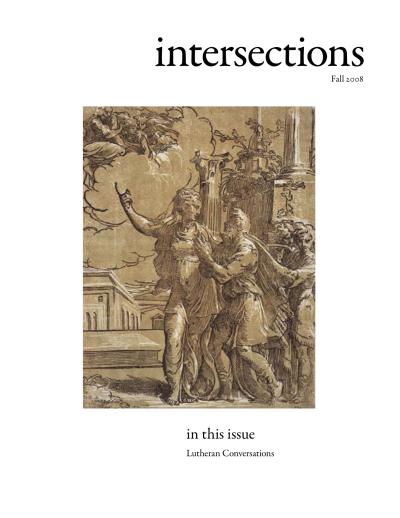 Reflection
Saving Minds
Lake Lambert
No. 28 · Fall 2008
In a sermon preached in the Castle Church in Wittenberg during Wartburg College’s 2006 faculty and staff development seminar, Lambert names two sins of the mind—coveting and mental sloth (in both its rigid refusal to think and its mindless relativism)—and, drawing on Luther’s Large Catechism and Martin Luther King, Jr.’s “A Tough Mind and a Tender Heart,” calls Christians to receive the wisdom that comes when faith puts knowledge into action, sustained by the hope of the resurrection.
-
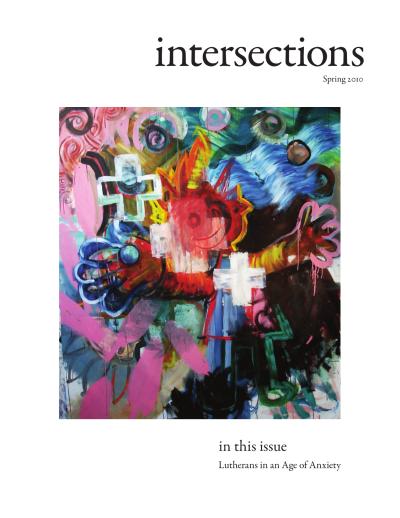 Reflection
The Neglected Miracle of Pentecost
Susan M. O'Shaughnessy
No. 32 · Spring 2010
O’Shaughnessy, in a homily delivered at Concordia College in 2008, reads the Pentecost narrative of Acts 2 through Maria Lugones and Elizabeth Spelman’s 1983 critique of white feminism’s cultural imperialism. She argues that the miracle is not the disciples’ speaking but the immigrant Jews’ hearing—and that the writer of Acts withholds the content of what was said precisely to teach disciples that people of privilege know less than the foreigner, the immigrant, the oppressed, the woman, the child, and must learn to listen in new languages before they can speak.
-
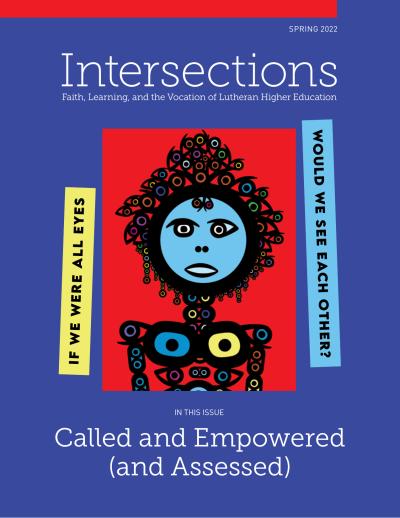 Institutional Focus
Pivoting to Imaginative Programming in the Midst of the Pandemic at Bethany College
Arminta Fox
No. 55 · Spring 2022
Fox recounts how Bethany College’s NetVUE Program Development Grant — originally designed around service-learning trips — was reimagined under COVID-19 into a guest-speaker model that tripled student participation and opened new vocational possibilities through the close, personal stories of alumni, alums-turned-volunteers, and community partners.
-
 Response
Finding the Words: The Trouble of Being California Lutheran University
Pamela M. Jolicouer
No. 6 · Winter 1999
Jolicoeur, provost and vice president for academic affairs at California Lutheran, recounts the marketing problem of a university whose middle name is Lutheran in a Southern California religious landscape where the operative modifier is “Christian” (Pepperdine, Azusa Pacific) and tests Christenson’s three themes against her own “alumni magazine test”—the Jesuit standard set by Santa Clara. She concludes that freedom, gift, and vocation, though not uniquely Lutheran, are the words she can actually use: with prospective faculty, with the constituent church bodies who pressed for “Christian” in the new CLU mission statement (compromise: “rooted in the Lutheran tradition of Christian faith…”), and with the “C student” alumna headed for a Ph.D. in psychology whose consciousness of her own gifts had evaporated.
-
Article
Point / Counterpoint: What It Means to be a "College of the Church"
Robert Benne, Tom Christenson
No. 28 · Fall 2008
Moderated by Wartburg College pastor Larry Trachte and introduced by Kathryn Kleinhans, this Wartburg campus conversation between Robert Benne (Roanoke College) and Thomas Christenson (Capital University) probes what it means to be a college of the church—Benne emphasizing ethos, vocation, and the Christian intellectual tradition over against secularization and generic education, and Christenson lifting up persistent vocational questions, the gift of difference, and induction into a community of discourse—and finds large common ground around hiring for mission, pedagogy that asks deep questions, and the courage to claim a living religious tradition while inviting everyone to the banquet.
-
 Article
Negotiating Legitimate and Conflicting Values
Eboo Patel, Katie Bringman Baxter, Mark S. Hanson
No. 44 · Fall 2016
In a closing-day conversation at the 2016 Vocation of a Lutheran College Conference, Mark Hanson and Eboo Patel — moderated by Katie Bringman Baxter of Interfaith Youth Core — share case studies in which legitimate religious values come into tension with one another, and make the case that Lutheran colleges should teach interfaith leadership through the hard cases rather than the easy ones.