Honesty of Mind: On the Uses and Abuses of Socratic Ignorance in Environmental Studies, Religion, and the Classroom
Intersections No. 15 · Winter 2002
Consider too how Holy Scriptures attribute honesty of mind also to the fool, while the wise man believes that no one is his equal;
—In Praise of Folly, Desiderius Erasmus, 1509
Going Fishing
Recently, I was reading an essay by David James Duncan, the author of The River Why, and a widely revered activist for “the church without walls” but with lots of rivers, mountains, and forests. Caught in the various pleasures of the essay, I suddenly stumbled across several lines which set my wheels spinning. As all people who have fallen in love with the ethos of the liberal arts tradition, I am constantly thinking about thinking. What is good thinking? What constitutes a decent argument on behalf of a position? How do we reflect, profess, or display perplexity? What makes for a good learning experience? These questions which serve as fodder for those of us who spend our times as teachers in the liberal arts came into perspective for me. Here’s how it happened.
Duncan is exploring his motivations for spurning river guides when he is out fly fishing. He contends that river excursions are at their best when they are “unmediated, one-on-one music played by a body of flesh and blood upon a body of water: it is a satisfying duet until a fish makes it an even more satisfying trio.” The trouble with guides, Duncan suggests, is that they often invade the music, like a popcorn munching movie critic who sits behind you and has lost the capacity for internal dialogue.
What jumped out from the page for me, however, was his conclusion. For he launches into an encomium for ignorance as his most important tool. He writes:
Fly-fishing guides accept payment in order to help clients circumvent their ignorance. But ignorance is one of the most crucial pieces of equipment any fly fisher will ever own. Ignorance is a fertile but unplanted interior field. Solitary fly fishing isolates us in this field, and leaves us no choice but to try to cultivate and plant and grow things in it. A guide, on the other hand, is like a hired farmer who, for a price, drives his tractor into your interior and plants your field for you…Fly-fishing guides turn clients into the absentee landlords of their own interiors.1
I blurt an unsolicited “yes!” but then I immediately wonder why. Somewhere in the recesses of my teaching brain, I know it has something to do with the dispositions we seek to cultivate in our students. But how does learning, the classroom structures of the learning process, and our enduring awareness of our own unknowing fit together?
The product of my reflections leads me to believe that I am defending a version of what is often called the doctrine of “Socratic Ignorance.”2 The classic location of this idea is at the end of the Theaetetus where, after what appears to have been a seemingly fruitless inquiry, Socrates declares:
Then supposing you should ever henceforth try to conceive afresh, Theaetetus, if you succeed, your embryo thoughts will be better as a consequence of today’s scrutiny, and if you remain barren, you will be gentler and more agreeable to your companions, having the good sense not to fancy you know what you do not know. For that, and no more, is all that my art can effect; nor have I any of that knowledge possessed by all the great and admirable men of our own day or of the past. But this midwife’s art is a gift from heaven…3
In the dialogue’s context, the point of Socrates’ declaration is that in spite of the supposed “fruitlessness” of their inquiry, although it has clearly been far from fruitless, the dialogue participants are still better off than they were before, since at the least knowing what we don’t know is still progress.
In what follows, I want to defend a modified version of this Socratic Ignorance which I will call “honesty of mind.” I suggest that “honesty of mind” can be understood through four premises. I will give a brief outline of these four relatively uncontroversial premises, then I will talk about their application to three areas of special concern to me: environmental ethics, the academic study of religion, and finally the liberal arts classroom. Other applications are quite possible, and I do not intend to claim any special privilege for these topics. Perhaps the third topic—the liberal arts classroom—stands out, since it addresses the ethos of learning that circumscribes the qualities of spirit with which I believe all learning ought to take place. Therefore, it is a bit broader than either environmental ethics or religion. Nevertheless, I believe I could apply the same rubric to the teaching of English literature, the social sciences, music, or athletics. In this way, honesty of mind functions and can be employed as a gauge of the successes of liberal arts education.
My four premises are:
- Human knowledge is constructed.
- Judgments are always wagered in the midst of imperfect knowledge.
- Expertise can disable our own learning processes.
- We are encumbered by other ways of knowing.
The order in which I present these considerations implies a certain conceptual movement. Consideration one is the lynchpin, for the goal of liberal arts education is to assist students in self-critical reflection on the assumptions of their knowledge, the viability of alternative assumptions, and the impact on ways of knowing such assumptions make. From that insight follow considerations two through four, although not in any particular order. Even this distinction should not be overstated, however. In practice, I believe we become aware of the entirety of these ideas in no neat fashion. Rather, they seem to me to be mutually reinforcing conceptual judgments which surface and resurface as we undergo our learning processes in cyclical fashion. We learn to sense the ramifications of the constructedness of knowledge (consideration one) as we wager tough judgments about action (two) or we evaluate the influence of expertise (three) in our own thinking. Likewise, awareness of the constructedness of knowledge influences how we relate to expertise or the encumbrances of alien ways of knowing (four).
At the same time, it should be made clear that these same qualities of the liberal arts ethos are open to abuse if they are not circumscribed by various caveats. To put it rather bluntly, to defend Socratic Ignorance is not to defend ignorance. In what follows it will be important to distinguish between employing unknowing as a basis to legitimate claims, what I consider foul play, and as a basis to circumscribe the relative “reach” of constructive claims, what I consider its appropriate employment. Mindfulness of the relativity of the reach of any claim is the mark of liberally educated students. Making the leap from the constructedness of knowledge to no claim being any more warranted than any other is not.
Field Test One: Environmental Studies
The history of physics is the history of giving up cherished ideas.
—Andrew Strominger
For any of us who have ventured into the world of environmental ethics, the first impression we have is of interdisciplinarity.4 To engage deeply in the issues of environmental ethics, we need to have some knowledge of basic issues like the biological and physical processes which govern the environing conditions under which life unfolds. Being informed about basic natural processes like hydrological cycles, biological diversity, topsoil formation, climatology, stellar evolution and planetary evolution, and molecular biology is the sine qua non of environmental ethics. Moreover, being informed is more complicated than simply knowing facts. It requires an awareness of the histories of these fields of inquiry as well as the current social conditions under which such knowing unfolds. While all of these fields of knowing are “science,” they diverge significantly in terms of their methodologies. For example, molecular biology looks different, although the differences should not be overemphasized, if studied within the context of chemistry than if taught within the field of biology. Likewise, genetics research looks different depending on who pays the bills for the research. And the matter can be more complex still, if we ask questions about gender and scientific method. Does science have a gender, as some suggest, and what would a feminist epistemology look like in scientific research? Just being scientifically literate is a challenging task in and of itself.
But mastery of information is not enough when doing environmental ethics. Specialization is the death of environmental ethics if it does not make the transition to the synthetic experiences of ecological reflection. In ecology, we seek to understand the interactions of these various domains in the open-ended systems of ecological networks. Geology influences hydrology, which in turn influences biodiversity which influences carrying capacities, and so on. In many ways, ecology cannot tolerate specialization. It forces the cross-discipline work that the liberal arts tradition commends.
Even here, however, we are not adequately versed to engage in “the doing of environmental ethics,” since it leaves out various considerations entailed by the human variable in the equation. Enter the social or human sciences. We need to investigate basic questions of the social sciences ranging from the nature and function of markets, the politics (both domestic and global) of environmental policy, and the psychology of environmental decision-making. For example, how to respond to mass extinctions in South America requires not only a knowledge of the various natural processes at work, but also studies of human population grown, the cultural forces which might support or impede family planning efforts, the economic forces that generate the need for human invasions of natural habitats, the politics of environmental decision-making, and psychological processes of risk-perception in individuals and groups.
If our heads begin to spin already with our growing awareness of the disciplines which we must take up, there is no rest for the weary. We also need to engage the religious and philosophical implications of the convictions, worldviews, and communities of faith to which various voices in the environmental debate owe loyalty. Add all of these considerations together, and we begin to glimmer the complexity of environmental issues, and perhaps an explanation for the glacial pace with which society often responds.
What might a typical citizen, or American college student, conclude from such an overview? One reaction might be despair and a dogged solipsism. In the midst of all this information, I am just going to declare my opinion and stick with it. I cannot hope to engage such diverse ways of knowing and will pursue my life in disregard for such considerations. Here, awareness of our ignorance seems disempowering. A second strategy might be simply to trust in “the experts.” We can follow through with our daily lives, resting confident that our leadership has access to the necessary expertise to tackle these issues. Here, awareness of ignorance seems to condone quiescence. A third strategy might be to seek insights that only confirm the assumptions we bring to the learning process. We look for information that confirms our lifestyles and do not raise any red flags environmentally. Here, awareness of ignorance generates the need to be informed simply to preserve our assumptions and the world we erect upon them. As I work in the field of environmental ethics, I see all three of these strategies all the time.
The model of learning I have outlined grounded in Socratic Ignorance (or Honesty of Mind) demands something different. It suggests to us, first, that our knowing is incomplete and that our ways of knowing are the product of specific historical, social, and environmental conditions. Our first duty is to investigate what these forces are and how they help and hinder us in coming to terms with various features of environmental debate. Once we begin to see our insights and limitations more clearly, we are driven to explore other ways of knowing. For example, the American experience of a plentitude of natural resources may imply that we seriously underestimate the difficulty of the choices faced by, say, poor farmers in Brazil driven to deforestation. Moreover, once we see our limitations we need to confront the question of how and when action is justified in light of our lack of perfect knowledge. For example, given the complexity of climatology, when is action warranted in curtailing greenhouse gas emissions even at the expense of many modern conveniences. Finally, it seems no one can be adequately informed about all the relevant issues associated with such complex issues, so we need to depend on the insights offered us by experts. Yet experts do not exist in a vacuum. They are influenced by social, economic, and political influences like anyone else. Moreover, like others, they can become so invested in a particular agenda that they cannot always see, and adequately address, divergent views. Expertise needs to be regarded with scrutiny like all other sources of information.
But the model of learning associated with Socratic Ignorance is open to abuse as well. The acknowledgment that our knowing is a human construction can be exploited for very questionable purposes. Take the idea of “theory” in the popular imagination. Given the fact that most science is a process of tacking back and forth between the creative construction of theory and its empirical testing against data, alternative theories sometimes can be proposed as science without holding themselves accountable to the same standards. We see this phenomenon, for example, in debates surrounding the greenhouse effect5 or the teaching of creationism in public schools.6 Because there are internal discussions within the scientific community about the exact consequences of global climatic change and various features of evolution, the attempt is made to discredit the science that does exist as “merely a theory” or “not proven” as “certainty.” As K. C. Cole writes:
One of the most common misconceptions about science (frequently fostered, I’m sorry to say, by science writers) is that scientific truth can’t be trusted because it is continually being revised. Au contraire. It can be trusted precisely because it is continually being revised.
Science is always “unfinished business.” Honesty of mind requires this insight. But we cannot derive from its opennendedness a lack of insight. To do so is to betray a fundamental flaw in our understanding of what science is and how it operates. In cases such as global climate change and creationism, it appears that science’s openness to the fallibility premise is being exploited to advance rival theories as “equally valid” simply because they are theories too. In American pluralistic culture, we seem especially prone to the seduction of the argument that everyone is “entitled to their opinion” regardless of warrants, even in matters of science. That deduction, however, exploits honesty of mind for dishonest purposes.
The climate change debate affords us a good example of another abuse of science’s honesty of mind. Since global warming is a complex phenomenon involving extremely intricate work in computer modeling of multi-variable scenarios, scientists interpret their data in terms of probabilities. This approach is an example of “being honest” about prediction under such circumstances. Opponents of changes in energy consumption, however, exploit this openness by contending that “further study” is required before enough information exists for action.7 Aside from overstating the degree of disagreement inherent in climate change modeling, opponents demand a higher degree of accuracy than is demanded under similar circumstances in other fields. In reality, the vast majority agree on the nature of the threat implied by global warming. In addition, hesitation can lead to run-away effects in climate change that no amount of later change could reverse. Thus, even in the absence of absolute certainty, caution and action seem warranted. By setting the bar so high as to impose unreasonable expectations on what science can do, opponents simply try to forestall action. That tactic, while understandable, is an abuse of science’s “honesty of mind.”
A third misuse is undue deference given to experts. Since considerations of scientific questions are notoriously complex, it is possible to decide that only experts have the requisite knowledge base to wager judgments. Complexity implies an immensity that “normal people” cannot hope to fathom, therefore experts, by the very nature of their expertise, ought to be given credibility. Aside from this conclusion being a recipe for passivity in our mental operations, it seriously underestimates the value-laden assumptions in the midst of which all scientific investigation occurs. Whatever scientists are, they are also people with a basic grounding in value assumptions about reality. Those value assumptions dictate what appears as relevant to their studies and what does not qualify as relevant. As consideration one points out, science is a social construction no less than any other way of knowing, organized around socially legitimated canons of evidence.8 It does not exist in a vacuum but rather is subject to the influences of its environment. In this day and age of the expanding costs of higher education and the potential market value of significant new scientific discoveries, it is never enough to know if an expert conducted the study. If we are savvy we also ask who financed the research, what was the method, and has this finding been replicated by other groups of scientists. A recent debate which well illustrates this point is discussion surrounding oil exploration in the National Arctic Wildlife Refuge.9 Each side in the debate has its resident panel of experts who can look at the same data and draw quite different conclusions about the relative risks to this national asset and the relative pay-offs for society.10 How much fuel efficiency can we expect from Detroit? Experts for Detroit tend to have lower estimates than experts from environmental groups. How much oil is available for “reasonable extraction” purposes in the Arctic National Wildlife Refuge? Oil industry experts estimate this figure as very high. Environmental groups estimate it as very low. In the midst of such divergent views, honesty of mind demands of us that we inform ourselves, assess the motivations and credibility of various experts, and draw our own conclusions.
Thus, in many respects, science is better to the extent that it internalizes the considerations implied by this disposition of “honesty of mind,” but it must also be weary of the potential abuses of such openness. Indeed, I suspect “honesty of mind” itself is the best medicine against its own potential abuse.
Field Test Two: Religious Studies
Being religious means asking passionately the question of the meaning of our existence and being willing to receive answers, even if the answers hurt.
—Paul Tillich
We are blessed to live in interesting times in religious studies. A recent Atlantic Monthly essay brings home the state of our growing sensitivity to religious diversity.11 Religion, and the our awareness of the enduring vitality of religion, is bursting onto the national and international scene. In the wake of September 11th, contemporary studies of the social and political behavior of people can no longer ignore the central role religion plays in motivating, informing, transforming, and destroying large and small scale relations. In religious studies, the relatively new field of NRM (New Religious Movements) studies is our current high growth industry. This branch of religious studies investigates the ways in which religions evolve, how new religious movements burst onto the scene, how they mix with other better established religions, and how they devolve and disband. Religious change is occurring at a pace unparalleled in human history. We need only to type religion into any search engine for the Internet to discover how the information revolution has put everything up for grabs. Whereas fifty years ago, it was standard to speak of the increasingly secular nature of modern civilization and to refer to new religious movements pejoratively as aberrations, cults, or sects, today we see an influx into our consciousness of massive numbers of religious options, all of which exist not just as theoretical possibilities, exotic oddities “out there,” but as real possibilities living next door to us, available to us with a simple click on the computer key pad.12
The sheer enormity of the change is astounding. For example, in the last century we have watched an amazing shift of the centers of Christianity from the Northern to the Southern hemisphere. Africa and South America are now demographically the true powerhouses of Christianity. In 1900, there were 10 million Christians in Africa. By 2000, that number swelled to 360 million.13 Another example is the rapidity of change in the global religious landscape. In order not to be blind to the world as it is now shaping up, religious studies teachers must now think about their discipline and its subject matter as never before. We need to work into our mental maps somewhere, somehow, the Ahmadis, a messianic Muslim sect based in Pakistan with eight million members, the curious blending of Confusianism, Taoism, and Buddhism called the Cao Dai with some half a million members, or the Umbanda of Brazil, a twenty million member movement that blends spirit worship and healing from African indigenous religions and Catholicism. Add to this proliferation the growing numbers of cyber-religions,14 religions based on the Internet and which American college students are finding increasingly attractive in their information driven world, and the colors of our world begin to come into focus. Complexity upon complexity. How are we in religious studies to cope?
But even this is not enough. We need also to consider the element of a students’ yearning to find meaning in their lives. Students not only ask “what’s out there?” but also “which one offers satisfactions?” and “how am I to choose?” How can I be a more authentic human being? What am I to make of the promises of so many religious options? What intellectual stance can I adopt that is suited both to my need for existential fulfillment and the diverse claims to religious insight? If religious studies is not to degrade into a kind of academic tourism which exposes students to exotic religious sights just because it can, but is also genuinely interested in assisting students in their spiritual journeys, then we must seek ways to both explore the religious landscape and teach students to sort out their own existential yearnings. The difficulty of this balance between exploration and religious commitment finds its clearest expression when we seek both to encourage students to take their religious inheritance and experiences seriously while also prompting openness to the new and viable religious alternatives offered by the global religious menu. It would be tantamount to academic malpractice simply to discount religious diversity and pursue our various and familiar religious terrains as a mostly Christian society, if that is even true in this day and age. To be Christian these days, for example, seems to require us to make some effort to grasp what that means within the larger context of the complexity of the religious landscape.
This problem was taken up in a recent interview in the New York Times.15 The President of Union Theological Seminary in New York, Joseph Hough, has gone public with his dissatisfaction of the handling of religious diversity by Christians in light of the September 11th bombings. He argues that even the most liberal of Christian groups who have called for religious tolerance still descend into a paternalistic attitude toward non-Christians unsuited to our situation. He notes that liberal Christians have called for a mutual regard toward Muslims, and the recognition that all Islam cannot be held responsible for the terrorist attack. This stance is an important contribution, to be sure. But even with this attitude, another problem still vexes the prospects of peaceful resolution, namely, a subtle superiority assumption on the part of the various religious communities involved in the conversation. He contends that “toleration alone, while desirable, is not sufficient in a world of religious pluralism.” He argues instead for a theology that recognizes the authenticity, indeed salvific capacity of non-Christian religions. To say that we come to know the divine mediated through the Christian tradition need not imply that others cannot know the divine authentically as it is mediated through their tradition. This is a demanding claim, for it will require Christianity to engage the world’s religions not merely as a host would entertain a guest with all its implicit power differentiations, but to encounter various religions as mutually enriching experiences of the divine. Any claim to exclusivity would, therefore, be eliminated.16 But can a Christian accept salvation via other religious traditions, and still be a Christian?17 It is interesting that Hough must repeatedly differentiate his views as an individual and a scholar of religion from his official capacity as the president of a Christian seminary. It signals the fine line he is walking these days.
Hough’s views seem to me to be better in keeping with the standards I articulated above as “honesty of mind.” Since all knowledge is culturally and linguistically constructed, Christians must recognize that their exclusivity claims cannot be justified. Moreover, this admission does not obviate the possibility that what Christians know relatively, they nevertheless know truly. But it also implies that they are not guaranteed insight either. Knowledge is constantly negotiated, renewed by fresh questioning, and in the field of religion that means that insight must test itself constantly, really put itself at risk, in the realm of mutual dialogue. The Christian, or any other adherent of a religious tradition, must accept the prospect of fallibility and attempt to see through the eyes of another religious community. Just a student cannot dismiss a book as insignificant without first having seriously engaged its claims, so also a religious believer cannot dismiss other religious options without first having seriously engaged these insights. Here we see consideration four from above making its appearance, namely, that we as Christians are encumbered by the claims of non-Christians. Honesty of mind requires not only that we make room for people with whom we disagree, but that we dare to experience, to the best of our ability with all its inherent limitations, what non-Christians say is true. We test it empirically (experientially or “on ourselves,” so to speak) to see how it might enrich us and bring us closer to insight. If we value the claims of our own religious heritage, we can do no less. That hallmark is the difference between faith and blind faith, between ethnocentrism and being centered. Finally, then, we cannot accept the claims of religious experts passively simply because of their expertise, although we ought to listen to them. Religious experts such theologians, priesthoods, gurus, scriptural claims, and yes, even religion professors, may offer invitations to the salvific domain of their religious experience, but they cannot substitute their expertise for personal spiritual cultivation.
Let us take a very concrete example: the teaching of the Bible to undergraduates in the liberal arts curriculum. What do the four considerations of “honesty of mind” imply for the process? The first consideration is the constructedness of knowledge, even insights regarded as divinely inspired. To make good on that insight, we need to see the human interpretive processes that give rise to sacred texts. In a widely used textbook for introductory classes in the Bible, Hauer and Young teach students a “three-world approach” to the study of the Bible.18 Deciding what a text means, any text for that matter, but in this case the religious texts of the Bible, is a complex process of triangulating between three worlds: the world behind the text, the world created by the text, and the world in front of the text. First, the world behind the text signifies the complex processes behind the completed set of documents we inherit as scripture. Arduous historical investigations are required to discover the historical settings, the editorial processes, and the social and cultural forces which gave rise to the construction of the documents that later become known as sacred texts.19 In many ways this is the most challenging for students, for it requires them to understand that sacred scripture has a history, that it displays the marks of human construction. For many, the Bible’s status as “revealed word of God” implies that it cannot have such a history and still be normative.20 Second, the world of the text signifies the complex of memories and experiences evoked by the text in its integrity as a completed opus.21 Here we ask ourselves what is the nature of the world displayed inside the pages of the documents themselves without reference to the world from which it originates. We learn to think of the text as artifact, as a work of art that supercedes its authors’ intentions. Finally, we need to explore the world in front of the text, that is, the world into which it is received.22 This is “our world” with all its assumptions, complexities, and questions. For example, we read scripture as scientifically informed people and this vision shapes the way in which we see the text and its potential meanings. We need to ask ourselves how the Biblical narratives of creation, resurrection, and end-times make sense in the context of a scientifically informed worldview.23 The decision about meaning emerges, therefore, from the complicated process of drawing all three of these worlds into conversation, observing the ways in which these multiple vectors interact to construct significance. Not only do we see the constructional dimensions of the text, but also we grow to appreciate the building process inherent in how we read. This implies to the student, among other things, that our religious insights are incomplete processes of negotiation between history, religious artifact, and contemporary needs. Finally, it suggests that religious ways of knowing need to be constantly renewed in this multivectoring manner.
As in our discussion of science, the other three consequences of honesty of mind follow and have their impact. Given the fact that meaning is accomplished only relative to particular times and places, any judgment about religious affiliation or moral stance must be tentative, open to revisibility, and dependent on the limited ranges of information we have before us. If new information surfaces about historical background or new insights emerge in our modern world, our judgments need to reflect these additional data.24 The emergence of religious diversity as live options in our pluralistic consciousness is one such piece of data. In the example above, Hough was simply trying to respond with honesty to this new context of reading the Christian historical witness.
Perhaps nowhere does the question of expertise press upon us more than in the domain of religious studies. Expertise appears in religious studies in the form of those who claim special insight into divine matters. Priests, gurus, prophets, and holy women articulate religious insights and claim special status for these insights on the basis of unique religious disclosures. Moreover, they link their insights to matters of human well-being and salvation such that our failure to follow their insights risks judgment by divine authorities, thereby raising the stakes of mistakes. While any and all such claims need to be treated with respect, we cannot with honesty of mind succumb to scare tactics either. We must analyze such claims with the same rigor we would research various types of medical advise or political views. In the end, experts cannot decide our religious questions for us. In an old Zen saying, if my face is dirty, it doesn’t help if others wash their faces. In the context of the Bible, the last court of appeal for its meaning and interpretation must be the individual who stands in this world, here and now, and must sort out life in the midst of this universe. That sorting out process requires the engagement of the multiplicity of diverse religious claims under conditions of publicly or generally available criteria of reasonableness.
Finally, as Hough so ably demonstrated, to be Christian, or Jewish, with our Bibles before us, we must engage and be willing to risk Biblical insights in the midst of other religious traditions. The scriptural traditions of other religious communities bear the same marks and burdens of inquiry that the Bible does.25 What do the stories of Muhammad tell us, then? What are we to make of the claims associated with the Buddha’s Enlightenment? Can we embrace their insights and still be Christian? Are there ways in which they converge? And if they diverge can we envision conversion in light of the evidence? Honesty of mind requires this possibility of us from the outset. To say that encumbrance by other traditions is necessary is not to say that it is easy, or ever thoroughly complete. It is an on-going process no less than is science’s investigations of the universe. The criterion of validity cannot be simply the sincerity of the persons who hold a set of beliefs passionately. Nor can be it be the inherent coherency of a religious community’s belief structure. This recognition lies at the heart of many religious traditions when they point to religious membership not as an arrival, but as the initiation of a journey, a way of being, a path.26 I believe that the liberal arts ethos is especially sensitive to these dimensions of religious life and stands students in good stead as they enter the world we see before us.
Yet abuse of the disposition to honesty of mind is just as relevant to religious studies as it was to science above. In other words, the embrace of this disposition needs to be surrounded by various caveats to protect against its abuse. For example, the constructedness of knowledge does not mean that any and all religious claims are equally valid. The right to an opinion as justified insight requires its redemption as insight through discursive elaboration among a community of open-minded religious seekers. This criterion is the most difficult to achieve in light of everyone’s seemingly universal willingness to admit fallibility. The difficulty results, it seems to me, in the belief that we are more open-minded than we actually are. To embrace fallibility in principle does not always translated into a practice of genuine listening. Engagement in listening is a fragile possibility that requires constant willingness to take note of our potential emotional, social, and cultural inhibitions. It is not an exaggeration to say that the willingness to conceive afresh, to return to the origins of what we think we know is a rare commodity, especially in the existentially charged and psychologically challenging atmosphere of people’s cherished religious views. Honesty of mind in the classroom, and in life, requires the fine balance that Reinhold Niebuhr enunciated in this manner: first,
Religious toleration through religiously inspired humility and charity is always a difficult achievement. It requires that religious convictions be sincerely and devoutly held while yet the sinful and finite corruptions of these convictions be humbly acknowledged; and the actual fruits of these faiths be generously estimated.27
And second:
The Christian position of contrition in regard to “our truth,” the humble recognition that it contains some egoistic corruption, degenerates into irresponsibility as soon as we disavow the obligation to purge the truth we hold of egoistic corruption. The irresponsibility degenerates into complete skepticism if we come to the conclusion, that since history contains nothing but partial perspectives and fragmentary viewpoints, there is no possibility of discerning truth from falsehood.28
Field Three: The Academy
I am often struck by the fact that many of my best students declare to me that they came to college wanting to discover answers, but that the deeper they have ventured in their own learning process, the less they feel they know. In our current academic world where so much emphasis is placed on “outcome assessment” I ask myself what this “confession” implies. It is certainly not something that will show up on any of the standard quantitative outcome assessment instruments that I have been encouraged to adopt. It seems to me as good an argument as any not to put too much emphasis on the limited types of information we as educators can expect to glean from such instruments. So what does it mean if our “success stories” are experiencing confusion after their four years at college?
If I enquire why these students think they are more confused than before, they suggest that they are less certain of what they think is true. Many factors seem to be at work in this experience, but my conclusion is that they are confessing an intellectual conversion to the liberal arts ethos. It seems to me simply that they are embracing a level of honesty of mind that they lacked before they underwent a liberal arts training. And that liberal arts ethos is identified—at least in part—by the four considerations of honesty of mind.
The more I know, the less I seem to know. This statement implies first of all that students have become aware of the complexity of insight. They have begun to see that human insight is always contextual, risky, and open to revision. It is certainly true that students are better informed about the various ways of knowing than when they came to college. They command a far greater range of information than before. So it isn’t that they know less information than before. Rather, their mastery of information is now situated against a backdrop of how much more they might come to know. Moreover, they now seem to comprehend that the possession of information is not the same thing as a grasp of its significance. So students are also dealing with the difficulties and risks associated with wagering a judgment about how what they now seem to know fits together in a larger existential context. Put differently, they are not quite sure what it all means. It does not mean, for example, that they do not have various ways of bringing a diversity of things into coherence (worldviews), for they have certainly been exposed to a variety of ways to assemble insights into coherent systems. No, they seem struck by the weaknesses implicit in their very best attempts at coherence. They see the strengths and weaknesses of their various options. Instead of the cognitive world of black and white with which they entered the community of inquiry, they are now more nuanced thinkers with a refined set of cognitive tools to discern various shades of grey. In the end, their confession implies a greater appreciation for the responsibility they must take for their own thoughts, a responsibility grounded in a greater responsiveness to their own culturally and linguistically complex world. They are beginning to take ownership of their own learning process. No longer can they permit themselves to rest confident in their insights, for they see the ways in which others now encumber their ways of knowing. They have become democrats of the mind, citizens in the human intellectual enterprise. And, it seems to me, the world will be a better place for their willingness to accept the insights they have and the confusion that remains. In the words of Plato, they will try henceforth “to conceive afresh.” They will be the midwife, in Plato’s language, of their own life-long learning challenges. Metaphorically speaking, it is perhaps not too much to declare this orientation of mind a “gift from heaven,” as Plato suggests. This accomplishment of the liberal arts will not show up on many of the outcome devices we employ, but it is a quality that ought not to be dismissed as important. It seems to me that it ought to be to be celebrated as one of the more important contributions we can make.
There is a lot that we can do as teachers to model a willingness to receive this “gift from heaven.” We can admit the constructedness of our knowledge by seeking answers and then posing before our answers the most serious questions we can muster. We can allow our various disciplinary methods and insights to be tested—wagered, if you will—in interdisciplinary dialogue and teaching experiences. The scientist can ask questions about the religious consequences of scientific discoveries, even as religious inquirers can be invited to scrutinize their arguments and claims through scientific investigation. We can wear our expertise lightly, not hiding behind our authority, but demonstrating the curiosity that made us want to be experts when we began our journeys. We can structure our classrooms so that students can see ways in which their experiences and learning can be successful contributions to the insights of the class, encouraging student research and scholarship as valued aspects of the our community’s learning. We can encourage students to learn how to learn for themselves and from each other in ways that far exceed what any professor might help to accomplish. In the imagery of Duncan from the introduction, we can empower them to toss out a line and see if a fish will rise.
Socratic Ignorance encourages an ownership of, and a set of responsibilities toward, our own learning processes. It is an extremely important dimension of the ethos of the liberal arts. It is a mark of character. It is not the only mark of character, to be sure, but it is a crucial one. In some ways, it is more noticeable by its absence in people than by its presence. It distinguishes those people who are willing to risk the unknown from those who only wager the known and secure. It separates those who aren’t willing to look at their own assumptions from those who are. It indicates people who have made mistakes and learned from them in contrast to people who have made mistakes and failed to learn from them. Honesty of mind suggests that we are all projects under construction both as teachers and as students. This will impact not only how students take up their own learning processes, but how we teach. We all have “interior fields” to cultivate, and the best teachers, it seems to me, lead their students by their willingness to cultivate their own “interior fields.”
Endnotes
1. “In Praise of No Guide” in My Story as Told By Water (San Francisco: Sierra Club Books, 2001), pp 234–235.
2. McPherran, Mark L. Wisdom, Ignorance, and Virtue: Essays in Socratic Studies (Edmonton: Academic Print. and Pub., 1997).
3. Plato: The Collected Dialogues, edited by Hamilton, Edith, and Huntingdon Cairns (Princeton: Bollingen, 1961), [210 b-c] p. 919.
4. On the capacity to think and work within an interdisciplinary educational setting where the environmental crisis calls for a consilience of knowing, see Orr, David W. Ecological Literacy (New York: SUNY Press, 1992), pp. 85–95.
5. Rosenbaum, Walter A., Environmental Politics and Policy (Washington, D.C.: CQ Press, 1991), pp. 66 ff. See also Davis, David Howard, Energy Politics (New York: St. Martin’s Press, 1993) pp. 57–61.
6. For a book that argues for creationism, now more frequently referred to as “intelligent design theory,” see Moreland, J. P, ed. The Creation Hypothesis: Scientific Evidence for Intelligent Design (Downers Grove, IL Intervarsity Press, 1994). It is worth noting that Intervarsity is a religious, not a scientific press. For a scientific investigation into the primary pillars of creationism, see Godfrey, Laurie E., ed. Scientists Confront Creationism (New York: W.W. Norton, 1983). And for a more overtly polemical treatment of creationism consult McKown, Delos B., The Mythmaker’s Magic (Buffalo, NY: Prometheus Books, 1993.
7. A good example of this maneuver is Dixie Lee Ray’s Environmental Overkill (Washington, D.C.: Regnery Gateway, 1993). She writes (p. 14): “First, whenever there is so clear a difference of opinion among experts, the conclusion must be: No one really knows. And when no one knows, it is best to withhold judgment and avoid precipitous action.”
8. Adrian Desmond and James Moore make the relation between doing science and the social-cultural matrix in which doing science occurs explicit in the fascinating example of Darwin’s work on The Descent of Man. See Darwin: The Life of a Tortured Evolutionist (New York: Warner Books, 1991, pp. 550–621.)
9. Torry, Jack, “Fuel Efficiency, Arctic Oil at the Crux of Energy Debate,” Columbus Dispatch, March 3, 2002.
11. Lester, Toby, “Oh, Gods!” Atlantic Monthly, February, 2002, pp. 37–45.
12. As I wrote this essay, I experimented with a “google” search for religion of the Internet. It came back to me with 11,900,000 possible entries.
13. Ibid, p. 44.
14. For anyone interested in this topic, I suggest a “Yahoo.com” search under counterculture and religions. Among the options that pop up, I would especially recommend the web site “www.self-improvement-personal-development.com” as a valuable resource.
15. “Acknowledging That God Is Not Limited To Christians,” New York Times, January 12, 2001.
16. The consequences for this attitude of mind for conflict resolution are immense. Indeed, in the ethics of dialogue, the demand that we make our best efforts to see through the eyes of the other is the crucial component. Few people are gifted with this skill naturally. Peace advocates all emphasize the difficult work it requires to maintain such openness of mind. See Patti, Janet, and Linda Lantieri, “Waging Peace in Our Schools: Social and emotional Learning Through Conflict Resolution” in Educating Minds and Hearts, edited by Jonathan Cohen (New York: Teachers College, Columbia University, 1999), pp. 126–136.
17. Martin Cook explores this question in his book The Open Circle: Confessional Method in Theology (Minneapolis: Fortress Press, 1991). He proposes an “open confessional method” built upon the model of the natural sciences.
18. Hauer, Christian E., and William A. Young, And Introduction to the Bible: A Journey Into Three Worlds (Fifth Edition) (Upper Saddle River, NJ, 2001).
19. For a concise overview of historical-critical methods in Biblical studies, see Barton, James, Reading the Old testament: Methods in Biblical Studies (Philadelphia: Westminster Press, 1984.), pp. 30–60.
20. Barr, James, The Bible In the Modern World (New York: Harper & Row, 1973), pp. 13–22.
21. For a concise survey of “literary criticism” which is the principal method of this genre, see McKenzie, S.L. and R. Haynes, To Each Its Own Meaning (Loisville, KY: Westminster/John Knox, 1993).
22. This field is called reader response theory. For an overview, see “Contemporary Theories of Biblical Interpretation” in The New Interpreter’s Bible, vol l (Nashville: Abingdon Press, 1994), pp. 107–124.
23. In my “Religion and Science” class, the main burden of our inquiry is this process of adjudicating between insights derived from religious communities and scientific communities; Excellent resources exist in this field. I would suggest Ian Barbour’s Religion and Science (San Francisco: HarperSan Francisco, 1997) as a general survey text. Ursula Goodenough’s The Sacred Depths of Nature (New York: Oxford University Press, 1998) is an excellent study from the perspective of a cellular biologist. John Dewey’s classic A Common Faith (New Haven: Yale University Press, 1934) still works well as a pragmatist’s approach to the religion and science dialogue.
24. The fervor over the recent “historical Jesus” research is a case in point. This new round of “the quest for the historical Jesus” was initiated by John Dominic Crossan in his important book The Historical Jesus (San Francisco: HarperSan Francisco, 1991.)
25. Many of the newer survey texts in Bible reflect this growing consciousness that effective Bible analysis can only take place within the context of crosscultural studies of the emergence of sacred texts and traditions. A good recent example of this is Exploring Religious Meaning, Monk, Robert C, et al, (Upper Saddle River, NJ: Prentice Hall, 1998)
26. I explore this imagery and its consequences in my book Staying With the Questions (unpublished manuscript).
27. Niebuhr, Reinhold, Children of Light and Children of Darkness (New York: Charles Scribner’s Sons, 1944), pp. 137–138.
28. Niebuhr, Reinhold, The Nature and Destiny of Man, vol 2, (New York: Charles Scribner’s Sons, 1941), p. 239.
-
 Editorial
From the Publisher
Arne Selbyg
Selbyg announces that the 2001 ELCA Churchwide Assembly has commissioned a new social statement on education, placing it alongside the economy, the environment, abortion, sexuality, health, and peace, and invites Intersections readers to submit input on which topics within the field of education the statement should address.
-
Editorial
From the Editor
Tom Christenson
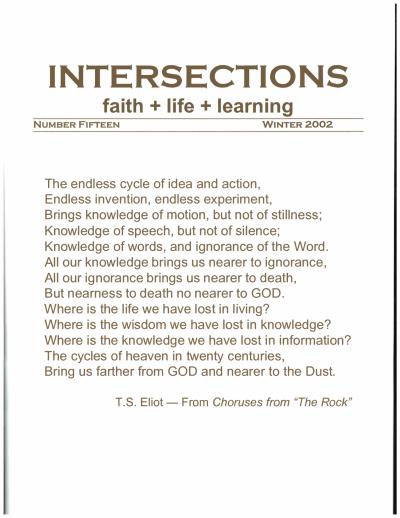
Christenson introduces an issue of varied voices—bishops and university presidents, philosophers and poets, students and their teachers—and defends the T. S. Eliot cover selection (“Where is the wisdom we have lost in knowledge?”) against the charge of being too depressing, arguing with cover artist Ida that Lutherans are realists about human accomplishments and that there is a huge difference between optimism and hope.
-
Article
The Marks of an ELCA College: One Bishop's Reflections
Stanley Olson
Olson, speaking as a bishop and “Harness Boy” whose job is to keep the church’s connections working, replaces his original four-noun outline (fealty, ingenuity, insouciance, focus) with eight marks the ELCA should be able to observe in its colleges: intentional Lutheran identity, significant Lutheran presence, Christian faith at every table, freedom of inquiry, coaching toward vocation, gravity and grace, nurtured community, and excellence by its own standards. Drawing on his survey of all twenty-eight ELCA college mission statements (two tables) and on Darrell Jodock and Mark Edwards, he argues that the Lutheran connection must be made explicit in mission, marketing, and faculty searches, and closes with six reciprocal expectations the colleges should hold of the ELCA—commissioner, mature parent, supporter of adventurous teenagers, advocate, steward of graduates, and a church faithful to its own Lutheran mission.
-
Article
Welcome Strangers
Gregg Muilenberg
Muilenberg, a non-Lutheran philosopher at Concordia, argues that self-consciously Lutheran colleges cannot make non-Lutheran faculty feel welcome through “institutional fit” rhetoric (he cites Concordia’s own hiring boilerplate) because identity must be sustained and developed, not preserved like a pickle. Drawing on Nikos Kazantzakis’s Report to Greco and the three marks of the “profoundly religious person”—commitment to the truth, to the power of the spirit, and to metousiosis through myth—he proposes that faith and reason are best understood as an unending struggle into which strangers must be invited as valuable and active participants, safeguarded by the strongest possible affirmation of academic freedom (citing Martha Nussbaum on Notre Dame and BYU).
-
Poem
Drunks in a Midnight Choir
Kevin Griffith
A pantoum-like Christmas-season poem in which red-robed choristers, flasks clinking and hands trembling, mangle the words of carols beneath “the midnight sky, your endless dark coat,” trusting that “it’s the season to forgive what’s vile” and that even wise men praise the humble and make glad.
-
Poem
The Etiology of Eschatology
Kevin Griffith
A wry meditation on end-times and beginnings in which the last trumpet is only a prelude to the longest dawn, newly handmade animals grow fat waiting for caretakers to name them, dark-robed cryptologists fret over the end of everything, and once everyone has solved the great conundrum the big man simply hits rewind.
-
Article
The Identity, Mission, Vision, and Goals of a Lutheran College vis a vis Bacon's "Of Studies" and Newman's "The Idea of a University"
Cora Lazor, Mary Theresa Hall
Hall, an Associate Professor of English at Thiel, and Lazor, a Thiel junior and 2002 ELCA Division for Higher Education summer intern, read Thiel College’s Statements of Identity, Mission, Vision, and Goals alongside Sir Francis Bacon’s “Of Studies” (1625) and John Henry Cardinal Newman’s The Idea of a University (engaging Azade Seyhan’s May 2002 PMLA essay along the way). They argue that Bacon’s “Read…to weigh and consider” and Newman’s defense of liberal over technical training underwrite Thiel’s new Writing-Intensive Course requirement, its ten institutional objectives, and its commitment to “service to society” in the Judeo-Christian tradition.
-
Book Review
Paul Dovre, ed.: The Future of Religious Colleges
Baird Tipson
Tipson, president of Wittenberg University, reviews Paul Dovre’s edited proceedings of the October 2000 Harvard Conference on the Future of Religious Colleges (Eerdmans, 2002), summarizing essays by Douglas Sloan on the failure of the “two-realm theory of truth,” George Marsden on faith-shaped scholarship, DeAne Lagerquist, Father David O’Connell, Mark Noll, Robert Benne, Mark Roche on Notre Dame, Joel Carpenter on neo-Calvinist Kuyperianism, and Mark Schwehn on a Lutheran “college-related church” and the centrality of vocation. Against Benne’s suggestion that only two or three robustly Lutheran colleges can be sustained, Tipson defends a less robust but still authentically Lutheran model embodied at places like Wittenberg, Gettysburg, and Roanoke, arguing for the enlightenment commitment to subjecting all truth claims to rigorous criticism and for hiring Marsden-style faith-shaped scholars rather than counting Lutheran heads.
-
 Book Review
Alister McGrath: Glimpsing the Divine: The Search for Meaning in the Universe
Don Braxton
No. 14 · Summer 2002
Braxton reviews Alister McGrath’s Glimpsing the Divine (Eerdmans, 2002), commending its twelve articulate, lavishly photographed meditations as a fine introduction to Western spirituality but criticizing its conservative neo-Barthian confessionalism, its Eurocentric treatment of non-Western traditions as “taillights” to Christianity’s “headlights,” its one-sided host-guest engagement with the natural sciences, and its metaphysical dualism. In a section added for ministerial readers, he contrasts McGrath’s self-contained confessionalism with H. Richard Niebuhr’s call to respond to all things as if to God’s actions upon us, and argues that in an era of rival fundamentalisms exclusivity must become a thing of the past.
-
 Article
A Response to Paul Santmire
Don Braxton
No. 4 · Winter 1998
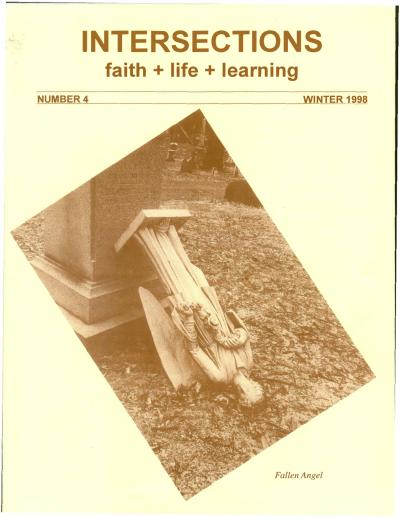
Braxton appreciates the dialectical structure of Santmire’s mandates—“skeletons in our closets and riches in our own vaults”—and reads it as a faithful expression of the Lutheran tradition of Paul, Augustine, and Luther. He argues that Santmire is on target in warning against premature flight to non-Christian traditions for environmental wisdom (theoretical sensitivity does not translate into ecological behavior in practice), and that classical Lutheran social ethics has too often been quietistic. But Lutheran ethics at its best is dialectical, not dualistic—recognizing the interpenetration of church and world, Law and Gospel, eschatological Kingdom and present realities, as in Hegel, Ritschl, Bonhoeffer, Reinhold Niebuhr, and Larry Rasmussen. Braxton commends environmental responsibility, social criticism of unsustainable practices, and a liturgical practice of resistance to instrumentalism as appropriate next steps for Lutheran liberal arts colleges, especially Capital University.
-
 Article
Education as a Christian (Lutheran) Calling
Tom Christenson
No. 21 · Summer 2005
Christenson opens with an imaginative reconstruction of early Christian communities as radically egalitarian, pacifist, communitarian gatherings within the Roman Empire and argues that such communities are natural homes for the educational vocation. Naming two temptations for contemporary Christian higher education—the parochial Bible school and “Generic U”—he uses his friend Sig Rauspern’s tree metaphor to insist that a university is Christian in its trunk and roots rather than in grafted-on branches. Drawing on Wendell Berry, Jacob Bronowski, Walter Wink, Douglas John Hall, and his own Gift and Task of Lutheran Higher Education, he names faithful criticism, engaged suspiciousness, simul justus et peccator, and a fallible, love-related Lutheran epistemology as the particular gifts Lutherans bring to the Christian educational calling.
-
 Reflection
Saving Minds
Lake Lambert
No. 28 · Fall 2008
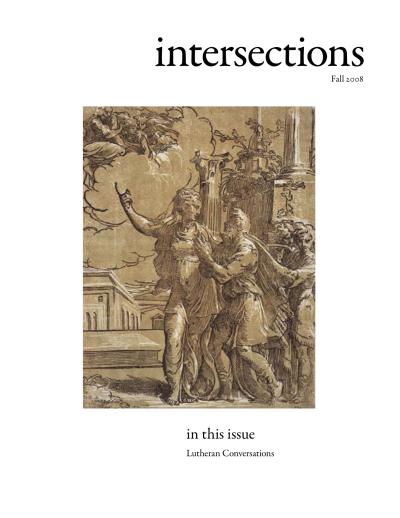
In a sermon preached in the Castle Church in Wittenberg during Wartburg College’s 2006 faculty and staff development seminar, Lambert names two sins of the mind—coveting and mental sloth (in both its rigid refusal to think and its mindless relativism)—and, drawing on Luther’s Large Catechism and Martin Luther King, Jr.’s “A Tough Mind and a Tender Heart,” calls Christians to receive the wisdom that comes when faith puts knowledge into action, sustained by the hope of the resurrection.
-
 Article
Preaching in Christ Chapel on Yom HaShoah: Reflections on Interfaith Relations at a Lutheran College
Sarah Ruble
No. 53 · Spring 2021
Ruble shares her 2019 Holocaust Remembrance Day homily preached before the cross in Christ Chapel at Gustavus Adolphus, then reflects on whether “professional Christians” on Lutheran campuses might practice a non-mutual, witnessed confession before colleagues of other traditions as a check on Christian self-deceit.
-
Article
Down and Out: First Year Students Encounter Lutheran Theology
Lindsey Leonard
No. 53 · Spring 2021
Leonard describes how Wartburg’s IS 101 first-year seminar wove the Dalai Lama, Paul Kingsnorth, Chimamanda Ngozi Adichie, and Mary Robinson’s Climate Justice into the Fall 2020 reader so the “COVID class” could encounter Lutheran theology’s call to serve the neighbor across the pandemics of disease, racism, and climate change.
-
 Reflection
Dreaming God's Dream: A Sermon on Isaiah 56:1-2, 6-8
Stephan K. Turnbull
No. 34 · Fall 2011
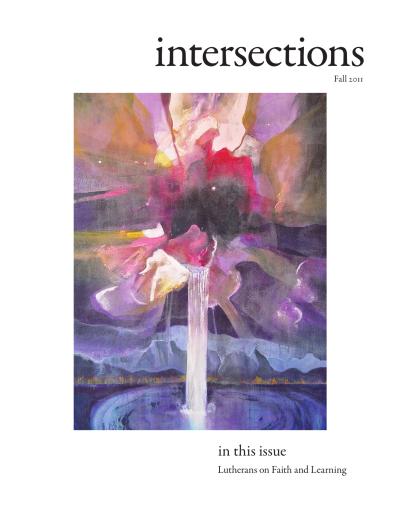
Preached at the 2008 “Savvy with Substance” Convocation of the ELCA at Central Lutheran Church, Minneapolis, this sermon by parish pastor Stephan K. Turnbull (First Lutheran Church, White Bear Lake) sets the small dreams of pastors and academics—balanced budgets, peaceful congregations, coherent midterm papers—over against the prophet’s dream in Isaiah 56 of a God who gathers all nations to a house of prayer for all peoples. Turnbull calls educators, preachers, and church leaders to articulate God’s dream of getting the world back through the dying of Jesus the Messiah and the resurrection’s first fruits of new creation.
-
Article
Teaching as an Expression of a Love Ethic
Abbylynn Helgevold
No. 53 · Spring 2021
Drawing on Kierkegaard’s Works of Love and Kevin Gannon’s teaching manifesto, Helgevold describes how an ethic of upbuilding love—love that presupposes goodness in students—reshapes inclusive pedagogy at Wartburg College, from syllabus language to how she addresses plagiarism and attendance.