On May 25, 2020, George Floyd was killed by the Minneapolis police on the corner of 38th Street and Chicago Avenue. As Mr. Floyd was murdered on camera for the world to see, we were all reminded of the deep evil that is white supremacy. This evil remains alive and well in our systems today, built in to allow systemic violence to continuously operate as the status quo. But the world did not respond to this act of violence with passivity or indifference. People came together, in large numbers, to form communities united in the vision of a more just world. Witnessing the formation of these communities, and the spaces they created, reminded us of the power generated through collective action. In the days following the murder of George Floyd, the intersection of 38th and Chicago transformed into a central meeting spot for community members who gathered to grieve, memorialize, and share space with one another. There was a collective sense that this ground was now sacred, and this fight for life and justice a sacred fight. Despite the acts and efforts of law enforcement and politicians, the corner of 38th and Chicago, memorialized as George Floyd Square, remains separated from the rest of Chicago Avenue, made distinct by the use of blockades that restrict motor traffic or external disturbance. George Floyd Square became and remains sacred space because of the community that believes in a better world in such a deep and real way that they have no choice but to stand together to work and construct a space in which that vision of the world could be possible.
Community is power, something I believe in the heart of my being. Still, we can lose sight of this power; when the grievances of the world and the rigid structures of our systems feel too strong we are discouraged by the lack of progress we may see and exhausted by what can feel like a never-ending battle against injustice. This is precisely why we cannot stand alone in the grief or trauma perpetrated against ourselves or our siblings in the world, left to our own spiral of despair. In community we are able to find connection and purpose. But how does this sense of unity become established in the face of cultural violence and destruction? Further, how does it move forward in ways so as to make new spaces that could be examples of an alternative vision for the world? One of the most powerful ways that we can join together in community and form deep intentional connections is through ritual action. George Floyd Square is an example of a place established as sacred (and set apart from the rest of the world), in which ritual action sometimes takes place as a way to envision and enact a vision of a better world. For example, the Square’s physical uses are many: there are multiple clothing donation and pick-up locations, free groceries and book centers, a community garden, and a resource hub, just to name a few. Here, the community began gathering in acknowledgment of sacred space, and grew unified through ritual actions such as memorialization through art, protests for justice, or offering their siblings in humanity care, whether medical, spiritual, or simply loving.
What can we learn from George Floyd Square by examining the roles of sacred space and ritual action in forming and maintaining an active and ignited community? Ritual action and sacred space are two interconnected concepts that have played an important role in many religious and cultural traditions throughout history. Ritual is an act, or a series of repeated acts, that are set apart from others which work to represent and embody a set beliefs.1 These actions may include prayer, meditation, chanting, dancing, or other forms of intentional repeated actions. Ritual can create a sense of community and belonging, as well as can inspire liberation. Ritual can also be utilized as a tool of control when used by a dominant power force to establish or maintain social control. Ritual is often practiced in particular locations that are often set apart from the rest of the world. This is often thought of as sacred space. Sacred space refers to a location or environment that is imbued with spiritual/cultural significance or power.2 Sacred spaces can vary widely in look and environment, from something in a natural setting such as a mountaintop or a forest to human-made structures such as temples, shrines, or mosques. The creation and maintenance of sacred space often involves ritual actions such as purification, consecration, and offering; however, this relationship between ritual action and sacred space is not entirely unidirectional but often reciprocal, with each reinforcing and enhancing the other. For example, a sacred space may be created through the performance of ritual actions, and in turn, the presence of a sacred space may facilitate deeper and more meaningful ritual experiences. Additionally, the use of ritual actions within sacred space may serve to enhance the power and efficacy of those actions. Through these practices, individuals and communities can tap into a sense of transcendence and meaning that goes beyond the mundane aspects of daily life, and connect with something greater than themselves. This sense of belonging to something bigger than oneself can often connect us to a greater community beyond what we may have thought ourselves to be a part of.
This being said, it is fair to say that one of the most powerful functions of rituals is their ability to create a sense of belonging and community. When people come together to participate in a ritual, they are united by a common purpose and experience. This shared experience can create a sense of connection and belonging that extends beyond the boundaries of the ritual itself and can become the foundation for a community to be effective in enacting real, deep change.
George Floyd Square in Minneapolis is a prime example of a sacred space in which ritual action occurs to enact social change. The square has been transformed into a sacred space through the use of ritual actions, including the laying of flowers, the lighting of candles, and the holding of vigils and protests. The site has become a place of pilgrimage for those seeking to honor and mourn Floyd's life, and engage in community movements for social justice. The square has also become a hub for cultural and political events, such as art installations, performances, and speeches. These events serve to strengthen the bonds of the community and empower people to take action. In this way, the square has become a space for transformation, where people can come together to grieve, heal, and work towards a better future. In these ways, George Floyd square in Minneapolis exemplifies the power of ritual action. Through the use of rituals, the square marks sacred space that holds deep meaning for the community. As a place of remembrance, mourning, and action, it has become a symbol of the ongoing struggle for justice and equality, despite attempts by the city to assert control and power over the space. The caretakers of the square and many other volunteers use ritualized actions to push back through the intentional maintenance of the space, fighting to protect it and uplift its sacredness so that it can remain a place that holds room for a powerful and radical community. There is a lot to learn from George Floyd Square. The Square is a visual representation of resilience and determination, and although complicated, it provides me with an immense sense of hope. It is not free from conflict, nowhere is, but it does not run away from that. Instead, the community learns from it. It takes knowing the community to know what is really needed for the community, and here, through ritual action, the knowing and seeing of the community is real, which makes real action possible. I wonder what could be gained if we began to look for the rituals we encounter in our own communities, and considered their impacts on the way we see ourselves and the greater world around us. I think that by becoming more aware and alert to the rituals of our culture and the social function of them, we may notice the power of ritual, therefore becoming increasingly able to utilize the potential within ritual to strengthen and unify community towards a real and tangible future in which peace and collective healing may be possible.
Endnotes
1. Bell Catherine M. 1992. Ritual Theory Ritual Practice. New York: Oxford University Press.
2. Douglas Mary. 1966. Purity and Danger; an Analysis of Concepts of Pollution and Taboo. New York: Praeger.
-
 Editorial
From the Publisher: Introduction and Invitation
Lamont Anthony Wells
Wells introduces himself as the new Executive Director of NECU, succeeding Rev. Dr. Mark Wilhelm, and frames this Spring issue as a passionate response to the crises facing higher education amid threats to academic freedom and the well-being of educators.
-
Editorial
From the Editor: Vocation [in] Disruption
Colleen Windham-Hughes
Windham-Hughes introduces the issue’s theme — vocation amidst disruption — previews new features including contributor contact information, a study guide for So That All May Flourish, and invited pieces on reproductive rights, and shares results from the Fall survey of readers.
-
Institutional Focus
So That All May Flourish Study Guide
A chapter-by-chapter study guide to So That All May Flourish (Fortress Press 2023), a new volume by NECU authors that develops the central tenet of “Rooted and Open” and offers discussion questions for use in orientation programs, classes, workshops, task forces, and professional development settings.
-
Reflection
“Miracles are no longer required”—Life Writing as a Healing Tool
Barbara Reul
A music historian and cancer survivor chronicles how a uterine cancer diagnosis in the early months of the COVID-19 pandemic disrupted her vocation as a university professor, and how writing two open-access memoirs became an unexpected tool for healing body, mind, and soul.
-
Reflection
Be Like Jesus: Flip Some Tables
Jessica Easter
Easter argues that the example of Jesus overturning the moneychangers’ tables in Matthew 21 calls Christians not to work within unjust systems but to disrupt them — and that this table-flipping must be done in community with others who share the vision of a world where all are seen, heard, and valued.
-
Article
Necessary Disruptions: Centering Vocation in the Common Good
Erin VanLaningham
VanLaningham previews the forthcoming NetVUE volume Called Beyond Our Selves: Vocation and the Common Good, arguing that vocation, common, and good all need to be disrupted and expanded so that students might arrive at a wider sense of individual purpose and collective well-being.
-
Article
Where Disruption and Vocation Meet: One Path Toward Teaching Reproductive Justice in Challenging Times
Lena R. Hann
Hann recounts how a missed math class in her first college term led her into volunteer work at a feminist abortion clinic and ultimately a career in public health, and describes how she designed and taught a Reproductive Justice immersive term course at Augustana College through the disruptions of COVID-19, George Floyd’s murder, and the Dobbs decision.
-
Article
The Duty to Teach and Restore Bodily Autonomy: Reflections from the Classroom
Cynthia Richards
Richards reflects on a Narrative Medicine course she taught at Wittenberg University in the wake of the Dobbs decision, in which students examined cultural “first recognitions” of the reproductive body and discovered that almost none had ever had a way of talking openly about their reproductive selves — an alienation she calls educators to address.
-
Article
Turning to a Reproductive Justice Framework for Inclusive Dialogue across Differences
Jenny M. James
James makes the case that a reproductive justice framework, rooted in the work of black feminist scholars and activists, gives educators tools to overhaul polarized pro-choice/pro-life conversations and to host inclusive dialogues across differences of race, sexuality, gender identity, and faith.
-
Article
A Reconsideration of the Political Approach to Abortion
Sophia Cruz Ponce
Cruz Ponce argues that the pro-life versus pro-choice binary distracts from the underlying social factors that lead to unwanted pregnancies, and proposes a reframed political approach focused on mandated sex education, free contraception, and crisis pregnancy centers that address the social, political, and economic barriers women face.
-
Article
Take Heart: Is Neutrality Really What We Need Right Now?
Abbylynn Helgevold
Helgevold, an ethicist at Wartburg College, argues that calls for faculty neutrality on abortion in the post-Roe classroom stifle the courageous conversations Lutheran higher education is uniquely positioned to host — conversations grounded in “Rooted and Open” and the ELCA’s 1991 Social Statement on Abortion.
-
Article
Views on Flourishing After the Age of Roe
Caryn Riswold, Mary J. Streufert
Riswold and Streufert reflect on the Radcliffe Institute’s January 2023 conference “The Age of Roe” and argue that the ELCA’s 1991 Social Statement on Abortion and its 2019 statement Faith, Sexism, and Justice offer Lutheran higher education a third way to approach reproductive justice grounded in serving the neighbor so that all may flourish.
-
 Institutional Focus
Health Food in the Inner City: An Interview with Brian Noy about Augsburg's Campus Kitchen
Brian Noy
No. 36 · Fall 2012
Noy, Director of Campus Kitchen at Augsburg College in Minneapolis, describes the Kitchen’s four-fold program—Food to Share (2,000 meals per month from surplus dining-services food and Campus Cooking Classes), Food to Grow (an 80-plot community garden), Food to Buy (two farmers markets that accept EBT/food stamps), and Food to Know (educational programming)—and the deep history of Augsburg’s service to the immigrant communities of the Cedar Riverside neighborhood, now Somali and Mexican as well as historically Norwegian.
-
 Article
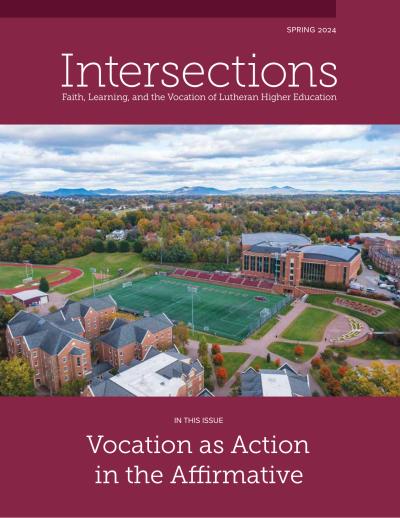
What Our Lutheran Heritage Entails for Lutheran Colleges and Affirmative Action
Mark Ellingsen
No. 59 · Spring 2024
Ellingsen argues that the Lutheran Two-Kingdom Ethic — far from leading to political reaction — supports the church-relatedness of ELCA colleges and obligates them to keep affirmative action alive, even reading a Chief Justice Roberts “loophole” in Students for Fair Admissions v. Harvard as an open door for Black community partnerships, ELCA congregations, and Lutheran colleges to act in the affirmative.
-
 Article
Fostering Moral Imagination and Inclusivity: The Role of Ethical Leadership in ELCA Colleges and Universities Amid Societal Challenges
Lamont Anthony Wells
No. 62 · Fall 2025
12 min audio
Wells argues that “moral imagination” — the capacity to envision ethical alternatives, empathize across difference, and respond creatively to injustice — is the heart of ethical leadership in NECU institutions, and that anchoring leadership in this principle positions Lutheran higher education to cultivate socially responsible citizens.
-
 Article
Creation, Justice, and Communio: Lutheran Insights Empowering Educational Access
Mary Elise Lowe
No. 60 · Fall 2024
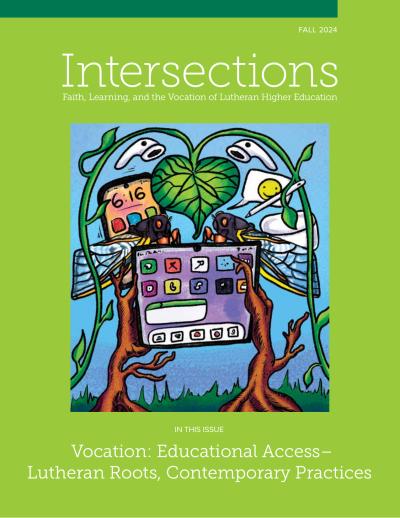
In her VLHE keynote, Lowe names three Lutheran commitments — continuing creation, neighbor justice, and communio — as the “why” that empowers ELCA colleges and universities to pursue equitable access for students often left behind by persistence and graduation gaps.
-
 Response
Feeling at Home: Dimensions of Faculty Life
Jane Hokanson Hawks
No. 2 · Winter 1997
Hawks of Midland Lutheran College responds to Bouman by reflecting on her path from a Lutheran childhood through the BSN at St. Olaf and thirteen years at four non-church-related institutions to her present home at Midland, where teaching at a Lutheran institution finally feels “right.” Bouman’s framing of the five themes as the Lutheran argument about what it means to be human helped her ad-hoc committee articulate the spiritual role in Midland’s new faculty mentoring program (recently funded by the Lilly Foundation), and grounds her work as a nurse educator confronting the daily humanness of grief, joy, ethical dilemmas, and care across cultural and religious difference.
-
 Reflection
Vocation
Matt Peterson
No. 10 · Fall 2000
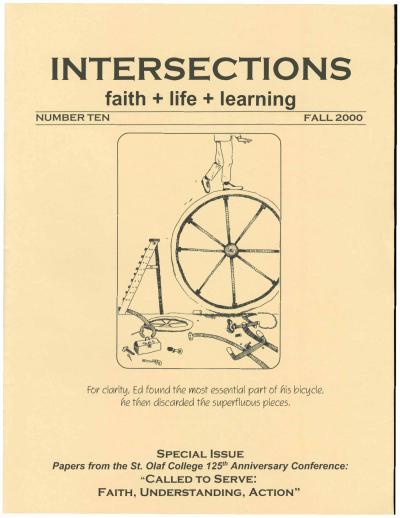
In a chapel homily, St. Olaf student Matt Peterson quotes former St. Olaf professor Howard Hong’s 1955 Our Church and the World—“the tragedy is that we seem to have lost the full grasp of the Christian vocation”—to argue that vocation, from the Latin vocare, is centrally a call into daily communion with God and into continually becoming Christian, not the title of a successful career marked by GPA, win-loss records, honorary degrees, or net worth. Drawing on Anthony Bloom on prayer that must be lived, he indicts the dread of Monday, the “come hell or high water” demand for production, and the “faith community” that we take on faith.