A Fifth Teat on a Cow: The Irrelevance of the Lutheran Doctrine of the Two Kingdoms for Academic Life
Intersections No. 9 · Summer 2000
A response to Hughes, LaHurd, Ratke et al.
Two Kingdoms: A Universal Condition for Faith Communities both Sacred and Secular
All Christians live in two communities and struggle with the sometimes-conflicting allegiances to those communities. Augustine in his City of God argues that the City of God and the City of Man are not identical (even when the City of Man formally affirms its character to be Christian). Thus, the sacking of Rome in 410 AD (approximately 30 years after the declaration of the Roman Empire as officially Christian) does not constitute a defeat of the City of God. It is a defeat of only one of the manifestations of the City of Man. Furthermore in the event of conflict, the ultimate commitment of the Christian must be to the City of God. Augustine was not, of course, the first to articulate a cultural conflict between two kingdoms or realms. Jewish reflection on the Babylonian captivity as embodied in the books of Esther and Daniel deals with problem of dual allegiances. One is definitely temporal and pagan. The other is the true community of faith with a transcendent ground. Analogous themes are dealt with in all of the great religions of the world. Furthermore, Marxism is an example of a secular religion that posits a temporally transcendent vision (the classless society where conflict, exploitation, alienation and history as we know it are no more) over against the normal history of mankind grounded in class conflict. Thus, the conflict between two kingdoms is not a uniquely Lutheran, uniquely Christian, uniquely Western or even uniquely non-secular theme. Many recent discussions of the Lutheran doctrine of two kingdoms have concentrated on the relationship of the Lutheran doctrine of two kingdoms to Lutheran higher education. This is perfectly appropriate but these discussions have failed to place this dialogue in the much larger context that adequate discussion requires. The two-kingdom doctrine and Lutheran higher education is more narrow even than a discussion of the two-kingdom doctrine and Lutheran faith and social policy. It is an important piece of this issue but not the entire issue.
The Two Kingdom Doctrine and Recent Discussions in Lutheran Higher Education
Is there a new orthodoxy for Lutheran colleges regarding the issue of faith and the academic disciplines? Philip Nordquist (“From Pietism to Paradox: The Development of a Lutheran Philosophy of Education,” INTERSECTIONS, Winter, 2000) does not use these words but speaks as if there is such an orthodoxy. Nordquist applauds the victory of Lutheran dialectical theology and the doctrine of two kingdoms among ELCA colleges:
“It is, however, now the view being expressed by the Division for Higher Education and Schools of the Evangelical Lutheran church in America (ELCA). It has been basic to these Vocation of A Lutheran College conferences, and it is was clearly and effectively summarized by Richard Hughes at the conference held at Carthage College in 1997” (p. 14).
Nordquist affirms clearly that “Dialectical—or two-kingdoms—theology is an indispensable foundation for the educational activity of Lutheran colleges and universities” (p. 15). He also refers to Richard Hughes’ article (“Our Place in Church Related Higher Education,” INTERSECTIONS, Winter 1998). Hughes address republished in INTERSECTIONS was given at the 1997 conference on “Vocation of a Lutheran College.” Prior to that, a similar presentation had been given by Hughes to the Lutheran Presidents. A copy of that presentation was used in at least one faculty retreat (Lenoir-Rhyne College, May 1997) as a point of discussion. Consistent with Nordquist, Hughes emphasizes the strength of the Lutheran vision for higher education in its affirmation of the paradox of the two kingdoms. Because of this paradoxical affirmation, Lutherans are not called to transform the secular world into the Kingdom of God (p. 8). There is for Lutherans a Christian worldview but there is no need to impose that worldview on others nor to “integrate faith and learning around that perspective” (pp. 8–9).
It is not entirely clear to me what “dialectical” and “paradoxical” mean in the context of these essays. A paradox appears to be something more than a difficult, confusing or ambiguous situation, problem or concept. Paradoxes seem in principle to be rationally incomprehensible or in the case of a particular problem incapable of resolution. Dialectical in this context is not the Hegelian or Marxian sense of dialectic. For Hegel or Marx the dialectical poles are overcome in a rationally comprehensive synthesis. For Lutherans it seems that our understanding and our concrete existential situation in both the spiritual kingdom on the right and our secular kingdom on the left must remain forever unreconciled. The genius of the Lutheran position and its ability to support the life of the mind lies in its ability to affirm these intellectual and existential poles without attempting to reconcile them. Thus each kingdom is affirmed. In academic life each discipline is affirmed. Theology is affirmed as a legitimate academic reflection on spiritual reality. The other academic disciplines have their own rational autonomous foundation and are capable of development independent of special revelation or special spiritual insight.
The above description suggests that here is at least one right-handed discipline (theology but perhaps also hermeneutics, church history, etc.) And numerous left-handed disciplines (mathematics, physics, biology, chemistry, economics, sociology, psychology, etc.). Thus, my colleague, David Ratke writes “To be a theologian is presumably to serve in the realm of God’s right hand, that is in the spiritual realm and inculcate and further God’s word.”1 Ratke following David Kelsey, distinguishes between the Athens model for education which is concerned with the cultivation of the soul and the Berlin model (named after the University of Berlin formed in 1810) which is concerned with specialized cultivation of knowledge in the distinct disciplines. Schools of the Church, Ratke affirms, are perhaps more consistent with the Athens model. Ratke also suggests that Luther affirmed that there are distinct sociological realms governed by different epistemological standards. Paraphrasing Luther, he writes: “The secular realm is the realm where reason prevails. One does not need the gospel to serve in this realm.” In this context he quotes Luther to the effect that government is clearly in the secular realm and is to be governed by reason (p. 294–5).
Ryan LaHurd (“Of Imaginary Cows and White Toy Sheep,” INTERSECTIONS, Winter, 1999) distinguishes between the “real” and the “imagined” college. The “real” college is associated with the business of the college and with the kingdom on the left. This college is not free. The “imagined” (ideal?) college is associated with the kingdom on the right and presumably is free. LaHurd who is the President of Lenoir-Rhyne does not believe that he has the same freedom as president that he formerly did as a professor of English at another Lutheran college.
“As I go about cultivating this potential donor, do I have the freedom to tell him that the mission of my college is to convince students that materialism is one of the idols of our time?” (P. 15)
He answers in the negative. He believes, however, that it would be useful to distinguish between two kinds of economy—the “gift economy” (kingdom on the right) and the “commodity economy” (kingdom on the left). LaHurd’s paper raises interesting questions about the role of the Christian college and roles within the Christian college. He fails to deal with a number of interesting questions that his article suggests. What specifically are the left-handed functions within the college and how does one know when one is performing one or the other. Are there right-handed disciplines (like English and philosophy)? Are there left-handed disciplines (like business)? If so, what about business ethics (which I teach in our MBA program)? If I critique materialism in my class is this a subversive activity, knowledge about which he should not share with a wealthy donor? How will we deal with this when the word gets out?2
Furthermore, faculty in small colleges like ours perform various functions that are administrative or quasi-administrative. They are department chairs, sit on tenure and promotion committees, personnel committees that hear grievances, propose salary schedules and make other policy proposals. They sit on admissions committees that determine who will be allowed to study at our institutions. They sit on academic standing committees and disciplinary committees that throw students out of our institutions. Are these all left-handed functions and what is the significance of calling them left-handed or right-handed? Are they governed by different ethical standards than the right-handed functions? Does the spiritual realm have anything to say to these functions?
The above is not an adequate summary or critical review of any of the addresses and articles mentioned. It is perhaps sufficient to indicate the variety of issues raised and provide a context for the critical remarks that follow. As I indicate below, my impressions of the meaning and use of the Lutheran two-kingdom doctrine is also informed by my nearly thirty years of teaching, dialoguing and attending conferences on the Lutheran perspective on faith, culture and the academic disciplines. The remarks that follow will, I hope, clarify the perspective of one who has for a long time been in the Lutheran world if never fully of it.
Critical Summary of the Lutheran Doctrine of Two Kingdoms
To put it in its briefest and boldest form, advocates of the Lutheran doctrine of two kingdoms seem to be committed either explicitly or implicitly to the proposition that there are two distinct sociological realms with distinct epistemological foundations and distinct ethical demands. Christians live in both these realms.
They are at one and the same time citizens of the kingdom on the right—subject to the demands of the gospel; and the kingdom on the left—subject to the demands of reason. As subjects of the kingdom on the right they have special knowledge and a special calling. As subjects in the kingdom on the left they also have a calling from God but no insight that is not also available to the non-Christian. Nor do they need any such insight. This dual existence is paradoxical and the life of the Christian is thus in a fundamental sense a life lived in a paradoxical state.
When this paradigm is applied to academe, it seems to come out that Christians (unless they are theologians) must be subject to the demands of reason when practicing the investigation related to their disciplines. Here, however, they do not have special insight from the scriptures or theology that non-believers do not have. Furthermore, they don’t need any special insight. If this living in two realms generates paradox, it also provides protection for academic freedom. Lutheranism above all other Christian perspectives is in a position to protect academic freedom from Christian theological encroachment. Above all other perspectives, it is able to make its peace with what Ratke referred to in his paper as the Berlin model of University education. This model stresses the autonomy of the separate disciplines, each subject only to the norms of rational scientific investigation.
My reservations can be stated bluntly. This doctrine of the two kingdoms is typically interpreted in ways that are sociologically meaningless. It is based on a description of intellectual history that, if it was ever true, has not been true for centuries, and is totally at odds with current postmodernist trends. It is anti-intellectual in its effect by encouraging specialists within disciplines to ignore—or at least giving them an excuse for ignoring—the epistemological and anthropological assumptions that are deeply imbedded in the paradigms that define the nature of their disciplines. Rather than providing a basis for interdisciplinary dialogue, it discourages it or at best gives no intellectual basis for supporting it. Likewise, it gives no intellectual basis for defending the liberal arts or the relationship of the liberal arts to the professions. It is a potential disaster for social ethics, particulary Christian social ethics which by definition rests on the premise that the Gospel does have implications for the ethical decisions that we make in society and the institutional frameworks within which those decisions are made. By walling off theology from the disciplines, it impoverishes the disciplines but is a virtual disaster for theology as a living developing enterprise. This is because the logical implication of affirming that theology does not have epistemological implications for the other disciplines, is that the other disciplines do not have epistemological implications for theology. This will protect theology from the predations of modern scholarship by making it totally irrelevant. Like a fifth teat on a cow! Finally, Lutherans defend their doctrine of the two kingdoms by two questionable strategies. On the one hand, they engage in a promiscuous use of the concept of “paradox” which often appears to be a catchall for all that is unclear. On the other hand, they like to affirm that 2+2=4 which is offered as paradigm for all that is clear. Their use of “paradox” tends to define as irrational that which can in fact be clarified. Their use of mathematics tends to treat as clear that which in fact is complex and ambiguous.
I wish to start by apologizing to those who may be put off by the syrupy tone and excessive subtlety of my attack. I could say more but perhaps this articulation of my reservations about the Lutheran doctrine of two kingdoms is enough to get us started. I will proceed to give my understanding of the typical Lutheran or at least a very typical Lutheran understanding of the two-kingdom doctrine. This doctrine sounds so rational, so charitable and so sophisticated that I am certainly obligated to explain why I find it to be complete nonsense. Furthermore, I must give an account that would at least attempt to explain how I, who have fed at the table of a Lutheran college for nearly thirty years, should be so lacking in charity and common civility as to say what I think. After all, academic freedom means that one is allowed to give harsh judgments when they are properly within the province of one’s discipline. It does not mean that one is always compelled to give those judgments. In the next page or two, I will do my best.
A Faulty Sociology
First, I will begin with what I see as the faulty sociology. I will do so by way of a personal illustration. I currently serve on the Ethics Committee of Catawba Valley Hospice. What is dying, especially dying under the care of hospice? It is clearly a biological event (left-handed stuff)? Is it also a spiritual event? Surely! Why does our local hospice have an ethics committee? Well, you say, they want to be ethical. It’s not quite that simple. Hospice organizations are not required to be accredited by JCAHO (Joint Commission for the Accreditation of Healthcare Organizations) but they can be. Furthermore, hospice care is funded by a combination of charitable giving (right-handed stuff), Medicare and Medicaid (that’s political and obviously left-handed stuff) and health insurance (business-read left-handed stuff again). The local hospice believes that at some point accreditation is going to be necessary to get governmental and insurance funding. JCAHO requires an ethics program (this usually means a committee) to be accredited. And you thought they needed lectures on J.S. Mill and Immanual Kant in order for them to know how to be ethical!
The point here is that dying is not just a biological and spiritual event. It turns out to be a political and economic event as well. But there is more. Hospice generally does not serve very many AIDs patients. Why? Because a patient needs to have six months or less to live in order to use the type of funding available to hospice. Just as federal agencies monitor our Lutheran colleges to see that we are not giving federal money to students who do not graduate on time, they monitor hospice organizations to see that they are not giving money to clients who do not die on time. Hospice organizations like the rest of us must live within the law. Dying is a juridical act as well. But it is also a social/psychological event. To come under the care of hospice, the patient and the caregivers of the patient (frequently family—family, isn’t that right-handed stuff?) must make a commitment to dying. Patients can be hospitalized—but only for palliative care. If they request and receive clearly curative care they can be dropped from the program. Making a commitment to die—is that a social/psychological event that can be analyzed by the science of psychology apart from its spiritual implications? Let us count the institutional structures that potentially come into play here. The church, the synagogue or the mosque, hospice, the hospital, perhaps a nursing home (independent or church sponsored—there is federal and private business insurance money involved either way) the federal government, private business. Oh! I almost forgot the funeral home. Educational structures are also involved. Hospice care is palliative care. We are getting better but studies have shown that medical schools have not historically done a good job teaching their medical students how to care for the dying. The young docs in training don’t treat dying patients! They don’t get adequate training in medication appropriate for palliative care versus medication necessary for curative care, etc. Aren’t there some important cultural issues here?
I have chosen one example. I could have chosen others. The point I wish to make is that we live in what sociologists refer to as a highly structurally differentiated society. We all play many roles and live in many institutional structures or if you prefer realms. Each of these structures has its own autonomy, so to speak but they are all interdependent in exceedingly complex ways. Luther’s sociology may have been appropriate for Luther’s time. It won’t work for ours. Some Lutherans may look at the example given above and see paradox. I think this is not only unhelpful, it is destructive. Life is hellishly complex, frustratingly complicated, governed by legal and ethical norms that do not always appear compatible and indeed, are not always compatible. Furthermore, our life in the world has many evils that are intractable. I believe that a theology informed by a sociology (or a psychology, economics, politics, jurisprudence, etc.) which in turn is informed by theology will better enable us to understand and attack some of the problems and alleviate them. But to alleviate these problems we must avoid an over-hasty retreat whenever we encounter issues that are complex and difficult. This over-hasty retreat is what Robert Benne argues against.
“Thus, in some areas of inquiry, a Lutheran college will recognize paradox, ambiguity and irresolvability. But this recognition takes place at the end of a creative process of engagement, not at the beginning, where some of the proponents of ‘paradox’ would like to put it. These proponents then simply avoid real engagement by declaring ‘paradox’ at the very beginning, essentially allowing everyone to go their own way and do their own thing.” (“Integration and Fragmentation: Can the Lutheran Center Hold?” INTERSECTIONS, Winter, 2000, p. 8).
I applaud Benne’s warning against putting the concept of “paradox” at the front of any discussion rather than at the end. The only useful function I can see for this ploy is to end all dialogue before it gets started and this is not useful at all. But I am not sure that “paradox” is generally useful at any stage in the dialogue. It is certainly useful to recognize ambiguity and irresolvability. It is certainly useful to avoid premature and superficial closure on academic debates by giving supposedly rationally coherent solutions that are neither rational nor coherent. It is also wise, however, to avoid claiming that a problem is ultimately irresolvable because it is a “paradox.” What cannot be resolved in this decade, in this culture, in this age, with present intellectual and cultural resources may be resolvable in another time and place with different insights and intellectual resources. I do not say that here are not paradoxes—the trinity, the incarnation, how the German Lutherans, the Swedish Lutherans and the Norwegian Lutherans are three and yet only one are instances that come to mind. But it seems best to me to keep a long list of presently unresolved problems and a short list of “paradoxes.”
Epistemological and Anthropological Pluralism and the Two-Kingdom Doctrine
The Lutheran two-kingdom doctrine assumes an academic culture characterized by epistemological monism that is neutral with respect to anthropological assumptions. In fact, academic culture is characterized by pluralism (some would say relativism). This is evident in the social sciences. Sociology, political science, psychology, anthropology, and economics do not have a single paradigm to which they all adhere. They do not even have single paradigms that define the nature of the particular discipline. The same may be said of the humanities. If history is part of the humanities (and historians disagree whether it is part of the humanities or part of the social sciences) there is certainly no single view of history to which all historians guided by a single view of reason subscribe. The same may be said of literature. Is there a single literary theory to which every competent Ph.D. in literature guided by a neutral reason must subscribe? Furthermore, the various candidates for paradigms within the disciplines make assumptions about the nature of ultimate reality, the nature of the knowing process and human nature that are deeply embedded within the paradigms. Some of these assumptions are theological in the narrow sense—cf. Freud’s Civilization and Its Discontents or Durkeim’s Elementary Forms of Religious Life or the works of Marx or Spencer. Others make assumptions that are at least broadly religious or make affirmations about the relationship of religion to various spheres of life—cf. Max Weber and Talcott Parsons, Alasdair MacIntyre’s Whose Justice? Which Rationality? has a title that is a rhetorical statement not meant to affirm relativism as an ontological and epistemological reality but meant to be a descriptive statement that characterizes where we are in the last half of the twentieth century. MacIntyre affirms that relativism and its twin, emotivism, are false as philosophical positions. He also affirms that it is correct to describe our culture as characterized by emotivism. He affirms that we have many competing views of reason and many competing views of the nature of ethical truth and do not have cultural agreement on standards by which to resolve our differences.
According to MacIntyre, Rational ethical discourse in our culture has become increasingly impossible. Maybe Luther could appeal to a single view of reason to which everyone whatever their religious persuasion could subscribe. As Robert Benne, has observed we, however, certainly cannot make any such assumption (Benne, pp. 8–9). Similar things may be said with respect to the field of business and more specifically business management. From Frederick Taylor, to Elton Mayo to Douglas McGregor to Peter Drucker, theories of business management make assumptions about human nature and the nature of human interaction, the value of wealth and the meaning of work that are profoundly religious.3 Theology simply does have something to say to these issues and these perspectives have something to say to theology. To fail to recognize this is to sin against theology. It is even something more serious than that. I am a professional philosopher and not a theologian. The Lutheran two-kingdom doctrine sins against epistemology. Any doctrine that discourages epistemological reflection on the nature of the various disciplines or seeks uncritically to impose a particular epistemology on an entire institution or denomination is not the preserver of the integrity of academe. It is anti-intellectual in a most fundamental way.
Personal and Institutional Vocation and the Lutheran College
Richard Hughes, who has had a tremendous influence on recent discussions among Lutherans on the vocation of Lutheran colleges, begins an important address on this topic by telling something of his spiritual journey and explaining that although he is not formally a Lutheran that he is spiritually a Lutheran. In brief, Lutheran theology was the means of his rescue from a brand of fundamentalism that stressed a very destructive form of works righteousness. I too affirm what I regard as the essence of Lutheran soteriology—the doctrine of justification not by works but by faith. My spiritual journey, however, differs somewhat from his journey. Like Hughes I grew up in a fundamentalist denomination but not one that stressed works righteousness. Salvation was by grace! I read Bainton’s Here I Stand for a high school paper on “The Causes and Effects of the Reformation.” I rejoiced in reading about Luther but not because he rescued me from guilt-ridden struggle with works righteousness but because he confirmed what I already believed. As a teenager I had intellectual interests that included reading Plato, Freud, Dewey and Marx. My problem with my religious heritage was not with soteriology but with a dispensational eschatology that placed social ethics and responsibility entirely in a future millennial kingdom. Robert Merton’s distinction between manifest and latent functions is helpful here. The manifest function of the preoccupation with eschatology was to emphasize a cardinal doctrine of the Christian faith—the Second Coming. But there was a latent function of structuring the doctrine in this way with what I regarded as an almost exclusive preoccupation with soteriology and eschatology. It was to develop a rationale for avoiding the life of the mind as well as critical reflection on the basis for the Christian’s responsibility in and for the world. It was both anti-intellectual and socially irresponsible. In college and seminary I was introduced to the full richness of the Reformed perspective especially in the Dutch Reformed tradition. I read widely in the classical tradition of sociological theory and wrote a dissertation in the philosophy of the social sciences. After five years teaching at Boston University in a sophomore humanities program built around utopian literature and the problems of constructing an ideal society, I came to Lenoir-Rhyne and had my first sustained encounter with Lutherans. I also had my first encounter with people who took the Lutheran version of the two-kingdom doctrine seriously.4 They sometimes stressed the experience of tension that Christians have if they try to take both their faith and the world of academe seriously. I couldn’t agree more. They sometimes talked as if there was a separate sociological realm with distinct institutional structures and ethical norms that had no direct bearing on the gospel. There was a corresponding distinct sociological realm to which faith did apply. This was surely nonsense. They sometimes talked as if we were living in an age where there was cultural consensus about the nature of truth and justice. This too was patently false. Lutherans sometimes talk as if there are functions within our colleges that are right-handed business (like firing faculty and staff and cutting departments that we can’t afford). This made me nervous. I hope the president knows that I am a tenured right-handed faculty member in a right-handed discipline and despite my occasional criticism that my heart is in the right place.
The Presumed Value Neutrality of Mathematical Knowing
When pushed, Lutherans often respond that 2+2=4 regardless of one’s faith commitment. This they seem to regard as the definitive refutation of the Reformed perspective and the conclusive proof of the two-kingdom perspective. Now it is true that Plato, Descartes, Spinoza, Kant, J.S. Mill and A.J. Ayer all agree that 2+2=4 or to use the equation that has become commonplace that 7+5=12. So did the Pythagoreans. But they differed radically about the “meaning” of this phenomenon. Is mathematical knowing the penultimate step in understanding the nature of ultimate reality? Is it an integral part of the knowing structure of all rational human beings? Is it simply a cultural creation that has turned out to be useful in manipulating our physical reality but that gives no insight into any higher reality? Can robots think? Do they have souls? Are we fundamentally rational creatures (with mathematical knowing the paradigm for rationality) or are we feeling creatures? If the twentieth century is the century of physics and the twenty-first the century of biology, what is the relationship of biology to physics and of physics to math? Are the “real” sciences those that can be reduced to mathematical models? What of God? Was Spinoza right when he reasoned that God could not love his creatures? He argued that God was perfect and that a perfect being must think perfectly. To think perfectly is to think clearly and distinctly (his model was mathematical thinking). Emotions are confused thoughts. Confused thoughts are imperfect. Love is an emotion. If God loved he would be imperfect. God is not imperfect. Therefore, he cannot love.
How science and mathematics relate to the meaning of life in the modern world is simply not a settled matter. The relationship of science, business, ecological responsibility, our responsibility to generations yet to come and to our God who created the universe are not settled questions either.
The Latent Function of the Lutheran Doctrine of the Two Kingdoms
I have perhaps said enough to indicate at least how I regarded the two-kingdom doctrine when I first encountered it. Merton encourages us to look for latent functions. We should especially do this when we encounter a cultural phenomenon that seems otherwise incoherent and dysfunctional. I have suggested that the manifest function of the fundamentalist exclusive preoccupation with soteriology and eschatology was to proclaim the Gospel. This is not an argument against the study and proclamation of soteriology and eschatology. Although I don’t agree with dispensational theology, it is not an argument against a particular treatment of apocalyptic literature. The fundamentalists were right, in my opinion, to reject a view of human nature and social progress that didn’t take seriously the problem of human evil and the necessity of grace. Christianity should not be reduced to social reform. Neither should it be reduced to or confused with a philosophical system. What I maintain, however, is that the latent function of the eschatology of fundamentalism was to enable its adherents to avoid facing intellectual problems and responsibility to transform the world. When I first confronted the Lutheran doctrine of the two kingdoms, it seemed to me and it still seems to me an apparently sophisticated way of avoiding the responsibility of honest intellectual effort and social reform. Why would otherwise intelligent and well meaning people adopt a position that is both sociologically and epistemologically incoherent? It has some latent functions. It keeps theology in its place. It allows us to hire and tenure faculty who whether Christian or not have little or no interest in interdisciplinary dialogue. It allows us as individuals in various disciplines to avoid examining the assumptions in our own areas. It allows us to avoid the rich, full and difficult implications of our faith. These are not just or primarily intellectual problems. They are profoundly spiritual ones. Except for keeping theology in its place (something dear to the sinful heart of a philosopher) they are goals we should not pursue. We should want, however, to dialogue with theologians as equal partners in articulating the faith not to marginalize them and render them and their discipline irrelevant.
Some Concluding Remarks and An Outline for Further Dialogue
Lutherans have been ambivalent (as well they might be) about the two-kingdom doctrine. The social statement of the ELCA Department for Studies of the Division for Church and Society “Sufficient, Sustainable Livelihood for All” is an excellent example of the kind of interdisciplinary statement and work that I think our colleges should participate in. In fact my own college did participate, largely through the efforts of Professor of Economics William Mauney, in the preparation of this document. Had it only been the work of theologians or only the work of economists or only the work of political scientists, it would have been a less valuable document.
There are numerous examples that could be cited of Lutherans confronting the world with the resources of the Lutheran tradition in a constructive and faithful manner that is spiritually enriching, sociologically insightful and epistemologically responsible. I do not want to deny the value of, this rich tradition or to belittle these accomplishments. I applaud them. But similar things may be said of the fundamentalists to which I have compared my Lutheran brethren. They have gone out into the world and founded schools and hospitals. They have fed the hungry. They have ministered to substance abusers. They have preached the gospel of salvation by grace through faith. They have, because of their faith, been honest in their dealings with their fellow citizens. But they have also withdrawn from public life and responsible intellectual work in the name of Jesus. They have been irrelevant when and where the relevance of Christian faith was needed. When they sought to be relevant after years of withdrawal, they entered the fray in an unsophisticated, clumsy, unhelpful and frequently destructive manner. To revisit my metaphor, five-teated cows are capable of giving a great deal of milk but only because farmers have the good sense to work around useless appendages. A farmer who concluded that the fifth teat was the most productive one and concentrated exclusively on that appendage would soon be out of business. I write this essay to protest the efforts of those who seem intent on turning our ELCA colleges into a barn full of fifth-teated cows. To the extent that this effort is successful we will succeed in sending our students, Lutheran and non-Lutheran, into the world theologically, sociologically and epistemologically unprepared. Naked Lutherans in the public square—it will not be a pretty sight.
How might Lutherans respond to the criticisms I have leveled here? First, they should continue dialogue regarding the two realms or kingdoms not because it is essentially Lutheran but because it is essentially Christian. There are, however, many things that need clarification, defense and modification. What is meant by “paradox?” What are the criteria for designating something as a “paradox?” What is the “pietism” that the ELCA colleges have presumably rejected? Was the real Luther a “dialectical theologian?” If so, are Lutherans prepared to articulate what this means to those who are neither theologians nor Lutherans? Lutherans frequently appear to be making sociological claims that are founded on dialectical theology. Do the proponents of this interpretation of Lutheran higher education mean to propose a uniquely Lutheran sociology? I rather doubt it but what do they mean? Lutherans frequently talk as though the distinct academic disciplines are founded on a single paradigm that makes unified anthropological, epistemological and metaphysical claims or avoids making such claims altogether. This appears on the face of it to be a descriptive claim that is absolutely false. If this is not what they mean, they need to make this clear. If this is what they mean, it is an assertion that needs defense. Lutherans appear to talk as though some Enlightenment version of knowledge is both true and unchallenged. There are presumably autonomous disciplines founded on autonomous reason. Lutherans do not have to agree with the various postmodernist critiques but they can neither uncritically accept postmodernism nor speak as if it is not a part of the contemporary intellectual scene.5 Is the Lutheran philosophy of higher education wed to a dialectical theology on the one hand and some Enlightenment view regarding autonomous reason on the other? If so fine! We should recognize, however, that we send our students out into a world where these assumptions will be vigorously challenged. Furthermore, we are and will be recruiting the Lutheran faculties of the future from graduate schools that not only reject these assumptions but also do not even take them seriously. Finally, there are both within our faculties and outside them those like myself who are not Lutherans. Many of us would aspire, nevertheless, to do more than to criticize the Lutheran program or to carry on subversive intellectual activity within our Lutheran colleges. We would like to assist in building a rich and full-blooded intellectual response to the crises of our times and to faithfully equip our students to live in the modern or postmodern world. For this to be possible we will need to develop a dialogue that is intellectually ecumenical. What this could mean needs to be developed in another article. At the very least, however, it requires non-Lutherans who are willing to take Lutheranism seriously and Lutherans who are willing to take non-Lutheran paradigms seriously. This will not always be easy. It will require a willingness to give and take criticism. If we can pull it off, however, our faculties, our institutions and our students will be the better for it. So will the two kingdoms in which we are called to serve.
Endnote
1. Ratke, David, “‘To Be in the World, But Not of the World’: The Relevance of Luther’s Two Realms Doctrine for Academic Life” in Theology at the Beginning of the 3rd Millennium in a Global Context—Retrospect and Perspectives (Peter Lang: Bern, 1999). Pp. 293–307. Ratke has just finished his first year as a professor of theology at Lenoir-Rhyne. The article cited here was previous published but was delivered at a theology colloquium held at Lenoir-Rhyne. Ratke has not been in attendance at any of the Vocation of a Lutheran College Conferences. He is, however, obviously a reflective and informed participant in the broader dialogue that is represented at those conferences. An earlier version of my paper was delivered the following month.
2. Almost every standard text written from a secular viewpoint deals with the moral issues associated with the justification of capitalism. A responsible business ethics course would at least have to raise this issue. The only question is really whether faith considerations should be introduced as part of this discussion.
3. Compare Lee Hardy, The Fabric of This World: Inquiries into Calling, Career Choice, and the Design of Human Work (William B. Eerdmans Publishing Company, Grand Rapids, Michigan, 1990) pp. 124–185.
4. My first encounter with Lutherans like most of my encounters over the years was very positive on the intellectual and personal level. Dr. James Unglaube was the young dean who hired me and who encouraged inter-disciplinary study (which included theology), epistemological reflection and a reflection on the nature of Christian higher education. Unglaube, as most of my readers will know, went on to the LCA and later ELCA Division of Higher Education where he vigorously encouraged the kind of dialogue I have been proposing ought to take place.
5. Robert Benne is critical of what he perceives as a shift from an Enlightenment view of the autonomy of reason to a postmodernist relativism. See Benne p. 8. It may be that the Lutheran two-kingdom is compatible with some version of both the Enlightenment and postmodernism. For this to be demonstrated, however, requires articulation and defense.
-
 Editorial
From the Publisher
Arne Selbyg
Selbyg reports on the “Reclaiming Lutheran Students” research by the Lutheran Education Conference of North America (partly funded by the Aid Association for Lutherans), which found that alumni of Lutheran colleges report higher satisfaction with the overall quality of their education than alumni of flagship public universities, with more than eighty percent affirming that their college helped them develop moral principles and benefit from spiritual development, while also noting that parents of Lutheran high school students remain largely unaware of both the magnitude of financial aid offered and the quality of the education provided.
-
Editorial
From the Editor
Tom Christenson
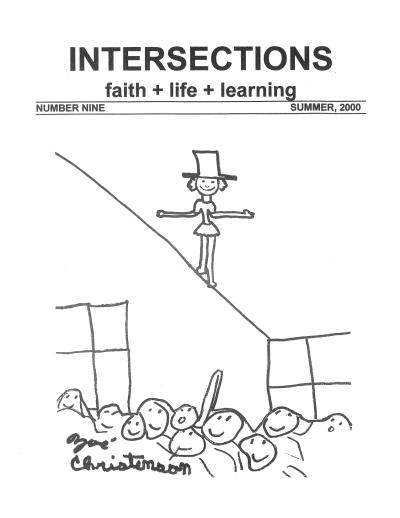
Christenson introduces a varied issue: the VonDohlen / Ratke discussion of the two kingdoms doctrine, Rachel Hammond’s “real gem” of a talk on her time in Ecuador (with an invitation to send contributions to the Home for Perpetual Hope orphanage via her home church in Oberlin, Ohio), Chuck Huff’s essay on the effect of liberal learning on the practice of psychology, and John Reumann’s reflection on a scholarly life lived between academy and church—and notes that the cover artist is his eight-year-old daughter Zoé, whose post-circus drawing of a balancing act struck him in light of Reumann’s opening line.
-
Response
Tat for Teat: Ratke Responds
David Ratke
Ratke, agreeing with much of VonDohlen’s critique but contending that VonDohlen misreads both Luther and the two-realms doctrine, marshals Luther’s To the Christian Nobility, On the Freedom of a Christian, Temporal Authority, Whether Soldiers Too Can Be Saved, and the “Sermon on Keeping Children in School,” along with Walther von Loewenich, to argue that Luther was well aware of structurally differentiated society, made no claim to a monistic epistemology, and intended the two-realms doctrine to combat—not introduce—dualistic bifurcation between sacred and secular. Our identity is “not as either Christian or academic, but as Christian and scholar.”
-
Reflection
Calling and Learning: On Losing and Then Finding Myself
Rachel Hammond
Hammond, a Capital University junior who spent two semesters studying in Guayaquil, Ecuador, recounts watching the sucre collapse from 10,500 to 29,000 per dollar between September and January, the overthrow of President Jamil Mahuad, the freezing of bank accounts over $4,000, the threatened eruption of the volcano at Baños, and her work at an orphanage that needed only $6.81 to feed a child for a month—and calls her fellow students, in light of Elie Wiesel’s warning that indifference is the enemy, to recognize their education as a gift and a responsibility to speak for those who cannot speak for themselves.
-
Article
Modeling Virtue: In Which a Social Psychologist Decides He Can Do Good Without Freely Choosing It
Chuck Huff
Huff, recalling his 1975 sophomore disillusionment with a sterile introductory psychology in South Georgia (and Danny Saunders’s question from The Chosen), defends a scientific psychology as model-making rather than meaning-finding, traces the collapse of Lawrence Kohlberg’s totalizing theory of moral development into chastened mini-theories, and presents William Damon and Anne Colby’s interview study of twenty-three “moral exemplars” whose lives were marked by self-good unity, constant self-examination in community, a felt inability to have done otherwise, religious grounding, and genuine happiness. Following Aristotle on virtue as learned habit and the Christian tradition of the “slave for Christ,” he concludes that goodness flows from the choice of constraints rather than from the lone free-will hero of fairy tales, complicating C. P. Snow’s two-cultures divide. Originally the 1998 Mellby Lecture at St. Olaf.
-
Article
Serving Two Masters: Teaching and Writing Between Academy and Church
John Reumann
Reumann reflects on more than fifty years navigating between academy and church—the Society of Biblical Literature and Exegesis (whose Doktorvater Morton Enslin was unceremoniously dumped at Toronto by “young Turks” Robert Funk and others, while Harry Orlinsky saved the day at the centennial), the 1978–1987 New American Bible Revised New Testament committee with its bishops, the U.S. Lutheran–Roman Catholic dialogue volume on “Righteousness,” and the 1999 Joint Declaration on Justification—and uses his Anchor Bible and Augsburg commentaries on Philippians, Colossians, and Romans to illustrate Krister Stendahl’s judgment that one can no longer master all the literature: epistolary research, rhetorical and discourse analysis, social-world readings, feminist scholarship on Euodia and Syntyche, the koinonia and friendship debates (Sampley, Fitzgerald, Witherington), and the house-church recovery of Filson. The academy is antepenultimate, the church penultimate, God ultimate—professors as “believers, testifiers, witnesses” serving pro bono, pro ecclesia, and pro Deo.
-
 Editorial
From the Publisher
Arne Selbyg
No. 19 · Summer 2004
Selbyg notes that while the primary source of articles for Intersections is the annual Vocation of a Lutheran College Conference, this issue draws on participants in the Lutheran Academy of Scholars in Higher Education, whose Lutheran Brotherhood and Lilly Endowment grants have been exhausted but which has been continued through DHES, the colleges, and especially St. Olaf’s release of DeAne Lagerquist to direct it. He draws attention to editor Tom Christenson’s new book The Gift and Task of Lutheran Higher Education (Augsburg Fortress).
-
 Article
Committed to Paradox
Caryn Riswold
No. 60 · Fall 2024
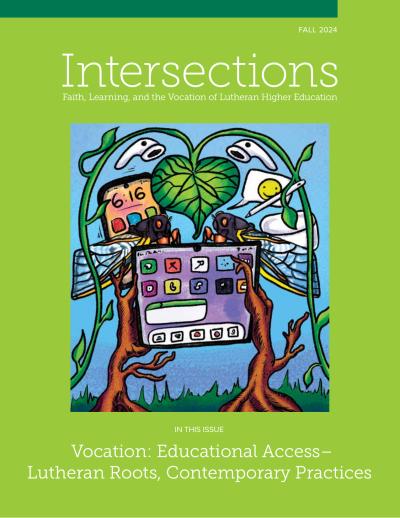
Riswold lifts up paradox — saint and sinner, lord and servant, Rooted and Open — as a distinctive Lutheran root that lets institutions honor the complicated truth of who their students are and embrace the messy, ever-reforming work of access and accessibility as a theology of the cross.
-
 Article
Community-Building On Campus and Beyond
Krista E. Hughes
No. 54 · Fall 2021
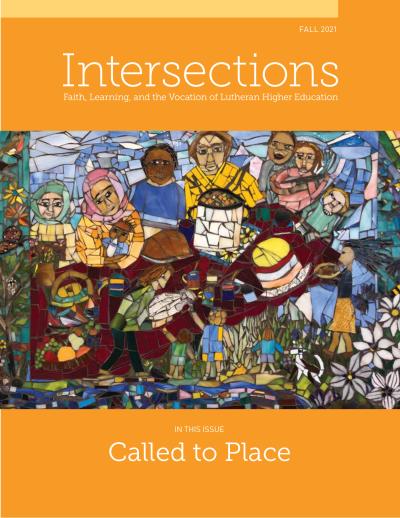
Hughes describes Newberry College’s effort to build a “culture of community” that mirrors South Carolina’s demographics while reckoning with the institution’s founding ties to slavery — and names the challenges and promising city-college collaborations that shape this ongoing work.
-
 Article
Staff Governance at St. Olaf College, Northfield, MN
Don Ezra Cruz Plemons
No. 58 · Fall 2023
Cruz Plemons describes how staff at St. Olaf, in the wake of a decade of difficult events, have built a three-year, glacier-paced effort toward a Staff Governance model — through affinity groups, the Council for Equity and Inclusion, and the Task Force to Confront Structural Racism — that gives staff a voice alongside faculty and students.
-
 Response
Response to Mark Wilhelm: Vocation—Wide Perspective Questions
Mary-Paula Cancienne
No. 56 · Fall 2022
Cancienne, drawing on Iain McGilchrist, asks whether higher education has prioritized micro lenses at the expense of the macro view, and invites educators to hold the drama of individual vocation stories within a wider plot that includes James Webb Telescope wonder, climate grief, the long shadow of enslavement, and the resilience of native populations.
-
 Reflection
David Kamins
David Kamins
No. 40 · Fall 2014
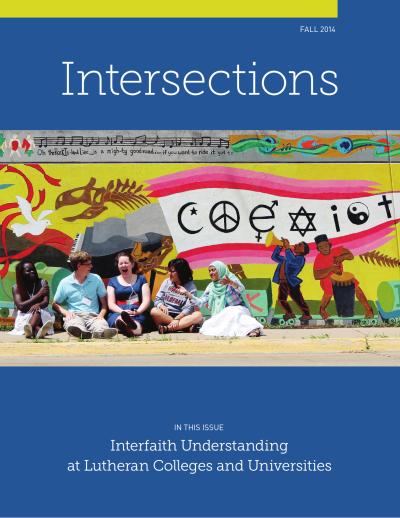
Kamins, a Jewish student at Muhlenberg College, reads Rabbi Joseph Soloveitchik’s The Lonely Man of Faith alongside his own journey at the Interfaith Understanding conference on the eve of Shavuot, finding in the dual figures of Adam I and Adam II a way to remain firmly grounded in his faith community while going out to learn from those around him.