We live in a culture which claims to take seriously the “doctrine” of separation of church and state. For many in our community, this concept is integral to our way of being religious in the world. We assume that this is “just the way things are” for us as Americans and Christians (and Lutherans).
We engage in lively debates about the role religion should play in our lives and in our public institutions. We wonder if the religious persuasion of our presidential candidates might have an effect on their performance in office. We debate if “wise-men scenes” should be allowed into the town square. Should a non-Christian be allowed to chair a religion department at one of our colleges? From a Lutheran perspective, what should be the role of our beliefs in relation to the culture? More pointedly, should our “Lutheranism” have any real effect on how we operate as “Lutheran colleges”? Or is this just a vestige of our pasts that for all practical purposes is best left to the side.
I suspect these questions would be strange to those whom we look to as founders—Martin Luther and Philip Melanchthon. We sometimes forget that they lived and taught in a world far removed from the ideas of “separation of church and state”—on the other side of interminable wars that led to the development of this concept. How did they imagine the relation of what they were doing within and to the culture around them? Specifically, how did they imagine the effect of their ideas on the educational practices and institutions of their day? A related question is whether our “Lutheranism” should have any discernable effect on how we identify ourselves among the institutions of high education today.
These are the issues addressed by the authors of the articles included in this issue. They clearly believe our “Lutheranism” does and should have an effect. Ernie Simmons and Sabine O’Hara outline some of the values that characterize our “Lutheran” institutions. Colleagues from Wartburg College reflect on how these values connect to practical life on the campus.
I wonder if we could (or should?) develop a list of “Lutheran” values that characterize our institutions. The first question might be to discover what would be on that list. If we were to develop a list of “Lutheran” values that characterize our institutions, what would be on that list? The articles in this issue would propose that Lutheran colleges take seriously…
- that the world and its problems are complex;
- that there is real evil in the world and within each of us;
- that suffering is a part of the human experience;
- that discourse within our community and beyond our community is crucial;
- that there are values that transcend the merely physical;
- that education must pay attention to place, including the world itself;
- that all institutions (including colleges) should be self critical;
- that lines that divide are often less important than those which unite.
Surely other values could be added to this list. As Simmons suggests, should “pursuing the common good” be added to that list? It is hard to imagine that anyone would argue too strenuously against that idea. But what would holding that value (or any of the values on this list) actually mean as we take seriously the practicalities of operating real institutions on our campuses? That question might lead to some very interesting conversations.
Upon entering this conversation we might find the list we developed is less significant than the conversation(s) that we had in developing the list—the process rather than the product might be that which characterizes us. But even that possibility raises questions. What sort of conversations should we be having? In what contexts? Who should be allowed into the conversation? Should some voices be privileged?
I challenge each of you to explore these issues on your campus…and I make the offer to provide this forum to share the results you achieve. This may be the place where the conversation you begin can continue in the larger community of Lutheran colleges and universities.
-
 Editorial
From the Publisher
Arne Selbyg
Selbyg notes that, while a stated purpose of Intersections over its twelve years and twenty-six issues has been the intersection of faith, learning, and teaching, surprisingly few articles have addressed how Lutheran faculty teach and why — and credits the editor for assembling essays from authors whose teaching has benefited from the ELCA Wittenberg Center, on the eve of the City of Wittenberg’s “Luther Decade” leading up to the 2017 Reformation anniversary.
-
Article
Lutheran Higher Education and the Public Intellectual
Ernest L. Simmons
Simmons argues that college faculty and administrators are, like it or not, public intellectuals, and that Lutheran higher education’s dialectical understanding of Christ and culture is well suited to support four functions of the public intellectual: articulating constructive critique of received social explanation (especially the “collage identity” described by Renate Schacht); presenting a transcendent theological perspective through the theology of the cross that takes seriously God’s hiddeness, the presence of ambiguity, and the reality of suffering; pursuing the common good amid the demise of the “commons” through H. Richard Niebuhr’s “Christ and Culture in Paradox”; and educating for citizenship through Christian vocation by connecting the practical and existential dimensions of the question “Why are you here?”
-
Article
The Vocation of a Lutheran College—Living the Legacy of the Reformation in the Twenty-first Century
Sabine U. O'Hara
O’Hara reflects on Luther’s understanding of education as Bildung — “becoming in the image of God” — through four key aspects: education must be relevant, education demands engagement with the community, education requires attention to place, and education demands engagement with the world. Drawing on her German upbringing, her work as president of Roanoke College, and on Darrell Jodock and Dietrich Bonhoeffer, she argues that Luther’s vision of a well-educated citizenry as the priesthood of all believers calls Lutheran colleges to messy, interdisciplinary, communal scholarship in service to the neighbor.
-
Article
Lutheran Heritage Across the Curriculum: Reflections from a Faculty/Staff Development Seminar
Cynthia Bane, Fred Waldstein, Kathryn A. Kleinhans, Penni Pier
Four Wartburg College colleagues share fruits of the 2006 Lilly-funded “Discovering and Claiming Our Callings” faculty/staff development seminar in Wittenberg, Eisenach, and Neuendettelsau. Kleinhans frames the curriculum and books used; Bane (psychology) finds Lutheran convictions about the value of humans, the affirmation of creation, and the universality of sin congruent with her discipline; Pier (communication arts) reads Luther as a model of dialectical rhetoric that gives educators permission to challenge students with uncomfortable ideas; and Waldstein (political science) reflects on the paradox of humility and self-confidence in Luther and on the Luther-Melanchthon collaboration as a model for the seminar group’s own work.
-
Article
No Child Left Behind Meets Philip Melanchthon: A Reflective Conversation
Kathy Book
Inspired by Tim Lull’s My Conversations with Martin Luther, Book imagines an interview with Philip Melanchthon in the cobblestone courtyard of the University of Wittenberg, in which the Praeceptor Germaniae reflects on his pedagogy (Socratic questioning, brevity and example, declamations, repetition, and interdisciplinary connections), his graded curriculum from primer to university, and his collaboration with Luther on the responsibility of community, parents, and government for the education of all children — and finds his vision strikingly resonant with the No Child Left Behind legislation of 2006.
-
Book Review
Reviews
Matthew J. Marohl
Marohl reviews two 2006 Lutheran University Press volumes from Grand View College (Des Moines, IA). Mark C. Mattes and Ronald R. Darge’s Imaging the Journey … of Contemplation, Meditation, Reflection, and Adventure pairs Mattes’s Lutheran meditations on seven themes (from a spirituality of communication to Alpha and Omega) with Darge’s photographs and Ronald Taylor’s short prayers, with Mattes’s writing on vocation singled out as the volume’s finest. The Grand View College Reader, edited by Mattes, Evan A. Thomas, Kathryn Pohlman Duffy, and Ronald Taylor, surveys the college’s Foundations, Creativity, and Vocation through chapters by Thorvald Hanson, Kenneth Sundet Jones, Kevin Gannon, Ammertte C. Deibert, Steven Snyder, and President Kent Henning, tracing Grand View’s Grundtvigian and Danish Lutheran roots.
-
 Book Review
Assessing the Value of Liberal Arts: A Review of The Evidence Liberal Arts Needs, by Richard A. Detweiler
Robert D. Haak
No. 55 · Spring 2022
Haak reviews Richard A. Detweiler’s The Evidence Liberal Arts Needs, in which the former president of the Great Lakes Colleges Association analyzes 240 college mission statements and interviews more than 1,000 graduates to argue that liberal arts educational experiences have a measurable impact on adult lives of consequence, inquiry, and accomplishment — and invites NECU institutions into a further conversation about how Detweiler’s methodology applies to Lutheran higher education.
-
 Article
The Vocation of Intersections on its Twentieth Birthday
Jason A. Mahn, Robert D. Haak, Tom Christenson
No. 43 · Spring 2016
The three editors of Intersections — Bob Haak, Jason Mahn, and Tom Christenson (in spirit, following his death in 2013) — trace the twenty-year vocation of the journal itself: its 1996 birth at Capital University; its coming-of-age years of debate over institutional markers, two-kingdoms theology, and Lutheran identity; the ascendancy of “education for vocation” as the central marker of Lutheran higher education; and its ongoing identity in relation to a changing ELCA and to the broader cultural conversation about purpose, wholeness, and the vocation of higher education.
-
 Editorial
From the Outgoing and Incoming Editors
Jason A. Mahn, Robert D. Haak
No. 34 · Fall 2011
Outgoing editor Robert D. Haak reflects on a six-year run inheriting Intersections from founder Tom Christenson, the “powerful voices” that have driven the conversation (Dovre, Jodock, Christenson, Simmons, Morgan, Olsen, Wilhelm) and the newer ones now entering (Mahn, Bussie); incoming editor Jason A. Mahn, picked up from the airport in Bob’s pickup truck five years ago, names central issues that “Lutherans on Faith and Learning” engages and previews essays by Dovre, Jodock, McDonald, Hill, Turnbull, and Jodock again.
-
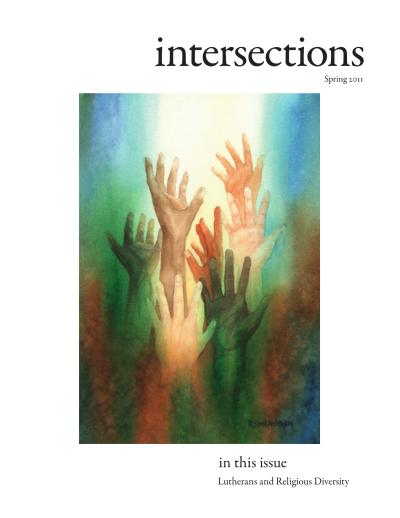 Editorial
From the Editor
Robert D. Haak
No. 33 · Spring 2011
Haak frames the issue by asking how Lutheran colleges and universities understand the changing landscape of religious identification on their campuses, and argues that Lutheran theological commitments — including the work of the Spirit and the Incarnation — call institutions to create places where the voice of “the other” is heard and valued.
-
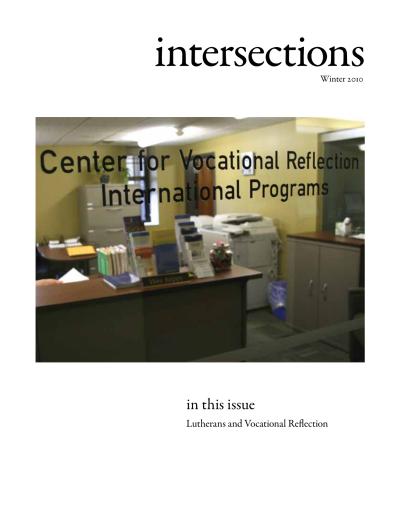 Article
Called to Serve
Robert D. Haak
No. 31 · Winter 2010
Haak describes Augustana’s Center for Vocational Reflection (CVR) and its threefold framework of skills/gifts/talents, passions/values, and needs of the community. He surveys the CVR’s Working with Faith group, seminary visits, spiritual companioning, Servant Leader Internships, international travel reflection, and the major Senior Inquiry curriculum revision—then reports the lessons learned at Augustana: that multiple exposures matter more than any single program, that the language of vocation works even for non-religious students, that student-initiated ideas (like Erin Blecha’s Athletes Giving Back) often succeed most, and that the CVR will soon merge into a new Community Engagement Center.
-
 Editorial
From the Editor
Robert D. Haak
No. 30 · Fall 2009
Haak frames the issue around the question of Lutheran college identity as formed in distinction from some “other,” introducing essays by Witherup on the Joint Declaration, Reuther on Holden Village, Afzaal on Christian-Muslim dialogue, Dovre on the history of Midwestern Lutheran colleges, Radecke on service-learning, and Ratke on Wilhelm Löhe — each making the claim that the “other” is an essential partner in conversation who helps us know who we are and shape who we will become.
-
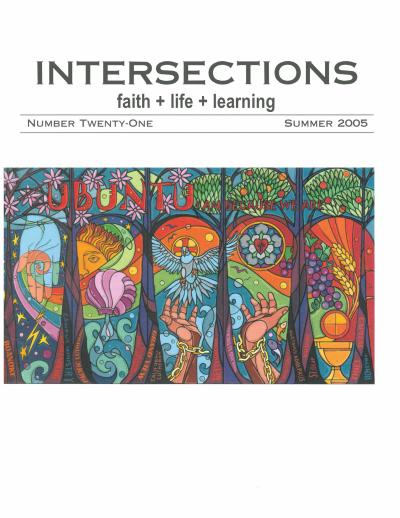 Article
The Church in Education? Education in the Church? Ten Theses on Why These Questions Matter
Leonard G. Schulze
No. 21 · Summer 2005
Writing in the months before the August 2005 Churchwide Assembly that will decommission DHES, Schulze frames his vision for the division as ten Lutheran-style theses, each followed by Luther’s catechetical question “What does this mean?” He argues that critical thinking and moral deliberation are in the Lutheran gene pool; that Luther’s devotion to learning was an expression of Christian vocation; that the rise of the research university and the binary public meaning of “evangelical” have marginalized church-related colleges; that DHES has been wrongly perceived as marginal; and that the reformed concept of vocation must drive the soon-to-be-created program unit for Vocation and Education. An appendix reproduces the 2005 DHES strategic planning overview.
-
 Reflection
Colleges Lead Way: Curiosity, Faith, Discernment, Mission are Key
Mark S. Hanson
No. 28 · Fall 2008
Reprinted from The Lutheran (November 2007), Hanson names four marks of the colleges of this church—nurturing unquenchable curiosity, nourishing faith formation and exploration, modeling public moral deliberation, and preparing students for engagement in the world—and gives thanks for the colleges’ vocation to call us to stand outside ourselves and reach out in mission for the sake of the world.
-
 Article
A River Runs Through It: CLU as a Church-Related University
A. Joseph Everson
No. 12 · Summer 2001
Everson borrows Norman Maclean’s A River Runs Through It and the small creek that flows through California Lutheran University’s Kingsman Park as images for the quiet stream of Christian tradition on campus, describes the dialectic of faith and reason (with a “Lord of Life” student congregation, two required religion courses, and a voluntary Wednesday chapel) as the “theology of paradox” that runs from Luther’s simul justus et peccator through Richard Solberg and Richard Hughes, and names six commitments that constitute the CLU ethos—academic freedom (Jeremiah 29:7 and John 8:32), vocation, service (Amos and Habitat for Humanity), grace and graciousness (Portia’s “quality of mercy” speech from The Merchant of Venice), diversity, and reverence (Proverbs 9 as awe and wonder).
-
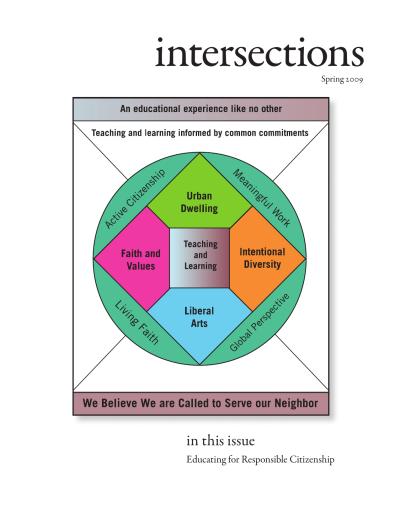 Article
Dual Citizenship: Reflections on Educating Citizens at Augsburg College
Paul C. Pribbenow
No. 29 · Spring 2009
Pribbenow argues that the vocation of Augsburg College is to educate “dual citizens”—those able to live within the messiness of common work rather than resolve every tension once and for all. Drawing on John Courtney Murray on democracy as “the intersection of conspiracies,” Bill Moyers, Jean Bethke Elshtain, Stephen Carter, and the Augsburg vision statement “We believe we are called to serve our neighbor,” he names four common commitments and five principles of civic education that ground Augsburg’s incarnational mission in its city neighborhood.
-
 Article
Sojourners in a Pluralistic Land: The Promise and Peril of Christian Higher Education
Randall Balmer
No. 25 · Spring 2007
Balmer, a Barnard scholar of American evangelicalism reared in evangelical parsonages and formed at Trinity College in the Chicago suburbs, defends public education even as he champions Christian higher education as a “halfway house” for students moving from religious subculture into a pluralistic world. Drawing on his own undergraduate experience, his books Mine Eyes Have Seen the Glory and Thy Kingdom Come, and a chastening visit to Patrick Henry College, he names three perils of Christian higher education—the Scylla of secularism (intellectual arrogance allergic to piety), the Charybdis of sectarianism (intellectual dishonesty as exemplified by intelligent design’s special pleading), and insularity—and prescribes mentors, primary sources, internships outside the subculture, and a broader, intergenerational pluralism on campus.
-
 Article
Women Presidents in Higher Education: How They Experience Their Calling
Aimee Goldschmidt, Gary McLean, Katherine A. Tunheim
No. 42 · Fall 2015
Drawing on in-depth interviews with fifteen women college presidents and a transformative-learning-theory framework, Tunheim, McLean, and Goldschmidt trace a three-stage journey — identifying, interpreting, and pursuing the call — and ask what the language of vocation contributes to the preparation and mentoring of women leaders in higher education.