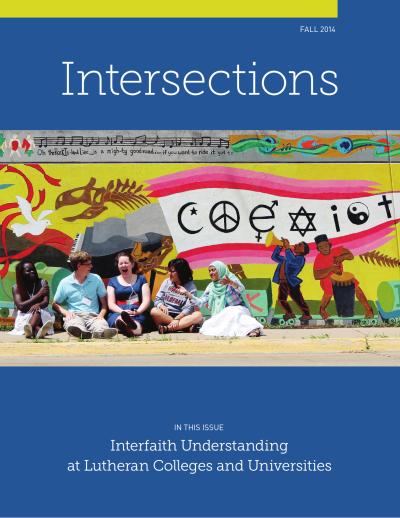
Not that long ago, few would have considered the promotion of interfaith understanding as a central feature of Lutheran higher education. We had buried the important implications of the gospel for the work of interfaith understanding in the same way we had once buried the implications of the doctrine of vocation for our mission.
The parallels between the rise of a renewed interest in vocational reflection on our campuses and the more recent emphasis on interfaith understanding are remarkable. Both have occurred in the context of a wider engagement with the topics (you will have to trust me about the popularity of the theme of vocational reflection in larger circles if you are unaware of it; the wider interest in interfaith matters is well known). Both have had the support of nationally influential agencies (the Lilly Endowment and now the Council of Independent Colleges for vocation; the Interfaith Youth Core and Federal Education Department for interfaith work). And both the themes of vocation and interfaith understanding have pushed Lutheran higher education leaders to rediscover rich resources in the Lutheran intellectual tradition long overlooked.
The work of unpacking the Lutheran tradition for the work of both vocational reflection and interfaith understanding also occurred intermittently, with ups-and-downs for both. Here I will only remind readers about the ups-and-downs of interest in interfaith work. Tensions in the Middle East of the 1960s and 70s and the rise of OPEC, as well as the opening of the United States to new immigration, led to a spate of interest in interreligious work, which continued into the early 1990s. Interest dissipated or at least seemed less urgent to many after the First Gulf War. Then 9/11 occurred, an awareness of a new multi-religious America increased, and global engagement and international student enrollment expanded significantly on our campuses. Interest in interfaith study and understanding was here to stay.
Since then we have been discovering that Lutheran higher education should have always been involved in interfaith understanding work, and how previously under-emphasized aspects of the Lutheran tradition point us to the work of interfaith understanding. We are learning again what Florence Amamoto, then assistant professor in Gustavus Adolphus College’s English department, wrote in the Summer 1996 issue of Intersections, “I know from experience that being Buddhist at a Lutheran College has not only taught me more about Lutheranism but has deepened my knowledge of and my faith in my own religion.” (Thanks to our editor, Jason Mahn, for pointing me to this quotation.) Even more, we are learning again how the Lutheran tradition compels us to teach that an educated person will honor, serve, speak well of and understand the faith of others, no matter what their religion—or lack of religion. The presentations in this issue of Intersections, from Augustana (IL) College’s June 2014 conference for our campuses, provide the reader with the state of the growing engagement of interfaith work in the ELCA college and university network. We are learning that—and this issue describes how—an authentic Lutheran college or university will make interfaith understanding a feature of its mission.
-
 Editorial
Guest Editorial
Kristen Glass Perez, Richard Priggie
Glass Perez and Priggie introduce the issue by recounting the campus conversations and the June 2014 Interfaith Understanding Conference at Augustana College that gave rise to it, framing the central question, “What does it mean to be Interfaith at a Lutheran College?,” as a living example of the praxis of being a Lutheran college in the twenty-first century.
-
Article
Vocational Re-Formation for a Multi-Religious World
Elizabeth Eaton
ELCA Presiding Bishop Elizabeth Eaton frames vocational formation for a multi-religious world as one of the most significant challenges facing the church and the liberal arts today, calling ELCA colleges and universities to live into Darrell Jodock’s “third path” that is both deeply rooted and dialogical.
-
Article
Why Interfaith Understanding is Integral to the Lutheran Tradition
Jason A. Mahn
Mahn returns to the root of the Lutheran tradition — church, theology, and pedagogy — to argue that interfaith encounter is not the vanishing point of Lutheran identity but central to it, beginning with confession of Luther’s anti-Judaic legacy, working through the typology of exclusivism / inclusivism / pluralism, and showing how the kenotic Christ and the theologian of the cross open Lutherans to authentic encounter with religious others.
-
Article
What it Means to Build the Bridge: Identity and Diversity at ELCA Colleges
Eboo Patel
Through the contrasting stories of two college students — Cassie’s identity relativism and April’s soft fundamentalism — Patel diagnoses Peter Berger’s twin pathologies of modernization and argues that ELCA campuses, anchored in Bonhoeffer and the Lutheran capacity to “have faith without laying claim to certainty,” are uniquely equipped to be places where the light falls: bridges of cooperation that nurture both strong religious identity and benevolence toward others.
-
Reflection
Danya Tazyeen
Danya Tazyeen
Tazyeen, a Pakistani-American Muslim student at Augustana College, reads Qur’an 49:13 — that God made us into peoples and tribes “that you may know one another” — as a charge to break down fear with open dialogue and to see one another as flawed and relatable fellow human beings.
-
Article
Building on a Firm Foundation: ELCA Inter-Religious Relations
Kathryn M. Lohre
Lohre traces the ELCA’s twenty-year arc of inter-religious work — from the 1994 Declaration to the Jewish Community and the Lutheran-Jewish Consultative Panel, through the post-9/11 Lutheran-Muslim Panel and the Shoulder to Shoulder Campaign, to fledgling dialogue with Sikhs and the dharmic traditions — and frames Lutheran inter-religious engagement as the strengthening, not the dilution, of Lutheran vocation.
-
Article
Building an Interfaith Bridge
Belle Michael
Drawing on the holiday of Shavuot, the Book of Ruth, and Martin Buber’s I-Thou, Rabbi Belle Michael picks up Patel’s bridge metaphor and identifies three building blocks for it: experiences with people of different ethnic and religious groups, genuine and long-lasting relationships, and the holy curiosity to ask the questions we are otherwise afraid to ask.
-
Reflection
Gifty Arthur
Gifty Arthur
Reading John 10:3 as a Ghanaian Christian student at Luther College, Arthur reflects on how Luther’s Journey Conversations have deepened her own spirituality precisely by giving room for students to share the personal experiences and beliefs at the center of their own traditions.
-
Article
Journey Toward Pluralism: Reimagining Lutheran Identity in a Changing World
Jacqueline Bussie
Bussie chronicles Concordia College’s Forum on Faith and Life initiative — assessing campus climate, building a President’s Interfaith Advisory Council, and drafting a one-sentence statement that Concordia practices interfaith cooperation “because of” (not “guided by”) its Lutheran identity — to argue that simul justus et peccator thinking equips Lutheran institutions to hold loyalty to tradition and reverence for others together as one piece.
-
Reflection
David Kamins
David Kamins
Kamins, a Jewish student at Muhlenberg College, reads Rabbi Joseph Soloveitchik’s The Lonely Man of Faith alongside his own journey at the Interfaith Understanding conference on the eve of Shavuot, finding in the dual figures of Adam I and Adam II a way to remain firmly grounded in his faith community while going out to learn from those around him.
-
Article
What's in a Name?
Matthew J. Marohl
St. Olaf College Pastor Matt Marohl tells the story of designing The Undercroft’s prayer and meditation room with a campus meditation group whose members began as “Matt” and ended — as their mutual respect grew — calling him “Pastor Matt,” a counterintuitive movement toward a more formal address that signals what intentional Lutheran-Christian hospitality looks like in practice.
-
Reflection
Annie Schone
Annie Schone
Schone, raised in a small conservative Central Illinois congregation, recounts how Augustana’s Interfaith Understanding group and Interfaith Youth Core gave her the first chance to befriend Muslim, Unitarian Universalist, and atheist peers, and how she hopes to bring the joy of those friendships back to her home church through the power of storytelling.
-
Article
Journey Conversations
Amy Zalik Larson, Sheila Radford-Hill
Larson and Radford-Hill describe Luther College’s Journey Conversations Project, a four-phase contemplative practice — quiet, listen, speak, respond — rooted in the Lutheran call to be true to one’s own faith while welcoming all faiths or none, and illustrate its fruit through faith journey stories from Luther students Sukeji Mikaya (South Sudan), Habibullah Rezai (Afghanistan), and Gifty Arthur (Ghana).
-
Reflection
Tom Natalini
Tom Natalini
Natalini, a Susquehanna University senior raised Lutheran, schooled Mennonite, and seasoned by a meditative encounter in India, reflects on his journey through churchgoing, philosophy, near-Jewish conversion, and Buddhist practice to a stance he calls patience — neither Christian, Jew, Buddhist, seeker, nor “none.”
-
Article
Well, Well…Plumbing Our Depths, Telling Our Stories
Ann Boaden
Beginning with a college visit that turned into a grieving mother’s confidence about her daughter’s last moments, Boaden uses John 4’s well of living water to argue that an interfaith education worthy of the name requires Lutherans to plumb the depths of their own tradition’s wells — with rituals, stories, and seasons intact — before they can see, respectfully, into the wells from which others drink.
-
 Article
Why All This Talk About Understanding the Mission of NECU Member Institutions as a Vocation?
Mark Wilhelm
No. 56 · Fall 2022
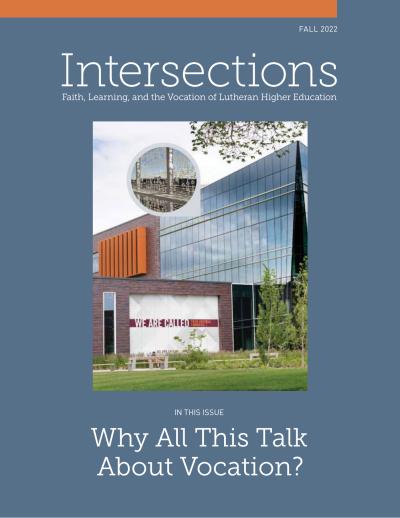
In his valedictory keynote, retiring NECU Executive Director Mark Wilhelm argues that Lutheran higher education is, properly understood, vocation-based education — outlining four core practices recovered over the past fifty years and naming the constructive and corrective work still to be done, including a fuller embrace of DEIJ and of the diverse vocations of NECU’s 27 institutions.
-
 Editorial
From the Publisher
Mark Wilhelm
No. 55 · Spring 2022
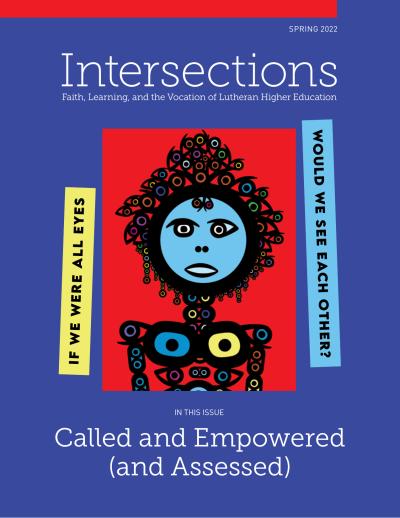
Wilhelm announces his planned retirement on January 31, 2023, after serving as the founding executive director of the Network of ELCA Colleges and Universities, and gives thanks for the privilege of helping NECU articulate a shared vision for Lutheran higher education in twenty-first-century North America.
-
 Editorial
From the Publisher
Mark Wilhelm
No. 53 · Spring 2021
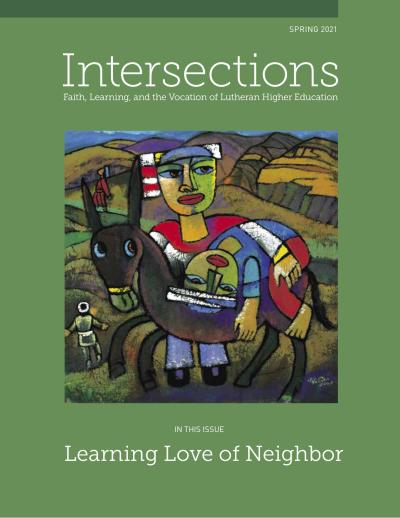
Wilhelm reflects on an NPR report of teenagers’ pandemic diaries and the fraught Christian history of struggling to live out Jesus’s ethic of love, framing the issue as a record of NECU institutions working out how to act for the common good through the pandemic of 2020–2021.
-
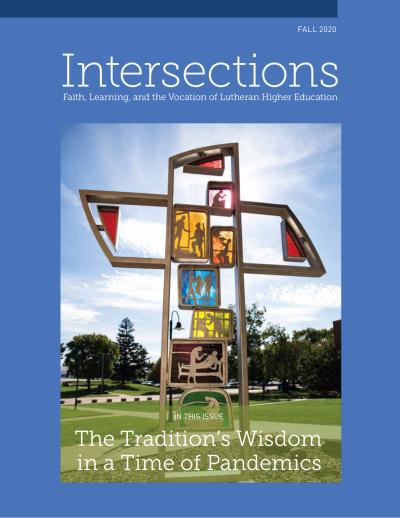 Editorial
From the Publisher
Mark Wilhelm
No. 52 · Fall 2020
Wilhelm argues that the “hackneyed” expressions of higher education — “you are not just a number,” “the college experience,” “risen to the challenge” — tell the simple truth about NECU institutions even as the Covid-19 pandemic has pushed budgets, employees, and campus life to the breaking point.
-
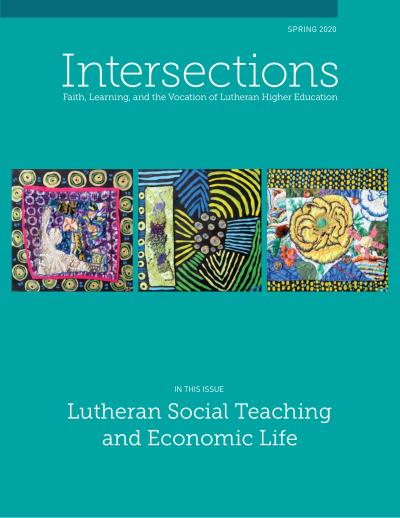 Editorial
From the Publisher
Mark Wilhelm
No. 51 · Spring 2020
Wilhelm frames the issue by tracing how Lutheran educational ideals — once a primary source of contemporary higher education — were masked in the United States, and introduces a NECU initiative that uses the case of business ethics to explore Lutheran social teaching as an academic resource.
-
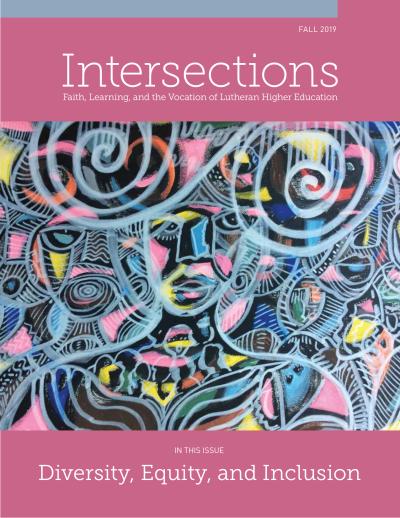 Editorial
From the Publisher
Mark Wilhelm
No. 50 · Fall 2019
Wilhelm frames the issue by noting that a federal court’s vindication of Harvard’s race-conscious admissions process is a win for higher education’s commitments to diversity, equity, and inclusion — and argues that for Lutheran higher education, the commitment to diversity is an old and foundational claim, rooted in Christianity’s openness to all and reflected in the four diverse gospels of the New Testament.
-
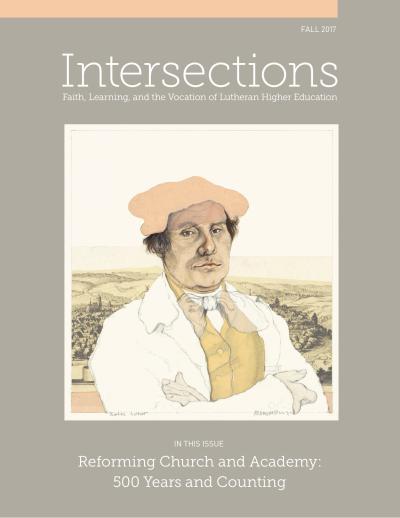 Article
Both Priest and Beggar: Luther among the Poor
Martha E. Stortz
No. 46 · Fall 2017
Reading Luther’s deathbed remark “We are all beggars” against his “priesthood of all believers,” Stortz argues that priest and beggar are two sides of a human reality — one that locates civic responsibility for the poor at the heart of the Reformation legacy and that pushes beyond paternalistic service toward the systemic question of justice.
-
 Response
Response to Robert Benne
Baird Tipson
No. 17 · Summer 2003
Tipson responds to Robert Benne’s comments in the previous issue about his review essay of The Future of Religious Colleges, affirming their fundamental agreement that the Enlightenment epistemology dominant in higher education poses the most serious threat to the vitality of Lutheran colleges. Using the example of lecturing on early Mormon history and the Book of Mormon, he concedes that the methodological “solvent” of Enlightenment historiography acts on Christian as well as Mormon faith claims, and concludes that while H. Richard Niebuhr’s “inner” and “outer” history and Walter Brueggemann’s approach in The Theology of the Old Testament are comforting to believers, they do not offer an epistemology that can stand alongside the Enlightenment model in evaluating truth claims in the academy.
-
 Reflection
Saving Minds
Lake Lambert
No. 28 · Fall 2008
In a sermon preached in the Castle Church in Wittenberg during Wartburg College’s 2006 faculty and staff development seminar, Lambert names two sins of the mind—coveting and mental sloth (in both its rigid refusal to think and its mindless relativism)—and, drawing on Luther’s Large Catechism and Martin Luther King, Jr.’s “A Tough Mind and a Tender Heart,” calls Christians to receive the wisdom that comes when faith puts knowledge into action, sustained by the hope of the resurrection.
-
 Reflection
“Miracles are no longer required”—Life Writing as a Healing Tool
Barbara Reul
No. 57 · Spring 2023
A music historian and cancer survivor chronicles how a uterine cancer diagnosis in the early months of the COVID-19 pandemic disrupted her vocation as a university professor, and how writing two open-access memoirs became an unexpected tool for healing body, mind, and soul.
-
 Editorial
From the Publisher
Mark Wilhelm
No. 33 · Spring 2011
Wilhelm notes that while the ELCA’s vocation in higher education remains vibrant, the landscape of churchwide leadership has shifted dramatically with the dissolution of the Vocation and Education unit, and expresses appreciation for the faculty and staff at ELCA colleges and universities who have stepped up to sustain the network during this time of transition.
-
 Editorial
From the Publisher
Mark Wilhelm
No. 34 · Fall 2011
Wilhelm bids farewell to Robert D. Haak, who is leaving the editorship of Intersections and the Augustana College Center for Vocational Reflection for a chief-academic-officer post at Hiram College in Ohio, and welcomes Jason A. Mahn as the incoming editor. He celebrates Haak’s tireless work to integrate the Lutheran concept of vocation into the practices and rhetoric of Augustana and ELCA higher education through six years of Intersections, and frames the journal as a vital tool for sustaining the conversation about education in a Lutheran key—even at colleges and universities where most students, faculty, and staff are not Lutheran themselves.