The Vocation of a Lutheran College—Living the Legacy of the Reformation in the Twenty-first Century
Intersections No. 26 · Fall 2007
I am both honored and humbled, and must confess, a bit nervous as well to be asked to address this assembly. And I am wondering what I was thinking when I said “yes” to your kind invitation to address all these Lutheran pastors on the topic of the Vocation of a Lutheran College, given my own academic background in economics and not in theology or history or education. But here I am, and if all of you are wondering what an economist might have to say about Lutheran higher education and why this topic is so close to my heart, let me share just a few comments by way of introduction.
I was born and raised in Germany and my earliest childhood memories are inseparably linked to our church, St. Paul’s Lutheran Church in Kornwestheim, a small farming town, now a suburban community, just north of Stuttgart in the southwestern part of Germany. I was the oldest of three and my dad had his own business—heating and air conditioning systems. Since my mother was quite occupied with my two younger siblings and my dad had a family business to run, I spent a lot of time with my grandmother, my mother’s mother. My grandmother was single-handedly responsible for my faith formation as a child. She sang through the Lutheran hymnal with me from front to back and back to the front; she taught me to knit and crochet for the church bazaar; she took me to the children’s choir at age five and to Sunday School; and there was never a meal at our house or a bed time when we didn’t say our prayers.
But that’s not all. As a student in the German public school system, I was required to take religion as a school subject from grade one through grade thirteen; and in good Lutheran fashion we also had two years of confirmation classes. So you see, after thirteen years of Lutheran religion, plus Sunday School, plus confirmation classes, plus my grandmother, I was steeped in Lutheran theology and religion and I could recite all kinds of things from the confession of faith, to the small and large catechisms, to various psalms and, of course, the Christmas story in the gospel of Luke—Luther’s translation of course; that’s the real thing, not King James: “Es begab sich aber zu der Zeit dass ein Gebot von dem Kaiser Augustus ausging, dass alle Welt geschaetzet wuerde….” You see, I still know it.
But how is it possible, you might ask, that Lutheran religion is taught in the public schools, and for thirteen years no less? The answer is simple. For Luther, the reformation of the church and the reformation of the education system were inseparably linked. For us Lutherans—the church and education, faith and reason, values and facts—have been connected from the very beginning. There is no need for us to make the case for the existence of a college of the church; we have always existed together, we have always been connected. After all, Dr. Martin Luther was a pastor and a university teacher. He was a professor of theology at the University of Wittenberg. Teaching was as much a part of his ministry as preaching. According to Luther, the Reformation demanded that people are well educated. The Reformation ideal of the priesthood of all believers argues that grace is indeed sufficient unto itself and that the priest is not needed as an intermediary between God and God’s people. This understanding demands that ordinary people are able to read, interpret and communicate the scriptures. To be the priesthood of all believers, people needed to be knowledgeable in the languages. They needed to be free thinking people trained in reading, writing, analysis, critical thinking and reasoning skills; people familiar with history, the arts, music, and, of course, theology. In other words, the reformation ideal was built on the very foundation of a well educated general public that could think freely and advance society.
And what exactly did being well-educated mean for Luther? What was the purpose, the mission, of education and why did Luther think of education as such as vital part of his mission? And what is our mission today as a college of the Lutheran church? I want to try to answer these questions by reflecting with you on four key aspects of Luther’s understanding of education. I will also share with you some examples of how these four key aspects influence our work as a college in the twenty-first century.
Key aspects of Luther’s understanding of education are:
- Education must be relevant!
- Education demands engagement with the community
- Education requires attention to place
- Education demands engagement with the world
Education Must Be Relevant!
The model of education that Luther had in mind when he called for a well educated general public is translated with the German word Bildung. Bildung literally means “becoming in the image of God” (Bild = image or picture; -ung is a process ending). This kind of Bildung/education is quite similar to what we here in the United States mean by a good liberal arts education. Bildung aspires to give students a solid education drawing on the accepted cannon of knowledge, which in Luther’s time came from the Greeks. It consisted of the basic arts (the trivium of grammar, logic and rhetoric) and advanced arts (the quadrivium of arithmetic, music, geometry and astronomy). Yet this kind of education was only available to the nobility and to the cloisters, not to the general public. Bildung stood in contrast to another type of education, namely Erziehung. Erziehung refers to the education that takes place in the home, education as bringing up a child right, as educating children in the proper ways and customs, including those of the trades, the guild systems (Stände). This kind of education was passed down from generation to generation. Luther argued that there is certainly nothing wrong with the Erziehung kind of education, but education had to mean more than that.
Luther aspired to an education that would bring about the educated public that could be the priesthood of all believers—the kind of education that could bring about progress and reform such as the translation of the scriptures into the vernacular German, Gutenberg’s printing press, access to reading materials for all people and not just for the learned clerics and aristocrats. That kind of education had to be more than what took place in the families and in the guilds. The Luther scholar Darrell Jodock draws the parallel between Luther’s Bildung and the liberal arts education of the American colleges.
The liberal arts are those studies which set the student free–free from prejudice and misplaced loyalties and free for service, wise decision making, community leadership, and responsible living…. Such an education endeavors to wean students (and their teachers!) from their comfortable, uncritical allegiance to social assumptions and to entice them into both an intense curiosity regarding the world beyond their own experience and an intense desire to make their corner of the globe a better place in which to live…. The objective is not merely to “meet the needs of the students” nor to “help them achieve their own goals;” the objective is to set them free–free “from” and free “for.” (25)
And as advanced as the educational role of the family and the guild systems may have been, Luther was skeptical of their ability to meet the educational needs required for advancing his vision of a free thinking and progressive society. Education, he felt, had to take place in schools and was needed in addition to the training provided in the trades and in the home.
Even when the training is done to perfection and succeeds, the net result is little more than a certain enforced outward respectability; underneath they are nothing but the same blockheads, unable to converse intelligently on any subject, or to assist or counsel anyone. But if children were instructed and trained in schools, or wherever learned and well-trained schoolmasters and schoolmistresses were available to teach the languages, the other arts, and history, they would then hear of the doings and sayings of the entire world, and how things went with various cities, kingdoms, princes, men and women. Thus, they could… gain from history the knowledge and understanding of what to seek and what to avoid in this outward life, and be able to advise and direct others accordingly. (725-26)
Education, you see was nothing abstract for Luther. It was never acceptable to curtail it to the so-called ivory tower; education had to be relevant, relevant to society, relevant to the world, relevant to God’s people, relevant to bringing about God’s kingdom even now! There is no room here for an “ignorance is bliss” attitude. That would just be plain laziness in Luther’s eyes. We must always challenge ourselves to learn more, always press on, always feel a sense of restlessness! And there is certainly no room either for some kind of intellectual elitism. Learning for the sheer passion and joy of learning, yes, but learning as intellectual elitism that just advances the ambitions and status of a select few? No! Luther’s understanding of education as Bildung implies learning for an expressed purpose, learning for service, for engaged citizenship, for progress in a world where the body of knowledge is constantly changing and expanding. For Luther, education must make a difference! That is what the issue of the indulgences was all about, which formed the core of what Luther addressed in his theses nailed to the church door in Wittenberg. This was a theological issue, for sure, and it was a social issue, and an economic issue, and a political issue and an international issue and an issue of justice! You see, relevant issues have this inevitable and unfortunate tendency of being messy and interdisciplinary and complex. They are not easily contained in one academic subject area. They cross definitions of human boundaries. They are multilayered and require the ability to recognize complexity and think connectively and integrate different fields. After all, relevant issues are so messy and complex because the world in which we live is like this—it is complex and interdisciplinary and messy—and it never fits into our limited human definitions and categories. For education to be relevant it cannot be content with simplistic knowledge. It must wrestle with the complexities of our world, must wrestle with the different ways of knowing that the disciplines teach us and it must wrestle with the virtues of knowing that often transcend individual disciplines. That’s what Luther meant by a good education. And how does one go about learning about and wrestling with these complex issues? It most certainly takes a solid foundation of knowledge. But it also takes a constant questioning of our knowledge.
“For Luther, education must make a difference!”
Education Demands Engagement with the Community
The community of learners, the campus community, the college community—this is how we frequently refer to Roanoke College; and you will find a lot of reference to “community” across higher education. Community is also a concept that strongly influenced Luther’s understanding of education. After all, how do we wrestle with the relevant issues and the complexities of our world? How do we find out what to do about them? How do we discern God’s call and will? For Luther, the answer was clear: by engaging with the community of learners; by exchanging opinions and perceptions and worldviews and assumptions; by debating issues thoroughly.
Simply put, for Luther the discovery, discernment, and learning process of education was about debate. Scholarship—the discovery, integration, and thoughtful application of knowledge—is about what we understand to be true about our world, about human experience and culture, and about that which transcends both and which always remains a mystery.1 Our human understanding is always partial, always subject to reconsideration, and always prone to error. We affirm this even today in our peer review process where we expose our work as scholars to the critique of other scholars. Scholarship, therefore, is often intensely personal, but it is never private. It is always a community process. Luther was actually very critical of secular models of education that were based on an individualistic understanding of rationality and on the segmentation of knowledge into discrete fields. These secular and individualistic models of rationality became later associated with the Enlightenment ideal that is still prevalent in our institutions of higher learning today. But Luther considered the individualism and “I-centeredness” of such models of learning to be self-absorption and incompatible with Christian teaching. For Luther, education was rooted in debate and thus it inevitably had a community dimension. The whole purpose of the well-educated citizenry was to enable people to take up their calling, to discern their vocation, to find their passion by finding their place within the community and by identifying the contributions each one could make to the common good. Just as the aim of a good American liberal arts education was to educate young men and women to become engaged and community-minded citizens, so Luther’s aim was to educate young men and women for service to society. To discern one’s calling, one’s vocation is what education was all about. Berufung—the German word for vocation—means literally “being called” and it forms the root for the German word Beruf, which means “job” or “profession.”
This is by no means a feel-good thing. Discovering and following one’s calling is work. One must be prepared for service, prepared by honing skills and intellectual capacities, prepared by being able to articulate ones position and to be in communication with others, prepared to be challenged and to test one’s call. This is precisely what Luther’s act of nailing the theses on the church doors in Wittenberg was all about. He issued an invitation to debate. He felt compelled to debate the relevant issues of his time and his place. He wanted to test in a public debate and in the exchange with the community where his calling would lead him. He wanted to engage the church, scholars, councilmen, and even the public in his community debate. Education, wrestling with the complexities of our world, was a communal act for Luther. It was an act that required rigorous study, the willingness to take a stance, the openness to rethink and argue and refine one’s perceptions and positions.
“The whole purpose of the well-educated citizenry was to enable people to take up their calling.”
And how sad it is that this kind of community engagement and debate is so absent from our society today! We have lost our public space for engaged public debate. Too many young people today are used to debating things talk-show style, in sound bites, where we call each other names and put each other down. They are more used to video games than dinner conversations. They are more used to television talk shows than to talking face to face, and many no longer know how to make eye contact. And how do we think we will be functioning as a democracy if we no longer teach engagement with the community and debate and the ability to openly and passionately discuss relevant issues of our time? Democracy has to be learned and practiced! It doesn’t just happen. To quote Thomas Jefferson: “If a nation expects to be ignorant and free…it expects what never was and what never will be.” I think Martin Luther would have agreed.
And the more diverse this community is, the better. Luther was way ahead of his time in terms of including voices typically left at the margin. Not only did he feel it was unacceptable that only the aristocrats and clergy received a formal education, he explicitly mentioned schoolmasters and schoolmistresses in his letter to the councilmen of the German cities (cited above). He demanded a formal school education for boys and for girls. Luther wrote, “…for the sake of the Scriptures and of God, this one consideration alone would be sufficient to justify the establishment everywhere of the very best schools for both boys and girls” (725). This was nothing less than revolutionary. Girls in the fifteenth and sixteenth centuries rarely received an education.2 Yet according to Luther, the important role women played in the family and in childrearing made it essential that they were well educated themselves. Luther’s vision also offers women a role as educators and as active participants in the public sphere beyond house and home. Yet whatever the make up of the community, Luther’s understanding of education is firmly rooted in a commitment to debate and even to the inevitable tension and dialectic that accompanies such a debate. It is the community that challenges us to continue to learn and grow; and it is the community that challenges our understanding of what is true about the world, our human experience and culture, and about that which transcends both.
Education Requires Attention to Place
Space is a most interesting concept. It may be so intriguing at least in part because our understanding of space varies so much with our cultural roots and origins. We Americans think a lot about space and we think about it predominantly as private space. We like our privacy and we need a lot of it. Gone are the close neighbors and front porches. We want big houses with a lot of private space, garages rather than porches out front and barriers around our yard so that others can’t look in. Conversations about space are also a big topic on a college campus. At a residential college like Roanoke, students live in close proximity to each other. Our first year students and many of our sophomores share a room. That is quite an adjustment since only about one-percent of our students have shared a room with a sibling at home.
Common space can be another challenge on a college campus. Just look at our public parks, our neighborhood hangouts, our sidewalks and streets and you know that these public spaces are not exactly well cared for. A very common notion seems to be that if it’s not mine, I don’t need to take care of it; why should I? We believe in private space and private property, and we often don’t quite know what to make of public space and communal property. And yet, the experience of living together with a roommate and with others in close proximity, the experience of sharing a living room and study area, sharing meals together, sitting and talking late in the common areas around campus, sitting outside under the trees with a guitar—these experiences change people. As a matter of fact, some of you have told me how much you enjoy being on our campus and how nice it is to experience the sense of community and beauty that emanates from this campus and from the beautiful mountains surrounding it. That space has something to do with how we feel and how we interact with each other is true today as it was in Luther’s time. Luther understood the importance of space. He gathered his students around the dinner table for his famous Table Talks; he invited them to his home for conversation and for readings. Often students actually lived with their professors and rented a room from them. Students then as now gathered in classrooms and outside of classrooms and in study spaces and libraries and under the trees.
Yet even with the far denser living quarters that most people lived in during Luther’s time (there was little private space unless you were very wealthy) and even with the hustle and bustle of communal life back then, people also had more quiet spaces, more sanctuaries, more space that invited reflection and contemplation. How hard it is for us today to find such reflection space! We are constantly exposed to noise and flickering lights and ringing cell phones and it is difficult to find quiet places to think and listen deeply. You see, space must do both: it must allow us to be in community and it must allow us to have room for contemplation. Yet for Luther contemplation had really nothing to do with our modern ideas of self-realization and finding ones self. The German theologian Dietrich Bonhoeffer writes:
Let him who cannot be alone beware of community; and let him who cannot be in community. beware of solitude (1954). For how is the creature free? The creature is free in that one creature exists in relation to another creature, in that one human being is free for another human being. It is in this dependence on the other that their creatureliness exists… The likeness, the analogy, of humankind to God is not analogy of being, but analogy of relationship (1959).
Space, place—whether on a college campus, on the beautiful Appalachian trail, or along the Blue Ridge Mountains—reminds us of our creatureliness, of our need for relationship and of our need for solitude and contemplation. Space can sustain community or it can undermine it; space can focus us on our individuality or it can focus us on our relationality; it can isolate us or it can connect us to each other as well as to God’s rich and beautiful creation. If we are to learn and grow, we cannot ignore space.
Education Demands Engagement with the World
Education must be engaged with the world. Luther did not have the kind of understanding of the separation of church and state or of the separation of individual and community that we have today. For Luther, it simply made sense that the educated general public he envisioned was engaged in the community, in society and in the world. In fact, educated individuals made a successful community, city and state first possible. In his letter to the councilmen of the German cities Luther emphasizes the importance of education.
Now the welfare of a city does not solely consist in accumulating vast treasures, building mighty walls and magnificent buildings, and producing a goodly supply of guns and armor. Indeed, where such things are plentiful, and reckless fools get control of them, it is so much the worse and the city suffers greater loss. A city’s best and greatest welfare, safety, and strength consists rather in its having many able, learned, wise, honorable, and well-educated citizens. (712)
Education, not money and weapons, are a society’s real wealth and real future! Wouldn’t it be refreshing if we remembered that a bit more as a society today? The educated citizens that Luther describes have one key characteristic: they use their education not simply as a springboard for personal success. They use their education to advance society and the common good. This should not be altogether foreign to us. After all, a big part of the aim of the American education system is to educate the constantly new and changing citizenry of the American melting pot and to turn people into committed citizens who are willing to engage in public life and able to make a difference. American public life has historically not relied on the State or on any other form of government. It relies on engaged and committed people willing to contribute to the common good. Similarly, Luther’s aim was to educate young men and women for service to their neighbor and to society at large. To simply use one’s education to advance one’s personal goals and to get that high paying job or to become famous and to gain power and influence, these were not acceptable aims for a well educated person.
“Luther’s aim was to educate young men and women for service to their neighbor and to society at large.”
When our faculty last spring defined our learning goals for Roanoke College, defined the goals and aspirations we have for our students and what we hope they will learn here at Roanoke College, they entitled their learning goals document “Freedom with Purpose.” I can’t help but think of Luther’s essay, “Freedom of a Christian,” when I think of this document. Luther wrote: “A Christian is a perfectly free lord of all, subject to none. A Christian is a perfectly dutiful servant of all, subject to all” (Dillenberger 53). In other words, God’s grace is freely given and thus a Christian is perfectly free and subject to no one but God alone. Yet it is out of this understanding of freedom and out of our gratitude for God’s boundless love and grace that we serve our neighbors and are subject to all. This seeming contradiction is at best a tension within which one must learn to live. And for Luther, tension is not a bad thing. It simply is. Lutherans live within the tension between the two kingdoms: the kingdom on the right and the kingdom on the left, the now and the not yet, the human reign and God’s reign to come. Freedom for Luther is clearly freedom from – freedom from fear, freedom from oppression, freedom from limiting mindsets of traditions, customs and superstitions; but it is also freedom for – freedom for service, for the community, for the advancement and welfare of all. Only when it finds its expression in service is freedom truly realized.
Yet to serve the world one must know it, must be in it, must be involved with it. Vocation is not something that can simply be contemplated. It must be practiced in the community, and in the world. It must be lived! One cannot simply think one’s way into being of service. One must do it. And according to Luther, we must be of service wherever we are placed, whether as teachers, or bus drivers, or merchants. Everyone can be of service to their neighbor and everyone has a contribution to make toward the common good.
Service is far more than charity. It is not simply doing for others, doing for the world. It is being with others, being in the world. At its best, service brings about social change by addressing the root causes of problems, by analyzing the issue at hand, by seeing connections and by articulating and naming problems so that we can move beyond them rather than remaining caught in them. Such service changes us and liberates us. And this may be the most rewarding experience that we are privileged to have in working with young men and women on a college campus and off-campus in service opportunities and internships and fieldtrips and travel. It is when you see that spark, when you see these young men and women find their passion. It is then that they are set free to find their own voice and their calling. It is then that we remember again and again why we are committed to our vocation as educators in a liberal arts college—to set them free from and free for.
I consider these as four key aspects of Luther’s ideas about education. These ideas became not just a model for education in the church or in Lutheran homes, but in public school education in Germany and subsequently in other areas of Europe. Luther’s collaborator, the classics professor Philipp Melanchthon, was particularly influential in shaping, refining and advancing much of Luther’s educational thought. And to this day he is referred to as the Schulmeister Europas—the headmaster of Europe.
My remarks have undoubtedly given you a pretty good idea of what matters for a college that educates students in the twenty-first century and that seeks to draw on the roots of Lutheran education in informing its liberal arts agenda. This is the task we each attempt to embody within the realities of the places we inhabit and the contexts of each of our institutions. This is the conversation in which we must engage each other in our work together. And this is the agenda of actions and activities to which we must hold each other accountable. In Luther’s and Melanchthon’s time the result was a true reformation of not only the church, but of society at large. It is on us to be a force for true reformation in our own time.
End Notes
1. I am indebted to William Craft, Dean of Luther College, for sharing his reflections on scholarship with me.
2. One of the few places that afforded women an education was the cloisters. Some have argued that Luther’s opening of the cloisters and the subsequent urbanization of higher education actually had a negative impact on women’s education. However, the introduction of a public school system opened unprecedented educational opportunities to women beyond those who had been part of religious orders.
Works Cited
Bonhoeffer, Dietrich. Creation and Fall: A Theological Interpretation of Genesis 1-3. New York: MacMillan, 1959.
______ . Life Together. Trans. J. W. Doberstein. New York: Harper, 1954.
Dillenberger, J., ed. Martin Luther: Selections from His Writings. Garden City: Anchor, Doubleday, 1961.
Jodock, D. “The Lutheran Tradition and the Liberal Arts College: How are they Related?” Called to Serve: St. Olaf and the Vocation of a Church College. Northfield, MN. St. Olaf College, 1999.
Luther, Martin. Martin Luther’s Basic Theological Writings. Ed. Timothy Lull. Minneapolis: Fortress, 1989.
-
 Editorial
From the Publisher
Arne Selbyg
Selbyg notes that, while a stated purpose of Intersections over its twelve years and twenty-six issues has been the intersection of faith, learning, and teaching, surprisingly few articles have addressed how Lutheran faculty teach and why — and credits the editor for assembling essays from authors whose teaching has benefited from the ELCA Wittenberg Center, on the eve of the City of Wittenberg’s “Luther Decade” leading up to the 2017 Reformation anniversary.
-
Editorial
From the Editor
Robert D. Haak
Haak introduces the issue with the question of whether “our Lutheranism” should have any discernible effect on how we operate as Lutheran colleges, and proposes a working list of “Lutheran” values that characterize our institutions — complexity, real evil, suffering as part of human experience, the centrality of discourse, transcendent values, attention to place, institutional self-criticism, and unity over division — inviting campuses to extend the conversation begun by Simmons, O’Hara, and the Wartburg colleagues.
-
Article
Lutheran Higher Education and the Public Intellectual
Ernest L. Simmons
Simmons argues that college faculty and administrators are, like it or not, public intellectuals, and that Lutheran higher education’s dialectical understanding of Christ and culture is well suited to support four functions of the public intellectual: articulating constructive critique of received social explanation (especially the “collage identity” described by Renate Schacht); presenting a transcendent theological perspective through the theology of the cross that takes seriously God’s hiddeness, the presence of ambiguity, and the reality of suffering; pursuing the common good amid the demise of the “commons” through H. Richard Niebuhr’s “Christ and Culture in Paradox”; and educating for citizenship through Christian vocation by connecting the practical and existential dimensions of the question “Why are you here?”
-
Article
Lutheran Heritage Across the Curriculum: Reflections from a Faculty/Staff Development Seminar
Cynthia Bane, Fred Waldstein, Kathryn A. Kleinhans, Penni Pier
Four Wartburg College colleagues share fruits of the 2006 Lilly-funded “Discovering and Claiming Our Callings” faculty/staff development seminar in Wittenberg, Eisenach, and Neuendettelsau. Kleinhans frames the curriculum and books used; Bane (psychology) finds Lutheran convictions about the value of humans, the affirmation of creation, and the universality of sin congruent with her discipline; Pier (communication arts) reads Luther as a model of dialectical rhetoric that gives educators permission to challenge students with uncomfortable ideas; and Waldstein (political science) reflects on the paradox of humility and self-confidence in Luther and on the Luther-Melanchthon collaboration as a model for the seminar group’s own work.
-
Article
No Child Left Behind Meets Philip Melanchthon: A Reflective Conversation
Kathy Book
Inspired by Tim Lull’s My Conversations with Martin Luther, Book imagines an interview with Philip Melanchthon in the cobblestone courtyard of the University of Wittenberg, in which the Praeceptor Germaniae reflects on his pedagogy (Socratic questioning, brevity and example, declamations, repetition, and interdisciplinary connections), his graded curriculum from primer to university, and his collaboration with Luther on the responsibility of community, parents, and government for the education of all children — and finds his vision strikingly resonant with the No Child Left Behind legislation of 2006.
-
Book Review
Reviews
Matthew J. Marohl
Marohl reviews two 2006 Lutheran University Press volumes from Grand View College (Des Moines, IA). Mark C. Mattes and Ronald R. Darge’s Imaging the Journey … of Contemplation, Meditation, Reflection, and Adventure pairs Mattes’s Lutheran meditations on seven themes (from a spirituality of communication to Alpha and Omega) with Darge’s photographs and Ronald Taylor’s short prayers, with Mattes’s writing on vocation singled out as the volume’s finest. The Grand View College Reader, edited by Mattes, Evan A. Thomas, Kathryn Pohlman Duffy, and Ronald Taylor, surveys the college’s Foundations, Creativity, and Vocation through chapters by Thorvald Hanson, Kenneth Sundet Jones, Kevin Gannon, Ammertte C. Deibert, Steven Snyder, and President Kent Henning, tracing Grand View’s Grundtvigian and Danish Lutheran roots.
-
 Reflection
Shelter in Place: Reflections from March 22, 2020
Jason A. Mahn
No. 53 · Spring 2021
On the fourth Sunday of Lent in 2020, Mahn meditates on the etymology of “shelter” (from shield) and on an email from a former student in Boston whose mutual-aid organizing models a Lutheran understanding of vocation: the upending of ego by divine love that frees us, finally, to see and serve the neighbor.
-
 Institutional Focus
Vocation for Life: A Report on a New Initiative for Alumni
No. 36 · Fall 2012
A report on “Vocation for Life,” a collaborative initiative of ELCA-related colleges and universities to make vocational exploration available to alumni across the country regardless of which school they attended. The first pilot retreat—“Explore Your Life’s Calling,” in Rochester, Minnesota in November 2011, facilitated by Tom Morgan of Augsburg, Chris Johnson of Gustavus, and Tom Scholtterback of Concordia using the Circles of Trust approach—is described.
-
 Editorial
From the Publisher
Mark Wilhelm
No. 43 · Spring 2016
Wilhelm announces the new Network of ELCA Colleges and Universities — established in 2015 and convened for its first Board of Directors meeting in February 2016 — as a missional collaboration between the churchwide organization and the twenty-six ELCA colleges and universities, replacing former churchwide units lost to budget reductions and offering a stronger, more viable vision of Lutheran higher education.
-
 Article
Who Said You Have Only One Calling?
Peter Marty
No. 27 · Spring 2008
Marty argues that our normal practice of thinking singularly about vocation must be enlarged: God has not limited any of us to one expression or gift, and Martin Luther never spoke of individuals as having only one calling. Drawing on Max DePree’s parable of the millwright-poet, William May on the etymology of “career,” Evelyn Underhill on the verb “to Be,” James VanOosting, Scot McKnight’s “Jesus Creed,” and a Golden Gate Bridge patrolman who has saved hundreds of lives, he identifies four features common to every story of vocation in scripture: special purpose, special gifts, a caller from outside, and the requirement of sacrifice and generosity.
-
 Editorial
From the Editor
Colleen Windham-Hughes
No. 60 · Fall 2024
Windham-Hughes welcomes newcomers and seasoned colleagues to the conversation, lifts up Mary Elise Lowe’s three Lutheran “whys” for educational access, and commends Rev. Jen Rude’s “Sacred Pause” practice as a way to humanize one another and make opening access both easier and more joyful.
-
 Article
The Search for a Just Peace in a Globalized World
Munib A. Younan
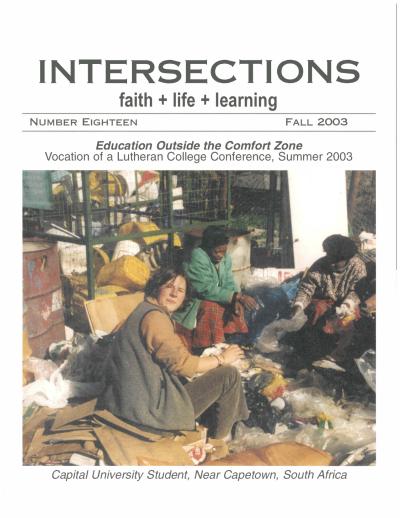
No. 18 · Fall 2003
Younan, Lutheran Bishop in Jerusalem, grounds Palestinian Christian identity in Incarnation theology and a Lutheran theology of grace and the cross, then surveys the Evangelical movement’s nineteenth-century legacy in the Middle East—the 1864 Arabic Bible, ELCJ schools, women’s ordination, and the Middle East Council of Churches. Engaging Edward Said’s critique of Samuel Huntington, he calls for international and local mutual-recognition agreements (including the Jerusalem Lutheran-Anglican agreement and a Lutheran-Reformed agreement in the Middle East), four marks of interfaith dialogue, and a sharp distinction between Lutheran “Evangelical” identity and the Dispensationalist evangelistic Right whose Israel-Palestine scenarios he names a heresy. He closes by proposing concrete scholarship, faculty exchange, and sabbatical partnerships between U.S. Lutheran colleges and the ELCJ’s churches, schools, and Dar al-Kalima Lutheran Academy.