No Child Left Behind Meets Philip Melanchthon: A Reflective Conversation
Intersections No. 26 · Fall 2007
After reading My Conversations with Martin Luther (Lull) in preparation for a traveling seminar to Germany with faculty and staff of Wartburg College, it was not hard to imagine oneself in historical conversation with influential figures “met” along our journey. While Martin Luther played a dominant role during the time of the Reformation and much of our learning centered on his contributions, it was the “conversation” with Philip Melanchthon that captured my interest. Acknowledging Dr. Lull’s influence, this conversational writing will proceed in a similar vein.
Having spent many years as an educator myself, I have invested much time in preparation and ongoing education to establish those attributes that contribute to the skills necessary to be a successful and effective teacher. The University of Wittenberg was fortunate to have a great scholar on its teaching faculty in the person of Philip Melanchthon. In contemplation of conversation with Melanchthon, reflection on his educational background provides insight as to his ability to speak to the topic of education.
Educated in a Latin grammar school, his early interest in Greek led Philip Melanchthon to further studies at the age of twelve at the University of Heidelberg where he earned his Bachelor of Arts degree. Only fourteen years old and unable to get a Master of Arts degree in Heidelberg, he went on to the University of Tubingen where he taught in the arts faculty. During this time Melanchthon also wrote and published his own works. Before he even reached the age of seventeen, Melanchthon took the Master’s examination (Wengert).
Standing in the twenty-first century cobblestone courtyard of the University of Wittenberg, one can imagine being transported back to the 1500s to envision a young Philip Melanchthon arriving at the university to teach fourteen-year old boys. Very boyish looking, twenty-one year old Melanchthon was viewed with some suspicion (Rhein 1996). With his first lecture On Improving the Studies of the Youth at the university, students and faculty alike recognized the gifted scholar and teacher in their midst. Melanchthon believed in lifelong learning; even while teaching he continued his own studies and added degrees at Wittenberg that gave him “license to lecture on the Bible” (Wengert).
Other than his own studies in Greek and Latin, how did Melanchthon know what he was doing as a professor? He had never taught before! What were the demographics of the students he taught? What were the expectations of the schools and universities in teaching young people? What expectations did he have of himself as a professor, and what expectations did he have of his students? As these questions wandered through my mind, an unnatural presence appeared before me, out of character because of the obvious garb prevalent in the 1500s. It took me a moment to realize that Philip Melanchthon himself was standing before me. In an instant I recognized my opportunity to ask the very questions that were threading through my mind.
KB: Herr Melanchthon, if I might introduce myself. My name is…
M: No need, Professor Book. I have been observing and note you are a part of a group of educators from an institution of higher learning, much like what I experienced here in Wittenberg in 1518. Many of your group wear the insignia “Wartburg College” on your clothing. I assume there must be some connection to the Wartburg castle where my good friend Martin Luther resided for a while. You look puzzled, however. Are there some questions I might be of some assistance in answering for you?
KB: Our group does indeed have ties to the Wartburg castle. As a college of the Lutheran church, the events that took place during the Reformation had a great impact on the tenets of our Lutheran church of today. But my interest is in the field of education, not unlike yours. My work at the college is centered on teaching and training students to become effective and capable teachers. It is not my intent to sound disrespectful, but much of my work is in preparing students to become teachers. Having had no formal instruction in learning how to teach, how is it you were able to be such an effective educator?
M: A phrase I heard members of your group using was “discovering and claiming your calling.” I believe teaching was my calling. As you know, to excel in your calling you have to believe in and have passion for what you do. Early in my education I was greatly influenced by teachers who instilled in me a love for learning. I especially loved studying Greek, Latin, and classical literature. My great love for studying languages and rhetoric led me to study theology, law, and the natural sciences in their original texts (Rhein 1996). It was the influence of my teachers, mentors I believe you call them in this century, who provided the model for my own teaching. I had opportunities to share my passion for knowledge with students through my writings and orations (Wengert). Just as I believe my calling was to make a difference by teaching and writing while at the University of Wittenberg, I also believe that learning is not merely limited for those whose work is in the church. Both boys and girls, poor and rich, simple and gifted should be given an equal opportunity to develop their callings in God’s kingdom (Faber).
KB: Your belief mirrors what has been proposed by the government of the United States with its No Child Left Behind legislation. Its intent is to assure that all students, regardless of their backgrounds, have equal access to a quality education and quality teachers. It seeks to close the achievement gap between the very groups you mention: boys and girls, poor and rich, simple (special education students) and gifted. Further, its goal is to close the gap in achievement among ethnic groups represented in our schools. I realize educational reforms have occurred in cycles throughout history, but it seems to me that if we had maintained the pattern of reform you established in Germany in the 1500s, we would not be faced with the startling discrepancies in student achievement in 2006. You allude to the fact that one needs to have an appreciation of history by your comment, “knowledge of God’s work in history is relevant for contemporary times, since the past informs and shapes the ideas that are current in the present” (Faber).
M: You have to understand, Professor Book, that this fundamental belief is apparent to those of us who are truly invested in assuring that all children learn. I am familiar with this No Child Left Behind document. As I understand its intent, all children should be taught by highly effective teachers, and schools are held accountable for grade level achievement by students. I agree with this notion. This is not a new concept. In order for teachers to be highly effective, they must have a strong grasp of the content that they teach. They must also have the methodology that enables them to deliver this knowledge to their students. If I may use my own pedagogy as an example, I relied on respected teachers from the past who influenced my philosophy of teaching. For example, from Aristotle, who himself, was influenced by Socrates and Plato, my method consisted of using a series of questions:
- What does the word mean?
- Does the thing exist?
- What is it?
- What are its parts?
- What are its various species?
- What are its causes?
- Its effects?
- Its associations?
- What things are related to it?
- What is contrary to it? (Denys)
While this method was effective for use in logic, dialectic, and rhetoric, I applied this process of questioning students to all areas.
KB: This sounds very much like the Socratic method of teaching, as you alluded to in your reference to Socrates’ influence on Aristotle. Has this formed your personal philosophy of education, then?
M: It is hard to align oneself with one specific philosopher’s philosophy, as you well know. With great respect for the teachings of Erasmus, I would have to say that I consider myself a reformer with humanist training. As such, I hold education in high regard (Faber) and recognize the importance of using highly effective teaching strategies.
KB: The No Child Left Behind legislation demands that students are taught by highly qualified teachers. Effective teachers know that knowledge of the subject matter is not sufficient to guarantee student success. No Child Left Behind is suggesting that teaching strategies that have a proven research base comprise the instruction that takes place in the classroom. To my knowledge, you did not find the need to rely on “research-based instruction,” yet you were extremely successful in motivating your students. You have been referred to as “Praeceptor Germaniae (Teacher of Germany).” As such, what methods did you utilize with your students to motivate and attain a high level of academic achievement?
M: There are many others with whom I work who are worthy and should share this title. Others have told me that this name was bestowed upon me by virtue of the many letters I exchanged with kings of France and England, as well as magistrates in Venice. I believe they might also have taken into account the fact that my textbooks were printed in many editions and were used in many schools and universities. A great number of my students who used these textbooks became competent teachers and professors in their homelands (Rhein 1996). However, I will humbly attempt to respond to your query. As you know yourself, as a teacher, the use of a variety of instructional strategies meets the needs of different learning styles and keeps students’ attention focused on the learning at hand.
The following reflect the pedagogical methods and aids I employed when teaching the young boys in my classes.
- Above all, it is important to provide order in the learning experience with clearly established goals. From my observations of your educational systems, I believe you accomplish this by establishing a scope and sequence within your curricula and structure your plans to meet recognized state and national standards in each of the curricular areas.
- When lecturing I made frequent use of examples. I also believed in brevity and the use of questions in lectures. Questioning draws upon the Socratic influence I mentioned before. When quoting rules I gave examples from classical authors, but rules should never get lost in the examples, for then no learning will take place.
- I often required student to produce a Latin speech or poem and present it in the form of a declamation, because eloquence is of high importance. I encouraged imitation of authors in the preparation of speeches and composition of poetry. To do this, knowledge of grammatical and rhetorical roles is necessary (Denys).
- Repetition results in retention. When more time is spent mastering few concepts well rather than covering many concepts in little depth, students have a stronger understanding of the authors’ meaning.
- Knowledges were intertwined; I believe you call this interdisciplinary learning. Making connections between disciplines helps students find relevance to their learning (Denys; Rhein 1996).
KB: I can see why you have been referred to as “Teacher of Germany.” These are practices that effective teachers in the twenty-first century are also using. You have commented on the methods you use in teaching your students. What influence then, did you have on the teachers of your time?
M: As I mentioned before, I wrote a great number of textbooks, grammars, and handbooks of education. My textbooks were used in classrooms for the teaching of Latin and Greek grammar, rhetoric, dialectics, and moral and natural philosophy. Because these texts were written specifically for use in the classroom and used in my classrooms, the hundreds of students I taught who later became teachers themselves were in a position to utilize these resources with their students. Consequently, they were also able to put into effect educational changes throughout Germany (Faber; Kusukawa). I also believed that teaching was not just a job. Because my students came from distances to study at Wittenberg, I often invited students to live with me. It was my hope that all professors would do the same, but that was not the case (Rhein 2006). We had the liveliest conversations sitting around the table in my home! It was quite rewarding to know students beyond the classroom.
KB: You have addressed the importance of having access to quality resources for use in the classroom, Professor Melanchthon. As we have discovered in the twenty-first century, this is also the situation. Students must not only have access to quality teachers, but in order for teachers to do their best they must also have the resources with which to teach. Many teachers have also recognized “knowing the whole child,” that is the child beyond the student who sits in a desk in the classroom. Most of the students in our schools live in the same community, so rather than inviting students to live with the teacher, many teachers visit the students’ families in their homes. Once again we share a similar philosophy.
If I may, Herr Melanchthon, I would like to move to another area I have been thinking about. Many twenty-first century schools have engaged in a process of curriculum mapping to identify that which should be taught to students at each grade level. In the process of the educational reform of which you were instrumental, what was your influence on the curriculum of schools?
M: I would like to think that I was instrumental in offering a structure by which students acquired their learning in the schools. If I could briefly outline this configuration for you, it would look like this:
- The goals in grade one would be to build up vocabulary, memorize the rules of grammar, learn to write, develop skills of memory, and learn music. The children would learn to read by using a primer. The primer would contain the basics of grammar in Latin, not German. By learning the basics in Latin, students could then apply these basic grammatical skills to their own German language (Faber).
- Students in the second grade would learn more music, develop reading and writing skills, good morals (they would memorize classical proverbs, most notably Aesop’s fables), they would study advanced grammar, etymology, and sentence structure, and one day a week the class would study Scripture for “it [was] essential that the children learn the beginning of a Christian and blessed life” (Faber).
- The third division students would have studied grammar well and shown promise of further learning. “These advanced students [w]ould continue to learn music and develop skills in translating and interpreting literature, including poets Vergil (sic) and Ovid, as well as Cicero, Roman orator, politician and philosopher. Upon development of these skills, students would go on to acquire the ability of public speaking, cogent arguing, and eloquent writing” (Faber; Wengert).
- At the university level learning was rebuilt with an arts curriculum as the basis. Students had to have a solid grasp of Latin, Greek, dialectics, and rhetoric. Declamations took place twice a month; mathematics that was learned from Euclid’s works and natural and moral philosophy were followed by disputations by those teachers (Kusukawa).
My rationale in emphasizing these particular skills in this order stemmed from the necessity to learn to read. If students had knowledge of grammar, dialectic, and rhetoric they could read the Bible. Through memory work, musical skills, and logical thinking students “learn[ed] the value of control, self-discipline, and orderliness” (Faber). Using myself as a model, I believed it was the students’ responsibility to be hardworking. Students needed to learn to speak well (grammar and rhetoric) and to think clearly (dialectics, or logic) (Wengert), for talking without knowing was impossible (Rhein 2006).
KB: As you point out, the need for proficiency in reading is critical. This is one of the central areas of focus in No Child Left Behind. The need to have students reading efficiently early in their schooling will affect the quality of their comprehension in the ensuing years of their education. Our biggest challenge is to have quality teachers in every classroom, implementing research-proven teaching strategies. We have conversed at great length about teaching pedagogy and curricular issues. Beyond the actual classroom, how do you see your influence affecting educational reform in Germany?
M: With my good colleague, mentor, and friend, Martin Luther, we examined the issues facing society in our country during that time. We recognized, as you have done with your No Child Left Behind legislation, that there are many stakeholders responsible for the education of a child. Our collective goal was to prepare good citizens, to teach our youth, for “they [were] the seedbed” of the city. A liberal education was crucial for completing this task (Faber).
Dr. Luther actually wrote two sermons that were delivered to stakeholder groups of the time: to the councilmen of all cities in Germany to establish and maintain Christian schools and to parents on keeping children in school. Together we believed that education was necessary for both boys and girls so they could be responsible, contributing citizens. In order to achieve this education, it was necessary for the community to stand behind this effort. Dr. Luther states it best by pointing out that:
…if we have to spend such large sums every year on guns, roads, bridges, dams, and countless similar items to insure the temporal peace and prosperity of a city, why should not much more be devoted to the poor neglected youth—at least enough to engage one or two competent men to teach school? (LW 45: 350)
Both Dr. Luther and I believed it was the responsibility of the people to assume a role in educating children. Well educated children who grow to be adults provide communities with “able, learned, wise, honorable and well-educated citizens.” As Dr. Luther noted, “we must do our part and spare no labor or expense to produce and train such people ourselves.” It is also important for communities to be involved in literacy; for all those who “earnestly desire to have…schools and languages established and maintained in Germany…no effort or expense should be spared to provide good libraries or book repositories” (LW 45: 339-78).
Dr. Luther and I also believed parents must share responsibility for the education of their children. It was extremely important that they keep their children in school and allow them to study. Even though a child may go on to learn a trade, he would be better prepared to use his knowledge in other areas as well. Parents must encourage their children to learn about virtues, ideas, and principles, for “the children who will best contribute to the state are those who understand the higher goals of their vocations” (Faber). Regardless of one’s station in life, whether poor or rich, every child had the need for an education. If parents did not make the effort to ensure their children were able to learn, they were doing them a great disservice. In this effort, the government should recognize its role in assisting the parents. Dr. Luther acknowledged this when he wrote, “If the father is poor, the resources of the church should be used to assist. Let the rich make their wills with this work in view…to establish scholarship funds” (LW 46: 257).
KB: These beliefs are so fundamental to all generations, Herr Melanchthon. Hundreds of years later, I believe we still share your desire to see all stakeholders involved in the education of children. The government of today shares a role to ensure that underprivileged students are not penalized for attending school. Through Title I programs schools are provided with additional government funding to secure teachers to assist struggling students in their efforts to achieve according to their grade levels. Government funding also provides free and reduced lunches for children whose parents have difficulty meeting the financial constraints related to sending their children to school. One of the biggest concerns with the demands of the No Child Left Behind legislation, however, is the lack of financial assistance from the government to implement the changes being mandated. In this, we would do well to heed your words from centuries past.
Unfortunately, our time is drawing short, Herr Melanchthon. Have you any profound thoughts to share with educators of the twenty-first century?
M: Perhaps not so much profound as merely observations of what I have noted throughout the centuries. My advice to teachers, both new to the profession and those who have been teaching for a number of years is this: Establish a strong basic foundation. Reading is fundamental to other learnings; understanding vocabulary is necessary in order to comprehend text. Learning doesn’t have to be dull! Students learn best when they are actively engaged in their learning; it can be an enjoyable experience! Above all, know that teaching is a calling and be passionate about who and what you teach. Don’t be hesitant to learn from those of us who have historical roots in the art of teaching. As Winston Churchill, a respected orator closer to your own century notes, “The farther backward you can look, the farther forward you are likely to see.”
With these parting thoughts, I am afraid I must bid you farewell. Continue to guide your students, Professor Book. I believe you see the value of connecting what we have learned from the past to the education you are implementing in your world today. Continue to challenge and nurture your students, for they will be the teachers of tomorrow. They will lead and serve the next generation of citizens of the world. Encourage them to continue to learn and grow themselves. Their faith-filled lives will serve as models to the students they teach. God’s blessing on the work you do. Auf wiedersehen.
Our time had gone so quickly, and there were so many more issues on which I would like to have sought the professor’s perspective. However, as I reflect upon my conversation with Philip Melanchthon, I am encouraged by what is taking place with education in the America of today. While many years, an ocean, and centuries of ideas separate Philip Melanchthon’s influence during the sixteenth century Reformation in Germany from the educational reform that is occurring in America in the twenty-first century, positive conclusions can be drawn. Although reform can be challenging, difficult, and at times confrontive to persons living through it, change need not be viewed as a negative consequence. In noting the positive impact Martin Luther and Philip Melanchthon had in successfully reforming the educational system of Germany through implementation of similar standards to those advocated in the No Child Left Behind legislation, one should surmise that we are on the right path toward ensuring that students have access to and can achieve a quality education. If we learn from history, in this instance it would be a good time for history to repeat itself.
Works Cited
Denys, E. P. “Philip Melanchthon’s Unique Contribution to Education.” Diss. Loyola U, 1973.
Faber, R. “Philip Melanchthon on Reformed Education.” Clarion 47 (1998): 1-11. Retrieved August 16, 2006 from http://spindleworks.com/library/rfaber/melanchton_edu.htm
Harran, M. J. Luther and Learning. Toronto: Susquehanna UP, 1985.
Kusukawa, Sachiko. Introduction. Orations on Philosophy and Education. By Philipp Melanchthon. Ed. Sachiko Kusukawa; Trans. Schirstin F. Salazar. New York: Cambridge UP, 1999. xi-xxi.
Lull, Timothy F. My Conversations with Martin Luther In Which I Learn About God, Faith, Marriage, Sexuality, Family, Education, War, Spirituality, Church Life, the Future, Ecumenism, Politics, Heaven and Other Things, Too. Minneapolis: Augsburg, 1999.
Luther, Martin. “A Sermon on Keeping Children in School.” Luther’s Works: The Christian in Society III. Vol. 46. Ed. Robert C. Schultz. Philadelphia: Fortress, 1967. LW 46: 207-58.
______. “To the Councilmen of All Cities in Germany that They Establish and Maintain Christian Schools.” Luther’s Works: The Christian in Society II. Vol. 45. Ed. Walther I. Brandt. Philadelphia: Muhlenberg, 1962. LW 45: 339-78.
Rhein, S. Handout from the Wittenberg Center. 1996.
______. Lecture at the Luther House in Wittenberg, Germany. 25 July 2006.
Wengert, Timothy J. “Beyond Stereotypes: The Real Philip Melanchthon.” Ed. Scott H. Hendrix and Timothy J. Wengert. Philip Melanchthon Then and Now (1497-1997): Essays Celebrating the 500th Anniversary of the Birth of Philip Melanchthon, Theologian, Teacher and Reformer. Columbia, SC: Lutheran Theological Southern Seminary on behalf of the Eastern Cluster of Lutheran Seminaries, 1999. 9-31.
-
 Editorial
From the Publisher
Arne Selbyg
Selbyg notes that, while a stated purpose of Intersections over its twelve years and twenty-six issues has been the intersection of faith, learning, and teaching, surprisingly few articles have addressed how Lutheran faculty teach and why — and credits the editor for assembling essays from authors whose teaching has benefited from the ELCA Wittenberg Center, on the eve of the City of Wittenberg’s “Luther Decade” leading up to the 2017 Reformation anniversary.
-
Editorial
From the Editor
Robert D. Haak
Haak introduces the issue with the question of whether “our Lutheranism” should have any discernible effect on how we operate as Lutheran colleges, and proposes a working list of “Lutheran” values that characterize our institutions — complexity, real evil, suffering as part of human experience, the centrality of discourse, transcendent values, attention to place, institutional self-criticism, and unity over division — inviting campuses to extend the conversation begun by Simmons, O’Hara, and the Wartburg colleagues.
-
Article
Lutheran Higher Education and the Public Intellectual
Ernest L. Simmons
Simmons argues that college faculty and administrators are, like it or not, public intellectuals, and that Lutheran higher education’s dialectical understanding of Christ and culture is well suited to support four functions of the public intellectual: articulating constructive critique of received social explanation (especially the “collage identity” described by Renate Schacht); presenting a transcendent theological perspective through the theology of the cross that takes seriously God’s hiddeness, the presence of ambiguity, and the reality of suffering; pursuing the common good amid the demise of the “commons” through H. Richard Niebuhr’s “Christ and Culture in Paradox”; and educating for citizenship through Christian vocation by connecting the practical and existential dimensions of the question “Why are you here?”
-
Article
The Vocation of a Lutheran College—Living the Legacy of the Reformation in the Twenty-first Century
Sabine U. O'Hara
O’Hara reflects on Luther’s understanding of education as Bildung — “becoming in the image of God” — through four key aspects: education must be relevant, education demands engagement with the community, education requires attention to place, and education demands engagement with the world. Drawing on her German upbringing, her work as president of Roanoke College, and on Darrell Jodock and Dietrich Bonhoeffer, she argues that Luther’s vision of a well-educated citizenry as the priesthood of all believers calls Lutheran colleges to messy, interdisciplinary, communal scholarship in service to the neighbor.
-
Article
Lutheran Heritage Across the Curriculum: Reflections from a Faculty/Staff Development Seminar
Cynthia Bane, Fred Waldstein, Kathryn A. Kleinhans, Penni Pier
Four Wartburg College colleagues share fruits of the 2006 Lilly-funded “Discovering and Claiming Our Callings” faculty/staff development seminar in Wittenberg, Eisenach, and Neuendettelsau. Kleinhans frames the curriculum and books used; Bane (psychology) finds Lutheran convictions about the value of humans, the affirmation of creation, and the universality of sin congruent with her discipline; Pier (communication arts) reads Luther as a model of dialectical rhetoric that gives educators permission to challenge students with uncomfortable ideas; and Waldstein (political science) reflects on the paradox of humility and self-confidence in Luther and on the Luther-Melanchthon collaboration as a model for the seminar group’s own work.
-
Book Review
Reviews
Matthew J. Marohl
Marohl reviews two 2006 Lutheran University Press volumes from Grand View College (Des Moines, IA). Mark C. Mattes and Ronald R. Darge’s Imaging the Journey … of Contemplation, Meditation, Reflection, and Adventure pairs Mattes’s Lutheran meditations on seven themes (from a spirituality of communication to Alpha and Omega) with Darge’s photographs and Ronald Taylor’s short prayers, with Mattes’s writing on vocation singled out as the volume’s finest. The Grand View College Reader, edited by Mattes, Evan A. Thomas, Kathryn Pohlman Duffy, and Ronald Taylor, surveys the college’s Foundations, Creativity, and Vocation through chapters by Thorvald Hanson, Kenneth Sundet Jones, Kevin Gannon, Ammertte C. Deibert, Steven Snyder, and President Kent Henning, tracing Grand View’s Grundtvigian and Danish Lutheran roots.
-
 Editorial
From the Editor
Jason A. Mahn
No. 42 · Fall 2015
Mahn introduces the “Vocation and the Common Good” issue by asking what is left of “the commons” in an age of privatized goods and education-as-commodity, and frames church-related colleges — with their stubborn vocabulary of “liberal arts,” “collegiate,” and “calling” — as among the least fully-privatized resources left in American life.
-
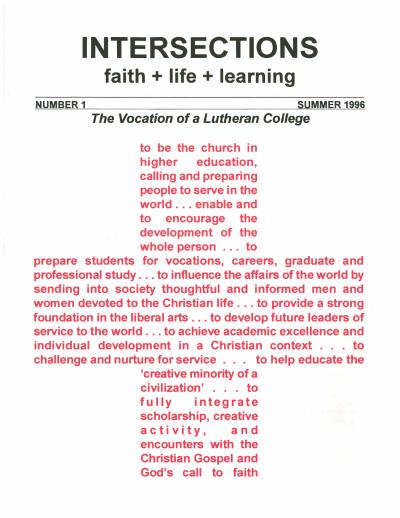 Institutional Focus
Continuing the Dialogue: Augustana College
Sandra C. Looney
No. 1 · Summer 1996
Looney describes Augustana College, Sioux Falls, debating and renaming its values—Christian, Liberal Arts, Community, Excellence, Service—under the leadership of religion professor Dr. Arthur Olsen and the T’N’T (“Through Thick and Thin”) committee, in the wake of ELCA Region III’s “What Does It Mean to be a College of the Church?” conversations. She describes Augustana’s 56% Lutheran student body, daily 10 a.m. chapel, dual Christmas Vespers in Our Savior’s Lutheran Church and St. Joseph’s Cathedral, the Capstone classes on moral and aesthetic issues, and the ongoing work of enlarging Augustana’s conversation to include Native American, Jewish, and Islamic voices.
-
 Article
Learning from Luther on Covid-19
Carl Hughes
No. 52 · Fall 2020
Reading Martin Luther’s 1527 treatise “Whether One May Flee from a Deadly Plague,” Hughes finds practical and spiritual guidance for a pandemic age: serve the neighbor, follow medical experts, honor those whose vocations put them at risk, and trust that even when we fail, God will not abandon the community.
-
 Editorial
From the Publisher
Mark Wilhelm
No. 40 · Fall 2014
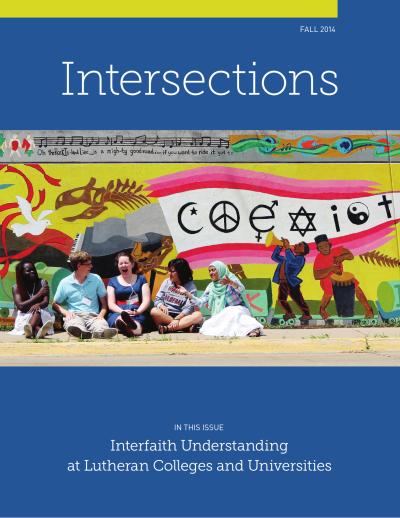
Wilhelm draws a parallel between the rediscovery of vocation and the rediscovery of interfaith understanding in Lutheran higher education, arguing that previously under-emphasized aspects of the Lutheran tradition point us to interfaith work and that an authentic Lutheran college or university will make interfaith understanding a feature of its mission.
-
 Article
It's Time to Rewrite the Rules of Civility
Jon Micheels Leiseth
No. 48 · Fall 2018
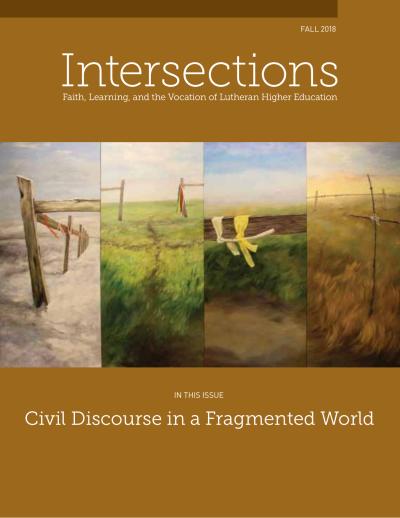
Leiseth contends that the prevailing rules of civility too often function as the majority’s rules, stifling those facing real harm — and proposes that NECU institutions rewrite civility as “neighboring,” guided by the ELCA’s five values of accompaniment: mutuality, inclusivity, empowerment, sustainability, and vulnerability.
-
 Editorial
From the Editor
Colleen Windham-Hughes
No. 61 · Spring 2025
5 min audio
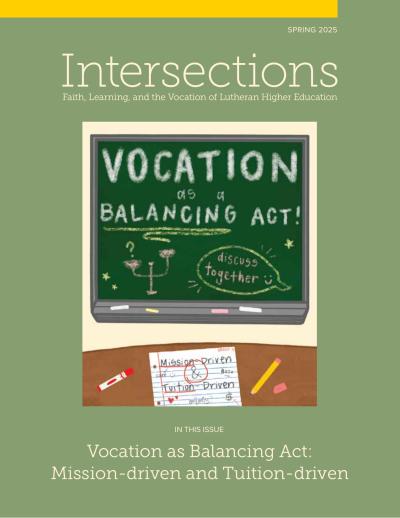
Windham-Hughes uses Fred Rogers’ neighborhood as a living embodiment of a Lutheran understanding of vocation — seeing dignity in each person, offering one’s gifts generously, and trusting that the well-being of the neighborhood is intrinsically connected to the well-being of every neighbor.