Educating for Peace: 21st Century Models for Thinking Globally and Acting Locally
Intersections No. 18 · Fall 2003
Let’s begin with a story. A rabbi gathers his students around him and challenges them with a question: “What is the distance between East and West?” One eager student immediately responds, “Well, it’s a long way for sure—maybe a thousand miles.” “Think it through some more,” the rabbi requests. After a silence, a second student looks at the rabbi and says, “I think the circumference of the earth is about 25,000 miles, so that means the distance between East and West must be 12,500 miles.” “Ah,” said the rabbi, “that is good reasoning, but let me illustrate another answer for you. Watch. I face the East. I take one step back and pivot and now I face the West. The distance between East and West is only one step.”i
What lessons are available to us in this story? What do we learn about the how and where of encountering difference, our opposite, “the other”? One strategy is to travel halfway round the globe. Another strategy is to turn and face our neighbor. The posture of the seeker or sojourner is critical. The seeker takes initiative, must move, must step out or back as the case may be. Interestingly, the step may well be a step back—a non-aggressive sign, a modest and reflective movement that opens up possibilities, makes it easy to turn, to change direction, to change perspective literally and figuratively. The story challenges us to notice, honor, and respect both the closeness of our human connections and the vast differences laced through those connections. It makes a memorable starting point for a discussion of the global/local dimensions of educating for peace.
The environmental slogan think globally, act locally captures not only the natural world’s inter-relatedness and interdependence, but also signals that anytime we connect with people across boundaries of cultural difference we engage the global community. Thus intercultural work encompasses what in many spheres are viewed as separate projects of international education and multicultural education. At Pacific Lutheran University (PLU), we are employing the term “global education” to denote the seamless nature of the educational project.
PLU is located in Tacoma, Washington. The 3,400 students benefit from a comprehensive academic environment that includes a college of arts and sciences, five professional schools, and selected master’s programs. The local Tacoma/Pierce County community with some 750,000 residents boasts the greatest population diversity in the state and is growing with and into the Puget Sound megalopolis (Seattle, Tacoma, and environs). For three decades now, PLU has been evolving its profile as a globally-focused university, cognizant of its roots in Scandinavia and its strategic Pacific Rim location.
Forty percent of 2003 bachelor recipients engaged in international study. Such participation places PLU among the top ten master’s level universities in the United States. A new strategic plan challenges us further to increase participation in on- and off-campus global education opportunities and to continue to build distinctive academic programs and global PLU presence. The motivating vision of the strategic plan—educating for a just, healthy, sustainable and peaceful world, finds grounding in our Lutheran identity and university mission. We believe that the intellect is cultivated as “a tool of conscience and an instrument of service.” We see service as hopeful and directed at seeking solutions and building bridges among peoples. Hence, the articulation of the ideal toward which we are striving, as individuals and as a community. The context of an unsettled and rapidly changing world of increasing economic, cultural, political, and ecological interdependence requires this kind of faithful commitment among those being prepared “for lives of thoughtful inquiry, service, leadership, and care—for people, for their communities and for the earth.”
Distinction in global education means more at Pacific Lutheran University than the existence of specific academic opportunities and high participation in these. It means that we are intentional about structuring learning so that students grow in intercultural knowledge and abilities as they progress in their studies. With support from the Teagle Foundation, a faculty planning team is adapting key approaches to intellectual and personal development (see Perry, Bennett, Musil) to create and elaborate a “Global Education Continuum.” The Continuum is a flexible four-phase model intended to nurture the ability to participate actively in global learning and working environments:
- The Introductory phase focuses on exposure to PLU’s commitment to and understanding of global education.
- The Exploratory phase concentrates on deepening of content and intellectual skill development, with emphasis on intercultural skills.
- The Participatory phase represents sustained, cross-cultural experiential learning that provides practice and refinement of intercultural abilities and understandings (e.g. service learning, internship).
- In the Integrative phase, students focus on experiencing global/local connections and life skills development as it relates to vocation and career in an increasingly interdependent world.
The Continuum is conceptualized to serve all participants in global education; but whereas all students should make progress along the Continuum, only students with exceptional commitments to global citizenship are presumed to engage the integrative phase. The Global Education Continuum provides the framework within which the overlapping experiences of a student’s academic program and personal transformation take place. In this way, global education at PLU is seen as a focused and intentional journey of intellectual and personal development. Appropriately, we can name these intercultural pilgrims “sojourners.” Likewise, their faculty, staff, and community mentors continue to sojourn, as they deepen and update their global perspectives.
Universities are inherently global organizations, dedicated to the widespread circulation of ideas and often people. In many cases, a happy serendipity governs the array of off-campus programs and partnerships that a college or university offers. Without denying the fortuitous connections that can accompany a new faculty hire or a new set of professional networks, the goal of deepening intercultural expertise requires that PLU and like-motivated campuses assume an intentional and disciplined posture with respect to our global partners. Why are we building and sustaining programs in certain places and with certain partners and not others?
PLU proposes to identify a limited number of focal locations for sustained off-campus presence. These sites will function as the primary gateways for global education development and will be integrated with the vision of educating for a just, healthy, sustainable, and peaceful world. Each site or gateway will provide a mix of programs across the Global Education Continuum—programs that connect with the on-campus curriculum and that feature well-designed experiential components like service learning, internships, and faculty-student research. A proven host-country partnership, strong leadership from both on-campus faculty and in-country staff and faculty, and a two-way flow of persons and activity will be key elements of the infrastructure.
The gateways will come on-line gradually over the next seven years. The Puget Sound region will serve as one of the sites. A couple of the other suggested locations are quite tentative, but the core cluster of sites is unlikely to change, since it represents commitments linked to our area studies programs and already-existing PLU semester programs. Here are three examples of current program development, as illustrations of how intentional new partnerships open the door to new global/local explorations of vocation and service: Trinidad in Tacoma, Community Partners in China, and Norway in Namibia. In all three cases, impulses and connections flow among a web of university and community partners, thereby honoring multidisciplinary approaches and experiential learning.
Trinidad in Tacoma
Ten years ago, in 1993, English Department faculty member Barbara Temple-Thurston led a January-term student group to Trinidad and Tobago. Three years later, our semester-long program at the University of the West Indies began. One of the learning objectives for the program is the transformation of racial and class consciousness through residence, study, and service in a highly-diverse community.
As Dr. Temple-Thurston describes the experience, “In Trinidad our students share classrooms with bright and talented Trinidadians who excel in a rigorous academic setting; they participate in cultural events and festivals with Trinidadians from all walks of life; and they commit to four hours a week of service learning work. Their volunteer experience means they serve at the pleasure of a variety of organizations and communities in whatever way they are needed, and they are guided and supervised by Trinidadian supervisors of various ethnic, racial, or religious backgrounds.”
While abroad, the sojourners move between the academic sector and the local community, encountering the legacies of colonization and observing the prejudices of class culture at work. We house the students in a modest guest house in a working-class neighborhood on the edge of the university, rather than in the university residence halls, and to ensure their interaction with folk culture we immerse them in traditional festivals and ceremonies like Carnival, Phagwa, and Hosay.
A return to campus after five months in Trinidad can produce considerable frustration, as there are few opportunities to process the sojourn with peers and to integrate intercultural skills into daily life. As one strategy for enabling the sojourners to continue their journeys, program faculty, with the help of Ione Crandall director of PLU’s Center for Public Service, envisioned a new residential opportunity in the local Tacoma neighborhood known as Salishan.
Salishan is a multicultural, subsidized housing community for a variety of groups, including Native Americans, African Americans and recent immigrants from Cambodia, Korea, Laos, Mexico, and Eastern Europe. Serving the community as Lutheran mission pastor is Ron Vignec, a former PLU campus pastor who assists with bridge building. Ron’s wife Nancy plays a leading role with the Tacoma Housing Authority and together, they helped broker an arrangement whereby several returnees from the Trinidad program will live in, and serve, the Salishan community. In return for a commitment to service, the housing authority is waiving the rent for one of the modest housing units. Even with the goodwill of all parties, it took almost a full academic year for the various agreements to be signed off on by the university and the local authorities. The first PLU students moved into the residence in summer 2003.
The Trinidad/Salishan initiative nurtures two intentional relationships: one local and one international. In Barbara Temple-Thurston’s words, “We are articulating the intersection of these two seemingly different worlds of Salishan and Trinidad and Tobago. By placing our students and ourselves at this dynamic intersection, we are learning to forge lasting and meaningful relationships with our surrounding communities and our friends in the Caribbean…Our students experience being resident members of a global and local community with expectations of service to both communities, an experience that deftly displays the connecting strands of diversity, culture, and otherness across the global/local divide.”
Support from the Association of American Colleges and Universities FIPSE-funded initiative “Liberal Education and Global Citizenship: The Arts of Democracy” has advanced curricular development for this program.
Community Partners in China
Chinese Studies is an interdisciplinary major that began as an area focus within the Global Studies program. Over the last twenty years, the China expertise of the PLU faculty has grown remarkably, as has the economic development importance of China to our state and region. Government and business leaders see facility in the Chinese language and advanced cultural understanding as precious assets and PLU is committed to providing access to these tools and to functioning as a bridge builder with China.
Founded in 2002, China Partners Network is a collaborative network of primarily Lutheran institutions in the State of Washington, including Good Samaritan Hospital, PLU, and a number of congregations, “who are committed to working in partnership with each other and with the Amity Foundation for the purpose of providing much needed health care, education, and basic needs for children and families in China.” Three campus entities are participating directly in the evolution of the network: Church Relations, Chinese Studies, and the Wang Center for International Programs.
By collaborating locally on fundraising, public education, and the development and administration of service learning opportunities, the network is able to respond to the needs and priorities identified and articulated by the in-country partner. Importantly, this Chinese partner, the Amity Foundation, is a well-regarded, Christian-based social service organization. We are excited about the student placements that will evolve through the partners network and the lives that are already being improved through the teaching of new therapy techniques for working with children with disabilities and the delivery of wheelchairs.
Having sent students to China for semester-long programs of study for more than twenty years, we have reached a decision point concerning the specific location(s) and affiliation(s) that will define our China gateway going forward. Both Zhongshan University and Sidman University have functioned as valuable exchange partners in years past, but a university connection alone is no longer sufficient. The China Partners Network provides an additional dimension for organizing and focusing our China presence. The link to our university mission and identity is obvious. The opportunities for students in professional programs like Nursing and Education are attractive. The posture of working according to the priorities established in-country by the Amity Foundation is ethically important. Even though Shanghai and Beijing are magnets for current business interests, we find ourselves affirming the importance of a PLU presence in a less developed region. Thus, academic decision-making and community partnerships become aligned to advance both student learning and the quality of life in rural China.
Another community dimension to PLU’s Chinese Studies program deserves mention in this connection, namely the identification of local partner school districts to augment Chinese instruction in the K-12 curriculum and encourage joint co-curricular programming and events. These efforts are being made possible by a major grant from the Freeman Foundation. Dr. Gregory Youtz, Professor of Music and Chair of Chinese Studies, provides the coordinating faculty leadership for these community partner initiatives.
Norway in Namibia
PLU was founded in 1890 as an academy for Norwegian immigrants. Appropriately, Scandinavian Area Studies became the university’s first area studies major (1977). Outreach to the Pacific Northwest Scandinavian-American community featured prominently in the initial program design and research priorities and found concrete expression in a campus Scandinavian Cultural Center, dedicated in 1989. A robust stream of students from Scandinavia has continued to energize the university’s cultural identity, but the intellectual and political weight of the international education curriculum shifted as a faculty generation with teaching interests in Kierkegaard, Rølvaag, and Ingmar Bergman films began to be replaced by faculty focused on Asia, Central and Latin America, and Africa.
Three years ago, a senior professor in political science and well-recognized expert in international education, Dr. Ann Kelleher, formulated a new program emphasis around the theme of “The Nordic Approach to Peace, Democracy, and Development.” In short order, the university acquired the necessary building blocks for a multi-faceted academic initiative, energized by on- and off-campus constituents and enabled by private and governmental funding.
The initiative is built on a formal three-institution partnership among Hedmark University College in Norway, the University of Namibia, and PLU. As Ann Kelleher explained when program activities began in 2001, “Envisioned as necessary to achieve authenticity, the three-way partnership has elicited enthusiastic and useful cooperation among its member institutions. Each one makes essential contributions…. Hedmark’s connections to Namibia are solid, based on continuous, long-lived personal relationships at the highest levels in the government and education. Having an active, enthusiastic partner in a developing country gives programmatic reality to one of the most distinctive guidelines in the Norwegian approach to development, that projects must be ‘recipient led.’ Analyzing examples of democracy and development without the equal participation of an institution in a developing country [University of Namibia] would belie the very essence of [the initiative]. For its contribution, PLU will provide the partnership’s institutional base, a focus for outside funding, and active as well as knowledgeable faculty and student participants.”
Alongside the university partners stands a significant NGO partner, the Namibia Association of Norway (NAMAS), whose work with the peoples of Namibia predates independence and whose reputation and contacts open many doors to university representatives. Additionally, the Lutheran church plays an influential and supportive role. In the late 1980s, Southwestern Washington ELCA congregations sponsored a first generation of Namibian students at PLU, all of them now exemplary contributors to the young democracy and important role models and facilitators for the current student generation.
Accomplishments to date include a PLU January short-term course in human rights and democracy at the University of Namibia, student-faculty research projects in Norway and Namibia, and faculty and curriculum development. Fall 2003 finds ten PLU students, a PLU professor of journalism, and several Namibian students gathered at Hedmark University College to launch “Democracy, Development, and Peace: A Semester of Active Learning in Norway.” Through case studies and site visits the sojourners will study Norwegian public policy and its implications for sustainable growth and peace building throughout the world. Internship placements and extended research projects follow the foundational coursework, ensuring that participants immerse themselves in local community contexts.
A specific project emanating from the Norway/Namibia/PLU partnership further illustrates new modes of conceptualizing global/local connections. Professor Kelleher wrote a successful USAID grant for capacity building for the Ondao primary school in rural, northwestern Namibia. Actually thirty individual school sites, under a single administrative unit, the Ondao school serves the proudly traditional, semi-nomadic Himba people. The Namibia Association of Norway provided the seed funding and professional expertise to develop the Ondao mobile schools, including the army tents used as classrooms. Now the three partner universities are collaborating to deliver training workshops for the native teachers seeking formal certification as teachers.
As members of PLU’s education faculty have undertaken this training assignment, PLU students, members of University Congregation, local secondary-school students, school administrators, and other community members have stepped forward to volunteer school supplies, to host the Ondao school principals on a professional development visit to Washington State, and to dream together about other ways to serve the Ondao learners and teachers, including creating libraries in a tub to circulate among the tent sites.
This three-way partnership offers creative new approaches to conceptualizing education for peace. Many next-step investigations are under exploration, including a focus on indigenous peoples in the three partner locations.
Common Threads and Commitments
Taken together, these three initiatives reinforce PLU’s capacity to serve the Puget Sound region with culture-specific resources, expertise in multiculturalism and development, and engagement with peacebuilding, conflict transformation, and related themes. The case studies illustrate that for experiential learning to flourish and intercultural skills and problem solving capacities to deepen, U.S. universities must seek out capable and committed partners abroad—both academic and community based, and strive for long-term, mutually beneficial relationships. In these examples, partners beyond the university sphere include foundations, NGO’s, hospitals and clinics, schools, a variety of service and internship sites, and in each case a link with the Lutheran church.
Furthermore, the deliberate cultivation of local partnerships can ensure that students have access to relevant pre-departure and re-entry experiences. Few universities focus systematically on helping students reflect upon their sojourner experiences. Yet these reflections and follow-up community engagements are critical aspects of a successful journey along the global education continuum. They also have powerful implications for the discernment of vocation. A major grant from the Lilly Endowment has provision for the development of sojourner reflection groups, which PLU will pilot in spring semester 2004. Developing domestic internships specifically for returning study abroad students is a priority project for our new international internship coordinator.
In the 1990s, four educational researchers examined the life stories of individuals whom they described as committed to the common good. Writing in Common Fire: Leading Lives of Commitment in a Complex World (1996), Daloz, Keen, Keen, and Parks observed: “The single most important pattern we have found in the lives of people committed to the common good is what we have come to call a constructive, enlarging engagement with the other….We believe that those who best practice a commitment to an inclusive common good are paradoxically those who can simultaneously reach across tribes and remain firmly rooted in the particularities of their own.” Larry Daloz’ essay “Transformative Learning for the Common Good” (2000) translates the Common Fire discovery into an educational context. Here Daloz elaborates what he calls four conditions of transformation: presence of the other, reflective discourse on assumptions, mentoring community, and opportunities for committed action.
In that Pacific Lutheran University and her sister Lutheran colleges and universities care deeply about the commonweal, we ought to take these research findings seriously in the design of our global education programs. Our work will then move out from our campuses in the impulse to educate for a more peaceful world. It will also move in and through our campuses as we aspire to be, and model, what Lee Knefelkamp calls, “communities of peace.”
Questions for reflection and discussion
On your campus, how far is it between East and West?
How vigorously have you considered the design of intercultural education for personal transformation? For global citizenship? For responding to God’s call?
Who are your partners in intercultural education? How are concepts of neighbor and partner understood and practiced?
What language works best for you—global, intercultural, international, multicultural—and why?
In what ways does your campus community facilitate the return and ongoing development of student, faculty, and staff sojourners?
How might we come together as a community of Lutheran colleges to explore the paths, and practice the postures, that show the way toward a just and peaceful world?
Endnote
- Lee Knefelkamp (Teachers College, Columbia University) told this story at the Institute for Intercultural Communication in July 2003 and I am grateful for her permission to retell it in the tradition of oral wisdom.
Works Cited
Bennett, Milton J. 1993. “Towards Ethnorelativism: A Developmental Model of Intercultural Sensitivity” in R. Michael Paige, ed., Education for the Intercultural Experience. Yarmouth, Maine: Intercultural Press, pp. 21-71.
Cornwell, Grant H. and Eve W. Stoddard. 1999. Globalizing Knowledge: Connecting International and Intercultural Studies. Washington, D.C.: Association of American Colleges and Universities.
Daloz, Laurent A. Parks. 2000. “Transformative Learning for the Common Good” in Jack Mezirow, ed., Learning as Transformation: Critical Perspectives on a Theory in Progress. San Francisco: Jossey-Bass, pp. 103-123.
Daloz, Laurent A. Parks, Cheryl H. Keen, James P. Keen, and Sharon Daloz Parks. 1996. Common Fire: Lives of Commitment in a Complex World. Boston: Beacon Press.
Dobbert, Marion L. Lundy. 1998. “The Impossibility of Internationalizing Students by Adding Materials to Courses” in Reforming the Higher Education Curriculum: Internationalizing a Campus. Phoenix: ACE/Oryx.
Internationalizing the Campus: Profiles of Success at Colleges and Universities. 2003. Washington, D.C.: NAFSA Association of International Educators.
Kelleher, Ann. 1996. Learning from Success: Campus Case Studies in International Program Development. New York: Peter Lang.
Kelleher, Ann and Laura Klein. 1999. Global Perspectives: A Handbook for Understanding Global Issues. Upper Saddle River, NJ: Prentice Hall.
Knefelkamp, L. Lee. 1992. “The Multicultural Curriculum and Communities of Peace” in Liberal Education 78, no. 2, 26-35.
Musil, Caryn McTighe. 2003. “Educating for Citizenship” in Peer Review 5, no. 3, 4-8.
Perry, William G. Jr. 1970. Forms of Intellectual and Ethical Development in the College Years: A Scheme. New York, NY: Holt, Rinehart and Winston, Inc.
Schreiter, Robert J. 1997. The New Catholicity: Theology between the Global and the Local. Maryknoll, NY: Orbis Books.
-
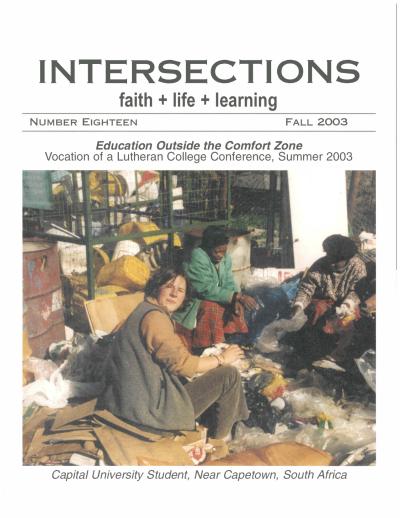 Editorial
From the Publisher
Arne Selbyg
Selbyg reports that the ELCA Church Council’s new strategic directions include the charge to “assist this church to bring forth and support faithful, wise, and courageous leaders whose vocations serve God’s mission in a pluralistic world,” and assures readers that Intersections, the Vocation of a Lutheran College conferences, and related programs will remain among the tools by which the churchwide organization reaches its strategic goals.
-
Editorial
From the Editor
Tom Christenson
Christenson draws on a ten-year alumni survey at Capital University showing that students most often credit practica, internships, travel-study, and service-learning—not classroom hours—as the places they best learned the university’s stated outcomes, and introduces this issue’s papers from the Summer 2003 Vocation of a Lutheran College Conference on education and global outreach.
-
Article
"The Earth is the Lord's And the Fullness Thereof": Six Theses Regarding Global Education at the Colleges of the Church
Christopher M. Thomforde
Thomforde surveys the breadth of global education across ELCA colleges—Susquehanna, Bethany, St. Olaf, Luther’s international students, Concordia’s language villages—and then frames its future around six theses: global education is a theological enterprise that teaches the First Commandment through dialog, wonder, and disillusionment; it necessitates coming to terms with “the stranger” and “hospitality” (drawing on Diana Eck); it is in, for, and against the world; it nurtures vocation and forms L. DeAne Lagerquist’s “cosmopolitan citizens”; it requires sympathetic engagement of faculty, staff, and administration in the spirit of pioneers like Ansgar Sovik; and it calls the ELCA colleges to exercise the gift of administration to bring greater clarity and collective coordination to the portfolio of programs offered across the twenty-eight institutions.
-
Article
Service Beyond the Comfort Zone
Kathryn Wolford
Wolford names economic globalization and the growth of civil society as the two issues shaping Lutheran World Relief’s mission, illustrating with the Guatemalan storekeeper undercut by subsidized “gringo” chickens, fair-trade coffee and chocolate campaigns, and Charles Onyango-Obbo’s warning about anti-terrorism laws in fragile African democracies. Drawing on Darrell Jodock, Art Simon, and the Good Samaritan, she frames the global vocation of Lutheran colleges as inviting students past comfort zones of race, class, ethnicity, and ideas through service-learning that links mercy and justice, and closes with a concrete LWR partnership invitation including site visits, internships, fair-trade campus campaigns, and the “A Place for Peace in Colombia” advocacy program.
-
Article
The Search for a Just Peace in a Globalized World
Munib A. Younan
Younan, Lutheran Bishop in Jerusalem, grounds Palestinian Christian identity in Incarnation theology and a Lutheran theology of grace and the cross, then surveys the Evangelical movement’s nineteenth-century legacy in the Middle East—the 1864 Arabic Bible, ELCJ schools, women’s ordination, and the Middle East Council of Churches. Engaging Edward Said’s critique of Samuel Huntington, he calls for international and local mutual-recognition agreements (including the Jerusalem Lutheran-Anglican agreement and a Lutheran-Reformed agreement in the Middle East), four marks of interfaith dialogue, and a sharp distinction between Lutheran “Evangelical” identity and the Dispensationalist evangelistic Right whose Israel-Palestine scenarios he names a heresy. He closes by proposing concrete scholarship, faculty exchange, and sabbatical partnerships between U.S. Lutheran colleges and the ELCJ’s churches, schools, and Dar al-Kalima Lutheran Academy.
-
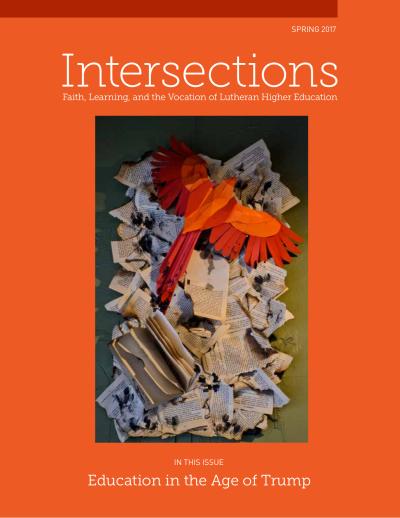 Article
Why Did the Chicken Cross the Road? A Homily on Liminality and Vocation
Lori Brandt Hale
No. 45 · Spring 2017
Drawing on Wes Moore’s The Other Wes Moore, Warren St. John’s Outcasts United, Victor Turner’s anthropology of liminality, and Dietrich Bonhoeffer’s poem “Who Am I?”, Hale considers how Hmong, Muslim, Latinx, LGBTQ+, non-traditional, and other students live in “double liminal” spaces — and asks whether liminality might itself be a place of transformation in conversations about vocation.
-
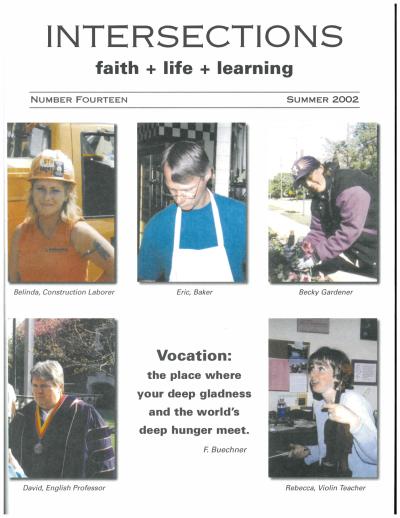 Editorial
From the Editor
Tom Christenson
No. 14 · Summer 2002
Christenson argues that whether or not the conversation is funded by the “Lilly lottery,” vocation should just be part of who we are and what we do at ELCA colleges, and proposes three low-cost conversations—among faculty (twenty dollars of wine, in vino veritas), with students throughout their four years, and with alumni—explaining why this issue is deliberately “fatter” than usual and inviting feedback on other single-topic issues.
-
 Response
Lutheran Colleges: The Context for the Conversation
Thomas Templeton Taylor
No. 1 · Summer 1996
Taylor of Wittenberg engages Schwehn’s first argument by sketching the institutional predicament of Lutheran colleges through three converging forces: the collapse of differences among old-line Protestant groups in the wake of ELCA-era ecumenism (with Robert Wuthnow); the secularization of American higher education described by George Marsden; and the post-war decline of liberal arts colleges under pressure to professionalize. The result is an “in-between stage” in which Lutheran colleges retain rhetoric without substance. Following Richard John Neuhaus’s “Eleven Theses,” he argues that, for a time at least, Lutheran colleges’ institutional affiliations must remain actively Lutheran if they are to remain in any sense Christian.
-
 Article
Toward an Adequate Theology of Christian Higher Education
Robert Benne
No. 10 · Fall 2000
Drawing on his forthcoming Eerdmans volume Quality With Soul—Thriving Ventures in Christian Higher Education, which studies St. Olaf, Valparaiso, Notre Dame, Baylor, Wheaton, and Calvin, Benne argues that these schools have kept their souls because a critical mass of boards, administrators, faculty, and students treat the Christian account as comprehensive, unsurpassable, and central. He critiques four inadequate theologies of Christian higher education—pietism, liberal theology (Whitehead, Henry Nelson Weiman, the “values” turn, and accommodation to diversity and multiculturalism), “First Article” approaches (including Merrill Cunninggim’s Methodist version and a Lutheran two-kingdoms quietism), and reactionary/triumphalist theology—and contrasts the Catholic (Notre Dame), Reformed (Calvin, Wheaton, Baylor), and Lutheran (St. Olaf, Valpo) ways of relating faith and learning, calling Lutherans to recover “Christ and culture in paradox” as serious extended conversation rather than as a lazy excuse.
-
 Book Review
The Information Deluge: Navigating the Digital Age with Recent Scholars
Virginia Connell
No. 39 · Spring 2014
From the reference desk at Concordia’s Carl B. Ylvisaker Library, Connell navigates Ann Blair’s Too Much to Know, Nicholas Carr’s The Shallows, Viktor Mayer-Schönberger’s Delete, and Howard Gardner and Katie Davis’ The App Generation, then describes information-literacy work at Concordia—primary-source assignments, Omeka and TimelineJS exhibits—that helps students move from app-dependent to app-enabled in the Lutheran tradition of reform.
-
 Editorial
From the Editor
Jason A. Mahn
No. 35 · Spring 2012
Mahn introduces five essays from the 2011 Vocation of a Lutheran College Conference at Augsburg, framing how Torvend, Anderson, Svennungsen, Tunheim, and Pribbenow press Lutheran colleges to turn outward—recovering the public character of Luther’s gospel, forming students for moral deliberation, investing in the infrastructure of civic renewal, and pursuing justice and education “off the main road.”