This summer I spent several thousand dollars and five weeks to learn about the process of truth and reconciliation set up in post-apartheid South Africa. And I did. But I learned so much more. I learned why I chose to be a teacher, and in particular why I remain a teacher at a faith-based college. I learned about the nature of students who come to colleges like ours.
It all began uneventfully enough. I was asked to be on an interview team to select three out of five applicants from Capital who would attend a workshop on peace building in South Africa. I looked at the proposed schedule of the workshop—peacemaking, reconciliation, truth, forgiveness; sounds interesting, I thought. We had thirty minutes to interview each of the five students. After listening to them each explain their background and interest in the area I came to two very clear decisions. First, we had to send all five students. Second, I wanted to go with them. Eventually our group was to include my wife (a kindergarten teacher in Columbus), two students from other Lutheran colleges, and a college health director and her 14 year old son.
We didn’t have a lot in common. The students had different majors, ages, religions, hobbies, and quite distinct personalities. But they exemplified the type of student who I have become familiar with in 24 years as a college teacher. They shared an openness to the world, a commitment to understand and to help others, and an unconventional view of what it means to live a good life.
We spent our time living with families in a city ten miles south of Cape Town. We visited churches, poor townships, schools, day care centers. We spent two days working in a children’s AIDS hospital. We delivered Christmas packages to schools (yes, in July). We saw Nelson Mandela’s cell. We listened to a political prisoner who spent eight years on Robben island. We saw penguins and seals, street children and beautiful flowers, we squished our way through the coldest and rainiest Cape Town winter in 44 years. We shopped. We walked. We listened. We listened to each other. I became just as interested in how these students absorbed the experience here as I was with what I saw about South Africa. We became close, dropping the masks we had brought with us from the U.S. I’ve taught at Capital for 20 years, and if I hear one more administrator talk about the “Capital family” I will jump out of my office window. Luckily, I am on the first floor. But in this case “family” is the only word I know to describe the experience. These are people I have grown to care about in a deep and personal way. These were my students, but they were my teachers too. They taught me how to open my soul and encounter the world with god’s eyes. I admire them. I want to be like them. I wanted them not to be disappointed in me. I wanted them not to see my shortcomings: my need for too much sleep and time alone, and my grouchiness when I don’t get it. I teach International Relations. I know lots about the world, but the truth is I don’t get it. I don’t know why people are sick and poor. I don’t know why others are indifferent. I don’t know how to fix it. I know only that this stuff is important and that I care about it. I feared this wouldn’t be enough for these students. They wanted real answers and I felt powerless when all I can do is sit down beside them and cry because it hurts so bad to see the world this way.
These students are so different from one another, yet they have something in common. Amy sees this place through a camera lens. I watch her lips as she tries to make sense of it all. There’s a half-smile, a frown for uncertainty; I like it best when her mouth drops open in awe with some surprise she sees. Brian called me Dr. Wallace so now I call him Dr. Murphy. I think he will be one someday. I see him as a teacher like me one day. He will teach his students with care and grace when he finds the right words to describe this place, and himself. There is Meghan who is constantly processing out loud the love she feels for this world, “well what about this” and “I saw that” and “what does this mean?” and “who am I and what am I supposed to do now that I know this stuff?”
Karrie is sometimes lost inside her own feelings, wondering how she can best use her talents to help the world. She is moved by what she has seen here, down to the center of her soul. I am amazed by her eyes. She will not look away from what she sees here, no matter how painful. Her eyes may be filled with tears, but they are open, focused. Patrick at 14 is the youngest and maybe the smartest of our group. He is a drummer. He pretends not to let any of this sink in, but it does. I admire him for his risk taking, that and the fact that his drum teacher once toured with Van Morrison. Meredith is quiet but she processes every thought and feeling out in the open, in the worry lines on her forehead. I watch her thinking, trying so hard to makes sense of this place, and I lose my breath. I see what it is to have a soul—to look at the world around you and wonder how to respond.
Cheryl is my soul mate. Sharing five weeks in South Africa has brought us closer than I thought possible after 15 years of marriage. She sees the children here; she sees them everywhere. She was the one who taught me children are real and they are people, and she will take what she has learned here back to open the hearts and eyes of her inner-city kindergartners. Corin is the most childlike person here except for me. Her face is a constant smile, ready to burst from all the joy inside her. I like to be near her when I am sad, which is much of the time. She is the one most likely to put her foot in her mouth, and also the one most likely to notice if one of us needs a hug, and to give it.
Debbie is our leader, but she wants to be one of the group too. She has so many hats to wear and has to switch them at a moment’s notice. I watch her swing back and forth from world to world, trying to get students to see the wonder of this place and also checking to make sure the vans get here on time to pick us up, and I am reminded of what it is to be a teacher. April is a nurse. She carries with her Noah’s pharmacy: two of every medicine ever made. Now I understand. She wants to heal all the hurt that is in the world. I see some of it in her eyes. Audra walks through this country like she is walking on air, suspended a few inches above the ground. She takes everything in with her listening heart. Something here has touched her deep inside. I look at her and I feel I am seeing Jesus, weeping sick and weeping over lost Jerusalem.
We live in a cynical age, or so says Jerry McGuire. I work in a cynical occupation. No one can be as skeptical as college teachers. We’ve seen it all before. We know everything. And students today aren’t as smart, as hard-working, or clever, or insightful, or as original as when we were in college. The world is going to hell in a handbasket, and we know why. It’s students these days. They aren’t what they used to be. I used to say that stuff. Even worse, I used to believe it. Not anymore. I see that wide-eyed wonder, the ears that listen to the voices of the world, the eyes smiling in awe and wonder, and the tears, all the tears, here, and I have no worries about the future.
It is in the presence of these people that I am reminded why I became a teacher, in particular at a faith-based college. I want to be like these students. I want to share my life with them, and have them share their lives with me. I am with them not because they are the smartest (although they are smart) or most creative. They are not likely to be titans of industry or winners of Nobel prizes. I am with them because they teach me how to be human.
They are honest, caring, and open. They are atheists and agnostics and Buddhists and Methodists and Baptists, but at their core they are searching for the truth about God’s existence in the world. They don’t want easy answers. They certainly don’t want doctrine. They want truth. They are not likely to be future billionaires (I hope they don’t read this part) or sports stars or supermodels. I have chosen to be with them because they want to be social workers, nurses, teachers, pastors, mission workers, parents, friends. I know this because they have told me, but also because I have seen them be all these things for each other, and for me.
They understand that the truth about God, whatever it is, has something to do with who they are and how they choose to act in the world. They embody vocation. Unlike many of us who teach higher education, these students are not compulsive achievers. They have no desire to build themselves up in the eyes of this world. Rather, they have responded to a voice which has called them out of their selves and asked them to be present in this world. They are certainly of this world. They laugh raucously and dance wildly and sing loudly and even tell dirty jokes. They get cranky and smelly and let me tell you, we all have bad hair days. But there is also something sacred about them. In how they see the world, let it touch them, and touch it back. God is here. They will not leave college to be the powerful, wealthy, or famous. They will walk quietly in the world, binding its wounds, holdings its hands, listening to its voices. They will be its healers. This is why I want to be with them. This is why I hope to be worthy of them. This is why I love them. They are my link to the reconstruction of this lost and broken world, the redemption of my lost and broken soul.
-
 Editorial
From the Publisher
Arne Selbyg
Selbyg reports that Executive Director Leonard Schulze has challenged the ELCA Division for Higher Education and Schools to develop a comprehensive communications plan reaching high school students, college students, parents, pastors, and journalists, and invites Intersections readers to review the redesigned elcacolleges.org website, the “FREE STUFF” brochures, the journal’s advertisements in The Lutheran and related publications, Ernie Simmons’ new Augsburg-Fortress book Lutheran Higher Education: An Introduction, and the ELCA video magazine Mosaic—and to send in their own ideas.
-
Editorial
From the Editor
Tom Christenson
Christenson previews a varied issue—Darrell Jodock’s Bernhardson inaugural lecture, Ernie Simmons’ Valparaiso conference talk on student/parent attitudes, two South Africa travel pieces by Brian Wallace and Corin Wesner, and reviews of Richard Hughes’s and Robert Benne’s recent books—and tells the story of “the church lady from hell,” a mid-fifties returning student who condemned everyone in the class with “God and I think…,” to ask what a religious tradition without a sense of humor would look like.
-
Article
The Lutheran Theological Tradition and Recruiting Lutheran Students
Ernest L. Simmons
Simmons opens with an Abraham-and-Isaac “Windows 98” joke to illustrate the dialectic of faith and learning, then argues that in a new market era of limited religious background, intentional mission and marketing go together. Drawing on Levine and Cureton’s When Hope and Fear Collide for the Millennial Generation born in 1982 and Tom Beaudoin’s Virtual Faith for their GenX parents, he reads “Reclaiming Lutheran Students” survey results showing 86% strong community at ELCA colleges versus 54% at flagship publics and 61% alumni mentoring versus 39%. He then develops three areas where the Lutheran tradition uniquely equips its colleges—community, mentoring and vocation, and the integration of faith and values—using Luther’s “two kingdoms” image of the “Left Hand” (reason) and “Right Hand” (faith) of God, with academic freedom as a product of Ahlstrom’s “Critical Current” in the tradition, and closes with three challenges: recruiting and retaining mentoring faculty, educating church leaders, and reaching potential students and parents.
-
Article
Freedom, Humor, and Community: A Lutheran Vision for Higher Education
Darrell Jodock
Jodock’s inaugural lecture for the Bernhardson chair at Gustavus Adolphus develops three interlocking themes drawn from the Lutheran tradition as a deeper grounding for the liberal arts college than contemporary American assumptions. A sense of humor rests on Luther’s discovery that God takes the initiative—Luther could call himself a beggar, joke about the epistle of James, and credit Wittenberg beer for the Reformation—and underwrites the freedom of inquiry that John Updike traces to Grace Lutheran Sunday School in Shillington. Community, grounded in Augsburg Confession VII and Luther’s 1524 letter to the German city councils, makes the college a community of discourse pursuing wisdom rather than “the same old blockheads.” Freedom is both “freedom from” and “freedom for,” illustrated by Nechama Tec’s Polish Holocaust rescuers and by Jodock’s Holocaust-class corporate role-play in which students voted to build a factory in a death camp rather than risk losing their board seats—a vivid case for educating toward “a passion for justice.”
-
Reflection
Sweet on My Lips
Corin Wesner
A passage from Wesner’s travel journal during the same South Africa workshop. Walking into a wood-and-tin shack church where raindrops fall on already-soaked carpet and the service is in Xhosa, she remembers her painted, carpeted home church and her adolescent argument with her mother about wearing a dress to worship, and finds herself engulfed in warmth as the few women sing—welcomed by a stranger’s smile and opened up.
-
Book Review
Richard T. Hughes: How Christian Faith Can Sustain the Life of the Mind
Tom Christenson
Christenson reviews Richard Hughes’s How Christian Faith Can Sustain the Life of the Mind (Eerdmans, 2001), which argues, drawing on Tillich’s notion of “religion breaking through its own particularity,” that faith is a means to the open pursuit of truth rather than its enemy. Christenson reads the argument as a natural fit for a Lutheran tradition of semper reformanda but notes Luther’s own dogmatism toward fellow reformers, and wishes Hughes had drawn a sharper line between an absolute truth that relativizes all human truths and a postmodern abandonment of truth altogether. The book was the most-cited title at the November meeting of North American Lutheran academic officers.
-
Book Review
Robert Benne: Quality With Soul: How Six Premier Colleges and Universities Keep Faith With Their Religious Traditions
Joy Schroeder
Schroeder reviews Robert Benne’s Quality With Soul (Eerdmans, 2001), which assesses the secularization documented by James T. Burtchaell’s The Dying of the Light and names six “bright lights” that resist it: Calvin, Wheaton, Baylor, Notre Dame, Valparaiso, and St. Olaf. Benne argues that piety alone or “generic Christianity” is insufficient—a school’s specific denominational intellectual tradition must permeate mission statements, classroom, and chapel, sustained by a critical mass of identifying faculty (he proposes a 2:1 ratio and at least one-third communicant membership), a first-rate theology department as “trustworthy guardian,” and visionary presidential and board leadership. Schroeder flags the under-representation of student and faculty voices but commends the book as required reading for presidents, board members, and faculty seminars at church-related institutions.
-
 Article
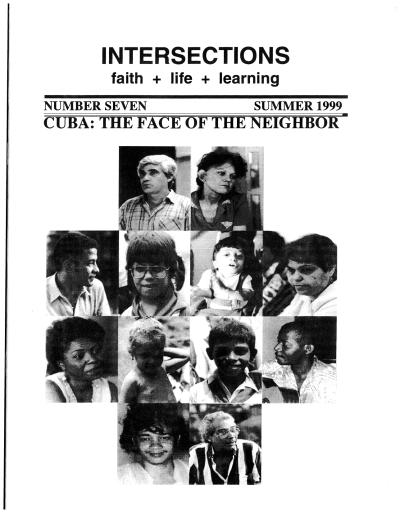
The Face of the Neighbor: An Interview with Four Capital University Faculty About Their Recent Visit to Cuba
Brian Forry Wallace, Michael Yosha, Reg Dyck, Susan Narita
No. 7 · Summer 1999
Four Capital University faculty—political scientist Brian Wallace (returning to Cuba a third time after the 1994 boat lift), English professor Reg Dyck, ESL teacher Susan Narita, and political scientist Michael Yosha—recount their summer 1998 trip with Pastors for Peace, describing Cuban priorities of education, health care, and military (in that order), the cultural richness of Havana from sixteenth-century cloisters to Miramar, the Cuban Foreign Service’s vision of a Scandinavian-style democratic socialism, the counter-productive U.S. embargo (including its effect on kidney dialysis machines), Castro’s 1991 reconciliation with religious communities, and a recurrent image of a little girl named Marguerite singing at a school for amputee and terminally ill children. The interview was conducted by Capital senior Jessica Brown and Tom Christenson.
-
 Poem
Poem
Two Poems: The Advent Carol / The Madonna of Dohany Street
Brian Forry Wallace
No. 2 · Winter 1997
Two poems by Brian Forry Wallace of Capital University: “The Advent Carol,” a litany of the babies who were not adored—the Jewish baby shot with a Luger, the Black child hanged from a tree, the female messiah tossed into a river, the Tutsi infant cut by machetes, the Japanese newborn incinerated by atom bombs, the Chinese baby crushed by Japanese bombs, the aborted Mary’s child—ending with the baby “whom we do not understand, cannot feed, whom we kill”; and “The Madonna of Dohany Street,” on a Holocaust photograph in a Budapest museum of a dead mother and her dead Christ-child daughter in the former ghetto, in which annunciation, nativity, adoration, and crucifixion are seen together in a single instant.
-
Poem
Two Poems: The Advent Carol / The Madonna of Dohany Street
Brian Forry Wallace
No. 2 · Winter 1997
Two poems by Brian Forry Wallace of Capital University: “The Advent Carol,” a litany of the babies who were not adored—the Jewish baby shot with a Luger, the Black child hanged from a tree, the female messiah tossed into a river, the Tutsi infant cut by machetes, the Japanese newborn incinerated by atom bombs, the Chinese baby crushed by Japanese bombs, the aborted Mary’s child—ending with the baby “whom we do not understand, cannot feed, whom we kill”; and “The Madonna of Dohany Street,” on a Holocaust photograph in a Budapest museum of a dead mother and her dead Christ-child daughter in the former ghetto, in which annunciation, nativity, adoration, and crucifixion are seen together in a single instant.
-
 Editorial
From the Publisher
Mark Wilhelm
No. 31 · Winter 2010
Wilhelm traces his decades-long enthusiasm for the Lutheran doctrine of vocation from his St. Olaf days reading Luther’s Open Letter to the German Nobility, notes Parker Palmer’s lecture-circuit ministry and Mark C. Taylor’s reflections on calling, and argues that ELCA colleges should claim vocation as the defining mark of Lutheran higher education—yet warns that vocation risks becoming “the program du jour” rather than a permanent hallmark.
-
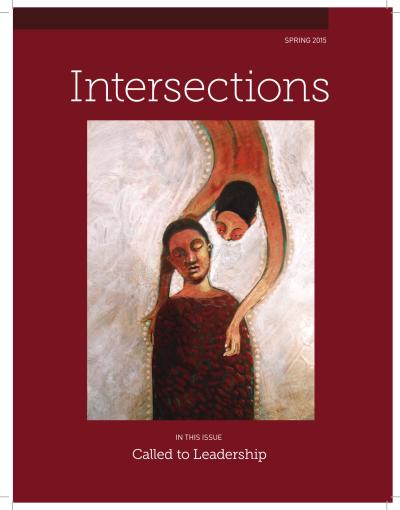 Article
The Dangers of "Vocation" for Students Thinking about Career
Carl Hughes
No. 41 · Spring 2015
Hughes warns that Lutherans too often use “vocation” as a theologically glorified synonym for a fulfilling career — a misuse that constricts God’s call to our jobs and excludes minimum-wage workers, caregivers, and others from the dignity of calling. Recovering Luther’s expansive understanding, he argues that vocation refers first to people, not professions, and must always be bigger than any one aspect of our lives.
-
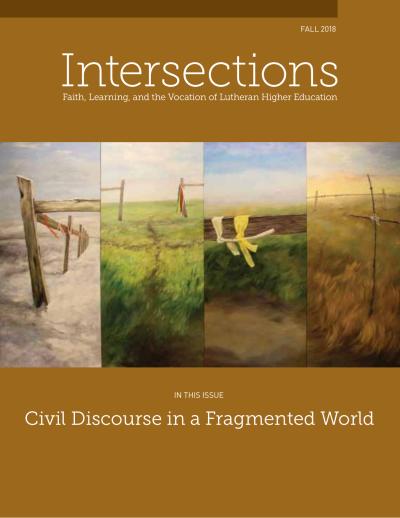 Article
It's Time to Rewrite the Rules of Civility
Jon Micheels Leiseth
No. 48 · Fall 2018
Leiseth contends that the prevailing rules of civility too often function as the majority’s rules, stifling those facing real harm — and proposes that NECU institutions rewrite civility as “neighboring,” guided by the ELCA’s five values of accompaniment: mutuality, inclusivity, empowerment, sustainability, and vulnerability.
-
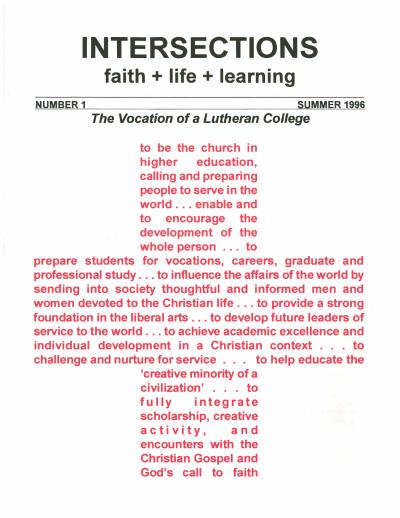 Response
"Whose Future?" or "Social Justice and the Lutheran Academy?"
Marsha Heck
No. 1 · Summer 1996
Heck argues that the future of Lutheran higher education lies less in defining Lutheran distinctiveness than in moral action grounded in face-to-face relationships with others. Drawing on David Lotz’s two-kingdoms theology of citizenship, Ernest Simmons’s relational reading of Luther, Arthur Preisinger’s indictment of the German Lutheran misreading of two kingdoms during the Third Reich, Starla Stensaas of Dana College, and Paulo Freire’s dialectic of empowerment, she calls Lutheran colleges to integrate moral reflection with moral action—to move students’ muscles against what is not true as well as to feel truths in their bones.
-
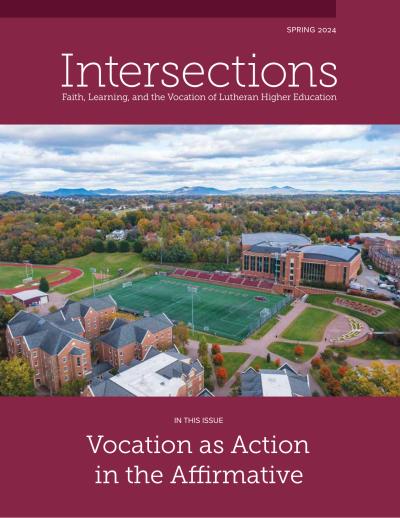 Article
What Our Lutheran Heritage Entails for Lutheran Colleges and Affirmative Action
Mark Ellingsen
No. 59 · Spring 2024
Ellingsen argues that the Lutheran Two-Kingdom Ethic — far from leading to political reaction — supports the church-relatedness of ELCA colleges and obligates them to keep affirmative action alive, even reading a Chief Justice Roberts “loophole” in Students for Fair Admissions v. Harvard as an open door for Black community partnerships, ELCA congregations, and Lutheran colleges to act in the affirmative.