The Lutheran Theological Tradition and Recruiting Lutheran Students
Intersections No. 13 · Winter 2002
Vocation of a Lutheran College Conference: Valparaiso University, August 2, 2001
I was fortunate enough to have a new computer installed in my campus office this fall. As I sat staring at the CRT screen and trying to figure out the new procedures for “Windows 98” I was reminded of what happened when Abraham tried to install “Windows 98” on his old 486 computer. As he too sat there staring at his CRT screen reading the install directions, somewhat like a cow staring at a new gate, Isaac walked by and with the presumption of youth quickly sized up what his father was doing. He observed, “Oh Dad! That old computer of yours does not have enough memory to run ‘Windows 98’!” Abraham’s countenance became crestfallen and as his chin fell to his chest he began to shake his head slowly back and forth and to mutter “Isaac, Isaac, Isaac!” under his breath. “Have you still not learned? Do you not yet know that God will provide the Ram!”
I like this joke for two reasons; first that I think it is a funny joke but also because it is a humorous example of the interaction of faith and learning. It is an example of the need to connect faith and learning because one needs BOTH some knowledge of computer science, e.g. nature of computers, RAM, windows, etc. AND the biblical tradition of Abraham and Abraham’s sacrifice of Isaac. The questions is—How many of our students or their parents would get this joke? I am sure most of them know about “random access memory” but how many of them would know the story of Abraham and Isaac? The joke is a dialogue, a dialectical relating of the realms of faith and learning. For this dialog to work, however, there must be persons on our campuses willing and able to engage in the dialogue. It is toward the sustaining of such a dialogue that my remarks will be addressed.
I would like us to reflect on just two questions this evening; What are the attitudes and issues of our students and their parents regarding Lutheran Higher Education, and what theological resources are there in the Lutheran tradition with which to respond? The central point of my reflection this evening is that today mission and marketing go together. In this new market era of limited religious background, the more intentional we are about our identity and mission the clearer we will stand out to future students and their parents. The most important task before all of us is to keep the questions of faith and learning alive on our campuses as a clear expression of the church in mission in higher education. To the degree that we intentionally embody our mission we will address many of the concerns of our future students and their parents. I have broken this presentation down into two basic parts. The first is a brief overview of current students and parents regarding their differing needs and hopes. For this section I will draw upon two books. With regard to current students, I will draw upon the fine book When Hope and Fear Collide: A Portrait of Today’s College Student by Arthur Levine and Jeanette Cureton1. With regard to their Generation X parents and their religiosity, I will use the intriguing book Virtual Faith: The Irreverent Spiritual Quest of Generation X by Tom Beaudoin2. Both books were published in 1998. In the second section I will address three areas from the Reclaiming Survey which I believe are relevant to the Lutheran Higher Education Tradition: a sense of community, cultivating mentoring relationships and finally the relationship of faith and values in higher education. I will then bring these concerns into relationship with some of the material from my book. In closing I will raise a few questions which I hope will stimulate some discussion for us during our time together.
PART I: STUDENT/PARENT OVERVIEW
First, let me give a brief caveat. I am a theologian, not a social scientist, so what I will be summarizing about these generations is from a non-specialist perspective. Also, in light of this research I do have some concern about what may be a basic assumption expressed in the survey title. I am not sure that the title “Reclaim” is relevant. If we mean by reclaim, making a new claim on students over whom we have had no prior claim, to reclaim some of our “market share,” then certainly the title is appropriate. But if we mean to restake a claim on students and parents over whom we have had a prior claim then we are probably far from the mark. It is to the first understanding that my remarks will be addressed this afternoon. I believe all bets are off in terms of prior claims on these future students and their parents. It is in this context that I will address the question of theological resources in the Lutheran tradition. There is room for optimism, however, because I believe that the Lutheran Model of Higher Education is particularly suited to the open-ended, spiritual searching and yearning that typifies both this current student generation and their GenX parents.
STUDENTS
Let’s begin by taking a brief look at our current students. Traditional age students who began college last fall were born in the year 1982. They are the first born of what Howe and Strauss in their book Millennials Rising: The Next Great Generation refer to as the “Millennial Generation,” those who graduate high school starting in the year 2000.3 Let me give you a few examples of what these students have or have not experienced.
They were 4 when the space shuttle Challenger exploded.
They were only 7 when the Berlin Wall came down.
They were 9 when the Soviet Union broke apart, and do not remember the Cold War.
There has only been one Pope.
They never had a Polio shot, and likely, do not know what one is.
Their lifetime has always included AIDS, being born the year after AIDS was identified.
They have always known MTV and the Compact Disc because both made their debuts in the year before they were born.
There have always been VCR’s, but they have no idea what Beta is.
The Vietnam War is as ancient history to them as WWI, WWII or even the Civil War.
They do not care who shot J.R. and have no idea who J.R. is.
Michael Jackson has always been white.
Kansas, Chicago, Boston, America, and Alabama are places, not bands.
McDonald’s food never came in Styrofoam containers.
Turning to a more systematic overview of the current student generation, Levine and Cureton indicate that a significant change occurred in student attitudes and values starting in about 1990. They view our current students as much more hopeful and socially concerned than their counterparts were in the late 70’s and 80’s but also deeply troubled. They are very comfortable with the Internet and global connections, being part of what Don Tapscott calls the “Net Generation.”4 But there is widespread suspicion of all institutions and a sense of victimization and being overwhelmed. They see politics and social involvement as primarily local where they can be involved and make a difference. Levine and Cureton conclude that students of the late 90’s are more socially active than at any time since the 1960’s. (p. xiv)
There has also been a significant shift in social and academic life. Many of the social activities such as drinking, parties, sports, music and movies remain but most students are working more and longer hours with much less time for socializing. Levine and Cureton observe, “Undergraduates are also coming to college more damaged psychologically. Binge drinking is on the rise, and traditional dating has all but disappeared from social life. Students are more socially isolated, have little time for social life, and are afraid of getting hurt.” (p. xv) Sleep is even listed as a form of recreation. (97) Academically they are still career oriented with more students saying they work hard but there is a tendency to confuse working hard with being intellectual, “Time spent means achievement attained.” (124) More remedial education is now required than for their predecessors. There also seems to be a growing gap between the ways in which faculty teach and students best learn, with faculty preferring the global and theoretical and students the direct and concrete. Yet students still report a high degree of satisfaction with their academic experience. (128-131)
With regard to hopes and dreams Levine and Cureton observe that, “Belief in the American Dream is stronger than ever students want good jobs, financial success, meaningful relationships, and a family. Although they are optimistic, they are also scared—everything seems to be falling apart. They worry that they will be unable to find jobs, afford a family, be able to pay back their student loans, or even avoid moving back home with their parents.” (p. xv) This student generation is not easily described and seems to involve a number of tensions if not outright contradictions. Levine and Cureton describe them as “deeply ambivalent” (127) and for that reason understand them as a “transitional generation” coming during a time of social and historical discontinuity. (151-6) There is a new world abornin’ and these students know it and, like we, do not know what it is going to look like. Unlike us, however, they are not yet professionally established so as to hope to be able to ride it out and this frightens them. Much of this can be seen indirectly through the Reclaiming Survey, especially the desire for community and mentoring relationships as well as the need for faith and values to guide them through such a transitional period. Peggy Wehmeyer, religion reporter for ABC News, reported on January 28, 2000, that there is serious interest in spirituality among today’s young people and a deep yearning for meaning beyond materialistic consumption. She reported that college religion courses nationwide are overflowing. Our colleges are strategically placed to offer responses to these needs if we can be conscious and intentional about addressing them. We will come to that in Part II but first I would like to briefly turn to some reflections about their Generation X parents and their religious attitudes.
PARENTS
By the widest sociological definition of a generation, twenty years, last year’s entering class is the very last that could possibly be considered part of generation X. Many sociologists would close off generation X much earlier, around 1977 or before. What this means, of course, is that Generation X is no longer our students. They are the parents of our students. Certainly most of the parents of 9-10 grade students surveyed in the Reclaiming Lutheran Students Study are. In his interesting book on Generation X religiosity, Virtual Faith: The Irreverent Religiosity of Generation X, Tom Beaudoin states the very clear difference in fundamental questions comparing Generation X with their “Baby Boomer” parents. Baby boomers he argues fundamentally are interested in personal existential issues. Their question is, “What is the meaning of life, particularly, my life?” We see this expressed in boomer’s drive for success but also in flagrant boomer consumption. X’rs, Beaudoin argues, ask a different question, “Will you be there for me?” (140) There is a frailty that pervades the Xer experience of relationships and moves them to constantly ask this question. A common thread of Xer experience is the sense of abandonment, the “latchkey generation” who came home from school to an often divorced and empty home where T.V. and later computers became the main relationship. Beaudoin argues that Xers thus grew up with remotes in their hands so that popular culture became the main way in which to express their values and, as such, their religiosity.
There is a tremendous suspicion of governmental institutions. He observes, “A generation born during Watergate, nourished on the stories of baby boomer protest against ‘the war,’ and exposed to Iran-Contra hearings in the 1980’s, had little trust left in the possibility of a benevolent government.” (11). Because of the sense of abandonment and betrayal this suspicion also carries over to religious institutions as well. Beaudoin quotes Michael Cohen (1993, p.97) in his book The Twentysomething American Dream as seeing a common Xer response voiced by “Suzanne” when she explains, “one of the reasons I do not go to church like I should [is that] they’re just hypocritcal.” Beaudoin adds, “This common attitude affects the value Xers place on ‘religious’ practice and is the most common charge I have heard from Xers about religion. The perception of hypocrisy is one reason religion is not a security blanket but a wet blanket to so many.” (25) Howe and Strauss in their work, Thirteenth Generation, report that, “religion ranks behind friends, home, school, music and TV as factors [Xers] believe are having the greatest influence in their generation.” (1993, p. 187) Is it any wonder that the TV show “Friends” is one of the most popular shows with this demographic group? Beaudoin observes, “For my peers, (He was born in 1969.) this distancing from religion often wasn’t new at all, because their families had treated religion as a disposable accessory. Many baby boomers had kept institutional religion at arm’s length until midlife. For their children, GenXers, the step from religion-as-accessory to religion-as-unnecessary was a slight shuffle, not a long leap.” (13)
The news is not all bad however. He goes on to add, “What intrigued me by the late 1980s was the way the Xers remained ambivalent or hostile to ‘religion’ in general but still claimed a sense of ‘spirituality’ in their lives.” (Ibid.) Beaudoin, among others, indicates that while there is a suspicion of institutional religion, there is also a deep spiritual hunger and that spiritual and ethical values are something deeply sought by this generation even if it is quite a hodgepodge. Just go to your local Barnes and Noble or Borders bookstore and look at the spirituality and inspiration holdings, not to mention the proliferating websites for spirituality and spiritual growth. This also partly explains the phenomenal attention given to the book Tuesdays with Morrie by Mitch Alborn. Beaudoin understands Xers as having a sense of ambiguity as central to faith and that suffering has a religious dimension to it. Indeed this generation may be well positioned to appreciate a theology of the cross. While Xers are comfortable living in media driven virtual realities, they know the difference and are particularly attracted to the concrete expressions of service and faith. Beaudoin sees this generation as more interested in Jesus than in the church. He observes, “They [Xers] know that if religion doesn’t go into the streets, the streets will overtake religion. I have personally known dozens of Xers who have been spiritually kickstarted by working in soup kitchens and food pantries for the poor.” (79) It is no wonder that service-learning experiences appeal strongly.
Beaudoin concludes his analysis of GenX religiosity with a double look at both what the Church can do for Generation X and what Generation X can do for the Church. One of the most important things that Generation X can learn from the church is Tradition, with a capital “T”. Drawing upon Jaroslav Pelikan’s famous insight that, “Tradition” is the “living faith of the dead” while “Traditionalism” is the “dead faith of the living.” Beaudoin points out that Generation Xers are looking for foundations and a creative way to reclaim religious traditions. Virtual faith needs to be grounded in historical reality and community. As Gadamer observes, “To be situated within a tradition does not limit freedom of knowledge but makes it possible.” (52) Tradition can be presented as active preservation and not mindless repetition.
Tradition functions as an ongoing, identity forming process. To lose or forget one’s past is to disconnect from the previous identity forming process. It is also to leave oneself contextless in addressing the future. To know who we are is to know from where we have come. The understandings, experiences, histories and conceptualities that have formed us need to be shared and transmitted. Not as a harness by which to plow or a straightjacket to limit diversity, but as windows upon reality to allow us a vision by means of which to venture forth and return. Tradition at its best gives perspective from which to engage the novel. At its worst tradition can refuse change and court irrelevance, by retreating to some nostalgically perceived halcyon past. The challenge for both the church and the colleges, if they are to connect with the concerns of Generation X, is to maintain tradition as a compass by which to approach the future and not a lock by which to close it out!
Finally, Generation X also has something to tell the church. As Beaudoin approaches the matter, there is a renewed call to humility and the liberation of Jesus, for the churches to stop domesticating their core message. There is scandal in the cross and the church would do well to affirm the intrinsic tension between the way of Jesus and the way of the world. This would also take seriously the religious dimensions of suffering and the role of ambiguity in faith. Dietrich Bonhoeffer is seen as representative of such an understanding of the Christian faith by Beaudoin, who is himself a Roman Catholic.
PART II: RECLAIMING LUTHERAN STUDENTS
I hope this brief overview of current students and Generation X religiosity has been helpful in contextualizing some of the survey responses. We will have another presentation on the survey so I will not deal with issues like the importance of critical thinking skills but rather simply take them for granted. Instead I would like to turn to several salient points in the survey results which relate specifically to theological resources. I would like to address three areas where I think Lutheran colleges are particularly well situated given the theological and educational resources of the tradition. These are the areas of a strong sense of community, cultivating mentoring relationships, and finally integrating faith and values in the college experience.
COMMUNITY
The survey indicates not only that students have a sense that our colleges are safe but 86% indicated that there was a strong sense of community among students and 82% indicated that faculty were interested in students personally as well as academically. This is in contrast to flagship publics where the percentages were 54% and 35% respectively. This is wonderful news and indicates that we are living up to our claims about the importance of community in a learning environment.
The noted Lutheran theologian George Forell who spent virtually his entire professional life teaching in a public university setting (The University of Iowa) when asked what should be the distinguishing characteristic of the church college replied without hesitation “community”.5 One can study the Christian faith at a public university but one cannot have the faith tradition inform the life of the academic community and bind it together. At a college of the church the faith tradition can provide a basis for care and grace among its members. Church-relatedness can support a community ethos in which faith can be encountered without being imposed. This is a movement from below where the interactions of persons in the community can become windows of transcendence, windows of witness, to others as they mentor them in their faith journey. This is not just the responsibility of the religion department or the campus pastors office. Community is built by the full participation of all of its members, diverse though they may be, including those of differing faith traditions.
Community resides in trust and in the willingness to transcend self-interest for the sake of the other. It is empowered by that around which the community gathers, indeed what it has in “common” to form the communio, the community. At this time in American society community is in short supply. Many of our students have not experienced community even at the family level much less at the larger institutional and societal levels. When a child does not experience trustworthy care-giving their vision of life and of the world can develop into one of mistrust and fragmentation governed by survival instincts. Church colleges can provide a nurturing and supportive vision of community. One which will allow all its participants to grow and develop their potential.
Yes, this is somewhat idealistic but that is the point about vision. If one never has their vision elevated from the street all they will ever see, like Plato’s cave dwellers, is the surface in front of them with its cracks and two-dimensionality. We have an obligation to lift our students vision higher and may well find our own elevated in the process. The function of the ideal, as Plato taught us, is to create a measuring rod, a canon, by which to understand our own position and from which growth can be measured. It is a form of “management by objective” if you will. If we do not have clear goals for ourselves and our community we will not achieve anything more than self-maintenance, and even that will deteriorate over time. Our students and their families are looking for clear alternatives beyond anonymous mass production in education. The community we can nurture on our campuses is a clear alternative and while valuable in itself is also helpful in representing the college to others. There is thus both an intrinsic and a pragmatic rationale for the cultivation of community on our campuses. How then can we achieve it?
While all persons on campus participate in and contribute to community, it is the faculty who must take the lead in its establishment and maintenance. Community cannot be assumed or taken for granted. It must be worked at continually. Faculty must be permitted enough discretionary time to allow free contact with their colleagues so that trust levels may be built up. To support community, faculty must trust one another enough to be willing to openly discuss community values, commitments, and faith traditions without fear of reprisal or rebuke. Community is built upon trust and trust requires time for interpersonal contact, caring, mutual respect and cooperation to develop. Community requires personal self-transcendence in order to serve the common good both in and out of the classroom. Perhaps our mission as academic communities has not so much changed, as it needs creative new articulations of the common good on our campuses.
MENTORING AND VOCATION
The survey indicates that 61% of our alumni had developed a mentoring relationship with a faculty member. In contrast, flagship publics indicated 39% with a mentoring relationship and a sobering 48% said that they had NO ONE who served as a mentor. To journey through higher education with no one to serve as a mentor is a tragic occurrence and makes the task of finding one’s vocation extremely difficult.
We are most affected in life by those persons who have embodied genuine humanity and faith for us and opened up our own possibilities to do the same. Spirituality comes through embodiment. It is in the encounter of individual lives as they are given for the needs of others that spiritual mentoring occurs. Spirituality comes in lecturing, writing, questioning, listening and serving…in sojourning with others in the community of inquiry which is academic life. It means “being there” for others as one incarnates one’s own faith in life. It is through personal encounter and experience that education and understanding are born as the mentors we meet assist us in giving rise to thought. Faith frees the mind for open inquiry and creative reflection for we are not saved by our own understanding but by the grace of God. From the survey results we see that our students and their parents seek colleges that will provide such personal mentoring opportunities in spirituality.
The human question of why always hangs suspended between the finite and the infinite. Juxtaposed between time and eternity, humanity seeks meaning before its own beginnings and after its demise. Part of the grandeur of being created in the image of God, of humus (soil) become spirit-breathed and self-conscious, is the ability to ask why. Human beings are meaning-seeking creatures. We are a form of incarnation where the spiritual is made manifest in the material precisely in the transcending of self-interest. Spirituality is opening up to the needs of the other, to transcendence of the self and to possibilities of meaning beyond materialistic consumption alone. The study of the liberal arts assists one in opening up to the transcendent dimensions of life and in so doing equips faith for meaningful expression in service to the other. That is why there has always been a close connection between liberal arts education and the Christian faith.
The purpose of Christian higher education is to conduct education in the context of the Christian faith, faith seeking understanding. But what is the Lutheran difference in higher education? Luther’s answer is vocation. We are called by God to incarnate faith through vocation as loving service in the midst of the world. Christian vocation is the living out of baptismal faith in the midst of the creation as one seeks to be a “little Christ” to one’s neighbor. It is through our work in the world that we incarnate faith and by so doing help sustain the creation. Vocation rejects the separation of the material from the spiritual, of nature from grace, insisting that they be kept together. Vocation is for the earth and the world of today so that as Swedish theologian Gustaf Wingren summarizes “Human action is a medium for God’s love to others.” The world of today is not a neutral place, but rather one of competing and conflicting powers in which struggle is a daily experience. It is for this reason Luther argued against leaving the world for the cloister, for this would be to abdicate one’s calling to serve God against the forces of destruction present in the world.
In Luther’s view the fundamental purpose of Christian education was the preserving of the evangelical message and the equipping of the priesthood of all believers for service in the church and the world. For Luther and his colleague, Philip Melanchthon, one of the direct results of the theological doctrine of justification by grace through faith was public education. For Lutheran higher education that purpose has not changed, but the manner in which it is carried out must reflect our contemporary context of meaning. The task is to bring into creative interaction relationships of faith and learning as those relationships encounter an increasingly global and multicultural society. The Lutheran model of higher education affirms the importance of diversity and the need to dialogue with multiple points of view. This means that all persons are important and contribute to the character of a community of inquiry including persons of other faith traditions.
Finally, of course, it is not institutions per se that are religious but individual believers. It is people who embody mission and incarnate their faith through their vocation. In so doing, alternative possibilities may be envisioned that will constructively critique the present and provide a source for hopeful change in the future. It is in light of what might be that one can become empowered to critique and change what is. Our society desperately needs informed and reasonable discussion of religious beliefs and our students bring that same need with them when they come to our campuses. In a culture where public discourse, especially about matters of religion, is not encouraged or even welcome, colleges of the church may offer one of the most effective venues for such deliberations. Our students, our society and our religious institutions need such reflection.
INTEGRATION OF FAITH AND VALUES
There are a number of elements in the survey pertaining to the Integration of faith and values into the college experience. Let me select on a couple. First 60% of Lutheran college students said that they learned more about their faith during college, including 38% who found spiritual life models in faculty or staff while only 14% at flagship publics, with only 8% finding models. In addition, 65% of Lutheran college alumni reported experiencing the integration of values and ethics in the classroom as opposed to only 25% at flagship publics. This should not surprise us given the way the separation of church and state is currently interpreted in public higher education. Going on to the Gen. X parents part of the survey, 88% of them said that an emphasis on personal values and ethics was important, the highest concern in the survey. There may be suspicion of religious institutions but the interest in spiritual values comes through strongly here, especially for their children. The connection between faith and values is at the heart of our mission and it is what our students and their parents would be looking to us to provide. In much of higher education there has occurred a separation between these two. How and why has such a separation occurred?
Ever since the Enlightenment, higher education has sought meaning through the ideal of pure reason. Pure, neutral, objective and rational analysis has been a goal not only in the natural and life sciences but also in many other disciplines of the liberal arts. This emphasis upon reason has produced great success in many ways and the gains of this effort must not be lost. But as the Twentieth Century comes to a close it becomes all too apparent that this inordinant rationalism has come at a cost. Too often “objectivity” was interpreted as “value free” with the consequent separation of fact and value and, of course, reason and faith. At the end of a century that has seen brutality on a massive scale, often technologically exacerbated, it becomes increasingly apparent that the life of the mind must be connected with the life of value and of faith as George Marsden and Glenn Johnson have argued before you on previous occasions.
Educator Parker Palmer observes that, “Ways of knowing are not neutral but rather have moral trajectories that are morally directive.” Ways of knowing necessarily include ways of valuing so a complete separation of fact and value is not possible. All “facts” are contextual truths, which arise through an interpretive context that is value laden. It is the interpretative process that translates raw data into meaningful fact and it is here that values are imbedded in the process. Technology is a prime example of the intentional connecting of fact and value. The values intrinsic in scientific knowledge are given embodied expression through the technological application of that knowledge.
The Lutheran Tradition in higher education has always insisted upon such a connection between fact and value, between reason and faith. Luther referred to the rule of God as occurring in two kingdoms or realms. There is the world of today in which God rules indirectly through the order in nature and the human extension of that order into civil law for a just society. In this realm, what Luther referred to as the “Left Hand of God,” reason is the most critical faculty. Reason reigns supreme in discerning the order of creation and the natural law God has placed within it. Education must involve the use of reason to discover the beauty, complexity and glory of God within the creation, in everything from music to mathematics. Reason, for Luther, only becomes prostituted, misused, when it attempts to determine one’s relationship with God. In all things under human influence, reason is to exercise its full sway. But in the economy of God, allowance must be made not only for the grace of creation but that of salvation and the faith which receives it. This is the world to come, the “Right Hand of God,” the realm of faith.
For Luther, these two realms converge in the life of the individual Christian in the everyday world as they seek to live out their faith in loving service to others. This is the calling of the Christian to actualize their Christian freedom in vocational service. For Luther, education must necessarily involve both reason and faith, both the left and the right hands of God because education is preparation of the priesthood of all believers to make their faith active in love. During the Enlightenment, however, this dynamic, dialectical, vision of education became lost in the desire to emphasize reason to correct the perceived religious fanaticism that had led to the Thirty Year’s War. With it, however, education became conducted with one hand tied behind itself.
One can image public higher education as being conducted using only the “left hand,” the hand of reason, and the “right hand,” the hand of faith, being tied behind it. One can function this way but clearly it is a disadvantage. It is difficult, if not impossible, to pick up heavy objects, express appreciation, and live a balanced life. The metaphor that the body has two arms but only one head, indicating two methods of activity proceeding from a common source, is lost. Public education affirms academic freedom at the cost of Christian freedom.
Conversely, but to a lesser extent, the church can sometimes be imaged as so preoccupied with the role of faith as to de-emphasize, if not neglect, the role of reason and the intellectual life. It moves with its “left hand” tied behind itself. This too leads to disadvantages, particularly in relating faith to contemporary life and thought. Too frequently the church can be found encouraging a rather fascile faith that borders on emotionalism rather than reflective judgment and commitment. It affirms Christian freedom but perhaps at the cost of academic, intellectual freedom.
Obviously, the Lutheran Tradition envisions higher education as employing both hands to relate faith and reason, values and reflection. For this to occur, however, academic freedom, which is a product of the “Critical Current” (Ahlstrom) in the Lutheran Tradition must be honored as well as Christian freedom. Academic freedom does not mean absolute neutrality in learning and reflection but rather the free and open debate and dialog between various perspectives of learning, the various personal and social contexts in which knowing takes place. Academic freedom assures an open playing field, not that there are no teams on the field. The Lutheran Tradition in higher education therefore demands that both freedoms be present on our campuses. To have only the “left hand” is to lose Christian freedom. To have only the “right hand” is to lose academic freedom. Public universities often embody the former and many Christian colleges only the latter. The Lutheran difference in higher education is to insist on the dialectical relationship of both freedoms, of both hands, as they serve the will and grace of the one God as their head. Two handed education is capable of bearing the heavy load of value reflective inquiry and informed ethical service. But for this to occur there must be persons on our campus who are willing to engage in such a dialectic and are interested in and committed to both freedoms.
If we do not do this, who will? The Church is not equipped for such an educational task and, because of the separation of church and state, we cannot expect the public universities to do it. We must do it, or it will not get done. Nothing less than the continued engagement of the Christian Tradition with contemporary life and thought is at stake. The public sector is not obliged and congregations do not have the resources. As Steven Carter has pointed out, it is difficult to discuss religion in public education and even in the public square in a reasoned and responsible way. It is seen either as fanatical or dismissed as a hobby. Our campuses and our sister institutions in the Christian tradition may be some of the few places within our society where a responsible discussion of religion can take place today. The Reclaiming Students Survey indicates that both students and parents are critically interested in such connections. If we hold true to our educational tradition and mission such connecting of faith and values will take place on our campuses.
CONCLUSION
To stimulate discussion I would like to close by briefly listing a series of questions we might want to explore in the time we have together. There are questions of an overall nature such as the “Why we are here?” variety. What distinguishes our own institutions from public education institutions? From other Christian institutions? From other sister Lutheran institutions? Should there even be differences? There are also questions of a more specific nature such as: What is the Lutheran understanding of academic freedom? What is the role of other faith traditions on campus? How does a theological heritage inform academic life? What is the particular contribution to the understanding of vocation that this institution can make? What do you think of the different models of Christian Higher Education? Should there be more than one model on campus? What is the faculty’s role in the faith development of students? Is it a faculty responsibility to assist them? What is the role of one’s own faith development in one’s work at the university? In the midst of congested campus calendars and lives is there time for community?
In light of the survey data and the theological resources just discussed, there are three final questions I would like to raise.
How do we recruit and retain mentoring faculty? This involves not only the cultivation of community on our campuses but also of nurturing loyalty and service beyond mere contractual obligations. Faculty development is key here since most graduate programs at research universities do not connect faith and learning. Programs like the Vocation of a Lutheran College Conferences and the Lutheran Academy of Scholars or individual college initiatives such as the Dovre Center for Faith and Learning are beginning to address these needs but more is needed.
How do we get church leaders to know more about us and advocate for us more? This is one of the more disturbing pieces of information from the survey, that so many of our “thought leaders” seem not to know who we are. This is a critical area for work.
Finally, how do we educate potential students and parents about the value of liberal arts education at colleges of the church? It is the most effective form of higher education to accomplish their goal of connecting faith and values in a meaningful career path. We do have many sympathetic listeners among parents and students which would not be typical of their generations as a whole.
There is no one way to respond to these challenges. The most critical process is to be willing to constructively undertake them, and keep the dialog of faith and learning open and growing. That is at the heart of the Lutheran Tradition in Higher Education and also at the heart of the life of faith. The life of faith has always involved courage and risk and that includes the academic life of faith as well. Will we be as courageous and riskful as our predecessors whose positions we now occupy? Will we be as faithful? Our times call for new expressions and creative responses, not mere repetitions and redundancies. We do stand on the threshold of a new age for church related higher education and the mantle is now upon our shoulders. Undertaken in humility and faith our tasks are achievable for we have the same spiritual resources at our disposal as Luther and Melanchthon, Muhlenberg and Schmucker, Hauge and Walther. We are simply called to go and do likewise for our time.
Endnotes
- Arthur Levine and Jeanette S. Cureton, When Hope and Fear Collide: A Portrait of Today’s College Student, Jossey-Bass, 1998.
- Tom Beaudoin, Virtual Faith: The Irreverent Spiritual Quest of Generation X, Jossey-Bass, 1998.
- Howe, Neil and Strauss, William. Millennials Rising: The Next Great Generation, Vintage, 2000.
- Don Tapscott, Growing up Digital: The Rise of the Net Generation, McGraw-Hill, 1998.
- In reply to a question at a public lecture “The Vocation of a Lutheran College,” at Concordia College, Moorhead, MN, April 8, 1997.
-
 Editorial
From the Publisher
Arne Selbyg
Selbyg reports that Executive Director Leonard Schulze has challenged the ELCA Division for Higher Education and Schools to develop a comprehensive communications plan reaching high school students, college students, parents, pastors, and journalists, and invites Intersections readers to review the redesigned elcacolleges.org website, the “FREE STUFF” brochures, the journal’s advertisements in The Lutheran and related publications, Ernie Simmons’ new Augsburg-Fortress book Lutheran Higher Education: An Introduction, and the ELCA video magazine Mosaic—and to send in their own ideas.
-
Editorial
From the Editor
Tom Christenson
Christenson previews a varied issue—Darrell Jodock’s Bernhardson inaugural lecture, Ernie Simmons’ Valparaiso conference talk on student/parent attitudes, two South Africa travel pieces by Brian Wallace and Corin Wesner, and reviews of Richard Hughes’s and Robert Benne’s recent books—and tells the story of “the church lady from hell,” a mid-fifties returning student who condemned everyone in the class with “God and I think…,” to ask what a religious tradition without a sense of humor would look like.
-
Article
Freedom, Humor, and Community: A Lutheran Vision for Higher Education
Darrell Jodock
Jodock’s inaugural lecture for the Bernhardson chair at Gustavus Adolphus develops three interlocking themes drawn from the Lutheran tradition as a deeper grounding for the liberal arts college than contemporary American assumptions. A sense of humor rests on Luther’s discovery that God takes the initiative—Luther could call himself a beggar, joke about the epistle of James, and credit Wittenberg beer for the Reformation—and underwrites the freedom of inquiry that John Updike traces to Grace Lutheran Sunday School in Shillington. Community, grounded in Augsburg Confession VII and Luther’s 1524 letter to the German city councils, makes the college a community of discourse pursuing wisdom rather than “the same old blockheads.” Freedom is both “freedom from” and “freedom for,” illustrated by Nechama Tec’s Polish Holocaust rescuers and by Jodock’s Holocaust-class corporate role-play in which students voted to build a factory in a death camp rather than risk losing their board seats—a vivid case for educating toward “a passion for justice.”
-
Reflection
Truth, Reconciliation, and Redemption in South Africa
Brian Forry Wallace
Wallace, a 24-year veteran political science professor at Capital University, recounts five weeks of post-apartheid peace-building travel-study with students living south of Cape Town—visiting townships, schools, day-care centers, a children’s AIDS hospital, Robben Island, and Nelson Mandela’s cell—and offers vivid sketches of his student companions Amy, Brian, Meghan, Karrie, Patrick, Meredith, Cheryl, Corin, Debbie, April, and Audra. He concludes that these students—atheists and agnostics and Buddhists and Methodists and Baptists, headed for social work, nursing, teaching, ministry, and parenthood—embody vocation by responding to a voice that calls them out of themselves to be present and to heal in this world, and that they are his link to the redemption of a lost and broken soul.
-
Reflection
Sweet on My Lips
Corin Wesner
A passage from Wesner’s travel journal during the same South Africa workshop. Walking into a wood-and-tin shack church where raindrops fall on already-soaked carpet and the service is in Xhosa, she remembers her painted, carpeted home church and her adolescent argument with her mother about wearing a dress to worship, and finds herself engulfed in warmth as the few women sing—welcomed by a stranger’s smile and opened up.
-
Book Review
Richard T. Hughes: How Christian Faith Can Sustain the Life of the Mind
Tom Christenson
Christenson reviews Richard Hughes’s How Christian Faith Can Sustain the Life of the Mind (Eerdmans, 2001), which argues, drawing on Tillich’s notion of “religion breaking through its own particularity,” that faith is a means to the open pursuit of truth rather than its enemy. Christenson reads the argument as a natural fit for a Lutheran tradition of semper reformanda but notes Luther’s own dogmatism toward fellow reformers, and wishes Hughes had drawn a sharper line between an absolute truth that relativizes all human truths and a postmodern abandonment of truth altogether. The book was the most-cited title at the November meeting of North American Lutheran academic officers.
-
Book Review
Robert Benne: Quality With Soul: How Six Premier Colleges and Universities Keep Faith With Their Religious Traditions
Joy Schroeder
Schroeder reviews Robert Benne’s Quality With Soul (Eerdmans, 2001), which assesses the secularization documented by James T. Burtchaell’s The Dying of the Light and names six “bright lights” that resist it: Calvin, Wheaton, Baylor, Notre Dame, Valparaiso, and St. Olaf. Benne argues that piety alone or “generic Christianity” is insufficient—a school’s specific denominational intellectual tradition must permeate mission statements, classroom, and chapel, sustained by a critical mass of identifying faculty (he proposes a 2:1 ratio and at least one-third communicant membership), a first-rate theology department as “trustworthy guardian,” and visionary presidential and board leadership. Schroeder flags the under-representation of student and faculty voices but commends the book as required reading for presidents, board members, and faculty seminars at church-related institutions.
-
 Editorial
Guest Editorial: Moral Deliberation in NECU Classrooms
Ernest L. Simmons
No. 51 · Spring 2020
Simmons introduces the guiding question of the NECU working group: could the ELCA’s twelve social statements and thirteen social messages — expressions of Lutheran social teaching originally formulated for congregational use — turn campuses into “academic communities of moral deliberation”?
-
 Article
Semper Reformanda: Lutheran Higher Education in the Anthropocene
Ernest L. Simmons
No. 43 · Spring 2016
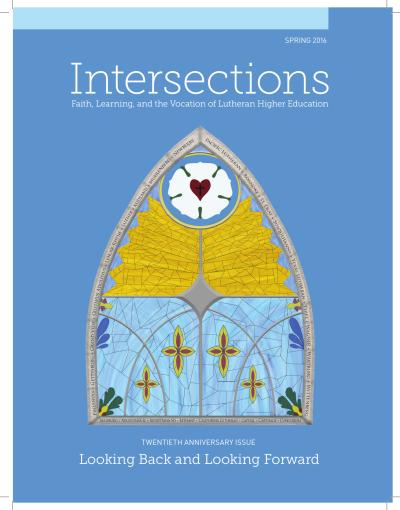
Simmons enumerates the ELCA initiatives over the past twenty years that have helped Lutheran higher education retrieve a Christian understanding of vocation, then argues that the looming reality of human-caused climate change — the geological epoch of the Anthropocene — now requires Lutheran liberal arts education to prepare students for “planetary citizenship” as sustainability leaders, drawing on the classical Trivium, Luther’s panentheism, and a quantum-physics-inflected theology of divine entanglement and hope.
-
 Article
A Lutheran Dialectical Model for Higher Education
Ernest L. Simmons
No. 37 · Spring 2013
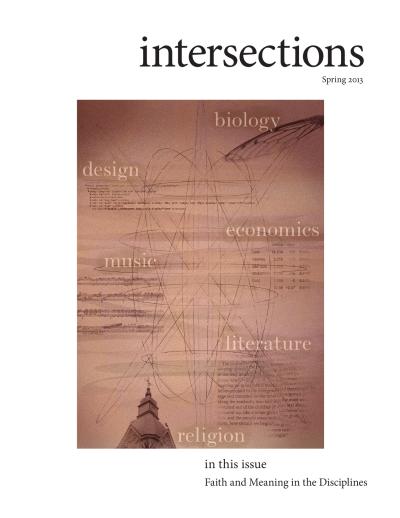
Drawing on “The Freedom of a Christian,” simul justus et peccator, Richard Hughes, Joseph Sittler, Martha Nussbaum, and Tom Christenson, Simmons argues that the Lutheran tradition informs an open, dialectical educational model that holds Christian and academic freedom together. He locates vocation at the intersection of the practical (why are you here?) and the existential (why are you here?) and proposes Lutheran higher education as education for self-transcendence and leadership Soli Deo Gloria.
-
 Article
Lutheran Higher Education and the Public Intellectual
Ernest L. Simmons
No. 26 · Fall 2007
Simmons argues that college faculty and administrators are, like it or not, public intellectuals, and that Lutheran higher education’s dialectical understanding of Christ and culture is well suited to support four functions of the public intellectual: articulating constructive critique of received social explanation (especially the “collage identity” described by Renate Schacht); presenting a transcendent theological perspective through the theology of the cross that takes seriously God’s hiddeness, the presence of ambiguity, and the reality of suffering; pursuing the common good amid the demise of the “commons” through H. Richard Niebuhr’s “Christ and Culture in Paradox”; and educating for citizenship through Christian vocation by connecting the practical and existential dimensions of the question “Why are you here?”
-
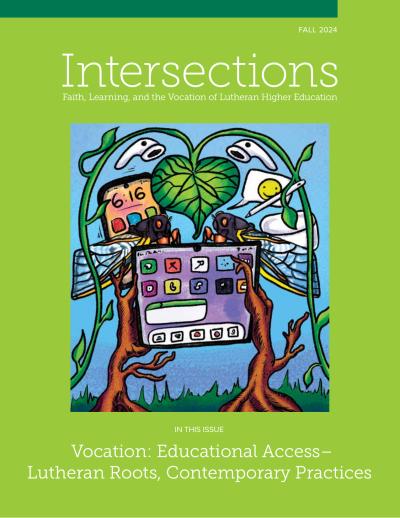 Article
Access, Accessibility, & Change: A Call for Trustworthy Leadership in Higher Education
Emma Jones
No. 60 · Fall 2024
Jones surveys the converging pressures on higher education — cost, the enrollment cliff, shifting demographics, and declining public confidence — and uses Reichheld and Dunlap’s four factors of trust (transparency, capability, reliability, humanity) to call campus leaders to rebuild trustworthy leadership from the inside out.
-
 Editorial
From the Publisher
Arne Selbyg
No. 17 · Summer 2003
Selbyg explains that the four essays in this issue grew out of the first Lutheran Academy of Scholars in Higher Education—a two-week seminar funded by the Lutheran Brotherhood Foundation and the Lilly Endowment, led for its first three years by Dr. Ronald Thiemann of Harvard Divinity School—whose official theme “Finding Our Voice—Christian Faith and Critical Vision” became informally “What’s Faith Got To Do With It?”
-
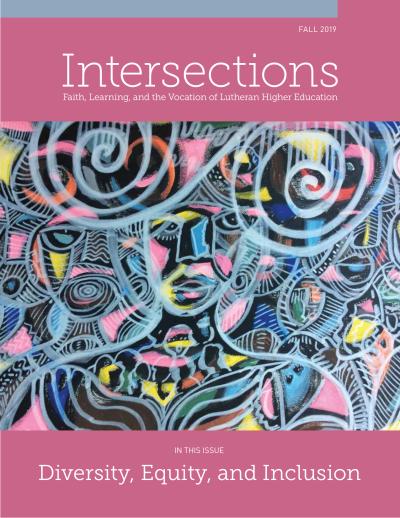 Editorial
From the Editor
Jason A. Mahn
No. 50 · Fall 2019
Mahn opens with Lenny Duncan’s observation that the ELCA is 96 percent white — the whitest denomination in the U.S. — and asks how teachers and administrators at historically, predominantly, and persistently white institutions can turn from white privilege and white supremacy toward spaces where people of color thrive and white people are re-formed into antiracist allies.
-
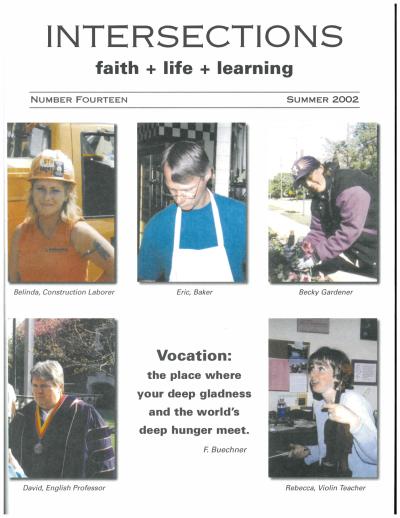 Article
Of Fathers and Feminism: How One Lutheran Woman Came to a Vocation
Karla G. Bohmbach
No. 14 · Summer 2002
Bohmbach, a recently tenured Susquehanna University feminist biblical scholar one month shy of forty, traces her vocation back through a Vacation Bible School injury, an LCMS upbringing in which only men could preach or preside, her father’s contradictory message that she could do anything while modeling a church that limited women, St. Olaf’s revelation of a Lutheran female face, and a Duke graduate seminar on the History of Feminist Thought with Carol Meyers. Her published feminist work on biblical daughters and on the concubine of Judges 19 is read alongside Kathleen Norris’s account of word-bombardment in church, Michel Tournier on childhood as “ardent confusion,” and her own recent participation as both student and teacher in an Authorized Lay Worship Leaders Program.
-
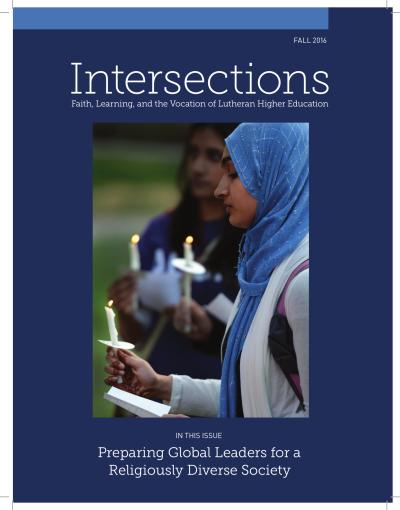 Article
Why Interfaith Work is Not a Luxury: Lutherans as Neighboring Neighbors
Martha E. Stortz
No. 44 · Fall 2016
Stortz argues that interfaith work is not a luxury but a constitutive commitment of Lutheran higher education — institutions she describes as both “faith-based and interfaith-dependent.” Reading the parable of the Good Samaritan as both an intra-faith and inter-faith encounter, she offers a four-fold matrix of theological reflection, spiritual engagement, social action, and everyday experience as portals into the work of being neighbor.
-
 Reflection
Reflections on Lutheran Identity on Reformation Sunday
Thomas W. Martin
No. 19 · Summer 2004
Beginning with an “intellectual vertigo” experienced when his celebrant announced that “today the Church gathers to celebrate the Reformation,” Martin—a biblical scholar who has belonged to four Protestant denominations—asks how Lutherans should tell their own foundational myth. He argues that the Reformation was a mixed bag whose dark side includes a century of religious warfare and the killing of Anabaptists; that Luther himself is too mythic a figure to monopolize; and that distinguishing “constitutive” from “prophetic” reading (after James Sanders) opens the way to a Reformation Sunday told “together with” rather than “over and against” the rest of the Church—one that mixes repentance for the dark with celebration of the glory.