Passage from a Travel Journal
Africa, the sound is sweet on my lips. The name is like a song, a kind word, warm and deep. It is quite something to learn from these people and see that they are so much like me. I went to church this morning. The building was a wood and tin shack, the seats a mixture of pews and wooden chairs. As I walked in I saw the raindrops of water fall from the ceiling and further dampen an already soaked carpet. The sound of the wind hitting the walls of the church, the way the ceiling creaked and the wood bent as if it were going to crack made me shiver as much as the cold inside did.
I remember a Sunday only months ago when I entered my home church. The look of the new walls, painted, the carpet fresh. Everything so warm and beautiful. My mind goes back to the conditions at hand and I wonder what I will see at this church…this tin shack with an altar and borrowed pews. I wonder how I will last the cold three hours that lie ahead. People start to arrive and I am conscious of their dress in comparison with my carefree ensemble. I am reminded of my childhood, an argument I had with my mother in early adolescence. She wants me to wear a dress but I tell her God doesn’t care if I wear a dress. I think of these women in their tin shacks as they pull out their best for worship. If only they had as many choices as I did.
The service is in Xhosa…I wonder how I will know what is going on. As the voices of the few who have come to sing fill the church I am engulfed in warmth. I see a life greater than any I have ever seen before. I am again taken back to my childhood. I stand in the church, singing. I am engulfed by the music, but I am not a part of it like these women are here in Africa. Their voices are like a perfect day. I am reminded of my love for people and the need for music, joy, beauty in my life.
As I stand, not sure of how to participate, I catch someone’s eye. We smile. I know I have been welcomed, so I try to listen, be there, and I am opened up. The wind howls outside, it is wet and cold inside, but I am more safe and warmed than ever before.
I have a lot to learn from this place.
-
 Editorial
From the Publisher
Arne Selbyg
Selbyg reports that Executive Director Leonard Schulze has challenged the ELCA Division for Higher Education and Schools to develop a comprehensive communications plan reaching high school students, college students, parents, pastors, and journalists, and invites Intersections readers to review the redesigned elcacolleges.org website, the “FREE STUFF” brochures, the journal’s advertisements in The Lutheran and related publications, Ernie Simmons’ new Augsburg-Fortress book Lutheran Higher Education: An Introduction, and the ELCA video magazine Mosaic—and to send in their own ideas.
-
Editorial
From the Editor
Tom Christenson
Christenson previews a varied issue—Darrell Jodock’s Bernhardson inaugural lecture, Ernie Simmons’ Valparaiso conference talk on student/parent attitudes, two South Africa travel pieces by Brian Wallace and Corin Wesner, and reviews of Richard Hughes’s and Robert Benne’s recent books—and tells the story of “the church lady from hell,” a mid-fifties returning student who condemned everyone in the class with “God and I think…,” to ask what a religious tradition without a sense of humor would look like.
-
Article
The Lutheran Theological Tradition and Recruiting Lutheran Students
Ernest L. Simmons
Simmons opens with an Abraham-and-Isaac “Windows 98” joke to illustrate the dialectic of faith and learning, then argues that in a new market era of limited religious background, intentional mission and marketing go together. Drawing on Levine and Cureton’s When Hope and Fear Collide for the Millennial Generation born in 1982 and Tom Beaudoin’s Virtual Faith for their GenX parents, he reads “Reclaiming Lutheran Students” survey results showing 86% strong community at ELCA colleges versus 54% at flagship publics and 61% alumni mentoring versus 39%. He then develops three areas where the Lutheran tradition uniquely equips its colleges—community, mentoring and vocation, and the integration of faith and values—using Luther’s “two kingdoms” image of the “Left Hand” (reason) and “Right Hand” (faith) of God, with academic freedom as a product of Ahlstrom’s “Critical Current” in the tradition, and closes with three challenges: recruiting and retaining mentoring faculty, educating church leaders, and reaching potential students and parents.
-
Article
Freedom, Humor, and Community: A Lutheran Vision for Higher Education
Darrell Jodock
Jodock’s inaugural lecture for the Bernhardson chair at Gustavus Adolphus develops three interlocking themes drawn from the Lutheran tradition as a deeper grounding for the liberal arts college than contemporary American assumptions. A sense of humor rests on Luther’s discovery that God takes the initiative—Luther could call himself a beggar, joke about the epistle of James, and credit Wittenberg beer for the Reformation—and underwrites the freedom of inquiry that John Updike traces to Grace Lutheran Sunday School in Shillington. Community, grounded in Augsburg Confession VII and Luther’s 1524 letter to the German city councils, makes the college a community of discourse pursuing wisdom rather than “the same old blockheads.” Freedom is both “freedom from” and “freedom for,” illustrated by Nechama Tec’s Polish Holocaust rescuers and by Jodock’s Holocaust-class corporate role-play in which students voted to build a factory in a death camp rather than risk losing their board seats—a vivid case for educating toward “a passion for justice.”
-
Reflection
Truth, Reconciliation, and Redemption in South Africa
Brian Forry Wallace
Wallace, a 24-year veteran political science professor at Capital University, recounts five weeks of post-apartheid peace-building travel-study with students living south of Cape Town—visiting townships, schools, day-care centers, a children’s AIDS hospital, Robben Island, and Nelson Mandela’s cell—and offers vivid sketches of his student companions Amy, Brian, Meghan, Karrie, Patrick, Meredith, Cheryl, Corin, Debbie, April, and Audra. He concludes that these students—atheists and agnostics and Buddhists and Methodists and Baptists, headed for social work, nursing, teaching, ministry, and parenthood—embody vocation by responding to a voice that calls them out of themselves to be present and to heal in this world, and that they are his link to the redemption of a lost and broken soul.
-
Book Review
Richard T. Hughes: How Christian Faith Can Sustain the Life of the Mind
Tom Christenson
Christenson reviews Richard Hughes’s How Christian Faith Can Sustain the Life of the Mind (Eerdmans, 2001), which argues, drawing on Tillich’s notion of “religion breaking through its own particularity,” that faith is a means to the open pursuit of truth rather than its enemy. Christenson reads the argument as a natural fit for a Lutheran tradition of semper reformanda but notes Luther’s own dogmatism toward fellow reformers, and wishes Hughes had drawn a sharper line between an absolute truth that relativizes all human truths and a postmodern abandonment of truth altogether. The book was the most-cited title at the November meeting of North American Lutheran academic officers.
-
Book Review
Robert Benne: Quality With Soul: How Six Premier Colleges and Universities Keep Faith With Their Religious Traditions
Joy Schroeder
Schroeder reviews Robert Benne’s Quality With Soul (Eerdmans, 2001), which assesses the secularization documented by James T. Burtchaell’s The Dying of the Light and names six “bright lights” that resist it: Calvin, Wheaton, Baylor, Notre Dame, Valparaiso, and St. Olaf. Benne argues that piety alone or “generic Christianity” is insufficient—a school’s specific denominational intellectual tradition must permeate mission statements, classroom, and chapel, sustained by a critical mass of identifying faculty (he proposes a 2:1 ratio and at least one-third communicant membership), a first-rate theology department as “trustworthy guardian,” and visionary presidential and board leadership. Schroeder flags the under-representation of student and faculty voices but commends the book as required reading for presidents, board members, and faculty seminars at church-related institutions.
-
 Article
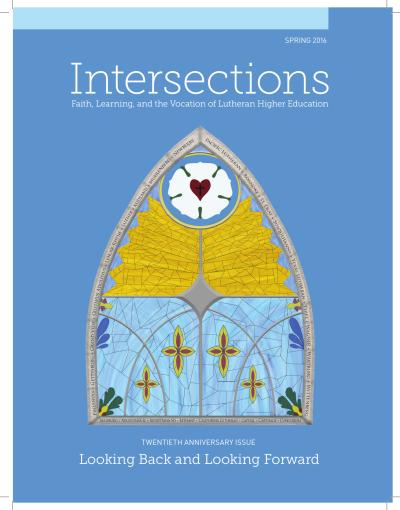
Diversity and Dialogue: Twenty Years and Counting
Florence D. Amamoto
No. 43 · Spring 2016
Twenty years after her essay “Diversity and Dialogue” in the first issue of Intersections, Amamoto returns to Gustavus Adolphus College to reflect on what has changed and what has not: rising numbers of students of color and international students, faculty turnover and increased publication pressures, the disappearance of the Center for Vocational Reflection, and the renewed importance of articulating Gustavus’s Swedish Lutheran heritage and inclusive sense of community in a tuition-dependent, cost-cutting environment.
-
 Article
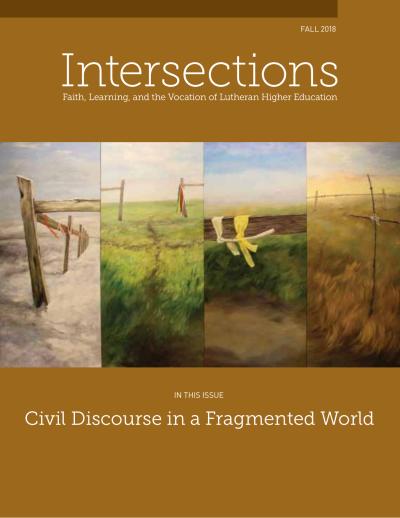
Polarization, Incivility, and a Need for "Change"
Guy Nave
No. 48 · Fall 2018
Nave argues that when Americans demand “change,” they usually mean that “others” need to see things their way — and that meaningful transformative change requires acknowledging the provisional nature of our perspectives, seeking to understand as much as to be understood, and bursting the ideological echo chambers of social media through projects like Clamoring for Change.
-
 Poem
Poem
Emily Dickinson in Columbus, Ohio
Caitlin McHugh
No. 17 · Summer 2003
McHugh imagines Emily Dickinson waking up on a COTA bus to find “the world had ended, and her violets were gone forever,” then escaping the crowd to wander High Street, taste “actual brewed liquor,” quit “the act of reclusive-drama queen-ghost,” and finally smash a bouquet of violets when she realizes that “Beauty had not stopped for her death, but crawled bravely onward.”
-
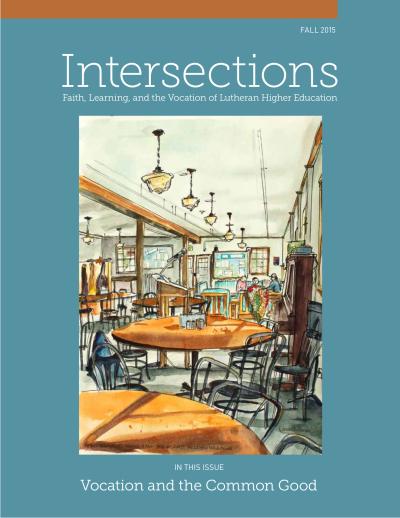 Article
Grinding for the Common Good and Getting Roasted
Rahuldeep Singh Gill
No. 42 · Fall 2015
Reading Starbucks’ ill-fated “Race Together” campaign as a parable for campus work on the common good, Gill argues that interfaith cooperation, vocational reflection, and the “re-storying” of our campuses require us to err boldly across lines of difference — not pretending that difference doesn’t matter, but inviting students to imagine and realize what the common good might mean to them.
-
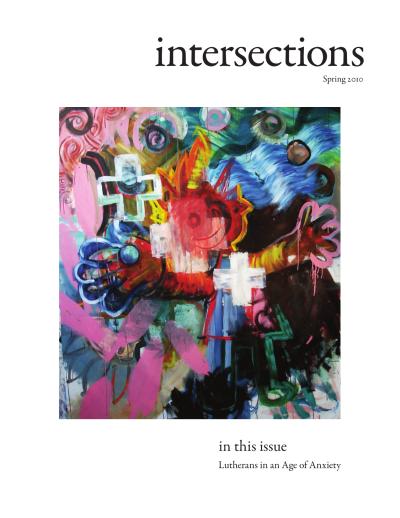 Reflection
The Neglected Miracle of Pentecost
Susan M. O'Shaughnessy
No. 32 · Spring 2010
O’Shaughnessy, in a homily delivered at Concordia College in 2008, reads the Pentecost narrative of Acts 2 through Maria Lugones and Elizabeth Spelman’s 1983 critique of white feminism’s cultural imperialism. She argues that the miracle is not the disciples’ speaking but the immigrant Jews’ hearing—and that the writer of Acts withholds the content of what was said precisely to teach disciples that people of privilege know less than the foreigner, the immigrant, the oppressed, the woman, the child, and must learn to listen in new languages before they can speak.
-
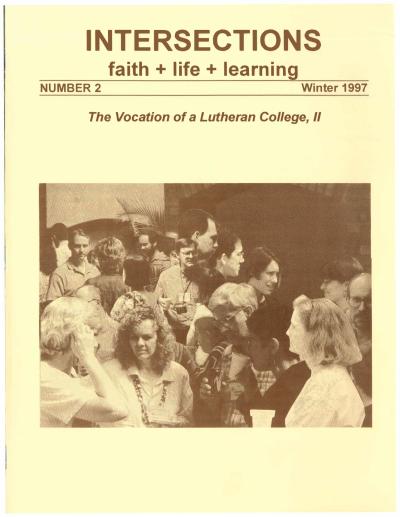 Response
On the Outside Looking Out: A Personal and Social Psychological Response
Chuck Huff
No. 2 · Winter 1997
Huff of St. Olaf—a self-described “Metho-Bap-terian” from the South educated at Bob Jones University—offers a personal response to Bouman’s themes (welcoming the rejection of biblical inerrancy, the distinction between gospel and scripture in the homosexuality debate, the gospel-in-the-creeds reading that releases him from Hellenistic conundrums, and the recasting of justification by faith as meaning rather than insurance policy) and a social-psychological response in which a planned study of campus social networks at St. Olaf was discontinued when preliminary interviews revealed that everyone—storied Lutherans, secular faculty, feminists, fundamentalists—felt like outsiders. Continuing the tradition requires constructing a conversation that is thoughtful, fair, inclusive, charitable, focussed, and still true to the tradition.