Thirty years ago a non-Lutheran colleague accepted an invitation to teach at my college. In those days—and in many days since—prospective faculty were not asked about their commitment to the mission statement of the college, let alone about how they saw themselves contributing to Lutheran higher education. In fact, my colleague reports that the college officials never even asked the vacuous question whether he/she was sympathetic with the mission of the college. Possessing excellent academic credentials, including a degree from a respected university, my colleague gave evidence of being a competent teacher and was hired. Over the years not only did he/she fulfill that promise by becoming both an outstanding teacher and an active participant in faculty governance, but he/she developed a commitment to the mission of the college. At career’s end, my colleague confided that although at the outset he/she could not affirm the mission of the college as a Lutheran institution, at retirement such was possible. This person’s diversity, though not initially intentionally engaged, yielded positive results for the institution.
This colleague contrasts in interesting ways with another to whom a previous president proudly points as evidence of his diverse hiring practices. A pleasant colleague, this person was not significantly involved in either faculty governance or campus life. Although representing a different religious tradition, this colleague never engaged the college in intellectual dialogue or practice with that tradition. It is not obvious how this person’s lauded diversity contributed significantly to the diversity aspect of the college’s mission, except perhaps in some token way.
The contrast between these two colleagues is instructive, especially as it raises the poignant question of the nature and role of diversity within a Lutheran college. Many different stories could be told, for there are multiple ways in which the triad of excellent educators commitment to Lutheran identity, and diversity interact. These stories join creatively where Lutheran colleges propose to be intentionally excellent, intentionally Christian, and intentionally diverse. Of course, colleges can manifest one or more of these traits by choice or happenstance. What is of interest here is how to bring these elements—especially the last two—into rational, creative tension without jeopardizing the institution’s Lutheran identity.
For over 20 years theologians and philosophers have employed the taxonomy of exclusivism, inclusivism, and pluralism in discussions of religious diversity.1 In what follows I apply these models to understanding issues of identity and diversity in educational institutions. Since Lutheran colleges stand most appropriately within the inclusivist vein, I will tease out the tensions that exist on the inclusivist model.
Taxonomy for Understanding Diversity
According to the exclusivist perspective on diversity, truths central to a given perspective are embodied in particular formulations and need to be guarded against being diluted. Diverse viewpoints are to be appreciated, but either are circumscribed to protect and foster the maintenance of the central truths or are posited to provide positions in respect to which one can distinguish, understand, or defend the central truths. Exclusivist educational institutions hold that their educational program contains dimensions that are not negotiable because they make possible the very discourse in which the institution engages. They constitute the framework on which the curriculum is constructed, affirm the common cultural values to which the community assents, and define the ethic that governs institutional social intercourse. It is not that other perspectives necessarily are mistaken (although this may be affirmed where such perspectives contravene what is espoused) or that other curricula cannot provide desirable educational outcomes. Rather, the institution desires to preserve a particular character and accordingly affirms this in word and, where consistent, in deed. To preserve their sine qua non, exclusivist institutions may require that some or all of its members assent to a mission statement that in one way or another affirms central core truths or ideals establishing the institution’s identity. Whereas secular exclusivist institutions may tacitly assume its members adhere to this core, religious institutions may require some or all of its members to assent to a core that may assume a doctrinal form, exposited in a more or less detailed statement of faith. When the core is understood behaviorally, an institution may require some or all of its members to participate in certain activities (chapel, courses in religion, service learning) and refrain from others.
The strength of an exclusivist institution is that it often knows what it is about. It has an explicit if not unified educational and social philosophy that seeks to realize its stated mission. It directs (theoretically if not in practice) its activities, both those at its educational foundation and those falling under the broader category of community or support services, to foster this mission.2 As a consequence, the faculty, administration, students, alumni, and donors possess a clear vision of the nature and purpose of the institution and ideally assent to furthering it by their activities.
The alleged weakness of this model is that it fosters insularity. Although students likely encounter on the campus people displaying a wide range of personality types and character traits, colleges intentionally expose students to peers and faculty who espouse a more narrow range of perspectives. What is taught, thought, read, and written about must fit within the parameters stated by the institution. In such a context cross fertilization between intellectual perspectives often occurs only second-hand, as presented not by adherents of other perspectives but in comment or critique by those already committed to a differing perspective. Advocacy of divergent views by members of the community often is limited.
Exclusivists respond that the unity of perspective can be a strength for the institution as it steers its course through society. A unified constituency, both internal and external, helps maintain the course, for the mission of the institution is less threatened when its members adhere conscientiously to what they have pledged. Diverse perspectives are not ignored but are discussed, especially in ways that help students see how they diverge from the primary truths espoused by the institution.
This leads to another worry that frequently surfaces regarding exclusivist institutions, namely, whether its members can maintain freedom of inquiry when their academic position depends upon prior assent. Members of such institutions often defend their freedom of inquiry on the grounds that they have the freedom to explore all ideas; indeed, because their biases already are stated and positions known, they are more honest and open to the community of hearers and readers than other explorers. Critics of such institutions contend that freedom of inquiry is limited in that the outcome of investigation and research already is evaluatively determined, at least with respect to the parameters specified by what is taken to be the sine qua non of the institution. From an outsider’s perspective, it is difficult to see how inquiry can be open and discussion mutually fruitful if the outcome is to some degree precluded. From an insider’s perspective, it is easy for critics to be deluded into thinking that perspective-free, completely objective exploration of ideas is possible anywhere.
In sum, exclusivist institutions maintain their identity through a unified worldview about doctrinal, pedagogical, or behavioral matters, while they face the criticism that they lack the yeast of diversity and the ingredient of freedom. Without these dimensions, it is alleged, the riches of education are not fully theirs.
According to the pluralist perspective, truths are not embodied in a particular mode of understanding but are many, perspectival, probably even contradictory. Indeed, it is possible, if not likely, that truths derive from rather than exist independent of truth-valuers. We apply the label truth to claims that work particularly well for us in understanding, operating within, or manipulating the world. Pluralist educational institutions hold that since diversity constitutes an educational end in itself, all views should be explored, preferably under the guidance of their advocates. Although not necessarily equally legitimate, views can be critiqued properly only by using criteria intrinsic to the perspective from which they are advocated. Externalist critiques result in triumphalist judgmentalism. Such institutions espouse the ideal of open-ended inquiry; there are no sacred cows.
The strength of the pluralist position is its welcoming attitude toward all perspectives. It not only allows but encourages the multitude of ideas to flourish. Intentionally pluralist institutions recruit faculty, administration, staff, and students with an eye to how they can bring diversity into the institution. The result may be a curriculum presenting a rich potpourri of courses and ideas, and a campus populated by individuals representing and espousing diverse life styles, cultural backgrounds, and points of view.
Critics contend that a pluralist institution by nature cannot claim a unique identity, for the advocacy of a common theme around which it is organized or to which it is committed, other than diversity, would be inconsonant with its pluralism. There can be no central theses or ideological mission to which the faculty or students must adhere, for in principle advocacy of such would violate the freedom of those who advocate a different set of ideas or mission to participate in the institution. To exclude such people from the institution contravenes the ideals of diversity and tolerance. Since by definition pluralist institutions have no ideological center or focus, they are not so much universities as diversities.
Defenders of the pluralism may reply that this characterization is inadequate, for pluralist institutions advocate certain core ideals. These ideals, including tolerance and civility, are values propounded by a liberal, civilized society and essential for successfully conducting the educational enterprise. Without tolerance and civility, an institution cannot function harmoniously and freely; harmony and freedom thus constitute additional central ideals.
Yet the more ideals are added and emphasized as indispensable, the more it looks like pluralist institutions possess a central core to which they expect their members to adhere, at least tacitly. Indeed, one irony of espousing this educational perspective is the temptation to become exclusivist institutions. In the name of these and other liberal ideals, pluralist institutions often exclude contrarian viewpoints from participation in the community. “Persons from a wide variety of races and cultures are welcomed into the university, but only on the condition that they think more-or-less alike…. One of the strongest current motives for discriminating in academia even against traditional religious viewpoints that play within the procedural rules of universities is that many advocates of such viewpoints are prone to be conservative politically and to hold views regarding lifestyle, the family, or sexuality that may be offensive to powerful groups on campuses. Hence in the name of tolerance, pluralism, and diversity academic expressions of such religious perspectives may be discriminated against.”3 In particular, political correctness often dominates their culture. Although in theory tolerance is the liberal value of pluralism, in practice tolerance often is offered only to those perspectives deemed consistent with or worthy of liberal recognition.4
In sum, pluralism provides for genuine engagement with diverse perspectives. Yet a dilemma results: diversity can lead to lack of focus, the correction of which encourages the tempting tendency to exclude particular positions that conflict with unstated or stated presuppositions about the kind of worldview educators on the pluralist campus should hold.
Employing a third model, inclusivists maintain that the central truths that inform the institution may be expressed in diverse ways. Institutions adhering to this model affirm a non-negotiable aspect, something that shapes the heart and soul of the tradition in which the institution is located. At the same time, inclusivist institutions realize that this non-negotiable core not only may be realized in diverse ways, in the context of the specific institution and in similar contexts (e.g., within similar institutions), but it can be enriched by bringing diverse perspectives to bear on it.
This position shares the strength of the exclusivist position in affirming a central core that most often is contained in the mission statement. The mission statement, if formulated thoughtfully and taken seriously, provides guidance for inclusivist institutions in directing the curriculum and extracurricular activities, hiring, and presenting the institution to the internal and external community. Inclusivism also shares the strength of the pluralist view in that it welcomes diversity into the community to enrich it. In dialogue with diverse viewpoints, it comes not only to a fuller understanding of itself but also of other points of view.5
Obviously a tension exists between maintaining a set of claims or ideals that the institution takes to be true while at the same time claiming to engage in open, learning dialogue with other, perhaps contrary, positions. Inclusivists have to be asked, when they claim that the core can be dialogically challenged, whether the dialogue with the other positions is genuine. Are they willing to question to the point of modifying their foundational mission or abandoning their central core beliefs, when those with whom they dialogue reject those core beliefs and suggest alternative points of view? If dialogue is open to persuasion, and if in dialogue one attempts to persuade others to one’s beliefs, then at the same time one runs the risk of being persuaded to another’s point of view.6
Dialogue is a two-way street. As Richard Hughes points out, inclusivists face the danger of lapsing into relativism.7
Inclusivists may reply that indeed dialogue is what they want. The ideas and challenges posed by others in turn enrich their own perspective. The critical point concerns the purpose of dialogue and the role of understanding and persuasion. Since the inclusivist believes that there are truths, the pursuit of truth will lie at the heart of the dialogue.
The inclusivist institution that intentionally creates a diverse college community faces several challenges. First, it may be so focused on diversity that it loses its character as a Christian (Baptist, Lutheran, Catholic) school. It may create an institution that under the weight of new forces assumes a new vision and shape, so that the old remains hardly recognizable. This occurs especially when the administration and staff are hired for their diversity, with little thought to maintaining a critical mass committed to the previous institutional identity. The carrots of diversity, tolerance, and academic excellence can tempt the institution to over-indulge.
Second, it confronts the challenge that in making diversity a goal, the college becomes essentially indistinguishable from its secular counterparts. As Gilbert Meilaender notes, when the talk turns to the importance of diversity, it is “the same kind of diversity … at which every other college and university is aiming. In the seeking of that elusive goal, in the attempt to be like everyone else, we will in fact do our bit to destroy the possibility that there might be truly diverse institutions of higher education in our society.”8 Instead, diversity should be a means to further broaden the educational perspectives of students and provide opportunities for growth within the context of a particular community. The curriculum will have a distinctive shape that embodies, dialogues with, and furthers the mission rather than a smorgasbord curriculum presenting unrelated individual menu items to students. The result will be an inclusive community focused around the central mission.
Third, an inclusive community faces the challenge of integrating the diverse members of the community in ways that avoid polarization of the community and treatment of either non-Christians or Christians as second-class citizens or resident aliens. One danger is that in a Christian inclusivist institution those who are not Christians may either see themselves or be viewed by Christian members of the community as less valuable or significant to the community, not contributing seriously to the on-going life and mission of the college. The correlative danger is that Christians become a defensive, embattled minority on the campus, cowed by political correctness into silence. If either of these occurs, the institution will fragment and the dialogue between faith and learning that is integral to the institution will dissipate into silence or result in carping or suspicion between the two sides.
This can be avoided when each person in the diverse community is able to address thoughtfully how he or she relates to all aspects of the college’s mission, including its Christian mission. Those who espouse the Christian emphasis as a matter of their own faith perspective will reflect on how it impacts their teaching, learning and community life. Those who do not espouse it as a matter of personal faith perspective will reflect on how they can creatively dialogue with their colleagues and students, especially with respect to matters of Christian faith and learning, and how they can help inform the core ideals and educate. Here, for example, professional development programs can significantly contribute both to educate the faculty about the mission and to facilitate constructive dialogue about that mission.
In short, a college that espouses an inclusivist mission faces a situation fraught with tension. The task is to turn the tension into creative education, a situation providing potential for growth for both students and faculty, and a context where issues of faith are raised with renewed vibrancy, recognizing the legitimacy of diversity, while at the same time maintaining the integrity and Christian identity of the institution.9
Lutheran Identity
It may be asked where Lutheran institutions of higher education fall on this spectrum. Although my surmise is that one can find Lutheran institutions in all three categories and that the movement in the last several decades has been toward pluralism,10 I don’t propose to address all three or categorize individual Lutheran institutions. Indeed, it is notoriously difficult to place concrete entities in ideal models. Instead, I inquire about institutions that self-consciously desire to be inclusivist.
To begin, if one is going to be inclusivist, what is the non-negotiable core of the Lutheran institution? From the outset, this proves a difficult question. Lutheran writers frequently warn that we should be careful to distinguish identity from distinctiveness.11 “Christians should feel under no particular compunction to say, ‘Only that is Christian which is distinctively Christian.’ … Many things characterize Christian existence even though they don’t characterize Christian existence alone.”12 Indeed, Meilaender notes that if we start looking “for something peculiarly Lutheran in higher education, we will get talk about how Lutherans appreciate ‘paradox.’ Or platitudes about freedom and mutual respect … We will get a misbegotten ‘two kingdoms’ notion [and] talk about the importance of diversity.”13 He contends that “it will always be mistaken to try to fashion a purely ‘Lutheran’ understanding of what Christian higher education ought to be.” His contention is that Luther did not intend to remove a segment of the Church from its wider context; instead, Lutherans are truly ecumenical.
However, Meilaender goes on to argue that “if there is a reason for the continued existence of such institutions, they must offer something distinctive and distinctively Christian.”14 Authors writing on the topic seem to concur that not only is there something identifiable and characteristic about the Christian education, but there is something identifiable and characteristic about the Lutheran take on that education. These features provide, in part, the raison d’etre for being a Church-related or Christian educational institution. Where is that identity to be located? Robert Benne argues that it is a mistake to define this core in terms of a Lutheran ethos culturally understood, for as the cultural identity of Lutheran institutions changes with the employment of a diverse faculty and the admission of an ethnically diverse student body, the cultural ethos evaporates. “The center for Lutheran liberal arts colleges ought to be religiously defined … This religious vision … would have within it an interpretation of the role and nature of human learning.”15 This center is a Christian center, incorporating a “Lutheran Christian vision of reality, particularly in its intellectual form.”16
While Lutheran writers often diverge regarding the content of this identity-informing core, some themes repeatedly run through the literature. Richard Hughes works out the inclusivist model in terms of “human finitude and the sovereignty of God.”17 In the educational context, it means that since our reason is impaired, we could always be mistaken. In this way we are freed to investigate critically not only the views and theories of others, but our own as well. Doubt, he says, is the companion of faith. The second trait is the emphasis on paradox “which shatters our rational categories and forces us to our knees as we ponder the mysteries that transcend our understanding.” Hughes here recalls the doctrine of the two kingdoms in which we simultaneously reside and that meet, notably, in our educational institutions. The life of the mind “fosters genuine conversation,” but without the necessity of “integrating faith and learning around a distinctly Christian perspective.” The model is one of sustained dialogue that “brings the secular world and a Christian perspective into conversation with one another.”18
Darrell Jodock presents a more robust position. He suggests five theological themes that help identify Lutheran education: God in the Gospel shows mercy and forgiveness but is also at work “through social structures to bring order and justice to the world,” Christianity “is primarily a dynamic set of interpersonal relationships,” we experience God’s unmerited adoption and Christian freedom, and the incarnational principle sees God as active and present in nature and authoritatively through the Word of God. From these theological themes respectively Jodock draws characteristics of Lutheran educational institutions: educating for service to the community, striving for academic excellence, allowing freedom of inquiry, embracing the liberal or liberating arts, and creating a community of discourse. There is nothing distinctively Lutheran or even Christian about these five characteristics. For Jodock, as for others, the Christian part is their rootedness—the ground from which the education proceeds.19
Other authors could be cited, but several points become clear from this search for a core around which colleges can construct an identity. First, Lutherans find the identity rooted theologically in the larger Christian Church. There is a desire to be not merely Lutheran but Christian in the broadest sense, of identifying with the entire Christian tradition, consonant with Luther’s desire to stay within but reform the Church. Here one finds the emphasis on creation and the theology of the cross. Second, the particularly Lutheran cast comes in locating the theological themes in Luther’s theological and educational writings. For example, the theological themes include Luther’s “four great solas, or ‘alones,’ of the Reformation—Sola Gratia, Sola Scriptura, Sola Fide, and Solus Christus.”20 In addition to these, five other themes emerge: the difference between the law and Gospel (the doctrine of the two kingdoms), Christian vocation, simultaneously saint and sinner, freedom, and with particular impact on ritual in the college, the Lutheran confessional heritage. Third, the unity manifested in these theological themes dissipates somewhat when the writers derive from them educational theory and practice. The resulting description is what one would find of any good—should we say excellent—liberal arts college or university: dialogue between views, academic excellence, freedom of inquiry, education for service (vocation), and humility in pursuit of the truth. Because the resulting picture is of a common educational ideal, the danger then becomes that these themes can be pursued quite apart from a Christian theological orientation. Educational institutions thus can tend the fruits without attending to the soil.
Dialogue between Identity and Diversity
We have argued that Christian schools that intentionally seek to be inclusivist rather than pluralist will find their rootedness in the soil of theological themes that in turn are developed in various ways to create institutional identity. The conceptual will be explicitly formulated for both internal and external communities in the mission statement and its supporting documents. It will be realized in forming the undercurrent beneath the institutional structure. The development will not be merely conceptual, as a guiding abstraction. Rather, it must be worked out in structural and concrete formations. It will flourish in constitutional requirements regarding governing boards and major leadership positions, inform the curriculum that addresses not only required religion courses but ways in which courses can more broadly integrate faith and learning, infuse campus social constructs (chaplaincy, convocations, extra-curricular groups, counseling, social life, and community outreach), and perhaps most importantly determine the presence of a “critical mass of faculty members [and staff] who, in addition to being excellent teacher-scholars, carry in and among themselves the DNA of the school, care for the perpetuation of its mission as a Christian community of inquiry, and understand their own callings as importantly bound up with the well being of the immediate community.”21
This critical mass, not to be measured in numbers, but assessed in terms of the key roles that particular faculty play in teaching, administering, and future hiring, is critical for continuance of the college’s mission and identity.
But this brings us to the heart of the problem. If the school’s task is in part to transmit a theological rather than a cultural tradition that embodies these themes, how will commitment to identity be balanced with intentional diversity, where students, faculty and staff with different theological perspectives and traditions are not only invited into the community, but in their faculty and administrative roles eventually assume positions of leadership in the institution, including responsibility for hiring? The exclusivist and pluralist responses to diversity are fairly straightforward. The issue becomes especially difficult for inclusivist institutions, which is perhaps why both exclusivism and pluralism present constant temptations. As we previously noted, the consideration of diversity results in a tension between commitment to the central core and the intentional invitation of those who introduce truths from outside the core, challenge the thinking about the core, or who have new or diverse perspectives on and perhaps wish to change the core to be more in line with their own conceptual framework or educational philosophy.
Clearly there is no easy formula for maintaining the balance between the two dimensions, to not lapse into either exclusiving or pluralism. This, I take it, is consistent with the Lutheran theology of paradox that holds opposing dimensions in tension. How is the paradox to be worked out in the educational context in large part has to do with the role or purpose of diversity in the inclusivist institution. In contrast to the pluralist perspective, the inclusivist seeks diversity not for its own sake but rather for how it contributes to the three educational objectives of the educational institution: the shaping of the intellect (the head) through free inquiry, the motivational preparation for vocation as service (the hands) in the cause of justice, and the shaping of the human character (the soul or heart). Meilaender notes that it may not be appropriate to mold the heart in the classroom; “it is chiefly a place to shape the intellect.” At the same time, he affirms that “vision and virtue—intellectual and moral virtue, mind and heart—can never be entirely separated.”22
Meilaender invokes the education of the student beyond the curriculum or classroom to address the heart or soul dimension. I would suggest, rather, that here we encounter another of those Lutheran paradoxes. On the one hand, the obvious function of the classroom is to educate the head and hands. The professor’s function, even in professing, is not to proselytize, convert, or to make disciples, but to challenge, empower, and free.23
On the other hand, education of the head and hands without educating the heart (the sentiments) leaves us with, to use C.S. Lewis’s poignant phrase, “men without chests.” Ideas without passion, service without commitment to and love for those served, ethical theory without moral character are an inheritance of the wind. If we educate our constituency, acquainting them with the facts and theories, but leave them less moral and uncommitted to a vision of the truth, we have failed in our mission to the Kingdom of God.
Educators unfortunately have bequeathed an atomistic view of persons, as if head, hand, and heart are not holistically connected. Sometimes the Lutheran doctrine of the two kingdoms reinforces this view, as if the kingdom on the right hand is completely divorced from the kingdom on the left hand. Rather, the two kingdoms, or using our metaphor, head, hands, and heart, belong to the same unified person. Theories without vocation in service, service without the sentiment of love, sentiment without truth, are destructive. The function of Lutheran education is not to bifurcate but to bring them together in a unity that preserves and employs fruitfully the tension.
Given the purpose to educate holistically, the issue is not simply to create an institution with diversity, but to employ diversity throughout the institution (what is sometimes referred to as seamless education) to further the educational goal of educating head, hands, and heart.24
Intentionally introducing diversity is directed toward creating a genuine dialogue that enhances the educational experience on all three fronts. Exposure to those who advocate diverse perspectives will more adequately prepare students for conscientious stewardship and caring service in the real world (the kingdom on the left). But through all this, care must be taken not to lose the institutional core identity. To this end, intentionally hiring faculty and staff who are committed to maintaining both the core components of the identity and who are willing to engage in the dialogue between the two kingdoms is critical.25
Furthermore, the curriculum should be such in Lutheran schools that when students graduate, they too can address intellectually, from whatever perspective they have, the relation between the two kingdoms. In short, not only should colleges educate for service, but the education should be with an awareness both of the theological tradition that informs that education, of the need for dialogue between the Christian faith and other perspectives, and with skills in navigating that dialogue.
In sum, the creation of an intentionally diverse institution within Lutheran tradition calls for implementing the paradox of maintaining the identifying core while at the same time creating an atmosphere of true dialogue, all in the service of education of head, hands, and heart. The temptation in our era is to foster diversity and/or excellence at the cost of identity. Diversity is not pluralism. Freedom of inquiry does not bring abandonment of institutional commitment. Instead, Lutheran colleges should manifest the incarnational motif of God at work in the world through us, motivated by the Gospel, as God’s stewards ultimately responding to God’s grace.
Works Cited
- Alan Race, Christians and Religious Pluralism: Patterns in the Christian Theology of Religions (Maryknoll: Orbis Books, 1982).
- It is important to understand that in this paper I am discussing ideal models, not necessarily the instantiated reality. That is, many institutions seek to embody the model provided but will realize it only in various degrees. Causes of this may vary from hypocrisy, inadequate leadership, financial contingencies that force institutions to act contrary to their philosophy, weakness of will, arrogance or pride, and the like.
- George Marsden, The Soul of the American University (New York: Oxford University Press, 1994), p. 432. A faculty colleague who strongly espouses diversity once told me that he/she would never hire a person who as a Christian advocated the views of the religious right.
- Herbert Marcuse argues that tolerance, though an end in itself when practiced by all, can be appropriately used in a partisan way against those opposed to freedom. “Repressive Tolerance,” A Critique of Pure Tolerance (Boston: Beacon, 1969).
- See Mark Mattes, “Dual Citizenship in Athens and Jerusalem,” unpublished paper.
- See Gerald McDermott, “Persuasion,” unpublished paper.
- Richard T. Hughes, “How the Lutheran Heritage Can Sustain the Life of the Mind,” 16.
- Gilbert Meilaender, “Forming Heart and Mind: Lutheran Thoughts about Higher Education,” The Lutheran Reader, ed. by Paul Contino and David Morgan (Valparaiso: Valparaiso University, 1999), p. 79. George Marsden makes a similar point that those who encourage diversity within the institution often discourage it among institutions. When pluralist perspectives dominate, as for example in accrediting agencies, all institutions are encouraged if not required to be identical in their diversity. Institutions with a unique vision, with statements about mission and purpose that are not negotiable, are held in contempt as being second-class educational institutions. Pluralism results in a schema designed to make all institutions look very much the same.
- It is easy for institutions bent on affirming diversity to confuse diversity with pluralism and consequently advocate a cultural mandate that requires them to migrate away from their heritage. For this reason it is important not only to distinguish between pluralist and inclusivist models but to distinguish verbally between “pluralism” and “diversity.”
- James Burtchaell, The Dying of the Light: The Disengagement of Colleges and Universities from their Christian Churches (Eerdmans, 1998).
- One Lutheran writer goes so far as to claim that Christians are called to be faithful, not distinctive. “The Idea of a Christian University,” in The Lutheran Reader. But the question then is what are we to be faithful to, and that will, in part, reflect certain propositions held to be true.
- Robert Bertram, “What’s Lutheran About Higher Education? Theological Presuppositions,” What’s Lutheran About Higher Education? (Washington, D.C.: LECNA, 1974), p. 22.
- Meilaender, p. 79.
- Meilaender, p. 80. In place of “distinctive,” Bertram uses the more helpful term “characteristically.”
- Robert Benne, “Integrity and Fragmentation: Can the Lutheran Center Hold,” Intersections, Winter 2000, 4.
- Benne, 6.
- Hughes, 14. It may be legitimately questioned whether Hughes’s position is properly inclusivist. The problem is not with his emphasis on doubt; humility should always be an academic virtue. However, as Aristotle would quickly point out, it should be an appropriate humility: the right kind, in the right way, for the right reason. That is, it should not be a humility that prevents members of the institution from professing that non-negotiable core. Indeed, one can see this in Hughes himself. Despite his argument that “Lutherans can never absolutize their perspectives, even their theological perspectives,” human finitude and divine sovereignty, he says, must always be absolutized. Neither does he question the two kingdoms doctrine, or that we are simultaneously sinner and justified. These absolute assertions conflict—appropriately though paradoxically, he might say—with his claim that Lutherans are constantly about the business of questioning their presuppositions, which are nonnegotiable. Should Hughes give up these presuppositions in his quest for the dialogic life of the mind, the Lutheran emphasis would go likewise. Thus, Hughes rightly worries over the Lutheran slippage to relativism.
- Hughes, 15. Despite his rejection of the Reformed concept of a worldview as informing education, Hughes himself articulates the beginnings of a Lutheran worldview from which education proceeds.
- Darrell Jodock, “The Lutheran Tradition and the Liberal Arts College: How Are They Related?” in Called to Serve, Ed. By Pamela Schwandt, et al, (Northfield: St. Olaf College, 1999). See also Bertram, p. 20 and Thomas Christenson, “Learning and Teaching as an Exercise in Christian Freedom,” Intersections, (Winter, 1999), 3-11.
- Ernest Simmons, Lutheran Higher Education (Minneapolis: Augsburg Fortress, 1998), p. 26.
- Schwehn, p. 65.
- Meilaender, pp. 87, 88.
- Bruce R. Reichenbach, “On Being a Professor: The Case of Socrates,” in Should God Get Tenure? Essays on Religion and Higher Education, ed. by David W. Gill (Grand Rapids: William B. Eerdmans, 1997), pp. 21-5.
- Richard Baepler, “Toward an Understanding of Lutheran Character in Higher Education,” The Lutheran Reader, p. 31.
- I have addressed this in more detail in Bruce R. Reichenbach, “Mission and Hiring in the Christian College,” Intersections 3 (June 1997), 13-19.
-
 Editorial
From the Publisher
Arne Selbyg
Selbyg explains that the four essays in this issue grew out of the first Lutheran Academy of Scholars in Higher Education—a two-week seminar funded by the Lutheran Brotherhood Foundation and the Lilly Endowment, led for its first three years by Dr. Ronald Thiemann of Harvard Divinity School—whose official theme “Finding Our Voice—Christian Faith and Critical Vision” became informally “What’s Faith Got To Do With It?”
-
Editorial
From the Editor
Tom Christenson
Christenson introduces the four essays by participants in the first Lutheran Academy of Scholars as fruit of the “genuine conversation” that emerges when specialists set aside their lecturers’ podiums to speak as human beings, and welcomes the issue’s additional “Intersections first”—a response to a response to a review—continuing the conversation between Baird Tipson and Robert Benne about the paradigm of Lutheran higher education.
-
Article
'In, With, and Under:' The Tradition and the Teaching of Christian Ethics
Pamela K. Brubaker
Brubaker describes how she teaches Introduction to Christian Ethics at California Lutheran University—a religiously diverse classroom where about 30% of students are Lutheran, 30% Roman Catholic, and many are “unchurched”—as a community of moral discourse rooted in the Lutheran dialectic of faith and reason. Drawing on Larry Rasmussen and Bruce Birch, Elizabeth Bettenhausen, Roger Crook, and Robert Benne’s typology of “Hot and Cool Connections” between church and politics, she walks through her course’s units on human sexuality, economic life, and war and peace—including the Bomb Shelter simulation, a mock Disney stockholders meeting on sweatshops, and a Congressional hearing on the School of the Americas—to show how ELCA social statements function as case studies in critical inquiry and education for citizenship.
-
Article
Impelled to Pluralism: Thoughts About Teaching in a Lutheran University
Jim Huffman
Huffman traces his personal journey through three stages of faith—the “comfortable Christ” of his Midwestern Christian childhood, Clark Pinnock’s “faith principle” of accessible salvation, and finally Christ as the “humble teacher”—to a pluralism that rejects religious triumphalism without abandoning Christian commitment. Drawing on Diana Eck, Wesley Ariarajah, John Cobb, the Catholic novelist Endo Shusaku, and the histories of Confucian China and imperial Japan, he then describes how this commitment shapes his teaching of East Asian religion and nationalism at Wittenberg University: insisting on respectful language, working sympathetically through doctrines like Buddhist non-attachment, and helping students see the pernicious effects of triumphalism in both religious and political life.
-
Article
Making Dry Bones Stand: Lutheran Higher Education at Century's End
Diane Scholl
Scholl reads John Winthrop’s “A Model of Christian Charity,” the banishment of Anne Hutchinson, de Crevecoeur’s American farmer, Olaudah Equiano, Phyllis Wheatley, and Hawthorne’s The Scarlet Letter alongside Ezekiel’s vision of the dry bones to ask how a Lutheran college can be a community that holds difference and commonality together. Drawing on Ernest Simmons’s warning against collapsing into either dogmatic absolutism or thoroughgoing relativism and Bruce Reichenbach’s companion essay in this issue, she identifies five features of shared life at a Lutheran college—the liberal arts, political process, the arts, the community of caring, and the recognition of difference and the right to dissent—and argues that the necessary tension between individualism and corporate identity, framed by theological vision, is “our best legacy and our best hope for the future.”
-
Poem
Emily Dickinson in Columbus, Ohio
Caitlin McHugh
McHugh imagines Emily Dickinson waking up on a COTA bus to find “the world had ended, and her violets were gone forever,” then escaping the crowd to wander High Street, taste “actual brewed liquor,” quit “the act of reclusive-drama queen-ghost,” and finally smash a bouquet of violets when she realizes that “Beauty had not stopped for her death, but crawled bravely onward.”
-
Response
Response to Robert Benne
Baird Tipson
Tipson responds to Robert Benne’s comments in the previous issue about his review essay of The Future of Religious Colleges, affirming their fundamental agreement that the Enlightenment epistemology dominant in higher education poses the most serious threat to the vitality of Lutheran colleges. Using the example of lecturing on early Mormon history and the Book of Mormon, he concedes that the methodological “solvent” of Enlightenment historiography acts on Christian as well as Mormon faith claims, and concludes that while H. Richard Niebuhr’s “inner” and “outer” history and Walter Brueggemann’s approach in The Theology of the Old Testament are comforting to believers, they do not offer an epistemology that can stand alongside the Enlightenment model in evaluating truth claims in the academy.

-
 Article
Faith, Understanding, and Action
Paul J. Dovre
No. 10 · Fall 2000
Dovre frames the St. Olaf 125th anniversary—originally read as part of a presentation with the St. Olaf Cantorei and organist Paul Manz—around T.F. Gullixson’s story of an immigrant woman who “turned her face to the west wind” and the 1874 gathering at the Holden parsonage of B.J. Muus, Harold Thorson, O.K. Finseth, K.P. Haugen, and O.O. Osmondson. He weaves Anselm’s “faith seeks understanding,” Harold H. Ditmanson on the universal relevance of Christian faith, and the music of Venatius Honorius Fortunatas, John Rutter, Herbert Brokering, Ralph Vaughan Williams, and John Tavener into a meditation on faith as motive, understanding as modus, and action as consequence, against the “ill winds” of poverty, child homicide, AIDS, and consumer gluttony.
-
 Editorial
From the Editor
Robert D. Haak
No. 24 · Fall 2006
Haak introduces the issue’s essays by Stanley N. Olson, Kathryn L. Johnson, Gail Summer, Lake Lambert, and Steven C. Bahls; argues that on Lutheran campuses, professional programs in business, education, and nursing are not “second-class citizens” but integral to the institution’s vocation; cites Olson’s mantra (“Because of Christ, the world; because of the world, vocation; because of vocation, education”); and thanks Matt Marohl for assisting with the editing.
-
 Article
Creation, Justice, and Communio: Lutheran Insights Empowering Educational Access
Mary Elise Lowe
No. 60 · Fall 2024
In her VLHE keynote, Lowe names three Lutheran commitments — continuing creation, neighbor justice, and communio — as the “why” that empowers ELCA colleges and universities to pursue equitable access for students often left behind by persistence and graduation gaps.
-
 Article
Why All This Talk About Understanding the Mission of NECU Member Institutions as a Vocation?
Mark Wilhelm
No. 56 · Fall 2022
In his valedictory keynote, retiring NECU Executive Director Mark Wilhelm argues that Lutheran higher education is, properly understood, vocation-based education — outlining four core practices recovered over the past fifty years and naming the constructive and corrective work still to be done, including a fuller embrace of DEIJ and of the diverse vocations of NECU’s 27 institutions.
-
Editorial
From the Publisher
Arne Selbyg
No. 10 · Fall 2000
Selbyg explains that, while Intersections usually publishes papers from the annual Vocation of a Lutheran College conferences, this issue gathers presentations from a St. Olaf 125th-anniversary conference—a companion to the volume Called to Serve edited by Pamela Schwandt—because the theology and educational perspectives behind them apply to any Lutheran college and clarify what makes ELCA church-related colleges excellent institutions for students of any faith.
-
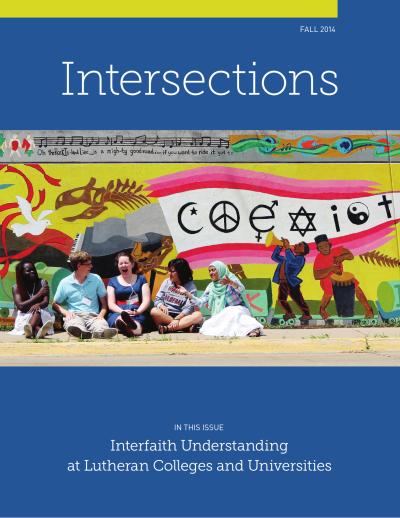 Article
Journey Toward Pluralism: Reimagining Lutheran Identity in a Changing World
Jacqueline Bussie
No. 40 · Fall 2014
Bussie chronicles Concordia College’s Forum on Faith and Life initiative — assessing campus climate, building a President’s Interfaith Advisory Council, and drafting a one-sentence statement that Concordia practices interfaith cooperation “because of” (not “guided by”) its Lutheran identity — to argue that simul justus et peccator thinking equips Lutheran institutions to hold loyalty to tradition and reverence for others together as one piece.