The deliberately convoluted title of this talk was inspired by my growing sense, as an administrator at a Lutheran University, that we have over the course of the last decade suffered from a diminished capacity to talk about the value of the education we provide even as we have increased our ability to discuss thoughtfully cost, pricing strategies, financial aid matrices, disruptive innovation, MOOCs, and a growing list of hot topics within the discourse of higher education. I intend my remarks as a small corrective to this tendency. However, I do not wish to encourage equally alarming tendencies to circle wagons around an unsustainable educational model or to hanker after a real or imagined Golden Age of Lutheran higher education informed by timeless ideals with little or no regard for the specific context within which those ideals must have life and pertinence. In other words, any compelling articulation of the value of Lutheran higher education must be mindful of the turbulence of our academic times.
My consideration of the value Lutheran higher education will consist of four parts. I will first present a recent analytical description of a college education that should provide both another dimension to the central problem of the commodification of higher education, and a direct challenge to the value of a Lutheran education, rightly understood. I will then, in the next two parts, consider two of the most important implications of the Lutheran concept of vocation for higher education, its invitation to re-conceptualize the hallowed distinction between liberal and professional studies and its insistence that we are all called simultaneously to multiple vocations. Finally, in a short final section, I will turn to certain practices that are central to all institutions of higher learning that Lutherans need to re-think and re-formulate in order more fully to realize the distinctive character of Lutheran higher education informed by the idea of vocation.
Disaggregation or Disintegration?
About a year ago, Michael Staton, the co-founder and CEO of Inigral, a company that offers a variety of technologies to enhance educational practices, answered the question, “What is College?” as follows:
College is a packaged bundle of content, services, experiences, and signals that result in an education with both inherent and transferable value to the learner. The end goal of this educational package is to prepare learners for the job market, as well as to instill the knowledge, procedures, and values that make individuals effective at navigating, succeeding within, and adding value to our society. (Staton 4-5)
To construe college as a bundle of contents and services rather than as an integral whole comprised of parts is to invite the kind of activity described by the title of the address in which Staton’s definition of college appears, “Disaggregating the Components of a College Degree.”
The major aim of Staton’s address was to demonstrate that the internet was already providing and would continue to provide many of the components of a college degree much more effectively and much more cheaply than the on-campus experience at the average college. He thus sought to unbundle those components from others that could not so easily be provided through the internet, inviting colleges to focus on the latter while relying on new technologies to provide the former. So, for example, content authoring, production, and transfer need no longer be left to faculty members, given the enormous resources already available free of charge on the internet, whereas mentoring and the supervision of metacognitive processes could not so easily be replaced by technology and should be left to faculty members.
Though most of us, including me, will find the vocabulary of disaggregation, commodification, and bundling repugnant, we should not be too quick to dismiss Staton’s analysis altogether. Indeed, I suspect that most of us have already applied his analysis to some degree or another, perhaps without realizing it. Faculty members, for example, are constantly engaged in improving their pedagogy, so many of them have long since used resources available on the internet to supply content or to provide out of class exercises to sharpen skills so that classroom activity can be addressed to collective endeavors to solve problems, apply concepts, and consider the content delivered on the internet in fresh ways. This is what flipped classrooms are all about. In sum, Staton’s analysis can be used as a kind of roadmap to help all of us enhance the distinctive education we provide through various technologies.
However, Staton’s message is finally deeply disturbing, and it is inimical to the concept of a Lutheran education informed by the idea of vocation. He really is recommending disaggregation, i.e. farming out completely some of our most vital learning activities to service providers outside of our colleges and universities. So, for example, he writes that colleges should allow their students to “go through their general education courses online” (16). At Valparaiso University, this recommendation, if taken seriously, would be catastrophic. Our Freshman Core course that runs the entire year and that is the foundation of our general education program introduces students to college life, forms them into small and enduring communities of inquiry, cultivates within them a number of pre-disciplinary skills, imbues them with the ethos of the institution, gives them a common vocabulary including an understanding of the Lutheran idea of vocation, and provides nine months of common experience during their first year for the students in all of our several colleges and schools. Would we dare to turn this vital enterprise over to one or another of the several external service providers?
“We must, as part of our effort to articulate the value of a Lutheran education, recover and strengthen those implications of our common vocation that require us to insist upon an education that is integral and whole, possessed of a distinctive kind of integrity.”
Enhancements and economies, hybrid courses, on-line offerings as part of a larger integrated curricular program are one thing; complete disaggregation of the services, content, experiences, and “signals” (to use Staton’s terminology) is quite another. Lutheran colleges and universities, in order to be faithful to their mission statements and their callings as colleges and universities of the church, seek to form as well as inform, to shape character as well as to cultivate arts and skills, to show forth every day, in the way that community life is ordered, that the moral, the social, the intellectual, and the spiritual virtues are inextricable and mutually reinforcing. Disaggregation, if carried to extremes, becomes disintegration. A call or summons, whether to an institution or to an individual, is addressed to a whole school or person, not to some truncated version of the same. In these days and times, we must, as part of our effort to articulate the value of a Lutheran education, recover and strengthen those implications of our common vocation that require us to insist upon an education that is integral and whole, possessed of a distinctive kind of integrity, if you will.
Practicality of the Liberal Arts
One such implication involves a reconceptualization of the relationship between liberal and professional study as warranted by the Lutheran understanding of vocation. Note that Stanton stipulated that the first goal of a college should be to “prepare learners for the job market.” Though such a claim used to dismay defenders of the value of liberal education, we have witnessed over the course of the last couple of years a decided apparent shift in both the attitude to such claims and in the rhetorical strategies used to defend the value of liberal learning by its strongest proponents. Friends of liberal education have increasingly defended the liberal arts on instrumental or utilitarian grounds: “The job market is rapidly changing; therefore, college graduates need to be prepared for jobs that have not yet been created. Moreover, most people will change jobs three or four times at least during the course of their lives. Therefore, students need the arts and skills and habits of mind that only the liberal arts can cultivate. Students need to learn how to learn, to be enabled to be flexibly responsive to the global market, and to be secure enough in their own identities and convictions to endure the hardships and disappointments they are bound to face. So if you want to be practical, get a liberal arts degree. Narrowly technical training makes no sense.”
Although this defense of a liberal education has much to recommend it, many of those who advance it do so grudgingly or with a guilty conscience. Guilt stems from the conviction that liberal education is diminished whenever its proponents stress its instrumental value over and above its intrinsic goodness. Knowledge for its own sake! Liberal education as an end in itself! To advance the cause of liberal education in any other terms than those that these battle cries suggest is to debase the currency of the liberal arts, thereby contributing to the narrowly practical mentality that has led—so the story goes—to the progressive demise of liberal education in our times.
“Lutheran educators who are and who should be friends of liberal learning should be more suspicious of claims that liberal education is an end in itself than of claims that the liberal arts are good for the sake of empowering and equipping human beings for various kinds of work in the world.”
Friends of the liberal arts should not be plagued by these doubts and self-recriminations. The history of liberal education provides ample warrants for defending it on instrumental grounds. Moreover, Lutheran educators who are and who should be friends of liberal learning should be more suspicious of claims that liberal education is an end in itself than of claims that the liberal arts are good for the sake of empowering and equipping human beings for various kinds of work in the world. Or, to put matters more positively, Lutherans should be guiltlessly disposed to use instrumental arguments to defend liberal education. Both the Lutheran concept of vocation and Luther’s and Melanchthon’s own defenses of what we today call liberal education demand that we understand, defend, and promote liberal learning in terms of its proper uses, not in terms of pure self-cultivation.
Bruce Kimball’s Orators and Philosophers: A History of the Ideal of Liberal Education still remains, after twenty-five years, the most authoritative source on the history of liberal education. As the title suggests, Kimball identified two separate, sometimes competing, sometimes complementary versions of liberal education that began to develop in ancient Greece and that continue to the present time. The two arose simultaneously in the fifth century BCE. The first, the philosophical tradition or the “liberal free” ideal, stemmed from Socratic notions of inquiry as a path to individual excellence, of self-examination as indispensable to human flourishing, and of contemplation, not action, as the most choice-worthy human activity. Contemporary defenses of liberal education that stress critical thinking, intellectual virtues, knowledge as an end in itself, the importance self-reflection, self-cultivation, and self-knowledge, and the never-ending project of disciplining and furnishing the mind to enable and secure the full realization of one’s own humanity all can trace their lineage to Socrates.
The oratorical tradition stemmed from the rhetorician Isocrates and came into full flower three centuries later in the work of the Roman philosopher Cicero. Liberal education, as it unfolded within this tradition, stressed speech and language, the moral virtues, good character, and knowledge for the sake of action in the world of public life. Contemporary defenses of the liberal arts that stress character formation, the primacy of inter-subjectivity over private thought, community, usefulness, civic engagement, and public service can trace their lineage to Isocrates and Cicero. Those who defend the liberal arts by stressing their usefulness for a life of action in the world, including professional life, can draw upon this tradition without a bad conscience.
Education for Citizenship
As Kimball insists throughout his book, the two traditions he identifies were never really present in their “pure” forms; rather, they more often represent two intertwined strands of a single tradition. When he published his book in 1986, however, he believed that the philosophical or liberal free strand was definitely in the ascendancy. Over the subsequent quarter century, the rhetorical strand has gradually overtaken the philosophical strand in the discourse about liberal education. Kimball himself came to believe, during the course of his work on American pragmatism, that in the United States at least, public, pragmatic philosophers, like the late Richard Rorty, shifted the discourse of liberal education away from the liberal free tradition and toward the rhetorical tradition. Moreover, the largest national association devoted to liberal education, the Association of American Colleges and Universities, has for about twenty-five years stressed “education for democracy” as one of its major programmatic emphases. AAC&U has definitely come to understand liberal education as education for citizenship above all else.
Such a conception is far from an innovation. Rather, as the (then) Archbishop Rowan Williams reminded the Oxford University community seven years ago in his Commemoration Day Sermon (June, 2004), the medieval universities in Europe, the places that supplied the context for the Protestant Reformation, arose primarily from the practical need for lawyers, doctors, and clergymen, especially for trained canon lawyers. The Arts faculty was from the beginning a part of a larger educational enterprise devoted to the preparation of “public people,” in Williams’s words, people who were equipped to go forth into the world enabled to distinguish between good arguments and bad ones, to honor the importance of reasoned speech, and to contribute to the common good through the exercise of their professional skills. For example, what later became a mere class marker or an avenue to historical and cultural understanding, the study of Latin, was initially a very “practical” undertaking. Latin was the language in which legal and ecclesiastical business was transacted. Thus, those who today scorn language courses that “merely” prepare, say, social workers to deal with growing Hispanic populations on the grounds that such study is not really liberal learning may have forgotten the principal rationale for language study in the medieval university.
“Lutheran educators today should be defending liberal learning in a way that honors this ‘medieval practicality.’”
Lutheran educators today should be defending liberal learning in a way that honors this “medieval practicality,” as Williams called it, not only because the medieval university arose under decidedly Christian auspices but also because Lutherans should agree, along with everyone else, that the quality of public action and public discourse has been steadily declining for years. Almighty God gave to human beings the gift of reason, which, when disciplined through the arts of the trivium (we today would call these arts and skills of critical thinking, interpretation, and clear expression in writing and in speech), equip men and women not only to read the Scriptures (which was the principal reason why the Reformers defended a liberal arts education) but also to elevate the level and the tone of public life. Historians of higher education in the United States will someday ponder the question of which came first: the abandonment by some English departments (to name only one field of study that should cultivate the arts of the trivium) of careful attention to close reading, careful writing, and good argument for the sake of the study of critical theory and the pursuit of fashionable publication, or the decline of liberal arts majors. Surely the two developments, widely reported and increasingly lamented, are deeply connected. Defending in a persuasive way, in word and deed, the liberal arts as “practical” skills should be one primary strategy for reviving them in our time.
Life of the Mind as Religion
Should nothing be said to elevate in the public mind the “liberal free” ideal, the idea of a liberal education for its own sake? Is it not a good thing to invite men and women to examine fundamental questions through the study of great texts in order that they might become more fully human? Is it not good to strengthen and furnish the mind through the practice of the liberal arts? Is the capacity to think critically not a noble end in itself? Perhaps the most eloquent defense of the idea of liberal education as its own end was mounted by Cardinal Newman in his The Idea of a University. No book on higher education has been in our own time so widely revered in theory and so little honored in practice. Though Newman recognized very well that a liberal education would inevitably have all sorts of practical results, he refused to defend it on those grounds. Rather, he insisted that general knowledge (what we would today understand as a combination of general education and liberal education) disciplined the mind through the cultivation of intellectual virtues like sound and balanced judgment, careful reasoning, and synthetic comprehension. To be able to bring to bear upon any subject the several perspectives of the academic disciplines in a thorough, careful, and fair-minded way for the sake of understanding the subject both steadily and in all its various dimensions—this was the ideal of a general, liberal education. It was, and it remains, an exalted and even a compelling ideal, since Newman insisted, unlike most of today’s educators, that theology had to be a part of the circle of learning (the encyclo-paedeia) that constituted general knowledge. Properly circumscribed and qualified, Newman’s idea of liberal education remains as worthy of defense by Christians today as it was in the nineteenth century. And needless to say, the ideal propounded by Newman depended upon a face-to-face collegial life, a context that would be difficult to disaggregate.
The qualifications and circumscriptions are critically important, especially if the liberal arts are being defended within the precincts of a church-related academy. Newman distinguished the intellectual virtues of a liberal education very sharply from moral virtues on the one hand and from saintliness on the other. No amount of general knowledge and no amount of liberal learning could by themselves make a man morally virtuous. Newman famously writes, “Quarry the granite rock with razors, or moor the vessel with a thread of silk; then may you hope with such keen and delicate instruments as human knowledge and human reason to contend against those giants, the passion and the pride of man” (121). It was the Church, not the university, that made saints, Newman insisted. The university at its very best, through the practice of liberal education, could only produce, in the language of Newman’s time, the gentleman. Thus, for example, the university may induce modesty, an intellectual virtue associated with the recognition of the limits of one’s own knowledge, but only the church could form the spiritual virtue of humility based on the understanding that all of the knowledge in the world counts for naught when one stands alone before the judgment seat of God.
Absent the strictures that Newman placed around his own ideal of liberal education, the “liberal free” tradition has become in some places, over the course of the last two centuries, a rough equivalent of the “religion” of the secular academy. As Jim Turner has shown, in his book The Liberal Education of Charles Eliot Norton and in several articles, at the same time that the research university was marginalizing Christianity from the formative role it had played in the antebellum colleges, the liberal arts and various fields of study (especially the humanities) came to replace Christianity as the source of intellectual synthesis, aesthetic cultivation, and moral formation within the academy in the United States. Within this broader context, Norton’s “invention of Western Civilization” (both the course and the concept) was but one of the most durable and successful efforts to shape the souls and moral sentiments of students in a manner that had once fallen within the province of religion. For the secular academy, this development may well be regarded, even by Christians, as salutary. But within the church-related university, unqualified defense of the “liberal free” ideal is problematic.
The replacement of Christianity by some version of the “liberal free” ideal within the secular academy may simply have been the inevitable result of a deep conflict between them. Leon Kass, considering the different ways in which “Athens and Jerusalem” have understood and pursued wisdom, has argued that the “liberal free” ideal may finally be incompatible with the Judeo-Christian tradition. Three years ago, during a conversation with me about liberal education, he spoke of the incompatibility between Athens and Jerusalem. He argued basically this: “If you rightly distinguish two points of departure: wonder seeking its replacement by knowledge, which makes the perplexities go away, on the side of Athens, versus, on the side of Jerusalem, the fear or reverence for the Lord, which is only the beginning of wisdom but which is never superseded by a kind of full understanding or by comfort in the sufficiency of one’s own powers. The spirit of these two points of departure is very different. Moreover, the wisdom of Jerusalem makes extraordinary demands on how you are to live. What begins with the fear and reverence for the Lord soon issues in a long list of commandments about how to live your life. By contrast, the pursuit of wisdom in the manner of Plato and Aristotle, following the model of Socrates, produces no obligation to family or community, and it seems that the highest kind of life is a private life of self-fulfillment through the pursuit of wisdom and reflection.”
Lutherans and the Liberal Arts
For Lutherans, then, the defense of liberal education in our time represents a vitally important but extremely complicated project. The liberal arts, justified in rhetorical terms, are quite compatible with Christianity, since their exercise belongs to the social and political realms in a way that provides for human flourishing. Christians can readily join with their secular counterparts in extolling the virtues of the contemporary counterpart of the trivium in promoting a spirit of public service and in forming “public people” who practice reasoned speech, careful argument, and honest and civil engagement with fellow citizens in word and deed. The motives for such advocacy may differ, but there is no disagreement over ends. As the great monastic Bernard of Clairvaux said in the century preceding the formation of the medieval university, “Some seek knowledge for the sake of knowledge. That is curiosity. Others seek knowledge that they may themselves be known. That is vanity. But there are still others who seek knowledge in order to serve and edify others, and that is charity.” Most Christian and many secular educators today would agree with Bernard.
The more “philosophical” tradition of liberal education, the one that promotes critical thinking and self-examination as practices leading to a life of private self-fulfillment and self-sufficiency, can be advocated by educators within church-related academies only if, like Newman, they stress both the powers and the limitations of this ideal. I myself would argue that the philosophical tradition of liberal education can only become most fully itself, purged of its own inherent tendencies toward a proud and self-sufficient intellectualism that mistakes corrosive skepticism for logical rigor, in constructive engagement with religious traditions like Christianity. It may well be that within the secular academy, the philosophical ideal of liberal education is the very best that can be offered as both a source and a bearer of wisdom and moral formation, and the durability of that ideal offers grounds for recommending it. Even so, the contemporary disenchantment with the liberal arts may be connected in part to the increasingly unappealing character of the good life for humankind as envisioned by the “liberal free” ideal of Athens.
“The Lutheran idea of vocation rightly understood must involve both serious attention to matters of identity and self-knowledge and to matters of faithful action in the world, in other words to a seamless integration of the liberal and the professional, the theoretical and the practical.”
Lutheran colleges and universities at their best attempt to maintain a creative tension between Athens and Jerusalem—and we might add today Benares and Shanghai and many other centers of learning around the globe. The Lutheran idea of vocation rightly understood must involve both serious attention to matters of identity and self-knowledge and to matters of faithful action in the world, in other words to a seamless integration of the liberal and the professional, the theoretical and the practical. Rightly articulated and developed, the Lutheran idea of vocation simply dissolves these distinctions and sets before the higher education community a set of practices that have their meaning, their sense, and their purpose only within a transcendent horizon and only in response to a summons from outside of the self. Liberal education cannot fully be itself unless it is pursued within a religious context.
A Certain Kind of Character
The Lutheran idea of vocation rightly understood and lived out can enhance the value of liberal learning, but it can also enhance and justify the value of the entire Lutheran college experience. I use the qualifier “rightly understood” advisedly here, since two of the many good fruits borne by the whole Lilly Endowment funded Project on the Theological Exploration of Vocation (PTEV) have been an extension into the public realm of the provenance of the term vocation and the recovery of the contested character of the concept of vocation within the Christian tradition. I want to acknowledge the dynamic character of the concept here, but this is not the place to review and analyze all of the various interpretations of the term. Instead, I want to consider one indisputably Lutheran construal of the concept of vocation, namely that we are called simultaneously to several tasks, i.e. we are multiply stationed in the world as sons and daughters, citizens, educators, partners, and sometimes parents.
Though this teaching is well known among Lutherans, our colleges and universities have been slow fully to develop the implications of the teaching for Lutheran higher education. Perhaps the public fixation over the course of the last decade on efforts to lead so-called “balanced lives” will impel Lutheran educators to realize that preparing young men and women for vocations in the world requires nothing less than a re-description of human excellence that is grounded in the idea of vocation. Such an understanding in turn will require the development of a new moral vocabulary, a way of speaking about what kind of lives are worthy of regard, admiration, and imitation. It will require as well self-conscious and self-critical reflection upon how all of the integral practices peculiar to Lutheran college life can be directed toward the cultivation of this excellence.
Lutheran educators have for many years recognized and valued the kind of excellence I have in mind here, and they have even spent hundreds of thousands of dollars documenting the success of Lutheran colleges and universities in cultivating this excellence within the souls of their students. Several years ago, the Lutheran Educational Conference of North America (LECNA) commissioned a research organization, Hardwick/Day, to do a sociological study that compared Lutheran graduates of Lutheran colleges with Lutheran graduates of flagship state universities and secular liberal arts colleges. The graduates of Lutheran colleges and universities consistently performed more admirably than both comparative groups in multiple domains of human endeavor. They voted more often, volunteered more often, read the daily newspaper more often, stayed faithful to their partners more often, attended church more often, and enjoyed their work more often. In other words, they lived out their several concurrent vocations with great distinction: they displayed a Lutheran form of human excellence.
So far as I know, the publications that reported and interpreted the results of this study made no effort systematically to link sociology and theology, to connect social facts to theological ideas. I would nevertheless argue today that a primary value of a Lutheran education is its capacity to cultivate this peculiar kind of excellence, integrally connected to the Lutheran idea of vocation but as yet only vaguely described. As I have already suggested, the excellence is hard to comprehend because we lack the vocabulary for doing so. I know this from firsthand experience.
Placing Lives Well Lived
About ten years ago, I tried to pay proper tribute to a Valparaiso University colleague who had died, a man named John Strietelmeier. I realized, as I tried somehow to capture John in words, that I did not have an adequate vocabulary to do so. I had to create a new term of art that I still do not much like, “local genius,” in my efforts to take the true measure of the man and to extol his virtues for the community. I was forced to invent this term of art because I discovered that established categories of honor just did not fit John. So I did the best I could to improvise both a tape measure of ethical assessment and a lexicon of virtue by developing a typology of human excellence that included the idea of the “local genius,” which I have now come to think of as an expression of living well in multiple stations within a local community. Or, to put it differently, local genius summarizes a conception of human excellence as the unfolding transaction between a place and a person.
Aristotle famously remarked that in seeking to live nobly there are many ways to go wrong but only one way to go right. And he might have added that the same thing holds true for assessing goodness and nobility in others. Once we have the right tape measure, once we have prepared ourselves rightly to take the measure of our fellow citizens, we can still go wrong—as I discovered in the case of John—unless we distinguish sharply among the following four types that are often confused: the genius, the local genius, the local hero, and the great-souled human being. There are family resemblances among these four kinds of people, but they are finally quite distinct.
Geniuses are those who are both possessed of extraordinary mental endowments and who use those gifts to create great works of human intelligence and imagination—Jane Austen in literature, Einstein in science, Georgia O’Keefe in art. Local geniuses are also extraordinarily gifted. But whereas geniuses are recognized as such exclusively on the basis of the products they create, regardless of the ethical quality of the lives that they lead, local geniuses are recognized as such primarily on the basis of the overall ethical quality of the lives that they lead. The excellence of geniuses does not depend at all on their local communities. On the contrary, many geniuses are not recognized as such by their contemporaries anywhere. Genius is in some ways to person what utopia is to place. Geniuses arise from somewhere, but their works must finally pass muster everywhere. Local geniuses, by contrast, are defined by the intersection of their lives with their locations.
“Great-souled human beings approach self-sufficiency; local geniuses are most definitely not self-sufficient, since their excellence is continuously shaped in vital ways by their communities.”
This latter fact distinguishes local geniuses from great-souled men and women who share with local geniuses excellence of character but who, like geniuses, do not finally belong to a particular place. Indeed, Aristotle had some doubt about whether those rare human beings who had achieved the full complement of moral and intellectual virtue had any need of other human beings. Great-souled human beings approach self-sufficiency; local geniuses are most definitely not self-sufficient, since their excellence is continuously shaped in vital ways by their communities. All local geniuses are fine and noble human beings, but not all fine and noble human beings are local geniuses.
Nor are local geniuses, local heroes, or heroines. One splendid moment of often self-sacrificial and always courageous achievement defines the local hero or heroine. Entire companies of 9/11 firefighters were local heroes, but only some of them were noble human beings. Local heroism has nothing to do with the overall tenor of a life. Like geniuses, local heroes and heroines are known for what they do or produce, not for who they are. Local geniuses are at least in one respect like local heroes or heroines in that they must along the way do some things that are truly exceptional.
Example of a Local Genius
Local geniuses, in other words, are not “representative” people. John Strietelmeier was anything but a “representative” or typical citizen of Valparaiso, Indiana. In the words of one of his eulogists, one could have seen in John “what a nineteenth century English gentleman might look like if he happened to tumble into the more disheveled and thread-bare twentieth century. John’s gentlemanly traits were a becoming modesty, an instinctive traditionalism, a certain reticence of feeling, a capacious mind, a fundamental sense of fair play, a robust churchmanship, a firm loyalty to friends and colleagues…charity and respect for the lesser fortunate, and a generous love for all things human.”
“John’s real life genius was a matter of the manner in which these several accomplishments and many others besides were undertaken, woven together, and offered up in service to his community.”
John Strietelmeier fit himself to the contours of the many communities in Valparaiso; his standing as a local genius in the whole, comprehensive community was his own doing. This work of local genius included John’s patient, uncomplaining care over many years for his invalid and increasingly demented wife. It included as well his joint authorship, credentialed with only a master’s degree, of an influential geography text, his twenty-year editorship of a journal of literature, the arts, and public affairs, his service as an academic vice president, and his authorship of the centennial history of Valparaiso University.
But these achievements are mere items in an obituary listing. John’s real life genius was a matter of the manner in which these several accomplishments and many others besides were undertaken, woven together, and offered up in service to his community. This involved thousands of decisions about when to yield to the call of duty, when to sacrifice personal ambition and when to pursue it, when to speak and when to keep silent, when to prefer parody and comedy to plain speaking. This pliable resourcefulness, this almost unfailing ability to know when to scold and when to bless, when to conform and when to dissent, this capacity to shape a life in seamless devotion to the tasks immediately to hand—this was a life’s work.
The measure of that life cannot be a brittle yardstick of absolute standards but instead a flexible tape measure that follows carefully all of the contours of that peculiar piece of the Valparaiso puzzle that John Strietelmeier was for so many years. John was a great character whose genius was constituted by his context, a man who excelled where he found himself stationed in life. His excellence was the direct result of his own construal of his life as the response to a summons from Almighty God.
I am guessing that everyone knows people like John Strietelmeier. I am guessing that many of them are graduates to your colleges and universities. And if the LECNA study is to be credited, I am guessing further that the people you know who remind you of John have attained a level of excellence that you admire in part because they are graduates of the schools you represent. What then is the “value added” to an education at a Lutheran college? It is the formation of a certain kind of character that can be understood, assessed, and celebrated only under the aspect of vocation.
Adding Value Added
I must begin this concluding section by complicating what I have already said. For we do not, after all, respond to our callings alone; we do so in community with others. Thus, we can speak intelligibly about the vocation of a Lutheran college, understanding that all members of such academic communities have different roles to play. John Strietelmeier did not live out his vocation in isolation from others. On the contrary, his flexible responsiveness to the needs of others and his dependence upon the work and the gifts of others were parts of what defined his character.
But do we really want to claim then that John exemplified the only kind of excellence that all Lutheran college students should emulate and that the colleges should seek to reward and celebrate? Yes and no. Yes, because a life like John’s does capture that special quality of Lutheran college graduates that we easily recognize but often fail to try to articulate. No, because it would be absurd not to recognize and celebrate our Pulitzer Prize winners, outstanding athletes, and inventive entrepreneurs on the grounds that such people often fall short of the mark as spouses or children or citizens or volunteers. Real genius often shows itself as part of a team effort. Within a marriage, for example, we might well witness over time one partner devoting herself to the achievement of excellence in a particularly demanding field like medicine while the other partner nobly carries forward familial and civic responsibilities. What we should say here is that the Lutheran college enlarges our conceptions of human excellence just as it enlarges the scope of academic freedom by inviting us to attend to ultimate questions and to matters of faith as well as reason.
“The Lutheran college enlarges our conceptions of human excellence just as it enlarges the scope of academic freedom by inviting us to attend to ultimate questions and to matters of faith as well as reason.”
With this qualification in mind, let me invite us to consider how we might revise or strengthen our present practices with our academies to make more obvious and more compelling the added value we evoke and provide as colleges and universities of the church. One collection of practices that we should review in light of what I have suggested about human excellence are our memorial services, eulogies, honorary degree conferrals, alumni recognitions, and all of the other practices we have established in order to set before the community embodiments of what we collectively regard as praiseworthy. Do we, as part of these practices, seek to articulate the special form of human excellence that we should and that we do foster? Or are our choices for awards and other forms of recognition pretty much the same as they would be anywhere?
In view of what I have just said about living out vocation in community with others, we should also wonder how we organize our work. For example, are academic departments simply collections of independent contractors that depend upon the department chair to provide all of the advising, student recruiting, course scheduling, etc. that are essential to education? Do we dare think of the task of providing a good science education as a collective endeavor, encouraging some faculty to provide advising, others to take responsibility for continued pedagogical innovation for the whole department, others to shoulder the burden of collegiate governance, and still others to focus upon research? Or do we prefer to ask each faculty member to take his or her turn regardless of the diversity of gifts and inclinations among them?
Works Cited
Kimball, Bruce A. Orators and Philosophers: A History of the Ideal of Liberal Education. New York: Teachers College Press, 1986.
Newman, John Henry. The Idea of a University, Defined and Illustrated. New ed. New York: Longmans, Green, and Co, 1891.
Staton, Michael. “Disaggregating the Components of a College Degree.” Paper prepared for the American Enterprise Institute Conference: “Stretching the Higher Education Dollar.” 2012. Accessed 1 Nov. 2013, http://www.aei.org/events/2012/08/02/stretching-the-higher-education-dollar/.
Turner, James. The Liberal Education of Charles Eliot Norton. Baltimore: John Hopkins, 1999.
Williams, Rowan. “Oxford University Commemoration Day Sermon.” 20 June 2004. Accessed Nov. 1, 2013, http://rowanwilliams.archbishopofcanterbury.org/articles.php/1637/oxford-university-commemoration-day-sermon
-
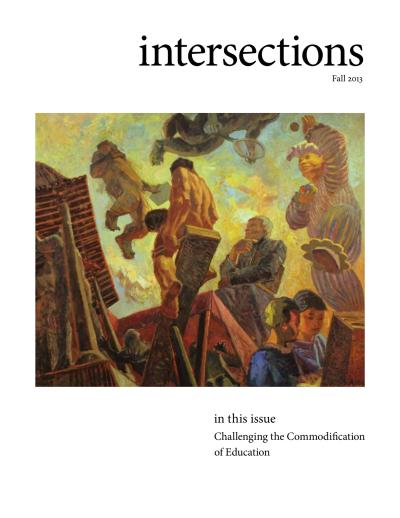 Editorial
From the Publisher: Staying Connected
Mark Wilhelm
Wilhelm frames Intersections as a tool for maintaining relationships among leaders in ELCA higher education, welcomes the journal’s new editorial advisory board, and points readers toward the 2014 Vocation of a Lutheran College conference at Augsburg and a special interfaith understanding conference at Augustana with Eboo Patel and Presiding Bishop Elizabeth Eaton.
-
Editorial
From the Editor
Jason A. Mahn
Mahn reads Michael Sandel’s What Money Can’t Buy alongside Larry Rasmussen and Martha Nussbaum to ask how Lutheran schools can articulate the “value added” of vocation without commodifying it, and previews the 2013 Vocation of a Lutheran College conference papers, Patricia Lull’s sermon, and Ann Hill Duin and Eric Childers’ Project DAVID essay that make up the issue.
-
Article
Welfare of the City and Why Lutherans Care about Education
L. DeAne Lagerquist
Lagerquist takes readers on a historical tour from sixteenth-century Saxony through the founding decades of Lutheran higher education in the United States to the present day, recovering Luther’s “gift economy” alongside Lewis Hyde and Oswald Bayer as a counter to the market logic that increasingly governs American higher education. She offers four propositions on vocation and commodification and proposes that Lutheran institutional vocation is to accept and pass along the gifts that come to our schools for the well-being of students, neighbors, and the world.
-
Article
"We're Looking for a College—Not a Vocation": Articulating Lutheran Higher Education to Prospective Students and Parents Seeking Relevance
Karl Stumo, Tom Crady
Drawing on Sallie Mae and UCLA enrollment data, the websites of competitor institutions, and candid voices from the field, Crady and Stumo describe a recruitment landscape in which yield rates have collapsed, discount rates have soared, and the word “Lutheran” often presents an obstacle until it is patiently unpacked. They survey mission language at Augsburg, PLU, Gustavus, and Wartburg and argue that strategic message development is the only way for ELCA schools to make vocation and Lutheran identity “credible, relevant, differentiating, and compelling” to prospective families.
-
Article
More Value than Many Sparrows: A Sermon on Matthew 10:26-31
Patricia Lull
Preaching at the 2013 Vocation of a Lutheran College conference, Lull recalls her own arrival at the College of Wooster the summer after Kent State and contrasts that era’s sense of students as participants in a college’s mission with today’s talk of “butts in seats.” Reading Matthew 10:26-31, she promises that the way of the cross—and its hard opportunities for slow-paced learning, genuine debate, and access for students who cannot pay the full cost—is the easy yoke, the lightest burden of all.
-
Article
Reinventing Lutheran Liberal Arts: A Preliminary Report on Project DAVID
Ann Hill Duin, Eric Childers
Duin and Childers introduce Project DAVID—Distinction, Analytics, Value, Innovation, Digital opportunity—as a framework for showcasing strategic reinvention across ELCA liberal arts institutions. Building on Childers’ College Identity Sagas and reading Selingo, Norris, and Popenici alongside the AAC&U, Adrian College, NITLE, and the Delta Cost Project, they pose framing questions about distinction, vocation, affordability, value propositions, two-track innovation, and BYOE technology that ELCA campuses can use to face their own “Goliath” moments.
-
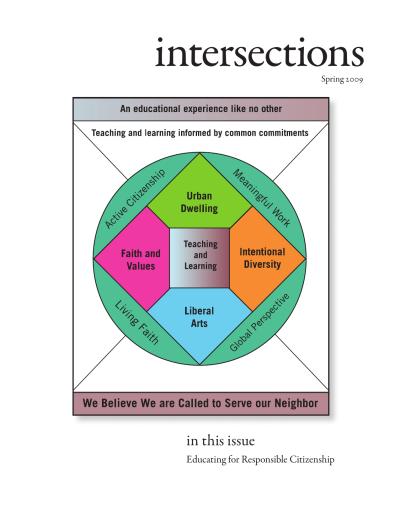 Editorial
From the Publisher
Mark Wilhelm
No. 29 · Spring 2009
Wilhelm introduces essays from the 2008 Vocation of a Lutheran College Conference held at Luther College under the theme “Educating for Responsible Citizenship,” previewing contributions from Paul Pribbenow on dual citizenship at Augsburg, Wanda Deifelt on Luther College’s engagement with civic vocation, Jose Marichal on the promise and peril of digital citizenship, and Arne Selbyg on his three experiences of being educated for citizenship.
-
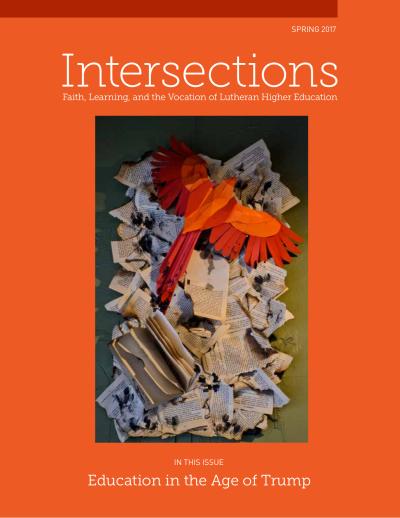 Editorial
From the Editor
Jason A. Mahn
No. 45 · Spring 2017
Mahn introduces “Education in the Age of Trump” by recounting a difficult academic year on his own campus — the Augustana “chalking” incident, a Latinx Unidos rally, and post-election conversations with marginalized students and quietly conservative Trump supporters alike — and frames the issue’s essays as careful (re)imaginings of the vocation of Lutheran higher education in an anxious political climate.
-
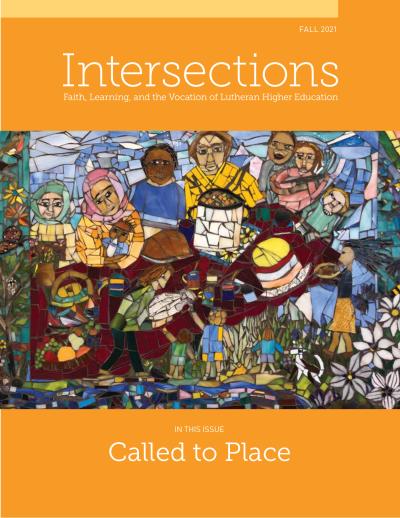 Editorial
From the Editor
Jason A. Mahn
No. 54 · Fall 2021
Mahn introduces the “Called to Place” theme of the 2021 VLHE Conference, arguing that Lutheran higher education’s emphasis on vocation must be grounded in particular geographies and embodied communities — for, as Wallace Stegner put it, “If you don’t know where you are, you don’t know who you are.”
-
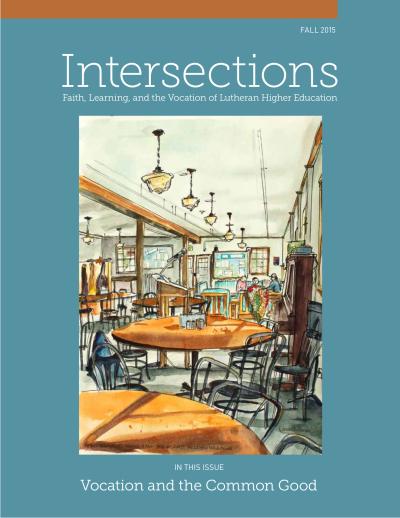 Editorial
From the Editor
Jason A. Mahn
No. 42 · Fall 2015
Mahn introduces the “Vocation and the Common Good” issue by asking what is left of “the commons” in an age of privatized goods and education-as-commodity, and frames church-related colleges — with their stubborn vocabulary of “liberal arts,” “collegiate,” and “calling” — as among the least fully-privatized resources left in American life.
-
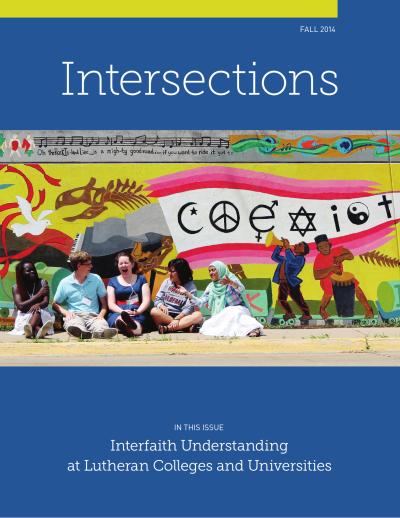 Article
What's in a Name?
Matthew J. Marohl
No. 40 · Fall 2014
St. Olaf College Pastor Matt Marohl tells the story of designing The Undercroft’s prayer and meditation room with a campus meditation group whose members began as “Matt” and ended — as their mutual respect grew — calling him “Pastor Matt,” a counterintuitive movement toward a more formal address that signals what intentional Lutheran-Christian hospitality looks like in practice.
-
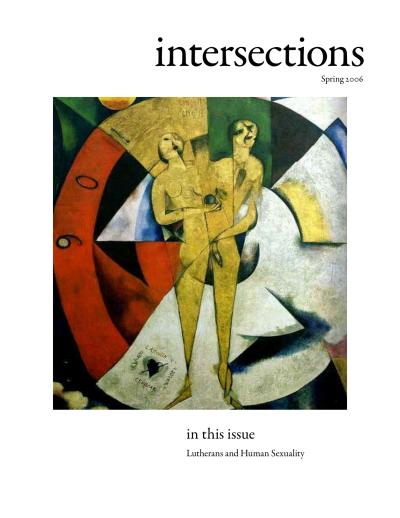 Editorial
From the Publisher
Arne Selbyg
No. 22 · Spring 2006
Selbyg notes that both the ELCA and Intersections have undergone major changes this year—the Division for Higher Education and Schools is gone, replaced by the Educational Partnerships and Institutions group within the Vocation and Education unit, and the journal has a new editor (Robert Haak), a new home at Augustana College, a new printer, and a new design. He commends the issue’s focus on human sexuality and points readers to the first draft of Our Calling in Education.