Access, Accessibility, & Change: A Call for Trustworthy Leadership in Higher Education
Intersections No. 60 · Fall 2024
Change, it often seems, is the only constant in higher education. In more than 20 years of working with leaders, universities, and organizations in this field, I’ve witnessed both the pace and the complexity of that change intensify. The boundaries between sector-specific issues and macro-level cultural, societal, and economic influences have become ever more permeable.
These influences and issues are so expansive that it can feel daunting for leaders serving on campuses across the country to find meaningful, tangible ways of making a difference. The reality is that no one leader or institution can pull the sector through the challenges of today, but leaders can impact the experience of all those in their care, from faculty to staff to students, and in the Lutheran tradition, do so with a refrain of “so that all may flourish.”
The question is, how do we arrive at a state of flourishing for ourselves and the communities we serve? To navigate the shifting landscape of higher education, it is essential to understand how interconnected issues such as rising costs, the impending enrollment cliff, changing student demographics, and the declining perceived value of degrees collectively shape the strategic challenges institutions face today.
Cost & affordability continues to be a central narrative.
Even though average net prices for students have dropped in recent years,1 the cost of college is still unarguably out of reach for the lowest-income families. While the decrease in net price is ostensibly good news for students, challenges remain for institutions; the drop has been driven largely by rising discount rates (total unfunded institutional aid divided by total gross tuition) across the country. In 2023, the average discount rate for first-time students hit an all-time high of 56.2%,2 which means that for every tuition dollar a college or university collects, it only keeps 43.8 cents. With discount rates this high, institutions are struggling to cover the cost of delivering on their educational mission, and we are seeing more and more colleges’ annual revenues slip into the red—often by millions. Financial struggles strain institutional resources and exacerbate uncertainty, undermining confidence in an institution’s strategic future.
The enrollment cliff is here (and, surprise, there might be two).
We’ve known for nearly two decades that the so-called “Enrollment Cliff” was coming. Starting in 2025, the number of graduating high school seniors in the U.S. will shrink by 15% over the next four years due to a decline in the birthrate that began during the Great Recession of 2008.3 This declining body of traditional-aged undergraduate students will significantly impact colleges and universities across the country whose core student base is made up of 18–22-year-olds. Moreover, recent forecasts by the U.S. Census also point to a second enrollment cliff beginning in 2033,4 in which another downturn in the number of graduating seniors would occur. Many institutions will face compounding financial issues in the years ahead if programs and opportunities are not adapted more robustly to meet the needs of non-traditional-aged college students.
And the demographics of our learners are changing.
The good news here, and the extraordinary opportunity for higher education, is that the diversity of students who can benefit from the educational experience of our institutions is expanding dramatically. The shifting racial and ethnic identity demographics across the U.S., as seen in the 2020 U.S. Census, demand that we engage in meaningful learning across differences,5 and some would argue, consider a redefinition of the “American Dream.”6 In higher education, these changes should guide us to vulnerably explore what it means to create belonging for the new wave of wonderfully diverse students in educational environments that were not, for the most part, built for them. The makeup of tomorrow’s student body amplifies the need for transparent and adaptive leadership to maintain trust and effectively address the diverse needs of a changing student body.
“In higher education, these changes should guide us to vulnerably explore what it means to create belonging for the new wave of wonderfully diverse students in educational environments that were not, for the most part, built for them.”
Meanwhile, the value of a college degree is in question.
Public confidence in higher education is on the decline as rapidly evolving skill sets and better consumer access to outcomes drive skepticism about the sector’s ability to adapt and stay relevant.7 A recent U.S. News & World Report found that “only 36% of Americans have confidence in higher education,” with significant concerns about cost and the student debt crisis driving the narrative behind the decline in trust.8 The declining value of a college degree is influenced by rising costs, shrinking enrollment, and shifting demographics. This trend exacerbates the erosion of trust in higher education as stakeholders question the sector’s ability to provide a relevant and affordable educational experience in the face of these mounting challenges.
So, what can we do?
Amid all the above, we face a declining level of trust in higher education as an American institution. In fact, I wonder if we’ve lost a bit of our own belief in the value and sustainability of our sector in a rapidly changing world. On campuses, the global pandemic undeniably impacted the energy and commitment of faculty, staff, and administrators alike, leaving exhaustion and disillusionment in its wake. To counter the popular narrative of higher education’s decline, we must begin with the people on our campuses who believe in the transformative nature of education.
Pursuing complex change successfully in any industry requires a variety of operational and strategic components. In higher education, we know change requires trust because, in this sector, our work is about people. Leadership and change happen through people, and people need to trust one another and their leadership to engage meaningfully in the hard work of change. Through an intentional focus on building trustworthy leadership, we can rebuild a foundation of strength within our colleges and universities to, in turn, drive a revitalization of higher education in the eyes of the nation.
How do you build trust, exactly?
The concept of trust often feels nebulous and complex—what do we really mean when we say, “I trust you?” Or when someone says, “I don’t trust the administration at my university?” It turns out, according to authors Reichheld and Dunlap, trust can be deconstructed into four factors that together build trusted relationships: Transparency, Capability, Reliability, and Humanity.9 Let’s unpack these four factors in the context of our campus communities.
TRANSPARENCY: Continual sharing of information that impacts people.
How can you improve transparency on your campus or within your team or department?
Share as much as you can, as often as you can. The more everyone in the community is connected to the big picture, the more powerful, effective, and willing they will be as partners in driving meaningful change. Your community can spot inauthenticity from a mile away, so these efforts cannot be perfunctory or surface-level.
Build education and context into information sharing. People need the “so what.” For example: sharing an update about your institution’s financial picture without couching it in an understanding of how institutional finance works will not maximize the trust-building capacity of your communications. Some of the most eye-opening workshops my colleagues and I have led have been helping faculty and staff understand higher education cash flow patterns, the difference between a budget and revenue, and how an endowment can be used. Let me tell you—the majority of people across your campus do not understand these concepts—they are not exposed to this context with any regularity. As a leader, this financial context may be your language, but it is not the language of individuals across campus. Make sure that you are providing an appropriate contextual underpinning for your updates.
Build an internal communication rubric (or set of questions) to guide how you share information. For example: why is this important? Can we connect this topic to mission, vision, or strategic pillars? Who will this information impact? What is already decided, and what has yet to be determined? What are we NOT sharing, and why?
CAPABILITY: The observable skills required to deliver on promises
How can you demonstrate the ability of the organization and its leaders to keep their word?
Evaluate skill gaps and invest in internal development efforts to close them. When people have confidence in their own ability to do what is asked of them and can see that others are equipped to execute against their roles, confidence in the organization will grow. And, if you have people in your environment who are capping your ability to make the kind of change and progress that’s needed, think long and hard about whether it’s more difficult to let them go or let them stay and perpetuate poor performance.
Empower the middle and put them at the table. The “middle” of an institution are those who bear responsibility for translating strategy into operations, and daily interactions with students, and are critical to organizational success. They know so much about what a campus experience feels like on the ground. During the pandemic, when so many voices were needed and decisions moved at lightning speed, we saw such extraordinary talent rise from the middle. Now, those who were given that kind of access and voice during a crisis are being asked to go back to their seats and receive directions. The impact of this disempowerment is felt across campus. Don’t degrade the leadership that you gained with these critical players—make sure they see that you still trust them to make meaningful contributions.
Streamline systems and processes to clear the way for impactful work. Many of us are familiar with James Clear’s Atomic Habits, a book about navigating change and goal-settling within ourselves. James asserted, “You do not rise to the level of your goals; you fall to the level of your systems.”10 If no one has confidence in the systems and processes that are primed to underpin your change initiatives, trust will suffer. The refrain will be, “How can leadership ask this of us when [insert your issue here: our data is so disconnected, our platforms don’t talk to each other, I can never get the information I need when I need it, etc.]?” The same is certainly true of our campuses. Systems efficiency is hard work, but building trust demands that you take every step possible to remove obstacles that will keep your institution from achieving its greatest potential.
RELIABILITY: Continual delivery on promises made
How can you demonstrate the commitment of the organization and its leaders to keep their word?
Show how far you’ve come. One of the easiest things for a group of people to do is to forget where they started. One of my favorite things to do in a strategic update in my own organization is to name all of the things we were not doing or did not have when we started and then connect the dots to all the growth and evolution we’ve experienced since. A simple act like stating progress to date encourages appropriate perspective and creates a sense of accomplishment for people who contribute to and/or benefit from the work. Don’t lose sight of what’s behind you on the path as you focus on what’s ahead.
Celebrate every win and visibly course-correct failures. In this environment, every win is a big win. People need hope to maintain momentum and keep them moving forward, so lift up moments of achievement and triumph, either at the institutional or the individual level. Acknowledge great work where it’s happening and connect the dots to institutional progress where it makes sense. Regarding their work on change, the Heath brothers encourage us to “find the bright spots,” the notion that we hold a predisposition to focus on the problems, but not on what’s going well. They wrote, “The question is not ‘How can my organization be like my best peer?’ The question is, ‘How can my organization be like itself at its best moments?’”11
“Celebrate every win and visibly course-correct failures. In this environment, every win is a big win. People need hope to maintain momentum and keep them moving forward, so lift up moments of achievement and triumph, either at the institutional or the individual level.”
Make the right commitments to your people and your students—then keep them. Meeting the needs of everyone on your campus is no easy task: the workplace writ large is more age-diverse now than ever before, with as many as five generations interacting in any given organization.12 Mental health challenges are on the rise for faculty, staff, and students alike,13 and the expectation of an organization to invest in wellness for its employees continues to increase.14 The most important thing to consider when we think about building trust through reliability is to commit to what you can deliver. Overcommitting and underdelivering when it comes to caring for your faculty, staff, and students is a quick road to a lack of trust, discouragement, and retention issues, all of which will slow institutional momentum.
HUMANITY: Recognition of the uniqueness of each person
How can you always bring it back to people?
Constantly ask the question: who does this impact, and how will we address that impact directly? Groups or individuals whose professional responsibilities, structures, or environment are altered in some way by organizational changes deserve at least explicit acknowledgment of that change from leadership and active support if the change is significant. This demonstration of care will reinforce your trustworthiness because people will feel, and be, seen.
Tap into your empaths for insight. You all have them on your team or across campus: those individuals with strengths in individualization, empathy, relatedness, and connection. Make sure they are at the table to bring humanity to strategy and action. Faculty and staff, as much as your students, need to experience belonging in your environment. Careless communication, microaggressions in language or personal interactions, and overt omissions of impact for different populations are quick ways to derail trust-building.
“So many of our systems, policies, and procedures are still built on rubrics of equality (providing the same thing for or requiring the same thing of everyone) rather than on an adaptive approach to equity (providing solutions and support based on each person’s needs).”
Center equity, not equality. So many of our systems, policies, and procedures are still built on rubrics of equality (providing the same thing for or requiring the same thing of everyone) rather than on an adaptive approach to equity (providing solutions and support based on each person’s needs). How can our policies and procedures be structured to create space for meaningful conversations that produce equitable solutions versus structured around rules that prevent or discourage human connection?
Our Charge
Trust is particularly critical in higher education because it underpins the relationships between institutions and key stakeholders—students, faculty, staff, and the broader community. The past few years of global upheaval and change have challenged our trust in the colleges and universities we serve and degraded the trust of the public in higher education. It may be a long road to restoring trust in our sector as a public good, but we must first look inside our organizations to generate passion for and momentum toward that future.
From wherever you sit on your campus, consider the opportunities you have to build trustworthy leadership through transparency, capability, reliability, and humanity; and remember that trust is built between people, not between entities or organizations. Campuses across the country hold incredible talent. If we can tap into the power of our people and rekindle our collective belief in the vitality of our educational mission, we can surely navigate the landscape around us with purpose and authenticity.
Endnotes
1. Levine, P. (2023). College prices aren’t skyrocketing—but they’re still too high for some. Brookings Institute. https://www.brookings.edu/articles/college-prices-arent-skyrocketing-but-theyre-still-too-high-for-some/
2. Tuition Discount Rates at Private Colleges and Universities Top 50 Percent. (2023). NACUBO. https://www.nacubo.org/Press-Releases/2023/Tuition-Discount-Rates-at-Private-Colleges-and-Universities-Top-50-Percent
3. Barshay, J. (2018). College students predicted to fall by more than 15% after the year 2025. Hechinger Report. https://hechingerreport.org/college-students-predicted-to-fall-by-more-than-15-after-the-year-2025/
4. Baumann, D. (2024). Colleges Were Already Bracing for an “Enrollment Cliff.” Now there Might Be a Second One. The Chronicle of Higher Education. https://www.chronicle.com/article/colleges-were-already-bracing-for-an-enrollment-cliff-now-there-might-be-a-second-one
5. Beheraj, K., Fitzpatrick, A. (2023). American’s fastest-growing demographic groups. Axios. https://www.axios.com/2023/06/29/fastest-growing-demographics
6. Success Index: Misunderstanding the American Dream. Populace. https://static1.squarespace.com/static/59153bc0e6f2e109b2a85cbc/t/650c26577a79de2ce29b61c8/1695295123767/Success+Index%3A+Misunderstanding+the+American+Dream
7. Clark, C., Cluver, M. (2023). Trend #2: The value of the degree undergoes further questioning. Deloitte Insights. https://www2.deloitte.com/us/en/insights/industry/public-sector/articles-on-higher-education/value-of-college-degree.html
8. Is College Worth It?. (2024). U.S. News & World Report. https://www.usnews.com/news/us/articles/2024-07-08/is-college-worth-it-poll-finds-only-36-of-americans-have-confidence-in-higher-education
9. Dunlop, A., Reichheld, A. (2022). The Four Factors of Trust. Wiley.
10. Clear, J. (2018). Atomic Habits. Avery.
11. Heath, C., Heath, D. (2010). Switch: How to Change Things When Change is Hard. Crown Currency.
12. Pollak, L. (2019). The Remix: How to Lead and Succeed in the Multi-generational Workplace. HarperCollins Leadership.
13. Meeks, K., Peak, A.S., & Dreihaus, A. (2023). Depression, anxiety, and stress among students, faculty, and staff. Journal of American College Health.
14. Work Remastered. (2023). United Culture Company.
-
 Editorial
From the Editor
Colleen Windham-Hughes
Windham-Hughes welcomes newcomers and seasoned colleagues to the conversation, lifts up Mary Elise Lowe’s three Lutheran “whys” for educational access, and commends Rev. Jen Rude’s “Sacred Pause” practice as a way to humanize one another and make opening access both easier and more joyful.
-
Editorial
From the Publisher: Reflections on the 2024 Vocational Leaders in Higher Education Conference
Lamont Anthony Wells
Wells reflects on the 2024 VLHE Conference theme — “Educational Access: Lutheran Roots, Contemporary Practices” — tracing today’s commitment to inclusivity back to Martin Luther’s radical 16th-century insistence that both boys and girls be educated, and previews NECU’s expanded engagement of student leaders alongside faculty and administrators.
-
Article
Creation, Justice, and Communio: Lutheran Insights Empowering Educational Access
Mary Elise Lowe
In her VLHE keynote, Lowe names three Lutheran commitments — continuing creation, neighbor justice, and communio — as the “why” that empowers ELCA colleges and universities to pursue equitable access for students often left behind by persistence and graduation gaps.
-
Article
Committed to Paradox
Caryn Riswold
Riswold lifts up paradox — saint and sinner, lord and servant, Rooted and Open — as a distinctive Lutheran root that lets institutions honor the complicated truth of who their students are and embrace the messy, ever-reforming work of access and accessibility as a theology of the cross.
-
Article
2024 VHLE Conference: "Rooting Access" Panel Talking Points
Guy Nave
Nave reads “access” across Deuteronomy 23, Ruth, Isaiah 56, Acts 10, and Matthew 15:21-28 as an ongoing biblical conversation that evolves from exclusion to ever-widening welcome — and presses ELCA institutions to shift their focus from “student readiness” to “institutional readiness.”
-
Article
Affirming, Entrusting, and Acting: A Baptismal Grounding of Affirmative Action in Lutheran Higher Education
Peter Carlson Schattauer
Schattauer draws on the Lutheran baptism liturgy — where the gathered assembly publicly affirms what it is for and is entrusted with responsibilities for justice and peace — to argue that NECU institutions create truly inclusive communities by affirming commitments, naming responsibilities, and acting in ways that embody both.
-
Reflection
Reflecting on Belonging
Melissa Woeppel
Woeppel, campus pastor at her own alma mater, wrestles with a Bethany student’s plea — “I want to feel like this is my home, like I belong” — and Mindy Makant’s reminder that we don’t choose the story of the past but do choose how we tell it forward, opening space for students from 35 faith traditions to find Lutheran institutions to be their home.
-
 Editorial
From the Editor
Tom Christenson
No. 2 · Winter 1997
Christenson opens with an invitation for reader submissions to balance the conference-paper format of the first two issues, then asks how college and universities can turn students positively toward learning. Drawing on Aristotle’s claim that study is loved for its own sake (which students greet with disbelieving laughter) and Neil Postman’s The End of Education, he argues that students lack narratives within which learning makes sense and proposes four Lutheran mega-narratives—stewardship of creation, the freedom of the Christian, the sacramental presence of the transcendent in the concrete and ordinary, and vocation—that could inspire learning at the 28 ELCA colleges and universities.
-
 Book Review
The American Myth of White Supremacy: A Review of Myths America Lives By
Susan VanZanten
No. 50 · Fall 2019
VanZanten reviews Richard T. Hughes’s Myths America Lives By: White Supremacy and the Stories that Give Us Meaning, which argues that the United States grounds its identity in five myths — Chosen Nation, Nature’s Nation, Christian Nation, Millennial Nation, and Innocent Nation — all informed by the primal myth of white supremacy, and considers what Lutheran theological values can offer for resisting that myth.
-
 Article
Called to Flourish: An Ethic of Care
Mindy Makant
No. 52 · Fall 2020
Drawing on Lenoir-Rhyne’s core value of Care, Glennon Doyle’s Untamed, Darrel Jodock’s “Gift and Calling,” and Luther’s plague-era practice of opening his home to the sick, Makant argues that flourishing is interdependent — that self-care is a means to extending care, and that an ethic of care is the meaningful, transformative work to which Lutheran liberal arts education is called.
-
 Article
Between Suspicion and Trust
Ahmed Afzaal
No. 30 · Fall 2009
Afzaal argues that scholars and educators have a unique vocation to shift Christian-Muslim relations from suspicion to trust, drawing on the 2007 Muslim open letter “A Common Word,” Robert Shedinger’s Was Jesus a Muslim?, and Muhammad Iqbal’s Reconstruction of Religious Thought in Islam to argue that Christianity and Islam converge in the insight that religion is a spiritual force for social justice and human liberation — an insight obscured by the modern Western discourse of sui generis religion.
-
 Reflection
Caught in a Place Between Caesar and God
Darrel D. Colson
No. 54 · Fall 2021
Colson reflects on his anguish, as Wartburg’s president, over an Iowa law that prevents him from requiring student COVID-19 vaccinations — reading Luther’s “Whether One May Flee From a Deadly Plague” alongside the conflict between obeying the law and serving neighbor.
-
 Article
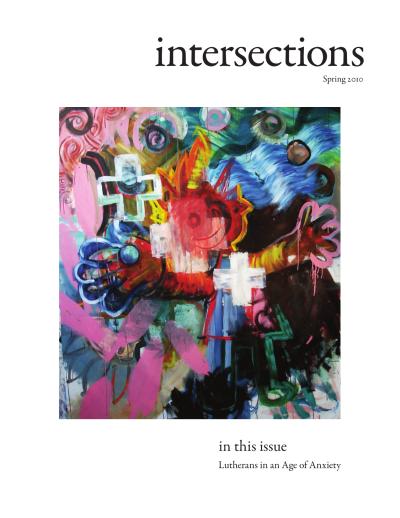
Hope in the Face of Ecological Decline
Jason Peters
No. 32 · Spring 2010
Peters reads our ecological crisis—a campus “Birth Control Tree,” feminized fish, population, climate, water, and soil—through Alexander Pope, William Blake, Søren Kierkegaard, and C. S. Lewis’s The Abolition of Man, and argues that the modern project of mastering nature has made despair (the unconscious form Kierkegaard named) our condition. He calls for three reorientations: practical (assigning value to domestic arts and place over disciplinary specialization), philosophical (dismantling the Baconian/Machiavellian/Cartesian project of control), and theological (recovering the Church’s rejection of Gnosticism so that grace comes to us by means of nature, not in contempt of it).