When I first read Richard Von Dohlen’s critique of the doctrine of the two kingdoms (which I prefer to think of as “two realms”) I wondered if I wrote what I had meant. Certainly it did not seem as if Von Dohlen had read what I had written. As I read further I realized that Von Dohlen and I use different languages which arise partly, I think, from different academic disciplines and partly from different theological traditions. I’ll begin by saying that I agree with much of what Von Dohlen says although I think he misunderstands me, Luther, and Luther’s doctrine of the two realms.
Von Dohlen argues that “it is a potential disaster for social ethics, particularly Christian social ethics which by definition rests on the premise that the Gospel does have implications for the ethical decisions that we make in society and the institutional frameworks with which those decisions are made” (p. 1). I agree. Moreover, Luther agrees. It is for this reason that he responded to rulers who asked him how they might exercise their powers and authority as Christians. It is for this reason that he wrote “Whether Soldiers, Too, Can be Saved.” His charge to princes and rulers in To the Christian Nobility of the German Nation, his On the Freedom of a Christian, and Temporal Authority: To What Extent It Should Be Obeyed are all attempts to combat the prevailing notion that to be secular was to be godless and somehow less than Christian. These writings were attempts to combat the prevailing notion that, for example, the pope had an authority (and holiness) higher and better than that of secular rulers. Von Dohlen, although not using Luther, makes Luther’s point well.
Von Dohlen, by way of a personal illustration, makes the point “that we live in what sociologists refer to as a highly structurally differentiated society. We all play many roles and live in many institutional structures or, if you prefer, realm. Each of these structures has its own autonomy, so to speak but they are all interdependent in exceedingly complex ways” (p. 2). Luther, I suggest, was aware that he was living in a society that was, or at least becoming, “structurally differentiated.” I won’t try to argue that it was “highly differentiated”; nonetheless it was differentiated and increasingly so. Can a man whose father began life as the son of a peasant farmer and then moved to a new town to become a miner, and then the owner of a mine as well as a councilor in the city government really be unaware of the differentiation in society? I think not.
Von Dohlen states that “Luther’s sociology may have been appropriate for Luther’s time” (p. 2). I’m not sure what Von Dohlen means when he speaks of “Luther’s sociology” so I’ll leave it to him to tell me what that might be. For insight as to the question of Luther’s sociology, I’m tempted to turn to Luther’s response to Assa von Kram, a professional soldier. Here Luther affirms the legitimacy of the soldiering vocation. It can be abused to be sure, but this misuse does not invalidate it any more than the misuse of the professorial office invalidates that vocation. Indeed the soldiering profession, Luther goes on to explain (borrowing Von Dohlen’s words), is “hellishly complex [and] frustratingly complicated.” Can killing—even in the name of peace and freedom—be justified? If a ruler is wicked and evil ought a soldier serve that ruler? Ought a soldier serve in a war that is apparently unjustifiable? These are the questions which Luther struggles to address. To me these are hellish and frustrating questions; in any case they certainly are not easy. Luther concludes that a soldier must take his faith seriously enough to question authority.2,3 At the same time a soldier’s trust and confidence are ultimately in God: “When the battle begins … [soldiers] should simply commend themselves to God’s grace and adopt a Christian attitude.” The soldier should then pray: In “faith I will live and die, fight, and do everything else.”4 Luther does not seek to evade the questions, nor does he even counsel others to evade hellish and frustratingly complex questions. He does however say, that at the end of the day when one has struggled with such questions, our trust and our confidence are not in our faculties of reason but in the One who has given us these faculties.
It is precisely for this reason that Luther would likely agree with Von Dohlen in saying, “I believe that a theology informed by a sociology (or a psychology, economics, politics, jurisprudence, etc.) which in turn is informed by theology will better enable us to understand and attack some of the problems and alleviate them” (p. 1). It is precisely for this reason that Luther tells Christians that they ought to support schools and educate their children. Luther encourages parents to send their children to schools to be educated so that they can be proud of how their child “maintains and helps to further the whole worldly government. … It ought to be a matter of great honor and satisfaction for you to see your son an angel in the empire and an apostle of the emperor, a cornerstone and bulwark of temporal peace on earth, knowing for a certainty that God so regards it and that it is really true. For although such works do not make men righteous before God or save them, nevertheless, it is a joy and comfort to know that their works please God so very much—and the more so when such a man is a believer and is in the kingdom of Christ.”5
Faith or theology is important; also important is that faith and reason are in conversation and dialogue with each other. Faith ought to impel the believer to godly service in society.
Von Dohlen charges that “the Lutheran two-kingdom doctrine assumes an academic culture characterized by epistemological monism that is neutral with respect to anthopological assumptions” (p. 2). I was raised on small words so I’m not exactly sure what Von Dohlen means. If he means that Lutherans or at least the two kingdoms doctrine thinks that academic culture is neutral or that it is neutral about its assumptions about humanity and God, about nature and the cosmos, then I think that I and others have misled Von Dohlen. Luther is pretty clear in his “Heidelberg Disputation” about his reservations concerning the neutrality of reason. Reason can accomplish some things, but it can seriously mislead. For this reason Luther says that what we can say about God always has to be said in light of the cross.
Luther, as near as I can determine, makes no claims about epistemology with respect to a Christian’s role in (secular) society. He merely argues that a Christian lives in the world, the world is good because God created it, and therefore a Christian ought to contribute to the welfare of God’s good creation by participating with God in fighting against the forces which threaten to upset good order and peace. If anything Luther acknowledges the plurality of epistemologies and the possibility of a single view of reason: “Both reason and natural law belong to God’s creation and therefore are not separated from God’s will.”6 Luther’s point in writings like On Temporal Authority, To the Christian Nobility of the German Nation Concerning the Reform of the Christian Estate, and The Freedom of a Christian is that there is more than one valid and legitimate epistemology. Each discipline has its own legitimate epistomology. The Christian’s task if anything is to ask “what is the gospel?” and “how might it be proclaimed?” No more!
Von Dohlen rightly condemns the oft heard argument from some Lutherans that “there were a separate sociological realm with distinct institutional structures and ethical norms that had no direct bearing on the gospel. This was surely nonsense. They sometimes talked as if we were living in an age where there was cultural consensus about the nature of truth and justice. This too was patently false” (p. 3). It’s hard to know what to say in response. I agree with Von Dohlen. Luther’s doctrine of the two realms has too often been misunderstood by both its proponents and its opponents. The gospel does not have a bearing on other “other” sociological realms and vice versa. To bifurcate in this way is to introduce an unnecessary dualistic element. This is what occasions Luther’s thinking on two realms. Christians have a two-fold existence. Both the secular and the sacred make legitimate claims on the Christian’s earthly existence.
The point of the two realms doctrine is to firstly acknowledge the duality of our earthly existence and secondly the ambiguity of earthly phenomena and knowledge. What is the meaning of “2+2=4” or “7+5=12”? Christians are called within their individual vocations to wrestle with the significance of these truths; and, as Christians, they are called to wrestle with the “gospel” within these truths. Both facets of our existence are important; neither can be abandoned without imperiling the identity of the individual who is created uniquely in God’s image.
Lutherans like Granger Westberg have been instrumental in the establishment and management of institutions like the Parkridge Center for Health, Faith and Ethics because they take seriously their dual identity or citizenship. Our identity is not as either Christian or academic, but as Christian and scholar. To assume otherwise and to understand Luther differently is to bifurcate something which was intended to combat a bifurcated dualism. Von Dohlen in his advocacy for a wholistic understanding of the human and of scholarship is to be commended. On the basis of Luther’s understanding of the two realms, I gladly and willingly volunteer to combat those forces which attempt to bifurcate.
Endnote
1. The title of the copy of the Von Dohlen paper I originally received was “A Fifth Tit on a Cow: The Irrelevance of the Lutheran Doctrine of the Two Kingdoms for Academic Life.” I found out that there was a discussion among my colleagues as to whether it ought to be a “teat” or a “tit” (the slang variation of the same term). Happily I missed that discussion.
2. “There is no doubt that the military profession is in itself a legitimate and godly calling and occupation” (LW 46:100).
3. In response to the question of whether a soldier ought to go to war when his lord is wrong Luther says, “if you know for sure that he is wrong, then you should fear God rather than men … and you should neither fight nor serve, for you cannot have a good conscience before God.” (LW 46:130)
4. LW 46:135–6
5. “A Sermon on Keeping Children in School,” in LW 46:240–1
6. Walther von Loewenich, Martin Luther: The Man and his Work, trans. Lawrence W. Denef (Minneapolis: Augsburg Publishing House, 1982), 239. Von Loewenich sets up this assertion by noting that both the secular and sacred authorities “have their unity in God’s decree” and that “the kingdom of Christ could not endure in this world without temporal authority—without defense against evil and efforts made toward earthly peace. On the other hand, spiritual authority assists temporal authority by proclaiming God’s will to government and to all classes … God rules in both kingdoms (through both authorities) … It is possible for love to be operating through the harsh realities of justice, punishment, the death penalty, ‘wrath’, and the ‘sword’ … God must at times carry out his ‘proper work’ only under the form of his ‘alien work’—his love under wrath, his grace under judgment” (237–9).
-
 Editorial
From the Publisher
Arne Selbyg
Selbyg reports on the “Reclaiming Lutheran Students” research by the Lutheran Education Conference of North America (partly funded by the Aid Association for Lutherans), which found that alumni of Lutheran colleges report higher satisfaction with the overall quality of their education than alumni of flagship public universities, with more than eighty percent affirming that their college helped them develop moral principles and benefit from spiritual development, while also noting that parents of Lutheran high school students remain largely unaware of both the magnitude of financial aid offered and the quality of the education provided.
-
Editorial
From the Editor
Tom Christenson
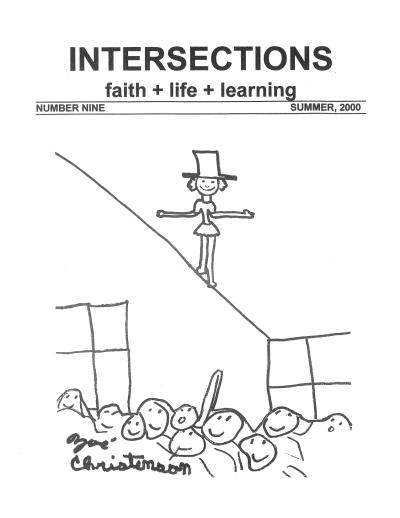
Christenson introduces a varied issue: the VonDohlen / Ratke discussion of the two kingdoms doctrine, Rachel Hammond’s “real gem” of a talk on her time in Ecuador (with an invitation to send contributions to the Home for Perpetual Hope orphanage via her home church in Oberlin, Ohio), Chuck Huff’s essay on the effect of liberal learning on the practice of psychology, and John Reumann’s reflection on a scholarly life lived between academy and church—and notes that the cover artist is his eight-year-old daughter Zoé, whose post-circus drawing of a balancing act struck him in light of Reumann’s opening line.
-
Article
A Fifth Teat on a Cow: The Irrelevance of the Lutheran Doctrine of the Two Kingdoms for Academic Life
Richard VonDohlen
VonDohlen, responding to Richard Hughes, Carol LaHurd, David Ratke, Philip Nordquist, and Robert Benne, argues that the Lutheran doctrine of the two kingdoms as commonly deployed in recent discussions of Lutheran higher education rests on a faulty sociology (taking Luther’s sixteenth-century structure for our highly differentiated society) and an epistemological monism (assuming a single neutral reason against the pluralism described by Alasdair MacIntyre and others), making it anti-intellectual, hostile to interdisciplinary dialogue and Christian social ethics, and ultimately as a defense of theology’s relevance about as useful as “a fifth teat on a cow.” Drawing on his experience on the Catawba Valley Hospice Ethics Committee, his Dutch Reformed and dispensationalist background, and the ELCA social statement “Sufficient, Sustainable Livelihood for All,” he calls for an “intellectually ecumenical” dialogue between Lutherans and non-Lutherans willing to take each other’s paradigms seriously.
-
Reflection
Calling and Learning: On Losing and Then Finding Myself
Rachel Hammond
Hammond, a Capital University junior who spent two semesters studying in Guayaquil, Ecuador, recounts watching the sucre collapse from 10,500 to 29,000 per dollar between September and January, the overthrow of President Jamil Mahuad, the freezing of bank accounts over $4,000, the threatened eruption of the volcano at Baños, and her work at an orphanage that needed only $6.81 to feed a child for a month—and calls her fellow students, in light of Elie Wiesel’s warning that indifference is the enemy, to recognize their education as a gift and a responsibility to speak for those who cannot speak for themselves.
-
Article
Modeling Virtue: In Which a Social Psychologist Decides He Can Do Good Without Freely Choosing It
Chuck Huff
Huff, recalling his 1975 sophomore disillusionment with a sterile introductory psychology in South Georgia (and Danny Saunders’s question from The Chosen), defends a scientific psychology as model-making rather than meaning-finding, traces the collapse of Lawrence Kohlberg’s totalizing theory of moral development into chastened mini-theories, and presents William Damon and Anne Colby’s interview study of twenty-three “moral exemplars” whose lives were marked by self-good unity, constant self-examination in community, a felt inability to have done otherwise, religious grounding, and genuine happiness. Following Aristotle on virtue as learned habit and the Christian tradition of the “slave for Christ,” he concludes that goodness flows from the choice of constraints rather than from the lone free-will hero of fairy tales, complicating C. P. Snow’s two-cultures divide. Originally the 1998 Mellby Lecture at St. Olaf.
-
Article
Serving Two Masters: Teaching and Writing Between Academy and Church
John Reumann
Reumann reflects on more than fifty years navigating between academy and church—the Society of Biblical Literature and Exegesis (whose Doktorvater Morton Enslin was unceremoniously dumped at Toronto by “young Turks” Robert Funk and others, while Harry Orlinsky saved the day at the centennial), the 1978–1987 New American Bible Revised New Testament committee with its bishops, the U.S. Lutheran–Roman Catholic dialogue volume on “Righteousness,” and the 1999 Joint Declaration on Justification—and uses his Anchor Bible and Augsburg commentaries on Philippians, Colossians, and Romans to illustrate Krister Stendahl’s judgment that one can no longer master all the literature: epistolary research, rhetorical and discourse analysis, social-world readings, feminist scholarship on Euodia and Syntyche, the koinonia and friendship debates (Sampley, Fitzgerald, Witherington), and the house-church recovery of Filson. The academy is antepenultimate, the church penultimate, God ultimate—professors as “believers, testifiers, witnesses” serving pro bono, pro ecclesia, and pro Deo.
-
 Book Review
Learning Across Campus: Hearing Bok's Call to Conversation
David Ratke
No. 39 · Spring 2014
Ratke reads Derek Bok’s Our Underachieving Colleges from Lenoir-Rhyne and argues that Bok’s call to think holistically about undergraduate education and to dialogue across disciplinary boundaries names the work already underway at ELCA colleges. He weighs faculty attitudes, the role of skills in the core curriculum and the major, and the importance of the extracurriculum for student formation.
-
 Article
Wilhelm Löhe and Higher Education
David Ratke
No. 30 · Fall 2009
Ratke recovers the educational vision of Wilhelm Löhe (1808–1872), spiritual father of Wartburg College and Wartburg Seminary, drawing on Löhe’s “Aphorismen über Schule und Schulunterricht” and other writings to argue that education is about the formation of whole persons by whole teachers in whole institutions, that all education is religious and never neutral, and that education is for eternity as well as the present — a vision in which the values of Christianity sanctify the so-called worldly means of education.
-
 Article
Ethical Leadership for a Changing World: A Shared Calling from Cradle to Career
Cory Newman, Janelle Rozek Hooper
No. 62 · Fall 2025
5 min audio
Hooper and Newman recount how an ELCA Barna survey on early childhood education sparked the realization at VLHE 2025 that ELCA colleges and the 1,200 Lutheran schools and early learning centers share identical challenges — and an untapped potential to form ethical leaders across the full educational continuum from cradle to career.
-
 Editorial
From the Editor
Jason A. Mahn
No. 42 · Fall 2015
Mahn introduces the “Vocation and the Common Good” issue by asking what is left of “the commons” in an age of privatized goods and education-as-commodity, and frames church-related colleges — with their stubborn vocabulary of “liberal arts,” “collegiate,” and “calling” — as among the least fully-privatized resources left in American life.
-
 Article
Reclaiming Grundtvig at Grand View College
Mark C. Mattes
No. 27 · Spring 2008
Mattes traces the Grundtvigian heritage of Grand View College — the only North American institution founded by Grundtvigian Danes — from its origins in the 1880s split between Pietist Inner Mission and Grundtvigian Danish Lutherans through its golden years of folk dancing, gymnastics, and the weekly lecture, to the demographic and curricular changes of the 1950s through 1990s. He describes recent tangible initiatives, including the Grand View College Reader, Imaging the Journey, and the 2007 Strategic Planning Commission’s “Faith Foundations” statement, that seek to recover the “Human first, then Christian” mantra of Grand View’s ancestors for a generation of students whose “ship” has had not only its planks but its very model replaced.
-
 Article
Uneasy Partners? Religion and Academics
Storm Bailey
No. 11 · Spring 2001
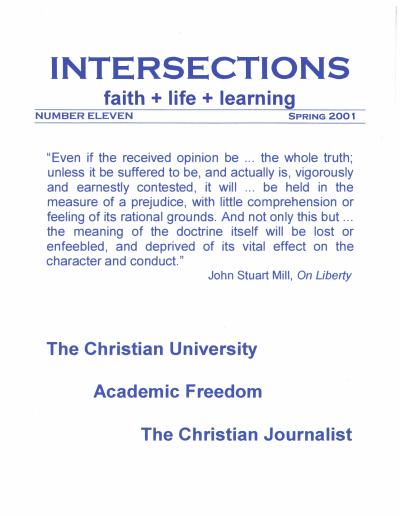
Bailey, a philosopher at Luther College, takes up the reflex of describing church-related colleges as “pretty good in spite of the religion” and argues instead that religious commitment serves academic goals on three fronts: service as central academic purpose (Richard Hughes on Mennonite colleges in Models of Christian Higher Education), educational community (Plato’s dialogues, Parker Palmer, and Mark Schwehn’s Exiles from Eden), and integration of knowledge across disciplines against Nelson and Watt’s “entrepreneurial disciplinarity.” He then defends academic freedom on Christian grounds by drawing on Mill’s On Liberty argument from fallibilism, the centrality of epistemic weakness in the Christian tradition, and Wolterstorff’s claim that to infringe academic freedom is to desecrate an image of God—making personal and institutional religious commitment a foundation, not a foe, of the liberal academic ideal.
-
 Reflection
Saving Minds
Lake Lambert
No. 28 · Fall 2008
In a sermon preached in the Castle Church in Wittenberg during Wartburg College’s 2006 faculty and staff development seminar, Lambert names two sins of the mind—coveting and mental sloth (in both its rigid refusal to think and its mindless relativism)—and, drawing on Luther’s Large Catechism and Martin Luther King, Jr.’s “A Tough Mind and a Tender Heart,” calls Christians to receive the wisdom that comes when faith puts knowledge into action, sustained by the hope of the resurrection.
-
 Article
What I Have Learned: Maybe Plato Was Right
Richard Ylvisaker
No. 4 · Winter 1998
Inaugurating the new “What I Have Learned” column, Ylvisaker reflects on a career of teaching philosophy at Luther College and offers four hard-won “preliminary examples” in which Plato turned out to be more right than fashionable criticism allowed: (1) communities are not necessarily better off by becoming more diverse—diversity needs a unity of purpose if it is to enrich rather than fragment; (2) politics, to be more than a struggle for power by competing interests, must rest on a moral basis that transcends those interests; (3) the much-derided body-soul dualism contains a measure of truth about the cognitive and moral limitations of embodied life; and, deepest of all, (4) reason itself depends on a community of discourse in which doctrinaire pronouncement gives way to disciplined inquiry. Athens and Jerusalem, he concludes, should meet at the college of the church.