Affirming, Entrusting, and Acting: A Baptismal Grounding of Affirmative Action in Lutheran Higher Education
Intersections No. 60 · Fall 2024
“How do you define affirmative action in the context of Lutheran (NECU) higher education, and what are its main objectives?”
This provocative question was asked to those of us who attended this past summer’s Vocation of Lutheran Higher Education Conference at Augsburg University after a panel discussion on our commitment to diversity, equity, and inclusion at institutions of the Network of ELCA Colleges and Universities (NECU).
We were asked to respond to this question while gathered in small groups with colleagues who occupy similar positions at other NECU institutions.
When this question came up on the screen, it immediately stimulated my imagination.
I thought perhaps, as the whitest Christian denomination in North America, institutions of the ELCA had little to say about the practice of affirmative action in our society.
As institutions grounded by the vision presented in “Rooted and Open: The Common Calling of the Network of ELCA Colleges and Universities,” I began to imagine how it was that Lutheran theology and practice might support and affirm the ways our institutions strive to create spaces for all students, particularly for those who come from under-represented populations on our campuses.
To this end, I asked myself, “Where in the shared practice of Lutheran communities do we make affirmations and where do we take action?”
As a Lutheran pastor, I immediately thought of the sacrament of baptism because it is through baptism that individuals are welcomed and incorporated into the community of the church.
Baptism is a sign of radical welcome into a community, where the baptized now unconditionally belong.
To do this, the Lutheran baptism liturgy includes a moment where the pastor presiding over the baptism asks the entire gathered assembly to make a profession of their faith.
“Where in the shared practice of Lutheran communities do we make affirmations and where do we take action?”
In this profession of faith, the pastor asks the assembly a series of six questions. The first three ask the gathered assembly to renounce ways of the world that defy God’s desire for humanity and creation, including evil and sin. The second three ask the assembly what they believe, using the words of the Apostles’s Creed to affirm faith.
The assembly is ritually asked what they say “no” to and what they say “yes” to. In their responses, they make affirmative statements about the content of their belief.1
Earlier in the liturgy, the presiding minister lists the responsibilities that are entrusted to those who are baptized, concluding with the effect these responsibilities have on the baptized, namely “so that [they] may learn to trust God, proclaim Christ through word and deed, care for others and the world God made, and work for justice and peace.”2
In the sacrament, the act of affirming belief entrusts the baptized with responsibilities, through which they are called to action in the world.
Action that promotes care, justice, and peace in our world.
As all these thoughts swirled in my head, I shared some of these initial ideas with colleagues at the conference. Speaking together, they helped me articulate a connection between my thinking and our shared work. Because similar to the way the gathered assembly affirms what they are for in the baptismal liturgy, our colleges and universities are also called to affirm what it is that we are for.
“Because similar to the way the gathered assembly affirms what they are for in the baptismal liturgy, our colleges and universities are also called to affirm what it is that we are for.”
In “Rooted and Open,” the authors affirm that “In their appreciation and cultivation of diversity in its many forms, Lutheran colleges and universities welcome all and learn from all.”3
This is an affirmation echoed by many of our schools in mission statements and college or university values. At my own school, St. Olaf College, our mission statement specifically names that we strive for our students to learn in an “inclusive, globally engaged community.”4
In this mission, we make an affirmative statement about the community of which we are a part.
“As the sacrament of baptism reminds us, our affirmations also entrust us with responsibilities, which move us towards action in our communities and the world.”
But, as the sacrament of baptism reminds us, our affirmations also entrust us with responsibilities, which move us towards action in our communities and the world.
The questions for our communities, then, are: What responsibilities do our affirmations to create diverse, inclusive communities create for us? And what actions do our responsibilities call us towards?
A Lutheran perspective on affirmative action argues that we will create truly inclusive and just communities when we clearly affirm our commitments, name the responsibilities that our affirmation entrusts to us, and act in ways that embody our affirmations.
May our work be grounded in such affirmations, responsibilities, and actions that we continue to move our communities to be places of belonging so that all our students may flourish.
Endnotes
1. “Holy Baptism,” in Evangelical Lutheran Worship (Minneapolis, MN: Augsburg Fortress, 2006), 229.
2. Ibid, 228
3. “Rooted and Open,” May 18, 2018, https://elcamediaresources.blob.core.windows.net/cdn/wp-content/uploads/Rooted_and_Open.pdf.
4. “Mission,” About St. Olaf, June 7, 2023, https://wp.stolaf.edu/about/mission/.
-
 Editorial
From the Editor
Colleen Windham-Hughes
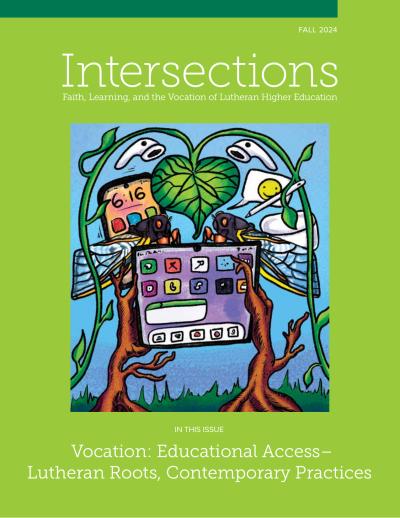
Windham-Hughes welcomes newcomers and seasoned colleagues to the conversation, lifts up Mary Elise Lowe’s three Lutheran “whys” for educational access, and commends Rev. Jen Rude’s “Sacred Pause” practice as a way to humanize one another and make opening access both easier and more joyful.
-
Editorial
From the Publisher: Reflections on the 2024 Vocational Leaders in Higher Education Conference
Lamont Anthony Wells
Wells reflects on the 2024 VLHE Conference theme — “Educational Access: Lutheran Roots, Contemporary Practices” — tracing today’s commitment to inclusivity back to Martin Luther’s radical 16th-century insistence that both boys and girls be educated, and previews NECU’s expanded engagement of student leaders alongside faculty and administrators.
-
Article
Access, Accessibility, & Change: A Call for Trustworthy Leadership in Higher Education
Emma Jones
Jones surveys the converging pressures on higher education — cost, the enrollment cliff, shifting demographics, and declining public confidence — and uses Reichheld and Dunlap’s four factors of trust (transparency, capability, reliability, humanity) to call campus leaders to rebuild trustworthy leadership from the inside out.
-
Article
Creation, Justice, and Communio: Lutheran Insights Empowering Educational Access
Mary Elise Lowe
In her VLHE keynote, Lowe names three Lutheran commitments — continuing creation, neighbor justice, and communio — as the “why” that empowers ELCA colleges and universities to pursue equitable access for students often left behind by persistence and graduation gaps.
-
Article
Committed to Paradox
Caryn Riswold
Riswold lifts up paradox — saint and sinner, lord and servant, Rooted and Open — as a distinctive Lutheran root that lets institutions honor the complicated truth of who their students are and embrace the messy, ever-reforming work of access and accessibility as a theology of the cross.
-
Article
2024 VHLE Conference: "Rooting Access" Panel Talking Points
Guy Nave
Nave reads “access” across Deuteronomy 23, Ruth, Isaiah 56, Acts 10, and Matthew 15:21-28 as an ongoing biblical conversation that evolves from exclusion to ever-widening welcome — and presses ELCA institutions to shift their focus from “student readiness” to “institutional readiness.”
-
Reflection
Reflecting on Belonging
Melissa Woeppel
Woeppel, campus pastor at her own alma mater, wrestles with a Bethany student’s plea — “I want to feel like this is my home, like I belong” — and Mindy Makant’s reminder that we don’t choose the story of the past but do choose how we tell it forward, opening space for students from 35 faith traditions to find Lutheran institutions to be their home.
-
 Editorial
From the Editor
Tom Christenson
No. 12 · Summer 2001
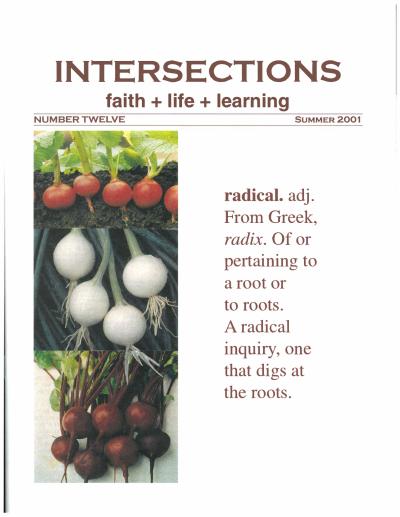
Christenson introduces three pieces from the summer 2000 Vocation of a Lutheran College Conference at Dana College—noting that Leonard Schulze was asked to keynote before becoming executive director of DHES—and recommends Peter C. Hodgson’s God’s Wisdom: Toward a Theology of Education and Douglas Sloan’s Faith and Knowledge: Mainline Protestantism and American Higher Education for their accounts of how faith and knowledge have been dissociated in modern higher education and what it might take to recover their connection.
-
 Article
The Lutheran Theological Tradition and Recruiting Lutheran Students
Ernest L. Simmons
No. 13 · Winter 2002
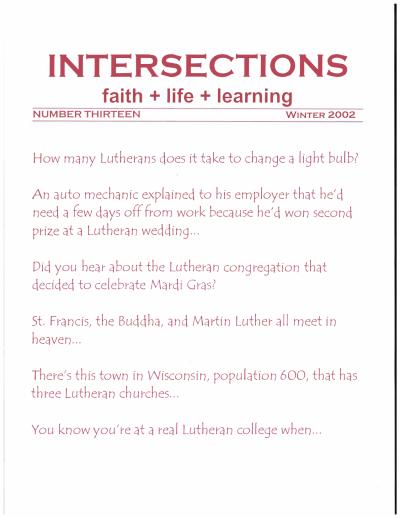
Simmons opens with an Abraham-and-Isaac “Windows 98” joke to illustrate the dialectic of faith and learning, then argues that in a new market era of limited religious background, intentional mission and marketing go together. Drawing on Levine and Cureton’s When Hope and Fear Collide for the Millennial Generation born in 1982 and Tom Beaudoin’s Virtual Faith for their GenX parents, he reads “Reclaiming Lutheran Students” survey results showing 86% strong community at ELCA colleges versus 54% at flagship publics and 61% alumni mentoring versus 39%. He then develops three areas where the Lutheran tradition uniquely equips its colleges—community, mentoring and vocation, and the integration of faith and values—using Luther’s “two kingdoms” image of the “Left Hand” (reason) and “Right Hand” (faith) of God, with academic freedom as a product of Ahlstrom’s “Critical Current” in the tradition, and closes with three challenges: recruiting and retaining mentoring faculty, educating church leaders, and reaching potential students and parents.
-
 Article
Of Fathers and Feminism: How One Lutheran Woman Came to a Vocation
Karla G. Bohmbach
No. 14 · Summer 2002
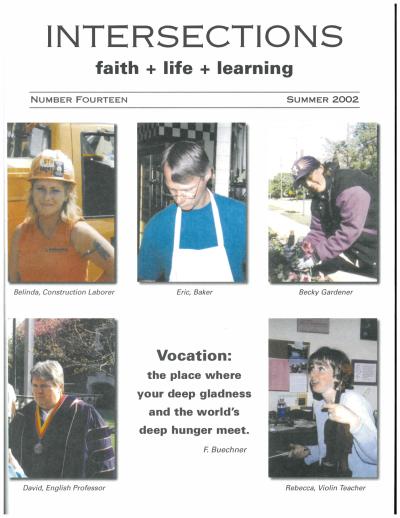
Bohmbach, a recently tenured Susquehanna University feminist biblical scholar one month shy of forty, traces her vocation back through a Vacation Bible School injury, an LCMS upbringing in which only men could preach or preside, her father’s contradictory message that she could do anything while modeling a church that limited women, St. Olaf’s revelation of a Lutheran female face, and a Duke graduate seminar on the History of Feminist Thought with Carol Meyers. Her published feminist work on biblical daughters and on the concubine of Judges 19 is read alongside Kathleen Norris’s account of word-bombardment in church, Michel Tournier on childhood as “ardent confusion,” and her own recent participation as both student and teacher in an Authorized Lay Worship Leaders Program.
-
 Article
Called for Life — Affirming Vocational Discernment
Richard L. Torgerson
No. 31 · Winter 2010
Torgerson introduces the “Called for Life” project, a three-year, $278,437 Lilly Endowment-funded collaboration among Luther, Augsburg, and Augustana that—in partnership with Luther Seminary’s Centered Life initiative and Wilder Research—rigorously assessed the effectiveness of campus vocation programs, examining whether students’ exposure to and understanding of calling had increased, and what program elements were most effective in shaping discernment.
-
 Article
Just Communities: From Liberal Arts in Prison to Racial Healing over Zoom
Monica Smith
No. 54 · Fall 2021
Smith showcases how Augustana College’s commitment to social justice extends into the Quad Cities through two initiatives: the Augustana Prison Education Program at East Moline Correctional Center, and Racial Healing conversations developed through the Truth, Racial Healing and Transformation framework.
-
 Article
What is Required of You?: Higher Education Leadership in a Moral Key
Paul C. Pribbenow
No. 62 · Fall 2025
15 min audio
Drawing on Micah 6:8 and Stephen Carter’s “etiquette of democracy,” Pribbenow describes the three things Augsburg requires of every incoming student — show up, pay attention, and do the work — as a democratic social ethic that prepares students for engaged citizenship in a fractured public life.