Finding the Words: The Trouble of Being California Lutheran University
Intersections No. 6 · Winter 1999
The last time I was in this part of the country, I was participating in a major gathering of faculty and administrators from Lutheran Colleges and Seminaries at the Sittler Symposium at Capitol University. My most vivid memory of that conference was of a discussion I was facilitating in one of the breakout groups. I asked the group, which consisted of at least half seminary or theology professors, about their religious identity. Each one had no hesitation in defining himself as Lutheran (there were only two females in the group, and we were both raised Catholic), but many went on to add a particular modifier to that statement. For the most part, these referred to one of the smaller, ethnic church bodies that eventually merged their way into the ELCA. So one was a Danish Lutheran; another identified himself with the Augustana Synod. It has taken me years to learn that this is a typical characteristic of clergy from the Augustana Synod. It’s akin to alumni from Santa Clara University, my alma mater, or Gonzaga, or Marquette saying that they graduated from a Jesuit University. That’s the relevant piece of information. Catholic comes after that.
After that lively exchange, I then asked them what they thought their children, who were mostly young adults, would say if I asked them the same question. After a couple of seconds elapsed, the responses tumbled out in words and gestures. The basic theme: “I don’t have a clue.” If they did, what they thought their children would say wasn’t necessarily “Lutheran.” It was more likely to be “Christian” or to indicate their status as seekers, open to many different forms of religious expression. Now I don’t know how representative this little sample was, but the exercise did leave me wondering how the Lutheran Church was going to sustain itself if there is that kind of erosion of identification from a generation who has been centrally involved in the life and work of the Church to their own offspring.
How will the Lutheran Church retain its identity as an institution? Is the post-modern world also post-denominational? If the church itself is facing this kind of a challenge, which appears to me to be unprecedented in its history, what will the fate of its colleges be?
That subject has, within this decade, become a hot topic in the church-related higher education community. With the publication of Burtchaell’s “The Decline and Fall of the Christian College” and George Marsden’s The Soul of the American University, many within the mainline Protestant traditions have been left wondering if there is a viable alternative path for our colleges between the “slippery slope of secularization,” clearly the fate of many Methodist, Congregational, and Presbyterian institutions, to name a few, and becoming a “Christian” college—that is, one in which a “Christian worldview” predominates and all learning is subordinated to it. Or, we are wondering what that middle ground looks like and how to market it.
This question of how religious institutions maintain their identity has both academic and professional significance for me. I have lived my entire life except for a brief stint in graduate school within some kind of religious educational community (first Catholic, then Lutheran) and one of my fields of specialization is the sociology of religion. But this issue became dramatically more personal for me when I moved from being a sociology professor to academic vice president at CLU. And it was ratcheted up yet another notch when I acquired the title of provost not quite two years ago and, with it, responsibility for admissions—for creating and implementing a plan to attract students to California Lutheran University.
Who are those prospective students? Some come with a strong Lutheran identity. Many of them are our student leaders—the ones most active in helping us live out the vocation of a Lutheran college—but they are declining in numbers. Others are Lutheran by ancestry, but their ties to the church at the moment are rather tenuous. A significant percentage are Catholic; and another large chunk, to the extent that they are religious at all, are part of the amorphous Southern California religious culture in which the core elements are religious experience and community, not theology (confessional or otherwise). The key modifier or identifier they use is “Christian,” as in, “Are you a Christian?” “Is this a Christian college?” I have to think about how we will market California Lutheran University to this group. That challenge is big enough. But it is enormously complicated by the fact that:
- having been channeled by their teachers, high school counselors and peers into California’s extensive public higher education system, we cannot assume that they or their parents (including Lutherans) understand and value—let alone are willing to pay for—private higher education.
- we cannot assume that, in their overwhelming concern about career preparation, they or their parents understand or value liberal arts education.
- and we most certainly cannot assume that they know what is essential or distinctive (or pretty much anything else) about a Lutheran college.
Unlike most of you whose founders had the wisdom to name you after the town in which you are located or to give you a name that’s an ambiguous Lutheran code word, like Augsburg or Concordia, we don’t have much flexibility in marketing ourselves. We’re stuck. We cannot avoid having to explain what it means to be a Lutheran university because it’s our middle name. We have to know what makes us distinctive and we have to communicate it to an audience that is relatively clueless. This is more than just a matter of marketing. I am convinced that we will survive and thrive to the extent that we know who we are, that we can tell our story in a compelling way, and that we live it out in our day-to-day encounters with students and with each other.
To make this even more personal, I have to be able to explain CLU’s “Lutheran-ness” not only to prospective students and parents but also to prospective faculty who must understand and preserve the tradition if we are to maintain our identity. I don’t have to do this nearly as often as presidents do; and, consequently, I haven’t had as much practice. But I’m highly motivated, and I’m not altogether lacking in resources. I had a decent theological education myself. In my formative years, I was a member of a Benedictine-affiliated religious community, and in recent years I chose to become a member of the Lutheran church for largely theological reasons which I can articulate. I have also had some excellent tutors along the way, some of whom are here in this room.
But, I have to tell you, when it comes right down to it, I often have trouble finding the words. The crunch for me, the most challenging situation, is in conversations with prospective faculty.
Picture the setting: I’ve never met this person before, and I have at most 45 minutes to cover an array of subjects and to get a feel for how good a fit he or she will be. It’s a virtual certainty that no one else they’ve talked to so far has brought up the subject of CLU’s Lutheran identity, except possibly to assure them that it won’t intrude on their academic freedom.
So I grab whatever I get for an opening. I’m really working at it, but if I’m not careful, I find myself defaulting to explanatory formulas that are seductively accessible, but pretty lame. More or less in order of frequency, I find myself using:
Definition by analogy:
- We’re not like “Christian colleges” (Pepperdine, Azusa Pacific) who have strict behavioral codes and require their faculty to sign statements of belief or pledges of practice.
- We’re kind of like Catholic colleges. All students receive theological education and worship is part of our community life, but there also is a strong intellectual atmosphere…
Or the ethnic approach:
- We’re an ethnic church, just like the Catholics. American Lutheranism is the product of the immigration of Germans and Scandinavians. Our heritage is primarily Scandinavian.
For the public radio crowd, there is a variation on the ethnic approach which relies on Garrison Keillor’s Prairie Home Companion:
- Our property was donated to us by a Norwegian bachelor farmer.
Finally, there’s the last resort, assurance by innuendo:
- After all, the Lutheran church was founded in a university by a rebellious professor making a statement of academic and religious freedom…
So when I saw the question posed by our keynote speaker as “What is this thing ‘Lutheran-ness’…?” with a promise of an answer that was “communicatable, learnable, something that a sensitive, perceptive, and concerned person can catch whether or not it is literally their tradition,” I thought, “Yes, I’ll get something useful out of this conference.” I’ll finally get the script—the words that have eluded me.
What I got from Tom Christenson’s presentation both did and did not meet my expectations. On the one hand, he offered a fresh take on the core ideas that define the Lutheran tradition. The fresh part for me was the focus on the Lutheran vision of the educational task that we are all engaged in versus the theological principles themselves. The paper reinforced in me the profound sense of gratitude for being part of this tradition that had been rekindled a few weeks earlier at a conference at Notre Dame University which examined how the faith traditions of several different denominations were embodied in their institutions of higher education. We are fortunate as faculty and administrators in Lutheran colleges and universities to have a religious tradition whose core ideas and values are so well suited to the business of higher education—that require no compromise on the part of either faith or reason.
But what I did not get, or at least didn’t think I got, from the presentation were the words and expressions that I could actually imagine myself using in conversations with prospective students or faculty. I still had work to do. Maybe that is exactly what one wants from a keynote presentation, but for a moment I felt like a disappointed student who has just discovered that the questions on the exam couldn’t be answered by simply regurgitating the class notes. I then thought, “What can I make out of this paper?”
As a start, I came up with a way to identify or at least recognize what would be useful to me. The core ideas, and their expression, had to pass what I’ll call the “alumni magazine test,” not to be confused with the “college viewbook test.” This notion came to me as I was reflecting on my last year of college, which was spent at Santa Clara University. This was the fifth Catholic college I had attended, and the one that, from my point of view as a student, had the clearest sense of identity. It seemed to me that practically every student and faculty member there knew what a “Jesuit” education was. It meant intellectual rigor, which included a sophisticated understanding of theology and philosophy; openness to new ideas and artistic expressions; a generally lusty appreciation for secular culture; and a strong commitment to service and justice.
And the reason I think this wasn’t just a hazy recollection which I have embellished over the years is that you can still see these themes expressed in the “letters to the editor” section of the alumni magazine as the writers take on alumni authors, or each other, over whether this or that idea “belongs” in a Jesuit University. They don’t agree on the logical implications of or on what is an appropriate expression of a Jesuit education, but they frame their arguments around the same core set of concepts. I thought, “Why couldn’t we achieve that for Lutheran higher education?” We’ve got about the same number of institutions that the Jesuits do and an equally rich theological heritage.
What would our core “alumni magazine” concepts be? We’d be limited to three, since that’s all anyone could retain, and they would have to be ideas that faculty and students of whatever religious persuasion could easily claim and articulate to each other. So I made my “short list” from my growing collection of pieces on Lutheran higher education. I rejected paradox and the two kingdoms at one end for being too esoteric and therefore inaccessible to the particular audiences I needed to address and academic excellence, the liberal arts and music at the other end for being not exclusive enough. I think we express the religious heritage of our colleges most tangibly in worship and the many rituals which often include prayer that are at the center of our community life. But this doesn’t strike me as distinctively Lutheran either. What I ended up with were freedom, gift and vocation—the three themes in our keynote paper. I decided they were useful.
While the last two were easy choices, it is the first—freedom—that I found most challenging. For me, the central idea in Lutheran theology is that we are justified by grace alone—which is God’s gift freely given to us, an expression of love wholly unearned on our part. The notion that our worth as human beings, children of God, is not determined by anything we do is tremendously liberating—especially for academics like ourselves who are constitutionally achievement oriented—but it is not so obviously related to what we do for a living.
In his paper Professor Christenson points out one of the relevant consequences: that is, that faculty and students in Lutheran colleges are free to investigate any aspect of knowledge or creation with openness and integrity. While faculty who apply to teach at CLU probably just assume this is the case, this concept of intellectual and religious freedom could be tremendously useful in explaining “Lutheran-ness” to them. The idea that in a Lutheran college, there are no assumptions, ideas, or claims to ultimacy that cannot be questioned, that education is valuable in itself, that it is a worthy endeavor to learn about, discuss, and debate everything in God’s creation, helps place us within a continuum of church-affiliated colleges. We are midway between those who either deny parts of culture or who use education to “Christianize” or transform it—Calvin College, Wheaton, Pepperdine, for example—and those for whom faith and reason exist in entirely separate spheres and never need encounter each other.
The idea that it is appropriate to challenge all claims to ultimacy is also helpful. It requires a stance of humility on our part and the recognition that, given the vastness of the unknown, even the sophisticated scholar can be wrong. I think it is easier for academics to accept critiques of the ultimacy of materialism or any aspect of culture—most of us are pretty good at it, actually—than it is for us to critique our own overt and subtle orthodoxies. At the conference I attended at Notre Dame this summer, I was struck by the comments from a Lutheran woman who was a faculty member at Wheaton College. She said she had never felt as “free” as she did at Wheaton College. What I think she meant was that, despite the fact that at Wheaton she does not have full academic freedom, she feels freer to express her conservative, evangelical brand of Christianity there than in other academic settings where it isn’t “correct.”
The concept of freedom could also be useful in encounters with students who are taken aback by their religion professor’s critical approach to Biblical literature or with the cranky pastor who says “how can you call yourself a Lutheran (or Christian) college when you (fill in the blank: host a woman’s forum on campus by Planned Parenthood, hold an event that appears to condone homosexuality, etc.)? It is useful to be able to explain that it is not the absence of religion or the absence of Christianity that allows us to do those things, but rather our particular expression of Christian freedom. Now I’m a bit worried about that modifier “Christian” because it can so easily be misunderstood, and it is candidly not one that would roll off my tongue, but I also think that we should not completely abdicate our claim to it to more conservative Christian groups.
Maybe this is a bigger deal in California than elsewhere. Let me offer two examples. I’m often asked why we don’t belong to the California Christian College group, why I don’t attend their Dean’s meetings, or why we don’t appear in the magazine mailer they sponsor that is sent to thousands of college-going high school students each year. That’s when I give my “we’re not like those colleges” speech. Does that mean we are not a Christian college?
A more significant instance of the “Christian” problem occurred a couple of years ago. In the course of adopting our new mission statement, we found ourselves in the middle of an unexpected and passionate debate on the floor of our annual Convocators meeting. Some vocal representatives of our constituent church bodies were not content to have CLU’s heritage described as just Lutheran. They felt that the word Christian needed to be in the mission statement to make a stronger, clearer statement. Ironically, while Southern California pastors didn’t think Lutheran was good enough on its own (these people understand firsthand the marketing challenge), the faculty, especially non-Christians, were equally as adamant that Christian should not be in there. They had come to understand what Lutheran meant and to affirm it, but they were exceedingly leery about the connotations Christian would have. We ended up compromising on “rooted in the Lutheran tradition of Christian faith…”
While the concept of freedom helps us understand why the intellectual climate on Lutheran college campuses can be both intellectually open and stimulating and perfectly Christian, I think it is the twin concepts of gift and vocation that speak most directly to our distinctive calling as Lutheran colleges.
It is useful for those of us who are faculty and academic administrators at Lutheran colleges to think of our job as helping our students recognize the gifts they have and to nurture them. As faculty, we do this relatively effortlessly for the students whose gifts are obvious because it is so rewarding for us to do that. I think we also do rather well with the students whose gifts are not apparent at all. At CLU we identify them in advance because they have been admitted by a special committee, and both faculty and academic support staff work hard to figure out what gifts there are to work with in each one and to make something out of them. These students provide some of our best success stories.
But it’s the vast majority of our students in the middle that are the challenge—especially given that the academic setting is so “works-oriented.” I still cringe when I recall an encounter I had a year or so ago with a former student who confessed to me at the end of the reception we were attending that she was embarrassed to come up and talk to me because she had been such an undistinguished student as an undergraduate. She was in a Ph.D. program in psychology, and she needed some assistance in finding internships in California. She obviously had gifts. But, for that moment, her consciousness of them evaporated as she looked at me and saw herself reflected back as a “C student.”
There are faculty—I can name them on my campus—who find a way to help many students recognize their gifts, and they do it without giving students grades they don’t deserve. They are the “mentors” who make all the difference at a critical point in a student’s life and whom students remember for the rest of their lives. We had them; we can name them. For most of us, though, it requires constant effort to maintain that kind of consciousness and to do the hard one-on-one work that noticing and nurturing gifts requires. We could foster that consciousness by claiming it as part of our Lutheran heritage.
The clearest connection between our heritage and our occupation, however, it the concept of vocation—that we are called to use our freedom and our gifts to serve God and our neighbor. I’ve heard Mark Edwards quoted as saying that “Lutheran colleges should be vocational schools… in the sense of being a place where students discover that life has a calling.”
I think that Lutheran colleges should be vocational schools in both senses of the word. On the one hand, we must prepare students for meaningful work and not eschew that effort as something that is beneath us, as liberal arts colleges, or is someone else’s job. In fact, the study of the liberal arts offers the best preparation for all careers, but we must ensure that we actually instill those habits of mind in all, or nearly all, of our students and that we help them make connections between the disciplines we teach and the world of work.
More importantly, though, Lutheran colleges should instill in students a sense that their lives have meaning beyond the work they do and that they have an obligation to make a meaningful contribution to the world around them. I think faculty at small liberal arts colleges intuitively grasp the concept of vocation, whether they use the word or not. It’s what motivates them to give so much of themselves to their students. But it is also a concept that is distinctively Lutheran.
These three concepts—freedom, gift, vocation—clearly do not fully define Lutheran higher education or the vocation of a Lutheran college. The theological tradition itself is so rich and complex and our colleges so varied that no single list can tell the whole story. The ideas themselves may not even be uniquely Lutheran. In fact, each can be expressed without any religious referent at all. But they’re ours and we should not only claim them, but use them.
We may not necessarily use these themes to market ourselves. The “viewbook test” is a different test, and our colleges are positioned differently in different markets. And they do not suffice as a mission statement. But they do offer a way for us to explain ourselves to prospective students and parents and, perhaps most importantly, to ourselves. At least they work for me.
It strikes me as very Lutheran that we seem to be constantly talking about and writing about what it means to be a Lutheran college without ever quite arriving at a definitive conclusion. There is also something very Jesuit about the high degree of self-consciousness in their institutions. But if we are going to retain our identity, we’ve got to be able to say something and to say it clearly enough for it to permeate faculty and student consciousness and to make a difference for those who choose to study at our institutions.
Even in the Lutheran hinterlands, you can talk about freedom, gifts, and vocation. The formulations will vary with the audience, but I could imagine myself telling prospective parents, students, and even faculty that as a Lutheran university, CLU is a place:
- where spirituality is considered an important part of a complete life and religion is viewed as a liberating, not a confining, reality;
- where we seek to free students from ignorance, fear, and from inhabiting too small a world to become all that they can be;
- where we help students discover their gifts and their worth;
- and where we encourage them to use their gifts wisely and consciously to build a more humane and compassionate world.
If we tell students that this is what they can expect from a CLU education, and if our faculty and administrators really make these things happen, then, in the process, we will be both strengthening our identity and fulfilling our vocation as a Lutheran college.
Works Cited
Burtchnell, James Tunstead, “The Decline and Fall of the Christian College,” First Things (April 1991), 16-26; “The Decline and Fall of the Christian College II,” First Things (May 1991), 30-38.
Marsden, George M., The Soul of the American University; New York, Oxford University Press, 1994.
-
 Editorial
From the Publisher
Arne Selbyg
Selbyg reports on the work of the Division of Higher Education and Schools to focus what makes Lutheran colleges and universities distinctive, recaps the 1998 Vocation of a Lutheran College conference at Wittenberg, previews the 1999 Susquehanna conference on “Identity and Fragmentation: Can the Lutheran Center hold?” (inspired by Yeats’s vision of the Second Coming), commends Ernest Simmons’s Lutheran Higher Education: An Introduction for Faculty (Augsburg Fortress, 1998), and announces a new NEH/NSF-style initiative called “The Lutheran Academy of Scholars in Higher Education.”
-
Editorial
From the Editor
Tom Christenson
Christenson explains that three of the five papers from the 1998 Wittenberg Vocation of a Lutheran College conference appear here (with Robert Scholz and Cheryl Ney to follow in the next issue), passes on Andy Sheppard’s “Books for Belarus” appeal from Southwestern College, and reflects on Douglas John Hall’s The End of Christendom and the Future of Christianity—its claim that disengagement from cultural dominance is the prerequisite for faithful re-engagement, and its retrieval of Christ’s metaphors of “a little salt, a little yeast, a little light” as a possible session topic for a future VLC Conference.
-
Article
Learning and Teaching as an Exercise in Christian Freedom
Tom Christenson
Christenson, the 1998 Wittenberg keynote, argues that what makes our institutions Lutheran is not the percentage of Lutherans served or employed, ethnic celebration, or self-conscious difference, but a theologically informed vision of the educational task framed by the linked ideas of gift, freedom, and vocation. Drawing on Joe Sittler, Wendell Berry, David Orr, Harold Kushner, John Updike, Frederick Buechner, and Luther’s On the Freedom of a Christian, he reframes the liberal arts as four “liberating arts”—critical/deconstructive, embodying/connecting, melioristic/creative, and arts of enablement and change—and closes with his mother’s “end-of-the-month soup” as an image of vocation in a particular place.
-
Response
Of Imaginary Cows and a White Toy Sheep: The Freedom of a Christian College
Ryan La Hurd
La Hurd, president of Lenoir-Rhyne and a former Thiel English professor and Augsburg academic dean, responds to Christenson by insisting (with Robert Kegan’s story of Tommy’s imaginary cattle farm) that a college is composed of people but is not itself a person, and so cannot share in Luther’s freedom of the Christian. Drawing on Benedict Anderson’s Imagined Communities, Lewis Hyde’s The Gift, George Marsden, Mark Schwehn, Jacques Barzun, and the Pew Higher Education Roundtable, he distinguishes the “imagined college” (the gift-economy realm of teaching and the alma mater) from the “real college” (the commodity-economy realm of fund-raising, deferred maintenance, and federal aid reconciliation that does not have such freedom)—and ends with Pablo Neruda’s “Childhood and Poetry” and the marvelous white toy sheep offered through a hole in a fence.
-
Reflection
Otherwise
David Wee
Wee’s September 3, 1997 St. Olaf Opening Convocation address takes its title from Jane Kenyon’s “Otherwise” and asks why we gather: to celebrate the gifts of life, place, companionship, and the work we love, and to become “otherwise”—wise about the others in our midst. He honors his own St. Olaf teachers (Ditmanson, Shaw, Stiehlow, Jordahl, Paulson, Meyer, Hove, Clausen, Larson, Jorstad) and the gruff Latvian stamp scholar Gus Eglas and Sherlock Holmes expert Randy Cox, draws Huck Finn’s “All right, then, I’ll go to hell” and Flannery O’Connor’s grandmother into a single argument, and closes on Tim Lull’s expectation that a Lutheran college campus should display contentment, courage, and cheerfulness as a family member faces day-six post-bone-marrow-transplant—“the first day of the rest of your life.”
-
Poem
Poetry: Rituals for an Uninvented Religion / On the Recently Discovered Mass Grave of Mice
Kevin Griffith
Two poems by Kevin Griffith of Capital University: “Rituals for an Uninvented Religion,” a seven-part liturgical bestiary of made-up customs (lead-filling cups in June, masks for the dying, two bottom-feeding August fish, wax grave markers with wicks, the leap-day child, and the carnival-free day of judgment), and “On the Recently Discovered Mass Grave of Mice,” prompted by New Zealand shepherds’ uncovering of 300,000 mouse skeletons, on the bones “each light as a child’s first question” and the “graveyard rush” we share with the good flock.
-
 Article
Calling Economists
Lynn Hunnicutt
No. 37 · Spring 2013
Reading Luther’s Whether Soldiers, Too, Can Be Saved alongside Adam Smith’s Theory of Moral Sentiments and Wealth of Nations, Hunnicutt asks whether economists, too, can be saved—and whether economics can host a serious conversation about vocation. She traces her own move from Utah State to Pacific Lutheran University and its Wild Hope Center for Vocation, and turns to Deirdre McCloskey and George DeMartino as economists whose work makes room for vocation and the common good within the discipline.
-
 Article
Professional Education/Liberal Arts Education: Not a Case of Either-Or but Both-And
Gail Summer
No. 24 · Fall 2006
Summer, Dean of Academic Programs at Lenoir-Rhyne College, traces the historical interweaving of liberal arts and professional education in American higher education (using the rise of engineering as a case study) and argues that the standard “either-or” framing of liberal arts versus professional preparation misreads both. At Lutheran colleges, the “both-and” relationship is shaped by a Lutheran understanding of vocation in which professional programs are integral to, not in tension with, the liberal arts.
-
 Article
Why Did the Chicken Cross the Road? A Homily on Liminality and Vocation
Lori Brandt Hale
No. 45 · Spring 2017
Drawing on Wes Moore’s The Other Wes Moore, Warren St. John’s Outcasts United, Victor Turner’s anthropology of liminality, and Dietrich Bonhoeffer’s poem “Who Am I?”, Hale considers how Hmong, Muslim, Latinx, LGBTQ+, non-traditional, and other students live in “double liminal” spaces — and asks whether liminality might itself be a place of transformation in conversations about vocation.
-
 Response
Response to Bishop Olson and President Tipson
Robert Benne
No. 16 · Winter 2003
Benne responds to two articles in the Winter 2002 Intersections: former Bishop Stanley Olson’s “The Marks of an ELCA College,” whose narrow reading of the two kingdoms cedes all epistemological claims to secular knowledge, and President Tipson’s engagement with The Future of Religious Colleges, whose “rather unchastened Enlightenment spirit” underestimates how loaded the social sciences and humanities are with their own philosophical and religious assumptions. Drawing on Reinhold Niebuhr, John Milbank, and William Buckley, Benne defends a “critical mass” of pervasively Lutheran colleges and calls on bishops and pastors to take the schools seriously lest they drift from their religious heritage.
-
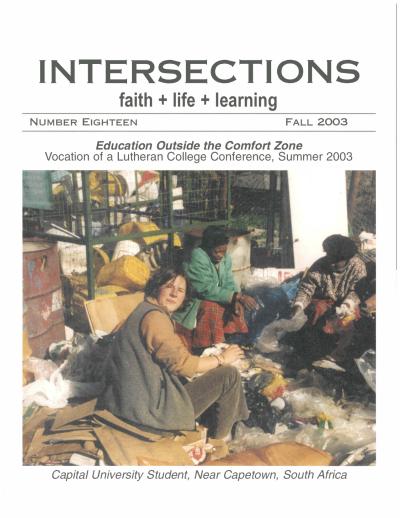 Article
"The Earth is the Lord's And the Fullness Thereof": Six Theses Regarding Global Education at the Colleges of the Church
Christopher M. Thomforde
No. 18 · Fall 2003
Thomforde surveys the breadth of global education across ELCA colleges—Susquehanna, Bethany, St. Olaf, Luther’s international students, Concordia’s language villages—and then frames its future around six theses: global education is a theological enterprise that teaches the First Commandment through dialog, wonder, and disillusionment; it necessitates coming to terms with “the stranger” and “hospitality” (drawing on Diana Eck); it is in, for, and against the world; it nurtures vocation and forms L. DeAne Lagerquist’s “cosmopolitan citizens”; it requires sympathetic engagement of faculty, staff, and administration in the spirit of pioneers like Ansgar Sovik; and it calls the ELCA colleges to exercise the gift of administration to bring greater clarity and collective coordination to the portfolio of programs offered across the twenty-eight institutions.
-
 Editorial
From the Publisher: Reflections on the 2024 Vocational Leaders in Higher Education Conference
Lamont Anthony Wells
No. 60 · Fall 2024
Wells reflects on the 2024 VLHE Conference theme — “Educational Access: Lutheran Roots, Contemporary Practices” — tracing today’s commitment to inclusivity back to Martin Luther’s radical 16th-century insistence that both boys and girls be educated, and previews NECU’s expanded engagement of student leaders alongside faculty and administrators.