I consider myself bad at change, yet I believe in the power of transformation.
I have undergone many transformations in my life. I moved from a Japanese-speaking preschool to an English kindergarten at age 5. My parents divorced when I was 11. I moved from Japan to the US, alone, at 18. I came out as non-binary and gay at 19. Each time, there was a period of intense discomfort before a dramatic transformation in how I understood myself and more importantly, in how I saw others.
There is a natural human instinct to live in the moment. I often forget that I have had a storied past, and will likely have a storied future. We tend to see ourselves as monolithic, as though the current version of ourselves was always who we were and who we will always be.
“We tend to see ourselves as monolithic, as though the current version of ourselves was always who we were and who we will always be. This is false.”
This is false. All of us have undergone dramatic (and not-so-dramatic) changes throughout our lives. Literature abounds with stories of transformation: the story of Paul’s conversion on the road to Damascus, personal accounts of Born-again Christians; the archetypal hero’s journey ends with the hero transformed.
Of course, transformation doesn’t mean throwing everything out; it just means removing what is unnecessary, much like smelting metal from ore. Many of us have been hurt, and we have built trauma responses as armor against that pain. When we become free from the hurt, that armor can begin to get in the way of our lives and our relationships. It can be difficult and scary, but shedding that armor is an important part of the healing process.
Cultural and institutional reform is much the same. In any institution, there is something about it that holds good, or it would not survive. The work of reformation is discarding what has become no longer useful, while keeping that which still holds value.
Change is uncomfortable. Biologically, a change in our environment requires us to expend resources to adapt, and so we have evolved to shy away from anything that might cause change. That armor of personal inertia is the first obstacle to transformation. Here is where I am drawn to an idea I have encountered at Cal Lutheran about living with—and engaging—that discomfort; many people simply turn away from that discomfort, suppressing it in order to remain in the comfort of familiarity. But without engaging that discomfort, it becomes much harder to change for the better.
“The work of reformation is discarding what has become no longer useful, while keeping that which still holds value.”
And here I must add: not all change is a life-changing, revelatory experience. Most change is slow and unnoticed. It can be for the better, or for the worse. But that is also the most important kind of change, as it is the kind that shapes us the most. The question then becomes how we can shape that change to become closer to the people we want to be.
For me, forgiveness also begins with this belief. I have been hurt by many of the people in my life. But as long as I can see them working to improve themselves, then I can believe that the person they are becoming will be better than the person they were when they hurt me.
My thoughts have been shaped by a class I am taking on the criminal justice system; in society we see incarcerated people as criminals, and much of the system is built on the precept that they will always be criminals. We do not try to transform them for the better, or to reintegrate them back into society. In the class, we try to press into the question of what it means to be human, and whether the systems of society seek to dehumanize people. I think that our institutions should allow us to become more human—more empathetic and connected to each other, more knowledgeable and with agency to live our lives the way we want to.
If we all endeavor to become the most human that we can be, then the work of transformation that begins in each of us will be reflected in our institutions as well.
-
 Editorial
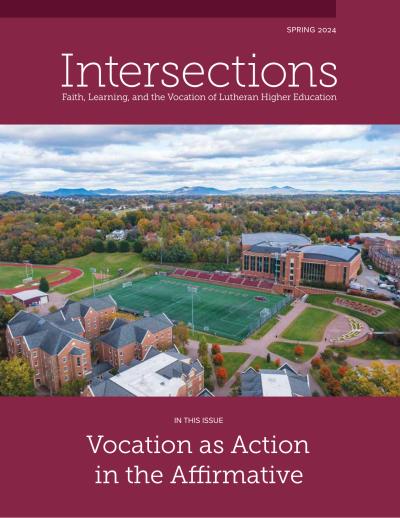
From the Editor: Vocation as Action in the Affirmative
Colleen Windham-Hughes
Windham-Hughes frames vocation as practicing “at the borders of our incompetence” — every small yes to the callings we experience, every effort made in the direction of life, is action in the affirmative — and previews the issue’s essays on diversity, transformation, AI, championship team culture, and dreaming big within and beyond our limitations.
-
Editorial
From the Publisher: Navigating Affirmative Action, DEI Policies, and Lutheran Vocational Identity
Lamont Anthony Wells
Wells surveys the converging pressures on NECU institutions — the unsettled landscape of affirmative action, political and academic scrutiny of DEI work, and the preservation of distinctively Lutheran vocational identity — and previews how the issue draws on affirmative practices, sociological viewpoints, and theological responses to navigate a path forward.
-
Article
Forming the Division for Access, Equity & Belonging at Susquehanna University
Amy Davis, Dena Salerno, María L. O. Muñoz, Nina Mandel, Scott Kershner
Five Susquehanna University colleagues trace the institution’s 166-year arc from a Missionary Institute founded to remove barriers to education through the formation of a new Division for Access, Equity & Belonging in 2023, arguing that access rooted in Lutheran origins must continue to drive policy revision, infrastructure, and belonging for minoritized communities today.
-
Article
On Recruiting Diverse Students, Rooted in Mission
Eric Rowell, Jason A. Mahn
Jason Mahn interviews Eric Rowell, Assistant Director of Admissions and Diversity Outreach at Augustana College, about how recruiting students from a wide variety of backgrounds — rooted in Augustana’s Lutheran commitment to vocation and educating across difference — remains essentially unchanged in the wake of the Supreme Court’s 2023 decisions on affirmative action.
-
Article
What Our Lutheran Heritage Entails for Lutheran Colleges and Affirmative Action
Mark Ellingsen
Ellingsen argues that the Lutheran Two-Kingdom Ethic — far from leading to political reaction — supports the church-relatedness of ELCA colleges and obligates them to keep affirmative action alive, even reading a Chief Justice Roberts “loophole” in Students for Fair Admissions v. Harvard as an open door for Black community partnerships, ELCA congregations, and Lutheran colleges to act in the affirmative.
-
Article
The Critical Role of Lutheran Higher Education in the Age of Artificial Intelligence
Jose Marichal, Maya Goehner, Tyler Haug
A Cal Lutheran political science professor and two of his students draw on Rooted and Open to argue that Lutheran higher education is uniquely positioned to stake out a middle path between AI utopianism and AI doom — cultivating a “healthy sense of human limit,” resisting data colonialism, and forming students to see the neighbor rather than the enemy as the world becomes increasingly synthetic.
-
Article
Team Culture is Key to Success: Learning from Student-Athletes
Colleen Windham-Hughes
On a December weekend in “Championship City” Salem, Virginia, both California Lutheran’s Women’s Soccer Team and St. Olaf College’s Men’s Soccer Team won NCAA Division III national titles. Windham-Hughes talks with coaches, faculty mentors, and student-athletes about how off-the-field team culture — built on trust, relationships, and shared why — translates onto the pitch and into liberal arts and sciences education.
-
Article
Low-Hanging Fruit, Moonshots, and Coffee: Dreaming Big Within and Beyond Our Limitations
Jeremy Myers
Myers shares the process used by Augsburg’s Christensen Center for Vocation to help teams move from a shared experience to next steps — an Ignatian-rooted Awareness Examen followed by naming low-hanging fruit, moonshots, and the coffee conversations that build the coalition to make it all happen.
-
 Article
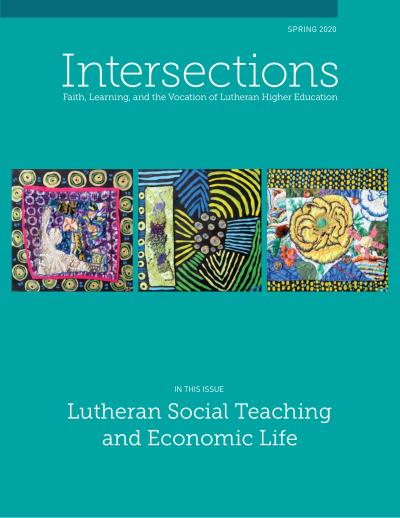
Responding to Student Hunger at NECU Institutions
Kristen Glass Perez
No. 51 · Spring 2020
Glass Perez recounts how her work as college chaplain at Augustana and Muhlenberg evolved after a student offhandedly declared, “I am always so hungry at this school,” and shares five lessons learned from launching campus pantries, emergency grant programs, and the HOPE Survey to address food insecurity as a defining calling of NECU institutions.
-
 Editorial
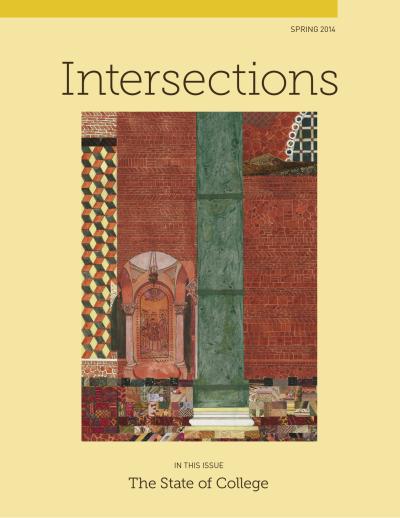
From the Editor
Jason A. Mahn
No. 39 · Spring 2014
Mahn reports on the working group “People of Wondrous Ability: Introducing Faculty and Staff to Lutheran Higher Education,” shares creative ways campuses are introducing colleagues to the charisms of the Lutheran tradition, and frames the issue as a set of reflective reviews that move from national trends to homegrown conversations about the state of college.
-
 Article
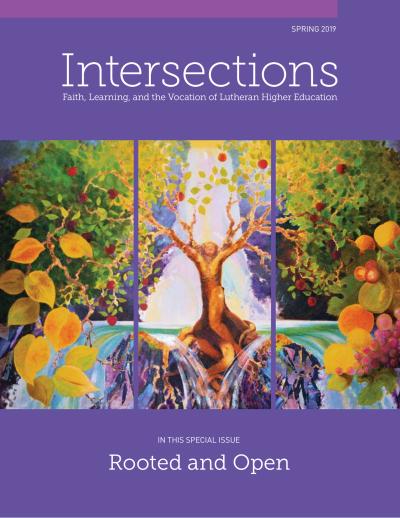
"Faithful Nones" and the Importance of a Rooted and Open Pedagogy
John Eggen
No. 49 · Spring 2019
Drawing on a student survey from his D.Min. thesis at Midland University, Eggen identifies a distinctive subset of religious “nones” — the “faithful nones” — who reject institutional religion yet retain substantive beliefs and practices, and argues that the non-binary, third-path pedagogy commended by Rooted and Open is uniquely positioned to engage a generation that has disambiguated faith, religion, and spirituality.
-
 Reflection
Ecotones of Faith
Tracy Paschke-Johannes
No. 61 · Spring 2025
7 min audio
Paschke-Johannes draws on the ecological metaphor of the ecotone — the life-teeming transitional space between two ecosystems — to claim that we are not called to minister in the world of the past or one fifty years hence, but to nurture the kairos moments God is creating in the freshwater-to-saltwater present.
-
 Article
Civic Engagement and Faith Perspectives
William O'Brochta
No. 63 · Spring 2026
15 min audio
Guest editor William O’Brochta introduces the section by overviewing the ELCA’s call to civic engagement, recapping the Fall 2025 Civic Engagement and Faith Perspectives conference at Texas Lutheran University, and previewing the participant essays that follow.
-
 Article
Both Priest and Beggar: Luther among the Poor
Martha E. Stortz
No. 46 · Fall 2017
Reading Luther’s deathbed remark “We are all beggars” against his “priesthood of all believers,” Stortz argues that priest and beggar are two sides of a human reality — one that locates civic responsibility for the poor at the heart of the Reformation legacy and that pushes beyond paternalistic service toward the systemic question of justice.