The Critical Role of Lutheran Higher Education in the Age of Artificial Intelligence
Jose Marichal
California Lutheran University
Maya Goehner
California Lutheran University
Tyler Haug
California Lutheran University
Intersections No. 59 · Spring 2024
Artificial Intelligence is a highly contested topic. Many conversations in social, political, and academic contexts eventually turn to the implications of AI on job prospects, college success, etc.
While discussing this topic can often feel overwhelming, the role of synthetic thinking produced by AI requires us to analyze the broader implications felt throughout higher education. Lutheran higher education champions critical thinking as a fundamental tool in our development as cognitive and spiritual selves. It “lays the foundation for a kind of critical thinking that can still register awe. It exhibits a freedom of inquiry that challenges every assumption.” (NECU 2018, 4). It is hard to observe the advances in artificial intelligence in the last year and not depart from it with a sense of awe and wonder.
Put in simplistic terms, the vast majority of AI models are highly complex deep learning algorithms trained on millions of data points. Text-based AI like ChatGPT, is part of a family of large language models (LLMs) trained on billions of words (and other grammatical elements) from all corners of the internet (social media, web pages, comment threads, etc.) The magic of AI emerges from the “tokenization” (e.g. converting into numerical data) of these billions of words and their context. This numerical data is placed into a massive mathematical array and analyzed through deep learning algorithms that uncover patterns in the structure of language. With generative AI models, these inexplicably complex multi-layered hidden operations can approximate human speech with astonishing results.
Even more astonishing is the recent insight among AI researchers that anything can be “tokenized” and placed in an array and analyzed using transformer-based encoder/decoder models (a method too complex to describe here). This means that the content medium is irrelevant: text can be mapped to images, audio can be mapped to speech, etc. Even though the study of artificial intelligence dates back to the 1950s, the rate at which artificial intelligence has advanced in the last seven years has been breathtaking. Yet these advances did not enter the cultural zeitgeist until the release of ChatGPT in early 2023.
“Lutheran higher education has a crucial role to play because it can stake out a middle position between a sense of awe and wonder about scientific discovery/reason while holding a healthy skepticism about overestimating human capability.”
It’s difficult to know what impact this explosion of AI will have on society, but it will likely be seismic. A 2020 report by the World Economic Forum predicted that 85 million jobs would be replaced by AI by 2025 (Brown et. al. 2020). While this is just a prediction, it is likely that as people and companies get more adept at using AI, the need for humans to do many rote tasks will most likely decline leading to an overall reduction in white-collar positions. These are the very positions that have traditionally supported many middle-class and upper-middle-class individuals and families. Additionally, these are the jobs that many of our graduates hoped to acquire after graduation. Currently, companies like OpenAI are developing “agents” that allow users, without coding knowledge, to apply AI models to specific tasks. For example, the model itself that was trained on billions of pieces of data can then in turn be trained on a state’s legal code or a state’s tax code to produce an “AI lawyer” or an “AI accountant.”
Currently, our discussions about artificial intelligence, like the rest of society, are polarized. On one side are people who call for caution in overhyping AI. AI scholars like Emily Bender and Timnit Gerbu call generative AI applications “stochastic parrots” that are good at mimicking human expression but are incapable of human understanding (Bender et. al. 2021). On the other side are people like a16z venture capitalist Marc Andreessen (whose company is investing in many AI startups), who claim Artificial Intelligence will “save the world.”
This is where Lutheran higher education has a crucial role to play because it can stake out a middle position between a sense of awe and wonder about scientific discovery/reason while holding a healthy skepticism about overestimating human capability. Lutheran higher education believes that reason and inquiry are intended to foster a “healthy sense of human limit” (NECU 2018, 5). The expansion of human knowledge only deepens the awareness of human limitations, leading to a dual attitude toward learning that reaches for excellence yet registers suspicion about claims to complete understanding (NECU 2018, 5). It is incumbent upon us to engage in a serious conversation about how we turn the wonders of AI into something fruitful and productive while recognizing the limits of human understanding.
Reckoning with the limits of human understanding is intuitive to any scholar who spends enough time engaged in scientific inquiry. Each scientific discovery unpacks more questions than it answers. The Enlightenment is rooted in this balance between human limitation and human capability. The purpose of the Enlightenment project of which Lutheranism was a key driver was that learning and understanding bring us closer to the divine, but does not get us all the way there. Inherent in the scientific method is this sense of limit. The entire concept of theory as applied to the sciences is rooted in the premise that we cannot collect data on the entire world. As a result, we use “samples” to test hypotheses derived from theory. Because we can’t collect data on the entire world, theories are a necessary abstraction from reality. We all know that theories do not explain every possible case. To do so is to fall into the trap of tautology: theories that explain everything, but paradoxically, explain nothing. This understanding of limits has served to keep “science in its place” regarding deeper questions reserved for theology.
We talk about theories that explain a good deal with a simple causal mechanism as “parsimonious.” But to presume any theory can “explain everything” contradicts the “healthy sense of limit” of Lutheran higher education. The actual world is far too disordered and complex to explain with simple theories. But AI introduces for some the dangerous notion that science can “explain everything.” We have the processor speed, the storage capacity and the data availability to answer previously unanswerable questions.
And here’s where the challenge of a limit-to-human understanding approach comes in. The more we use AI to dive into the world’s complexity, the more turbulent and confounding the world becomes. In this environment, people are prone to seek out simple answers. This is the challenge for Lutheran higher education. Our mission is more important than ever. We need to produce young people who are “called and empowered to transform the world, who go into that world with wisdom, humility, and hope” (NECU 2018, 5). To not take up this task is to not address the confusion, frustration, and instability of our modern era. Paradoxically, as AI makes more scientific discovery, the sense of the world for many becomes increasingly incomprehensible. The philosopher David Weinberger observed the increased use of big data “with the new database-based science, [and found] there is often no moment when the complex becomes simple enough for us to understand it” (2012, online).
This leaves us vulnerable to demagogues who promise to make the complex simple. We are in the late stage “great tech man” theory where formerly lionized figures like Elon Musk and Mark Zuckerberg’s platforms are accused of fueling ethnic conflict, spreading conspiracy/misinformation, and moving slowly to take down harmful content. But, as writer Anna Della Subin’s recent wonderful book Accidental Gods highlights, the frequency with which we’ve turned our fellow humans into deities is an unfortunate persistent feature of human society (2021). Modernity/rationality was supposed to be a “resistance to gods,” a rejection of irrational impulses. But when society (and AI) become too complex for humans to comprehend, we become anxious and are more susceptible to the vicissitudes of demagogues. A great danger of our time is the ability of bad-faith actors to use AI tools to spread misinformation and otherwise disrupt democratic societies. We must be clear-eyed about the challenges we face. Simple answers are appealing especially when they have the force of religious authority and dogma behind them.
In this effort to remain vigilant with false claims of clarity in an otherwise unclear age, Lutheran higher education calls us to be reminded that “The divine is present in ordinary life. Every person and every creature [are] potential vessels of grace, and the whole of life displays sacramental significance” (NECU 2018, 7). By adopting a position of gratitude, we can find inherent, unchanging beauty and knowledge such as the natural world, as a foundation for mental grounding. Rather than turning to authoritative figures, manipulative messages, or avoidance entirely, devoting time to discovering beauty in the pure simplicity of creation is a critical pathway toward freedom of being. Lutheran theology prioritizes “radical freedom,” described “as a freedom from false ideas about earning one’s worthiness and a freedom for a life of service to and with the neighbor” (NECU 2018, 4).
Seeing others as “neighbor also resists all that brands them as ‘enemies’ or ‘threats’ or ’strangers.’” To be a neighbor means to seek to understand and serve people and communities (p. 6). As the world becomes more complex, people become attracted to simpler answers regarding who is to blame for their alienation or isolation. In The Origins of Totalitarianism Hannah Arendt identifies social isolation as creating a vulnerability to authoritarianism. As people become detached from their society, they become vulnerable to alternative “unrealities” that appear to explain their condition.
AI only adds to these challenges. if many people already feel isolated from the broader political community. How much more isolated will they feel when they are increasingly engaging with synthetic talk discourse on social media? One of Lutheran Higher Education’s goals is to impart upon students “the essential relationality of Lutheran theology” which is that “individuals flourish only as they are embedded in larger communities” (NECU 2018, 8). This is Intimately connected to the ability to resist seeing the neighbor as enemy or threat. How does the inevitable widespread adoption of synthetic communication impact this ability? Increasingly we forego being in community with one another for the comforts of the phone, the screen, and the algorithm feeding endless curated content. Increasingly, we opt for convenience of Amazon next day delivery rather than opt for an awkward conversation with a stranger at the checkout line. AI gives us the possibility of forming more manageable less contingent synthetic relationships. AI dating apps that provide virtual girlfriends are no longer the stuff of science fiction.
Without regulation and guidelines tech companies may use AI to create even more addicting technology that may exacerbate current issues with youth and adult suicide and mental health. The use of AI created and curated push notifications in gambling and daily fantasy apps designed to boost interaction and addictive gambling behaviors is a prime example of the potential harms of AI. Those prone to gambling addiction can be manipulated through AI advertising designed to attract and take advantage of individuals betting history to curate types of bets, times, etc. that will maximize money spent and money lost.
In a world that is becoming increasingly dissociative, fragmented and materially oriented, Lutheran higher education institutions must be prepared to fight a lonely battle against the hardening of the human soul. Artificial Intelligence, as a piece of the technological age, continues to place barriers between face-to-face interactions, causing distortions of the truth, not just physically (ex: deep fakes) but psychologically (how do I know what I am seeing or hearing is real?) We are called to “seek to draw on the resources of both [faith and learning] to address human problems.” Their hope is that in doing so, students will feel called to reduce suffering and improve well-being of themselves and those they are in comity with (NECU 2018, 8). It is critical that Lutheran higher educational institutions engage with how artificial intelligence can address human problems and can avoid causing human suffering.
Although AI discovery can produce hope, it can also move us away from the natural world. AI can aid discovery at breathtaking speed, but it can also disrupt and destroy. The ability to tokenize millions of “data points” and instantiate models on high-speed Graphical Processing Units (GPUs) means that science gets detached from understanding and knowing. In January of 2024, a team of researchers at Microsoft announced that they were able to “analyze 32.6 million potential battery materials in 80 hours, a process that would have taken 20 years manually” to discover the desperately needed battery alternatives to Lithium (Calma 2024). These powerful tools can also be used for malevolent purposes. A 2022 study in Nature reports on a Swiss research team that used a machine learning model created to identify pharmaceutical drugs and were able to use it to produce 40,000 potential biological weapons similar to nerve agents. How are we called to address the awesome power for both good and evil they tools can harness (Calma 2022).
Lutheran higher education calls on institutions to train students to see the other as “the neighbor” and to “resist all that brands them as ‘enemies’ or ‘threats’ or ‘strangers’ (NECU 2018, 5). In 2024, more than half of the nations in the world, representing ~60 percent of global GDP will hold elections. This year, more than any other, democracy is on the ballot. An IMF report found that 60 percent of jobs in Western societies will be immediately impacted by AI. A recent report from the World Economic Forum in its 2024 Global Risks Report found that misinformation in the form of deep fakes was one of humanity’s greatest threats (WEF 2024). How do we ensure that these threats aren’t used to foster ethnic conflict or genocide?
Luther’s Theology of the Cross compels us to identify with the marginalized. AI accelerates the rate at which realistic seeming material can be disseminated. Social media remains a relevant and powerful mechanism for disseminating false narratives that inflame passions. Less understood is the ways in which AI’s trained on primarily Western data can be used to marginalize the culture and languages of those in the global south. This phenomenon known as data colonialism often manifests in the disproportionate reliance on “Western”-centric datasets and knowledge collected from predominantly English speaking and “developed nations” reflecting historical power dynamics and biases inherent in the data collection process. Much of AI training data is sourced from Western English language content, forming a skewed representation of other cultures, languages, and perspectives. This overrepresentation of “western” influence in technology reinforces a form of digital colonialism, where the voices and experiences of “non-Western” communities are excluded or ignored.
Addressing the issue of data colonialism in AI is no small task requiring widespread diversification of training datasets and languages, prioritizing inclusive data collection practices. To foster collaboration across diverse communities ensuring that AI technologies are more representative, equitable, and respectful of nuance and a depth of understanding that comes with other belief systems’ ways of understanding and explaining the world. Ignoring the need for diversification of training data will cause more issues as AI is implemented further entrenching and digitally redlining society.
“Lutheran Higher Education calls us to examine, monitor, and advocate for the environmental consequences of Artificial Intelligence.”
Finally, Lutheran higher education is relevant in encouraging young people to “weigh the impact of their actions on other creatures, both human and non-human.” We are losing species at a rate of “8,700 species a year, or 24 a day” (Pearce 2015, online). It is comforting to think that we can “nerd” our way out of our behavior through scientific advancement. While there are promising advances in the use of AI to address global climate change and its effects, without people who have an ethic of care, AI will prove futile. We must resist the impulse to blindly adhere to technocratic answers.
Lutheran Higher Education calls us to examine, monitor, and advocate for the environmental consequences of Artificial Intelligence. In an article discussing the book review session for Atlas of AI by Kate Crawford, the author notes that “undeniably, the AI industry is responsible for significant greenhouse gas emissions and the release of toxic chemicals, contributing to climate change and global warming, the harmful environmental impacts caused by it” (Ling Chan 2023, online). With this insight, there is a call to develop more sustainable and responsible AI systems. “This involves designing algorithms to be more energy-efficient, reducing the use of single-use hardware, and prioritizing the utilization of renewable energy sources.” Lutheran Higher Education has a call to advocate for these measures, ensuring AI development is ethical, and to “pursue justice for creation through active participation, solidarity, sufficiency, and sustainability.”
The mission of training students for this purpose drives professionals in Lutheran higher education. In a world that is increasingly fragmented and materially oriented, these institutions fight a lonely battle against the hardening of the human soul. We are called to “seek to draw on the resources of both [faith and learning] to address human problems.” In doing so, students will feel called to reduce suffering and improve well-being (p. 8). Lutheran higher educational institutions must engage in discovering ways that artificial intelligence can address human problems and avoid suffering.
Works Cited
Bender, Emily M., et al. “On the dangers of stochastic parrots: Can language models be too big?” Proceedings of the 2021 ACM conference on fairness, accountability, and transparency. 2021.
Brown, S., et al. “World Economic Forum: The future of jobs report 2020.” (2020).
Calma, J., “AI suggested 40,000 new possible chemical weapons in just six hours.” The Verge, 17 Mar. 2022.
Calma, J. “How Microsoft found a potential new battery material using AI.” The Verge, 12 Feb 2024.
Della Subin, Anna. Accidental Gods: On Race, Empire, and Men Unwittingly Turned Divine. Metropolitan Books, 2021.
Ling Chan, S. “Exploring the Environmental Costs of Artificial Intelligence (AI).” Cross-Currents, 30 Jan. 2024.
NECU, Rooted and Open: The Common Calling of the Network of ELCA Colleges and Universities (2018).
Pearce, Fred. “Global extinction rates: Why do estimates vary so wildly?” Yale Environment 360 (2015).
Weinberger, David. “To Know, But Not Understand.” The Atlantic, January 3, 2012. http://www.theatlantic.com/technology/archive/2012/01/to-know-but-not-understand-davidweinberger-on-science-and-big-data/250820/.
World Economic Forum “The Global Risks Report 2024: 19th Edition.” Cologny, Switzerland: World Economic Forum, 2024.
-
 Editorial
From the Editor: Vocation as Action in the Affirmative
Colleen Windham-Hughes
Windham-Hughes frames vocation as practicing “at the borders of our incompetence” — every small yes to the callings we experience, every effort made in the direction of life, is action in the affirmative — and previews the issue’s essays on diversity, transformation, AI, championship team culture, and dreaming big within and beyond our limitations.
-
Editorial
From the Publisher: Navigating Affirmative Action, DEI Policies, and Lutheran Vocational Identity
Lamont Anthony Wells
Wells surveys the converging pressures on NECU institutions — the unsettled landscape of affirmative action, political and academic scrutiny of DEI work, and the preservation of distinctively Lutheran vocational identity — and previews how the issue draws on affirmative practices, sociological viewpoints, and theological responses to navigate a path forward.
-
Article
Forming the Division for Access, Equity & Belonging at Susquehanna University
Amy Davis, Dena Salerno, María L. O. Muñoz, Nina Mandel, Scott Kershner
Five Susquehanna University colleagues trace the institution’s 166-year arc from a Missionary Institute founded to remove barriers to education through the formation of a new Division for Access, Equity & Belonging in 2023, arguing that access rooted in Lutheran origins must continue to drive policy revision, infrastructure, and belonging for minoritized communities today.
-
Article
On Recruiting Diverse Students, Rooted in Mission
Eric Rowell, Jason A. Mahn
Jason Mahn interviews Eric Rowell, Assistant Director of Admissions and Diversity Outreach at Augustana College, about how recruiting students from a wide variety of backgrounds — rooted in Augustana’s Lutheran commitment to vocation and educating across difference — remains essentially unchanged in the wake of the Supreme Court’s 2023 decisions on affirmative action.
-
Article
What Our Lutheran Heritage Entails for Lutheran Colleges and Affirmative Action
Mark Ellingsen
Ellingsen argues that the Lutheran Two-Kingdom Ethic — far from leading to political reaction — supports the church-relatedness of ELCA colleges and obligates them to keep affirmative action alive, even reading a Chief Justice Roberts “loophole” in Students for Fair Admissions v. Harvard as an open door for Black community partnerships, ELCA congregations, and Lutheran colleges to act in the affirmative.
-
Reflection
On the Power of Transformation and Becoming Human
Ken Yanai Flores
Flores, a Cal Lutheran sophomore, reflects on personal and institutional transformation as the slow work of shedding the armor of trauma responses, engaging discomfort rather than turning away, and trusting that the work of becoming more human — more empathetic, knowledgeable, and free — will be reflected in our institutions as well.
-
Article
Team Culture is Key to Success: Learning from Student-Athletes
Colleen Windham-Hughes
On a December weekend in “Championship City” Salem, Virginia, both California Lutheran’s Women’s Soccer Team and St. Olaf College’s Men’s Soccer Team won NCAA Division III national titles. Windham-Hughes talks with coaches, faculty mentors, and student-athletes about how off-the-field team culture — built on trust, relationships, and shared why — translates onto the pitch and into liberal arts and sciences education.
-
Article
Low-Hanging Fruit, Moonshots, and Coffee: Dreaming Big Within and Beyond Our Limitations
Jeremy Myers
Myers shares the process used by Augsburg’s Christensen Center for Vocation to help teams move from a shared experience to next steps — an Ignatian-rooted Awareness Examen followed by naming low-hanging fruit, moonshots, and the coffee conversations that build the coalition to make it all happen.
-
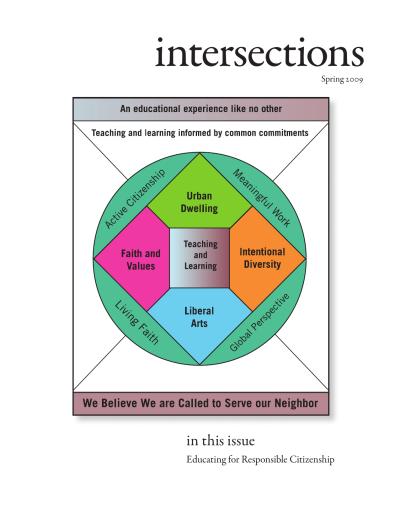 Article
Students in the Cloud: Creating Digital Citizens
Jose Marichal
No. 29 · Spring 2009
Marichal weighs the utopian and dystopian views of the “networked information economy,” drawing on Yochai Benkler, Manuel Castells, Henry Jenkins, Cass Sunstein, Robert Putnam, Nicholas Carr, and Andrew Keen to chart the promise and peril of life “in the cloud,” and proposes Aristotle’s intellectual virtue of phronesis—developed through Hubert Dreyfus’s five stages of skill acquisition—as the goal of digital citizenship for college faculty and their students.
-
 Article
Why Diversity and Civic Engagement Don't Talk to Each Other on College Campuses: The Need for Public Work
Jose Marichal
No. 25 · Spring 2007
Marichal opens with Thurgood Marshall’s line from Milliken v. Bradley and traces the “decoupling” of campus diversity and civic engagement initiatives back to their shared grounding in Benjamin Barber’s “thin” or pluralist democracy. Reviewing CIRCLE data on youth political disengagement, the limits of mandatory volunteerism, and persistent residential segregation, and drawing on Mary Ann Glendon, Lani Guinier, Caryn McTighe Musil, and Richard Rorty, he argues that only Harry Boyte’s notion of “public work” can bind diversity and civic engagement together—and contends that Lutheran colleges, with their understanding of vocation as call into the world, are uniquely positioned to build that infrastructure.
-
 Editorial
From the Publisher
Mark Wilhelm
No. 37 · Spring 2013
Wilhelm reports that decisions at the February 2013 LECNA and ELCA presidents’ meetings authorized reviews of funding and organizational practices and appointed a working group to draft a presidential statement on what it means to be a college or university of the ELCA, signaling a more substantive future role for the annual presidents’ gathering in shaping the shared identity and common mission of ELCA schools.
-
 Editorial
From the Publisher
Mark Wilhelm
No. 35 · Spring 2012
Wilhelm describes the “four-legged stool” supporting ELCA higher education—the annual Vocation of a Lutheran College Conference, the Lutheran Academy of Scholars, the Thrivent Fellows program, and Intersections—and argues that the conversation about Lutheran mission and identity must now be extended beyond college and university personnel to the larger church and community before the gains of a generation are lost.
-
 Article
Modeling Virtue: In Which a Social Psychologist Decides He Can Do Good Without Freely Choosing It
Chuck Huff
No. 9 · Summer 2000
Huff, recalling his 1975 sophomore disillusionment with a sterile introductory psychology in South Georgia (and Danny Saunders’s question from The Chosen), defends a scientific psychology as model-making rather than meaning-finding, traces the collapse of Lawrence Kohlberg’s totalizing theory of moral development into chastened mini-theories, and presents William Damon and Anne Colby’s interview study of twenty-three “moral exemplars” whose lives were marked by self-good unity, constant self-examination in community, a felt inability to have done otherwise, religious grounding, and genuine happiness. Following Aristotle on virtue as learned habit and the Christian tradition of the “slave for Christ,” he concludes that goodness flows from the choice of constraints rather than from the lone free-will hero of fairy tales, complicating C. P. Snow’s two-cultures divide. Originally the 1998 Mellby Lecture at St. Olaf.
-
 Response
"Whose Future?" or "Social Justice and the Lutheran Academy?"
Marsha Heck
No. 1 · Summer 1996
Heck argues that the future of Lutheran higher education lies less in defining Lutheran distinctiveness than in moral action grounded in face-to-face relationships with others. Drawing on David Lotz’s two-kingdoms theology of citizenship, Ernest Simmons’s relational reading of Luther, Arthur Preisinger’s indictment of the German Lutheran misreading of two kingdoms during the Third Reich, Starla Stensaas of Dana College, and Paulo Freire’s dialectic of empowerment, she calls Lutheran colleges to integrate moral reflection with moral action—to move students’ muscles against what is not true as well as to feel truths in their bones.
-
 Response
Response to Mark Wilhelm: Vocation—Wide Perspective Questions
Mary-Paula Cancienne
No. 56 · Fall 2022
Cancienne, drawing on Iain McGilchrist, asks whether higher education has prioritized micro lenses at the expense of the macro view, and invites educators to hold the drama of individual vocation stories within a wider plot that includes James Webb Telescope wonder, climate grief, the long shadow of enslavement, and the resilience of native populations.
-
 Editorial
From the Publisher
Mark Wilhelm
No. 51 · Spring 2020
Wilhelm frames the issue by tracing how Lutheran educational ideals — once a primary source of contemporary higher education — were masked in the United States, and introduces a NECU initiative that uses the case of business ethics to explore Lutheran social teaching as an academic resource.