Keeping Close from a Distance: Pandemic Reflections of a Library Coordinator
Intersections No. 53 · Spring 2021
The library at Luther College, University of Regina is the smallest of four academic libraries on campus. It employs me, a part-time assistant, and four student assistants who keep the library operating in the evenings and on weekends. This year, Luther College celebrates fifty years of being on the university campus as a federated college of the University of Regina. But our history actually extends to 1913 with the founding of Luther Academy, a high school which relocated to our present city and began offering university level courses in 1926.
As I write this, we are approaching what our chaplain calls our “COVIDversary.” At 5:00 pm on Friday, March 20, 2020, I closed our library doors for what we thought would be a few weeks. Although the Spanish Flu had temporarily shut down Luther Academy in December 1918, this was the first time in the University of Regina’s history that people had been sent home. Our university community was hurt and needed stability and reliable information. It was the very void a library was meant to fill. And I had just locked the doors. Ours had been one of the last units on campus to remain open—my staff and I were still madly scanning, packing, loading everything we could identify as crucial for our students’ success. Taking a 4100 square foot library and moving it, its collection and services online or to our individual homes was not easy. Additionally, this was happening at a particularly critical point in the winter semester: research papers and projects were in full swing, classroom library instruction was in peak demand. This was the time of the semester when I typically cleared my schedule to accommodate one task only—to sit down with students one-on-one, ensuring they had a focused research question, guiding them towards the resources they needed, and helping them manage their anxieties along the way. I took my cues from the Luther College mission and vision: “a commitment to retaining the personal atmosphere, individual attention, and sense of community that only a small university can offer.” How was I going to retain this “personal atmosphere” or nurture this “sense of community” from behind a computer screen in my basement? I was a Library Coordinator without a library. What was I coordinating?
“How was I going to retain this ‘personal atmosphere’ or nurture this ‘sense of community’ from behind a computer screen in my basement?”
Within hours, it became clear: I was coordinating information delivery, just in new and different ways. University operations across the province moved into virtual spaces, but university libraries continued to provide vital services with barely any disruption. With the help of the other three academic libraries, my own staff, and the immeasurable expertise of my campus library colleagues, we embraced new buzzwords: pivot, mobilize, and touch base. We rolled out chapter and article scans, a curbside pick-up system and home delivery service of our physical collection. We streamlined our virtual consultation methods, revamped our events to online formats, and upped our social media game. We switched our instruction delivery methods to Zoom, made videos and LibGuides. We promoted the existence of our online collections, bought new ones, and tapped into resource-sharing partnerships, such as HathiTrust. We stressed the benefits of institutional repositories, open access and open educational resources (and watched those benefits finally “sink in” to faculty), and held workshops on how to design them. We increased the frequency of our regular meetings and formed new working groups.
I saw my campus colleagues (albeit on screen) more often than I ever had before, and the synergy was amazing and heartwarming. Many of us envision these online services continuing for years to come, regardless of when or to what extent in-person instruction resumes—precisely because they are so valuable. Libraries had been preparing for this shift for decades and I am incredibly proud of how nimble we were and continue to be. So, why was I left with this feeling that the online universe was completely out of sync with the spirit of my job? Something had not “mobilized,” or “pivoted” to the digital realm—an important group of people with which I had yet to “touch base.”
“Something had not ‘mobilized,’ or ‘pivoted’ to the digital realm—an important group of people with which I had yet to ’touch base.’”
The start of a new semester at the University of Regina means, for me, a new set of library “regulars”—that little group of students and library users who are waiting for me at the door when I arrive to open it. (The makeup of the group changes every semester, along with course schedules.) Within a few weeks, this group learns my opening procedures and silently starts to pitch in: the first few people through the door turn on the workstation computers, someone carries in the daily newspapers and hangs them on the old wooden rods, one might even slide a ream of paper from behind my desk and start filling the photocopiers and printers. I rarely know their names, they rarely know each others’ names, and apart from pleasantries, there is little or no interaction. But what they all have in common is a need for early morning privacy and isolation in proximity to one another. I realize now that this group was practicing social distancing before it was a thing. I would wait until the third or fourth week into the semester before introducing a Friday morning ritual—a box of doughnuts that we would pass around as we each quietly settled into our desks and daily routines. We would become fixtures in each others’ lives for the rest of the semester. It was a community.
Another custom at the start of each fall semester is first-year orientation. In fact, in addition to Orientation Day, Luther College offers an advanced, two-day program called UPREP. This past August/September, I welcomed these new students and introduced them to campus libraries via Zoom. I never saw their faces come through the library door. I never learned who I should keep the tiniest watchful eye on for signs of homesickness. They are now a few weeks away from crossing the threshold into becoming second year students, but they have yet to see the library as a place to gather and to seek out answers and connections. I wonder if they ever will.
Part of my daily routine in the library is to get up from my desk at the top of every hour and walk through the entire place. I meander through every row of computers, every row of study tables, every aisle of bookshelves. It is not a patrol. I am not concerned with what is on their computer screens, or what may be going on in that blind spot in the stacks. I pretend to push in chairs that have gone astray or scoop up paper coffee cups left behind. But the real purpose is to try to make eye contact and smile at every student in there. Much of the time, I come back to my office with little more than an armful of old coffee cups. I have resented these walks more times than I care to admit. They are disruptions to my work and the more pressing tasks. Nevertheless, I keep to this hourly schedule because of those times I get smiles back. And at the next hour, on my next walk, one of the smilers will make eye contact first. And the following hour, they will shyly ask for help finding journal articles. In the library world, this is a model of library service known as “roving” or “roaming” reference librarianship. For me, it is something far more natural—being in the same space.
Once the student has made contact, I pull up a chair to conduct a “reference interview” (another unnatural library term). The end goal of these interactions is for the student to walk away with the skills and/or information they need—another satisfied customer. But these experiences are so much more. When the student describes the assignment to me, what topic they have chosen, their plan of attack (or lack thereof), I can decipher how well they are doing in the course, how well they are doing at university in general (whether they are thriving or hanging by a thread), and if they need additional support (academic or otherwise).
These hourly walks seek out the students waiting to ask for help, but also occasionally reveal cries for help. Despite being communal spaces, libraries also offer quiet privacy and often attract people, like the regular morning crowd, needing a combination of both. The student who is fast asleep on their laptop is working two jobs to pay for the courses that they are too tired to attend; the student sobbing into their hands has just received their first failing grade and the hopes (or parents’ hopes) of med school might be over; the student making tiny cuts to their forearm misses family overseas. After thousands of hourly walks, you learn when to mind your own business and when to put a hand on a shoulder.
“After thousands of hourly walks, you learn when to mind your own business and when to put a hand on a shoulder.”
Whether these encounters are standard reference interviews or an accompanied (and somewhat urgent) walk down the hall to our pastor or to counseling services, they spark a relationship. The student who gets a good grade because of their stellar journal articles will come in to give me high fives. The student who had to have the tough conversation with their parents about med school will come in to tell me “it wasn’t so bad” (but they could still use a hug). None of this translates to a virtual space. I have spent much of this pandemic mourning the loss of these relationships, trying to figure out how to light those sparks from afar.
“I have spent much of this pandemic mourning the loss of these relationships.”
Something else I have done during this pandemic is worry. Our closure is a temporary measure that keeps all of us safe. I know that. Nevertheless, our campus counseling services have never been busier; student anxiety is through the roof; academic misconduct is at an all-time high (most studies cite stress as the number one predictor for student cheating). Not all students (or faculty or staff, for that matter) are thriving in this online environment. We all know the challenges—loss of loved ones, loss of financial stability, loss of social supports and childcare supports, inadequate access to technology. It is a long list. Students have never needed our support more than they do now. If those hourly walks have taught me anything, it is that students are hardwired to wait for us to come to them. They will seek out help if they are desperate but would prefer that we make the first move.
The majority of students who seek my help now, in this virtual space, are usually upper-level students that I had already established relationships with (pre-pandemic) and they typically reach me by email. My contact information and availability are well-advertised. I have struggled to reach those first-years. I have struggled to reach the ones who may have stumbled upon us looking for a communal, private space.
I have tried. Early on, I ended each Zoom instruction session by staring straight into the camera and explaining that I was here to help, and not just with the stuff we had spent the last hour discussing. I think the only thing that sparked were feelings of unease—it probably came across as creepy. A campus library colleague had moderate success working with an instructor to make a 15-minute Zoom chat with a librarian mandatory to their participation mark. When I do hear from student names I do not recognize, I am thrilled and I sign off my responses with something like: “I know you’re busy with this paper, but when you have a minute, I’d like to know how you’re doing. And please come in and introduce yourself when we’re back on campus.” Sometimes I never hear from them again—like walking back to my desk with the empty cups. But sometimes I receive lengthy responses—the spark. I can now slide up the chair.
As I reflect on this COVIDversary, I realize how much I miss those hourly walks, and that they were my way of practicing servant leadership. When they led to a reference interview, I never told students what their thesis should be, nor did I read their scholarly articles for them. When non-academic trouble bubbled up, I did not counsel, or offer to talk to professors, parents, or employers. I was never a servant to students, a superior, a guardian, or even a friend. And I do not need to be any of those things now. I listen, I am curious, I take their concerns seriously, and I guide them to the resources and expertise they need. I can still do that from my basement. Many library workers deeply feel our responsibility to teach students something (as we should); however, at the end of this pandemic, what will matter most will not be that they learned how to cite a book in APA, but that they learned, perhaps by example, to support, trust, and advocate for each other. That is what I will spend the rest of this pandemic doing: supporting them through the ways I know how (information gathering, evaluating, delivery), trusting that they will ask for help when they need it, and advocating for them when professors and administrators forget that schoolwork cannot always be a student’s top priority.
“I realize now that those hourly walks were not disruptions to my work, they were my work, and I will never again take them for granted.”
The adaptability demonstrated by academic libraries deserves to be applauded and I am proud of my part in that. But, to say we did not miss a beat suggests that we are merely information repositories. When we lost our physical space, we lost our community and, for me, it felt like a huge hole at the center of the entire operation. The next few months will be focused on uncertainty, health and safety, and the current and potential budget cuts that need to be managed. I know it will take some time to build back that unspoken, unacknowledged camaraderie of the morning “regulars.” Demonstrating our importance to students who completed their first-year without setting foot in a library will be challenging. I will come up with new ways of expressing a smile behind a mask and when I pull up a chair, it will be from a safe distance. I will rein in the high-fives, the hugs, the communal boxes of doughnuts. But, I realize now that those hourly walks were not disruptions to my work, they were my work, and I will never again take them for granted.
-
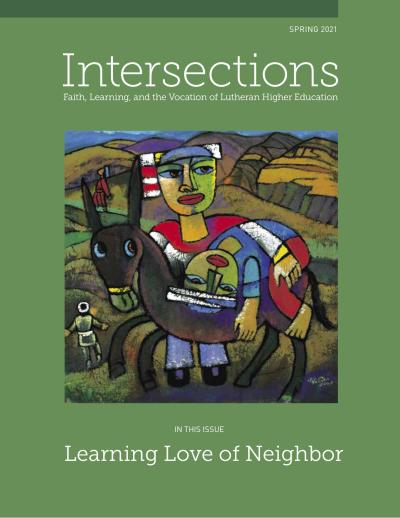 Editorial
From the Publisher
Mark Wilhelm
Wilhelm reflects on an NPR report of teenagers’ pandemic diaries and the fraught Christian history of struggling to live out Jesus’s ethic of love, framing the issue as a record of NECU institutions working out how to act for the common good through the pandemic of 2020–2021.
-
Article
Teaching as an Expression of a Love Ethic
Abbylynn Helgevold
Drawing on Kierkegaard’s Works of Love and Kevin Gannon’s teaching manifesto, Helgevold describes how an ethic of upbuilding love—love that presupposes goodness in students—reshapes inclusive pedagogy at Wartburg College, from syllabus language to how she addresses plagiarism and attendance.
-
Article
Preaching in Christ Chapel on Yom HaShoah: Reflections on Interfaith Relations at a Lutheran College
Sarah Ruble
Ruble shares her 2019 Holocaust Remembrance Day homily preached before the cross in Christ Chapel at Gustavus Adolphus, then reflects on whether “professional Christians” on Lutheran campuses might practice a non-mutual, witnessed confession before colleagues of other traditions as a check on Christian self-deceit.
-
Article
Down and Out: First Year Students Encounter Lutheran Theology
Lindsey Leonard
Leonard describes how Wartburg’s IS 101 first-year seminar wove the Dalai Lama, Paul Kingsnorth, Chimamanda Ngozi Adichie, and Mary Robinson’s Climate Justice into the Fall 2020 reader so the “COVID class” could encounter Lutheran theology’s call to serve the neighbor across the pandemics of disease, racism, and climate change.
-
Article
(Re)Defining Vocation: Gladly Challenging a Vocational Giant
Andrew Tucker
Tucker challenges Frederick Buechner’s famous definition of vocation as “where your deep gladness and the world’s deep hunger meet,” arguing that gladness reflects a privileged perspective and proposing instead that vocation be defined as “any meaningful, life-giving work you do for the world.”
-
Article
Vocation Outside of Career: Discovering Purpose through Comics
María Evelia Emerson
Emerson recounts building an Augustana Vocational Discernment course around G. Willow Wilson’s Ms. Marvel series, using Kamala Khan’s juggling of family, friendship, faith, and superhero identity to help sophomores see vocation as not what they do for a living but how they want to live.
-
Article
Leadership in a Pandemic: Grace-Filled Lessons in Unprecedented Times
Marc Jerry
Reflecting on his first year as president of Luther College at the University of Regina, Jerry argues that the best preparation for leading through a long crisis was not his economics or strategy training but seminary and pastoral formation—and that NECU institutions are called to a post-pandemic ministry of kindness, grace, and community.
-
Book Review
Unconventional Wisdom and Talking about God: A Review of Beckstrom’s Leading Lutheran Higher Education in a Secular Age
Ann Rosendale
Rosendale reviews Brian Beckstrom’s Leading Lutheran Higher Education in a Secular Age, recommending its diagnosis of the gap between espoused and perceived Lutheran identity at ELCA schools and its prescription—Trinitarian Missiological Ecclesiology and a campus-wide willingness to talk explicitly about God.
-
Reflection
Shelter in Place: Reflections from March 22, 2020
Jason A. Mahn
On the fourth Sunday of Lent in 2020, Mahn meditates on the etymology of “shelter” (from shield) and on an email from a former student in Boston whose mutual-aid organizing models a Lutheran understanding of vocation: the upending of ego by divine love that frees us, finally, to see and serve the neighbor.
-
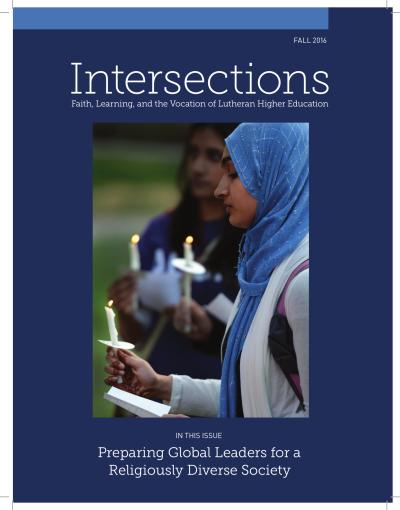 Reflection
Mapping Interfaith Encounters
Callista Isabelle
No. 44 · Fall 2016
Muhlenberg College Chaplain Callista Isabelle uses a student-designed subway map of religious and spiritual communities as an image for interfaith engagement — one that invites students to leave their “home” stations, encounter common ground and respectful disagreement, and explore the major intersections where religion meets science, environment, and mental health.
-
 Poem
Poem
Emily Dickinson in Columbus, Ohio
Caitlin McHugh
No. 17 · Summer 2003
McHugh imagines Emily Dickinson waking up on a COTA bus to find “the world had ended, and her violets were gone forever,” then escaping the crowd to wander High Street, taste “actual brewed liquor,” quit “the act of reclusive-drama queen-ghost,” and finally smash a bouquet of violets when she realizes that “Beauty had not stopped for her death, but crawled bravely onward.”
-
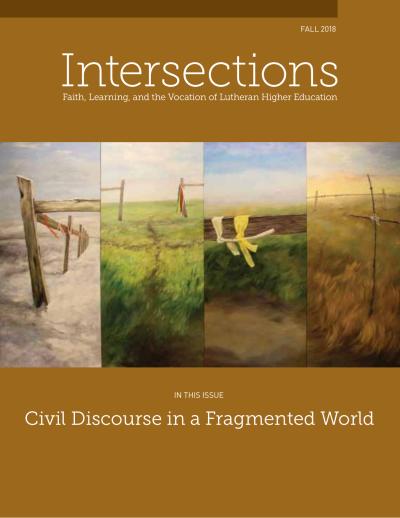 Article
Vocation and Civil Discourse: Discerning and Defining
Lynn Hunnicutt
No. 48 · Fall 2018
Hunnicutt draws on Rabbi Amy Eilberg’s reading of Moses’ calling to identify four features of vocational discernment — attention, wonder, communal consciousness, and humility — and argues that these same qualities are also key aspects of civil discourse, so that forming students for vocational discernment is simultaneously forming them for civility.
-
 Reflection
Some Personal Reflections on the ELCA Vocation of a Lutheran College Conference, 1998
Jennifer Sacher Wiley
No. 7 · Summer 1999
Sacher Wiley, a Unitarian Universalist with one Jewish parent and a first-year music faculty member at Susquehanna, reflects on common-ness and other-ness at the 1998 conference—Tom Christenson’s weaver’s warp and Charles Ives’s essay on American music—and proposes four markers of group identity. Against the fear of secularization expressed by some attendees, she suggests that “Christian” might be defined less by belief in Christ as Savior than by living a vocation as Jesus lived, with Cheryl Ney offered as an example of a “working prophet,” or “little Christ,” regardless of specific belief in the Trinity.
-
Article
Religious Diversity and the Vocation of a Lutheran College
Darrell Jodock
No. 44 · Fall 2016
Jodock argues that a college which takes its Lutheran values seriously is well positioned to foster inter-religious relations along a “third path” that is both religiously rooted and inclusive. He traces the relational and communal character of Lutheran theology, develops a Lutheran understanding of deeper freedom, the theology of limits, and human complexity, and shows how a down-to-earth image of God offers theological resources for overcoming the anxiety and fear that block interfaith engagement.
-
 Editorial
From the Publisher: Introduction and Invitation
Lamont Anthony Wells
No. 57 · Spring 2023
Wells introduces himself as the new Executive Director of NECU, succeeding Rev. Dr. Mark Wilhelm, and frames this Spring issue as a passionate response to the crises facing higher education amid threats to academic freedom and the well-being of educators.