I tell myself I can do this. I tell myself I’m exactly where I was meant to be. It’s like that Persian guy Rumi said. “Wherever you are...was circled on a map for you.”
—Kamala Khan, Ms. Marvel
“I’m sorry. I feel like I’m not explaining this correctly, but I know this experience mattered.”
The comment came from a student in my “Vocational Discernment” class.1 We were discussing events that students identify as helping them form the morals they live by in their lives. The student was explaining a significant and life changing event that happened to them, and anyone listening could see how much this event was, and always would be, a part of their everyday life. The student knew, even if they could not fully articulate it, that this certain moment in their life contributed to the path they are on now. Even though they struggled finding the words they wanted, it was clear that the student knew the experience tied into their vocation.
The vocational discernment course was created as a result of Augustana College’s Education-for-Vocation seminar that I participated in during the 2019-2020 academic year. I had just begun my role as the Faculty-in-Residence at Augustana College. In this role, I live with my family in one of the residence halls, where I provide academic and personal support to sophomores. I was interested in ways I could have conversations about vocation with these students. I had been a first-year advisor for a couple of years at that point, and often had conversations with students about their career goals, interests, and passions. I correctly intuited that conversations about vocation would happen in my role as Faculty-in-Residence as well.
Talking about Vocation
Vocation can be difficult to talk about with students because everyone has their own understanding of the word. I grew up in a Catholic family, and my hometown has strong roots in the Christian Reformed tradition. Because of that, vocation was a word I grew up hearing from an early age. It was a word that meant calling—as in: what was God calling you to do in your life? For others, it meant a trade, such as welding or plumbing. Others never heard the word vocation. When everyone has a different familiarity with the topic of vocation, it can be difficult to find common ground.
“I was interested in discussing vocation in terms of ‘living your best life.’”
In the course and through my mentorship, I was interested in discussing vocation in terms of “living your best life.” Many college students think about vocation in terms of career. They are trying to decide what the perfect job will be for them, and what steps they need to take to get it. However, I want students to consider that vocation can be fulfilled in ways outside of career. I want them to think about parts of their lives that are equally (or even more) important as/than their career. Many students I have conversations with about their goals are very practical. They are interested and passionate about their career goals, but it is not unusual for them to bring up the importance of money in order to live. They are correct; when all is said and done, food, clothing, and shelter are essential.
Partly due to these conversations, I want to show students that vocation can be fulfilled outside of career. I want them to think about how experiences impact them in their life. Who is important to them? What do they learn from others? How would they describe themselves and their role in others’ lives, and why does that matter?
But how was I to go about this?
Exploring Vocation through Ms. Marvel
Enter the superhero, Ms. Marvel. Written by G. Willow Wilson, Ms. Marvel is a superhero character and the first Muslim superhero to headline her own comic book series. Kamala Khan, a 16 year old, Pakistani-American, nerdy girl, becomes a superhero one night and names herself Ms. Marvel. I had recently reread the series before the vocation seminar was announced, and I immediately thought of how well the series ties into the concept of vocation. Because Kamala became Ms. Marvel overnight, she has to learn to balance this new role in her life with her other roles. Throughout the series, we see Kamala reflect on her different responsibilities, her relationships, her religion, and her life experiences, all while striving to be the best superhero she can be.
With the help of the Education-for-Vocation seminar, as well as discussions with colleagues at Augustana College, the LSC 250-Vocational Discernment course was determined to be the best fit for the class I envisioned. The first nineteen issues of the Ms. Marvel series served as the core reading, and all activities and assignments centered around the series and student examinations of their lives. Sixteen students enrolled in the class; only a few were familiar with Ms. Marvel, but the majority of them enjoyed superheroes. Some took the class simply because they needed the credits, but overall many of the students were genuinely interested in the topic. Although the class was geared towards sophomores, there was a mix of all years in the class.
“They thought about their own identities, their families, friendships, life events, religion (or lack thereof), and how it all led them to where they were in their lives.”
The class was broken into five different units: family and identity, friendships and relationships, teamwork, religion and morals, and layers of vocation. Students read the Ms. Marvel issues, and we discussed Kamala/Ms. Marvel’s vocational journey. In class, we talked about her different family members, friends, romantic interests, and her work with the superhero team, the Avengers. We discussed how Kamala is raised, the influence that Islam plays in her role as a superhero and as a friend and daughter, and how she becomes more comfortable with her identity as a person and as a superhero. For the last unit, “layers of vocation,” we discussed how all the different responsibilities and parts of Kamala’s life play a role in her vocation as Ms. Marvel.
Students took what they learned from the Ms. Marvel issues and our class discussions, and then reflected on their own lives. They thought about their own identities, their families, friendships, life events, religion (or lack thereof), and how it all led them to where they were in their lives. Throughout, they gained a better understanding of their own vocation. Now, they better understand why their values and goals are important.
Takeaways
For their final assignment, students gave presentations about their vocations. They shared statements such as: “I want to be a positive force in the world,” “I want to be the best version of myself,” or “I want to love myself for who I am, and show others that they should just be themselves.” Not everyone could define their vocation in one sentence, but the students had a much better sense about what is important to them. They could talk about vocation in a way that goes beyond their major or career choice. They could discuss what makes them feel like they are living a life of purpose. They understood how they feel fulfilled in ways outside of classes and future goals.
In the first class, I had students fill out a very short survey with the following questions:
1) Why did you take this class?
2) What does the word vocation mean to you?
3) How do you want to live your life?
During the final session, I had students fill out the same survey in order to gauge if their thoughts on vocation changed over the course. In the first survey, many students responded to “What does the word vocation mean to you?” with words and phrases like purpose, passion, or “to be honest, I’m not too sure.”
At the end of the semester, students had a clearer understanding of vocation. When asked, “What does the word vocation mean to you?”, one student responded with this: “The thing that makes you get up in the morning, and the thing that you seek out that shapes your life how you want it to be. It can be more than just your job, like people, activities, hobbies, the world around you, and more.” When asked, “How do you want to live your life?” I saw responses such as: “I want to leave a positive impact on people’s lives, especially my family”; and: “Living in confidence, and having no shame of myself.”
In class, we often discussed specific scenes that stood out to students. One scene that resonated with many students appears in issue 5. In this scene, readers see Kamala/Ms. Marvel putting together her superhero costume. She says “Good is not a thing you are. It’s a thing you do.” In class, students often spoke of wanting to do good in the world, normally in ways of supporting family, friends, and themselves. The students saw themselves in Kamala/Ms. Marvel. They had the same desire to contribute positively to those around them. It was clear that students were able to conceptualize that desire better at the end of the course than they could in the beginning.
“Taking a step back from traditional academics helps students examine their lives and values, which in turn helps them learn about how they want to live.”
A comic book series may not be the first thing you think of when helping students explore their vocation, but approaching the topic in this manner helps students think of their vocation in a different light. It shows them that vocation does not have to be what you want to do with your life, but how you want to live it.
Students not only enjoyed reading the Ms. Marvel series, they were able to find ways to relate to Kamala/Ms. Marvel in some way. This shows how taking a step back from traditional academics helps students examine their lives and values, which in turn helps them learn about how they want to live.
Endnote
1. I want to acknowledge and thank the Augustana College LSC-250 class of Fall, 2020. I appreciate and value how the students in this class explored and shared their vocational journeys with me and their classmates.
Works Cited
Wilson, G. Willow. Ms. Marvel Omnibus Vol. 1. Illustrated by Alphona, Adrian, et al. Marvel Worldwide, Inc., a subsidiary of Marvel Entertainment, LLC., 2016.
-
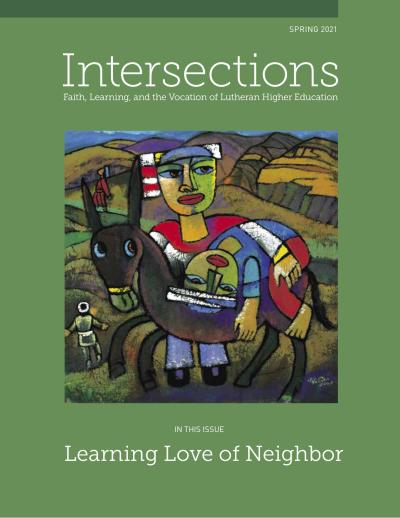 Editorial
From the Publisher
Mark Wilhelm
Wilhelm reflects on an NPR report of teenagers’ pandemic diaries and the fraught Christian history of struggling to live out Jesus’s ethic of love, framing the issue as a record of NECU institutions working out how to act for the common good through the pandemic of 2020–2021.
-
Article
Teaching as an Expression of a Love Ethic
Abbylynn Helgevold
Drawing on Kierkegaard’s Works of Love and Kevin Gannon’s teaching manifesto, Helgevold describes how an ethic of upbuilding love—love that presupposes goodness in students—reshapes inclusive pedagogy at Wartburg College, from syllabus language to how she addresses plagiarism and attendance.
-
Reflection
Keeping Close from a Distance: Pandemic Reflections of a Library Coordinator
Carla Flengeris
Flengeris reflects on a year of running Luther College’s library at the University of Regina from her basement and mourns the loss of the hourly walks through the stacks—the “roving reference” that, she realizes, were never disruptions to her work but were the work itself.
-
Article
Preaching in Christ Chapel on Yom HaShoah: Reflections on Interfaith Relations at a Lutheran College
Sarah Ruble
Ruble shares her 2019 Holocaust Remembrance Day homily preached before the cross in Christ Chapel at Gustavus Adolphus, then reflects on whether “professional Christians” on Lutheran campuses might practice a non-mutual, witnessed confession before colleagues of other traditions as a check on Christian self-deceit.
-
Article
Down and Out: First Year Students Encounter Lutheran Theology
Lindsey Leonard
Leonard describes how Wartburg’s IS 101 first-year seminar wove the Dalai Lama, Paul Kingsnorth, Chimamanda Ngozi Adichie, and Mary Robinson’s Climate Justice into the Fall 2020 reader so the “COVID class” could encounter Lutheran theology’s call to serve the neighbor across the pandemics of disease, racism, and climate change.
-
Article
(Re)Defining Vocation: Gladly Challenging a Vocational Giant
Andrew Tucker
Tucker challenges Frederick Buechner’s famous definition of vocation as “where your deep gladness and the world’s deep hunger meet,” arguing that gladness reflects a privileged perspective and proposing instead that vocation be defined as “any meaningful, life-giving work you do for the world.”
-
Article
Leadership in a Pandemic: Grace-Filled Lessons in Unprecedented Times
Marc Jerry
Reflecting on his first year as president of Luther College at the University of Regina, Jerry argues that the best preparation for leading through a long crisis was not his economics or strategy training but seminary and pastoral formation—and that NECU institutions are called to a post-pandemic ministry of kindness, grace, and community.
-
Book Review
Unconventional Wisdom and Talking about God: A Review of Beckstrom’s Leading Lutheran Higher Education in a Secular Age
Ann Rosendale
Rosendale reviews Brian Beckstrom’s Leading Lutheran Higher Education in a Secular Age, recommending its diagnosis of the gap between espoused and perceived Lutheran identity at ELCA schools and its prescription—Trinitarian Missiological Ecclesiology and a campus-wide willingness to talk explicitly about God.
-
Reflection
Shelter in Place: Reflections from March 22, 2020
Jason A. Mahn
On the fourth Sunday of Lent in 2020, Mahn meditates on the etymology of “shelter” (from shield) and on an email from a former student in Boston whose mutual-aid organizing models a Lutheran understanding of vocation: the upending of ego by divine love that frees us, finally, to see and serve the neighbor.
-
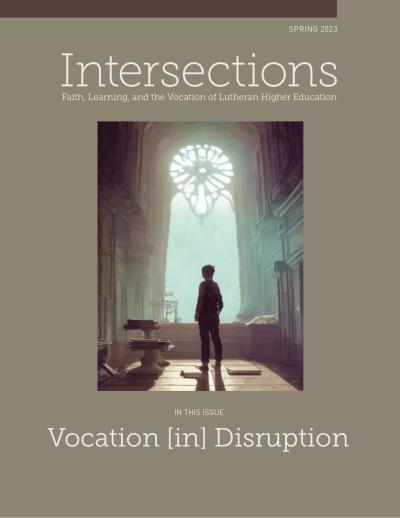 Article
Take Heart: Is Neutrality Really What We Need Right Now?
Abbylynn Helgevold
No. 57 · Spring 2023
Helgevold, an ethicist at Wartburg College, argues that calls for faculty neutrality on abortion in the post-Roe classroom stifle the courageous conversations Lutheran higher education is uniquely positioned to host — conversations grounded in “Rooted and Open” and the ELCA’s 1991 Social Statement on Abortion.
-
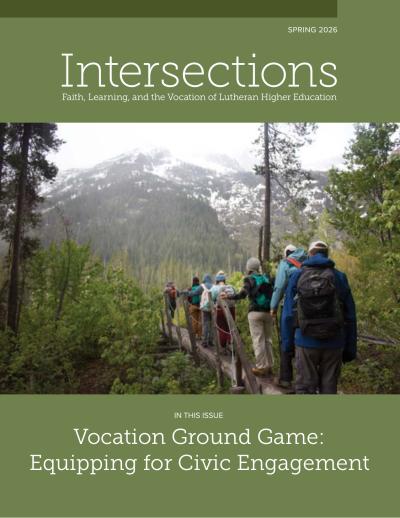 Article
Fragmented in Faith: The Concerns and Hopes Found in Student Spirituality and Civic Engagement
Emma Bohmann, Monica Sitachitta
No. 63 · Spring 2026
11 min audio
Two Texas Lutheran University students reflect on the cyclical pattern of low spiritual and civic engagement on their campus and argue that distinguishing Lutheran values from Lutheran practice could open space for civic engagement to become a non-optional expression of neighbor-justice for all students.
-
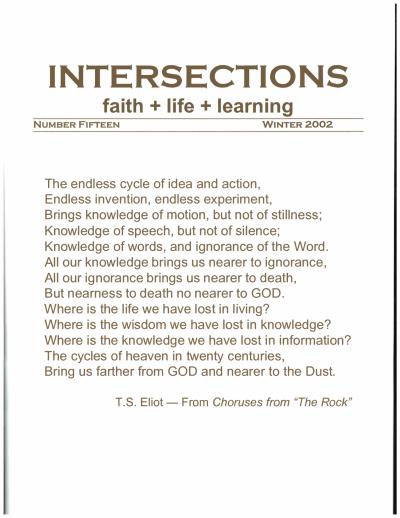 Editorial
From the Publisher
Arne Selbyg
No. 15 · Winter 2002
Selbyg announces that the 2001 ELCA Churchwide Assembly has commissioned a new social statement on education, placing it alongside the economy, the environment, abortion, sexuality, health, and peace, and invites Intersections readers to submit input on which topics within the field of education the statement should address.
-
 Editorial
From the Publisher
Mark Wilhelm
No. 51 · Spring 2020
Wilhelm frames the issue by tracing how Lutheran educational ideals — once a primary source of contemporary higher education — were masked in the United States, and introduces a NECU initiative that uses the case of business ethics to explore Lutheran social teaching as an academic resource.
-
 Article
Vocational Leadership
Darrell Jodock
No. 41 · Spring 2015
Jodock proposes “vocational leadership” as a name for a distinctive educational value at the heart of a Lutheran college — one that seeks to benefit the neighbor and the community, inspires and invites others to participate in that service, and is institutionally anchored in the Lutheran concept of vocation. He unpacks twelve facets of vocational leadership and ties them to Luther’s own leadership around indulgences, public schooling, and beggary.
-
 Book Review
Robert Benne: Quality With Soul: How Six Premier Colleges and Universities Keep Faith With Their Religious Traditions
Joy Schroeder
No. 13 · Winter 2002
Schroeder reviews Robert Benne’s Quality With Soul (Eerdmans, 2001), which assesses the secularization documented by James T. Burtchaell’s The Dying of the Light and names six “bright lights” that resist it: Calvin, Wheaton, Baylor, Notre Dame, Valparaiso, and St. Olaf. Benne argues that piety alone or “generic Christianity” is insufficient—a school’s specific denominational intellectual tradition must permeate mission statements, classroom, and chapel, sustained by a critical mass of identifying faculty (he proposes a 2:1 ratio and at least one-third communicant membership), a first-rate theology department as “trustworthy guardian,” and visionary presidential and board leadership. Schroeder flags the under-representation of student and faculty voices but commends the book as required reading for presidents, board members, and faculty seminars at church-related institutions.