My introduction to vocational reflection came rather late. Prior to coming to Wartburg, my own experiences in higher education, both as a student and an instructor, were shaped by the culture of large, public, research-focused institutions. Up until my third full year of teaching, I had no direct experience with vocational guidance or mentorship, though as an ethicist and scholar of religion I often found myself working with ideas and questions closely tied to the concept of vocation. Fortunately, in 2016 I was able to participate in a vocation-focused Leadership Academy supported by the administration at my previous institution. Over the course of that year, I remember feeling embarrassed by the newness of my own vocational insights. As I dove deeper into my own vocational questions and quest, I was drawn to the powerful ethical pull of love. This call to love is expanded on most strikingly by the Danish Lutheran philosopher Søren Kierkegaard, but also elucidated by other religious and philosophical perspectives. Over time, the challenge and potential of living in a loving way became the lens through which I understood my personal and professional calling.
At first, I was nervous about exploring this at a public institution; talk of love seems beyond the constraints of the more rational and neutral values of our public spaces. As an instructor in religious studies at a public institution, I strove to make sense of what this could or should look like within a curriculum dedicated solely to the academic study of religion. And, in all honesty, I was also anxious about appearing naïve or being caricatured as an uncritical, new-agey, peace-loving, hippie type. Of course, the last of these fears is almost laughable; anyone who has seriously investigated and/or experienced love in the context of our moral lives understands that choosing to love is one of the hardest things we do as humans.
“Anyone who has seriously investigated and/or experienced love in the context of our moral lives understands that choosing to love is one of the hardest things we do as humans.”
Still, I remain drawn to the idea of love as a virtue and a responsibility; in it is a bold affirmation of fundamental goodness that is life-giving in its generosity. It is also transformative in its challenge to life-numbing and destructive habits and practices. Education as an expression of love is education that is accessible to all in light of their inherent and equal value; it is life affirming in its capacity to nurture and challenge; and it is grounded in an acceptance that goes deeper than performative concerns about success and failure.
Adopting an ethic of love as my basic orientation has greatly impacted my teaching and broader professional vision. When the opportunity to join the faculty at Wartburg College emerged, and as I came to learn more about the mission and vision of Wartburg and the distinctive qualities of Lutheran higher education, I found myself inspired by educational principles that aligned so well with my own calling. It is a great privilege to be able to teach and serve in a setting that is committed to an approach to education centered in the whole person, one that directly embraces ideals of interdependence and reciprocal human flourishing and that challenges destructive, culturally reinforced, judgments about worthiness and practices of exclusion in an effort to foster deep learning (NECU 8). Despite making this transition in 2020, during a time of great collective stress and upheaval, I remain inspired.
Love and Critical Inclusion
One of the reasons an ethic of love is so appealing and challenging is because it is maximally inclusive. However, we all know that articulating principles and realizing them by living them out in our policies, deeds, and choices are different things. This is as true for institutions as it is for individuals. In the field of ethics, one of the most perplexing and challenging questions we face is the question of integrity—how does one come to consistently align one’s values and ideals with one’s choices and actions? Recently, this gap between ideals and actions has been highlighted by ongoing concerns about the persistence of cultures of exclusion and inhospitality despite professed values of inclusion, diversity, equity and hospitality. A loving orientation to inclusivity and genuine acceptance acts as a prophetic plumb line (see Amos 7) against which we can measure our beliefs, attitudes, practices, and policies. An ethic of love is always calling for greater inclusion; imbedded in this call is the hopeful confidence in its possibility. When our failure to measure up is revealed, we are called to change course.
“A loving orientation to inclusivity and genuine acceptance acts as a prophetic plumb line against which we can measure our beliefs, attitudes, practices, and policies.”
Already in my first year, I have been able to meet and work with colleagues who share a common concern to shift the culture toward greater inclusion. In addition to the task forces, councils, and formal and informal conversations, several of us are participating in a year-long inclusive pedagogy faculty seminar. Together we have been reading, sharing resources and experiences, and reflecting on our own teaching practices. We have begun to implement changes in our teaching. We have been called to examine our own habits, assumptions, and practices in an effort to gain a better understanding of the ways that we contribute to exclusionary practices that cut off access to and limit opportunities for deep learning experiences. In my own case, I have had to question the overall accessibility of my course as I redesign coursework, adopt new formats for assigned readings, and adapt instructional materials in an effort to make opportunities for learning genuinely open to every student in my class. I have been challenged to more deeply consider the impact of my students’ cultural backgrounds and educational histories on their ability to engage with course material and to connect with me as their instructor.
As Kevin Gannon claims in his “teaching manifesto,” this work is radically transformative and it is hard. Sustaining it requires clarity about core values and principles and a vision of transformation (8). My own source of sustenance in this work is the love ethic expressed in the dual love command, which is compellingly elucidated by Søren Kierkegaard in Works of Love. It is clear that the values of love and neighborliness are at the root of Lutheran higher education. For those of us who are motivated by such values, I’d like to suggest that we weave the language of love into our efforts toward inclusion as both a source of inspiration for and critique of our efforts.
Kierkegaard was gifted with an ability to call out his readers for their complacency and inauthenticity, while at the same time calling them into spaces of honest reflection and reorientation. My first encounter with Kierkegaard felt a little like a punch in the gut followed by an intense moment of clarity and a call to honor the power of the demand. I had never appreciated or felt it quite that way before. Though nothing can quite describe the process, it seems to me now like that THX audio sound in a movie theater (remember those?) when things begin to resound in their clarity. What once was a smattering of ideas and concepts became clearer, and more significant, than it ever had before. What I had experienced was a radical shift in perspective, which has been with me ever since.
“It is clear that the values of love and neighborliness are at the root of Lutheran higher education.”
Upbuilding though Education
One of the most meaningful ways that Kierkegaard’s thought shaped my own love ethic was through his reflections on the statement in 1 Corinthians 8:1 that “love builds up.” In reflecting on what it means to say that love “builds up,” Kierkegaard underscores the importance of our presuppositions. Love in its true expression will presume and affirm a goodness already present in the other. This affirmation builds the other up. Love, in its generosity, leads with affirmation, and upbuilding love consists in this affirmation. To be built up is to be strengthened and empowered; it is to experience being welcomed and accepted. When you are loved by another, Kierkegaard states, “even when you doubt yourself, doubt that there is love in you, [the loving person] is loving enough to presuppose it.” Through this presupposition you will be liberated from the weight of this doubt to trust in the goodness that is affirmed by this love (224).
Kierkegaard here reminds his readers that we love best when we bring forth love in others by presupposing its presence in the very ground of their being. To cultivate upbuilding love requires us to turn inward and examine our own presuppositions or assumptions about others and it challenges us to start from a place of affirmation and acceptance. There is great power in this. In an educational setting, this presupposition acts as a counter-narrative to a range of destructive messages about worthiness, value, and lack of belonging that serve to exclude. A truly inclusive educational setting will be one in which participants are built up in this deeper sense. The affirmation expressed in upbuilding can go a long way toward supporting students’ agency as they understand themselves to be valued members of a learning community.
Using upbuilding as our plumb line, we ask: how often do we come across instances that do not measure up? How often do we, usually unintentionally, communicate messages that tear down and exclude? Do our assignment policies and grading practices communicate to students that they are here to be judged and to have their shortcomings pointed out in a way that amplifies their concerns about worth and belonging—or do they communicate a message of support and inclusion? Because upbuilding is tied to our presuppositions, Kierkegaard reminds his readers that anything we do or say has the potential to build up or tear down. When we look carefully at things like our syllabus language, what presuppositions about our students are revealed? Do they align with our shared educational principles?
One effective inclusive pedagogical practice that can contribute to creating an upbuilding educational setting is collaborative expectation setting. By encouraging students to establish mutually agreed upon expectations about the learning environment, we affirm students’ interest in their own learning and their experiential wisdom. This presupposes that their experiences and insights are valuable and that they have a genuine interest in their own education. As Kevin Gannon notes, such practices can help instructors become better able to “use [their power] in ways that work for, rather than against, student learning” (88). Students are invited in as allies and collaborative learning partners. When instead we give them “paragraphs vividly describing the consequences for a litany of specific cheating scenarios,” we communicate that “we are expecting them to do something wrong, that we expect them to pounce on any opportunity to game the system, that we see them as adversaries” (118). In moving toward greater collaboration with students we move toward more opportunities for upbuilding. If we lead from affirmation, what we say and how we say it changes, and these shifts in perspective can go a long way toward creating an environment that manifests genuine hospitality and inclusion.
“If we presuppose and affirm the good in our students rather than rushing to judgment, we are likely to learn more about who they are, what is going on in their lives, and how to support them.”
Keeping our attention focused on upbuilding can be especially important when things “go wrong.” When mistakes or poor choices are made, it can be easy to slide into what Gannon calls an “adversarial” stance that further serves to undermine deep learning experiences, growth, and engagement (116). Addressing problems with students that range from poor attendance to plagiarism or cheating from a place of affirmation opens up possibilities for problem solving and supporting agency. If we presuppose and affirm the good in our students rather than rushing to judgment, we are likely to learn more about who they are, what is going on in their lives, and how to support them. Perhaps they’ve disengaged from their own learning because they overburdened by repeated microaggressions that consistently serve to point out their lack of belonging. Maybe their anxieties about how to pay for their education are overwhelming their capacity to prioritize their learning experiences. Shifting from a punitive to an upbuilding stance changes the nature of the relationship we have with our students; it invites us into a space where we can acknowledge that the lives we live are complicated and difficult and that we are each more than the sum of our poor choices and mistakes.
Concluding Reflections
My inclusive pedagogy seminar has made its way through a range of discussions about the need for and examples of inclusive pedagogical practices. Throughout, I have been continuously struck by the ever-present need to remain humble and critically reflective about our own assumptions and presuppositions. These are at the root of everything—and what grows out of that root makes all the difference.
Unexamined presuppositions can work to sustain exclusionary practices that have an enduring impact on our students and our environment. As we strive to reduce and remove our harmful assumptions, we do well to focus on strengthening those that have the capacity to build the other up. The Lutheran theological tradition that informs the “common calling” of the NECU emphasizes a “radical freedom” that consists in “a freedom from false ideas about earning one’s own worthiness and a freedom for a life of service to and with the neighbor” (NECU 4). Embracing the freedom to choose the way of upbuilding love in our interactions with others is one important means by which we can create inclusive interactions, which in turn extend that experience of radical freedom to each of the students we encounter.
Works Cited
Gannon, Kevin M. Radical Hope: A Teaching Manifesto. West Virginia University Press, 2020.
Kierkegaard, Søren. Works of Love. Edited and translated by Howard V. Hong and Edna H. Hong. Princeton UP, 1995.
NECU (Network of ELCA Colleges and Universities). “Rooted and Open: The Common Calling of the Network of ELCA Colleges and Universities.” Accessed 1 April, 2021, https://download.elca.org/ELCA%20Resource%20Repository/Rooted_and_Open.pdf
-
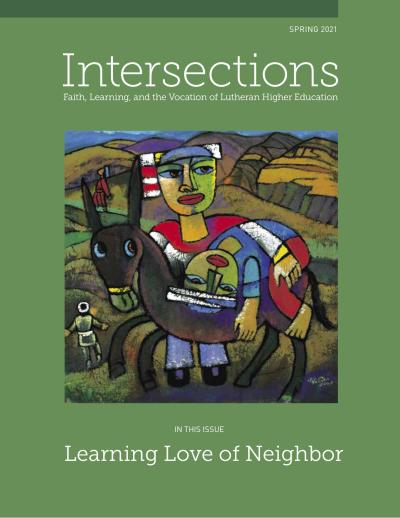 Editorial
From the Publisher
Mark Wilhelm
Wilhelm reflects on an NPR report of teenagers’ pandemic diaries and the fraught Christian history of struggling to live out Jesus’s ethic of love, framing the issue as a record of NECU institutions working out how to act for the common good through the pandemic of 2020–2021.
-
Reflection
Keeping Close from a Distance: Pandemic Reflections of a Library Coordinator
Carla Flengeris
Flengeris reflects on a year of running Luther College’s library at the University of Regina from her basement and mourns the loss of the hourly walks through the stacks—the “roving reference” that, she realizes, were never disruptions to her work but were the work itself.
-
Article
Preaching in Christ Chapel on Yom HaShoah: Reflections on Interfaith Relations at a Lutheran College
Sarah Ruble
Ruble shares her 2019 Holocaust Remembrance Day homily preached before the cross in Christ Chapel at Gustavus Adolphus, then reflects on whether “professional Christians” on Lutheran campuses might practice a non-mutual, witnessed confession before colleagues of other traditions as a check on Christian self-deceit.
-
Article
Down and Out: First Year Students Encounter Lutheran Theology
Lindsey Leonard
Leonard describes how Wartburg’s IS 101 first-year seminar wove the Dalai Lama, Paul Kingsnorth, Chimamanda Ngozi Adichie, and Mary Robinson’s Climate Justice into the Fall 2020 reader so the “COVID class” could encounter Lutheran theology’s call to serve the neighbor across the pandemics of disease, racism, and climate change.
-
Article
(Re)Defining Vocation: Gladly Challenging a Vocational Giant
Andrew Tucker
Tucker challenges Frederick Buechner’s famous definition of vocation as “where your deep gladness and the world’s deep hunger meet,” arguing that gladness reflects a privileged perspective and proposing instead that vocation be defined as “any meaningful, life-giving work you do for the world.”
-
Article
Vocation Outside of Career: Discovering Purpose through Comics
María Evelia Emerson
Emerson recounts building an Augustana Vocational Discernment course around G. Willow Wilson’s Ms. Marvel series, using Kamala Khan’s juggling of family, friendship, faith, and superhero identity to help sophomores see vocation as not what they do for a living but how they want to live.
-
Article
Leadership in a Pandemic: Grace-Filled Lessons in Unprecedented Times
Marc Jerry
Reflecting on his first year as president of Luther College at the University of Regina, Jerry argues that the best preparation for leading through a long crisis was not his economics or strategy training but seminary and pastoral formation—and that NECU institutions are called to a post-pandemic ministry of kindness, grace, and community.
-
Book Review
Unconventional Wisdom and Talking about God: A Review of Beckstrom’s Leading Lutheran Higher Education in a Secular Age
Ann Rosendale
Rosendale reviews Brian Beckstrom’s Leading Lutheran Higher Education in a Secular Age, recommending its diagnosis of the gap between espoused and perceived Lutheran identity at ELCA schools and its prescription—Trinitarian Missiological Ecclesiology and a campus-wide willingness to talk explicitly about God.
-
Reflection
Shelter in Place: Reflections from March 22, 2020
Jason A. Mahn
On the fourth Sunday of Lent in 2020, Mahn meditates on the etymology of “shelter” (from shield) and on an email from a former student in Boston whose mutual-aid organizing models a Lutheran understanding of vocation: the upending of ego by divine love that frees us, finally, to see and serve the neighbor.
-
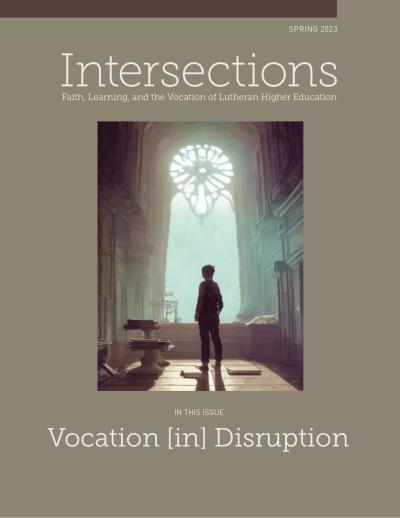
 Editorial
From the Editor
Robert D. Haak
No. 25 · Spring 2007
Haak frames the issue around the question of what holds the twenty-eight ELCA colleges together amid their geographic, economic, and theological diversity, introducing Mark Hanson’s address to the assembled college presidents, Randall Balmer’s outsider perspective on the commonalities of Christian liberal arts, José Marichal and Pamela Brubaker on diversity rooted in community and globe, Storm Bailey’s argument that being Lutheran is precisely what makes us embrace diversity, and Jaime Schillinger’s St. Olaf chapel reflection on the formative power of worship and liturgy.
-
 Article
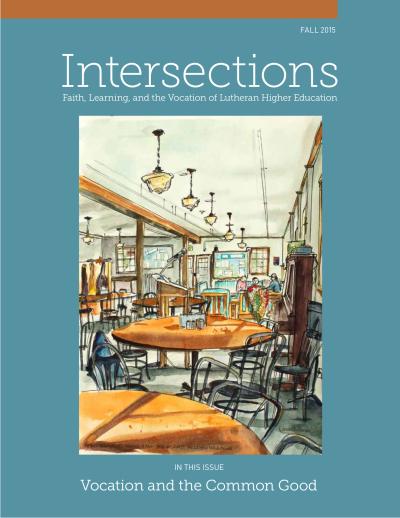
"Greed is an Unbelieving Scoundrel": The Common Good as Commitment to Social Justice
Samuel Torvend
No. 42 · Fall 2015
Torvend uses his Lutheran Heritage course at Pacific Lutheran University to ask what “the common good” might mean concretely — fresh air, clean water, food, shelter, healthcare — and traces the early Lutheran reform of literacy and social welfare to argue that the first gift of Lutheran education is the capacity to question the status quo and to push beyond charity into the pursuit of social justice.
-
 Article
The Lutheran Calling in Education: Context and Prospect
Paul J. Dovre
No. 23 · Summer 2006
Dovre, President Emeritus of Concordia College and co-chair of the ELCA Task Force on Education, undertakes three tasks: focusing on the current social context (young people’s spiritual lives, the state of mainline denominations, the family map, schools, communities, and higher education); reflecting on why Lutherans care about education (creation in God’s image, vocation, Luther’s legacy, the priesthood of all believers, civic righteousness, and hope); and considering the prospects and possibilities for addressing the calling (biblical, confessional, theological, and pedagogical legacies; the renewal of apostolic ministry, the Christian-college renaissance, K–12 reform, and the congregational education explosion).
-
 Reflection
Vocation
Matt Peterson
No. 10 · Fall 2000
In a chapel homily, St. Olaf student Matt Peterson quotes former St. Olaf professor Howard Hong’s 1955 Our Church and the World—“the tragedy is that we seem to have lost the full grasp of the Christian vocation”—to argue that vocation, from the Latin vocare, is centrally a call into daily communion with God and into continually becoming Christian, not the title of a successful career marked by GPA, win-loss records, honorary degrees, or net worth. Drawing on Anthony Bloom on prayer that must be lived, he indicts the dread of Monday, the “come hell or high water” demand for production, and the “faith community” that we take on faith.
-
 Article
Living Biology
Stephanie Fuhr
No. 37 · Spring 2013
Fuhr recounts how a one-credit Becoming Biologists course at Augustana College was rebuilt around the biological worldview after a student flagged John Janovy Jr.’s argument that values are legitimate tools in biology. Drawing also on Stephen Jay Gould’s The Mismeasure of Man, she argues that visions and values—not skills alone—inspire a life’s work in science and provide the foundation for lifetime engagement in the work of biology.
-
 Editorial
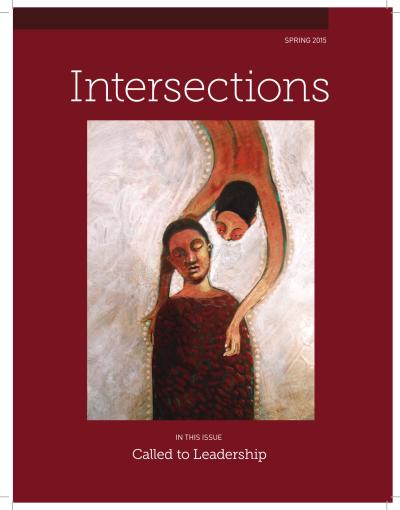
From the Editor
Jason A. Mahn
No. 41 · Spring 2015
Mahn introduces the “Called to Leadership” issue by worrying that training for leadership has become so ubiquitous in higher education as to be nearly meaningless, and recovers Luther’s sense of leadership as service — a calling to be a “slave” whose learning, power, and wisdom belong to the unlearned, the oppressed, and the foolish — as the shared mission of Lutheran colleges to train servant-leaders.