They arrived as they always do: high on independence, terrified of freedom, looking for a place to belong. They carried with them bins, and bags, and boxes full of stuff (so much stuff!) labeled carefully, dutifully, with their name and hall assignment. A printed orientation schedule and a stack of forms tucked neatly in a folder lay on their dashboard. The lanyard around their neck held a college student ID, the ultimate signal of first year status.
They also arrived with cautious eyes above masked noses (for those who didn’t need correcting). They carried with them six months of disappointment and heartache; with it, almost unbearable amounts of anticipatory grief. Some didn’t bother bringing winter clothing, sure we’d be sending them home before the temperatures ever dropped. Others didn’t bother coming at all. The heightened sense of uncertainty created a haze of reluctancy; better not get too close, too comfortable, or too confident—knowing all too well how quickly this can all be taken away.
Fall of 2020 required all of us—staff, faculty, students—to reach deep into our (nearly depleted) reservoirs of perseverance. We resumed mitigated life on a college campus in ways that on the surface felt familiar but were often unfulfilling. The triage we found in the Spring was continuing, and some of the greatest concern was felt, specifically, for the first-year students. What a time to move into college, to be met with such a monumental transition during an international health crisis, to be asked to take on another challenge in an already challenging time.
At Wartburg College, all first-year students are enrolled in a first-year seminar course, called Inquiry Studies or IS 101. In addition to being the cornerstone for the first-year transition, IS 101 seeks to welcome students into an academic community by introducing the value of a liberal education. Curated by the IS 101 teaching team, students interact with an anthology of essays, book chapters, manuscripts, and poems throughout the course. This IS 101 Reader is organized using the college’s mission pillars: leadership, service, faith, and learning.
Effective first year seminars center opportunities for active involvement, social integration, personal reflection, personal meaning, and personal validation (Cuseo). Done well, students are met with content and pedagogy that upholds these five learning processes. Recognizing that the circumstances of the world and the environment in which these students were beginning college, and valuing Cuseo’s research, we made two additions to the IS 101 Reader just before it was published for the Fall 2020 cohort. The first, a piece written by the Dalai Llama titled, “Prayer is Not Enough,” which ran in the New York Times. The second, a reflection and story penned by Paul Kingsnorth titled Finnegas.
Through readings and discussion about the coronavirus pandemic, using these two additional works as a backdrop, first year students heard the call for a unified response toward a global crisis. Many could express deep commitment to wearing a mask, following campus policy aimed to mitigate the spread, and holding their community accountable so that everyone could be safe. Even with a student body comprised almost entirely of traditional students (age 18-22), class discussion about remaining vigilant in the fierce protection of those most vulnerable were prevalent; these are not times to be selfish. No matter how uncomfortable, inconvenient, or unwanted this exercise in compassion is, the call to consider and serve the neighbor was a sentiment much discussed and well honored. Consideration and service to the neighbor—a theme had surfaced that would transcend the current topic.
As part of a new community, often more diverse than the homes from which they came, first year students were invited to consider and reflect on stereotypes by reading the transcript of Chimamanda Ngozi-Adichi’s TedTalk Danger of a Single Story. They were also participants in a workshop on microaggressions (what they are, how they happen, what to do when one occurs). Through this IS 101 content, students were called to consider their privileges (everyone has privilege!) and reflect on ways that those identities hold unearned yet clearly given power in our society. Students quickly understood that there is another pandemic plaguing America, and this pandemic wasn’t a new one; black people have been fighting the effects of slavery and racism and bigotry for years.
“Consideration and service to the neighbor—a theme had surfaced that would transcend the current topic.”
These conversations around racial injustices in our nation are challenging, especially when done in a students’ first term. Yet we must be bold in commitment to be a part of the work of antiracism—work that starts in the head, takes roots in the heart, and serves through the hands. In considering the stereotypes of which they held, students begin to understand their own biases and learn to interrupt their thinking—work of the head. By acknowledging their privilege, they see themselves as both part of the problem and part of the solution—work of the heart. At our predominantly white institution, many of our students have been able to separate themselves from the direct effects of racism. Now, though, they are offered the tools to no longer be complicit in systems that uphold discrimination and white supremacy. Antiracism is work of the hands, and another example for what it means to serve the neighbor.
“Antiracism is work of the hands, and another example for what it means to serve the neighbor.”
Every year, a common read is selected campus wide as an opportunity to increase engagement through shared experiences. This year, we selected Climate Justice by Mary Robinson. After learning about what climate change is, what contributes to global warming, and what can be done to slow the effects, students discussed Robinson’s work, which engages the reader in stories from across the world to illustrate how those who contribute to climate change least are affected by it the most. Students considered how closely climate change reform is connected to policy, how policy is connected to people with power, and how people with power often only have a sliver of narrative for how others live (clear connections here with Adichie’s piece). Students reflect on how, beyond the devastating Iowa derecho and some hotter hot days and other colder cold days, their daily lives may be free from the deep pressure to change habits that can clearly impact climate change. However, the truth is clear that communities, tribes, families, and lives depend on a swift and coordinated world-wide effort by all global citizens to prioritize practices that lead to reduced emissions; we all must be committed to doing the work so all may flourish. Climate justice, too, is care of neighbor.
Each fall, our campus pastor accepts the invitation to speak to the first-year cohort about what it means to be attending a Lutheran institution. Students learn that there was a time that Lutheran institutions were only for Lutheran students and sought to produce Lutheran pastors. However, that is no longer the vocation of Wartburg College (but it is okay if they decide to be Lutheran in the end). Pastor describes that the Lutheran heritage informs a belief that everyone, every student, has a vocation, a calling, a purpose. Because Lutheran theology is rooted in sola fide (faith alone), the way to honor God is to live out our commitment through our vocation. Because God’s love and grace comes all the way down to us, we are freed up to go out and serve our neighbor.
By recognizing and taking seriously the injustices of climate change, in no longer being complicit in racism, in masking and distancing to protect those with the most weakened immune system, students were interfacing with Lutheran theology, which directly calls us to serve our neighbor. In embracing this theme, we were all reminded that Jesus’ gift freely given liberates us from reaching for God in attempts to achieve salvation; instead, the Spirit has come all the way down to us, and this “frees us to love our neighbor and promote the common good” (ELCA). Now, more than ever, we are called to be part of a global response to every pandemic rooted in the “down and out”.
“By recognizing and taking seriously the injustices of climate change, in no longer being complicit in racism, in masking and distancing to protect those with the most weakened immune system, students were interfacing with Lutheran theology, which directly calls us to serve our neighbor.”
They arrived as they always do. Unsure of the purpose of IS 101, eyes rolling with the consideration of liberal learning as having immense value, weary of what it means to be attending a Lutheran institution. They began to read, think, and write about the many pandemics—not just the most obvious health crisis, but also the pandemics of racism and climate change. They came to see that they are “called and empowered to serve the neighbor so that all may flourish” (NECU). For our first-year students, the “COVID class”, as well as liberal, Lutheran education as a whole, teaches service, citizenship, connectedness, and compassion. That education has never been more applicable, or more valuable, or more transformative.
Works Cited
Cuseo, Joseph. Instructor’s Manual for Thriving in College and Beyond: Research-Based Strategies for Academic Success and Personal Development, 2010, Kendall/Hunt. Accessed 1 April 2021, https://www.millersville.edu/gened/files/pdfs-faculty-handbook/1-fyscoursepedagogy-cuseo.pdf
ELCA (Evangelical Lutheran Church in America). “A Social Statement on: Our Calling in Education,”2007. Accessed 1 April 2021, https://download.elca.org/ELCA%20Resource%20Repository/EducationSS.pdf
NECU (Network of ELCA Colleges and Universities). “Rooted and Open: The Common Calling of the Network of ELCA Colleges and Universities.” Accessed 1April 2021, http://download.elca.org/ELCA%20Resource%20Repository/Rooted_and_Open.pdf
-
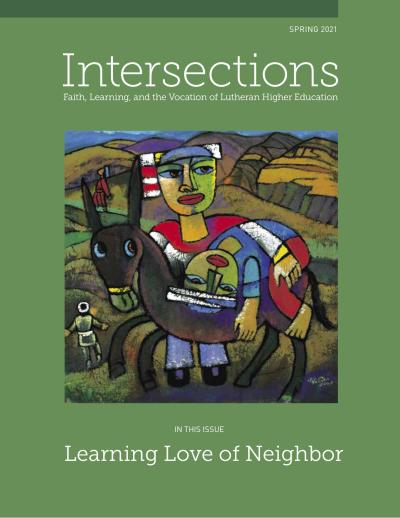 Editorial
From the Publisher
Mark Wilhelm
Wilhelm reflects on an NPR report of teenagers’ pandemic diaries and the fraught Christian history of struggling to live out Jesus’s ethic of love, framing the issue as a record of NECU institutions working out how to act for the common good through the pandemic of 2020–2021.
-
Article
Teaching as an Expression of a Love Ethic
Abbylynn Helgevold
Drawing on Kierkegaard’s Works of Love and Kevin Gannon’s teaching manifesto, Helgevold describes how an ethic of upbuilding love—love that presupposes goodness in students—reshapes inclusive pedagogy at Wartburg College, from syllabus language to how she addresses plagiarism and attendance.
-
Reflection
Keeping Close from a Distance: Pandemic Reflections of a Library Coordinator
Carla Flengeris
Flengeris reflects on a year of running Luther College’s library at the University of Regina from her basement and mourns the loss of the hourly walks through the stacks—the “roving reference” that, she realizes, were never disruptions to her work but were the work itself.
-
Article
Preaching in Christ Chapel on Yom HaShoah: Reflections on Interfaith Relations at a Lutheran College
Sarah Ruble
Ruble shares her 2019 Holocaust Remembrance Day homily preached before the cross in Christ Chapel at Gustavus Adolphus, then reflects on whether “professional Christians” on Lutheran campuses might practice a non-mutual, witnessed confession before colleagues of other traditions as a check on Christian self-deceit.
-
Article
(Re)Defining Vocation: Gladly Challenging a Vocational Giant
Andrew Tucker
Tucker challenges Frederick Buechner’s famous definition of vocation as “where your deep gladness and the world’s deep hunger meet,” arguing that gladness reflects a privileged perspective and proposing instead that vocation be defined as “any meaningful, life-giving work you do for the world.”
-
Article
Vocation Outside of Career: Discovering Purpose through Comics
María Evelia Emerson
Emerson recounts building an Augustana Vocational Discernment course around G. Willow Wilson’s Ms. Marvel series, using Kamala Khan’s juggling of family, friendship, faith, and superhero identity to help sophomores see vocation as not what they do for a living but how they want to live.
-
Article
Leadership in a Pandemic: Grace-Filled Lessons in Unprecedented Times
Marc Jerry
Reflecting on his first year as president of Luther College at the University of Regina, Jerry argues that the best preparation for leading through a long crisis was not his economics or strategy training but seminary and pastoral formation—and that NECU institutions are called to a post-pandemic ministry of kindness, grace, and community.
-
Book Review
Unconventional Wisdom and Talking about God: A Review of Beckstrom’s Leading Lutheran Higher Education in a Secular Age
Ann Rosendale
Rosendale reviews Brian Beckstrom’s Leading Lutheran Higher Education in a Secular Age, recommending its diagnosis of the gap between espoused and perceived Lutheran identity at ELCA schools and its prescription—Trinitarian Missiological Ecclesiology and a campus-wide willingness to talk explicitly about God.
-
Reflection
Shelter in Place: Reflections from March 22, 2020
Jason A. Mahn
On the fourth Sunday of Lent in 2020, Mahn meditates on the etymology of “shelter” (from shield) and on an email from a former student in Boston whose mutual-aid organizing models a Lutheran understanding of vocation: the upending of ego by divine love that frees us, finally, to see and serve the neighbor.
-
 Article
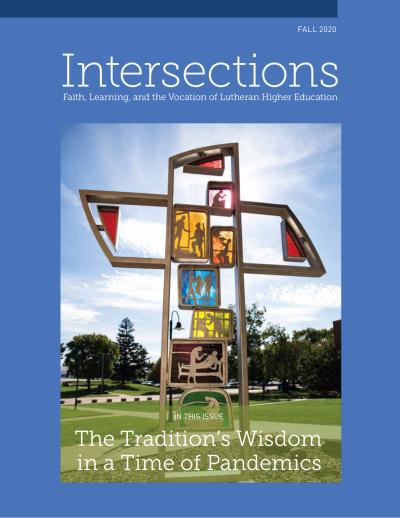
Radical Hospitality on Haunted Grounds: Anti-Racism in Lutheran Higher Education
Krista E. Hughes
No. 52 · Fall 2020
Writing from Newberry College’s campus on land once home to the Cherokee and within a day’s drive of Mother Emanuel A.M.E., Hughes argues that NECU’s call to “practice radical hospitality” demands that predominately white institutions open themselves to the hauntings of racism — pursuing belonging rather than mere welcome, and risking kenotic transformation of institutional identity itself.
-
 Editorial
From the Editor
Tom Christenson
No. 20 · Fall 2004
Christenson introduces an issue featuring “young and old, angry and encouraging, prophetic and hopeful” voices unified by the assumption that Christians engaged in thinking and educating will ask hard questions: how to raise concerns about militarism and the new American “imperialism,” what a Lutheran law school will say about training a new generation of attorneys, and what Lutheran colleges communicate to undergrads about vocation. Such faithful criticism, he argues, is part of who Lutheran institutions are.
-
 Article
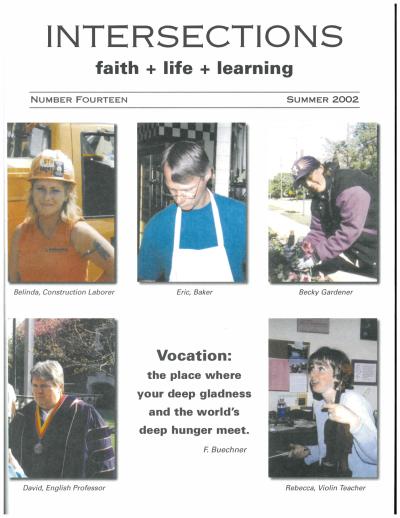
Martin Luther, Vocation, and Church Colleges: Nurturing Future Leaders for Faith and Community
Richard W. Rouse
No. 14 · Summer 2002
Rouse, citing Arne Selbyg’s statistic that thirteen of sixteen newly elected ELCA bishops graduated from a Lutheran college (and 49 of 65 in the new Conference of Bishops), argues that ELCA colleges are training grounds for future church and community leaders because of Luther’s doctrine of the priesthood of all believers and his distinction between vocation and station—the basis of PLU’s motto “educating for lives of service, inquiry, leadership, and care.” He describes “Paths Unknown: Where is God Leading Me?” a Western Mission Cluster collaboration of California Lutheran, Luther Seminary, Pacific Lutheran Theological Seminary, PLU, and Trinity Lutheran College that used a dedicated web site (godleading.com), a January-February 2001 online virtual forum reaching over 300 participants in 40 states and Canada and Mexico, and one-day interactive video workshops featuring Trump’s play “Holy Odors,” and reports LECNA’s Reclaiming Lutheran Student Project findings on teaching, community, and faith integration at Lutheran schools.
-
Article
Finding Purpose in Chaos: Reflection In and Beyond the Public Health Classroom
Lena R. Hann
No. 52 · Fall 2020
When the pandemic hit her new public health professionalism course, Hann recalibrated her teaching from the “how” of professional preparation to the “why” of vocational reflection — and recounts how Augustana public health students and alumni found purpose in the chaos through food banks, disaster response, palliative care, and research on health inequities.
-
 Book Review
Old and New Ideas of the Liberal Arts: A Review of Claiming Our Callings
David Crowe, Katie Hanson
No. 41 · Spring 2015
Crowe and Hanson review Claiming Our Callings: Toward a New Understanding of Vocation in the Liberal Arts (Oxford 2014), a collection of thirteen essays by St. Olaf faculty edited by Kaethe Schwehn and L. DeAne Lagerquist. They commend the book’s thoughtful, sincere engagement with consumerism, sustainability, Buddhist meditation, and Lutheran-Bonhoefferian theology — and recommend it for any liberal arts campus pulled between idealistic mission and career-minded pressure.
-
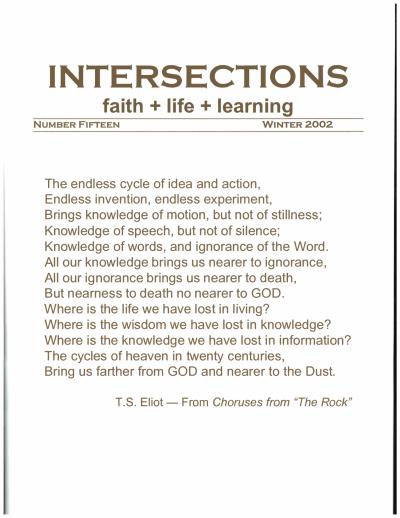 Article
Welcome Strangers
Gregg Muilenberg
No. 15 · Winter 2002
Muilenberg, a non-Lutheran philosopher at Concordia, argues that self-consciously Lutheran colleges cannot make non-Lutheran faculty feel welcome through “institutional fit” rhetoric (he cites Concordia’s own hiring boilerplate) because identity must be sustained and developed, not preserved like a pickle. Drawing on Nikos Kazantzakis’s Report to Greco and the three marks of the “profoundly religious person”—commitment to the truth, to the power of the spirit, and to metousiosis through myth—he proposes that faith and reason are best understood as an unending struggle into which strangers must be invited as valuable and active participants, safeguarded by the strongest possible affirmation of academic freedom (citing Martha Nussbaum on Notre Dame and BYU).