I bet there are a lot of things on your mind right now. We are so close to being done with this year, one more year down, one less to go. What are you thinking about? Probably exams, parties, good-byes, maybe where you are going to live. A bunch of you are probably getting ready to leave Cap and take a step into the real world, the big scary one outside of the Learning Center and Batelle Hall, where we have to put four years of theory into practice. You are thinking about jobs for the summer, or about how you can’t wait to go home or how you dread going home. Your mind is filled with absorbing your last minutes here after a year of your life that you will never do again.
I want you to know that I come before you as one of you. I come to you as a college student, as confused and excited about my future as you are. I am a junior International Studies and Spanish double major and have been here at Cap for almost three years. I went to freshman orientation, I lived in a dorm, I have been involved in homecoming, played tennis, and served in student government. I am a sister of Chi Theta Pi sorority. I have moved in and out of the dorms. I have gone home on the weekends and I have stayed on campus. I have studied hard, I have partied, I have had to fight my way into classes and I have arranged my schedule so I didn’t have to get up before noon. I am one of you. I have one more short year left, then my world will no longer be filled with classes and studies and Banana Joe’s and weekend house parties. All of a sudden my world will expand into something larger than I have ever imagined. I am scared; I can’t wait, and as I look around, I see faces that have become intricate parts of my life. I remember the nights of Euchre in the dorm … it should be illegal for time to pass by as fast as it has. I am one of you.
Yet I don’t know exactly how to fit in here at Capital anymore. Why? Because two semesters of my career at Capital have been spent outside of this cozy campus, this state, this country, this continent, and the developed world.
I was away from everything I have ever known. I dove into a new world, scary yet intoxicating; a new reality in Ecuador. I came into a world that was unlike anything I had ever known. It was a world of boiled water because the tap water was dirty; a world of poverty, because there weren’t food banks or homeless shelters. It was a world of children on the streets, shining shoes, selling ice cream or candies on buses; a world of children working all hours of the day just to feed themselves and their families.
I came into a world of incredible beauty, of dazzling mountains and a majestic ocean. Yet it was also a world of undrivable roads, because El Nino—the phenomenon that meant that we had a few extra months of sun a couple of summers ago—meant something different for Ecuador. In Ecuador El Nino meant shattered highways, dead banana crops, and houses that couldn’t stand the rain and the storms. Our extended summer meant an increase in malaria, a disease carried by mosquitoes that thrives in wet, humid environments. El Nino was devastating to Ecuador, yet analysts report that the world overall ended up making more money than it lost, due to extended growing seasons elsewhere in the world. But in Ecuador the roads still aren’t fixed. Two years later, there is still no money for repairs. In Ecuador, I encountered a whole different concept of life; different morals, different ideals, different languages, and different ways of doing things.
I don’t want you to get a bad impression of Ecuador. I love Ecuador. I crave it. I miss it when I am not there. The people of Ecuador have a love in their hearts that I haven’t found here. They are beautiful and have a beautiful country, full of nature’s richness. They own the Galapagos Islands, where Charles Darwin founded his theory of evolution. It is a GREAT tourist area. The international surfing championships are held at a breathtaking beach on the Ecuadorian coast, and traveling is inexpensive. Because of Ecuador’s small size, (it is the size of Nevada), traveling is also extremely easy. It is possible to go from the mountains to the beaches in a day. That is what the tourists who spend a couple of weeks in Ecuador see.
Maybe some of you may have had this experience on Spring Break trips to Cancun, Mexico or Jamaica. Mexico and Jamaica are two countries that embody a lot more than beaches and resorts, than tans and Corona.
Ecuador can be fun on the tourist circuit. According to the tour books, visitors should stay away from Guayaquil, the city where I lived. Why? The books say that it is too hot and too crowded. People are too poor; the roads are too bad, and there is nothing to do. There is no reason to go there. Tourist guides urge visitors to go to the beaches, go to the mountains, see the waterfalls. But trust me, there is a lot more outside of those resorts, outside of the tequila and the parties. There are people who live only minutes away who work 20 hours a day to feed their families. Yet they don’t put that part of the country in the tour books, along with the jungle trips and scuba diving. No one really wants to see that poverty.
Ecuador is a developing country. There are a lot of things that we have that Ecuador doesn’t have yet, things like Perkins Loans, clean water, safe roads, subsidized medical care, free HIV testings, homeless shelters, and food banks. That is what happens when a country just doesn’t have the money to get everything done. There are not a whole lot of frills in real life Ecuador. It is a painful but eye-opening experience that I will never forget to see a mother sending her two year old who can hardly walk out to beg for money. Even though I was surrounded by it, I never quite got used to it, and I hope that I never do. It wasn’t just one two year old or one family. It was the countless number of faces, of lives, of individuals that probably will live their whole lives just seeking their basic nutrition. I will never forget the things I saw.
Do me a favor, please. Close your eyes. Close them and try to form a picture in your mind of the words I am saying. You are walking down the street with your best friend in downtown Guayaquil, with cars and buses everywhere. It is a hot, sticky day, and you are hungry. You dodge all the people walking around. You block out the vendors trying to sell you lottery tickets or anything that will earn them a little bit of money. And as you and your friend search for a vegetarian restaurant, your friend pulls out her apple and starts to munch on it. You feel someone touch you, someone tug your shirt, and you know it is a beggar. There stands a little girl, with a dirty face and no shoes, looking at you. So you start to sift through your backpack. Looking for spare change, you stop as her eyes hungrily focus on the apple and she beckons for it. She doesn’t want your money, she wants the half eaten apple. Of course you give it to her, and you watch her devour it, seeds and all, as a smile that whispers, “Thank you” lights up her face.
Then there is one cold, frigid night in Quito. You are coming back from dinner, drinking your bottle of clean water. A little boy toddles up to you on his unsteady legs, and once again, you reach in your pockets but he grasps the half-drunken bottle of clean water you are holding. Suddenly, everything else disappears—the American’s desires for the new and the colorful and the different and the name brand. You realize that while you have been trying to pick out the perfect jeans, children and babies are begging for clean water and half eaten fruits. You always buy bread or cookies, bigger ones, because you know that you aren’t going to finish them. Someone will come asking, their eyes lock into your food, and they don’t have to say a word. Cookies are easy to give away, and besides, kids like cookies.
I grew up in a country that teaches us to buy and that more is better. It teaches us that we can never have enough. Here in the U.S. there is no such thing as too much stuff. Then if you have too much stuff, it is the wrong brand and you need stuff from the new brand. No one wears Tommy anymore, it is Abercrombie and Fitch! If you have a computer, it doesn’t copy CD’s. So you need a new one. If you have a car, you need power windows. Then how are you going to drive without your CD player? We grew up in a country that tells us that our success is measured by what we have, and someday everyone will know how good we are at our job if we can come to the job in the new BMW. We grew up in a country that instills in us an insatiable craving for more, better, bigger, newer, smaller, lighter. There are those of you who probably argue that is why we are where we are today, on the top of the world. We are a consumer society. We buy things, all the time, we spend our money, which gives people jobs. Then they can take care of their families and buy more stuff that gives people more jobs.
I come from this world, from this reality. Suddenly, I am there walking through the craziness of the middle of Guayaquil. I turn my face and see a little six year old boy, with no shoes and a torn shirt, sitting on the dirty ground. He has his treasure chest, his little box that holds his materials to shine shoes. This is not a strange sight at all. There are hundreds of little shoe shining boys. Yet this boy is sitting on the ground, his legs spread open, using both hands to shine a designer shoe. He is shining the shoes—the designer shoes—of a man sitting on a chair above him. This man is wearing a three piece suit and is talking on his cell phone. I stop, I freeze, and I watch. I really see this world, maybe for the first time. I see this world in an image of two human beings, one with and one without.
I continue to watch; this little boy’s expert hands polish the black until it shines. I wonder what the boy and his customer were thinking. I wonder if the little boy is angry that he is given this role in the world. I wondered if he resents the designer shoes that he has to polish so that he can eat. I wonder if I make him upset, the American who comes to stand on the Equator and see the beaches, to party in the clubs and work on a tan. Yet I don’t think he is mad. Maybe neither of them give it a second thought, but that moment changes me. I realize that I am the one with the cell phone and the designer shoes.
I didn’t know how to respond to all of this. Maybe one of the most frustrating experiences of my life was to see all of this and wonder how to answer. How do you answer to these needs? Sure, I shared my food and I gave change. That didn’t seem to appease me. It didn’t take away the feeling that I really should be doing something there. I couldn’t just be in Ecuador. I couldn’t simply be there and watch and feel bad and cry and then do nothing. So I worked with girls in an orphanage during my first semester there and returned to the United States around Christmas.
Before my second trip to Ecuador, I raised money for the girls. I knew that the girls weren’t going to have much of a Christmas. There would be no presents from Santa. I wanted them to each have a little gift. After all, they were children. I sat down with one of the nuns in charge of the orphanage and I asked about their needs after I returned. I told them I had brought money to help them, for Christmas. Every girl needs toys. I wanted to know what else they needed. Madre Anita told me, “Well, the girls really need some more food. We don’t have money for food. The girls aren’t eating enough or aren’t eating food that is nutritious, so they don’t sleep or study very well. They get sick a lot.”
The orphanage had been borrowing money from anyone who would loan them money to buy food to feed these girls. The orphanage brought in no money and the money from the government never came. Money was too tight in Ecuador for Ecuadorians to have money to spare and there were so many needs there. So I went home that night and cried, cried for the country, cried for the past and the future, cried for the reality of this world.
It would take me several hours to tell you about everything that I did in Ecuador. In my five months there, I had the blessing or curse—depends on how you look at it—to see a country practically fall apart. I arrived in Ecuador in September, and was trading my dollars at 10,500 sucres per dollar. In January, I was trading my dollars for as high as 29,000 sucres.
What does this mean in reality? By analogy, it means that first semester at Capital costs you $8,000, which is equivalent to 84 million sucres. Second semester runs you 232 million sucres. Where do those extra 148 million sucres come from, that extra $5,000? All of the sudden, second semester costs you three times what first semester did. There was no warning about the tuition hike. You aren’t earning any more money at your job. Your parents aren’t making any more money. There are no more loans to be taken out, and if there were, you can’t pay them back. You can’t get another job because no one is hiring. Besides, working at McDonalds pays you 8,000 sucres an hour, about 35 cents … so that is an extra 18,500 hours of work. If you work 40 hours a week, that is 462 weeks, almost 9 years. (Buy the way, that is true. McDonalds does pay 32 cents an hour to workers in Ecuador, 40 cents if you are closing. I have a friend that works there.) Those with jobs are envied, because there is no one hiring. No one has money to pay for extra help. Yet not only has the price of your education increased. Everything has, from rice to oil changes, from movies to clothes, from books to paper. Everything.
Did you have any say, any control, over this? No. Simply, you just got screwed. By whom? No one knows. It could have been investor speculation. Maybe it was a bad rumor about the central bank. But the reality is that you can no longer study. In the worst cases, your little brothers and sisters can no longer go to school. Why? They need to work; someone needs to make money to put food on the table. It has to be a family effort. It is a devastating equation—people earning less plus things costing more plus no jobs available. All of this probably has a lot to do with why I saw the military and the people overthrow the president. How can a government let such poverty attack its own people? How can a government watch while a currency is destroyed? I don’t know. Was it President Jamil Mahuad’s fault? I don’t know. Was the president in trouble to begin with? Maybe. I don’t know if anyone would have survived a presidency with the conditions he faced. He inherited a country devastated by El Nino and ready to fight a war with Peru over a fifty year old territorial dispute. He inherited a country that needed to be fixed. Oil, Ecuador’s number one export, was priced at a 20 year low. (We all remember the 95 cent/gallon gasoline a couple of years ago. It was great for us, but there is a whole other side to that). The president had a treaty signed with Peru. At least there was no longer a threat of a border war that would cost lives of brothers and fathers, and cost money that Ecuador couldn’t afford to spend.
Then 1999 came. Rough 1998 was finally over. The country still didn’t have the money to fix the damage done to the infrastructure by El Nino. Then came the bad week in March of 1999, when the sucre started to go crazy. Everyone’s money was losing value in front of their eyes, so the president announced the increase of gasoline prices, which were much lower than those on the world market. To people who study economics, this made sense. The government needed more revenue, and the state owned oil company brought in a lot of funds. Besides, gasoline prices were artificially low on the world market, even though those living in Ecuador could barely afford it. So what resulted from this solution that looked so neat on paper? Strikes. The taxi drivers and the bus drivers went on strike, and they didn’t march with signs. They took their buses and parked them across the intersections, so business was halted. Nothing moved; no exports left the country. The president backed down, but not without freezing the bank accounts of anyone who had saved more than $4000. If you had $4000 in the banks, sorry. It would be 7–10 years until you can use that money. Businesses went bankrupt. How were they going to pay their staff and buy supplies? Futures disappeared.
Then, things got worse. A volcano threatened to erupt, evacuating a town of 20,000 people. This town was also one of the biggest tourist spot in the country. What should these 20,000 people do, where should they go? Hopefully some of them had relatives elsewhere in the country. Others were left to fend for themselves. I read an article about people who were shot at by the military, trying to return to their town. Why? Banos wasn’t safe. No one knew when the volcano would erupt. The soldiers were trying to protect the citizens of Banos. “You can’t go back home,” they said, “The volcano could destroy this whole town in minutes.” But these people persisted, because they were starving, and left everything in Banos. They had to get back to their animals, back to their farms. Besides, they said, they would rather die in a volcano, at their home, than slowly starve to death.
What did I see that was new? I left Ecuador on December 17, 1998 and went back there on September 10, 1999. Eight short months, but A LOT had happened. I know that I just used a lot of technical language and a lot of big words, but what did I see? I didn’t remember SO MANY children on the streets. In 1998 there were children, but not THAT many. I didn’t see so many elderly people on the streets. I saw more faces, more futures being snuffed out by economics. I saw worried and distrustful faces, because no one knew what was going to happen. I saw a lot of people buying the dollars that I had simply brought with me from the United States. No one knew if next week it would cost 15,000 sucres to buy a dollar instead of 10,000 sucres.
So I watched Ecuador fall apart. I watched her break. I watched the news as the people climbed the walls of the presidential palace, the people who had nothing to lose because they had already lost everything. I read the newspapers the next day as the entire world condemned the rupture of democracy. They frowned on the lack of respect for the constitution. I wondered if all of the people shouting and screaming and pointing their fingers were doing so from their air-conditioned offices with leather chairs and their degrees on the walls that somehow made them experts. I wondered if they have watched their money disappear and their country fall apart. I wondered if they have had to take their children out of college or have had to send their three year old daughter to beg for food money.
Maybe, Ecuador’s critics have an education that makes them experts on world poverty. They understand concepts of world poverty learned in the Learning Center, in the classrooms with the televisions and desks. The only poor people they see and the only images of developing countries they see are in the $80 textbooks. Have they watched a child ask them for half eaten fruit, or heard a nun running an orphanage plea for money for nutritious food? I got my education on world poverty from poor people, an education that no book could ever provide.
I came back to life at Capital as a different person, and I didn’t know how to fit in here. I kept reminding myself that I am a college student. I am a sorority sister. I am almost 21. I am an athlete, and that this is where I belong—on my university’s campus. I came back here, to this place that I have spent two years of my life. I was shocked at how I felt towards everything, wondering how I ever lived here in the first place. My soul had changed. My world had changed. What I knew had changed and I could no longer see things the same way.
It is different with you. It isn’t your fault. You haven’t seen what I saw. You didn’t have children asking you for what they asked me for. You didn’t have trouble sleeping as you wondered about the future of the girls who have become like sisters to you in an orphanage with no money. I did. I will never be the same. Sometimes I wish I could be like you, that I could go to the bars again and just enjoy the craziness, without the faces of the children sleeping in the hot sticky night, on cardboard boxes.
I am not asking you all to give up what you have. I am not asking for all of us to go home and feel really guilty about who we are and what we do. The fact is that I was here too, before this all happened. Leaving Cap didn’t change anything for me. The only thing that changed was that now I knew. My leaving Cap didn’t suddenly create world poverty. Returning won’t stop it. It has been going on forever, since before I was born. It just took me a long time to figure that out.
I know that everyone in the world doesn’t have what we have here. I know that an opportunity to educate myself is a privilege, not a right. I can’t tell you how many Ecuadorians dream of studying in the States, of the opportunity to obtain a college education from this country. I know that thousands of people die every year trying to get into this country where I was born. Sometimes when I say that, it still doesn’t make sense. I still can’t grasp that fact.
People leave their homes and families and countries and cultures so they can work here to take care of their children, doing anything that will make a few dollars. They risk their lives. I did nothing at all to earn my passport. I just got my passport photo taken, sent in my $65 and it was a done deal. I did nothing at all. I just got lucky. I was born here like most of you. I didn’t do anything, didn’t win anything, I just got it. I know that maybe if I had been born in another person’s shoes, I might be devouring half eaten apples.
We are blessed by our education. What we learn here matters, and one day we are going into a very big world with some very big problems. We are tomorrow. We have to take the reigns and make things how they should be. We need doctors and nurses and accountants and teachers and lawyers and coaches and dreamers to make this world into what it should become. That is us. You and me. We have the responsibility because we can do this. We have the ability. We have the influence. We can have the voice.
“We should not let our classes get in the way of our drinking,” some people think. We didn’t come to college to drink; we came to college to learn. Does that mean I hate alcohol? No. But did I come here to study, and take this education outside of the Learning Center and Battelle? Yes. What did you come here for? Think about that, think about that hard.
We are needed, desperately needed, in this world. It is up to you to decide who you want to be in the future, where you want to pledge your allegiance. You need to decide if money is really what makes you happy, if that is really what you ache for.
What do I want from you? I want to see you fulfill your potential. I want you to know that there is a whole other world where names like Abercrombie and Fitch don’t exist. There is a world where children don’t get any education. Parents don’t get food stamps to feed their children. Children are abandoned simply because their parents don’t have the financial ability to care for them. Just remember that we are blessed, and, to quote the Bible, “To whom much is given, much is expected.”
Where do we go from here? Maybe some of you—if I did my job, all of you—are pondering in your heads, in your minds and in your hearts, what do I do now? What do I do know? You see that things change when you KNOW, that you can no longer be who you were before, that you can’t continue your life in the same way. Maybe that is a little bit extreme—maybe that is the words of a girl who lived in another country for months, who saw what she needed to see for months, and then came back to her country. She realized that she couldn’t simply have the same priorities, the same goals and dreams. She came back from seeing a poverty that she really didn’t want to know existed. That was me. But whether or not you know it, it does. It does. Now you know. Elie Weisel, a famous author and a holocaust survivor, said this, “I think the greatest source of evil and danger in this world, to the world, is indifference. I’ll always believe that the opposite of love is not hate—but indifference. Indifference is the enemy.” A man who watched thousands die at the hands of the Nazi’s declares the enemy of humankind, our biggest fault, our biggest sin—indifference. He continues on by saying, “To most people it was normal that I should be among the first to raise my voice, because when I needed people to speak for me, there were no such people. When we needed people to speak for us, there were no such people. Therefore, I feel that now we must speak for other people.”
I don’t want anyone to think that I am trying to make what the people of Ecuador struggle through every day of their lives into a Holocaust experience. We need to remember that all of the people who lived through the Holocaust taught us a crucial lesson, one that we are obliged to never forget—that we JUST CAN’T BE IGNORANT, we can’t ignore the world around us. Like the Germans living in Germany during the Holocaust, we will be judged by ourselves, our children, our God and future generations about our actions or lack thereof. The biggest question about the Holocaust was HOW on earth could something like that happen, how could so many people just watch, while millions were exterminated, a race of people was practically wiped off the earth? My question has different faces, different names and different issues, but the essence, the point, rings loud and clear, No one has come for the Communists, or the Jews or the Catholics, but are we not going to speak up because we are not poor, or are not hungry, or are not homeless, or are not cold at night? The question is, “How can we know, and just watch? How can we be indifferent?” How can I know, how can I see what I saw, and simply pack up, and return to my life here at the university? How can I come back to a world of studies and classes and parties, sit in the classroom, and return to a life where what I saw exists only in theory, on the black and white pages of my $80 textbook? I CAN’T. I can’t and I won’t forget the faces. LOOK at the faces again, pick up your sheet of paper and look into them. Look into their eyes. Their futures are unwritten. No one knows what is going to happen.
I invite you to help me. I invite you to answer to God’s call, to humanity’s call, to the call of your conscience. I have with me forms to share for those who want them, a donation form for money to be sent to these girls in Ecuador, money for food. Every single cent of every single dollar will go directly to the needs of these girls. I will not let these children be hungry. I invite you to take some of these forms and share them with those people you know, your parents, churches or groups, or even look them over yourself. Did I tell you that the orphanage only needs $6.81 to feed a child for a month?
My soul, my heart, my mind and my God call me to educate myself for them, for the shoe shining boys, for the toddlers spending their days seeking food for the girls at the orphanage. And remember this lesson from Matthew, “Jesus said, ‘I was hungry and you fed me, thirsty and you gave me a drink; I was a stranger and you clothed me, I was sick and you took care of me, in prison and you visited me.’ The righteous will then answer, ‘When Lord, when did we ever see you hungry and feed you, thirsty and give you a drink? When did we ever see you a stranger and welcome you in our homes, or naked and clothe you? When did we ever see you sick or in prison, and visit you?’ The King will then reply, ‘I tell you, whenever you did this for one of the least important of my brothers and sisters, you did it for me.’”
-
 Editorial
From the Publisher
Arne Selbyg
Selbyg reports on the “Reclaiming Lutheran Students” research by the Lutheran Education Conference of North America (partly funded by the Aid Association for Lutherans), which found that alumni of Lutheran colleges report higher satisfaction with the overall quality of their education than alumni of flagship public universities, with more than eighty percent affirming that their college helped them develop moral principles and benefit from spiritual development, while also noting that parents of Lutheran high school students remain largely unaware of both the magnitude of financial aid offered and the quality of the education provided.
-
Editorial
From the Editor
Tom Christenson
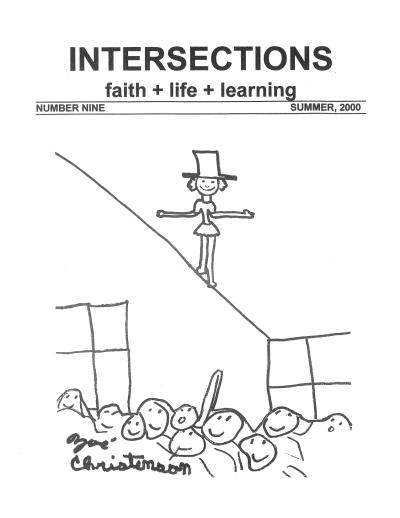
Christenson introduces a varied issue: the VonDohlen / Ratke discussion of the two kingdoms doctrine, Rachel Hammond’s “real gem” of a talk on her time in Ecuador (with an invitation to send contributions to the Home for Perpetual Hope orphanage via her home church in Oberlin, Ohio), Chuck Huff’s essay on the effect of liberal learning on the practice of psychology, and John Reumann’s reflection on a scholarly life lived between academy and church—and notes that the cover artist is his eight-year-old daughter Zoé, whose post-circus drawing of a balancing act struck him in light of Reumann’s opening line.
-
Article
A Fifth Teat on a Cow: The Irrelevance of the Lutheran Doctrine of the Two Kingdoms for Academic Life
Richard VonDohlen
VonDohlen, responding to Richard Hughes, Carol LaHurd, David Ratke, Philip Nordquist, and Robert Benne, argues that the Lutheran doctrine of the two kingdoms as commonly deployed in recent discussions of Lutheran higher education rests on a faulty sociology (taking Luther’s sixteenth-century structure for our highly differentiated society) and an epistemological monism (assuming a single neutral reason against the pluralism described by Alasdair MacIntyre and others), making it anti-intellectual, hostile to interdisciplinary dialogue and Christian social ethics, and ultimately as a defense of theology’s relevance about as useful as “a fifth teat on a cow.” Drawing on his experience on the Catawba Valley Hospice Ethics Committee, his Dutch Reformed and dispensationalist background, and the ELCA social statement “Sufficient, Sustainable Livelihood for All,” he calls for an “intellectually ecumenical” dialogue between Lutherans and non-Lutherans willing to take each other’s paradigms seriously.
-
Response
Tat for Teat: Ratke Responds
David Ratke
Ratke, agreeing with much of VonDohlen’s critique but contending that VonDohlen misreads both Luther and the two-realms doctrine, marshals Luther’s To the Christian Nobility, On the Freedom of a Christian, Temporal Authority, Whether Soldiers Too Can Be Saved, and the “Sermon on Keeping Children in School,” along with Walther von Loewenich, to argue that Luther was well aware of structurally differentiated society, made no claim to a monistic epistemology, and intended the two-realms doctrine to combat—not introduce—dualistic bifurcation between sacred and secular. Our identity is “not as either Christian or academic, but as Christian and scholar.”
-
Article
Modeling Virtue: In Which a Social Psychologist Decides He Can Do Good Without Freely Choosing It
Chuck Huff
Huff, recalling his 1975 sophomore disillusionment with a sterile introductory psychology in South Georgia (and Danny Saunders’s question from The Chosen), defends a scientific psychology as model-making rather than meaning-finding, traces the collapse of Lawrence Kohlberg’s totalizing theory of moral development into chastened mini-theories, and presents William Damon and Anne Colby’s interview study of twenty-three “moral exemplars” whose lives were marked by self-good unity, constant self-examination in community, a felt inability to have done otherwise, religious grounding, and genuine happiness. Following Aristotle on virtue as learned habit and the Christian tradition of the “slave for Christ,” he concludes that goodness flows from the choice of constraints rather than from the lone free-will hero of fairy tales, complicating C. P. Snow’s two-cultures divide. Originally the 1998 Mellby Lecture at St. Olaf.
-
Article
Serving Two Masters: Teaching and Writing Between Academy and Church
John Reumann
Reumann reflects on more than fifty years navigating between academy and church—the Society of Biblical Literature and Exegesis (whose Doktorvater Morton Enslin was unceremoniously dumped at Toronto by “young Turks” Robert Funk and others, while Harry Orlinsky saved the day at the centennial), the 1978–1987 New American Bible Revised New Testament committee with its bishops, the U.S. Lutheran–Roman Catholic dialogue volume on “Righteousness,” and the 1999 Joint Declaration on Justification—and uses his Anchor Bible and Augsburg commentaries on Philippians, Colossians, and Romans to illustrate Krister Stendahl’s judgment that one can no longer master all the literature: epistolary research, rhetorical and discourse analysis, social-world readings, feminist scholarship on Euodia and Syntyche, the koinonia and friendship debates (Sampley, Fitzgerald, Witherington), and the house-church recovery of Filson. The academy is antepenultimate, the church penultimate, God ultimate—professors as “believers, testifiers, witnesses” serving pro bono, pro ecclesia, and pro Deo.
-
 Editorial
From the Editor
Tom Christenson
No. 10 · Fall 2000
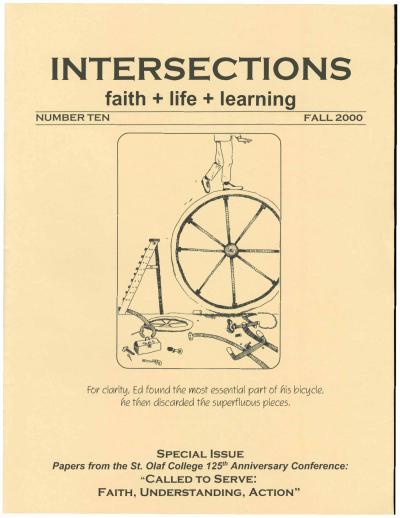
Christenson recommends the St. Olaf 125th-anniversary volume Called to Serve—edited by Pamela Schwandt with Gary de Krey and L. DeAne Lagerquist—particularly Walter Sundberg’s “What Does It Mean To be Lutheran?” and Darrell Jodock’s “The Lutheran Tradition and the Liberal Arts College.” He notes that the volume’s biographical sketches of Lars Boe, F. Melius Christiansen, Ole Rolvaag, Emil Ellingson, Agnes Larson, John Berntsen, Arne Flaten, and Howard and Edna Hong show, against an outsourcing age, that the life of an institution like St. Olaf is the committed life of the people who work there.
-
 Reflection
The Long Pilgrimage of 2020-21
Kara Baylor
No. 52 · Fall 2020
Drawing on Martha Stortz’s definition of pilgrimage as “intentional dislocation, for the sake of transformation, where the body teaches the soul,” Baylor invites students and educators worn out by the 2020-21 academic year to ask what is essential, to listen to what their bodies are telling their souls, and to be more open to the transformations the dislocation might still yield.
-
 Article
Sense of Vocation
Ruth R. Kath
No. 31 · Winter 2010
Kath describes Luther College’s Sense of Vocation program, organized into three components: General Program Initiatives (Vocation Visitors such as Parker Palmer, the Faith and Learning Workshop, self-directed reading grants, publications, and travel funds), the Church Ministry Program (Vocation Fellowships, the DIAKONOS discernment group, seminary visits, alumni discernment retreats, church leader workshops, clergy renewal, and the WIYLDE youth initiative), and the All-Student Vocation Program (Paideia I orientation, Peer Mentors, Capstone curriculum development grants, the Vocation Advising Workshop, and a Vocation Advising Handbook).
-
 Editorial
From the Publisher
Mark Wilhelm
No. 55 · Spring 2022
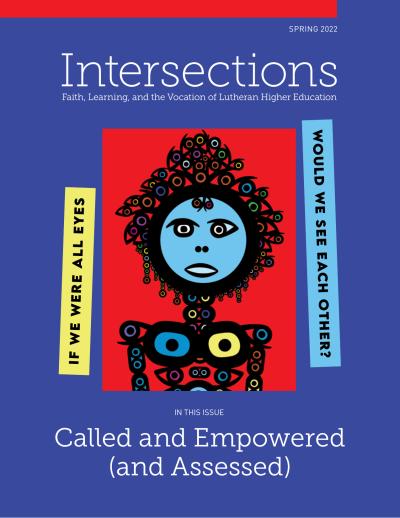
Wilhelm announces his planned retirement on January 31, 2023, after serving as the founding executive director of the Network of ELCA Colleges and Universities, and gives thanks for the privilege of helping NECU articulate a shared vision for Lutheran higher education in twenty-first-century North America.
-
 Reflection
Annie Schone
Annie Schone
No. 40 · Fall 2014
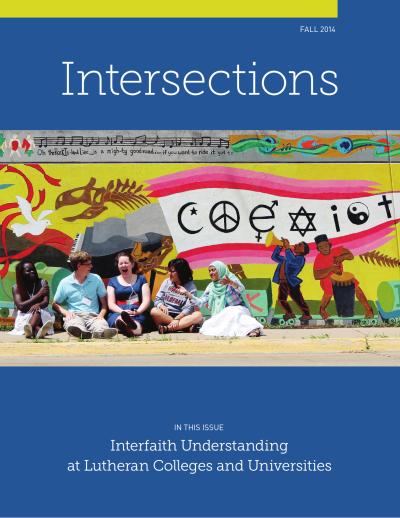
Schone, raised in a small conservative Central Illinois congregation, recounts how Augustana’s Interfaith Understanding group and Interfaith Youth Core gave her the first chance to befriend Muslim, Unitarian Universalist, and atheist peers, and how she hopes to bring the joy of those friendships back to her home church through the power of storytelling.
-
 Editorial
From the Editor
Jason A. Mahn
No. 45 · Spring 2017
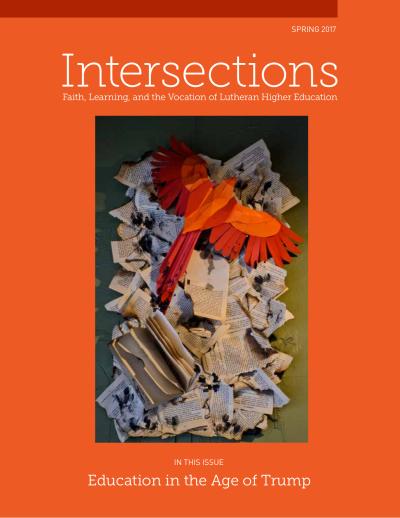
Mahn introduces “Education in the Age of Trump” by recounting a difficult academic year on his own campus — the Augustana “chalking” incident, a Latinx Unidos rally, and post-election conversations with marginalized students and quietly conservative Trump supporters alike — and frames the issue’s essays as careful (re)imaginings of the vocation of Lutheran higher education in an anxious political climate.