I am delighted to be with you at the 17th annual Vocation of a Lutheran College conference. I am passionate about the work of our Lutheran Schools, and am delighted to have attended Concordia Moorhead, served at Texas Lutheran, and will begin work at St. Olaf in two weeks. In this essay, I will make a case for why Lutheran colleges need to engage the larger civil sphere; the following essay by Kathi Tunheim will suggest practical ways that they might begin to do so. It’s a joy to be part of this conversation.
This past year as a resident scholar, I have been working on The Presidents’ Pledge Against Global Poverty, inviting university presidents to pledge 5% of their personal income to organizations of their choosing that fight extreme poverty.1 This is a moral and public commitment intended to inspire greater giving and resolve in the public square—and to model civic engagement for students, the next generation of global citizens. It is also an effort to galvanize public will around an issue that Bread for the World’s David Beckmann calls the Holocaust of our time. As I thought about my topic, I was reminded of my conversation with the president of an urban university. Very supportive of the idea, she had one serious reservation. The school she leads is really the “anchor” institution in a city facing serious economic challenges. To shine a spotlight on the president’s giving to fight poverty overseas—without also recognizing her sense of personal commitment and giving to address local poverty—misrepresents the university’s sense of calling to local community. So, we modified The Presidents’ Pledge so that, while at least half of individual contributions must focus on international projects, up to half may be allocated to causes that alleviate poverty within the United States.
What is the vocation of a Lutheran college in the larger community—or civil society as a whole? Per Anderson’s essay in this issue of Intersections makes a compelling argument about the work of colleges as incubators of communities of moral deliberation. My essay’s focus is more on an institution’s direct engagement in the surrounding community.
The focus on civic engagement seems to be everywhere—from the Association of American Colleges and Universities’ (AAC&U) “Liberal Education and America’s Promise” (LEAP) project to the work of Campus Compact, a national coalition of college presidents committed to fulfilling the civic purposes of higher education.2 In the past 20 years, almost 1200 colleges have joined Campus Compact—representing more than a quarter of all higher education institutions—and over 20 million students, representing 5.7 billion dollars annually, have contributed through volunteer service. The Campus Compact schools are committed to make educating citizens a national priority, to the development of personal and social responsibility as integral to the educational mission, and to advocating the participation of students, faculty, staff, and higher education institutions in public and community service.
Equally compelling are the 88 Programs for the Exploration of Vocation—funded by grants from the Lilly Endowment, many of which emphasize community service as a key ingredient in a student’s discernment of vocation.3 In fact, when I read about the program at Gustavus, and their list of seven experiences that are fundamental for enhancing a person’s sense of vocation, I marveled at how most of the seven could be experienced through community service. The fundamental experiences, as articulated by Darrell Jodock, are as follows:
- A sense of connectedness with others—that is, a sense of being “nested” in a larger whole
- A safe place in which to consider alternatives
- Modeling, which includes hearing other people talk seriously about responsibility and significant community matters
- Mentoring, which includes being asked the right questions by others, questions which prompt thinking about vocation
- “A constructive engagement with otherness”
- A sense of agency and influence, which includes experiences that affirm that what I do matters and makes a difference
- Religious reflection on questions of meaning and purpose in life (Jodock 7)
The list reminds me of what can happen on a spring break service trip, although each of us could capture these experiences in a host of ways. Our world’s need for this work and the wisdom these experiences provide is enormous. There’s much in Luther’s theology to commend this emphasis. Service-learning provides experience within the community of those who are serving others with mentors, models, and experiences of otherness. The community of the world that we’re called to serve provides many more as well.
This is no small issue. Recently, two authors renewed for me this passion for civic engagement and community service. First, David Brooks, in a New York Times op-ed piece, “Tree of Failure,” describes the relationship between civility and modesty—modesty about oneself, one’s limitations, one’s failures. Brooks writes:
We all get to live lives better than we deserve because our individual shortcomings are transmuted into communal improvement. We find meaning—and can only find meaning—in the role we play in that larger social enterprise….Civility is the natural state for people who know how limited their own individual powers are and know, too, that they need the conversation. They are useless without the conversation.
The problem is that over the past 40 years or so we have gone from a culture that reminds people of their own limitations to a culture that encourages people to think highly of themselves…. [O]ver the past few decades, people have lost a sense of their own sinfulness…So, of course, you get narcissists who believe they or members of their party possess direct access to the truth, people who prefer monologue to dialogue. Of course you get people who detest politics because it frustrates their ability to get 100 percent of what they want. Of course you get people who gravitate toward the like-minded and loathe their political opponents. They feel no need for balance and correction. Beneath all the other things that have contributed to polarization and the loss of civility, the most important is this: The roots of modesty have been carved away. (Brooks)
Brooks thus traces the connection between our lost sense of modesty (and even “sinfulness”) and the corrosion of a shared civic world. The second author, Harvard professor Michael Sandel, further tracks our decaying public world and diminishing sense of civic virtue. In his book, Justice: What’s the Right Thing To Do?, Sandel notes that “within the United States, the gap between rich and poor has grown in recent decades, reaching levels not seen since the 1930s” (265). Political philosophers from John Rawls to Alasdair McIntyre have long debated the appropriate of “just distribution” of income and wealth. Sandel, however, argues that the most important reason to worry about the growing inequality of American life is that
Too great a gap between rich and poor undermines the solidarity that democratic citizenship requires….As inequality deepens, rich and poor live increasingly separate lives. The affluent send their children to private schools (or to public schools in wealthy suburbs), leaving urban public schools to the children of families who have no alternative….Private health clubs replace municipal recreation centers and swimming pools. Upscale residential communities hire private security guards and rely less on public police protection. A second or third car removes the need to rely on public transportation…. The affluent secede from the public places and services, leaving them to those who can’t afford anything else.
This has two bad effects, one fiscal, the other civic. First, public services deteriorate, as those who no longer use those services become less willing to support them with their taxes. Second, public institutions such as schools, parks, playgrounds, and community centers cease to be place where citizens from different walks of life encounter one another. Institutions that once gathered people together and served as informal schools of civic virtue become few and far between. The hollowing out of the public realm makes it difficult to cultivate the solidarity and sense of community on which democratic citizenship depends. (Sandel 266-67)
So convincing are Brooks and Sandel about this erosion of the public realm, civic virtue, and a sense of citizenship that a solution seems hard to come by. Sandel, however, does not leave us without hope for civic renewal:
A politics of the common good would take as one of its primary goals the reconstruction of the infrastructure of civic life. An earlier generation made a massive investment in the federal highway program….This generation could commit itself to an equally consequential investment in an infrastructure for civic renewal: public schools…public transportation…public health clinics, playgrounds, parks, recreational centers, libraries, and museums that would, ideally at least, draw people out of their gated communities and into the common spaces of shared democratic citizenship. (267)
Is there time for service learning and civic engagement in the Lutheran college curriculum? Can we afford to do it? Can we afford not to? Does it make a difference? I will leave the practical questions to my colleagues like Kathi Tunheim—and to organizations such as Campus Compact.
“Is there time for service learning and civic engagement in the Lutheran college curriculum? Can we afford to do it? Can we afford not to?”
From my perspective, I want to make the case that this work is as important for Lutheran educators as it ever was. Luther was always pushing people into the community. “If your town needs a mayor,” he said, “become a mayor. If it needs a school, help build a school.” Perhaps, the same wisdom can be applied to the vocation of a college as an institution. What does the community need? What does the world need? How is this university in this community, this region, this world, being called to serve—to meet real needs?
If Brooks and Sandel are correct, what our world clearly needs today are opportunities for conversation, civic engagement, and service-learning. I am grateful for the work of our Lutheran colleges in providing such opportunities, grateful for this conference as a means to engage in serious conversation about such matters, and grateful to the faculty and staff of our ELCA colleges and universities who serve on the front lines in these programs, making a vital difference in our world.
Endnotes
1. See www.presidentspledge.org/about.php. Accessed 1 June 2012.
2. See www.aacu.org/leap and www.compact.org. Accessed 1 June 2012.
3. See www.ptev.org, as well as the newer “NetVUE” network to “expand and extend the conversation about vocational exploration”: http://www.cic.edu/Programs-and-Services/Progams/NetVUE/Pages/default.aspx. Accessed 1 June 2012.
Works Cited
Brooks, David. “Tree of Failure.” Editorial. New York Times 14 Jan. 2011: A27. Accessed 1 June 2012, www.nytimes.com/2011/01/14/opinion/14brooks.html
Jodock, Darrell. “Vocational Discernment—A Comprehensive College Program.” Intersections 14 (Summer 2002): 3-10. Also available at: gustavus.edu/faith/pdf/vocation.pdf
Sandel, Michael J. Justice: What’s the Right Thing To Do? New York: Farrar, Straus, and Giroux, 2009.
-
 Editorial
From the Publisher
Mark Wilhelm
Wilhelm describes the “four-legged stool” supporting ELCA higher education—the annual Vocation of a Lutheran College Conference, the Lutheran Academy of Scholars, the Thrivent Fellows program, and Intersections—and argues that the conversation about Lutheran mission and identity must now be extended beyond college and university personnel to the larger church and community before the gains of a generation are lost.
-
Editorial
From the Editor
Jason A. Mahn
Mahn introduces five essays from the 2011 Vocation of a Lutheran College Conference at Augsburg, framing how Torvend, Anderson, Svennungsen, Tunheim, and Pribbenow press Lutheran colleges to turn outward—recovering the public character of Luther’s gospel, forming students for moral deliberation, investing in the infrastructure of civic renewal, and pursuing justice and education “off the main road.”
-
Article
Critical Engagement in Public Life: Listening to Luther's Troubling Questions
Samuel Torvend
Torvend narrates the medieval “spiritual/temporal” division and the neo-platonic devaluation of the body that shaped the world into which Luther was born, then traces the disruptive questions Paul’s letters provoked in Luther: about indulgences, the two estates, vocation, and the public reach of baptism. He argues that Luther’s reform — expressed in Kirchenordnungen, social welfare reform, public schools, and writings on lobbyists, usury, and monopolies — carries a “genetic encoding” of public engagement that Lutheran colleges should reclaim against the temptations of holy apathy and Christian nationalism.
-
Article
Cultivating Transformative Responsible Dialogue: Community of Moral Deliberation and Lutheran Higher Education
Per Anderson
Anderson proposes that ELCA colleges and universities embrace a project of “transformative responsible dialogue” that advances the ELCA’s commitment to be a “community of moral deliberation” and answers the LIFT Report’s call for a culture of faithful discernment. Drawing on Michael Meyer’s “liberal civility,” Martha Nussbaum, Hans Jonas’s responsibility ethic, Patrick Keifert’s ecclesiology of strangers, and Kathryn Tanner on culture, he argues that liberal education at our schools can form students whose dialogue knits together civility, responsibility, and Christian openness to the other.
-
Article
Practical Approaches for Lutheran Colleges to Engage Civil Society
Katherine A. Tunheim
Tunheim distinguishes a college’s mission from its vocation—a calling from the community—and offers four examples of Lutheran colleges “dancing with their neighbors”: Augsburg’s engagement with the Cedar Riverside Neighborhood, her Gustavus students’ work with the St. Peter Soccer Club, St. Olaf football players in the All-Star After-School Program in Northfield, and Concordia students filling sandbags during the 2009 Red River flood. She presses Lutheran educators to ask the troubling questions that prepare students to lead with ethics rather than merely with money.
-
Article
Hospitality is Not Enough: Claims of Justice in the Work of Colleges and Universities
Paul C. Pribbenow
Pribbenow argues that Augsburg’s incarnational motto — “And the Word became flesh” — grounds a calling beyond hospitality to justice. Drawing on Stephen Carter on civility, Letty Russell on just hospitality, Henri Nouwen, Parker Palmer, Michael Sandel, Bonhoeffer, Niebuhr, and Teresa of Avila, he describes four components of Augsburg’s practice: education “off the main road,” co-created common life, abundance over entitlement, and the anchor-institution model in which colleges become economic and civic partners with their neighborhoods.
-
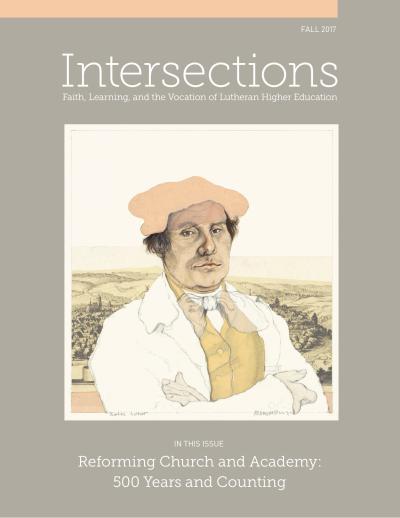 Article
Celebrating the Reformation: The Lutheran Foundation of a Called Life
Mark D. Tranvik
No. 46 · Fall 2017
Tranvik traces vocation from the monastic impulse through Luther’s rejection of the monk’s vow as the only true calling, and translates the “called life” for twenty-first-century Lutheran colleges — institutions that see students as made in the image of God, enlist the whole community in discernment, and make room for faith and its convictions.
-
 Article
Honoring the Word: Lutherans and Creative Writing
Carol Gilbertson
No. 16 · Winter 2003
Gilbertson argues that “honoring the Word” in Lutheran colleges means cherishing the sacred power of human language as God’s gift across three sites—the chapel talk, the classroom of wonder, and the poem—and illustrates her argument by reading aloud her own poems: “The Refiner’s Fire and Leaping Calves,” “Late June,” “Early June,” “Sweet July,” “Good Friday,” “Pondering These Things,” “The Limbs of Words,” and “Night Rising,” drawing on Darrell Jodock, John Updike, Martha Nussbaum, George Steiner, and T. S. Eliot’s “The Dry Salvages” to claim writing as a Christian vocation that “incarnate[s] the unseen sacred.”
-
 Reflection
VLHE—Wednesday Morning Sacred Pause
Ann Rosendale
No. 62 · Fall 2025
8 min audio
Rosendale draws on Esther 4:14 and the Lutheran practice of holding death and resurrection together — with “and” as the hardest word — to argue that the calling of Lutheran higher education for “just such a time as this” requires us to remember and name out loud that ours are places where God is at work.
-
Article
The Impropriety of Jesus' Teaching: The Woman at the Well and The Vagina Monologues
Susan M. O'Shaughnessy
No. 16 · Winter 2003
O’Shaughnessy Poppe dedicates her message to those who worked to put on Eve Ensler’s The Vagina Monologues against administrative resistance and reads the Samaritan woman at Jacob’s well alongside the testimony of a Bosnian rape survivor whose story Ensler asked to tell, arguing that the “impropriety” of Jesus—his scandalous recognition of those silenced by sexism, racism, war, custom, and the church—is the model for the mission of a college of the church to defend academic freedom and to break the chains of oppression by inflicting discomfort on the proper and pure.
-
 Article
From Alien to Citizen
Arne Selbyg
No. 29 · Spring 2009
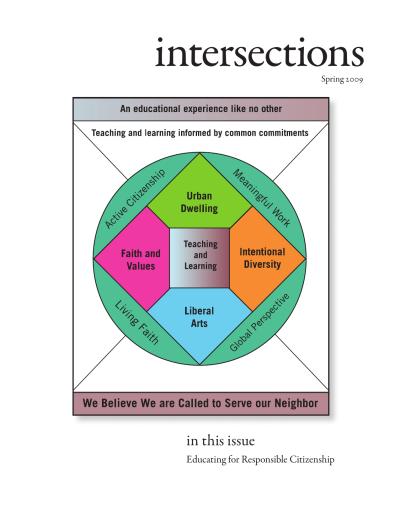
Selbyg reflects on three experiences of being educated for citizenship—growing up in Norway under the legacy of Lutheran pastors and public school teachers who resisted the Nazi occupation, arriving in America as a resident alien, and becoming a naturalized American citizen—and proposes the jazz ensemble as a better metaphor for American society than the melting pot, one in which different citizens learn skills, study other instruments, and dialog with one another in service to the common music.
-
 Article
Vocational Re-Formation for a Multi-Religious World
Elizabeth Eaton
No. 40 · Fall 2014
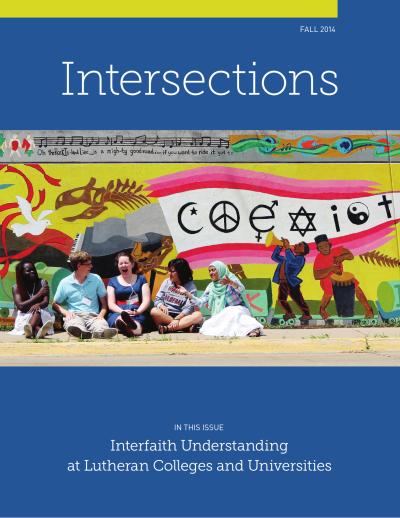
ELCA Presiding Bishop Elizabeth Eaton frames vocational formation for a multi-religious world as one of the most significant challenges facing the church and the liberal arts today, calling ELCA colleges and universities to live into Darrell Jodock’s “third path” that is both deeply rooted and dialogical.