In April 2018, following a series of hate incidents on the Luther College campus, Dr. Herbert Perkins, known as Okogyeamon, spoke at a campus forum on the subject of antiracism. Okogyeamon, the founder of Antiracism Study Dialogue Circles (ASDIC Metamorphosis), compared racism to a first language that we acquire from birth in the United States and antiracism to a “foreign language which must be learned” in order to foster a more just and inclusive society (Warehime and Meyer).
During the past year, I have been engaged in a project that frames inclusive pedagogy as a foreign language and that attempts to raise my own and my faculty colleagues’ proficiency in this language. I began with the premise that, as professional instructors, my colleagues and I already have a degree of proficiency in the language of inclusive pedagogy. Some have achieved an advanced level of proficiency through training and practice over decades, while others may know just enough words and grammar to understand a basic conversation. Regardless of our current level, my thesis is that we can grow our proficiency in the language of inclusive pedagogy by learning its vocabulary, grammar, and underlying cultural values. Likewise, our proficiency will deteriorate over time if we do not practice this language regularly and in a variety of contexts. After a year of immersing myself in readings, conversations, and workshops on inclusive pedagogy, I’d like to reflect on how my proficiency has changed.
Vocabulary Acquisition: Key Concepts of Inclusive Pedagogy
Building proficiency in a foreign language means acquiring new vocabulary, and moving from an elementary to an intermediate level requires significant vocabulary learning. The language of inclusive pedagogy (as well as related languages like critical pedagogy, social justice pedagogy, and antiracism) is replete with terms that were mostly unfamiliar to me a year ago but that I am able to use more comfortably today. More than inventory my newly acquired vocabulary, I’d like to reflect on the process of vocabulary acquisition.
I did not start with an inclusive pedagogy vocabulary list, look up the definitions of new terms, and write them in a notebook. Nor did I gradually build a vocabulary journal with new terms and definitions as I read or attended workshops. The process of acquiring the vocabulary of inclusive pedagogy has been circular and recursive. A term that I heard first in a workshop I encountered later in journal articles and conversations. Terms that I discovered initially in readings were repeated in videos and other online resources. Naturally the same term used in different contexts lends the term a range of meanings and import, so as I encountered new concepts I also began to see more clearly the contexts for their appropriate (and inappropriate) use. Repeated exposure in a variety of contexts has been, for me, the most significant means of acquiring the vocabulary of inclusive pedagogy. Increased comfort with the new language has come as a result of frequent, regular practice in a variety of circumstances.
Definitions matter, and many of the key concepts of inclusive pedagogy are broad terms that require careful definition and distinction.
Definitions matter, and many of the key concepts of inclusive pedagogy are broad terms that require careful definition and distinction. In his plenary address at the 2019 Vocation of a Lutheran College conference, Dr. Guy Nave reminded us, for example, that the words diversity, equity, and inclusion are not synonymous. Diversity refers to the presence of difference among individuals in a group, while inclusion refers to the degree of belonging and participation of individuals in the decision-making processes of the group. Thus, an organization may be diverse without being inclusive. Nave argues that equity, which is rooted in fairness and the elimination of barriers that inhibit full participation of some individuals, is a process or mind-set that works to cultivate diversity and inclusion.1 In recent years many colleges and universities have established offices of and administrative leadership positions in “diversity, equity, and inclusion.” That the three terms are often grouped together might suggest interchangeability, but, as Nave suggested, a lack of clarity in definitions will prevent us from setting clear goals for our equity initiatives and adopting specific strategies for greater inclusion.
Other high frequency vocabulary of inclusive pedagogy includes privilege, classroom climate, Universal Design for Learning, cognitive bandwidth, stereotype threat, implicit bias, self-efficacy, and asset-based approaches. One of the best resources for encountering these terms and seeing examples are the websites of teaching and learning centers at institutions like Yale University, Carnegie Mellon University, and the University of Michigan.2 Those of us building proficiency in inclusive pedagogy can acquire new vocabulary through repeated exposure in a variety of contexts.
Grammar: Rules and Structures of Inclusive Pedagogy
The grammar of inclusive pedagogy, like the grammar of any language, consists of the rules and structures that govern its practice. Grammar always evolves and responds to the ways in which language communities determine appropriate usage over time, but grammatical patterns are usually discernable as a result of consensual language practice in the community. In writing and presentations from the community of experts currently shaping our understanding of inclusive pedagogy, I discern several common rules and structures, for example, implementing Universal Design for Learning principles in classroom materials and assignments, scaffolding assessments of learning from low to high stakes, exercising equitable methods of participation, and always addressing instances of discriminatory behavior or oppression in the learning environment. Once again, context is the foremost variable, thus the ways in which instructors conform to the rules and structures of inclusive pedagogy shift according to characteristics of the discipline and learning environment. Yet the standard grammar of inclusion is apparent in the ways it is observed or ignored. Students are keenly aware of environments governed by exclusive structures, such as course syllabus language that emphasizes policies and prohibitions, especially when it is without clear connection to course goals. Implicit rules of success are operating in the background of every classroom. It is up to instructors to be aware of those rules and their effects on students. Allowing instances of discrimination or oppression to pass unacknowledged reveals an underlying lack of concern for inequities among students and minoritized groups generally. There are many ways that we may address such instances appropriately and effectively. Not addressing them is fundamentally incompatible with the grammar of inclusive teaching.
Being explicit in communication of course expectations is another ground rule of inclusive pedagogy. Recent studies point to the benefits of more detailed, explicit instruction in assignments and other course elements, particularly for first-in-family college students and students from low-income households.3 Since students from these groups often arrive at college with little social capital, underdeveloped academic support networks, and a heightened sense of impostor syndrome, they are hesitant to ask for help to understand basic terms, basic procedures, or any course expectations that appear to be implicitly understood by the majority.
Since students from these groups often arrive at college with little social capital, underdeveloped academic support networks, and a heightened sense of impostor syndrome, they are hesitant to ask for help to understand basic terms, basic procedures, or any course expectations that appear to be implicitly understood by the majority.
Explicit communication of course structures involves the course syllabus and its policies on attendance, due dates, late work, and accommodations for disabilities. On the other hand, instructors should take care not to use explicit language only to convey rules and penalties. We should also use specific language to communicate learning goals, opportunities for help, strategies for success, the importance of curiosity and reflection, and our own paths to success in the discipline. Explicit communication in all facets of the course is advantageous for the whole class, since it builds consensus about what constitutes good learning in the discipline. However, explicit language is especially important for students who enter the classroom with significant, often invisible, disadvantages. Explicit communication is, in fact, an equity process targeted to increased opportunities for every student to succeed.
Reflecting on the grammar of inclusive pedagogy during the past year has meant thinking about my own classes each time I read a new article or attend a workshop. There are ways in which my teaching was already conforming to the underlying rules of inclusive pedagogy. And yet, it has not been difficult to identify syllabus elements, assignments, or class activities that break those rules and require revision. Grammar mistakes aren’t usually bothersome in writing where they are expected (like text messages or Tweets); it is when they occur in formal or high-stakes writing that they impede reception and understanding. Cultivating inclusive environments is a high-stakes priority for our institutions. The more we cultivate our classrooms as inclusive, equity-minded learning environments, the more we will become aware of the structures that sustain inclusive pedagogy and the errors that weaken communication in this teaching language.
Cultural Values: Knowing Students Well
Learning a new language is not just a matter of vocabulary acquisition and familiarity with grammar rules. Languages facilitate communication among individuals in a community where cultural practices and products are exchanged in tandem with words and ideas. The language of a community thus reflects and reinforces the values of its people. What are the cultural values that underpin an inclusive teaching and learning environment, and how does an instructor become more attuned to these values? Exploring inclusive pedagogy in the past year, I have noticed several underlying values that shape the products and practices of inclusive learning environments and have begun to compare those values to my own.
The list of values I offer here is not exhaustive, but I would suggest they are common to inclusive classrooms: knowing students well; taking an asset-based approach to students; adopting high expectations for student performance, as well as high confidence in students’ ability to meet those expectations; and using feedback to combat stereotype threat and impostor syndrome. While all of these values underlie inclusive pedagogy, here I will focus on the cultural value of knowing students well.
The culture of inclusive pedagogy promotes knowing students well. In fact, I believe that speaking the language of inclusive pedagogy more fluently requires increasing my awareness of the forces that stimulate or inhibit my students’ success in college. I always try to get to know my students at the beginning of a new semester and build rapport with them throughout the term, but I would like to improve my understanding of the less visible concerns and oppressions that bear heavily on student thinking and choices.
In her compelling book Bandwidth Recovery: Helping Students Reclaim Cognitive Resources Lost to Poverty, Racism, and Social Marginalization, Cia Verschelden argues that these forces (poverty, food insecurity, social marginalization, racism, etc.) rob students of the cognitive resources they need to solve problems, do creative work, and succeed in college. The solution to cognitive bandwidth depletion, according to Verschelden, is not a matter of access—making available more campus resources to struggling students—but a matter of intentional strategies aimed at helping students recover cognitive resources. Such intentional strategies may include instruction and feedback to cultivate a growth mind-set; feedback to build agency and self-efficacy; the scaffolding of major assignments; and the creation of meaningful learning goals and pathways to their achievement (Verschelden 61-71).
Knowing students well, then, means knowing more than their demographic profiles and past academic performance, especially when this data fuels assumptions about ‘underprepared’ students and deficit-based approaches to their learning.
Furthermore, the implementation of such strategies must be carried out in pedagogically strategic ways based on what we know about students’ identities and socioeconomic circumstances, their beliefs about learning and academic disciplines, and their positions in our institutional structures and value systems. Knowing students well, then, means knowing more than their demographic profiles and past academic performance, especially when this data fuels assumptions about “underprepared” students and deficit-based approaches to their learning.
In order to know my students more deeply I plan to revise the questions I ask students on a first-day questionnaire to get a better sense of their strengths and the values and challenges that are foremost in their minds. I don’t intend to ask more questions, but rather substitute a few questions related to demographics and academic experience with questions such as: “What are three values that shape your thinking and choices?” and, “What are three things that you do well?” I also intend to ask them what fears they have about my course. Asking such questions does not constitute inclusive teaching by itself, but the answers may help me create a more inclusive learning experience by honing my understanding of the forces (often invisible to me) that work against student belonging and student success. What I learn about students in this process will inform my responsibility and my labor. A clear consequence of getting to know students better is an increasing responsibility to reduce or eliminate the barriers to their belonging and success.
Such work may involve extending myself beyond the classroom to help students address financial or food insecurities or belongingness uncertainty.4 Just as incidents of injustice or oppression in class discussion receive acknowledgement and response in the inclusive classroom, so too instructors in inclusive learning environments respond to the cognitive and emotional needs of students when belonging or academic success is at stake. Knowing students well and responding to their cognitive needs is a cultural value that infuses inclusive pedagogy.
Toward Proficiency: Practicing Inclusive Pedagogy
I conclude this reflection with a reference to inclusive pedagogy’s sister tongue, intercultural pedagogy, and with some implications of raising our proficiency in these languages. Inclusive pedagogy and intercultural pedagogy may in fact be dialects of the same language, since much of their vocabulary, grammar, and cultural values overlap.
Amy Lee writes that intercultural pedagogy is “the commitment (not just the desire) to make intentional, informed decisions that enable our courses to engage and support diversity and inclusion” (25). She stipulates that this mode of teaching is not about mastering a technique but “a lifelong journey that reflects a theoretical understanding that effective teaching and intercultural effectiveness (and hence intercultural pedagogy) are developmental processes” (23). In other words, both inclusive and intercultural pedagogy can be conceived of as proficiencies that grow when instructors study and practice them repeatedly in various contexts and that atrophy when we ignore them for extended periods. Every instructor has some proficiency in these languages, yet none of us attains complete mastery. None of us are born speaking the language of inclusive pedagogy, and, as Lee states of intercultural pedagogy, it “doesn’t just happen either; equity and inclusion don’t ‘naturally’ result from the presence of demographic diversity” (22). Teachers move up and down the proficiency scale of inclusive/intercultural pedagogy based on frequency of engagement and intentional practice.
Both inclusive and intercultural pedagogy can be conceived of as proficiencies that grow when instructors study and practice them repeatedly.
I believe my increased fluency in inclusive pedagogy has come as a result of encountering its vocabulary in a variety of circumstances; practicing (and breaking) its grammar rules; and noticing the cultural values that underlie an inclusive learning environment while comparing them to my own. Ultimately, I believe that growing my proficiency in inclusive pedagogy will lead to more productive interactions with more students. As Nave so convincingly stated in his plenary address, the key question regarding privilege is how we use it. We use privilege either to preserve and promote inequity or to challenge inequity by promoting diversity and inclusion. Raising my proficiency in inclusive pedagogy is a way to use my privilege to combat privilege’s effects and to pursue inclusive excellence and academic success for all students in my classes.
Endnotes
1. See Nave’s article in this issue of Intersections.
2. A concise list of these websites and other resources on inclusive pedagogy is available here: https://www.luther.edu/thomda01/inclusive-pedagogy/
3. See the articles by Eddy et. al. and Tanner.
4. Referring to the study by Walton and Cohen, Verschelden defines belongingness uncertainty as uncertainty about social connections that is rooted in social capital and that can be measured in terms of mattering and marginality. See chapter 8 of Verschelden’s Bandwidth Recovery.
Works Cited
Eddy, Sarah L., et al. “Getting Under the Hood: How and for Whom Does Increasing Course Structure Work?” CBE—Life Sciences Education, 13.3 (2014): 453-68.
Lee, Amy, et al. Teaching Interculturally: A Framework for Integrating Disciplinary Knowledge and Intercultural Development. Stylus, 2017.
Tanner, Kimberly D. “Structure Matters: Twenty-One Teaching Strategies to Promote Student Engagement and Cultivate Classroom Equity.” CBE—Life Sciences Education, 12.3 (2013): 322-31.
Verschelden, Cia. Bandwidth Recovery: Helping Students Reclaim Cognitive Resources Lost to Poverty, Racism, and Social Marginalization. Stylus, 2017.
Walton, Gregory M., and Geoffrey L. Cohen. “A Question of Belonging: Race, Social Fit, and Achievement.” Journal of Personality and Social Psychology, 92.1 (Jan. 2007): 82-96.
Warehime, Jacob and Katrina Meyer. “Luther community responds to hate.” Luther College Chips. May 3, 2018. Accessed 1 Oct. 2019, digital.luther.edu/islandora/object/LUTHERrepository%3A52143#page/1/mode/1up.
-
 Editorial
From the Publisher
Mark Wilhelm
Wilhelm frames the issue by noting that a federal court’s vindication of Harvard’s race-conscious admissions process is a win for higher education’s commitments to diversity, equity, and inclusion — and argues that for Lutheran higher education, the commitment to diversity is an old and foundational claim, rooted in Christianity’s openness to all and reflected in the four diverse gospels of the New Testament.
-
Editorial
From the Editor
Jason A. Mahn
Mahn opens with Lenny Duncan’s observation that the ELCA is 96 percent white — the whitest denomination in the U.S. — and asks how teachers and administrators at historically, predominantly, and persistently white institutions can turn from white privilege and white supremacy toward spaces where people of color thrive and white people are re-formed into antiracist allies.
-
Article
Making Diversity Matter: Inclusion is the Key
Monica Smith
Smith, Augustana’s inaugural Vice President for Diversity, Equity and Inclusion, frames the work of a Chief Diversity Officer as that of a disrupter and argues that while diversity in higher education is already happening, inclusion is a choice — one requiring a fundamental institutional transformation that diversifies faculty and staff, infuses diversity into the curriculum, invests in professional development, and draws on senior leadership to dismantle barriers.
-
Article
The Perils and Promise of Privilege
Guy Nave
Nave argues that privilege is always used in one of two ways — to preserve privilege by promoting inequity, or to challenge privilege by promoting diversity, inclusion, and equity — and uses examples from Indianapolis Catholic schools, Martin Luther, and equity-mindedness research to call Lutheran institutions to address the racist practices and policies that reproduce whiteness on their campuses.
-
Article
The Vocation of White People in a Racist Society
Caryn Riswold
Riswold proposes that whiteness is a weakness borne of apathy, atrophy, and ignorance — an atrophied muscle of race-consciousness — and offers concrete practices (reading, adjusting one’s gaze, consuming media differently, drawing on ELCA social statements like the repudiation of the Doctrine of Discovery) for exercising that muscle and naming the vocation of white people in a racist and white supremacist culture.
-
Article
The "V" Word: Different Dimensions of Vocation in a Religiously Diverse Classroom
Martha E. Stortz
Stortz responds to a sea of blank stares when she used the word “vocation” in a religiously diverse required course by offering five metaphors — place, path, relationships, lens, and story — that point to different dimensions of vocation across the world’s religions and help students articulate their callings on their own terms.
-
Book Review
The American Myth of White Supremacy: A Review of Myths America Lives By
Susan VanZanten
VanZanten reviews Richard T. Hughes’s Myths America Lives By: White Supremacy and the Stories that Give Us Meaning, which argues that the United States grounds its identity in five myths — Chosen Nation, Nature’s Nation, Christian Nation, Millennial Nation, and Innocent Nation — all informed by the primal myth of white supremacy, and considers what Lutheran theological values can offer for resisting that myth.
-
Reflection
Seeing in a New Way: A Meditation
Kara Baylor
Baylor, the only Black campus pastor in the NECU, weaves Psalm 25, the parable of the Good Samaritan as re-read through Lenny Duncan, and the “crimson thread of divine justice” from Allen Dwight Callahan into a meditation that closes with the invitation she offered at the 2019 conference — to tie a crimson thread around the wrist as a symbol of collective commitment to moving beyond privilege toward inclusion and equity.
-
Article
Conciliatory and Queer: The Radical Love of Lutheran Higher Education
Kiki Kosnick, Sharon Varallo
Kosnick and Varallo reflect in conversation on how Augustana’s Five Faith Commitments and its conciliatory ecumenical roots in the Augsburg Confession have given them — a non-binary queer first-generation faculty member and a twenty-one-year veteran — the “street cred” to act on radical love, build bridges to imprisoned and non-binary communities, and discover that Augustana is welcoming not despite the fact that it is Lutheran, but because of it.
-
 Editorial
From the Editor
Jason A. Mahn
No. 45 · Spring 2017
Mahn introduces “Education in the Age of Trump” by recounting a difficult academic year on his own campus — the Augustana “chalking” incident, a Latinx Unidos rally, and post-election conversations with marginalized students and quietly conservative Trump supporters alike — and frames the issue’s essays as careful (re)imaginings of the vocation of Lutheran higher education in an anxious political climate.
-
 Response
"Whose Future?" or "Social Justice and the Lutheran Academy?"
Marsha Heck
No. 1 · Summer 1996
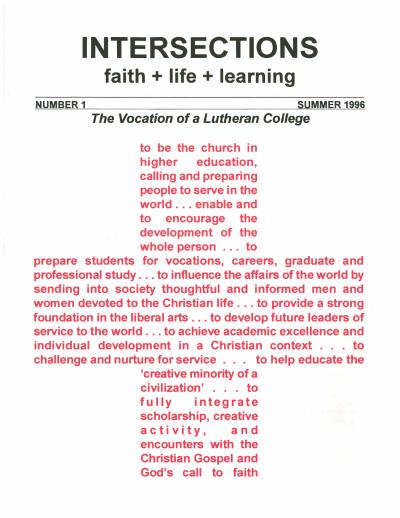
Heck argues that the future of Lutheran higher education lies less in defining Lutheran distinctiveness than in moral action grounded in face-to-face relationships with others. Drawing on David Lotz’s two-kingdoms theology of citizenship, Ernest Simmons’s relational reading of Luther, Arthur Preisinger’s indictment of the German Lutheran misreading of two kingdoms during the Third Reich, Starla Stensaas of Dana College, and Paulo Freire’s dialectic of empowerment, she calls Lutheran colleges to integrate moral reflection with moral action—to move students’ muscles against what is not true as well as to feel truths in their bones.
-
 Article
Gift and Calling: A Lutheran Perspective on Higher Education
Darrell Jodock
No. 34 · Fall 2011
Jodock argues that a Lutheran perspective on higher education rests on three underlying ideas—that we are gifted (a giftedness that calls forth wonder, awe, gratitude, a sense of humor, and vocation as response to neighbor); that the Lutheran tradition affirms a particular kind of God who is down-to-earth and at work in the world for justice and human wholeness; and that a Lutheran “third path” can be both rooted in the tradition and inclusive of others. He draws out ten implications for higher education, from wonder as the heart of religion through liberal learning oriented toward the freedom of its members.
-
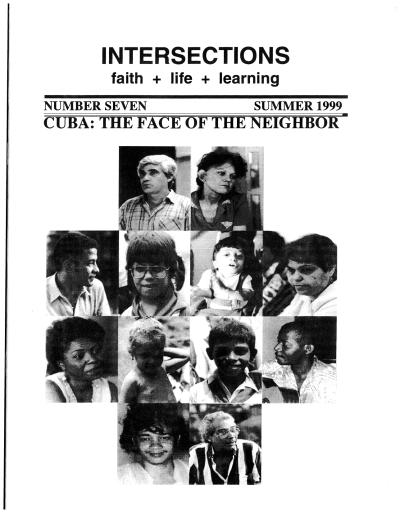 Editorial
From the Publisher
Arne Selbyg
No. 7 · Summer 1999
Selbyg celebrates the popularity of the previous issue—the first to draw on papers from the annual “Vocation of a Lutheran College” conference—and announces a new Lutheran Brotherhood Foundation grant that will fund the inaugural Lutheran Academy of Scholars in Higher Education, a two-week seminar at Harvard led by Ronald Thiemann on “Finding Our Voice: Christian Faith and Critical Vision.”
-
 Article
Lutheran Tradition: Five Continuing Themes
Walter R. Bouman
No. 2 · Winter 1997
Bouman of Trinity Lutheran Seminary identifies five themes central to the Lutheran theological tradition (understood through Alasdair MacIntyre’s account of tradition as “an historically extended, socially embodied argument”): biblical (a non-oppressive authority for the Bible rooted in the gospel rather than in scholastic inerrancy, against the backdrop of Luther’s 1517 challenge to Tetzel and the post-Enlightenment marginalization of theology); catholic (continuity with the Book of Concord and the three ancient creeds, with Luther’s “Christology from below” recovering a Jewish rather than Hellenistic understanding of God, revived by Tillich, Pannenberg, Forde, and Jenson); evangelical (justification by faith as the answer to mortality’s radical question); sacramental (Word, Eucharist, and Baptism as Christ’s presence from the future of God’s consummated Reign); and world-affirming (creation as gift, vocation as God’s work in every calling, and stewardship of the ecological crisis).
-
 Reflection
Otherwise
David Wee
No. 6 · Winter 1999
Wee’s September 3, 1997 St. Olaf Opening Convocation address takes its title from Jane Kenyon’s “Otherwise” and asks why we gather: to celebrate the gifts of life, place, companionship, and the work we love, and to become “otherwise”—wise about the others in our midst. He honors his own St. Olaf teachers (Ditmanson, Shaw, Stiehlow, Jordahl, Paulson, Meyer, Hove, Clausen, Larson, Jorstad) and the gruff Latvian stamp scholar Gus Eglas and Sherlock Holmes expert Randy Cox, draws Huck Finn’s “All right, then, I’ll go to hell” and Flannery O’Connor’s grandmother into a single argument, and closes on Tim Lull’s expectation that a Lutheran college campus should display contentment, courage, and cheerfulness as a family member faces day-six post-bone-marrow-transplant—“the first day of the rest of your life.”