Luther's Theology of Learning: Discovering the Vocation of Today's Small Lutheran Liberal Arts College
Intersections No. 20 · Fall 2004
The following is an excerpt from a senior thesis for Wake Forest University Divinity School in Winston-Salem, NC. The essay addresses Luther’s understanding of education and vocation, especially in the context of the theology of the two kingdoms. It argues the responsibility of Lutheran colleges and universities to fulfill their calls to an intentional Lutheran approach to building communities of learning. The section featured here lifts up the success stories of outstanding Lutheran students from three of the 28 ELCA colleges and universities, intending to express the full possibility and reward of Lutheran higher education.
Lutheran Educational Experiences Observed in the Stories of Students
The section that follows tells the stories of six students at three of the 28 Lutheran colleges. This narrative methodology is intended to enliven the theories, theology, history, and commentary of Luther’s theology of learning. It is intended to be a living testament to how ELCA colleges and universities are living into and fulfilling the vocation they are called to do in ministry and service. It is vital to note that students were not selected to represent a cross-section of ELCA college populations. Issues of race, gender, sexual orientation, economics, ethnicity, or even religious affiliation were not considered. Introducing such variables as these in this short study simply would not be possible, as I would not have ample space to adequately or fairly treat such charged issues. Instead, the students were chosen based on geographical distribution in the United States (by college) as well as their understanding of vocation and its relationship to faith and learning. It is essential to understand that the narrative of these six students does not represent a mere sampling of students at ELCA colleges, but rather is a celebration of achievements by students at these colleges. Handpicked by college presidents and chaplains, these students cannot—and are not intended—to represent the full spectrum of students at ELCA colleges. The students featured here have simply demonstrated a profound personal understanding of their own vocations, faith, and learning.
Geographically, I chose three Lutheran colleges situated in diverse regions of the country: Concordia College representing the Midwest, Lenoir-Rhyne College representing the South, and Muhlenberg College representing the Northeast. Moreover, the student participants were chosen directly by the college presidents and chaplains at each institution, upon my explanation of the aforementioned criteria for the study. Finally, each of the students, as well as the three presidents, completed a survey of assorted questions relating to personal background, faith, learning, and college life. While survey responses will be offered in straightforward manner for each student in the following paragraphs, analysis of the responses will be offered in the final section of this study.
Nathan Gossai and Amy Nelson were interviewed to represent Concordia College, located in Moorhead, MN. Nathan, from Plymouth, MN, named his ethnic background as half Asian and half Norwegian. He e-mailed his responses to the survey and boarded a plane for a four-month volunteer service-learning study trip to Africa. A biology and classical studies double-major, Nathan intends to study medicine after he returns from his service trip to Africa. Nathan considered Duke University and Washington University before ultimately choosing Concordia, based on “the relationship that was evident between faculty and students, as well as the proper balance of faith and academia.”
An active member of Trinity Lutheran Church, Nathan is also active on campus in choir, student government, and residence life, and in the community with church youth and a junior high mentor program. In addition to receiving financial aid, Nathan works on campus as an assistant in the lab, in the admissions office, and the student programming office. Attending a small college was “very” important to Nathan because it allowed for closer community and the opportunity to participate in diverse extra-curricular activities. However, when asked if there is a place for every kind of student at a Lutheran college, he responded, “I felt as though students either loved it or hated Concordia. I felt that certain students were perfect for the setting and certain students were fish out of water.” What characteristics must a student possess to fit in at a Lutheran college? He added, “A student with a strong background in the faith tradition who is willing to be active on campus socially and academically.”
Vocation is important to Nathan. He responded, “As a Latin student, I equate (vocation) with calling.” Furthermore, Nathan offered a profound statement regarding his understanding of the concept of calling. “Isolation and identification of the passions and possibly the occupation through which you will allow yourself to lead a meaningful and productive life.” He further explains how faith and learning work together to provide a foundation upon which academic pursuits are built. Most important, the relationship of the two initiates the tension of faith and doubt.
Nathan’s classmate, Amy Nelson, tells a similar story of her experience at a Lutheran college. A native of Bismarck, ND, Amy is double majoring in classical studies and religion, and her vocational objective is to serve as a professor of religion or medieval studies. Before choosing Concordia, Amy considered Augustana College (another ELCA institution) and the University of Minnesota. Among the reasons for choosing Concordia, she responded, “(Concordia’s) proximity to my hometown, its strong religion and classics departments, the smaller size of the college community, the excellent teaching staff, the youth ministry program, the extracurricular ministry opportunities, and a spiritual sense of calling.”
On campus, Amy coordinates Concordia Outreach Ministries, participates in the Campus Ministry Commission, and is a member of Mathetai, a religion and philosophy discussion group. Though she is a member of a Lutheran congregation in her hometown, she serves as a volunteer intern at First Presbyterian Church in Fargo where she works with junior high students. She has also been active at Bismarck Baptist Church where she was a youth intern for two summers, and at Camp of the Cross Ministries as a counselor. In light of her ecumenical activities, Amy said, “Although I am very comfortable as a Lutheran, I am somewhat of a ‘denominational mutt’ right now.” Amy receives financial aid at Concordia, and also earns money working part-time as an annual fund caller, a parking patroller, an outreach coordinator (for which she receives a stipend), and a youth intern.
The small size of a college was an important factor in Amy’s decision process. She described the advantages of small colleges to be community, academic focus, and personal mentoring relationships between students and teachers. Amy explained the importance of faith in her learning process, especially related to her religion major. She said, “One can never leave their faith at the door just as one can never leave their mind at the door. Concordia has done a very good job encouraging people to explore their personal sense of calling.” Like Nathan, Amy’s understanding of vocation is keen. Of vocation, Amy said, “Similar to a calling, vocation is a specific calling for one’s life work. God has uniquely equipped each individual with certain abilities, traits, and passions that contribute to one’s sense of vocation. One uses these gifts from God to serve others in truth and love.”
Alison Schmidt and Ryan Sigmon of Lenoir-Rhyne College in Hickory, NC, were also interviewed. Alison Schmidt of Jacksonville, FL, is majoring in family ministries with a vocational goal of serving as an ordained pastor in the ELCA. Before choosing Lenoir-Rhyne, Alison considered three other East Coast ELCA institutions—Newberry College (Newberry, SC), Roanoke College (Salem, VA), and Susquehanna University (Selinsgrove, PA)—as well as Florida State University, where she had been awarded a full tuition scholarship. She chose Lenoir-Rhyne because, “the people here are very friendly, more so than most, and because they offer the major which put me toward my goal of being a pastor.”
A member of Lenoir-Rhyne’s branch of Lutheran Student Movement, Roteract (college version of Rotary international), and Sigma Kappa Sorority, Alison also volunteers ten hours per week at a nursing home, for Maine Seacoast Mission, and for Alzheimer’s Disease research efforts. A member of Philadelphia Lutheran Church, Alison serves as an intern youth director, the Sunday school superintendent, and a member of the choir and hand bells. In addition to financial aid, Alison works part-time at a grocery store, a department store, and in the college library.
Alison described vocation, or calling, as “an understanding I get from God about what He wants me to do with my life, or a choice I feel He wants me to make.” Moreover, Lenoir-Rhyne has provided a close-knit environment for Alison to learn and grow in her faith. She commented specifically on the close attention of Lenoir-Rhyne’s faculty to students, saying, “I have been to every one of my professor’s homes at some point during my four-year stay! You actually know your professors one-on-one and can get help in various ways from writing papers to counseling.” In addition to the faculty, Alison credits the experiential learning of her internship and the college’s intentional emphasis on incorporating faith into the classroom with helping develop in her a sense of vocation and confidence in pursuing her call as an ordained minister. The small size of Lenoir-Rhyne was also a major factor in Alison’s choosing the college. “You’re more than a number here,” she responded.
However, like Nathan, Alison was quick to point out that a small Lutheran college was not the perfect fit for every student. Like Nathan, Alison suggested that the successful student at such a college should have an active faith tradition or at least be open to learning about other faith traditions and desire a fairly small college atmosphere.
Ryan Sigmon of Spartanburg, SC, had also considered Furman University, Clemson University, and Belmont University, but he finally decided on Lenoir-Rhyne College because of the friendliness of the campus, the financial aid package he received, and because his father and mother had both attended. A senior majoring in biology, Ryan’s vocational goal is to study medicine and become a physician. At Lenoir-Rhyne, Ryan serves as worship leader for the Fellowship of Christian Athletes, public address announcer for college basketball and volleyball games, lab assistant, chemistry tutor, Prologue new student orientation leader, and intramural sports participant. Ryan receives financial aid and serves as the children’s choir and youth praise team director at Bethany Lutheran Church. At his home church, St. John’s Lutheran, he was president of his youth group and intern youth leader, and while at college, he worships regularly with friends at a Methodist church.
Of all the students interviewed, Ryan’s answers were the most explicitly religious and evangelical. Regarding the issue of faith and learning, Ryan said, “I am truly able to learn only because of God’s glory in Jesus Christ. I tend to apply the biblical teaching, ‘work at it with all your heart as if working for God and not for man,’ to my studies. When I do well in school and soak up as much knowledge as possible, I bring glory to God.” He explained that God calls people to a location through situations and experiences a person encounters. His college experience instilled in him a sense of vocation, particularly through the liberal arts curriculum that has developed in him an instrument of critical thinking. According to Ryan, his college experience has revealed an ethos of Lenoir-Rhyne that is “ideal for learning and growing into adulthood.”
Julie Christianson and Jeffrey Slotterback were interviewed to represent the ethos of Muhlenberg College. Julie Christianson’s hometown is Vernon, CT, and she examined other Northeastern colleges and universities—Bucknell, Colby, Bates, and ELCA colleges Gettysburg and Susquehanna—before choosing Muhlenberg. Julie is a biology and secondary education double major, and she intends to teach in an urban setting, eventually earning a doctoral degree in education. She ultimately chose Muhlenberg because “the community was amazing, and honestly, I fit in as necessary. The coach pushed me over the edge.” A recipient of financial aid in the form of scholarships, Julie also works part-time for the Muhlenberg Annual Fund and for her college’s admissions office.
An avid athlete and sports fan, Julie is a varsity athlete and participates in intramural sports. Also committed to community service through after-school inner-city work with children, she is a member of chapel fellowship. Alpha Phi Omega, the education society, and the biology club. Apart from engagement at her home Lutheran church in Connecticut, Julie participates in ministry and worship activities at four area Lutheran churches in Muhlenberg. At these churches, she helps to coordinate worship and fellowship activities, intramural teams, and Sunday school programs; at Zion Lutheran, she serves as a youth group director.
When asked to describe her understanding of calling, Julie answered, “It means that you are called to go on and do because it was ‘meant to be’ according to God. Usually it means to go on and be a pastor, but I firmly believe that I am called to teach in urban public schools. And I think that it is a call from God.” She explained that her Muhlenberg College experience has helped her to think about what she knows and, more often, what she doesn’t know in her major, as well as all of her academic studies. A sense of challenge in her environment has also been helpful in testing her own limits and abilities, especially with regard to her call to the vocation of teaching. She added, “My faith is greatly affected by what I learn. And as I am challenged, my faith is challenged. I was challenged academically and intellectually, emotionally and spiritually, and I loved it. When it got the toughest, it was the best.”
Finally, Jeffrey Slotterback of Haddon Heights, NJ, investigated Haverford College and Swarthmore College before choosing Muhlenberg, “because it was a small liberal arts school with close faculty/student relationships.” At Muhlenberg, Jeffrey serves on the Judicial Panel, in the Alphi Phi Omega service organization, on the Presidential Task Force for the Prevention of Sexual Crimes, on the Community Building Committee, and in Lutheran Student Movement. Jeffrey’s extensive community service is impressive: cultural programs for community children, food programs for the homeless, and international relief efforts for impoverished children.
Like all the other students in the survey, Jeffrey receives financial aid and also works part-time with the Office of Community Service and Outreach. While he has already been offered a position as an accountant with Deloitte and Touche in Philadelphia, Jeffrey said, “I am beginning my career in public accounting, but I have no doubt that I will end up in non-profit work before I retire.” He explains vocation to be the necessary purpose that all humans discover in different ways. Muhlenberg College has helped him to understand his own calling and direction his life has taken.
How do the students’ responses to the survey illumine the vocation of today’s small Lutheran liberal arts college? I argue that the stories of these six students demonstrate the Fullness of what the vocation of Lutheran education can become. Obviously, not every student at every ELCA college and university shines as brightly as the ones showcased here. However, the service and achievements of Nathan and Amy, Alison and Ryan, and Julie and Jeffrey can be lifted as hallmarks, and more important, benchmarks for excellence in educating the whole student emotionally, spiritually, and academically.
Taking careful notice of the other institutions the six students considered before choosing their colleges is helpful in establishing the academic reputations of the ELCA colleges. Duke, Swarthmore, Furman, Bucknell, and Bates are all excellent and prestigious company with which to be compared. Though the question of their academic record was not explicitly posed, their achievements and goals with regard to scholastics, earned scholarship aid, and extracurricular service all point to exceptionally successful students. Incidentally, five of the six students rated the academic rigor of their college a seven on a scale of ten.1
Each student demonstrated an incredibly sharp comprehension of vocation in general, and of his and her own sense of vocation specifically. The vocational aspirations were diverse: two physicians, one pastor, one public school teacher, one college professor, and an accountant. Moreover, the students expressed the role each of their college experiences played in helping them to discover, name, and develop these vocational and servant identities.
Given the busy schedules and ambitious goals of the cohort, I was amazed that all of them additionally worked one, two, or even three part-time jobs. Nearly all of the part-time jobs were integral to their campus or church communities, ranging from admissions office assistants to development office telephone phone callers to youth ministry interns. Perhaps not surprising, every one of the students responded that the small size of a school was “very” important—and in some instances most important—in their college selection processes.
Finally, the students expressed a passionate commitment to faith, learning, and those endeavors of service that lie in that intersection. Given their commitment to service, their diverse extracurricular activities, their awareness of ecumenism, their part-time work, their sense of vocation, and their deep commitment to their faith, the overall profiles of the six Lutheran college students are strikingly similar.
Conclusions, Reflections, and Outlooks
My own story as a former student of an ELCA college shares many commonalities with the six students surveyed. I count my days at my college as some of the most formative influential, and sacred I have known. Indeed, my college experience, perhaps more than any other experience, helped to shape me into the person I am today. Like the student cohort, I also received financial aid, worked three part-time jobs, held leadership positions among my campus community, participated in community service, and was active in my own Lutheran congregation. A Morehead Scholarship nominee, it seemed that I was bound for the University of North Carolina at Chapel Hill, arguably the paramount public institution of higher learning for all North Carolinians. However, I gave the advantages of a small campus community a second look. In the end, a small, close-knit community where faith and learning are in tandem and faculty mentoring is a non-negotiable tenet were the decisive factors in my college selection process. Incidentally, had I chosen to attend the University of North Carolina, my experience would have most likely been a positive one, but I contend that choosing to attend Lenoir-Rhyne College was vitally important to shaping my own sense of vocation and revealing my own call to ministry.
I recall my position as an admissions office work-study assistant at Lenoir-Rhyne my undergraduate college, where I gave tours to prospective students. Strangely, this experience helped me to understand Lutheran colleges. I remember saying to the families over and over, “We are a Lutheran college, but it’s not what you think.” By that, I really meant to say, “We’re not like those other schools. We’re not like those religious colleges where students are not allowed to disagree with what they read in books. At this school, you must ask questions.” At Lutheran colleges, like in Lutheran middle school catechetical instruction, students are taught to ask again and again and again, “What does this mean? What does this mean? What does this mean?” Lutheran colleges expect students to ask questions, to challenge, to wonder.
The questions I would hear during those tours were often similar: “Is the environment authoritarian? Are you required to take religion classes? Really, what are the liberal arts? Can you drink beer on Lutheran campuses? What is service learning, anyway?” I found myself apologizing for Lenoir-Rhyne being a Lutheran college to those who did not even understand what it meant to be a religiously affiliated college. I was apologizing, and I didn’t exactly know why. What I eventually realized is that I did not understand what it meant to attend a Lutheran college. Much later, during professional work at a Lutheran college and during study at an ecumenical divinity school, I realized that many Lutherans did not understand the purpose—and value—of Lutheran colleges. Luther’s Freedom of a Christian helps to dispel the notion of the American Christian college as restrictive in conduct and study. This treatise, as previously described, declares the freedom of the Christian to learn and serve.
Today, are Lutheran colleges fulfilling the missions to which they are called? How effective are they? Are Lutheran colleges taking the risks to fulfill the foundational theology of its doctrines? The answer is yes and no. Lutheran educational leaders have acquiesced to American educational trends and economic pressures for maintaining their colleges and universities. While the Lutheran Church has not compromised its doctrine and Luther’s theology of education, it has not maximized Luther’s grand vision for education either. Risk must be taken in order to do this. Solberg suggests three ways Lutheran higher education has not fulfilled its calling: (1) denying the existence of the 2 kingdoms and Christians’ active participation in both realms, which has led to “quietism to social action,” as well as closing of certain scientific research in fear that it will damage faith; (2) some Lutherans have diminished its rich doctrines into absolute formulas, which has limited inquiry and critical judgment; (3) the inherent paradox of Lutheranism is baffling to some scholars because it is perceived to defy logic and conclusion, thus failing to fulfill its calling.2
Like Solberg and other scholars, Mark Schwehn has contended that the enterprise of Lutheran higher education in America has failed to grow into its fullest potential. Citing James Burtchaell’s argument, Schwehn agrees that Lutheran education has failed to critically engage theological and scriptural questions, especially given the tradition’s inherent charge to do so. Lutherans have failed to articulate their own theology of education. However, Schwehn suggests that the work of Lutheran scholars such as Robert Benne and Ernest Simmons to systematize a Lutheran educational theology will help to more effectively articulate this theology. Schwehn adds, “Evangelicals like Mark Noll and leading experts in the field of Christian higher education like Richard Hughes have recently observed that Lutherans have implicitly and potentially the best theology of higher education in our time, though neither one of these scholars believes that it has yet been articulated with the force and vigor that it needs.”3
During the 20th century, however, Lutheran colleges and universities did not disaffiliate with the church, as some other denominations did. Because of its commitment to education, its concern for developing leaders for service in the church and world, defense of the liberal arts as a preparation for service, and its doctrinal foundations—especially the freedom of Christians as unshackled from sin and bound as servants to God and neighbor, as well as the paradox of accepting and questioning—the Lutheran Church has maintained a strong, dynamic marriage between its congregations and schools.
Solberg suggests that Lutheran colleges should: (1) affirm their identity; (2) strive for academic excellence by students and teachers; (3) seek to enroll Lutheran students, while remaining open to all qualified people; (4) not define their success by the number of Lutheran students enrolled but rather by embracing Luther’s emphasis on Christian service in the world, by maintaining faculties of excellence, by affirming the connection of faith and learning, by lifting up its Lutheran tradition, and by demanding steadfast leadership that imagines clear policy informed by Lutheran principles. Likewise, the church holds a responsibility: to expect excellence at its schools, to demand them to nurture worshipping communities, and to maintain a close adherence to the Lutheran principles of education proclaimed by Martin Luther.4
Does Luther’s theology of learning still matter? Nearly 500 years after Martin Luther, in the twenty-first century, is Luther’s theology of learning relevant today? I argue passionately that Luther’s zeal for education is more important today than ever before! In fact, I am called to fulfill my own vocation in the light of Luther’s theology of learning. Because of my continued study of Luther’s work and particularly as a result of my internship experience at Mt. Olive Lutheran Church, I understand a clearer pattern to my discernment call. Dr. Luther’s words regarding education in 1530 resonate with me: “If I could leave the office of preacher and my other duties, or were forced to do so, there is no other office I would rather have than that or schoolmaster or teacher of boys. For I know that next to the office of preaching, this is the best, the greatest, and the most useful there is.”5
Luther does matter. Today, the value of education is often challenged and questioned, pushed aside in favor of work for material gain. Luther matters to Christian education, but his philosophy of learning and its power also means a great deal to education in general. I am most encouraged by Luther’s defense of the liberal arts and the power of this classical curriculum to prepare people for versatile, meaningful, and rewarding vocation of service. So what is the vocation of today’s small Lutheran liberal arts college? What are these places of learning called to do? The challenge for colleges and universities of the Evangelical Lutheran Church in America has been and continues to be to embrace, engage, and galvanize its Lutheran tradition of learning, embedded firmly in the liberal arts and marked by a steadfast affirmation of Scripture and the Lutheran confessions, in an environment of open and confident ecumenism.
Such a task, such a calling, involves intrinsic paradox in Lutheran higher education: a tension of old and new pedagogy, of the sacred and the secular, of the orthodox and the newly imagined, of institutions that merely instruct and those that insist on the development of the whole person. For Lutheran colleges to ignore this paradox would be for them to choose the cloister over the world, a choice that Luther argued was a rejection of one’s calling to serve neighbor and to serve God. Ultimately, for one to be equipped to effectively answer one’s call for service to one’s neighbor, community, and world in God’s kingdom is the ambitious goal of Lutheran education.
Endnote
- In the survey, the scale was 1 to 10, with 10 representing extreme difficulty.
- Solberg, 79-80.
- Mark R. Schwehn, “Lutheran Higher Education in the Twenty-first Century,” in The Future of Religious Colleges, ed. Paul J. Dovre (Grand Rapids: Eerdmans Publishing Company, 2002), 214.
- Ibid., 81.
- James M. Kittelson, Luther the Reformer: The Story of the Man and His Career, (Minneapolis: Augsburg Publishing House, 1986), 248.
-
 Editorial
From the Publisher
Arne Selbyg
Selbyg reports that during 2004 a task force appointed by the ELCA Division for Church in Society has been laying the groundwork for a Social Statement on Education, with a draft to be debated in congregations and educational forums in 2006 and considered for adoption at the 2007 Churchwide Assembly. He urges Lutheran educators to obtain and study the new Task Force study document from the Division for Church in Society and submit their reactions so that the drafters know what those with ties to Lutheran educational institutions think is important.
-
Editorial
From the Editor
Tom Christenson
Christenson introduces an issue featuring “young and old, angry and encouraging, prophetic and hopeful” voices unified by the assumption that Christians engaged in thinking and educating will ask hard questions: how to raise concerns about militarism and the new American “imperialism,” what a Lutheran law school will say about training a new generation of attorneys, and what Lutheran colleges communicate to undergrads about vocation. Such faithful criticism, he argues, is part of who Lutheran institutions are.
-
Article
Mars, Mammon—and Other Options
Carl Skrade
In a wide-ranging public lecture from a Capital University Philosophy and Religion department series on “The Empire, Its Religions, and Some Alternatives,” Skrade distinguishes the military from militarism (using Oxford and Chalmers Johnson definitions), catalogs evidence of contemporary U.S. militarism—budget allocations, arms sales, the military-academic complex, post-1945 interventions, overseas bases, and Bush-era profiteering through Bechtel and Halliburton—and traces its roots in resource greed, racism, right-wing religiosity, and Augustinian incurvatus in se ipsum. After surveying the financial and human costs through testimony from Jonathan Shay’s Achilles in Vietnam, Samuel Hynes’s The Soldier’s Tale, Dalton Trumbo’s Johnny Got His Gun, and Staff Sergeant Jimmy Massey, he applies Vincent Ferraro’s seven principles of just war to Gulf II, reads Matthew 5:43-48 as a call to indiscriminate care, and proposes a www.religiousleft.org website to host a Christian alternative to Mars and Mammon.
-
Article
Leading Students to Distinguish Between Career and Vocation: Reflections from a Lutheran Law School
Steven C. Bahls
Bahls, writing as former dean of the Capital University Law School, argues that most law students and many legal educators confuse vocation with career—asking “what kind of lawyer do you want to be?” rather than “who do I want to be?” Drawing on John O. Mudd’s five attributes of a well-prepared lawyer and Susan Daicoff’s empirical research on lawyer dissatisfaction and the “amoral professional role,” he turns to Ernest L. Simmons’s and Darrel Jodock’s articulations of Luther’s understanding of vocation and proposes five steps—reflection, assessment, vision, integrative thinking, and reassessment—along with explicit leadership from law school deans, engagement of career services offices, and leadership within the profession (illustrated by Capital’s joint venture with the Columbus Bar Association).
-
Book Review
Review of Educating for Shalom: Essays on Christian Higher Education
Tom Christenson
Christenson reviews Nicholas Wolterstorff’s Educating for Shalom: Essays on Christian Higher Education (Eerdmans, 2004), edited by C.W. Joldersma and G.G. Stronks. After recounting his own early prejudice against Wolterstorff’s Reason Within the Bounds of Religion and his subsequent conversion through Art in Action, he focuses on two threads: Wolterstorff’s expansive reading of shalom—not merely peace but justice, community, communal responsibility, and delight—as the overall goal of Christian collegiate education, and the influence of Abraham Kuyper’s claim of “privileged cognitive access” for Christian inquirers, which Wolterstorff demonstrates rather than declares.
-
 Editorial
From the Editor: So That We, Too, May Flourish
Colleen Windham-Hughes
No. 58 · Fall 2023
Windham-Hughes introduces the 2023 VLHE conference theme of educator flourishing, drawing on Dr. Monica Smith’s plenary challenge — “How can we flourish if only some are centered and others are at the margins?” — and invites readers to ground themselves in Us/We, the cover art by Augustana graduate William Hatchet, and join the conversation.
-
 Editorial
From the Editor
Tom Christenson
No. 15 · Winter 2002
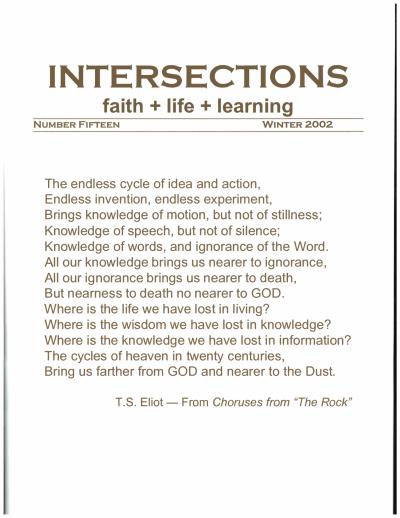
Christenson introduces an issue of varied voices—bishops and university presidents, philosophers and poets, students and their teachers—and defends the T. S. Eliot cover selection (“Where is the wisdom we have lost in knowledge?”) against the charge of being too depressing, arguing with cover artist Ida that Lutherans are realists about human accomplishments and that there is a huge difference between optimism and hope.
-
 Article
Journey Toward Pluralism: Reimagining Lutheran Identity in a Changing World
Jacqueline Bussie
No. 40 · Fall 2014
Bussie chronicles Concordia College’s Forum on Faith and Life initiative — assessing campus climate, building a President’s Interfaith Advisory Council, and drafting a one-sentence statement that Concordia practices interfaith cooperation “because of” (not “guided by”) its Lutheran identity — to argue that simul justus et peccator thinking equips Lutheran institutions to hold loyalty to tradition and reverence for others together as one piece.
-
 Book Review
Learning Across Campus: Hearing Bok's Call to Conversation
David Ratke
No. 39 · Spring 2014
Ratke reads Derek Bok’s Our Underachieving Colleges from Lenoir-Rhyne and argues that Bok’s call to think holistically about undergraduate education and to dialogue across disciplinary boundaries names the work already underway at ELCA colleges. He weighs faculty attitudes, the role of skills in the core curriculum and the major, and the importance of the extracurriculum for student formation.
-
 Article
Practicing Hope: The Charisms of Lutheran Higher Education
Martha E. Stortz
No. 32 · Spring 2010
Stortz names four charisms—theological gifts of identity rather than commodities—that Lutheran higher education brings to a culture of fear: semper reformanda as flexible, responsive institutions; the freedom of a Christian as simul justus et peccator critical inquiry that holds opposites in creative tension; regard for the other as “neighbor” rather than friend or alien; and the priesthood of all believers as a public, civic calling to know the poor. Drawing on Augustine, George Lindbeck, Patricia Killen, James Clifford, Earl Shorris, Carter Lindberg, and Augsburg’s Center for Global Education, she argues that immersion trips, neighbor-regard, and welfare reform witness that the gift Lutherans bring is hope grounded in Christ in you, the hope of glory.
-
 Editorial
From the Publisher
Mark Wilhelm
No. 43 · Spring 2016
Wilhelm announces the new Network of ELCA Colleges and Universities — established in 2015 and convened for its first Board of Directors meeting in February 2016 — as a missional collaboration between the churchwide organization and the twenty-six ELCA colleges and universities, replacing former churchwide units lost to budget reductions and offering a stronger, more viable vision of Lutheran higher education.