Faculty, staff, and students at member institutions of the Network of ELCA Colleges and Universities (NECU) have long called for and practiced civic engagement — defined here as knowledge of social and political institutions and processes, skills to participate in civic life, and an interest in acting to better one’s community (Adler and Goggin 2005). As of August 1, 2025 with the adoption of the ELCA social statement Faith and Civic Life: Seeking the Well-Being of All, we are formally called to live out a mission that includes civic engagement as a cornerstone of our educational efforts.
The social statement makes this call in two parts. First, “To have a strong democracy, members of the public must know how civic institutions are supposed to function and how they are called to participate” (ELCA 2025, article 47). In other words, civic engagement is critically important. Second, the singular mention of higher education in a statement that runs more than fifty pages is “To urge faculty, staff, and administrators of ELCA-related colleges, universities, and seminaries to renew and emphasize education toward callings in public service, and to model and encourage dynamic civic participation among their students” (ELCA 2025, resolution 15).
To address such a substantial and meaningful call, we seven political scientists (and students) gathered for a conference. The social statement and the specific charge of NECU institutions is much more than can be achieved through a conference, but a conference is something concrete and, importantly, it does represent a meaningful step forward in several ways. First, to our knowledge, the conference was the first intentionally constructed gathering of political scientists from NECU member institutions in recent memory. Second, the conference brought together scholars working on both civic engagement pedagogy and scholarship across institutions from different faith traditions. As a central theme, participants were asked to reflect on “How is your civic engagement work linked to your institution’s faith-affiliation?”
This essay will discuss the conference from several perspectives. First, it will briefly overview some of the ways that civic engagement is part of the call of NECU institutions. It will then recap some of the main themes and calls to action from the conference. Finally, it will introduce the short essays that follow from the other political scientists who participated along with the perspectives of two student participants.
The Importance of Civic Engagement at Lutheran Institutions
As Kleinhans (2018, 120) argues, “Martin Luther considered governmental authority to be one of the structures through which God exercises providential care of the created world.” This is because “individuals flourish only as they are embedded in larger communities” (NECU 2018, 7). Those communities include people, all of whom are our neighbors, and Luther demonstrates that radical hospitality and neighbor justice mean engaging with and caring for everyone (Peñaranda 2023). Since neighbors are necessarily both members and non-members of the church, Lutherans are called to be faith-based and interfaith-dependent and to engage in their communities including government, non-profit, and community groups (Stortz 2016). How do Lutheran higher education institutions heed this call? A variety of authors in Intersections have provided their own reflections and experiences from their institutional perspectives (e.g., Carlsen 2008; Hughes 2021; Marichal 2007; McDonald 2011; Tunheim 2012).
We seek to extend and to expand the existing conversation beyond these excellent examples, and this conference represents one step in that direction. While Luther calls us to consider civic engagement as part of our vocation, other religious leaders similarly call their adherents and affiliated institutions to perform civically engaged work. At the same time, public higher education institutions have a natural and often statutorily mandated responsibility to serve their community. Instead of arguing that Lutheran institutions exclusively operate in this space, we find it instructive to be guided by these perspectives and to adapt them in ways that fit our own institutional characteristics. Civic engagement can be done differently at Lutheran institutions, but our approach is best guided by our own Lutheran values, the experiences of those at other Lutheran institutions, and the knowledge and understanding of those from different faith perspectives also called to value civic engagement.
Conference Overview
The conference took place at the Chapel of the Abiding Presence on the campus of Texas Lutheran University (TLU). Faculty were political science professors selected based on their own expertise in civic engagement scholarship and practice as well as to represent a variety of institutions that share geographic location, institutional size, and/or faith-affiliation to TLU. Faculty came from California Lutheran University, Valparaiso University, Muhlenberg College, Saint Leo University, St. Edward’s University, and Baylor University. Through this diversity, the conference aimed to demonstrate how institutions and faculty have approached and successfully navigated a wide-range of opportunities and challenges related to civic engagement work. More than a dozen TLU students presented as part of the conference in a variety of sessions designed to engage participants in meaningful conversations on different aspects of the conference theme.
The conference format focused heavily on discussion — with each other, with students, and with the audience — and, therefore, included no traditional lectures or presentations. The first day started with introductions, goal setting, and a session exploring how civic engagement has been included in a variety of religious texts. That session, led by TLU theology and philosophy professor H. David Baer, presented textual snippets on politics from authors with various faith perspectives. Discussion centered around whether and how faith is integrated into or separate from politics and civic life. A key question was whether these thinkers considered politics as encompassing civic engagement.
Following this grounding work and a conference-themed chapel break, attendees were treated to two student-led panels approaching civic engagement at faith-affiliated institutions from two perspectives. First, students Ainsley Lake, Monica Sitachitta, and Emerald St Laurent focused on what faith-affiliation means for the student experience and the opportunity to perform civic engagement work. These students were some of those who traveled with TLU faculty Kathleen Seal, Tiffiny Sia, campus pastor Rev. Wes Cain, and me to Holden Village in May 2025. Their discussion focused on the extent to which students understand and subscribe to the values that undergird a faith-affiliated education, as these values are inclusive of a range of religious perspectives. The students also emphasized that, while religious activities on campus can help promote student belonging and engagement that then further civic life, lack of engagement in religious life is a symptom of larger challenges with student belonging, sense of purpose, and vocational discernment.
Students Andie Lozano-Lomeli, Allegra Negrete, Izzie Stephens, and Ruby Wilsford then considered challenges and opportunities of doing civic engagement at a faith-affiliated institution. Each of these students have led civic engagement initiatives at TLU. Their discussion focused on how civic engagement work is only possible through comprehensive planning and alignment across all elements of student life. Students must be recruited with a clear sense of and subscription to the institution’s mission. Curricular and co-curricular offerings and experiences must deliver on these mission-based principles. Faith-affiliated institutions — and especially Lutheran institutions — have long stated the importance of mission, but it requires a comprehensive, institution-wide effort for students to be able to clearly articulate why the education that they are receiving at a faith-affiliated institution is distinctive, how that education helps them to live out their vocation, and the extent to which civic engagement is a mission-aligned point of distinction.
Our faith-informed missions can be used to provide strong guidance for civically engaged action if our institutions clearly articulate these principles.
The afternoon featured students leading discussions on essays prepared by the faculty attendees, the finalized versions of which follow this essay. Mase Aleman, Gigi Baeza-Smith, Ainsley Davis, Matthew DeLeon, Jenna Newman, and Eleanor Puchot served as discussants. From these conversations, participants noted the commonalities between many of the strategies and challenges of doing civic engagement work across faith-affiliated institutions. Despite the participants coming from different locations, institutional sizes, and faith affiliations, participants recognized that there can be a stronger connection between our faith affiliations and civic engagement. Our faith-informed missions can be used to provide strong guidance for civically engaged action if our institutions clearly articulate these principles.
Call to Action
With a clear framework established regarding the student and faculty experience of doing civic engagement work at faith-affiliated institutions, the remainder of the conference was dedicated to reflections, next steps, and idea generation. Through our discussion, participants developed a series of calls to action for students, faculty, staff, and institutions to further the connection between our faith-affiliations and civic engagement.
Our call to students is to seek out opportunities to participate in the mission of their institution, to discern their vocation, and to increase their civic engagement. Faith-affiliated institutions add value when students see their time at these institutions holistically but also understand how faith-affiliated values are truly important for a fruitful and productive life.
Our call to faculty is to invest in civic engagement work as part of the core of their disciplines, alongside other components of their institution’s mission. Civic engagement must be embedded as an institutional mission in all the work in which we engage. Doing so allows students to see how civic engagement fits into their vocation and to do so in a variety of contexts.
Our call to institutions is to actively use faith-affiliated language to live into and to promote our own mission. Institutions that aim to be everything to everyone or that follow short-term opportunities and trends lack a clear identity. Civic engagement is a traditional strength of faith-affiliated — and particularly Lutheran — institutions. Institutions may be hesitant to clearly define how their faith-affiliation shapes all components of campus life. As many institutions aim to bolster enrollment, they must move boldly forward, advertising and acting to define the type of students and the type of engagement that they wish to foster. Part of such a movement toward our mission and so that all may flourish is focusing on the well-being of faculty and staff and ensuring that they have the capacity, resources, energy, and direction to lead students to become more civically engaged.
Our call to NECU and to the ELCA is to provide more opportunities for faculty to engage with one another, to problem solve, and to develop relationships across campuses. Faculty have the expertise, knowledge, and interest in supporting their institution’s mission and, more generally, in collaborating to address common cross-institution problems like those associated with civic engagement work.
Participant Essays
Each faculty participant was asked to reflect and to prepare a short essay on the conference theme, and these essays follow. The essays demonstrate a range of approaches to thinking about the role of institutional faith-affiliation in civic engagement work. A. Lanethea Mathews-Schultz frames her courses around the core values of the Muhlenberg family, who themselves found their Lutheran faith as a calling to participate actively in civic and political life. Haco Hoang brings these connections into the modern day, describing how partnerships with the Lutheran Office of Public Policy provide grounded opportunities for civic engagement work that reflects institutional values. James Old reminds those interested in civic engagement work that the transition between rooted historical and religious values and contemporary practices is often challenging — amid financial and enrollment challenges, how can Lutheran institutions continue to meaningfully fulfill their civic engagement mission?
We were fortunate to expand faith affiliations beyond Lutheranism to include participants from Baptist and Catholic institutions. David Thomason describes how Christians are called by their faith to be involved in civic life and the furtherance of democracy and to do so in a way that is intentionally inclusive. Austin Trantham zooms in on specific core values that form the basis of an Order of Saint Benedict education. Finally, Rebecca Flavin shows readers a Baptist perspective that civic engagement is a global calling to meaningfully build and sustain community.
The section concludes with an essay from students Emma Bohmann and Monica Sitachitta, who describe their thoughts and reflections from the conference. They identify several challenges linking faith to civic engagement work, especially in contexts where faith affiliation is less central to institutional identity and where other institutional concerns are seemingly more urgent. Nevertheless, their essay, and indeed the call of the entire conference is that meaningfully linking our faith affiliations to civic engagement work is critically important for democracy, for our students and their vocational discernment, and for the health and identity of our institutions.
Works Cited
Adler, Richard P., and Judy Goggin. 2005. “What Do We Mean By Civic Engagement?” Journal of Transformative Education 3(3): 236-53.
Carlsen, Mary S. 2008. “Engaging the Local Community: Why Bother?” Intersections 27: 6-12.
ELCA. 2025. “Faith and Civic Life: Seeking the Well-Being of All.”
Hughes, Krista. 2021. “Community-Building on Campus and Beyond.” Intersections 54: 9-10.
Kleinhans, Kathryn A. 2018. “Good Government and the Vocation of Citizenship: A Lutheran Perspective.” Dialog 57(2): 120-25. doi:10.1111/dial.12392.
Marichal, José. 2007. “Why Diversity and Civic Engagement Don’t Talk to Each Other on College Campuses: The Need for Public Work.” Intersections 25: 25-30.
McDonald, Joseph. 2011. “Lutheran Colleges, the Lutheran Tradition, and the Future of Service-Learning.” Intersections 34: 17-22.
NECU. 2018. “Rooted and Open: The Common Calling of the Network of ELCA Colleges and Universities.”
Peñaranda, Nicolette Marie. 2023. “The Gospel According to Civic Engagement.” Dialog 62(1): 71-74. doi:10.1111/dial.12804.
Stortz, Martha E. 2016. “Why Interfaith Work Is Not a Luxury: Lutherans as Neighboring Neighbors.” Intersections 44: 9-20.
Tunheim, Katherine A. 2012. “Practical Approaches for Lutheran College to Engage Civil Society.” Intersections 35: 20-22.
-
 Editorial
From the Publisher & Editor
Colleen Windham-Hughes, Lamont Anthony Wells
6 min audio
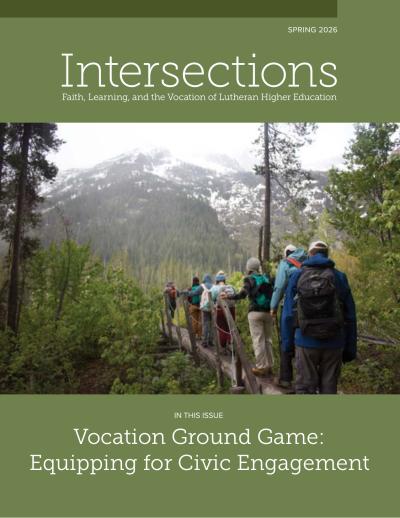
Wells and Windham-Hughes frame vocation as “ground game” — the practical, public living-out of faith through civic engagement — and introduce the issue’s focus on how Lutheran higher education equips students to repair the world.
-
Reflection
I am a Treaty Partner
Kyrie Fairbairn
7 min audio
A recent California Lutheran graduate reflects on how a course on Indigenous Rights and Practices, and a conversation with a former Chairman of the Lummi Nation, led her to claim a “treaty partner” identity and to challenge readers to learn the treaties that shape the lands they call home.
-
Article
Leaning-In to the Civic Lessons of Our Namesakes
A. Lanethea Mathews-Schultz
6 min audio
Mathews-Schultz uses the civic legacy of the Muhlenberg family — from General Pete’s Revolutionary call to action to President Muhlenberg’s inaugural address on the “education of conscience” — to invite students at Muhlenberg College into a shared civic inheritance.
-
Article
Teaching and Mentoring in Service of Civic Engagement
Haco Hoang
6 min audio
Hoang describes how her teaching, mentoring, and research at California Lutheran University — including a multi-year collaboration with the Lutheran Office of Public Policy on Lutheran Lobby Day — cultivate civic skills grounded in ELCA social statements and the Lutheran tradition of faith and reason.
-
Article
Community-Based Research as Engaged Citizenship
James Paul Old
6 min audio
Old argues that genuine citizenship requires more than charitable gestures — it demands long-term, reciprocal community partnerships — and describes how Valparaiso’s Community Research and Service Center embodies that vision even amid the financial pressures threatening such programs.
-
Article
An Ecosystem of Democracy
David Thomason
6 min audio
Thomason argues that faith-based institutions should equip students not to dominate the public sphere with their convictions but to cultivate an “ecosystem of democracy” — pursuing universal values with virtue and tolerance while acknowledging humanity’s incomplete grasp of truth.
-
Article
Bringing Core Values to Life through Civic Engagement
Austin Trantham
5 min audio
Trantham shows how Saint Leo University’s Benedictine Core Values shape his civic engagement work — from advising a “Why Vote?” campaign and Constitution Day panels to engaging students in the Unify Challenge for respectful cross-institutional discourse.
-
Article
Civic Engagement, "Baylor In Deeds," and Engaged Learning
Rebecca Flavin
6 min audio
Flavin describes how Baylor’s strategic plan “Baylor in Deeds” and its Office of Engaged Learning are building civic engagement into the Arts & Sciences core curriculum, with early Global Engagement Survey data showing gains in civic efficacy and global civic responsibility.
-
Article
Fragmented in Faith: The Concerns and Hopes Found in Student Spirituality and Civic Engagement
Emma Bohmann, Monica Sitachitta
11 min audio
Two Texas Lutheran University students reflect on the cyclical pattern of low spiritual and civic engagement on their campus and argue that distinguishing Lutheran values from Lutheran practice could open space for civic engagement to become a non-optional expression of neighbor-justice for all students.
-
 Editorial
From the Editor
Tom Christenson
No. 16 · Winter 2003
Christenson previews this issue’s papers from the Vocation of a Lutheran College Conference—Curt Thompson on “the Lutheran knot,” Carol Gilbertson on the creative dimensions of language, Bruce Heggen on theological vocabulary in the state university, Susan Poppe on the boundaries of campus freedom, and Sig Royspern’s oracular gems—welcomes Robert Benne’s response to the previous issue as a sign that Intersections is becoming a locus of continuing conversation, and confesses his reluctant consent to appear on the cover.
-
 Article
Where Your Feet are Standing: Institutional Engagement and Place
Melissa Maxwell-Doherty
No. 54 · Fall 2021
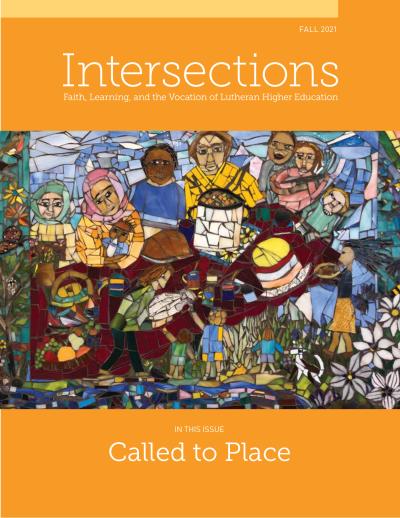
Maxwell-Doherty draws on Cal Lutheran’s Hispanic-Serving Institution designation and its location on Chumash, Fernandino Tataviam, and Ohlone lands to ask how the university’s mission might shift if it depended on where its students are standing — not just where the institution sits.
-
 Article
The Critical Role of Lutheran Higher Education in the Age of Artificial Intelligence
Jose Marichal, Maya Goehner, Tyler Haug
No. 59 · Spring 2024
A Cal Lutheran political science professor and two of his students draw on Rooted and Open to argue that Lutheran higher education is uniquely positioned to stake out a middle path between AI utopianism and AI doom — cultivating a “healthy sense of human limit,” resisting data colonialism, and forming students to see the neighbor rather than the enemy as the world becomes increasingly synthetic.
-
 Article
Views on Flourishing After the Age of Roe
Caryn Riswold, Mary J. Streufert
No. 57 · Spring 2023
Riswold and Streufert reflect on the Radcliffe Institute’s January 2023 conference “The Age of Roe” and argue that the ELCA’s 1991 Social Statement on Abortion and its 2019 statement Faith, Sexism, and Justice offer Lutheran higher education a third way to approach reproductive justice grounded in serving the neighbor so that all may flourish.
-
 Editorial
From the Editor
Robert D. Haak
No. 25 · Spring 2007
Haak frames the issue around the question of what holds the twenty-eight ELCA colleges together amid their geographic, economic, and theological diversity, introducing Mark Hanson’s address to the assembled college presidents, Randall Balmer’s outsider perspective on the commonalities of Christian liberal arts, José Marichal and Pamela Brubaker on diversity rooted in community and globe, Storm Bailey’s argument that being Lutheran is precisely what makes us embrace diversity, and Jaime Schillinger’s St. Olaf chapel reflection on the formative power of worship and liturgy.
-
 Article
Fostering Moral Imagination and Inclusivity: The Role of Ethical Leadership in ELCA Colleges and Universities Amid Societal Challenges
Lamont Anthony Wells
No. 62 · Fall 2025
12 min audio
Wells argues that “moral imagination” — the capacity to envision ethical alternatives, empathize across difference, and respond creatively to injustice — is the heart of ethical leadership in NECU institutions, and that anchoring leadership in this principle positions Lutheran higher education to cultivate socially responsible citizens.