A well-founded premise is that public policy is initiated by self-interest. A group petitions the city to expand public parks for new pickleball courts. Residents living in a neighborhood request that their county install a stoplight at a nearby intersection. Both of these succeed because specific interests bring the concerns to those making public decisions. Democracy is rarely this simple. Often, we are driven to public advocacy because we recognize that our self-interest is at odds with others on the same issue. The stakes are higher when the conflicting public problem ties into our deeply held beliefs. Given the opportunity, should the tools of power be used to make public life mirror our deeply held beliefs? For example, should Christians invoke a state requirement to display the Ten Commandments in public schools, require Christian prayers in school, or mix Christian theology in public school curriculum?
A central problem of democracy is whether and how individuals and groups can simultaneously advocate for personal values, while also recognizing, tolerating, and respecting the public sphere as a shared space of divergent, competing, incommensurable held values. Some resolve this by an agency of dominant power in the public space, overtaking the system with the values they support at the expense of all others that disagree. In other words, some claim that since their values are the truth and the democratic majority is on their side, then what is stopping them from transferring their values into law?
Is this how faith-based institutions should equip students to engage as citizens of our democracy: teaching that faith is a catalyst to overpower and dominate other interests in society? I suggest it is not. Rather, I see faith-based institutions equipping students to understand and promote a healthy ecosystem of democracy. As Romans 3:23 states, “for all have sinned and fall short of the glory of God.” Human beings are flawed, imperfectly conveying God’s truth.
The tools of faith-based civic engagement should lead students to pursue universal values while acknowledging how imperfectly humanity applies them to social, political, economic, and even religious institutions.
Unlike public universities, faith-based institutions should help students embrace their faith with conviction, encouraging them to connect how their faith can guide them in addressing public problems. Faith-based institutions must promote the recognition of humanity’s incomplete grasp of truth. The tools of faith-based civic engagement should lead students to pursue universal values while acknowledging how imperfectly humanity applies them to social, political, economic, and even religious institutions.
Christian citizens should advocate their beliefs with virtue and tolerance, even when other participants are locked in a zero-sum outcome. Faith-based institutions should promote a public space more akin to an ecosystem of interests, with a healthy promotion of the American republic. Transferring religious values directly into political institutions endangers any open society, especially when those values belong to a single religious tradition. The American founders understood this in the First Amendment, that “Congress shall make no law respecting an establishment of religion.”
Christian citizens should advocate for public values that can best promote shared aspirations of justice, liberty, equality, and peace among all citizens and non-citizens. Instead of mounting the Ten Commandments on a wall or prayer in public schools, we should ask whether either promotes a healthy ecosystem of democracy. Teaching self-restraint and limits is a critical part of a faith-based education. An ecosystem of democracy provides a more properly understood, respectful approach to promoting self-interest in a community of competing and often incommensurable values. It should be the responsibility of faith-based institutions to cultivate the civic virtues of tolerance, respect for the law, and using reason for public discourse; some of the virtues the American Founders understood as cooperatively unifying a deeply held faith and an active democratic participation, while optimistically encouraging strong citizens for this world, as well as hope in the one to come.
-
 Editorial
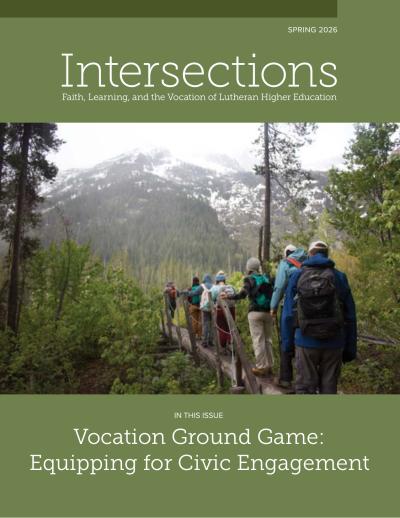
From the Publisher & Editor
Colleen Windham-Hughes, Lamont Anthony Wells
6 min audio
Wells and Windham-Hughes frame vocation as “ground game” — the practical, public living-out of faith through civic engagement — and introduce the issue’s focus on how Lutheran higher education equips students to repair the world.
-
Reflection
I am a Treaty Partner
Kyrie Fairbairn
7 min audio
A recent California Lutheran graduate reflects on how a course on Indigenous Rights and Practices, and a conversation with a former Chairman of the Lummi Nation, led her to claim a “treaty partner” identity and to challenge readers to learn the treaties that shape the lands they call home.
-
Article
Civic Engagement and Faith Perspectives
William O'Brochta
15 min audio
Guest editor William O’Brochta introduces the section by overviewing the ELCA’s call to civic engagement, recapping the Fall 2025 Civic Engagement and Faith Perspectives conference at Texas Lutheran University, and previewing the participant essays that follow.
-
Article
Leaning-In to the Civic Lessons of Our Namesakes
A. Lanethea Mathews-Schultz
6 min audio
Mathews-Schultz uses the civic legacy of the Muhlenberg family — from General Pete’s Revolutionary call to action to President Muhlenberg’s inaugural address on the “education of conscience” — to invite students at Muhlenberg College into a shared civic inheritance.
-
Article
Teaching and Mentoring in Service of Civic Engagement
Haco Hoang
6 min audio
Hoang describes how her teaching, mentoring, and research at California Lutheran University — including a multi-year collaboration with the Lutheran Office of Public Policy on Lutheran Lobby Day — cultivate civic skills grounded in ELCA social statements and the Lutheran tradition of faith and reason.
-
Article
Community-Based Research as Engaged Citizenship
James Paul Old
6 min audio
Old argues that genuine citizenship requires more than charitable gestures — it demands long-term, reciprocal community partnerships — and describes how Valparaiso’s Community Research and Service Center embodies that vision even amid the financial pressures threatening such programs.
-
Article
Bringing Core Values to Life through Civic Engagement
Austin Trantham
5 min audio
Trantham shows how Saint Leo University’s Benedictine Core Values shape his civic engagement work — from advising a “Why Vote?” campaign and Constitution Day panels to engaging students in the Unify Challenge for respectful cross-institutional discourse.
-
Article
Civic Engagement, "Baylor In Deeds," and Engaged Learning
Rebecca Flavin
6 min audio
Flavin describes how Baylor’s strategic plan “Baylor in Deeds” and its Office of Engaged Learning are building civic engagement into the Arts & Sciences core curriculum, with early Global Engagement Survey data showing gains in civic efficacy and global civic responsibility.
-
Article
Fragmented in Faith: The Concerns and Hopes Found in Student Spirituality and Civic Engagement
Emma Bohmann, Monica Sitachitta
11 min audio
Two Texas Lutheran University students reflect on the cyclical pattern of low spiritual and civic engagement on their campus and argue that distinguishing Lutheran values from Lutheran practice could open space for civic engagement to become a non-optional expression of neighbor-justice for all students.
-
 Reflection
Confessions of a Collaborator
Chuck Huff
No. 3 · Summer 1997
Huff of St. Olaf offers a tongue-in-cheek public confession of his lifelong sin of collaboration—from elementary-school reports on dinosaurs and Cliff notes on Faulkner, through high-school algebra and college group projects, to borrowed syllabi, group work imposed on resentful students, tutorials, independent studies on every form of self-reliance, and circulated drafts. Even this confession was collaborated on, and (he confesses) he enjoyed it.
-
 Article
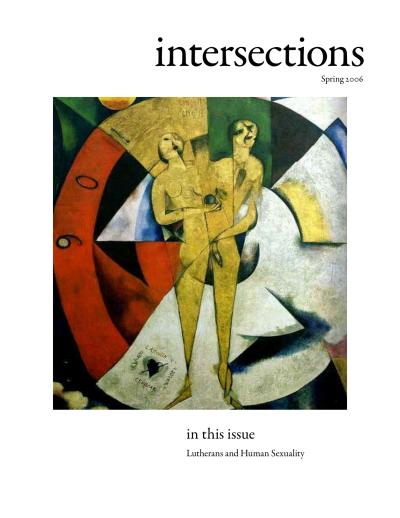
Sexuality over the Lifespan—Social Trends Pose Moral Dilemmas for Communities of Faith
Adina Nack
No. 22 · Spring 2006
Nack, a sociologist who presented to the ELCA Task Force for Studies on Sexuality, surveys empirical research on three life-stages flagged by the Task Force as particularly contested—premarital sexuality among adolescents and young adults, sexuality after divorce and within single parenting, and sexuality in late adulthood. Drawing on the Alan Guttmacher Institute, the Office of the Surgeon General, AARP, National Council on the Aging, and the World Health Organization’s 2002 definition of sexual health, she closes each section with questions about the church’s role in education, blessing of committed nonmarital relationships, and dismantling stereotypes about aging and sexuality.
-
 Article
“A Decolonizing Conversation”: Indigenous Engagement at Luther College at the University of Regina
Marc Jerry, Sarah Dymund
No. 58 · Fall 2023
Jerry and Dymund describe Luther College at the University of Regina’s response to Canada’s Truth and Reconciliation Commission — Land Acknowledgments, a Starblanket ceremony, the Project of Heart, an Elder in Residence, and the unedited video conversation with Elder Lorna Standingready that anchored their 2023 VLHE keynote.
-
 Reflection
Reflections on Lutheran Identity on Reformation Sunday
Thomas W. Martin
No. 19 · Summer 2004
Beginning with an “intellectual vertigo” experienced when his celebrant announced that “today the Church gathers to celebrate the Reformation,” Martin—a biblical scholar who has belonged to four Protestant denominations—asks how Lutherans should tell their own foundational myth. He argues that the Reformation was a mixed bag whose dark side includes a century of religious warfare and the killing of Anabaptists; that Luther himself is too mythic a figure to monopolize; and that distinguishing “constitutive” from “prophetic” reading (after James Sanders) opens the way to a Reformation Sunday told “together with” rather than “over and against” the rest of the Church—one that mixes repentance for the dark with celebration of the glory.
-
 Article
What Our Lutheran Heritage Entails for Lutheran Colleges and Affirmative Action
Mark Ellingsen
No. 59 · Spring 2024
Ellingsen argues that the Lutheran Two-Kingdom Ethic — far from leading to political reaction — supports the church-relatedness of ELCA colleges and obligates them to keep affirmative action alive, even reading a Chief Justice Roberts “loophole” in Students for Fair Admissions v. Harvard as an open door for Black community partnerships, ELCA congregations, and Lutheran colleges to act in the affirmative.
-
 Book Review
Assessing the Value of Liberal Arts: A Review of The Evidence Liberal Arts Needs, by Richard A. Detweiler
Robert D. Haak
No. 55 · Spring 2022
Haak reviews Richard A. Detweiler’s The Evidence Liberal Arts Needs, in which the former president of the Great Lakes Colleges Association analyzes 240 college mission statements and interviews more than 1,000 graduates to argue that liberal arts educational experiences have a measurable impact on adult lives of consequence, inquiry, and accomplishment — and invites NECU institutions into a further conversation about how Detweiler’s methodology applies to Lutheran higher education.