Today’s rapidly changing religious landscape provides new opportunities for thinking about and engaging in inter-religious relations. Over the years, the Evangelical Lutheran Church in America (ELCA) has built a firm foundation of relationships and resources, and now is undertaking new projects to address emerging needs.
Jewish Relations
Inheriting significant work in Jewish relations from its predecessor bodies, the ELCA’s initial inter-religious focus was on Jewish-Christian relations. In the early 1990s, a Consultative Panel on Lutheran-Jewish Relations was established, serving in an advisory role to the Presiding Bishop and to the whole church in order to increase cooperation with the Jewish community, to advance the conviction that anti-Semitism is “an affront of the Gospel, a violation of our hope and calling,” and to live out our faith “with love and respect for the Jewish people” (“Declaration”). The Panel invested its initial efforts in building a firm foundation for this mandate by developing a document that would become central to our inter-religious life.
Twenty years ago, in 1994, the ELCA Church Council adopted the “Declaration of the Evangelical Lutheran Church in America to the Jewish Community,” rejecting Luther’s later anti-Judaic writings, acknowledging their tragic effects throughout history, and reaching out in reconciliation and relationship to the Jewish Community. This Declaration served a dual purpose; it enabled the ELCA to address a troubling aspect of our legacy and sent an important message to our Jewish partners. The Jewish community received the Declaration with a great deal of appreciation, expressed in various ways. To offer some examples, in Allentown, Pennsylvania, the modern Orthodox synagogue reached out to the Institute for Jewish-Christian Understanding at Muhlenberg College in a spirit of cooperation. The National Holocaust Museum in Washington, DC included mention of contemporary American Lutheran rejection of Luther’s anti-Semitic views in one of its featured films. One of our Jewish dialogue partners and colleagues has a framed copy of the Declaration hanging on her office wall as a reminder of our commitments to her community.
In 2005, Rabbi Eric Yoffie, then president of the Union for Reform Judaism (URJ), addressed the ELCA Churchwide Assembly, the first Jewish leader and inter-religious guest to do so. He acknowledged his appreciation for “the role played by the [ELCA] in forging meaningful relationships between Christians and American Jews” (ELCA “Assembly”). This was in reference to the bilateral dialogue between the ELCA and the URJ, but also to longstanding local and national Christian-Jewish dialogues. Over the years, the Consultative Panel had undertaken significant work to develop resources in support of such dialogues, including Covenantal Conversations, a book and companion DVD published by Fortress Press in 2008, which explores “the shared theological framework, special historical relationship, and post-Holocaust developments and current trouble spots that situate the contemporary Jewish-Christian relationship” (Jodock).
Muslim Relations
Luther also wrote some troubling things about Islam in the context of the Ottoman Turkish advances in Europe, as they approached German borders. Nevertheless, while addressing difficult theological and pastoral questions about warfare and possible crusade, he sought reliable information about Islamic teachings, and insisted that Muslim Turks could live virtuous lives—a useful precedent for contemporary Muslim relations. In this vein, the ELCA and its predecessor bodies nurtured a variety of relationships and participated in several initiatives with Muslims over the years. In response to 9/11, however, the ELCA, like many other churches in the United States, sought to give greater focus to Muslim relations, both bilaterally and through national Muslim-Christian dialogues.
“In response to 9/11, the ELCA sought to give greater focus to Muslim relations, both bilaterally and through national Muslim-Christian dialogues.”
In 2007, the ELCA participated in efforts to respond to “A Common Word Between Us and You,” an open letter from 138 Muslim leaders around the globe addressed to Christian leaders that both underscored religions’ emphases on love of God and neighbor and called for unity and peace on that basis. The following year, a group of ELCA scholars and leaders convened to explore how the church could enhance its Muslim relations, an initiative that became the Consultative Panel on Lutheran-Muslim Relations. With the work of the Lutheran-Jewish Relations Panel as a model, this new panel set out to develop several resources to educate ELCA members on Islam and to nurture local dialogue and engagement (see Sample of Resources on adjacent page). The need was only increasing. By Fall of 2010, Islamophobia had reached a fever pitch as pundits weighed in daily on the so-called “Ground Zero Mosque” controversy and as Terry Jones threatened to burn copies of the Qur’an. Together with over 20 interfaith partners, the ELCA became a founding member of the Shoulder to Shoulder Campaign: Standing with American Muslims, Upholding American Values.
In 2011, on the tenth anniversary of 9/11, Dr. Sayyid Sayeed of the Islamic Society for North America (ISNA) was the first Muslim speaker to address the ELCA Churchwide Assembly. He described how “during the last millennium mountains of hate [and] discrimination have been built.” “Our job,” he said, “is to see those mountains of hate removed.” He was received by the Assembly with a standing ovation. Later that same year, with the endorsement of ISNA, Discover Islam: USA generously offered ELCA members and leaders complimentary copies of their six-disc DVD series entitled, Discover Islam. The Consultative Panel, in partnership with A Center of Christian-Muslim Engagement for Peace and Justice at the Lutheran School of Theology at Chicago, developed a study guide for use with the series, providing an interpretive framework from a Christian (Lutheran) point of view. This study guide is also used by several ecumenical partners (see Sample of Resources).
Expanding the Table
ELCA inter-religious relations have historically focused on the “Abrahamic” traditions of Judaism and Islam, and for good reason. Not only does our specific legacy as Lutherans connect us, albeit in difficult ways, to Judaism and Islam; Judaism, Christianity, and Islam are also connected through history and tradition. Yet as our religious landscape becomes increasingly diverse, reflecting the spectrum of the world’s religions and the diversity of global Christianity, we must continue to ask ourselves: What kinds of inter-religious relations are needed today? How can we most faithfully respond to the eighth commandment?
The ELCA participates more broadly in inter-religious relations through bodies such as Religions for Peace USA and the Council for a Parliament of the World’s Religions, and in partnership with organizations such as the Interfaith Youth Core. Conversations have recently begun about possibilities for national ecumenical dialogues with the dharmic traditions, beginning with Sikhism. For the ELCA, this is a growing edge. After the Oak Creek shootings in 2012, the ELCA was amongst the first interfaith partners to reach out, and a fledging relationship was established with Sikh leaders in the United States. As a sign of this, Tarunjit Singh Butalia of the World Sikh Council, America Region was the first inter-religious guest from a dharmic tradition to address the 2013 Churchwide Assembly. Who else are our neighbors? How do we understand what it means to be neighbors in an era of globalization and global migration?
In order to discover the real-life practical and theological challenges facing Lutherans today, the ELCA Consultative Panels jointly launched an inter-religious case studies project in early 2013. After receiving dozens of submissions over the course of a year, a drafting team has begun to weave them together into a narrative of best practices and challenges, with the goal of publishing a resource booklet for study and reflection in local contexts. This project is a first step toward building a framework for the future of ELCA inter-religious relations on the firm foundation that has already been established.
Sample of ELCA Inter-Religious Resources
Developed by the Consultative Panel on Lutheran-Jewish Relations and the Consultative Panel on Lutheran-Muslim Relations.
- Talking Points: Topics in Lutheran-Jewish Relations
- Windows for Understanding: Jewish-Muslim-Lutheran Relations
- Talking Points: Topics in Christian-Muslim Relations
- Discover Islam DVD series Study Guide (DVDs available at: www.discoverislam.com/elca)
- Why Follow Luther Past 2017: A Contemporary Lutheran Approach to Inter-Religious Relations
Each is available for download: http://www.elca.org/Resources/Ecumenical-and-Inter-Religious-Relations
An important question as we look toward the 500 year anniversary of the Reformation in 2017 will be: What of Luther’s legacy, then, is instructive with regard to inter-religious relations? The ELCA’s newest resource for inter-religious relations explores this question in depth. “Why Follow Luther Past 2017? A Contemporary Lutheran Approach to Inter-Religious Relations” lifts up four underlying principles of Luther’s theology as particularly instructive: (1) God adopts people solely out of God’s generosity, without any prerequisites; (2) God is active in the world in such a way as to empower but not to control; (3) theology of the cross; and (4) vocation as a calling from God.
“Who else are our neighbors? How do we understand what it means to be neighbors in an era of globalization and global migration?”
The development of this resource, like the others preceding it, modeled one of the key learnings of inter-religious relations, namely, that “the common experience of individuals who have engaged in inter-religious dialogue is that their understanding and appreciation of their own tradition is enhanced in the process” (“Why Follow”). But it also enhances relations as well. The Consultative Panel on Lutheran-Jewish Relations invited Jewish partners to review and offer input as part of the revision process, which strengthened the content and demonstrated an ongoing commitment to mutual accountability. The ultimate hope is that the resource will be used by Lutherans to better understand our legacy, and to “equip Christians to engage Jews and others in positive, constructive and honest ways” (“Why Follow”).
Expanding the table of our inter-religious partners must be done with careful attention to the reasons for doing so. There is a real concern that if we engage in inter-religious relations, we are participating in a form of religious relativism, sliding down the slippery slope to a compromised faith in Jesus Christ. Yet, one of the learnings from inter-religious relations is that, in practice, precisely the opposite is true. By authentically engaging with others, we become more deeply grounded in who we are, reinforcing our faith and witness. In dialogue with others, we are challenged to clarify what it is we believe, and why. In partnership with our neighbors who share our concern for the common good, we find opportunities to collaborate for the sake of the world. In other words, inter-religious relations both strengthen and support our Lutheran vocation. The role of ELCA colleges in vocational formation for a multi-religious world has been and will continue to be significant. Together we have a firm foundation on which to build. Thanks be to God!
Works Cited
A Center for Christian-Muslim Engagement for Peace and Justice. Lutheran School of Theology at Chicago. 2014. Accessed 1 August, 2014, http://centers.lstc.edu/ccme/
“A Common Word Between Us and You.” Open letter. 2007. The Royal Aal al-Bayt Institute for Islamic Thought, Jordan. Accessed 1 August, 2014, http://www.acommonword.com/the-acw-document
Discover Islam. Accessed 1 August 2014, http://www.discover-islam.com/elca/
ELCA (Evangelical Lutheran Church in America). “Assembly Hears from President of Union for Reform Judaism.” August 8, 2005. Accessed 1 August, 2014, http://www.elca.org/News-and-Events/5534
—. “Declaration of the ELCA to the Jewish Community.” 1994. Accessed 1 August, 2014, http://download.elca.org/ELCA%20Resource%20Repository/Declaration_Of_The_ELCA_To_The_Jewish_Community.pdf
—.”Why Follow Luther Past 2017? A Contemporary Lutheran Approach to Inter-Religious Relations.” Accessed 1 August 2014, http://download.elca.org/ELCA%20Resource%20Repository/Why_Follow_Luther_Past_2017.pdf
Jodock, Darrell, ed. Covenantal Conversations: Christians in Dialogue with Jews and Judaism. Minneapolis: Fortress, 2008.
Shoulder To Shoulder: Standing with American Muslims: Upholding American Values. Accessed 1 August 2014, http://www.shouldertoshouldercampaign.org/
-
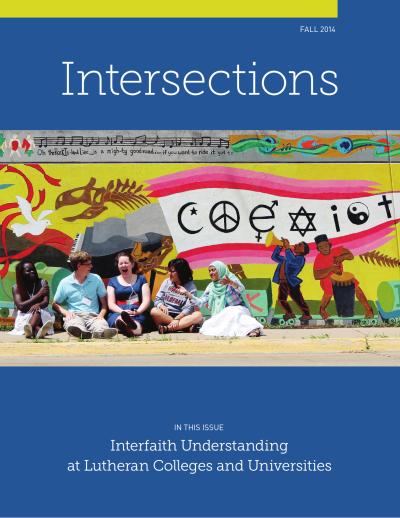 Editorial
From the Publisher
Mark Wilhelm
Wilhelm draws a parallel between the rediscovery of vocation and the rediscovery of interfaith understanding in Lutheran higher education, arguing that previously under-emphasized aspects of the Lutheran tradition point us to interfaith work and that an authentic Lutheran college or university will make interfaith understanding a feature of its mission.
-
Editorial
Guest Editorial
Kristen Glass Perez, Richard Priggie
Glass Perez and Priggie introduce the issue by recounting the campus conversations and the June 2014 Interfaith Understanding Conference at Augustana College that gave rise to it, framing the central question, “What does it mean to be Interfaith at a Lutheran College?,” as a living example of the praxis of being a Lutheran college in the twenty-first century.
-
Article
Vocational Re-Formation for a Multi-Religious World
Elizabeth Eaton
ELCA Presiding Bishop Elizabeth Eaton frames vocational formation for a multi-religious world as one of the most significant challenges facing the church and the liberal arts today, calling ELCA colleges and universities to live into Darrell Jodock’s “third path” that is both deeply rooted and dialogical.
-
Article
Why Interfaith Understanding is Integral to the Lutheran Tradition
Jason A. Mahn
Mahn returns to the root of the Lutheran tradition — church, theology, and pedagogy — to argue that interfaith encounter is not the vanishing point of Lutheran identity but central to it, beginning with confession of Luther’s anti-Judaic legacy, working through the typology of exclusivism / inclusivism / pluralism, and showing how the kenotic Christ and the theologian of the cross open Lutherans to authentic encounter with religious others.
-
Article
What it Means to Build the Bridge: Identity and Diversity at ELCA Colleges
Eboo Patel
Through the contrasting stories of two college students — Cassie’s identity relativism and April’s soft fundamentalism — Patel diagnoses Peter Berger’s twin pathologies of modernization and argues that ELCA campuses, anchored in Bonhoeffer and the Lutheran capacity to “have faith without laying claim to certainty,” are uniquely equipped to be places where the light falls: bridges of cooperation that nurture both strong religious identity and benevolence toward others.
-
Reflection
Danya Tazyeen
Danya Tazyeen
Tazyeen, a Pakistani-American Muslim student at Augustana College, reads Qur’an 49:13 — that God made us into peoples and tribes “that you may know one another” — as a charge to break down fear with open dialogue and to see one another as flawed and relatable fellow human beings.
-
Article
Building an Interfaith Bridge
Belle Michael
Drawing on the holiday of Shavuot, the Book of Ruth, and Martin Buber’s I-Thou, Rabbi Belle Michael picks up Patel’s bridge metaphor and identifies three building blocks for it: experiences with people of different ethnic and religious groups, genuine and long-lasting relationships, and the holy curiosity to ask the questions we are otherwise afraid to ask.
-
Reflection
Gifty Arthur
Gifty Arthur
Reading John 10:3 as a Ghanaian Christian student at Luther College, Arthur reflects on how Luther’s Journey Conversations have deepened her own spirituality precisely by giving room for students to share the personal experiences and beliefs at the center of their own traditions.
-
Article
Journey Toward Pluralism: Reimagining Lutheran Identity in a Changing World
Jacqueline Bussie
Bussie chronicles Concordia College’s Forum on Faith and Life initiative — assessing campus climate, building a President’s Interfaith Advisory Council, and drafting a one-sentence statement that Concordia practices interfaith cooperation “because of” (not “guided by”) its Lutheran identity — to argue that simul justus et peccator thinking equips Lutheran institutions to hold loyalty to tradition and reverence for others together as one piece.
-
Reflection
David Kamins
David Kamins
Kamins, a Jewish student at Muhlenberg College, reads Rabbi Joseph Soloveitchik’s The Lonely Man of Faith alongside his own journey at the Interfaith Understanding conference on the eve of Shavuot, finding in the dual figures of Adam I and Adam II a way to remain firmly grounded in his faith community while going out to learn from those around him.
-
Article
What's in a Name?
Matthew J. Marohl
St. Olaf College Pastor Matt Marohl tells the story of designing The Undercroft’s prayer and meditation room with a campus meditation group whose members began as “Matt” and ended — as their mutual respect grew — calling him “Pastor Matt,” a counterintuitive movement toward a more formal address that signals what intentional Lutheran-Christian hospitality looks like in practice.
-
Reflection
Annie Schone
Annie Schone
Schone, raised in a small conservative Central Illinois congregation, recounts how Augustana’s Interfaith Understanding group and Interfaith Youth Core gave her the first chance to befriend Muslim, Unitarian Universalist, and atheist peers, and how she hopes to bring the joy of those friendships back to her home church through the power of storytelling.
-
Article
Journey Conversations
Amy Zalik Larson, Sheila Radford-Hill
Larson and Radford-Hill describe Luther College’s Journey Conversations Project, a four-phase contemplative practice — quiet, listen, speak, respond — rooted in the Lutheran call to be true to one’s own faith while welcoming all faiths or none, and illustrate its fruit through faith journey stories from Luther students Sukeji Mikaya (South Sudan), Habibullah Rezai (Afghanistan), and Gifty Arthur (Ghana).
-
Reflection
Tom Natalini
Tom Natalini
Natalini, a Susquehanna University senior raised Lutheran, schooled Mennonite, and seasoned by a meditative encounter in India, reflects on his journey through churchgoing, philosophy, near-Jewish conversion, and Buddhist practice to a stance he calls patience — neither Christian, Jew, Buddhist, seeker, nor “none.”
-
Article
Well, Well…Plumbing Our Depths, Telling Our Stories
Ann Boaden
Beginning with a college visit that turned into a grieving mother’s confidence about her daughter’s last moments, Boaden uses John 4’s well of living water to argue that an interfaith education worthy of the name requires Lutherans to plumb the depths of their own tradition’s wells — with rituals, stories, and seasons intact — before they can see, respectfully, into the wells from which others drink.
-
 Editorial
From the Publisher
Mark Wilhelm
No. 30 · Fall 2009
Wilhelm reports on the difficult financial season facing the ELCA churchwide organization — a ten-percent budget reduction announced in November and significant cuts to unrestricted grants for colleges and universities — while affirming that the ELCA’s commitment to the mission of its schools remains strong, including its commitment to engaging the “other,” the theme of this issue.
-
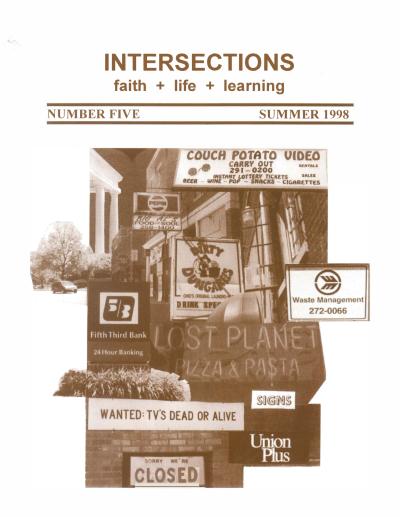 Article
You Don't Seem Angry: Methodological Confessions Of A Lutheran Lay-Woman
L. DeAne Lagerquist
No. 5 · Summer 1998
Lagerquist, opening from a colleague’s 1981 observation about her M.A. thesis on four female abolitionists, traces her path from feminist historian and battered women’s shelter advocate through the University of Chicago’s obsession with method to a more self-conscious account of her own. The method grows out of four Lutheran themes—original sin (caution and humility), the eighth commandment against bearing false witness (generosity and forgiveness), the neighbor as “little Christ” (cooperative interpretation), and vocation (interpretation as calling, located alongside feeding the hungry and visiting the lonely)—and shapes her ongoing work on a history of Lutherans in the United States with a plot about learning to live with diversity.
-
 Editorial
From the Editor
Tom Christenson
No. 3 · Summer 1997
Christenson explains that this issue breaks from the first two issues’ single-focus pattern to feature three principal papers on the environment, the education of desire, and hiring and personnel policies, plus two poems and a piece of reflective bemusement. He then commends George Marsden’s The Outrageous Idea of Christian Scholarship (Oxford, 1997) and challenges Lutheran scholars to articulate how the particulars of their faith inform their scholarship—in conversation with Calvinist work like Nicholas Wolterstorff’s Reason Within the Bounds of Religion and Art in Action—rather than remaining silently complicit in the view that faith has no place in the academy.
-
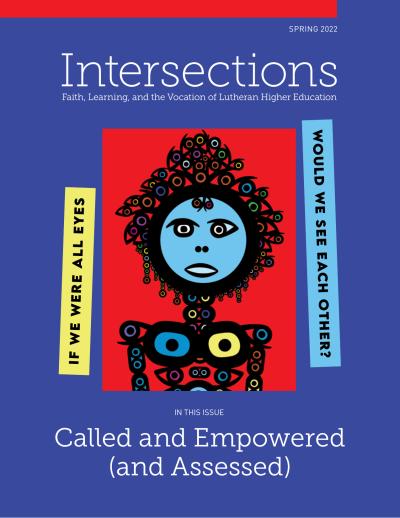 Institutional Focus
Serving and Building Community at Concordia College
Larry Papenfuss
No. 55 · Spring 2022
Papenfuss, director of the Dovre Center for Faith and Learning, frames eight ways Concordia College serves the world by building community — from quality teaching and liberating liberal learning to interfaith cooperation and modeling “diversity with particularity” as a Lutheran “third path” institution.
-
 Article
Holy Odors
John P. Trump
No. 14 · Summer 2002
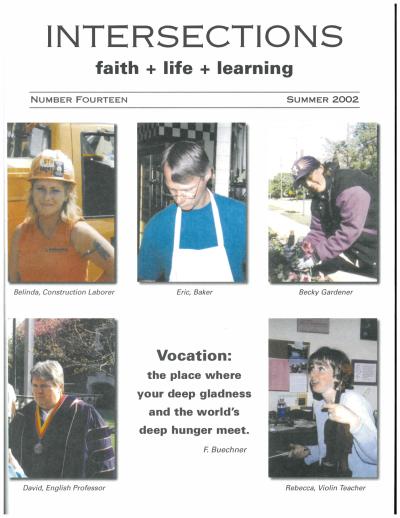
A one-act play by John P. Trump, premiered at Pacific Lutheran University, in which Maggie, a senior studying Reformation history in the library stacks, falls asleep over the Apology of Augsburg and dreams a 16th-century pickled-herring merchant—Herr Leonard Kopp, the man who smuggled Katie von Bora and eight other nuns out of the convent—into existence to argue that her call to archaeology (“digging up old bones”) is as holy as ordained ministry, with Luther’s joke that the church burns incense to insulate priests from the “holy odors” (not holy orders) of everyday life.
-
Reflection
Walls: Talk At Gustavus Adolphus College
Elizabeth Baer
No. 5 · Summer 1998
Baer’s September 11, 1997 Gustavus Adolphus chapel homily on Joshua 6 turns from the trumpets to the walls—Robert Frost’s “Mending Walls,” the walls of the Warsaw ghetto in Vladka Meed’s On Both Sides of the Wall and Margaret Zassenhaus’s Walls, the Berlin Wall coming down in 1989—and then to the autobiographical, intertextual discourse of Gustavus chapel itself as a place where misunderstandings come down. An author’s note added after the March 29 F3 tornado reports the closing line (“LET’S MAKE THOSE WALLS COME TUMBLING DOWN”) as eerily prescient: roofs, windows, and 90% of campus trees were lost, but the Chapel walls and the eternal flame in the red glass lantern stood firm.