In his recent What Money Can’t Buy: The Moral Limits of Markets, American political philosopher Michael Sandel points to hundreds of cases where encroachments of “the Market” on goods that used to be priceless corrode our civic values and our sense of civic togetherness. Some of the Market’s expansions are irksome but perhaps morally inconsequential: the trend toward monetizing gifts through those once-tacky gift cards, the scalping of campsite tickets for Yosemite National Park, or the corporate renaming of professional baseball parks. Others are ethically alarming: the sale of the right to immigrate, cash to female drug addicts if they undergo sterilization, or the rise of the viatical industry, through which a terminally ill person sells his or her life insurance to a third party who then makes money when the terminal person dies—the sooner the death, the bigger the profit (Sandel 35-37, 62-62, 136-49).
Sandel’s primary objection to the expansion of market forces into the civic realm is that putting a price on public goods or “incentivizing” consumers to choose the right thing to do (lose weight, stop smoking, care about the environment) does not simply add external motivations to internal ones but actually corrodes the latter. We no longer do what is good because it is good or right or helpful to “our neighbors.” We do it because we are paid. And when those payments cease to be worth our effort, we stop doing it altogether (Sandel 84-91).
While shared goods presently sell off at surprising rates, Sandel’s concerns are not new. Some twenty years ago, Larry Rasmussen foresaw how the Market beguiles us into believing that obligation to others is fulfilled through calculated self-interest (Rasmussen 61-76). Some two centuries before that, Adam Smith himself insisted that capitalism could help humans flourish only so long as nonmarket civic virtues restricted the domain and curbed the temperament of economic exchange (Smith in Rasmussen 41-45).
“Adam Smith himself insisted that capitalism could help humans flourish only so long as nonmarket civic virtues restricted the domain and curbed the temperament of economic exchange.”
Indeed, the trend toward the commercialization, “incentivization,” and commodification of what were once shared, public goods poses real risks for the goods and aims of education. Martha Nussbaum, for one, traces our expanding Market’s corrosive effects on education. Her book, Not for Profit: Why Democracy Needs the Humanities, documents the particular corrosion that worldwide pursuits for profitability have on humanistic education and its promise to educate for citizenship and democracy. When education becomes exclusively or primarily for economic growth, we lose the skills and dispositions that are at the center of humanistic education and that are necessary for human flourishing. Certainly we at Lutheran colleges and universities feel this trend with every meeting about enrollment and endowment numbers. Most of us have ceased to resist the temptation to market the liberal arts by showing prospective students and their paying parents statistics about how many of our students open their own businesses or go on to law school. One small but important instance of this trend is the place and function of “vocation” within Lutheran schools.
A parallel trend is already upon church-affiliated colleges and universities. Language of vocation can seem ubiquitous these days even outside of Lutheran higher education—especially since 1999 when Lilly Endowment, Inc. began giving millions of dollars in grant money to schools to examine the link between faith and vocational choices. The fact that a leading pharmaceutical company financed a good deal of vocational reflection over the past decade does not in itself degrade it. But the fact that, in these trying economic times, church-related colleges increasingly point to education-for-vocation as a distinctive “trademark,” as that which might sell, may raise some scruples.
Two short examples: First, at a recent Vocation of a Lutheran College conference at Augsburg College in Minneapolis, I attended a breakout sessions led by a staff person of the Lutheran Educational Conference of North America (LECNA) entitled, “Marketing the Concept of Individual and Institutional Vocation.” After chatting with Laurie Brill, the LECNA representative and session leader, I know she shares healthy reservations about how or whether the idea of vocation can be marketed without commercializing and corrupting it. But the fact that tough economic times in Lutheran higher education seemingly “necessitate” that we pitch vocation as part of the Lutheran brand remains disconcerting.
Second and closer to home, Augustana College, my own institution, has incorporated the Center for Vocational Reflection within an overarching Community Engagement Center so that it can communicate more efficiently with the study abroad office, internship coordinators, and the career center. This—like marketing vocation to prospective students—makes all kinds of institutional sense, but the danger is that aims to discern God’s call or to find meaning in the whole arc of one’s life now principally buttresses the institution’s retention rates or the student’s career exploration. I am not claiming that anyone intends to relegate “vocation” to sound career planning in the face of economic necessities—quite the opposite, we intend to promote it. But if Sandel is right in noting how incentives often dis-incentivize us toward nobler ends, we should be careful about how we promote vocation.
How might emphases on the liberal arts and on the goal of discerning one’s calling survive and maybe even thrive in an economic culture where fear of unemployment and of not paying back student loans increasingly drive student expectation and exploration? How can vocational discernment—a practice which is, at bottom, ethical, maybe even theological and pastoral in concern—resist getting absorbed or eclipsed by careerism, the pursuit of professional advancement as one’s chief or only aim? How might we articulate both the “value added” of vocation and the ways vocation’s value resists quantification? And finally, how might we characterize human callings and the Caller behind them in ways that do not wholly separate vocation from the investment in a career, on the one hand, but do not eclipse the first by way of the second, on the other?
“How can vocational discernment—a practice which is, at bottom, ethical, maybe even theological and pastoral in concern—resist getting absorbed or eclipsed by careerism, the pursuit of professional advancement as one’s chief or only aim?”
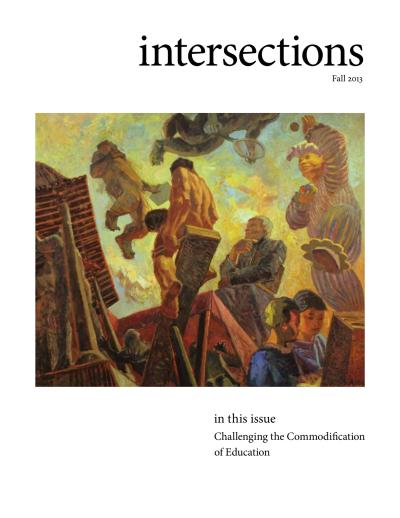
These questions are my own, and I’ve pursued them in a theological way in an essay called “Called to the Unbidden: Saving Vocation from the Market.”1 The presenters of the 2013 Vocation of a Lutheran College conference, “Vocation: A Challenge to the Commodification of Education,” whose papers comprise the bulk of this issue of Intersections, come from different academic and professional backgrounds and pursue their own questions in different ways. Yet undergirding each is this shared concern to rearticulate and revalue education-for-vocation and other “distinctives” of Lutheran higher education in an economic climate that threatens to erode their most important features.
In “Welfare of the City and Why Lutherans Care about Education,” DeAne Lagerquist (St. Olaf College) takes us on a historical tour of Lutherans engaging education, with an eye toward how we got to today, can weather the present, and thrive in the future. She asks us to resist collapsing a distinction central to the Lutheran Reformation—that between a closed system of economic exchanges (whether commercial or spiritual) and “economies of the gift,” where receiving a gift enables and impels one to pay it forward through worship of God and service to those in need. While the history of Lutheran higher education was not immune from quid pro quo exchanges between benefactors, rulers, administrators, teachers, and students, preserving this gift economy—with its focus on the welfare of the city—will continue to remain invaluable.
In “The Value of Evoking Vocation and the Vocation of Evoking Value,” Mark Schwehn (Valparaiso University) also turns to history, this time to uncover what has been valued in the liberal arts by Lutherans and why. While “knowledge for knowledge’s sake” and cultivating a “life of the mind” remain popular reasons for valuing liberal education, Schwehn convincingly argues that Lutherans have or should have more of a stake in education-for-vocation, that is, education “for the sake of empowering and equipping human beings for various kinds of work in the world.” He makes a case for the practicality of the liberal arts, assuring educators at Lutheran schools that they need not feel guilty about “selling” their programs by holding up such practical results. While some of this pulls in an opposite direction than does Lagerquist’s essay, one notes that Schwehn includes within liberal arts’ “practicality” dispositions often unrelated to earning potential: fidelity to family, finding joy in daily work, and responding to neighbors in need.
The 2013 Vocation of a Lutheran College Conference next included a keynote address by Lynn Hunnicutt, (Pacific Lutheran University) entitled, “Can Higher Education be Commodified? And Why Does it Cost So Much?,” which explained the rising costs of higher education and offered an economics-based model for thinking about the challenge to and by education-for-vocation. Unfortunately, because Hunnicutt spoke from notes, we were able to reproduce her talk here.
Next, Karl Stumo (Pacific Lutheran University) and Tom Crady (Gustavus Adolphus College) lean on their experience directing recruitment and enrollment offices to convey realities shared by all our colleges—that of supply and demand, of a decline in the perceived value of college and in “willingness to pay,” of “messaging” and “leveraging,” and of the diminishing role of church-relatedness as a reason to enter one of our schools. As they admit, many of the strategies they offer to face these realities will appear to underwrite “the commodification of Lutheran higher education.” Yet, the authors insist that without becoming increasingly strategic in marketing and recruitment, fewer students will benefit from our institutions.
A short sermon preached at the conference by Patricia Lull offers a word of hope in these trying times. It gets us to hear anew the promise of being valued in a world of collegiate worry and woe. We are happy to reproduce it here.
Finally, we are able to include an essay about the scope and aim of a recent valuable research project that considers how ELCA and other liberal arts schools are strategically reinventing themselves to deal with today’s challenges: Project DAVID by Ann Hill Duin and Eric Childers. Neither author currently resides at a Lutheran institution but both come from them and have spent their recent years analyzing them. Specifically, Project DAVID asks how ELCA schools create distinction, use analytics, articulate value, foster innovation, and explore digital opportunities to ensure future success. We include some of their initial findings because the project highlights the resolute reclamation and recreation of Lutheran institutional identities while facing the pressures of our market economy.
Please send along any letters to the editor, essay ideas or submissions, or suggestions for future topics to me (jasonmahn@augustana.edu). In the meantime, may our ongoing conversations about faith and learning and Lutheran higher education prove to be priceless.
Endnote
1. This editorial repeats several paragraphs from that longer essay (citation below); used with permission by the editors of The Cresset.
Works Cited
Mahn, Jason. “Called to the Unbidden: Saving Vocation from the Market.” The Cresset (Michaelmas 2012): 6-17.
Nussbaum, Martha C. Not For Profit: Why Democracy Needs the Humanities. Princeton: Princeton University Press, 2010.
Rasmussen, Larry L. Moral Fragments and Moral Community. Minneapolis: Fortress, 1993.
Sandel, Michael J. What Money Can’t Buy: The Moral Limits of Markets. New York: Farrar, Straus and Giroux, 2012.
Smith, Adam. The Theory of Moral Sentiments. Ed. D.D. Raphael and A.L. Macfie. Oxford: Clarendon, 1976.
-
 Editorial
From the Publisher: Staying Connected
Mark Wilhelm
Wilhelm frames Intersections as a tool for maintaining relationships among leaders in ELCA higher education, welcomes the journal’s new editorial advisory board, and points readers toward the 2014 Vocation of a Lutheran College conference at Augsburg and a special interfaith understanding conference at Augustana with Eboo Patel and Presiding Bishop Elizabeth Eaton.
-
Article
Welfare of the City and Why Lutherans Care about Education
L. DeAne Lagerquist
Lagerquist takes readers on a historical tour from sixteenth-century Saxony through the founding decades of Lutheran higher education in the United States to the present day, recovering Luther’s “gift economy” alongside Lewis Hyde and Oswald Bayer as a counter to the market logic that increasingly governs American higher education. She offers four propositions on vocation and commodification and proposes that Lutheran institutional vocation is to accept and pass along the gifts that come to our schools for the well-being of students, neighbors, and the world.
-
Article
The Value of Evoking Vocation and the Vocation of Evoking Value
Mark Schwehn
Schwehn answers Michael Staton’s call to “disaggregate” the components of a college degree by insisting that Lutheran education is integral and whole. Working through Bruce Kimball’s history of liberal education, Cardinal Newman, and Leon Kass on Athens and Jerusalem, he argues that Lutherans should defend liberal learning on instrumental grounds and offers the figure of the “local genius”—exemplified by his Valparaiso colleague John Strietelmeier—as the form of human excellence that Lutheran colleges uniquely cultivate.
-
Article
"We're Looking for a College—Not a Vocation": Articulating Lutheran Higher Education to Prospective Students and Parents Seeking Relevance
Karl Stumo, Tom Crady
Drawing on Sallie Mae and UCLA enrollment data, the websites of competitor institutions, and candid voices from the field, Crady and Stumo describe a recruitment landscape in which yield rates have collapsed, discount rates have soared, and the word “Lutheran” often presents an obstacle until it is patiently unpacked. They survey mission language at Augsburg, PLU, Gustavus, and Wartburg and argue that strategic message development is the only way for ELCA schools to make vocation and Lutheran identity “credible, relevant, differentiating, and compelling” to prospective families.
-
Article
More Value than Many Sparrows: A Sermon on Matthew 10:26-31
Patricia Lull
Preaching at the 2013 Vocation of a Lutheran College conference, Lull recalls her own arrival at the College of Wooster the summer after Kent State and contrasts that era’s sense of students as participants in a college’s mission with today’s talk of “butts in seats.” Reading Matthew 10:26-31, she promises that the way of the cross—and its hard opportunities for slow-paced learning, genuine debate, and access for students who cannot pay the full cost—is the easy yoke, the lightest burden of all.
-
Article
Reinventing Lutheran Liberal Arts: A Preliminary Report on Project DAVID
Ann Hill Duin, Eric Childers
Duin and Childers introduce Project DAVID—Distinction, Analytics, Value, Innovation, Digital opportunity—as a framework for showcasing strategic reinvention across ELCA liberal arts institutions. Building on Childers’ College Identity Sagas and reading Selingo, Norris, and Popenici alongside the AAC&U, Adrian College, NITLE, and the Delta Cost Project, they pose framing questions about distinction, vocation, affordability, value propositions, two-track innovation, and BYOE technology that ELCA campuses can use to face their own “Goliath” moments.
-
 Article
Vocation at Full Stretch: Reflections on Follow Your Bliss and Other Lies about Calling and its Use among College Students
Jason A. Mahn
No. 61 · Spring 2025
43 min audio
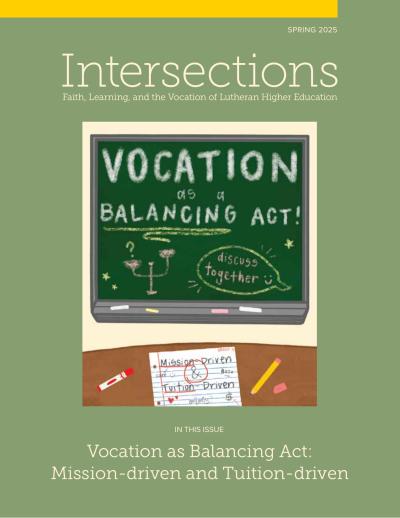
Mahn engages Bonnie Miller-McLemore’s Follow Your Bliss and Other Lies about Calling as required reading in a sophomore religion course, showing how her categories of missed, blocked, conflicted, fractured, unexpected, and relinquished callings empower young adults to perceive embodied, unplanned, and often painful dimensions of life as essential parts of vocation — and help close the gap between mission-driven and tuition-driven realities.
-
 Article
On Recruiting Diverse Students, Rooted in Mission
Eric Rowell, Jason A. Mahn
No. 59 · Spring 2024
Jason Mahn interviews Eric Rowell, Assistant Director of Admissions and Diversity Outreach at Augustana College, about how recruiting students from a wide variety of backgrounds — rooted in Augustana’s Lutheran commitment to vocation and educating across difference — remains essentially unchanged in the wake of the Supreme Court’s 2023 decisions on affirmative action.
-
 Editorial
From the Outgoing Editor
Jason A. Mahn
No. 55 · Spring 2022
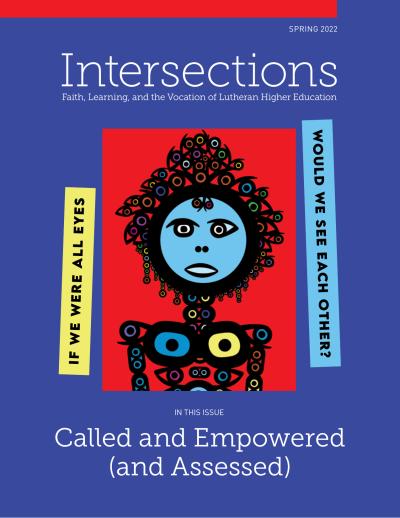
Mahn closes out a decade of editing Intersections, passes the duties to Colleen Windham-Hughes, gives thanks to Mark Wilhelm and Augustana College, and introduces an issue largely drawn from comments by Lutheran faculty, staff, and administrators at the 2022 NetVUE national gathering.
-
 Editorial
From the Editor
Jason A. Mahn
No. 54 · Fall 2021
Mahn introduces the “Called to Place” theme of the 2021 VLHE Conference, arguing that Lutheran higher education’s emphasis on vocation must be grounded in particular geographies and embodied communities — for, as Wallace Stegner put it, “If you don’t know where you are, you don’t know who you are.”
-
 Reflection
Shelter in Place: Reflections from March 22, 2020
Jason A. Mahn
No. 53 · Spring 2021
On the fourth Sunday of Lent in 2020, Mahn meditates on the etymology of “shelter” (from shield) and on an email from a former student in Boston whose mutual-aid organizing models a Lutheran understanding of vocation: the upending of ego by divine love that frees us, finally, to see and serve the neighbor.
-
 Editorial
From the Editor
Jason A. Mahn
No. 52 · Fall 2020
Mahn narrates a year of crisscrossing pandemics — Covid-19, economic collapse, partisan politics, and the long pandemic of white supremacy revealed anew by the murder of George Floyd — and argues that Lutheran liberal arts schools, by educating for vocation, are uniquely poised to help students respond with character and capable callings.
-
 Editorial
From the Publisher
Arne Selbyg
No. 27 · Spring 2008
Selbyg, retiring this summer as Director for ELCA Colleges and Universities, reflects on his decade serving as spokesperson between the church and its twenty-eight colleges and universities, and argues that the link between the colleges and the church has grown stronger over the last ten years — sustained by supportive church leaders like Presiding Bishop Mark Hanson, the annual Vocation of a Lutheran College conference, and a Lutheran theology of higher education whose principles (questioning authority, returning to the sources, including the excluded, serving the neighbor) remain a strong basis for operating colleges and universities in the twenty-first century.
-
Article
Learning from Luther on Covid-19
Carl Hughes
No. 52 · Fall 2020
Reading Martin Luther’s 1527 treatise “Whether One May Flee from a Deadly Plague,” Hughes finds practical and spiritual guidance for a pandemic age: serve the neighbor, follow medical experts, honor those whose vocations put them at risk, and trust that even when we fail, God will not abandon the community.
-
 Article
Cultivating Staff Flourishing in Lutheran Higher Education: A Framework for Advocacy and Engagement
Laree Winer
No. 58 · Fall 2023
Winer narrates her own “love affair” with Lutheran Higher Education to argue that the heart of the tradition — vocation, de-emphasized hierarchy, and shared humanity — equips NECU institutions to advocate for staff flourishing through data collection, professional development, and ongoing relational commitment.
-
 Reflection
I am a Treaty Partner
Kyrie Fairbairn
No. 63 · Spring 2026
7 min audio
A recent California Lutheran graduate reflects on how a course on Indigenous Rights and Practices, and a conversation with a former Chairman of the Lummi Nation, led her to claim a “treaty partner” identity and to challenge readers to learn the treaties that shape the lands they call home.
-
Editorial
From the Publisher: Navigating Affirmative Action, DEI Policies, and Lutheran Vocational Identity
Lamont Anthony Wells
No. 59 · Spring 2024
Wells surveys the converging pressures on NECU institutions — the unsettled landscape of affirmative action, political and academic scrutiny of DEI work, and the preservation of distinctively Lutheran vocational identity — and previews how the issue draws on affirmative practices, sociological viewpoints, and theological responses to navigate a path forward.
-
Article
Civic Engagement and Faith Perspectives
William O'Brochta
No. 63 · Spring 2026
15 min audio
Guest editor William O’Brochta introduces the section by overviewing the ELCA’s call to civic engagement, recapping the Fall 2025 Civic Engagement and Faith Perspectives conference at Texas Lutheran University, and previewing the participant essays that follow.