My connection with St. Olaf College has been long and varied. It goes back to the early fifties when I heard the St. Olaf choir sing at the Municipal Auditorium of Fremont, Nebraska. As a junior high student I was mesmerized by the quality of the choral music and the magnetic dignity of the director, who may have been the great F. Melius himself. Later on my major professor at Midland College was a graduate of St. Olaf. He taught us to love the immigrant literature of the Great Plains, including books written by another St. Olaf figure, O.E. Rolvaag. When I embarked on seminary teaching at the Lutheran School of Theology at Chicago, many of my colleagues and students were St. Olaf graduates. Just recently I was honored to have been asked to write a chapter in the Called to Serve volume, which was produced as a companion piece to this conference. Finally, I am including St. Olaf among the six schools I have studied in preparation for a volume entitled Quality With Soul—Thriving Ventures in Christian Higher Education, which should appear in early 2001 under the Eerdmans label. In that book I have attempted to discern why and how six schools—St. Olaf, Valparaiso, Notre Dame, Baylor, Wheaton and Calvin—have maintained a rich relation to their religious heritages. The fact that I included St. Olaf in that list is a signal of my continuing admiration for St. Olaf as a genuinely Christian college.
I.
What have I learned in my study of those six schools? Why have they maintained a close connection with their sponsoring Christian heritage? How have they done so? Those are questions to which I set out to find the answers.
I have far too much material to share with you in this brief space.
Let me give you the bottom line: These colleges maintained their “soul”—their lively connection with their sponsoring heritage—because a sufficient number of persons on their boards, administrations, faculties and student bodies had confidence that the Christian account of life and reality was relevant—even paradigmatic—for all aspects of the college’s life…both curricular and extra-curricular.
It is a fairly rare occurrence that such confidence reigned among those key groups. The large majority of church-related colleges and universities were secularized by the vast and various forces that we cannot afford to get into now. At bottom, other accounts of life and realicy overcame the Christian account and provided the organizing rationale for the educational process.
This is not to say that those who presided over the secularization process were faithless or unbelieving people. Far from it…many were well-intentioned, sincere Christians who thought they were doing the right thing. While they had faith in the Christian account for their private lives, they did not have confidence in its capacity to shape higher education on the institutional level.
Before I go any further, it is important to spell out what I mean by “the Christian account of life and reality.” I am indebted in my thinking on this subject to Paul Griffiths, who wrote a very interesting book called Religious Reading, where he outlines what he means by a religious account.
A religious account, he thinks, is dependent on a living religious tradition if it is to be persuasive. This religious account is believed and lived by the persons who participate in that living tradition. As a belief system it is articulated in a vision and as an ethos is expressed in a way of life.
A religious account—a Christian account—is envisioned and lived as comprehensive, unsurpassable and central.
It is comprehensive because its vision encompasses all of reality. It provides the umbrella of meaning under which all facets of life are gathered, valued and interpreted. It does not leave the understanding of our life and world to completely secular sources, though it certainly draws on those sources. While Christianity’s comprehensive account does not claim to have all the relevant data and knowledge about life in this world, it does claim to offer a paradigm in which that data and knowledge are organized, interpreted and critiqued. In other words, if Christianity is taken seriously, its comprehensive account must be given intellectual and lifestyle relevance in the central educational tasks of the college. The Christian account is not relegated to the “gaps” in the life of a college, much as some Christians operate in their personal lives with a “god of the gaps,” not a God of all life and reality.
A serious Christian account is unsurpassable—it cannot be replaced by another account without giving up the Christian account itself. It is claimed to be a vehicle of ultimate truth, though its adherents ought to be aware that they are humanly fallible in their reception of that truth. Its core vision and ethos persist through time; there is a “there” there with which to contend in the educational enterprise.
Finally, the Christian account is central—it addresses the essential and inescapable questions of life and reality. It conveys a Christian view of the origin and destiny of the world, of nature and history, of human nature and its predicament, of human salvation and of our conduct of life. From a more existential viewpoint, it addresses the key questions: Who are we? Where did we come from? Who or what threw us into existence? How can we be saved? What can we believe? What ought we do? For what can we hope?
While I have cast my interpretation of the Christian account in dominantly intellectual terms for the purposes of this paper, it is certainly more than that. Any living religious tradition possesses an account that is lived, not just believed. It is embodied in a way of life, an ethos. Elements in that ethos include the practices of worship, music, celebrations of holidays, Sabbaths and seasons, hospitality, justice and fairness, the marking of rites of passage, particular habits of mind and heart, and morally-ordered ways of living together. Christian life together certainly involves service to others. For the Lutheran tradition the idea of vocation is central—all humans are called by God to exercise their gifts in service to others through specific kinds of roles.
It is obvious that a specific religious vision and ethos—a religious account—cannot be publicly relevant in a college without persons who carry them. If a religious tradition is to make its vision and ethos effective in the school it sponsors, it needs a critical mass of person who bear the DNA of that tradition. It needs them as board members, administrative leaders, faculty, staff, and students. It is no doubt possible to have those who are not participants in the tradition to know it, respect and even further it, but it seems unlikely that they can embody it in a way that committed participants can. It is also perhaps possible in principle to have a generically Christian college without relation to a specific Christian tradition, but in reality such a phenomenon is as rare as truffles in the dessert. We come to the Christian faith through particular traditions; schools maintain their Christian identities through voluntary accountability to specific Christian traditions even though they may be capaciously ecumenical.
My focus here is on the vision dimension of the Christian account, particularly as that is articulated in a theology of Christian education. Sometimes—perhaps often, for rhetorical purposes—a vision of Christian higher education is not expressed in the technical categories of theology, but nevertheless it needs at some time to be articulated in those categories if there is to be an effective conception of the relation of faith to secular learning. Further, this theological articulation of the vision is employed to define a college’s identity and mission, to gather a theology department in which its members gladly carry that vision on behalf of the school, to help construct a coherent liberal arts curriculum, to elaborate a justification of the school’s ethos, and very importantly, to provide a Christian intellectual tradition with which the whole school in its many departments can engage.
Now that I have made clear what I mean by a Christia account, I want to work toward an adequate theology o Christian higher education. One way to do that is identify theologies that are not adequate to the task.
II. INADEQUATE THEOLOGIES OF CHRISTIAN HIGHER EDUCATION
1. Pietism
If one ploughs through the copious literature on the secularization of church-related higher education, some religious orientations show up time and time again as culprits. One of these is often called “pietism,” which means an orientation to the Christian faith that focuses on internal states—emotions, affections or virtues—which have little to do with the center of the educational enterprise, the mind. Now I think pietists have gotten somewhat of a bad rap from Burtchaell and others. Pietists do have a belief structure. They want it to be simple, orthodox and unadorned with a lot of intellectual accretion. They want integrity, simplicity and as much agreement on basics as one can reach. All those are admirable traits. But pietism does have the liability of a-intellectualism, if not anti-intellectualism. Perhaps the former is more common. Pietists often do not see that the Christian faith makes intellectual claims…truth claims.
Serious pietists have not let their colleges secularize completely though. Rather, they often fasten on the extra-curricular facets of college life and create a “Christian atmosphere” for the faculty and students. I have said “serious pietists” because most appeals to Christian atmosphere by church-related colleges are bogus. They are desperate appeals to some vague reality that is only a figleaf to cover their nakedness. But some efforts are very serious. Wheaton and Baylor, for example, for many years followed what has been called a “two-spheres” or “add-on” or “value-added” approach. Curricula were pretty much like any secular school—except for the Bible and religion courses—but extensive efforts were made to bathe the students in a Christian ethos, many times with great success.
But the problem with this is that huge areas of human life—the intellect and the relevant knowledge of daily life in the world—are left untouched by Christian truth claims. At its worst this leads to a bifurcated life for the students; Christian people cannot live as whole people in the world. Moreover, this “add-on” approach can dissolve quickly, first by the departure of a critical mass of religious people from the colleges, but more likely by a secularization that overtakes extra-curricular life as pervasively as it took over intellectual life. If the crucial areas of curricular life can best be shaped by secular understandings, why not extra-curricular? Serious pietists may have answers to that question but less serious ones capitulate rather easily.
2. Liberal Theology
By “liberal theology” I do not mean those sorts of theology that take modem thought forms seriously; every decent theology must do that. Rather, by liberal theology I mean those that accommodate so eagerly and completely to modem thought forms that they give up the substantive content of the Christian theological account. I went to a Divinity School that at one time was dominated by this sort of theological liberalism. In the case I am talking about, Christian substance was surrendered in order to fit Whiteheadian process philosophy, or in other cases, to fit the “empirical” philosophy of Henry Nelson Weiman. If the incarnation or sin or judgment or salvation through Christ didn’t fit with the preferred philosophical categories, well, too bad for the Christian account.
The irony of a goodly share of such liberal theology is that it set out to revise classic Christianity enough for it to become credible and persuasive to a new generation but wound up allowing the new generation’s criteria of credibility to supplant Christianity in favor of a rival view of the world. The essence of such liberal theology is its tendency to transform biblical, doctrinal and ecclesial sources of the Christian faith into a religious and moral philosophy decisively shaped by the leading philosophies of the day. Usually such theology is overwhelmingly concerned with progressive moral imperatives—enlightened social ethics—so that it tends to reduce religion to morality.
Liberal Christians in the leading church-related universities wanted to adapt to an age of rationality, science, and practical progress fueled by American ethical idealism. Most of them over time crossed the line in which American/Enlightenment idealism replaced the Christian vision as the organizing vision of life. When that took place, it was no longer necessary to rehearse the Christian account or to staff a university with confessing Christians. Those who actually believed in the Christian account either left or became very quiet.
The elite Protestant colleges followed this trajectory rapidly; the others more slowly. But in them the theological accounts became thinner and thinner until they were left with vague talk of “values.” After a time in which American idealism has been in eclipse, such idealism is making a come-back in the movement to enshrine “service” as the centerpiece of extra-curricular student formation. Since there is nothing left to integrate a curriculum, service becomes a unifying, up-building theme beyond mere competence to justify and dress up these schools’ ethical tone. Interestingly, though, many secularized church-related colleges cannot find the gumption to justify their service efforts in Christian terms, which would be embarrassingly narrow to them. So they again rely on more generic American civic ideals.
Other forms of liberal theology have come to the fore, however. In their continuing efforts to remain relevant, mainstream Protestant colleges often lurch heavily toward recent intellectual and social currents, or what has come to be known as left-wing political correctness. Following mainstream Protestant churches, these colleges commit themselves to the mantras of diversity, inclusiveness, multiculturalism, and to ecological and feminist ideologies as correctives to, or sometimes surrogates for, the classical Christian vision. Having lost interest or confidence in communicating that Christian vision, they accommodate instead to much more “with it” elite liberal cultural imperatives. Unsurprisingly, the more militant adherents of these imperatives use them to subvert or marginalize the Christian vision itself. Catholic colleges can take similar paths when they automatically conflate left wing social and political causes with their traditional “peace and justice” concerns. Then the “proper” socio-political opinions and actions take the place of Catholic formation.
3. First Article Theologies
Third, I would like to point out the inadequacies of what I call “First Article” approaches, for want of a better name for my category. By First Article I mean the First Article of the creed, which confesses God as Creator of the world. I realize the problems of using this language, because genuine First Article theologies would draw on Christia doctrines of creation, human nature, sin and history, but the inadequate ones don’t. Rather, they use “First Article” approaches to evacuate the Christian vision of intellectual content and they wind up in the same place as the pietists—with a “two spheres or add-on” approach to Christian higher education.
One variety of these approaches was adopted by the Lutheran Church in America as an official theology, but one doesn’t have to be a Lutheran to adopt it. Merrill Cunninggim, a well-known patriarch in Methodist higher education, follows this path. Essentially, it declares that all truth is grounded in God and therefore all genuine quests for truth are from God and please God…as well as serve the creation. It does not make any critical judgments about which quests for truth are indeed genuine, nor does it insist that pursuers of truth confess that the ground of their inquiry is God. Thus, the educational process goes on the same as in a secular school. But, if that is the case, why have a church-related school, except for perhaps a few religious adornments here and there? Methodists must certainly ask themselves that question now and then.
Another variety is more self-consciously Lutheran. It evacuates intellectual content from the Christian vision by giving education over to autonomous reason. It does this by a distorted use of two-kingdoms theology that in fact separates Gospel and Law, the Left and the Right hands of God. The separation takes place in this way. The Gospel is narrowly construed as the doctrine of justification. This Gospel is preached in chapel and taught by the theology department. But it is not the full-blown Christian theological account of life and reality…it does not have much intellectual content.
Then secular learning is relegated to the realm of the Law, where autonomous reason holds sway. But since no intellectual content is given to the Gospel—or the Christian account in its larger sense—there is no basis from a Christian point of view to engage the proposals put forth by autonomous reason. This is a peculiar type of Lutheran quietism in the educational realm. We have proven we can be quietists in the political realm, but now we show our versatility by bowing down before the secular authorities in the intellectual realm.
When we do this, we of course then hire “the best available faculty” without regard for their religious convictions or their interest in the serious engagement of faith and learning. Lutheran theology can then be used as an instrument of secularization.
4. Reactionary Theology
The final sort we can dispense with quickly, because it is unlikely to be a temptation at ELCA colleges like St. Olaf. This fourth type could be called “triumphalist” or perhaps “reactionary” theology. Theologies of this sort are rigid, defensive and closed to genuine engagement with contemporary secular thought. Covering their own fear of inadequacy, they appear triumphalistic in that for them biblical or theological truths simply trump whatever the world offers. Fundamentalist schools operate this way. Some Missouri Synod-controlled schools appear to have tendencies in this direction. Schools under sway of these theologies exhibit neither theological vitality nor genuine faith/learning engagement. While there may be a few individuals sprinkled about our ELCA colleges with this orientation, it is scarcely an institutional danger. However, it is easy to get lumped with these few folks if you really insist on the public relevance of the Christian intellectual account. Secular persons—or even mildly involved Christians—often have no other model in their minds for the faith/learning engagement than the fundamentalist one. If you insist on intellectual content for the Christian account, they think you are a bible-thumping fundamentalist.
MARKS OF ADEQUATE THEOLOGIES OF CHRISTIAN HIGHER EDUCATION
Well, if those theologies are inadequate to the task of shaping Christian higher education, which ones are more adequate? In the following, I want to give the marks of adequacy in general and then make some comments about particular kinds of adequate theologies.
Such a theology has confidence in the comprehensiveness, unsurpassibility, and centrality of the Christian account of life and reality in its efforts to shape Christian higher education.
COMPREHENSIVENESS
In order to have this confidence in the comprehensiveness of the Christian account, this theology draws upon the whole Christian narrative as it is elaborated in the Bible and in trinitarian Christian theology. Only this large vision will provide the kind of light we need in order to see the truth and falsity, possibilities and limits, in the many smaller secular sources of light that are part of a modem college or university. Further, a theology confident in the comprehensiveness of the Christian account will draw upon the vast stores of wisdom the Christian intellectual tradition has built up over the millennia. Christians have thought seriously and persuasively about the origin and destiny of the world, about human nature and dignity, about the meaning of history, about the meaning of our own personal lives in that larger story, about human longing and fulfillment, about the Christian meaning and conduct in everyday life. Christians have thought about the public dimensions of our visible lives, not just the mysterious and ineffable dimensions of our private existence. A Christian college has to employ a theology that is public and comprehensive.
Two caveats here. Not everyone on a faculty can be expected to master the vast wisdom of the Christian intellectual tradition. Certainly a number of persons in the theology department should have this capacity…and the willingness to use it on behalf of the college. Others, however, do need a solid lay knowledge of Christian theology, enough so that they can relate their own fields of inquiry to their Christian convictions in a meaningful way.
Second, I do not mean by comprehensiveness an arrogant overconfidence that the Christian account has all the answers. Christianity possesses wisdom and insight, not a lot of hard knowledge, and there is much to be filled in by secular knowledge. Some of that “filling in” will complement Christian wisdom, but some of it will create dissonance if not indigestion, to mix metaphors. There will be much room for mutual critique and, sadly, for irresolvable differences in some cases. But the point I’m making is that this larger Christian vision has to be given genuine intellectual status in the Christian college.
UNSURPASSABILITY
Here, a college must employ a theology that confidently flows from the classical core of Christianity. The core of Christian religious and moral belief is articulated in the Ecumenical Creeds, the Small and Large Catechisms. The core is the Apostolic Tradition, the Great Tradition, Mere Christianity. It is this that is unsurpassable and finally non-negotiable. A Christian college must have a critical mass that actually believe in its truth.
But a creative theology that engages the world of learning must be able to extend and apply meanings from that core, must be able to draw out implications that have not been thought of before, must find the flexibility within it to engage secular proposals that seem to have little obvious relation to it, and must even be able to submit the core itself to scrutiny.
Yet, if a college allows some other account—the Enlightenment or a commercial—to supplant the Christian, then it no longer has a strong rationale to remain church-related.
CENTRALITY
An adequate theology has confidence that the Christian account is central, it addresses the essential issues and values of life and reality. Let me give you an example. Glen Tinder, a distinguished Christian political philosopher, argues that the Christian view of human nature is definitive for western politics. In Tinder’s parlance “the exalted individual,” is a translation of the Christian teaching about each person being created in the image of God and about each person being redeemed by Christ. Humans are, as he puts it: “sacred but not good.” This dual definition, he argues, is at the center of western politics. It means that each life is irreplaceable, has rights, cannot be treated with impunity and has a dignity far beyond utilitarian calculations. Yet humans are fallen; they have a propensity for idolizing themselves.
Without this background Christian teaching and its ontological grounding in God, Tinder fears politics will become either cynical—judging humans on the quality and intensity of their lives (as is happening now in the West)—or idealistic—looking for messianic ways of saving humanity (as happened in both Fascism and Communism).
That’s enough. You see the richness of Christian wisdom about human nature. But I could relate that wisdom to psychology, to sociology, to literature. The Christian account deals with the truth and goodness of crucial matters.
You will notice that up to this point I have talked about the Christian account in general. I have not added many denominational nuances. That is because I want to emphasize that being a Christian college means adhering to the general—shall I say “universal”—Christian account before we get to our Christian differences. We share so much on this level that it is a mistake to emphasize our differences, which do not amount to much when we compare them with a secular approach. We should not carp about each other, engaging in the narcissism of small differences when so much more is at stake.
But finally let us get to those differences. After my study of the six schools, I know there are real differences in vision and ethos. Each tradition has a different way of relating faith (the Christian account) and learning (secular knowledge). Those differences are based upon deep differences in the way that each relates revelation and reason, grace and nature. Notre Dame is simply different than Calvin. The former sees natural and revealed truth converging but, as its mission statement says, that natural truth is “subject to critical refinement.” Reason, even for the Catholics, is not autonomous.
Calvin sees reason as far more fallen. Secular approaches to truth must be subjected to worldview analysis, critiqued and then transformed toward genuine Christian knowledge. Wheaton and now Baylor are intrigued by the Calvin model, though they entertain other faith/learning models. But even in the Calvin model things are not as tidy as the theory makes them seem. There are loose ends. Sometimes faith and reason seem to lead in opposing directions. Professors at Calvin and Wheaton and Baylor simply do not trump secular reason on the basis of revealed truth. There is far more conversation than that. The actual process on the ground level is not that different from what goes on at Notre Dame or Valpo or St. Olaf.
Lutherans—those at both St. Olaf and Valpo—have a wonderful theological tradition at their disposal, one that takes into account the difficulties of both the Catholic and Reformed models. But we often misuse it. We separate the two kingdoms. At some other times we use “paradox” as a lazy excuse for not engaging in faith-learning conversation at all. We declare paradox at the very beginning of the educational process and then let everyone go their own way… that’s the easy way out. But it leads to secularization very quickly. No, Christ and culture in paradox means that we engage the Christian account with secular learning in a serious and extended conversation. We should seek for as much overlap as possible, engage in as much mutual critique as needed to draw us closer together, and in some cases, finally declare that for the moment we see no way of resolving the conflicts of faith and learning, but because we as Christians believe that God is One, someday the full truth will be revealed to us.
May St. Olaf College continue to engage in such a conversation for at least 125 more years. That will certainly be one of the most important ways that St. Olaf can serve its students and through them the world.
-
 Editorial
From the Publisher
Arne Selbyg
Selbyg explains that, while Intersections usually publishes papers from the annual Vocation of a Lutheran College conferences, this issue gathers presentations from a St. Olaf 125th-anniversary conference—a companion to the volume Called to Serve edited by Pamela Schwandt—because the theology and educational perspectives behind them apply to any Lutheran college and clarify what makes ELCA church-related colleges excellent institutions for students of any faith.
-
Editorial
From the Editor
Tom Christenson
Christenson recommends the St. Olaf 125th-anniversary volume Called to Serve—edited by Pamela Schwandt with Gary de Krey and L. DeAne Lagerquist—particularly Walter Sundberg’s “What Does It Mean To be Lutheran?” and Darrell Jodock’s “The Lutheran Tradition and the Liberal Arts College.” He notes that the volume’s biographical sketches of Lars Boe, F. Melius Christiansen, Ole Rolvaag, Emil Ellingson, Agnes Larson, John Berntsen, Arne Flaten, and Howard and Edna Hong show, against an outsourcing age, that the life of an institution like St. Olaf is the committed life of the people who work there.
-
Article
Faith, Understanding, and Action
Paul J. Dovre
Dovre frames the St. Olaf 125th anniversary—originally read as part of a presentation with the St. Olaf Cantorei and organist Paul Manz—around T.F. Gullixson’s story of an immigrant woman who “turned her face to the west wind” and the 1874 gathering at the Holden parsonage of B.J. Muus, Harold Thorson, O.K. Finseth, K.P. Haugen, and O.O. Osmondson. He weaves Anselm’s “faith seeks understanding,” Harold H. Ditmanson on the universal relevance of Christian faith, and the music of Venatius Honorius Fortunatas, John Rutter, Herbert Brokering, Ralph Vaughan Williams, and John Tavener into a meditation on faith as motive, understanding as modus, and action as consequence, against the “ill winds” of poverty, child homicide, AIDS, and consumer gluttony.
-
Article
Education for Peace and Justice
David J. O'Brien
O’Brien surveys justice and peace education in Catholic higher education from Vatican II through the 1980s pastoral letters on nuclear weapons and the American economy, contrasting evangelical radicals (“what would Jesus do?”) with comfortable accomodationists, and argues that Catholic social teaching remains the church’s “best-kept secret.” Drawing on Bryan Hehir, David Hollenbach, Pope John XXIII, Patricia Hample’s “placing ourselves in the world to be of use,” and Martin Luther King’s last book on the “world house,” he develops pastoral care, solidarity (rooted in the mystical Body of Christ), and a realistic vocation-and-citizenship as the three needed responses for Catholic and Lutheran colleges alike.
-
Article
The Literature of Spiritual Reflection and Social Action
Shirley Hershey Showalter
Showalter, president of Goshen College, opens with Garrison Keillor’s “Singing with the Lutherans” and Walter Sundberg’s account of the Anabaptist “radical reformers” to locate Mennonite identity in a theology of suffering, humility, narrative, and song—tracing it through John S. Coffman’s 1904 “The Spirit of Progress,” Harold S. Bender’s 1944 “Anabaptist Vision,” John Howard Yoder’s The Politics of Jesus, and J. Lawrence Burkholder. She uses her Senior Seminar “Pedagogy of the Holy Spirit” reading of Viktor Frankl’s Man’s Search for Meaning, Madeleine L’Engle’s “Be a namer” and Walter Wink on the angels of institutions, and a Goshen Study-Service Term (SST) journal entry by student David Roth returning from Haiti—closing with two poems by Sarah Klassen—to argue for naming as the redemptive practice of church-related education.
-
Reflection
Vocation
Matt Peterson
In a chapel homily, St. Olaf student Matt Peterson quotes former St. Olaf professor Howard Hong’s 1955 Our Church and the World—“the tragedy is that we seem to have lost the full grasp of the Christian vocation”—to argue that vocation, from the Latin vocare, is centrally a call into daily communion with God and into continually becoming Christian, not the title of a successful career marked by GPA, win-loss records, honorary degrees, or net worth. Drawing on Anthony Bloom on prayer that must be lived, he indicts the dread of Monday, the “come hell or high water” demand for production, and the “faith community” that we take on faith.
-
 Article
Point / Counterpoint: What It Means to be a "College of the Church"
Robert Benne, Tom Christenson
No. 28 · Fall 2008
Moderated by Wartburg College pastor Larry Trachte and introduced by Kathryn Kleinhans, this Wartburg campus conversation between Robert Benne (Roanoke College) and Thomas Christenson (Capital University) probes what it means to be a college of the church—Benne emphasizing ethos, vocation, and the Christian intellectual tradition over against secularization and generic education, and Christenson lifting up persistent vocational questions, the gift of difference, and induction into a community of discourse—and finds large common ground around hiring for mission, pedagogy that asks deep questions, and the courage to claim a living religious tradition while inviting everyone to the banquet.
-
 Article
What Could the Lutheran Colleges and Universities Contribute to the ELCA Discussion of Sexuality—But What Would They Actually Contribute?
Robert Benne
No. 22 · Spring 2006
Benne hopes that Lutheran colleges might model fair moral discourse on sexuality by gathering a balanced mix of what James Davison Hunter calls “orthodox” and “progressive” voices from religion and social-science faculties, with the Great Tradition treated as the default position. He doubts this is what would actually happen: citing Klein, Stern, and Western’s research showing a ten-to-one liberal-to-conservative ratio in social-science and humanities associations, he suspects Lutheran faculties skew further left than other private colleges and would simply reinforce the ELCA’s already-progressive seminary and churchwide leadership.
-
 Response
Response to Bishop Olson and President Tipson
Robert Benne
No. 16 · Winter 2003
Benne responds to two articles in the Winter 2002 Intersections: former Bishop Stanley Olson’s “The Marks of an ELCA College,” whose narrow reading of the two kingdoms cedes all epistemological claims to secular knowledge, and President Tipson’s engagement with The Future of Religious Colleges, whose “rather unchastened Enlightenment spirit” underestimates how loaded the social sciences and humanities are with their own philosophical and religious assumptions. Drawing on Reinhold Niebuhr, John Milbank, and William Buckley, Benne defends a “critical mass” of pervasively Lutheran colleges and calls on bishops and pastors to take the schools seriously lest they drift from their religious heritage.
-
 Article
Integrity and Fragmentation: Can the Lutheran Center Hold?
Robert Benne
No. 8 · Winter 2000
Benne answers the conference’s question pessimistically—“the Lutheran center cannot hold in many, if not most of our colleges, because it was never there in an articulated form in the first place”—and distinguishes “Christ of culture” colleges like the Midland Lutheran of his youth (Lutheran by ethno-religious ethos rather than by articulated theology) from James Burtchaell’s “confessional colleges” that operated from a theologically distilled Lutheran humanism. Drawing on Alasdair MacIntyre and Mark Schwehn’s First Things essay on Christian universities, he sketches what a Lutheran center looks like (unity, universality, integrity, a tradition of thought) and how its distortion—reducing the Gospel to justification and ceding everything else to autonomous reason—splits Christ and culture as dangerously as the German church separated Gospel and politics. For colleges that have lost their center, he proposes an “intentional, robust pluralism” that guarantees a Lutheran voice in every department and an “affirmative action for Christians” in hiring.
-
Editorial
From the Publisher
Arne Selbyg
No. 22 · Spring 2006
Selbyg notes that both the ELCA and Intersections have undergone major changes this year—the Division for Higher Education and Schools is gone, replaced by the Educational Partnerships and Institutions group within the Vocation and Education unit, and the journal has a new editor (Robert Haak), a new home at Augustana College, a new printer, and a new design. He commends the issue’s focus on human sexuality and points readers to the first draft of Our Calling in Education.
-
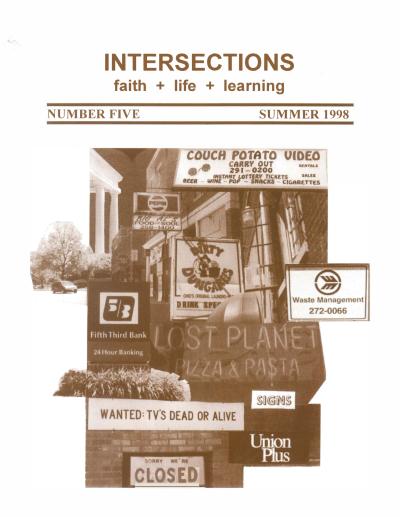 Article
The Quest Of The Historical Jesus: Problem & Promise
Robert W. Funk
No. 5 · Summer 1998
Funk, founder of the Jesus Seminar, frames the quest as the search for reliable data amid twenty-two ancient gospels and as a confrontation among three “parties”—the Jesus Party, the Apostolic Party, and the Bible Party. He surveys the Seminar’s 1985–1998 work (The Five Gospels, The Acts of Jesus, the color-coded reports), defends the synoptics over John, the priority of Mark, the Sayings Gospel Q and the Gospel of Thomas, and argues that a recovered Jesus—a teacher of a trust ethic, celebration, a kingdom without social barriers, a society without brokers, without cult rituals—may serve as catalyst for a sweeping third-millennium reformation that purges the “clogged arteries” of institutional Christianity.
-
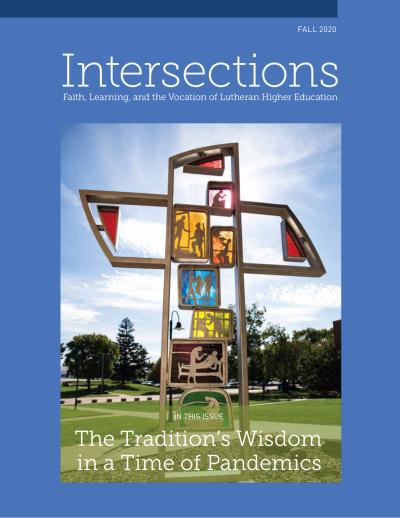 Article
Finding Purpose in Chaos: Reflection In and Beyond the Public Health Classroom
Lena R. Hann
No. 52 · Fall 2020
When the pandemic hit her new public health professionalism course, Hann recalibrated her teaching from the “how” of professional preparation to the “why” of vocational reflection — and recounts how Augustana public health students and alumni found purpose in the chaos through food banks, disaster response, palliative care, and research on health inequities.
-
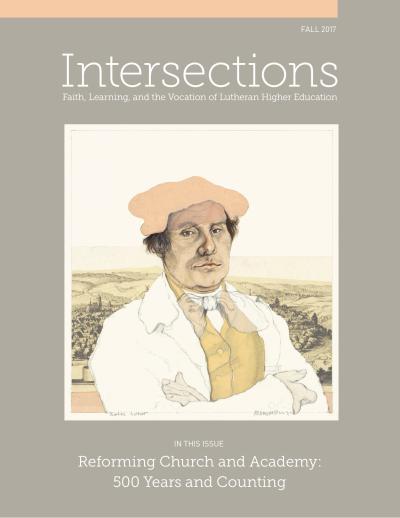 Article
Why Martin Luther and the Reformation Matter 500 Years Later
Kathryn A. Kleinhans
No. 46 · Fall 2017
Adapted from a 2017 address to Wartburg College’s entering class, Kleinhans surveys Luther’s lasting impact in vocation, education, social service, and the necessary work of repentance — closing with the Lutheran World Federation’s Windhoek assembly and the Reformation World Exhibition’s call to live reform forward into the next 500 years.
-
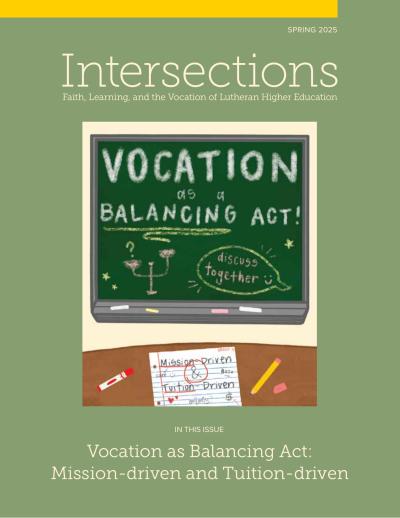 Institutional Focus
So That All May Belong: Lutheran Roots for Diversity, Equity, Inclusion, and Justice
Altheia Richardson, Angie Hambrick, Caryn Riswold, Colleen Windham-Hughes, Deanna Thompson, Marcia Bunge, Robert Clay
No. 61 · Spring 2025
22 min audio
The full NECU statement grounds DEIJ work in Luther’s 16th-century reforms and Lutheran theological claims about the image of God, equal dignity, and the limits of human knowing — offering definitions, Lutheran roots, and calls to action for diversity, equity, inclusion, and justice, with belonging as the outcome of DEIJ at work.
-
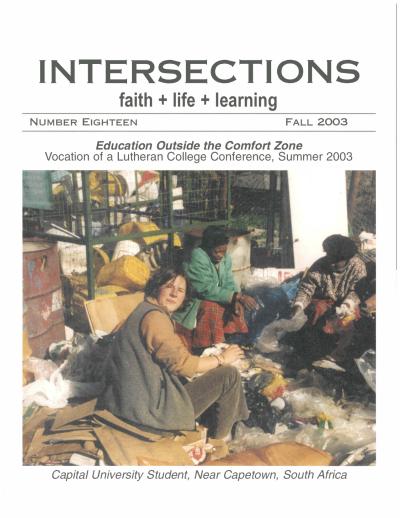 Article
Service Beyond the Comfort Zone
Kathryn Wolford
No. 18 · Fall 2003
Wolford names economic globalization and the growth of civil society as the two issues shaping Lutheran World Relief’s mission, illustrating with the Guatemalan storekeeper undercut by subsidized “gringo” chickens, fair-trade coffee and chocolate campaigns, and Charles Onyango-Obbo’s warning about anti-terrorism laws in fragile African democracies. Drawing on Darrell Jodock, Art Simon, and the Good Samaritan, she frames the global vocation of Lutheran colleges as inviting students past comfort zones of race, class, ethnicity, and ideas through service-learning that links mercy and justice, and closes with a concrete LWR partnership invitation including site visits, internships, fair-trade campus campaigns, and the “A Place for Peace in Colombia” advocacy program.