Why Diversity and Civic Engagement Don't Talk to Each Other on College Campuses: The Need for Public Work
Intersections No. 25 · Spring 2007
Unless our children begin to learn together, there is little hope that our people will ever learn to live together. Milliken v. Bradley 1974.
Thurgood Marshall’s one simple sentence captures a vexing problem for American higher education: how do we educate for a multicultural society in a way that recognizes our need to address common problems? This task requires striking a balance between recognizing and affirming difference (learning together as learning from each other) and encouraging commonality and collaboration (living together).
These two tasks are presumably carried out through university diversity and university civic engagement initiatives. Both of these efforts are socially and politically fashionable on college campuses. On the one hand, universities (and other social institutions) purport to be engaged in creating “diverse learning environments” that reflect the complexity and pluralism of the society in which we live. On the other, public universities are increasingly justifying public funding by emphasizing their civic missions. Many campus efforts are designed to foster a culture of “civic engagement” where young people come to recognize their linked fate (Dawson) and get involved in their communities to solve common problems.
Despite the obvious interdependencies between these two efforts, they are often conceptually detached from one another in practice on college campuses. Civic engagement and its progeny—service learning, community service, and university-community partnerships—often proceed on different tracks than campus diversity initiatives, including multicultural clubs and events, and co-curricular programming.
As McTighe-Musil observes, the explosion of civic engagement initiatives on college campuses has occurred without a serious discussion of how diversity and otherness related to addressing social issues. In her view, “the language of diversity has been decoupled from the language of civic engagement” at colleges and universities (18). This decoupling of diversity and civic engagement as concepts means both efforts proceed without serious reflection on how they work together to promote common ends. Diversity work without a solid foundation in a civic purpose becomes little more than, what I call, menagerie diversity, or an examination of difference that ends at the classroom bell or when the mandatory campus event ends. Conversely, civic engagement efforts that do not seriously consider diversity run the risk of merely reaffirming pre-existing structures of injustice and exclusion (Stephan; Eby; Hepburn, Niemi and Chapman).
This essay thus engages the question of why diversity and civic engagement initiatives on college campuses often proceed on parallel tracks. I argue that this disconnect exists primarily because both diversity and civic engagement efforts are undergirded by thin or pluralist notions of democracy that emphasize adversarialism and rights-claims rather than a strong notion of democracy that encourages deliberation, collaboration and civic obligation (Barber). To the extent that civic engagement encourages students to work collaboratively, it is largely in voluntaristic ways that do not challenge underlying pluralist assumptions about what it means to be a citizen of the United States and the world.
In this article, I illustrate how both diversity and civic engagement efforts reinforce a thin view of democracy. I then review the empirical research to highlight the shortcomings of a thin approach to civic engagement and diversity practices. I conclude by advocating for a public work (Boyte Everyday Politics) perspective as a means to linking diversity and civic engagement and discuss the implications for Lutheran higher education.
Thin vs. Strong Democracy
Both civic engagement and diversity have underlying socio-political assumptions that motivate their work. Guinier calls the process of constructing a freshman class at colleges and universities a public act that either challenges or reinforces current structures of power and oppression. Those engaged in diversity and civic engagement efforts are similarly engaging in political actions. While institutions differ in the actual practice of diversity and civic engagement, there are overarching trends that inform institutional efforts. I argue that, in general, both efforts are tied to a thin version of democracy.
Thin democracy is a term coined by Benjamin Barber to describe what he viewed as an individualistic and interest-based notion of citizenship and social relations. Barber argues that the Lockean tradition of the state as a guarantor of fundamental liberties through a contractual relationship with the citizen encourages a “thin” perspective on the individual’s role vis-à-vis government. Government in this instance is presumed to be in need of “watching” from an adversarial public. The extent of civic responsibility in a thin democracy is to keep government from infringing upon the individual’s fundamental liberties.
A thin democracy also reinforces pluralist notions of democracy. A pluralist perspective presumes individuals and groups in the political sphere present a neutral government with competing claims and allow government to arbitrate among them (Truman). Glendon refers to this tendency in American politics as a rights talk culture that emphasizes “rights assertion over reason giving,” “individual demand vs. collective responsibility,” and “debate over dialogue.” A protective and pluralist view of democracy reinforces a “thin” (i.e. instrumental) notion of the individual’s obligation to his or her fellow citizens..
Barber argues that democratic states need vibrant civil societies that encourage a “strong citizenship” based on identifying shared problems, seeking common ground and working towards the common good. He emphasizes moving from a moribund civic sphere where state and market make the majority of decisions, what he calls a “politics of zoo-keeping,” towards a politics of amateurs “where every man is compelled to encounter every other man without the intermediary of expertise” (152). The emphasis in strong democracy is developing participatory habits by creating structures for citizen deliberation and decision-making.
The Decline in Political (not Civic) Engagement
The decline in democratic participation (thin or strong) is particularly acute among college-age youth. To the consternation of democratic theorists, there has been a steady decline in youth political engagement in the last three decades (Zukin). Despite the upsurge in voting during the 2004 and 2006 election cycles, young people report significantly less interest in politics than either previous generations or their peers (Zukin). A 2002, study found that only 24% of 18-24 year olds reported “following government and public affairs most of the time” (Keeter et al.). Perhaps more alarming are the decreased levels of social trust among young people. The study found that 70% of 18-25 year olds agreed with the statement “most people look out for themselves,” compared to 40% of persons 65 and over (Keeter et al.). A majority (56%) agreed that “most people would take advantage of you” compared to 29% of persons over 65.
What is curious is that this decline in civic-mindedness is happening at the same time a “civic engagement” revolution is happening in U.S. high schools and colleges. In 2002, three out of four high school students and about two out of three (65%) of college students say that their school arranges or offers volunteering opportunities (Keeter et al.). Similarly, one out of five (19%) college seniors participated in service learning in 2004. This was up from one out of eight (12%) in 1999 (Kuh). This increase in civic engagement opportunities is driven by the documented effectiveness of service and experiential learning programs in enhancing student learning (Battistoni).
Not surprisingly, given the effort put forth by secondary and post-secondary institutions, young people report levels of volunteerism comparable to older cohorts. In 2006, 15-25 year olds were more likely than older cohorts to have volunteered in the last twelve months (Keeter et al.). Over one-third (36%) of 15-25 year olds had volunteered in the last twelve months compared to 32% for persons over twenty-five. Evidence suggests that people who engage in mandatory service learning projects go on to volunteer at greater levels than those who do not (Lopez et al.). Thus at first glance, it would seem that students involved in service learning are developing habits that lead to more political engagement in a strong democracy.
However, the upsurge in volunteerism has not brought with it an increase in political engagement. Why is this? In the same 2006 survey, only 13% of young people ages 15-25 who had volunteered in the last twelve months reported volunteering for a “political group” (Lopez et al.). This is because community service might connect young people to others in their community, but is does nothing to alter their fundamental understanding of the political system and their role therein.
Levels of political engagement among young people could be low because there is a time lag between doing service learning and civic engagement projects and translating those civic skills into the political sphere. Perhaps if we check back in ten years, this generation will be as politically active as their grandparents’ generation. This may turn out to be the case. Young people’s levels of social trust and their attitudes towards citizenship suggest, however, that the larger culture is reinforcing a sense of atomism that is difficult for campus service projects to combat. Lopez et al. found that only 38% of young people thought that being a citizen entailed a sense of responsibility (as compared to 60% of people over forty years of age). The typical view of young people was that being a citizen meant being a good person and following the law (Lopez et al.).
“The larger culture is reinforcing a sense of atomism that is difficult for campus service projects to combat.”
Given the data, it would appear that civic engagement efforts on college campuses do not appear to be altering a thin view of citizenship. I argue that if civic engagement efforts hope to produce democratic citizens, they must explicitly challenge thin notions of democracy. As Theiss-Morse and Hibbing recently suggested, it may be challenging, if not impossible, to develop democratic habits through volunteerism, largely because volunteerism does not necessarily promote or teach democratic values of deliberation, compromise and conflict-resolution. One way that campus civic engagement efforts can provide citizens with these vital democratic skills is by being deliberate about combining civic engagement with diversity.
Diversity Work and Thin Democracy
The American Association of Colleges and Universities statement on diversity suggests that diversity is to be centrally linked to civic engagement. Its statement calls on universities to deploy “diversity as an educational asset for all students, and prepare future graduates for socially responsible engagement in a diverse democracy and interdependent world” (AACU “Statement on Diversity”). Inherent in the term “diverse democracy” is recognition that engagement with otherness is important for democratic practice. These efforts seem to be complementary. Just so, a number of amicus briefs in the Grutter v. Bollinger Supreme Court decision on affirmative action at the University Michigan Law School argued that educating citizens for a diverse society served as a “compelling governmental interest” needed to support affirmative-action programs.
Indeed, diversity serves a great many pedagogical purposes. It serves to enhance cognitive complexity among those exposed to “diverse courses” (Antonio et al.), it leads to greater empathy and openness to other views (Astin), and it provides students with the cultural competency needed to function in a diverse workforce (Carnevale).
The academy, however, is unsure how to “deploy diversity” toward the end of training democratic citizens. A recent call for papers to an American Association of Colleges and Universities conference on the intersections of diversity and civic engagement suggests as much:
The Academy has witnessed a significant expansion of innovative civic engagement programs in recent years, driven by student interest, community needs, social inequities, new understandings about teaching and learning, a growing commitment to social responsibility. At the same time, decades of work in diversity and global education driven by similar forces and committed to similar goals have often developed on separate tracks (AACU “Call for Papers”).
The presumption is that increased exposure to otherness translates into increased tolerance towards out-groups which will lead to more acceptance of pluralism and difference in a democracy. Indeed, as diversity initiatives have increased on college campuses, so too have tolerant attitudes. Keeter et al. found greater acceptance of gay marriage and immigrants among people aged 15-25 than older cohorts. This tolerance is reflected in a number of attitude surveys that show greater affinity for once taboo subjects like inter-racial dating, gay marriage and immigrants.
However as important as tolerant attitudes are, it is not altogether clear that they translate into cross cultural engagement. Residential segregation patterns across the United States have changed only incrementally since the 1960s (Adelman). Driven by persistent residential segregation, public school systems in the United States are in the process of re-segregation (Orfield and Yun). Two current cases before the U.S. Supreme Court, Parents Involved in Community Schools v. Seattle School District No. 1 and Meredith v. Jefferson County Board of Education, designed to provide remedies for de-facto segregation, are likely to deem voluntary desegregation programs unconstitutional.
“This evidence presents a challenge to linking diversity to civic engagement.”
Recent work suggests that an “add diversity and stir” notion leads to negative effects on civic engagement. Research from the civic engagement benchmark survey reveals that people in diverse communities are less trusting of others, more personally isolated, had lower levels of political efficacy, and had fewer acquaintances across class lines (Saguaro). On college campuses, as every diversity officer knows, there is an inherent tendency to form friendship bonds based on propinquity, or shared likeness. Maramos and Sacerdote found in their study of social networks at a small liberal arts college in the Northeast that race was a greater determinant of social interaction than common interests, majors, or family background.
This evidence presents a challenge to linking diversity to civic engagement. Why do people report increased levels of tolerance for other groups but are not any more disposed to want to interact with them? Again, we must return to the thin notion of democracy. A view of democracy that treats diversity as a set of competing rights claims that should be respected rather than an obligation to engage each other to explore areas of commonality and pursue the common good does not change the underlying structure of society.
Undoubtedly, making people aware, particularly white males, that “race” and “gender” are phenomena that structure the social world is important work. But is it insufficient to prepare young people to address looming social problems. Making students aware of “isms” and hoping that by some alchemy, students from different racial and ethnic backgrounds have the tools to, as Richard Rorty puts it, “achieve our country,” is misguided.
While students are learning all these “isms” in diversity courses (hopefully), they are also being asked to engage with a political system that emphasizes conflict over consensus and claims-making over collaboration. Failing to engage the underlying political factors upon which issues of race, gender, class, etc. are played, means leaving students to ponder the tip of the iceberg they can see above water.
Merging the Civic and the Multicultural Through Public Work
How do we make civic engagement and diversity conform to notions of strong democracy? I argue that both initiatives must be tied together through the notion of public work. Boyte defines public work as
sustained effort by a (diverse) mix of citizens whose collective labors produce things of common and lasting civic value. Public work solves common problems and creates common things. It is also cooperative work by “a public,” a mix of people whose interests, backgrounds and resources may be quite different. And it is work that creates “public goods,” things of general benefit and use (“Civic Populism” 7).
This emphasis on diversity as public work links it to civic engagement by emphasizing diversity as practice rather than as an intellectual exercise. This perspective does not replace diversity initiatives on college campuses, but rather integrates them intentionally by creating contexts on campuses and in communities where diverse students work to address common problems (providing day care services, building a well, putting on a play, teaching Shakespeare to high school students).
Far from being a “whitewashing” of differences, a public work perspective that takes diversity seriously engages students and communities without ignoring the group identities that give meaning to them. Diversity brings to collective activity the innovative capacities of “weak ties” necessary for groups to address complex, evolving problems (Granovetter). A public work approach focuses on a definition of the political based on “negotiating plurality” and finding common solutions rather than fostering adversarialism or paternalism (Boyte Everyday Politics).
Constructing public work oriented assignments emphasizing deliberation and collaborative work is made significantly easier by the advent of social networking websites like Wikipedia or De.licio.us that allow users to create on-line group products. The Web can be an effective tool for facilitating community-based action research, engaging students in organizing campus or community-wide town halls, or study circles.
The Role for Lutheran Colleges and Universities
Lutheran colleges and universities, with their emphasis on vocation as a call to the world rather than away from it, are better positioned to bridge the divide between diversity and civic engagement than both public institutions with their wariness of values-based education and more fundamentalist-oriented, religiously-affiliated institutions that emphasize a retreat from the secular rather than a dialogue with the secular (Christenson).
The challenge of getting our students to both “learn together” and “live together” can be both frustrating and invigorating. If we hope to move our students beyond recognizing injustice and intolerance towards acting on that knowledge through the political process, we must challenge our own assumptions of what it means to be a citizen in the United States. Moreover, it requires us to reflect on how that notion of citizenship affects those outside of the United States.
It also means we move ourselves beyond a “thin” view of both diversity and civic engagement. Too often we repeat mantras of “engaging with otherness” that we in the academy do not heed. If we do “engage with otherness” it is an otherness with which we are comfortable. We should not be immune from engaging in public work with those whom we might disagree or feel threatened.
This is easier to say than to realize. Private institutions, particularly smaller liberal arts institutions, are heavily dependent upon private benefactors for their survival. As a result, emphasizing a strong democracy that might motivate citizens to participate in ways contrary to those favored by sought after benefactors is a source of tension for institutions. A participatory culture that engages students in collaborative decision-making might produce outcomes that abut the interests of corporate capital. All institutions, including ELCA affiliated ones, must ask themselves how they will address potential conflicts between donor interests and pedagogical practice.
Furthermore, public work is hard work. As faculty at some teaching-oriented colleges are aware, innovation is not always rewarded if it results in poor student evaluations. Those who have entered the exciting yet challenging world of service learning pedagogy will tell you that it takes a great commitment of time on the part of faculty to make it work. At some places, it may not be worth the time and effort. Certainly at Research-1 universities where teaching is not a priority, there is little incentive to bring public work into the curriculum. Institutions like ours can serve a vital niche by creating the institutional infrastructure to support faculty in their efforts to link diversity and civic engagement through public work.
Works Cited
Adelman, R. “The Roles of Race, Class, and Residential Preferences in the Neighborhood Racial Composition of Middle-Class Blacks and Whites.” Social Science Quarterly 86.1 (2005): 209-28.
American Association of College and Universities. “Statement on Diversity.” Retrieved March 2006. <http://www.aacu.org/issues/diversity/>.
———. “Call for Papers: Civic Learning at the Intersections: U.S. Diversity, Global Education, and Democracy’s Unfinished Work.” Retrieved March 2007. <http://www.aacu.org/meetings/civic/index.cfm>.
Antonio, A., et al. “Research Report Effects of Racial Diversity on Complex Thinking in College Students.” Psychological Science 15.8 (2004): 507—10.
Astin, A. “Diversity and Multiculturalism on Campus: How Are Students Affected?” Change 25.2 (1993): 44-49.
Barber, B. Strong Democracy: Participatory Politics for a New Age. Berkeley: U of California P, 1984.
Battistoni, R. Civic Engagement Across the Curriculum: A Resource Book for Service-learning Faculty in All Disciplines. Providence, RI: Campus Compact, 2002.
Boyte, H. Everyday Politics: Reconnecting Citizens and Public Life. Philadelphia: U of Pennsylvania P, 2004.
———. “Civic Populism.” Perspectives on Politics 1 (2004): 737-42.
Carnevale, A. “Diversity in Higher Education: Why Corporate America Cares.” Diversity Digest 3.3 (Spring 1999) <www.diversityweb.org/Digest/Sp99/corporate.html>.
Christenson, Thomas. “Brief Comments on ‘Our Calling in Education: A First Draft of a Social Statement.’” Journal of Lutheran Ethics 6.6 (2006) <http://www.elca.org/jle/article.asp?k=618>.
Dawson, M.C. Behind the Mule. Princeton, NJ: Princeton UP, 1994.
Eby, J. “Why Service-Learning Is Bad.” March 1998. <http://www.messiah.edu/external_programs/agape/service_learning/articles/wrongsvc.pdf>.
Glendon, M. Rights Talk: The Impoverishment of Political Discourse. New York: Free Press, 1991.
Granovetter, M. “The Strength of Weak Ties: A Network Theory Revisited.” Sociological Theory 1:1 (1983): 201-33.
Grutter v. Bollinger (02-241) 539 U.S. 306 (2003).
Guinier, L. “Admissions Rituals as Political Acts: Guardians at the Gates of Our Democratic Ideals.” Harvard Law Review 117.1 (2003): 113-224.
Hepburn, M., R. Niemi, and C. Chapman. “Service Learning in College Political Science: Queries and Commentary.” PS: Political Science and Politics 33.3 (2000): 617-22.
Keeter, S., et al. The Civic and Political Health of the Nation: A Generational Portrait. College Park, MD: The Center for Information and Research on Civic Learning and Engagement (CIRCLE), 2002.
Kuh, G. The National Survey of Student Engagement: The College Student Report. Bloomington, IN: Indiana University Center for Postsecondary Research and Planning, 2000.
Lopez, M., et al. The 2006 Civic and Political Health of the Nation. College Park, MD: The Center for Information and Research on Civic Learning and Engagement (CIRCLE), 2006. <http://www.civicyouth.org/research/products/youth_index_2006.htm>.
Marmaros, D., and B. Sacerdote. “How Friendships Form.” Quarterly Journal of Economics 121.1(2006): 79-112.
Milliken v. Bradley. (1974) 418 U.S. 717, 783.
McTighe-Musil, C. T. “The Civic Work of Diversity.” Diversity Digest 9.1 (2005), 1-11.
Orfield, G., and J. Yun. Resegregation in American Schools. The Civil Rights Project. Cambridge, MA: Harvard U, 1999.
Rorty, R. Achieving Our Country: Leftist Thought in Twentieth-century America. Cambridge, MA: Harvard UP, 1998.
Saguaro Seminar. “Social Capital Community Benchmark Survey: Executive Summary.” Cambridge, MA: John F. Kennedy School of Government, Harvard U, 2000. <http://www.cfsv.org/communitysurvey/results.html>.
Stephan, W. “The Contact Hypothesis in Intergroup Relations.” Group Processes and Intergroup Relations 9 (1987): 13-40.
Theiss-Morse, E., and J. R. Hibbing. “Citizenship and Civic Engagement.” Annual Review of Political Science 8 (2004): 227-49.
Truman, D. The Government Process. New York: Knopf, 1951.
Zukin, C. A New Engagement? Political Participation, Civic Life, and the Changing American Citizen. Oxford: Oxford UP, 2006.
-
 Editorial
From the Publisher
Arne Selbyg
Selbyg notes that most papers in this issue grew out of a pan-Lutheran conference organized by the Association of Lutheran College Faculties in fall 2006 rather than the annual Vocation of a Lutheran College conference, and argues that the ELCA’s ecumenical posture—truthful but open to learning from others—is a good foundation for institutions of higher education whose faculty likewise profess while remaining subject to change based on new research and insights.
-
Editorial
From the Editor
Robert D. Haak
Haak frames the issue around the question of what holds the twenty-eight ELCA colleges together amid their geographic, economic, and theological diversity, introducing Mark Hanson’s address to the assembled college presidents, Randall Balmer’s outsider perspective on the commonalities of Christian liberal arts, José Marichal and Pamela Brubaker on diversity rooted in community and globe, Storm Bailey’s argument that being Lutheran is precisely what makes us embrace diversity, and Jaime Schillinger’s St. Olaf chapel reflection on the formative power of worship and liturgy.
-
Article
Reflections on Our Shared Commitments
Mark S. Hanson
Originally delivered to the Lutheran Educational Conference of North America in March 2007, Hanson’s address describes the ELCA as “an ecology of interdependent ecosystems” and locates the church’s relationship to its twenty-eight colleges and universities in a shared mission rather than in older anxieties about church-relatedness. Drawing on Wittenberg’s Lutheran Identity Study, Augustana’s “Five Faith Commitments,” Pamela Jolicoeur’s Concordia address, W. Robert Connor on “big questions,” Joseph Sittler on grace, Walter Brueggemann on fear, Jonathan Strandjord on being “other-wise,” and Cynthia Moe-Lobeda’s Public Church for the Life of the World, he names four marks of shared mission: communities of free inquiry, encouragement of religious expression in a diverse society, education for the common good, and the formation of leaders for church and religious communities worldwide.
-
Reflection
Currents
Jaime Schillinger
Preached in St. Olaf chapel on March 29, 2005, Schillinger reads three “currents” pulling on her hearers—Minnesota spring, the academic year’s final stretch, and Holy Week’s passion and resurrection—against poetic voices from ee cummings, Gerard Manley Hopkins, and Edna St. Vincent Millay, before turning to the Song of Songs to suggest that this nexus calls students into the rhythms of love, awakened desire, and an elusive, unresolved promise that animates academic, spiritual, and vocational search alike.
-
Editorial
Guest Editor
Madeleine Forell Marshall
Marshall introduces the four papers in this issue from the 70th annual meeting of the Association of Lutheran College Faculties, held at California Lutheran University in October 2006 on the theme “Identity and Diversity in the Lutheran College.” She notes a geographic pattern—the two East Coast contributors (Balmer and Bailey) defend Christian liberal arts against perceived suspicion, while the two Westerners (Marichal and Brubaker) treat Lutheran identity as advantage and diversity as a Lutheran given—and announces the 2007 ALCF meeting at Newberry College on “Beyond ‘Whatever’: Values Based Learning in Lutheran Higher Education.”
-
Article
Sojourners in a Pluralistic Land: The Promise and Peril of Christian Higher Education
Randall Balmer
Balmer, a Barnard scholar of American evangelicalism reared in evangelical parsonages and formed at Trinity College in the Chicago suburbs, defends public education even as he champions Christian higher education as a “halfway house” for students moving from religious subculture into a pluralistic world. Drawing on his own undergraduate experience, his books Mine Eyes Have Seen the Glory and Thy Kingdom Come, and a chastening visit to Patrick Henry College, he names three perils of Christian higher education—the Scylla of secularism (intellectual arrogance allergic to piety), the Charybdis of sectarianism (intellectual dishonesty as exemplified by intelligent design’s special pleading), and insularity—and prescribes mentors, primary sources, internships outside the subculture, and a broader, intergenerational pluralism on campus.
-
Article
Lutheran Identity, Academic Integrity, and Religious Diversity
Storm Bailey
Bailey argues that one might rightly say of a college “that’s a pretty good school because it’s religious,” defending the proposition under three headings: academic and curricular virtues, free inquiry, and religious diversity. Drawing on Mark Schwehn’s Exiles from Eden, Richard Hughes on the Lutheran tradition’s “most potent theological resources” for the life of the mind, Parker Palmer, Lendol Calder, Mill’s On Liberty, Newman’s Idea of a University, and the AAUP’s 1940 Statement, he proposes a “critical mass” alternative in which the Lutheran commitment to truth-seeking and self-critique itself requires—rather than tolerates—a religiously diverse faculty whose opposing voices are needed for the mission to flourish.
-
Article
Rich and Poor in an Era of Globalized Religion and Economies: Challenges to Lutheran Colleges
Pamela K. Brubaker
Brubaker opens with two World Council of Churches communion stories—a generous Aymara potato meal in Bolivia and a gated invitation-only lunch at a prosperous immigrant German Lutheran church in Brazil—to frame the question of which stance Lutheran colleges will adopt toward diversity. Drawing on Richard Hughes and Ernest Simmons on Lutheran “ecumenical confessionalism,” Linell Cady, Ulrich Beck, Held and McGrew, the World Bank’s 2006 Equity and Development report, Mark Juergensmeyer’s Global Religions, Harvey Cox on the Market as God, the WCC’s “economy of life” / AGAPE document, and Larry Rasmussen on universal human rights, she argues that part of the academic work of Lutheran colleges is to educate for critical citizenship by questioning neo-liberal assumptions and equipping students to claim social, economic, cultural, civil, and political rights for the whole human family.
-
 Article
The Critical Role of Lutheran Higher Education in the Age of Artificial Intelligence
Jose Marichal, Maya Goehner, Tyler Haug
No. 59 · Spring 2024
A Cal Lutheran political science professor and two of his students draw on Rooted and Open to argue that Lutheran higher education is uniquely positioned to stake out a middle path between AI utopianism and AI doom — cultivating a “healthy sense of human limit,” resisting data colonialism, and forming students to see the neighbor rather than the enemy as the world becomes increasingly synthetic.
-
 Article
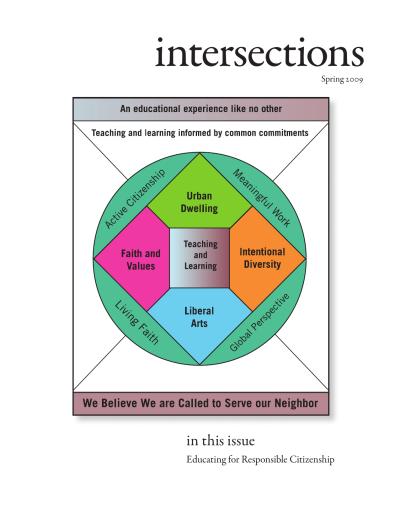
Students in the Cloud: Creating Digital Citizens
Jose Marichal
No. 29 · Spring 2009
Marichal weighs the utopian and dystopian views of the “networked information economy,” drawing on Yochai Benkler, Manuel Castells, Henry Jenkins, Cass Sunstein, Robert Putnam, Nicholas Carr, and Andrew Keen to chart the promise and peril of life “in the cloud,” and proposes Aristotle’s intellectual virtue of phronesis—developed through Hubert Dreyfus’s five stages of skill acquisition—as the goal of digital citizenship for college faculty and their students.
-
 Editorial
From the Publisher
Arne Selbyg
No. 22 · Spring 2006
Selbyg notes that both the ELCA and Intersections have undergone major changes this year—the Division for Higher Education and Schools is gone, replaced by the Educational Partnerships and Institutions group within the Vocation and Education unit, and the journal has a new editor (Robert Haak), a new home at Augustana College, a new printer, and a new design. He commends the issue’s focus on human sexuality and points readers to the first draft of Our Calling in Education.
-
 Article
Lutheran Education in the None Zone
Samuel Torvend
No. 23 · Summer 2006
Torvend, Associate Professor of Religion at Pacific Lutheran University, argues that any ELCA social statement on education must speak not only to those raised within the cultural and theological traditions of ELCA Lutheranism but also to the diverse communities of the “none zone” — the Pacific Northwest and other regions where religious affiliation is increasingly unaffiliated. The statement must therefore equip Lutheran colleges, congregations, and schools for engagement with religious pluralism and cultural diversity rather than presuming a Lutheran cultural baseline.
-
Article
Sexuality over the Lifespan—Social Trends Pose Moral Dilemmas for Communities of Faith
Adina Nack
No. 22 · Spring 2006
Nack, a sociologist who presented to the ELCA Task Force for Studies on Sexuality, surveys empirical research on three life-stages flagged by the Task Force as particularly contested—premarital sexuality among adolescents and young adults, sexuality after divorce and within single parenting, and sexuality in late adulthood. Drawing on the Alan Guttmacher Institute, the Office of the Surgeon General, AARP, National Council on the Aging, and the World Health Organization’s 2002 definition of sexual health, she closes each section with questions about the church’s role in education, blessing of committed nonmarital relationships, and dismantling stereotypes about aging and sexuality.
-
 Article
Wilhelm Löhe and Higher Education
David Ratke
No. 30 · Fall 2009
Ratke recovers the educational vision of Wilhelm Löhe (1808–1872), spiritual father of Wartburg College and Wartburg Seminary, drawing on Löhe’s “Aphorismen über Schule und Schulunterricht” and other writings to argue that education is about the formation of whole persons by whole teachers in whole institutions, that all education is religious and never neutral, and that education is for eternity as well as the present — a vision in which the values of Christianity sanctify the so-called worldly means of education.
-
 Article
Views on Flourishing After the Age of Roe
Caryn Riswold, Mary J. Streufert
No. 57 · Spring 2023
Riswold and Streufert reflect on the Radcliffe Institute’s January 2023 conference “The Age of Roe” and argue that the ELCA’s 1991 Social Statement on Abortion and its 2019 statement Faith, Sexism, and Justice offer Lutheran higher education a third way to approach reproductive justice grounded in serving the neighbor so that all may flourish.
-
 Article
Finding Purpose in Chaos: Reflection In and Beyond the Public Health Classroom
Lena R. Hann
No. 52 · Fall 2020
When the pandemic hit her new public health professionalism course, Hann recalibrated her teaching from the “how” of professional preparation to the “why” of vocational reflection — and recounts how Augustana public health students and alumni found purpose in the chaos through food banks, disaster response, palliative care, and research on health inequities.