Stories of beginnings are, like the fields of force reaching out from the quantum void, vehicles of immense and superhuman power. Just as these fundamental physical forces, which although hidden away deep within the universe’s subconscious, are capable of controlling the actions of galaxies and atoms, mythic stories reach from their primal vortices to exert their forces on our images of ourselves and our sense of order and purpose in the universe. The mythic casts within which we rehearse varied aspects of our always occurring beginnings give shape to life, purpose to action, meaning to living and, when shared by whole cultures or subcultures, sanction to social structures and mores. Such myths have been with us, as near as anthropologists can tell, since the beginning. From the Ennuma Elish to The Boston Tea Party such stories have served to legitimate identities and produce seemingly self-existent frames of reference by which we anchor our thinking and very existence. They also enable us to ignore or subsume the thinking, or even existence of those who differ from us.
On Reformation Sunday as Lutherans we gather to rehearse our foundational myths. We tell the story, in narrative and abstract doctrine, which serves as the basis of our identities and provides the lens through which we view our God, our Church, and those around us. It is a story whose immense force in shaping our lives achieves an inertia in driving us, often unaware, toward the future.
If we are to reflect critically on our Lutheran myths, to judge their power for good or ill, it is important first to note that it is innately human to see the speck in someone else’s eye before noticing the log in one’s own. The other’s1 myth is always easily debunked, seen through. One’s own myths stand as self-evidently true, opaque, obviously just the way things are. It has been easy for most Americans to see the foibles of Marxist economics. Yet a significant majority of us accept the myths of market driven consumer capitalism and its attendant economic theory as simply exhibiting the facticity of universal laws. It is similarly difficult, if not impossible, for us Lutherans to see being simultaneously saints and sinners, or dividing our lives into two paradoxically related kingdoms as anything other than just the way things are. To return to the allusion to Jesus’ words which began this paragraph, “criticism of myths should begin at home,” or, perhaps, “people who live in mythic constructs shouldn’t throw bricks.”
My experience of Reformation Sunday this year began with a disconcerting moment. The celebrant called us to begin worship by saying, “Today the Church gathers to celebrate the Reformation.” Instantaneously I experienced an intellectual vertigo as my mind teetered on the brink of a chasm filled with variant definitions of church. None of my Roman Catholic friends had this particular Sunday marked on their calendars. (They don’t even celebrate Counter Reformation Sunday!) I briefly wondered how many of the world’s Orthodox Christians are aware that a thing called The Reformation took place, or could name its major players. My mind recoiled at the thought that those in the Anabaptist tradition, whose ancestors Lutherans tortured and killed in the name of Jesus had much to celebrate with us. I struggled to try and name even other mainstream Protestant denominations that marked this day with such finely focused festival. I tried desperately to remember from when I was a United Methodist pastor, still blissfully ignorant in his Arminianism that he was predestined to be a Lutheran, if Methodists made much of Reformation Day. But I could not remember having ever told my congregation we had gathered to celebrate Reformation Sunday. Would those in the Reformed tradition be celebrating the same things I was meant as a Lutheran to be celebrating? (And if they did, wouldn’t John Calvin be watching somewhat uncomfortably from Heaven?) What exactly were we celebrating for The Church? And why was I having such a difficult time imagining all the Church as seeing the same (or any) celebratory content in the Reformation? All this flashed through my mind before the Brief Order of Confession, like one’s life replaying itself just before death.
Anyone even slightly aware of ecumenical moves in the past decades will object that this is much too complex a topic to fit between the Greeting and the Brief Order. I have left out a great deal. First, I need to make clear that I am speaking from my experience. My life has played out in formal relationship to four different Protestant denominations (currently ELCA) and in informal relations with many others. I am reflecting on my sense of grass-roots understandings and celebrations of Reformation Sunday, not the way in which this festival Sunday is viewed by clergy types intimate with liturgical calendars and ecumenical committees. Reformation Day does appear on the calendars of a significant number of Protestant churches. However, in a brief and non-scientific survey of on-line calendars I found it often to be printed parenthetically. Lutheran celebration of Reformation Sunday is anything but parenthetical! Thus not being able to recall a single Sunday as a Methodist pastor having formally focused liturgy and sermon on the Reformation, even though it was most likely printed on denominational calendars, is not surprising. Methodists just don’t identify with the Reformation as Lutherans do. And in meetings with clergy colleagues, I don’t remember it as topic of conversation. (“I need new ideas for Reformation sermons. Got any?”) In my five years as a member of the Church of England, All Saints always trumped the Reformation. (I am, tongue-in-cheek, doubtful that many Lutheran laity even know that All Saints is a liturgical day!)
I am certain that my Roman Catholic friends are unaware of our premier Sunday for similar reasons. Yes, a year ago Roman Catholics and Lutherans signed an historic accord. Catholics now have on their liturgical calendar “Reformation/Reconciliation” Sunday. Yet when I talk with real Catholics who fill Roman pews on Sundays it is not in their awareness. If it is being celebrated in their churches it went unnoticed by large numbers. Other celebrations trump their awareness of our Lutheran day.
These thoughts having interfered with listening to the readings the sermon pulled me back into the service and answered many of my questions, at least the ones about what we were celebrating. It was an articulate and creative rehearsal of the gifts Luther brought to the Church.2 It laid out in enlightening prose and apt metaphor issues of corruption set against theological insights of grace and faith which exposed the abuses. The speaker’s story told of the restatement of an age-old Pauline-Augustinian theology which was God’s prescription for healing the abuses that had crept into the Church. The sermon went on to ask the ongoing question of Lutheranism, “Given such underserved grace freely bestowed upon the vilest of sinners who continue to be sinners, just how is it we live out the need to behave ourselves?” We do so in the paradox, of course, of being simultaneously both saints and sinners. We live the life of grace in the struggle of being what we are not. All good Lutheran stuff!
My (formerly Wesleyan) heart was strangely warmed, if not perfected. This was a festival Sunday. We genuinely have much to celebrate. The world was righted, the vertigo gone. Once again neatly opaque my Lutheranism anchored my universe. Or did it? Experiences of seeing through are not so easily exorcised. The initial experience of this festival Sunday would not go away, even though it struck such a convenient paradoxical balance with the exposition of Lutheran theology.
The real issue is, of course, not the importance of the Reformation and Luther’s magisterial place in starting it, nor is the issue the choice of a festival day to focus such importance. Luther must be somewhere in anyone’s list of top ten theologians. He ranked quite high in Time Magazine’s list of most important people for the last millennium (but then so did Aquinas). Although Protestantism could have arisen from other persons and events, we cannot ignore that it in fact began with Luther. All Protestants owe him a debt. Catholics cannot ignore the historical impact he has had on their beliefs and structures as well. All of this goes without saying.
The issue is how the myth is told, framed, celebrated; it is the significance drawn from the story. Roman Catholics almost certainly tell the story with an emphasis on the present, and reconciliation.3 It is a day to celebrate healing of past wounds and misunderstandings. From a Catholic theological perspective it is not that Catholic doctrine has changed. It is the recognition that common vocabulary and frameworks now exist which allow us to see that we were always trying to say the same thing, but in differing keys. The Reformation was, in one sense, a talking-past one another. We now celebrate talking-to one another. My experience of Lutheran celebrations is quite different. The focus tends to be on the past. The locus of holiness and sanctity is on a “then,” which we try to recapture for our “now.” Some Lutheran laity (and some clergy) I have spoken with saw the Joint Declaration more as a they-finally-got-it, a see-we-were-right-all-along. The myth, even after the Joint Declaration, was celebrated to confirm superiority with its attendant separation.
Although told as if this was a new experience this Reformation Sunday, in truth the story reveals an ongoing struggle I have with my Lutheran identity. I am in many ways disadvantaged in achieving the elusive goal of a being a good Lutheran. One is that I am a biblical scholar/theologian. I live in a professional relationship with a book that continues to astound me with its ability to say one thing in a first reading and something very different in the second or hundredth reading. A multivalent (perhaps, infinitely-valent) God uses the Bible I read to consistently step outside my hermeneutical frames to say the unexpected, to say things my theologically preconceived gospel sometimes says God can’t say. The God of the texts I read professionally is sometimes a Jew, or a Baptist, sometimes a Catholic, often Orthodox, and frequently Lutheran, but never settles into any one viewpoint. Seeing both, indeed all, sides of a text is a curiously de-centering, unnerving practice. And this cubist dismantling of theologically unified views to see all sides of a thing also applies to how I look at the founding myths of Lutheranism in its reading/telling of the theological and historical stories of the Reformation.
A curious feature of foundational myths is the way in which they frequently hide or obfuscate a dark side of the events they celebrate. Those of us who came of age during Vietnam and Watergate will never again hear the myths of American origins in the same way. This is true even if, post 9/11, we might like to recapture some small part of a patriotic naivete. The realities behind our founding national myths were, in fact, less about freedom and justice and more about privileged and advantaged white-males seeking a still more privileged institutional structure to be able to exploit more effectively their advantages over others and the environment than the British Crown and Parliament were willing to allow. Our nation’s founding myths fail to speak of American Patriots set over against American Loyalists and the silencing of the latter in the myth telling process. We silence the Native Americans who fought for the British having prophetically seen that the revolutionary rhetoric of freedom and justice would not be for them. Our stories, in their orthodox form, fail to speak of an uncompromising militant belligerency intent on its own way no matter what. What dark secrets fail to be told in our recounting of the Reformation in its guise as the foundational myth of Lutheranism?
For all the good Luther unleashed, he also helped in birthing unspeakable horrors. He (we Lutherans) was (are) no less culpable in the sin of schism than was Pope Leo. The oft trumpeted sincerity of Lutherans in efforts to avoid schism does not lessen the culpability. In the end both sides schismed. It takes two to tango. This is true, even if in historical judgment, as a post-colonial analysis might suggest, a greater burden is placed on the Papacy because of its institutional power. The Pandora’s Box, Luther himself only wanted to crack open, was opened nonetheless. In the wake of the Reformation the Body of Christ has been hopelessly fragmented. So much so that one of the chief tasks of post-modern theology has been to remake a vice into a virtue. The Reformation for all its good, spawned more than a century of religious warfare in which millions died in the name of Jesus.4 Protestants killed Catholics, Catholics killed Protestants and everybody killed Anabaptists.5 Even though the historical causation of these events is incredibly complex, it is at least true that this horrendous evil occurred because each side insisted that somehow their reading of God was privileged, their foundational myth alone was sacred.6 They claimed their definition of gospel exhaustive and full to the exclusion of other insights. Europe emerged from the carnage so tired of Christian squabbles and so convinced of the abject failure of Christianity to provide answers to life that it has yet to recover from the ensuing wave of secularism. From any viewpoint, the Reformation was a mixed bag. Indeed, a Lutheran take may be a satisfying analysis. So full of hope, promise and good the Reformation, under the tutelage of human sinfulness, became a tool of both divine grace and demonic hate.
It is also problematic that Luther himself was such a truly mythic figure. Diverse in his thinking, prolific in literary output, shifting costumes throughout life, his theology developing and shifting across his life, and with a flair for flamboyance and over statement Luther’s legendary status even during his lifetime was already writ larger than life. The shear mass of materials, stories and first and second hand accounts creates an historical problem similar to that encountered in attempting to understand Jesus. The discontinuity between the Luther of history and the Reformer of Faith is real, even if Lessing’s great ugly ditch is not quite as great or ugly. As the Father of Protestantism Luther’s person and thought belong not only to Lutherans, but to countless others who follow his legacy.
The diversity of appropriation of both his person and thought mean that there are multiple interpretations of just who he was and what his ideological legacy should be. Baptists can in some measure own an interpretation of Luther, even though they don’t always self-identify as Protestants. If I were Baptist I would find it hard to forgive, even after 500 years. But time eases hurt and Baptists can identify with the fact that “Luther was a radical.”7 Radical?! That isn’t the Luther I meet in Lutheran circles. That Luther is almost always distanced by parsecs from anything smacking of radicality (which still includes anything remotely Anabaptist). Methodist wouldn’t exist without Wesley’s auditory experience of Luther’s Preface to Romans, yet the Luther I knew as a Methodist was colored like Menno Simmons. This is not the Luther I have met since becoming a Lutheran. Such a mythic figure, capable of multiple appropriations from various interpretive frames, cannot be monopolized. Diversity of interpretation will follow in such a person’s wake. The Reformationt Luther was a part of are much more complex than Lutherans, or even Protestants in general have allowed.8 All tellings of the story are thus selective. And there’s the rub.
We have learned from Michel Foucault that all human activities are in some way tainted with desire for power. Human telling of the most holy stories for the purest of expressed intentions nevertheless can hide latent plays for power and control over others. The complexity of Luther, his thought and legacy contribute to the dark side of our foundational myths when we insist on rehearsing the story to support our theological constructs, institutions, history, denominational clout, and to bolster our membership roles to the implied exclusion of differing theologies and institutions which, in some manner different than ours, also look to Luther for at least partial inspiration for their existence.
It is to be expected that the dark side would be suppressed in our celebration of the Reformation Myth. Such a telling of the myth would have a tendency to undermine the ideological means by which we construct our Lutheran identities. We want to be the guys in the white hats. It was, of course, others who are culpable for the evils of the Reformation. If only they had listened to us, all this could have been avoided!
So just how should this myth be told? Mythic origins can be told over and against the other. This is, it would seem, the normal way in which they have functioned in human history. One group tells its story of good and right over and against the outsider, the evildoer, and the unenlightened. In sociological analysis, this is simply good strategy for building group identity and cohesion. Well-defined group boundaries over against other groups in the environment are necessary for group survival. And when God’s truth is what’s at stake in the group’s survival, well, this becomes serious business indeed. These latent needs for institutional continuance lurk unseen in our appropriation of our history. So, our Reformation myth continues to be told in ways that set us over and against other Christians; continues to be rehearsed so that our institutional structures are strengthened, keeping our fences repaired, and our gates guarded. It can do so even as we work to be more ecumenical. Can we tell our foundational myth another way?
I would suggest that as Lutherans in our corporate and individual worship we need to explore ways of telling and remembering our foundational myth that are not over and against, but together with the rest of the Church. Some years ago I was part of a search committee screening candidates for a teaching position at our ELCA college.9 The position was specified to teach Lutheran theology. However, given that only some 30% of our student body was Lutheran, we had come to the decision that this professor needed to be a very ecumenical Lutheran. I had learned in my own teaching that working at an ELCA college meant I had to be much LESS Lutheran than, say, a Lutheran chaplain at a state university. I had to respect, accept and give validity to the theological positions of Methodists, Baptists, Catholics, Episcopalians, and a host of other Christian viewpoints in my classroom or my teaching would be a failure. The classroom necessitated that there had to be some sort of mere Christianity we were all trying to get at and to which each was contributing differing pieces. I could not simply teach Lutheranism as the viewpoint, even though I worked hard to ensure that this view was well comprehended.
In this light we decided to ask candidates two related questions. First, what does the Church Catholic need to learn from the Lutheran tradition? Hardly any of the card-carrying Lutheran Ph.D.s we interviewed found this difficult. Then we asked, “What do Lutherans need to learn from other Christian denominations?” Many candidates choked. Others began to talk incoherently and unconvincingly. Some almost immediately said, “Nothing!” The few who spoke articulately to this question made the cut. I found it surprising that so many Lutheran trained theologians were unable to see the rest of the Church as a gift to us, and that their vision ended with our Lutheranism as the only gift God had given the Church.
James Sanders, has, in the context of understanding early Christian-Jewish relations, spoken of two types of reading: constitutive reading and prophetic reading.10 Constitutive reading assumes that the blessings of scripture are directed to one’s own group and the curses/challenges of scripture are directed to outsiders. It is a reading which builds group confidence in the idea that group membership equates with access to the truth and right living. Prophetic reading takes as its stance an internal hermeneutic of suspicion in which the negatives of scripture could be read as applying to “us.” We all usually wish to identify with the good guys in a story. We read of the disciples and say, “That’s us!” We look at the Pharisees and say, “Wow! They are bad.” Prophetic reading is to say, “We’re the Pharisees. Help!” It is a reading which takes seriously the possibility that standing within a tradition one could challenge the tradition itself as insufficient or perhaps even wrong. (Lutherans are always ready to acknowledge this stance vis-a-vis our status as sinners, but tend to be blind to its critique of the self-righteousness we find in having good theology.) Prophetic reading is to acknowledge the failure inherent in one’s own ideological positionality.
Several years ago an ELCA seminary president was visiting the campus at which I was teaching. I remember only a single sentence from that day. It was, “Lutherans need to repent of the Reformation.” It was so shocking as to burn itself indelibly into my memory. If I remember correctly this was near to the time that Pope John Paul II had begun initiatives for Catholics to repent of institutional failures across the centuries. Perhaps this had influenced his statement. But it comes back to haunt me periodically.
If the Reformation itself was/is a mixed bag, so should our celebration of it on its festival day be. I envision the celebrant standing to say, “Today we gather to repent of our sins in the Reformation!” “Today the Church gathers to celebrate Reformation Sunday!” The juxtapositioning of such a discordant proclamation gets at knocking us out of our complacency about the inherent goodness, righteousness, of our theological and institutional identity. Dealing with it in this paradoxical manner is curiously more Lutheran than only telling one side of the myth. To do so would address liturgically the way in which Lutheranism, if understood as protest against all human ism-ing, de-centers itself and would view such a de-centering of the ism as a good thing. It is to read ourselves in our Lutheranism against a prophetic critique and to let it unnerve the simplicity of our identity as Lutherans. If we wish to begin to learn to tell this foundational myth together with11 rather than over and against we will have to begin by owning our complicity in the beginning of12 and continuance of division in the Body of Christ. We will have to learn both sides of our myth, its dark side as well as its glorious side. We need to mix repentance for the dark together with celebration of the glory. And, perhaps even more difficult, we will need to begin to relativize the glory we identify in our theological heritage in the context of a God who speaks through others than just us. When we invite Baptists, Pentecostals, Catholics, and the new Evangelicals to come and teach us on Reformation Sunday we will have begun to own a new relationship to our foundational myths and will have begun a worthy celebration of the Reformation for the whole Church.
Endnote
1 Simone de Beauvoir’s sense of “other,” not Emmanuel Levinas’.
2 It was preached by Rev. Mark Radecke, Chaplain to the University, Susquehanna University, Selinsgrove, PA, not only to celebrate the Reformation, but also to commemorate the 25th anniversary of his ordination to the ministry of Word and Sacrament.
3 E.g. www.saintjosephcathedral.org/sitemap/bulletins/Bulletins_2000/l0292000.htm
4 I almost always avoid any red clothing on Reformation Day. I know that the overt message is of the Church’s foundation in the blood of Christ and the Martyrs. But the covert message is of the towns and villages of Europe turned blood red by the slaughter of children, women, old men, as well as soldiers, all to glorify Jesus. This makes the liturgical red tradition a participation in Christian imperialist triumphalism I can no longer stomach.
5 Just recently I had a conversation with a fellow church member who was proudly telling me of his son-in-law’s doctoral research in Spain on Spanish persecution of Lutherans. The story was told with pregnant body language and vocal emphasis to indicate that “they” persecuted, “we” didn’t.
6 Cf. Regina Schwartz, The Curse of Cain: The Violent Legacy of Monotheism (Chicago: 1997).
7 Found in my unscientific survey at www.tribune.org/Archives/Tribune/2002/OctoberPg30.shtml
8 Cf. Felipe Fernandez-Armesto and Derek Wilson, Reformations: A Radical Interpretation of Christianity and the World (1500-2000), (New York: Scribner’s, 1996).
9 Midland Lutheran College, Fremont, NE.
10 First laid out in a series of articles in the 1970s: esp. “From Isaiah 61 to Luke 4” in Christianity, Judaism and Other Greco-Roman Cults, Ed. Jacob Neusner (Leiden, E.J. Brill: 1975).
11 It must be acknowledged that such explorations are beginning and services planned to focus on reconciliation over division do exist.
12 This is not to forget that Catholics and the Orthodox have a whole other context to deal with this in light of the Great Schism, which predates our contribution to Christian division by 500 years.
-
 Editorial
From the Publisher
Arne Selbyg
Selbyg notes that while the primary source of articles for Intersections is the annual Vocation of a Lutheran College Conference, this issue draws on participants in the Lutheran Academy of Scholars in Higher Education, whose Lutheran Brotherhood and Lilly Endowment grants have been exhausted but which has been continued through DHES, the colleges, and especially St. Olaf’s release of DeAne Lagerquist to direct it. He draws attention to editor Tom Christenson’s new book The Gift and Task of Lutheran Higher Education (Augsburg Fortress).
-
Editorial
From the Editor
Tom Christenson
Christenson reflects on the scarcity of time in over-committed academic lives and posts a tongue-in-cheek help-wanted advertisement for his own successor as editor. He introduces the issue’s four authors as “three friends and one new acquaintance” whose work addresses Lutheran higher education, the significance of Paul Ricoeur, the implications of being a reformation community, and the perils of teaching ethics.
-
Article
Academic Vocation: What the Lutheran University has to Offer
Wendy McCredie
Writing as a practicing Lutheran, a trained literary scholar, and the associate director for interpretation at the ELCA churchwide office, McCredie articulates a vocation for ELCA colleges and universities grounded in the dialogical tension Gilbert Meilaender names between “bonds of particular love” and “a love which is open to every neighbor.” Drawing on Berube and Nelson, Marsden, Pelikan, Schwehn, Toulmin, Simmons, Hughes, MacIntyre, and Wolterstorff, she argues that Lutheran tradition resists both the easy separation and the collapse of sacred and secular, that human reason errs while God’s grace makes action possible, and that listening to the marginalized and to those outside the tradition is itself a theology of the cross enacted in classroom and collegial life.
-
Article
Dual Citizenship in Athens and Jerusalem: Ricoeur's Hermeneutics and the Promise of Lutheran Higher Education
Mark C. Mattes
Mattes proposes a Lutheran model of Christian higher education that develops conversation between faith and learning while preserving the integrity of each, in contrast to Reformed, Roman Catholic, and Mennonite/free-church alternatives. Drawing extensively on Paul Ricoeur’s hermeneutics of suspicion and retrieval, his account of myth and symbol, and his understanding of truth as manifestation rather than mere correspondence, Mattes argues that issues of faith can be genuinely public; that the four phenomenological contours of dialogue—risk, listening, mutuality, and open-endedness—mark authentic Lutheran pedagogy; and that Lutheran education is best served when it charts a path between accommodationist and sectarian responses to the liberal-rationalist tradition.
-
Article
The Ought
Ned Wisnefske
Wisnefske observes that students and faculty raise contradictory objections to moral education—that students are already morally formed, and that teachers must not form them—and argues that both share the same fear of “the Ought.” He proposes that the Ought is best encountered not in front of us but behind us, nudging us, as we exercise impartiality, sympathy, and free will and discover that the persons participating in moral inquiry deserve respect; the Ought can then reform our past formations and transform our wants, so that it is never too late, or a mistake, to be shaped by it.
-
Poem
Unpossible
Tim Knopp
A new Capital University education graduate reflects on the bargain of trading childhood for “four years closer to some hidden knowledge, four years farther from what I once knew,” as the noon chimes call him out into a campus where professors and students teach one another along worn brick paths that “love is” should be “love can be.”
-
 Article
Journey Toward Pluralism: Reimagining Lutheran Identity in a Changing World
Jacqueline Bussie
No. 40 · Fall 2014
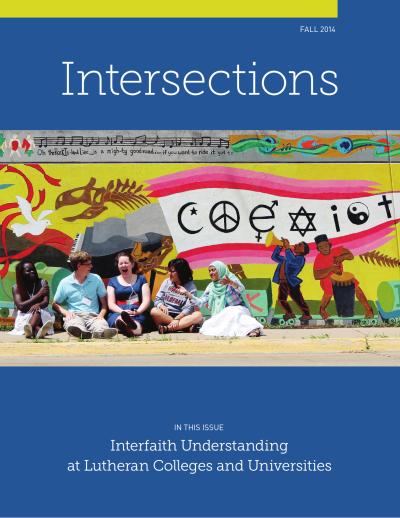
Bussie chronicles Concordia College’s Forum on Faith and Life initiative — assessing campus climate, building a President’s Interfaith Advisory Council, and drafting a one-sentence statement that Concordia practices interfaith cooperation “because of” (not “guided by”) its Lutheran identity — to argue that simul justus et peccator thinking equips Lutheran institutions to hold loyalty to tradition and reverence for others together as one piece.
-
 Editorial
From the Editor
Robert D. Haak
No. 24 · Fall 2006
Haak introduces the issue’s essays by Stanley N. Olson, Kathryn L. Johnson, Gail Summer, Lake Lambert, and Steven C. Bahls; argues that on Lutheran campuses, professional programs in business, education, and nursing are not “second-class citizens” but integral to the institution’s vocation; cites Olson’s mantra (“Because of Christ, the world; because of the world, vocation; because of vocation, education”); and thanks Matt Marohl for assisting with the editing.
-
 Reflection
Shelter in Place: Reflections from March 22, 2020
Jason A. Mahn
No. 53 · Spring 2021
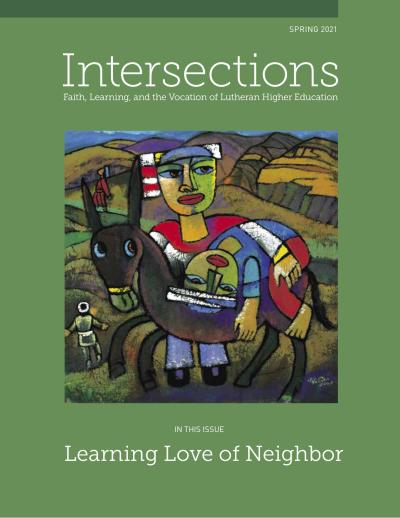
On the fourth Sunday of Lent in 2020, Mahn meditates on the etymology of “shelter” (from shield) and on an email from a former student in Boston whose mutual-aid organizing models a Lutheran understanding of vocation: the upending of ego by divine love that frees us, finally, to see and serve the neighbor.
-
 Article
A Response to Paul Santmire
Don Braxton
No. 4 · Winter 1998
Braxton appreciates the dialectical structure of Santmire’s mandates—“skeletons in our closets and riches in our own vaults”—and reads it as a faithful expression of the Lutheran tradition of Paul, Augustine, and Luther. He argues that Santmire is on target in warning against premature flight to non-Christian traditions for environmental wisdom (theoretical sensitivity does not translate into ecological behavior in practice), and that classical Lutheran social ethics has too often been quietistic. But Lutheran ethics at its best is dialectical, not dualistic—recognizing the interpenetration of church and world, Law and Gospel, eschatological Kingdom and present realities, as in Hegel, Ritschl, Bonhoeffer, Reinhold Niebuhr, and Larry Rasmussen. Braxton commends environmental responsibility, social criticism of unsustainable practices, and a liturgical practice of resistance to instrumentalism as appropriate next steps for Lutheran liberal arts colleges, especially Capital University.
-
 Institutional Focus
Serving and Building Community at Concordia College
Larry Papenfuss
No. 55 · Spring 2022
Papenfuss, director of the Dovre Center for Faith and Learning, frames eight ways Concordia College serves the world by building community — from quality teaching and liberating liberal learning to interfaith cooperation and modeling “diversity with particularity” as a Lutheran “third path” institution.
-
Editorial
From the Editor
Tom Christenson
No. 4 · Winter 1998
Christenson thanks the departing Jim Unglaube, recommends Ronald A. Wells’s Keeping Faith: Embracing the Tensions in Christian Higher Education (Eerdmans) as both an interesting collection of essays and a model worth imitating at ELCA institutions, previews the issue’s pieces by Richard Hughes, Carl Skrade and Spencer Porter, Gregory Clark, and Karla Bohmbach, and introduces three new features of the journal: “What I Have Learned” (an essay by a senior or emeritus faculty member, inaugurated by Richard Ylvisaker), “Reviews” (initiated by Karla Bohmbach), and a “Bulletin Board” for cross-campus announcements.