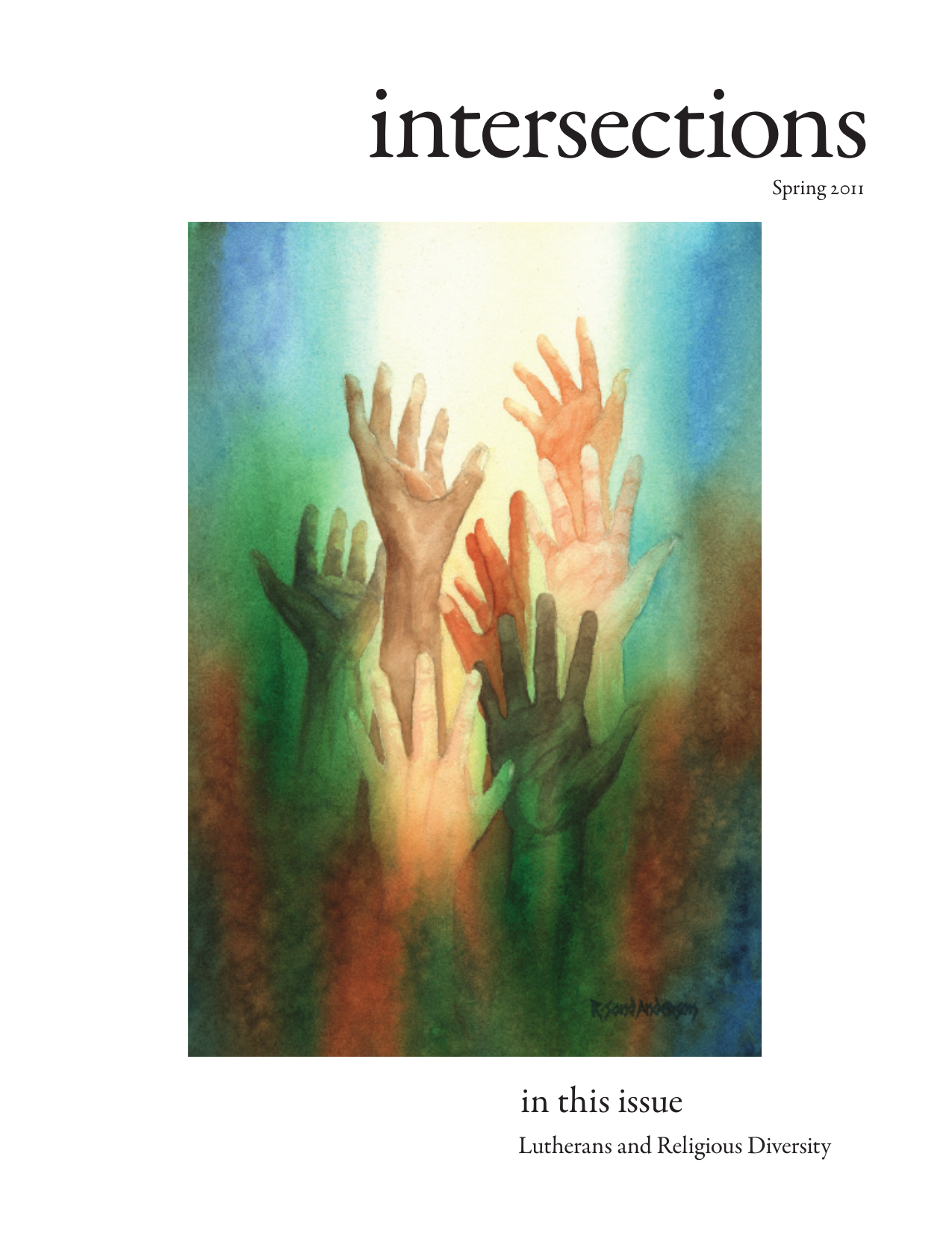
Lutherans and Religious Diversity
The Spring 2011 issue of Intersections, drawn from the 2010 Vocation of a Lutheran College Conference, asks how Lutheran campuses respond to religious diversity. Essays by Darrell Jodock, Terence S. Morrow, Karla R. Suomala, Mark N. Swanson, and Jacqueline Aileen Bussie chart a “third path” between sectarian and non-sectarian models, examine civil discourse on campus, trace new contexts for Jewish-Christian engagement, explore Christian-Muslim relations at ELCA institutions, and offer practical recommendations for embracing reconciled religious diversity.
Editors
Articles in this Issue
-
 Editorial
From the Publisher
Mark Wilhelm
Wilhelm notes that while the ELCA’s vocation in higher education remains vibrant, the landscape of churchwide leadership has shifted dramatically with the dissolution of the Vocation and Education unit, and expresses appreciation for the faculty and staff at ELCA colleges and universities who have stepped up to sustain the network during this time of transition.
-
Editorial
From the Editor
Robert D. Haak
Haak frames the issue by asking how Lutheran colleges and universities understand the changing landscape of religious identification on their campuses, and argues that Lutheran theological commitments — including the work of the Spirit and the Incarnation — call institutions to create places where the voice of “the other” is heard and valued.
-
Article
Vocation of the Lutheran College and Religious Diversity
Darrell Jodock
Jodock describes a “third path” for Lutheran colleges that is both rooted in the Lutheran tradition and inclusive of religious diversity — an alternative to sectarian and non-sectarian default models — and identifies six interlocking features of the Lutheran tradition (giftedness, an engaged God, wisdom, caution about claims to know, community, and an emphasis on service and community leadership) that shape how such a college engages interreligious dialogue and civil discourse.
-
Article
The State of Civil Discourse on Campus and in Society
Terence S. Morrow
Morrow examines the troubled state of civil discourse in the United States and on college campuses, drawing on three deep traditions — the liberal arts, Lutheranism, and the Anglo-American legal tradition — to argue that Lutheran colleges can serve students and society by acknowledging the tensions inherent in civil discourse and helping students navigate them, and surveys promising campus programs at St. Thomas, Tufts, Loyola, and Harvard.
-
Article
The New (con)Texts of Jewish-Christian Engagement
Karla R. Suomala
Suomala surveys four contemporary contexts of Jewish-Christian engagement on American college campuses — campus populations, Jewish studies curricula, the changing nature of Jewish identity among Millennials, and the shift from formal Jewish-Christian dialogue toward broader religious pluralism — and argues that at Lutheran colleges this success story can serve as a model for engaging the other religious neighbors who increasingly form part of our society.
-
Article
The Breadth and the Depth: Dimensions of Christian-Muslim Relations at Educational Institutions of the ELCA
Mark N. Swanson
Swanson reflects on the spatial metaphors of depth and breadth that shape Lutheran higher education and argues that the study of Islam and real conversation between Christians and Muslims can contribute to both the broadening of horizons and the deepening of faith, drawing on his experience at the Lutheran School of Theology at Chicago and pointing to hospitality as a Christian practice in which depth and breadth come together.
-
Article
Reconciled Diversity: Reflections on our Calling to Embrace our Religious Neighbors
Jacqueline Bussie
Bussie offers three concrete recommendations for cultivating reconciled religious diversity on Lutheran campuses — Lutheran listening and the telling of stories, engendering encounters with religious neighbors through curriculum and bridge-building events, and choosing empathy and collaboration over evangelism and creed — arguing that what students fear most in encounters with the religious “other” is the loss of their own identity and distinctiveness, and that we can show them how loyalty to one’s own tradition and reverence for different traditions can coexist.