Reconciled Diversity: Reflections on our Calling to Embrace our Religious Neighbors
Intersections No. 33 · Spring 2011
“The problem to be faced is: how to combine loyalty to one’s own tradition with reverence for different traditions.” –Abraham Heschel
“God gave us two ears and one mouth for a reason—that we might listen twice as much as we speak.” –Epictetus
In 2005, because of my many years of involvement in Jewish-Christian dialogue, I had the immense pleasure of being Capital University’s ambassador to a speaker’s series in Pittsburgh featuring Holocaust survivor and Nobel Peace Prize Winner Elie Wiesel. Wiesel told a striking story that weekend about the great Jewish thinker Martin Buber who reminded his listeners that Judaism and Christianity share an obsession with the Messiah. The Jews, of course, are still waiting for the messiah who will come to redeem the world at the end of days. The Christians, although they do believe the Messiah has already come, are also waiting on the Messiah—waiting for Jesus the Messiah to return. And so, declared Buber, let’s all wait together. Buber’s attentive friends, thinking the story ended there, murmured their approval at the teacher’s wisdom and bobbed their heads in agreement. But Buber continued, “And no doubt when the Messiah comes in those end days, someone will lean over and ask in his ear, ‘Hey, have you been here before?’ And when that happens, I hope I’m there too so I can caution him, ‘For heaven’s sake, whatever you do, don’t answer that.’”
I love Buber’s story because it underscores both the promise and the problems of religious diversity. The tale unfolds how much we have in common, but also unveils through humor our insidious tendency to consider all conversations about religion as ultimately conversations about nothing more than rightness, or—to be more honest—about my rightness and your wrongness. Tragically, in the real world our obsession with being right when it comes to religion all too often trumps our embrace of our common humanity and shared dreams for a redemptive and just future. Part of the goal of responsible Lutheran higher education must be to help our students unlearn this hasty, premature conflation of religion and rightness. Instead, we must help our students move toward a shared vision where collaboration and hope once again become real possibilities for a future that must be lived or lost together or not at all.
That same weekend, Wiesel also shared his optimistic assessment that in the 21st century, as a result of decades of post World-War II dialogue, Jewish-Christian relations are stronger than ever before. However, Wiesel pronounced from behind his lectern, from the inception of those dialogue groups that began in the 1960s, we made a terrible mistake. Everyone in the auditorium held their breath ever so slightly, waiting for the Nobel Peace Prize winner to tell us where we had gone wrong. And this is what he said: “When we began those interfaith dialogues, we failed to invite Muslims to the table.”
I couldn’t agree more with Wiesel, but I must push him further and ask, who else are we failing to invite? This question leads to the several even larger questions which constitute the primary focus of my reflections in this essay. What can those of us who work at Lutheran universities do to overcome past systemic failures to engage in interfaith dialogue and address religious diversity? In a world where the media and politics thrive on divisiveness, difference, and conflict and in a world filled with fist-clenching “us/them” language, how can we help our students to speak in terms of ‘ours’—our collective future, our children, our earth, our dreams? What can we do to help our students embrace not only religious diversity in principle, but also the real people behind that principle, namely, our Sikh, Muslim, Buddhist, Native American, Hindu, atheist, and Jewish sisters and brothers? How can we help our students and our greater communities transmute their fear of religious difference into a sense of awed giftedness at a tapestry of diversity so colorfully woven? As a scholar and a theologian who believes theology is reflection upon praxis, I will not address these questions through abstractions. Instead, I want to share with you three concrete and practical recommendations that can be done here and now on our campuses to help us cultivate, embrace, and foster reconciled religious diversity.
Lutheran Listening and Speaking our Stories
The first step we can take on our campuses to achieve greater responsibility to religious diversity is create a safe yet challenging public space for our students to tell their own stories and to learn to listen to the religious neighbor as she tells hers. As the Lutheran pastor and theologian Paul Tillich is said to have written: “The first duty of love is to listen.” As a Muslim student once paraphrased Epictetus to me: “God gave us two ears and one mouth for a reason—that we might listen twice as much as we speak.” Living amidst religious diversity in the 21st century demands a politics of love, which entails a politics of listening.
Our students do not come to us culturally prepared to know how to listen. Instead of “listening” to another person express a viewpoint with which we vehemently disagree, many of us are “re-loading” our verbal gun with ammunition so we can fire off our killer rebuttal. The problem with reloading, of course, is that while we are doing it, we don’t genuinely hear what the other person has said. To demonstrate this commonplace failure to listen in my ethics classes, I often pause the classroom debate at its most heated moment and ask students to summarize the argument of their opponent or of the person with whom they disagree most, and to do so with such accuracy that the person who espouses that argument approves the summary as a genuine encapsulation of her or his own point of view.
Our initial rounds of this ‘recall’ game usually end in embarrassed laughter because we are all called out on the fact that we haven’t really listened to those with whom we disagree. And yet, my students become much, much better at this over time. The moral of this story is: we can listen well to one another—it’s simply that we don’t. As I have written in my forthcoming new book, Outlaw Christian: Straight Talk We Never Hear about Faith, Grief, Hope and Suffering, we do not practice listening or feel we need to be taught it. We misconceive listening as something which comes naturally to us, like breathing, when really, listening is more like swimming, learning not to breathe at the right time.
On our Lutheran campuses, part of our vocational responsibility is to teach our students to swim in the 21st century waters of religious diversity. To do so, we faculty, staff and administrators also need to value and practice authentic listening. We need to teach our students to tell their own stories and create spaces in classrooms and on campus for them to do so. If you ask someone who she is, how does she answer you? No doubt she tells you a story: “I was born in Ann Arbor Michigan and when I was three my family moved to Georgia…”
Our identity is a story. We are our stories. This is as true for individuals as it is for universities, and I have noticed in the 21st century a strange plague on both of these houses. Both individuals in our day and too many religiously-affiliated universities appear to be ashamed of their own stories as if distinctiveness inherently offends diversity. Just as we cannot assume that students will know how to listen, we also cannot assume they feel empowered enough to share their own stories without our intentional modeling and prompting. Religious difference and distinctiveness scare us, and so, strangely, we try to hide them, as if by not discussing them with people different from ourselves they will magically disappear.
On my previous campus at Capital University, our dean took the bold step of establishing a new committee called, aptly enough, the Telling Our Stories committee, of which I served as chair. Part of our committee’s job was to collect the stories of faculty, staff, administrators, and students and disseminate them via wiki, newsletter, alumni magazines, luncheons, forums, university webpages, and the like. The university has a long way to go, but this intentional effort at celebrative storytelling has already helped cultivate and create a greater sense of shared values and mutual celebration in an environment all too often prone to cynicism, uncertainty, and negativity. Every new story I heard and shared shamed me a little at how little I once knew about my colleagues and their projects and students. At the same time, each new story refashioned my day with a sense of giftedness. I walked through the campus differently, watchful and appreciative.
Such storytelling also has had a remarkable side-effect on our fundraising. When my students in 2008 expressed to me their dream of going on a service-learning trip to South Africa to learn more about the nonviolent end to apartheid and to serve the poor and AIDS orphans, I knew the trip would be too expensive without subsidy. So, I wrote letters and talked to people, and in the end raised over $25,000 in private funds. Even I was shocked by this radical generosity. All I did to prompt it was to let my students tell their own stories about why they dreamed of going to Africa (I included excerpts from these autobiographies in my fundraising letters). I also told true stories about all my students had done for our local community on a weekly basis in my service-learning classes for the last two years. Both literally and figuratively, I believe our stories are our university community’s currency. These stories can make us rich or leave us poor, and if they go untold, the result is always poverty.
Engendering Encounters
This brings me to my second recommendation about how our Lutheran colleges and universities can become better stewards of the God-given gift of religious diversity. Our universities must create occasions for our students to engage in authentic encounters with our interfaith neighbors. If your university is like mine, our student and faculty populations are not yet as religiously diverse as they should be. Changing that demographic is the ongoing responsibility of admissions, recruitment, and the whole institution. But in the meantime, from the grassroots up we must be intentional about taking steps to facilitate opportunities for students to authentically encounter and interact with our religiously diverse neighbors. We cannot wait around and expect diversity to come to us; we need to bring it to our students right now. For faculty, this means incorporating encounters with diversity into the curriculum through texts, invited speakers, service-learning, experiential learning, internships, and field trips.
I want to share with you some practical examples of how to foster for students opportunities for engagement and genuine encounter with religiously diverse neighbors.
Curriculum Matters
First and most obvious, we can address the reality of religious diversity through the curriculum. The best part of being a university with a religious heritage is that we understand how much religious traditions and heritage matter, not just to ourselves, but to everyone who is part of one. One of the things I love best about teaching at a Lutheran institution is that we require an introduction to religion class, in which students are exposed to the basic understandings of the world’s major religious traditions. In short, we teach our students religious literacy. Through such a requirement, our sectarian institutions hold themselves accountable to the realities of religious diversity and to the irreducible way it matters in our global society in a way that most non-sectarian institutions with no religion requirements simply do not or cannot. Ever since a student asked me if Muslims worship Muhammad or the Buddha, and because another student asked me if the Holocaust really happened or if Jews just made it up, and because people such as a turban-wearing Sikh man in Texas are killed after 9/11 for being mistaken for a Muslim, I have become a passionate, unwavering advocate of the importance of religious diversity. Religious illiteracy leads to mistaken assumptions which in turn lead to wild-flung prejudice and hate. Every semester on the first day of class I tell my students why I teach religion: I want to help create a world where people stop hating and harming each other because of their vast ignorance about religious traditions outside their own.
I remain flabbergasted that we as a nation believe that students can be college graduates and not know why their American Buddhist co-worker in the next cubicle is against the wars in Iraq and Afghanistan, or why their orthodox Jewish neighbor would never eat a cheeseburger or drive to synagogue on the Sabbath. Our graduates should know, for example, that only 20% of Muslims in the world are Arab, that Muslims believe in the second coming of Jesus as well as the virgin Mary, or that there are 635 denominations in the United States that identify themselves as Christian, and 9000 different Christian denominations worldwide (9000!).
Our Lutheran and other sectarian institutions lose a genuine critical edge and become irresponsible when we consider eliminating religion requirements from our curriculum. Diversity in the United States is, in large part, religious diversity, and yet where and how do we educate young people about what that diversity is and what it means? Where and when do we provide young people with the tools needed to acquire religious literacy? Where is a safe place where they can clarify misperceptions about one another and ask messy questions about difference, if not in the university? It is dangerous and deleterious to imagine that young people can learn to embrace the religious neighbor by some imaginary form of cultural osmosis, rather than intentional education. Ignorance about religious diversity in the 21st century leads not to bliss, but to harm and brutality.
Bridging Communities
A second and relatively simple way to foster encounters with religious diversity is to bring speakers to campus, host interfaith events on campus, or take students to interfaith events out in the community. In other words, build bridges. If your faculty does not have representatives of today’s religious diversity who are willing to speak to students, such neighbors need to be brought to campus or students taken to them. Every term, I take students to at least one interfaith event hosted by the Interfaith Association of Central Ohio. I have taken students to observe worship services at mosques, Sikh temples, churches, synagogues, and sweat lodges. One my colleagues hosts an on-campus Seder, open to all students, and once she and I partnered together and had a Jewish-Christian shared Bible study on campus. In my Introduction to Religion class, as we begin our study of each religious tradition—Sikhism, Judaism, Islam, Buddhism—I bring to class friends of mine who practice those traditions.
My Muslim friend Ahmad always makes an especially strong impression on my students. My students, the majority of whom are Christian or Jewish, always ask Ahmad how he feels about the events of September 11. Ahmad always says to the class, “That’s such an important question. I’ll answer it by asking you a question back: How do those of you who are Christians feel about Christians who target abortion clinics? I do not feel that those involved in the WTC events were real Muslims. They are extremists and they do not represent what my community believes to be the true Islam.” Though we would never presume this about our own traditions because we are aware of all the inner controversies, we tend to conceive of other faith traditions as monolithic wholes, which is a dangerous misassumption.
When one of my students asked Ahmed about the Muslim concept of jihad and what that meant to him, Ahmed pointed out that in mainstream Islam, jihad does not really mean holy struggle: it means struggle, any struggle to follow the will of God. Ahmed then said to the class, my greatest jihad is raising my teenage daughter! The class laughed, but this answer gave them a broader understanding of a complex and highly misused and misunderstood term. During Ahmad’s visit, most of my students confessed they had never met a Muslim let alone asked him what the term jihad really means in his daily life of faith.
Every semester I take my Introduction to Religion students to a Ramadan Iftar dinner organized by the Columbus chapter of The Council on American Islamic Relations (CAIR). There my students and I share a meal served and prepared by our Muslim neighbors. One year, the dinner started right after an OSU football game. My students the next day in class could not stop talking about the Muslim college women they met who wore their OSU sweatshirts along with their hijabs, or the kind elderly man who invited them to visit their mosque, or the young people at their table who that very night after the iftar had ended sent them friend requests on Facebook. My students had learned so well from the media and our culture to “other-ize” Muslims that all of these small commonalities—Muslim teens root for OSU and use Facebook just like me!—was for them akin to creaking open the lid of a dusty old chest and discovering inside the unexpected gold doubloon-treasure of a shared humanity. If there is one thing I’ve learned from nearly a decade of interfaith activities, it is that meeting people from other faiths transforms lives in a way that textbooks and lectures can never achieve.
On my course evaluations, my students never fail to mention these encounters as the experiences where they learned the most, and it is worth noting that when they do so, instead of the generic labels Muslims, Sikh, Buddhist, or Jew, they now use Ravi, Abukar, Ahmad, and Alfred—the names of real people they have met and now know. Part of our calling as institutions of higher education is to teach our students that diversity is not a “p.c.” buzzword or abstraction. Rather, ‘diversity’ is real people with real names, kids, jobs, and dreams.
I want to share two excerpts with you from my most recent batch of evaluations, because I think both of these comments testify to the phenomenal power of interfaith dialogue and genuine encounter with religious diversity to transform lives when allotted its proper place within higher education. One student wrote:
People say ignorance is bliss, but I do not always believe that to be true. In fact, I believe that ignorance within religion breeds hatred. Again, I fall back on the example of the world’s current situation and the many Islamic nations involved. People consume a majority of what the media says and believe it to be true. Nonetheless, it takes a small amount of research to discover what Islam stands for. This was truly brought to my attention after our speaker. Without this course, I would still be carrying my preconceived notions of Muslims as antagonistic and likely extremists.
Another student wrote:
I think this is the first lesson in any study of world religion: that individuals or groups are not representative of the whole, nor should they be. Yet so frequently we base our fear, mistrust, and hatred of each other on these episodic experiences that we have condemned the other’s religion before we even know what it is or how it instructs.
At this point, you might be thinking that I have made interfaith dialogue sound easy or even Pollyannaish when we all know that such conversations are extremely frightening to many people, which is precisely why we try to avoid them. A lot of students show up to my Religion 101 class with terror in their eyes, and once a group of my Campus Crusade for Christ students protested having to attend the Ramadan dinner by refusing to eat any of the food prepared by Muslims. This resistance raises the question: What are we afraid of as a culture when it comes to education about religion and encounters with the religious ‘other’? What we are afraid of on our campuses when it comes to difficult conversations about religious diversity and all its ancillary, heavily-freighted related social issues such as homosexuality, abortion, and the like?
What we fear most in encounters with the religious “other” is the loss of our own identity and distinctiveness. Our faith and religious practice is so bound up with the core of ourselves that we fear losing ourselves in such dialogues, being told we are wrong, and being coerced to change. This is especially true for our young students, who are still in the fragile process of discovering their own personhood and who tragically have been taught by our culture to define themselves not by who they are, but by who they are not. In such an environment, diversity is a cause for fear and not celebration.
A strong definition of the religious “other” keeps identity safe, whereas the discovery of a common, shared humanity threatens to blur the edges of our identity. In my decade of teaching undergraduates introduction to religion survey courses, I have discovered that the driving fear-question buried in the chest cavity of interfaith discussions is: “How can I be a part of a ‘we’ and still be ‘me’?” In religious classrooms and other interfaith events, my students overwhelmingly fear betraying themselves and their own traditions. We must show them that it is possible to learn without conversion, and the best way I have found to do this is to teach without evangelism.
Empathy and Collaboration vs. Evangelism and Creed
Our culture unduly confuses education with evangelism, when of course it is possible to learn without conversion, just as it is possible to teach Spanish or learn to speak Spanish fluently and not become a Spanish person. This is why it is important to always state that the goal of interfaith dialogue and even religious higher education is not to convince anyone to change or that we are right and they are wrong, but simply to achieve mutual empathic understanding. I need to write something to that effect on course syllabi. Although it may seem obvious, undergraduates need reminding that understanding is not the same thing as agreement. I can understand why you would do something, though I can wish with all my heart you had not done it. How many friends and family members do we disagree with on hundreds of issues yet nonetheless love and understand? Our students do this all the time in their personal lives, and they need teaching, encouragement, and the opportunity to apply many of those same relationship skills to our campus discussions of religious diversity.
Our institutional missions aspire to unity in diversity, but to most of our students this sounds like an oxymoron because they (probably inspired by contemporary politics) confuse sameness with unity. Unity means we have a goal in common—a shared vision—but it does not mean we are homogeneous. This distinction lies at the heart of all communities and certainly to Lutheran universities in the 21st century.
When I talk to my students about this important distinction, I use the analogy of love. Have you ever been in love? Nearly everyone who has ever been in love recognizes that you don’t stop being yourself because of your relationship. No, ask a person in love how love has transformed her and she will usually say, “My love and my relationship has made me a better me than I was before. I am more myself than ever.” The question before us in a religiously diverse world on a campus with a particular religious identity is this: How can we make our students’ four year experience one at the end of which each student can say, ‘The encounters I had and the relationships I built have made me a better me than when I first set foot on these grounds?’
To achieve our desired goal, we need to show our students examples of how conflict and disagreement can make us bloom and not wither, and how I can still be me and you can still be you, but we are a better ‘we’ than before we got to know one another. In the words of Abraham Joshua Heschel, “The problem to be faced is: how to combine loyalty to one’s own tradition with reverence for different traditions.” I try to be a living incarnation of both loyalty and reverence for my students and also to introduce them to others who are too, so that part of their education is understanding that such a nuanced position is possible. In my own theological writings, I have often said that one of the best contributions Martin Luther has made to modern thought is his grasp of the paradox, his dialectic understanding of most things in life as not either-or, but instead as both-and. Helping our students and communities to embrace both-and thinking is crucial to practicing reconciled diversity, which recognizes both our irreducible uniqueness and our insistent commonalities. Surely we are capable of recognizing difference, yet not allowing it to divide.
And so, my third and final recommendation for achieving greater responsibility toward religious diversity is to create opportunities for doing over doctrine, collaboration over creed. By participating in interfaith service projects through organizations such as BREAD (Building Responsibility Equality and Dignity—an interfaith justice ministry) and the Interfaith Hospitality Network which feeds and shelters the homeless, my students learn the important truth that we don’t have to agree on every theological or doctrinal issue with our interfaith neighbors in order to get something done alongside them. While consensus on belief is impossible, collaborative action to better our communities is always possible. We don’t have to agree with each other on whether the Messiah has already come in order to plant tomato seeds in a community garden, work tirelessly to establish an Affordable Housing Trust Fund, or serve a homeless child a thanksgiving meal.
The obvious activism which unites Buddhists, Christians, Jews, Sikhs, Hindus, and Muslims is social justice. People of all these faiths share a desire for compassion, solidarity, peace, and the defeat of poverty and hunger. This common ground of the world’s great religions is an exciting, wide-open portico which beckons us to walk through it with bold steps of collaboration and cooperation.
In the spirit of religious diversity, I’ll conclude with a saying from the Koran that my Muslim friend Abukar once quoted as a celebration of our religious diversity: “If God had so willed, He would have created you one community, but He has not done so, that he may test you in what He has Given you; so challenge one another in good works. Unto God you all must return, and then He will make you truly understand all that on which you were wont to differ” (Sura 5:48).
-
 Editorial
From the Publisher
Mark Wilhelm
Wilhelm notes that while the ELCA’s vocation in higher education remains vibrant, the landscape of churchwide leadership has shifted dramatically with the dissolution of the Vocation and Education unit, and expresses appreciation for the faculty and staff at ELCA colleges and universities who have stepped up to sustain the network during this time of transition.
-
Editorial
From the Editor
Robert D. Haak
Haak frames the issue by asking how Lutheran colleges and universities understand the changing landscape of religious identification on their campuses, and argues that Lutheran theological commitments — including the work of the Spirit and the Incarnation — call institutions to create places where the voice of “the other” is heard and valued.
-
Article
Vocation of the Lutheran College and Religious Diversity
Darrell Jodock
Jodock describes a “third path” for Lutheran colleges that is both rooted in the Lutheran tradition and inclusive of religious diversity — an alternative to sectarian and non-sectarian default models — and identifies six interlocking features of the Lutheran tradition (giftedness, an engaged God, wisdom, caution about claims to know, community, and an emphasis on service and community leadership) that shape how such a college engages interreligious dialogue and civil discourse.
-
Article
The State of Civil Discourse on Campus and in Society
Terence S. Morrow
Morrow examines the troubled state of civil discourse in the United States and on college campuses, drawing on three deep traditions — the liberal arts, Lutheranism, and the Anglo-American legal tradition — to argue that Lutheran colleges can serve students and society by acknowledging the tensions inherent in civil discourse and helping students navigate them, and surveys promising campus programs at St. Thomas, Tufts, Loyola, and Harvard.
-
Article
The New (con)Texts of Jewish-Christian Engagement
Karla R. Suomala
Suomala surveys four contemporary contexts of Jewish-Christian engagement on American college campuses — campus populations, Jewish studies curricula, the changing nature of Jewish identity among Millennials, and the shift from formal Jewish-Christian dialogue toward broader religious pluralism — and argues that at Lutheran colleges this success story can serve as a model for engaging the other religious neighbors who increasingly form part of our society.
-
Article
The Breadth and the Depth: Dimensions of Christian-Muslim Relations at Educational Institutions of the ELCA
Mark N. Swanson
Swanson reflects on the spatial metaphors of depth and breadth that shape Lutheran higher education and argues that the study of Islam and real conversation between Christians and Muslims can contribute to both the broadening of horizons and the deepening of faith, drawing on his experience at the Lutheran School of Theology at Chicago and pointing to hospitality as a Christian practice in which depth and breadth come together.
-
 Article
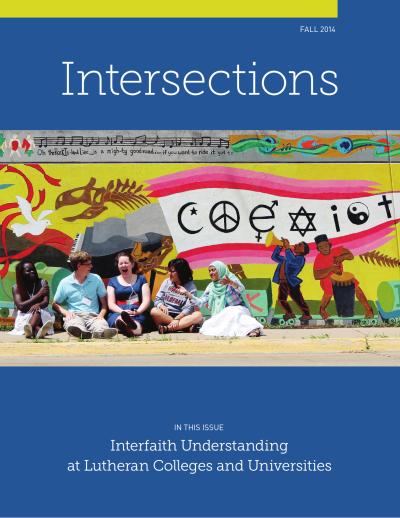
Journey Toward Pluralism: Reimagining Lutheran Identity in a Changing World
Jacqueline Bussie
No. 40 · Fall 2014
Bussie chronicles Concordia College’s Forum on Faith and Life initiative — assessing campus climate, building a President’s Interfaith Advisory Council, and drafting a one-sentence statement that Concordia practices interfaith cooperation “because of” (not “guided by”) its Lutheran identity — to argue that simul justus et peccator thinking equips Lutheran institutions to hold loyalty to tradition and reverence for others together as one piece.
-
 Article
Scarred Epistemologies: What a Theology of the Cross Has to Say about the Gay Marriage Ban
Jacqueline Bussie
No. 22 · Spring 2006
Responding to Robert Benne’s claim (citing Gilbert Meilander and Wolfhart Pannenberg) that one cannot defend gay marriage on biblical or confessional grounds, Bussie reads three theses of Luther’s Heidelberg Disputation alongside Moltmann’s Crucified God and Martin Luther King Jr.’s Letter from Birmingham Jail to argue that the theologia crucis—with its insistence on calling the thing what it is, its acknowledgment of scarred epistemologies and simul justus et peccator, and its refusal to domesticate God—exposes the Ohio Defense of Marriage Act as scapegoating, selective literalism, and an unjust law that the Christian conscience must reject.
-
 Article
A Lutheran Call for Educator Flourishing
Krista E. Hughes
No. 58 · Fall 2023
Hughes argues that without educator flourishing there is no student flourishing, traces how an exploitative “passion tax” can distort vocation, and offers seven Lutheran “third-way” value pairings — including Metrics/Grace, Efficiency/Kairos, and DEI/Priesthood of All Believers — to reframe institutional success at NECU campuses.
-
 Article
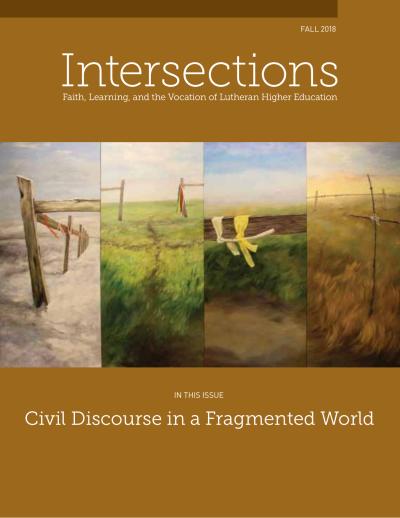
It's Time to Rewrite the Rules of Civility
Jon Micheels Leiseth
No. 48 · Fall 2018
Leiseth contends that the prevailing rules of civility too often function as the majority’s rules, stifling those facing real harm — and proposes that NECU institutions rewrite civility as “neighboring,” guided by the ELCA’s five values of accompaniment: mutuality, inclusivity, empowerment, sustainability, and vulnerability.
-
 Article
Ethical Leadership for a Changing World: A Shared Calling from Cradle to Career
Cory Newman, Janelle Rozek Hooper
No. 62 · Fall 2025
5 min audio
Hooper and Newman recount how an ELCA Barna survey on early childhood education sparked the realization at VLHE 2025 that ELCA colleges and the 1,200 Lutheran schools and early learning centers share identical challenges — and an untapped potential to form ethical leaders across the full educational continuum from cradle to career.
-
 Article
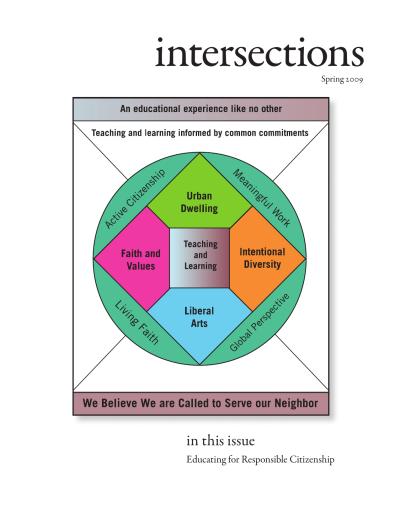
Dual Citizenship: Reflections on Educating Citizens at Augsburg College
Paul C. Pribbenow
No. 29 · Spring 2009
Pribbenow argues that the vocation of Augsburg College is to educate “dual citizens”—those able to live within the messiness of common work rather than resolve every tension once and for all. Drawing on John Courtney Murray on democracy as “the intersection of conspiracies,” Bill Moyers, Jean Bethke Elshtain, Stephen Carter, and the Augsburg vision statement “We believe we are called to serve our neighbor,” he names four common commitments and five principles of civic education that ground Augsburg’s incarnational mission in its city neighborhood.
-
Article
Ethical Deliberation and the Biblical Text—A Lutheran Contribution to Reading the Bible
Ritva Williams
No. 22 · Spring 2006
Williams articulates a Lutheran “critical traditionalist hermeneutic”—a phrase borrowed from her Hebrew Bible professor Robert Polzin—that honors Scripture as queen while keeping Christ as its king, and tests it by critiquing Robert Gagnon’s use of Romans 1:18-32 in The Bible and Homosexual Practice. Drawing on Lazareth, Lotz, Philip Esler’s Conflict and Identity in Romans, Stanley Stowers’ Rereading Romans, and Ben Witherington III, she proposes an alternative reading in which Paul recites a Hellenistic-Jewish ethnic caricature in 1:18-32 only to overturn it in 2:1-16, making the passage a critique of self-righteous stereotyping rather than the foundation of a moral doctrine on same-sex intercourse.
-
 Article
Fragmented in Faith: The Concerns and Hopes Found in Student Spirituality and Civic Engagement
Emma Bohmann, Monica Sitachitta
No. 63 · Spring 2026
11 min audio
Two Texas Lutheran University students reflect on the cyclical pattern of low spiritual and civic engagement on their campus and argue that distinguishing Lutheran values from Lutheran practice could open space for civic engagement to become a non-optional expression of neighbor-justice for all students.