What happens to relationships between people from different groups when those interactions move on-line? Two decades ago, this question would have been the stuff of science fiction writers instead of the province for serious scholarly pursuit. However, as we move rapidly into what Yochai Benkler calls the “networked information economy,” these questions gain greater salience. Increased server storage capacity, the proliferation of personal computers with fast microprocessor speeds, and the advent of broadband internet access have combined to make it possible to store vast amounts of easily retrievable information in “the cloud.” The cloud is a term commonly used to refer to this virtual ether where e-mails, photographs, home movies, blog entries, Facebook chats and other forms of information combine to form an individual’s on-line self. In fact this paper is being written on-line in a “document page” through a private Google account. Google provides me with a nearly unlimited amount of storage capacity for e-mails, RSS feeds, documents, photographs and other materials. In exchange for this storage, Google sells my attention to people who would like to borrow it for a few moments to tell me about an exciting new product.
This seems a convenient proposition: free storing of data in exchange for the ability to sell your attention to the highest bidder. In the case of social networking sites like Facebook and MySpace, personal information can be paired up in communities of like-minded others in innumerable ways. This proposition is so alluring that the vast majority of our students have a “ life in the cloud.” According to the well respected technology blog, TechCrunch, 85% of college students had a Facebook account in 2005. As processor speed and server capacity escalate even further, more of these social interactions can be conducted in virtual communities where people can create on-line personas and interact visually with others in the cloud. Although the actual number of active users is debated, the on-line virtual-reality community Second Life has over seven million “residents.” (Second Life)
Because companies like Google have developed a business model around encouraging people to place more and more information in the cloud, there are strong market incentives driving an acceleration of this trend. Companies are making an aggressive push to get children into the cloud at increasingly earlier ages. Debra Aho Williamson, an analyst at the research firm eMarketer, estimated that twenty million children would be members of a virtual community by the year 2011 (Barnes). The growth of these “virtual” spaces provides users an allure that “off-line” society lacks. Interactions through the cloud are controlled and mediated directly by the user. In a 2007 New York Times article, 9-year old Nathaniel Wartzman of Los Angeles said about Club Penguin, a Disney created social networking site for children, “I get to decide everything on Club Penguin.” (Barnes). Unlike the real world where parents make you eat your vegetables, the virtual world is free of these social constraints.
The penetration of these social networking sites has wrought unprecedented and poorly understood changes in our social relationships. What should be of particular concern to college faculty is the effect these changes have on our students’ social selves (as well as our own). To what extent does the networked information economy affect the development of human beings and citizens ready to take on the challenges that face this new generation of students? What does this increasing cloud presence say about our development as human beings in an increasingly multicultural world? Does the cloud bring diverse people into closer contact where they can develop meaningful relationships, or do these virtual communities allow us to customize our social networks such that we can freely avoid interacting with those whom we disagree? In this essay, I’ll look at the utopian and dystopian views to this question and offer a view of digital citizenship that seeks to leverage the benefits of the cloud to promote the ethical development of our students.
The Utopian View
A utopian view of our future in the cloud suggests a vastly broadened network of social relationships. The ability of the networked information economy to place us in contact with a boundless world of people, ideas and images will make us more worldly, engaged and productive. The social theorist Manuel Castells suggests that the great transformation wrought by a network society creates identity crises as people reorient their selves to these new social forms of organization. These new networks (of which the cloud is an integral part) allow for a greater exploration and construction of the individual self. Castells suggests that possibilities exist for people to develop project identities whereby individuals incorporate transformational ideologies that seek to change the structure of society into their own identity system. Examples of these transformation ideologies are those who adopt an ethos of global human dignity and work to have it carried out in the world.
While Castells suggests that few people develop transformational identities, I argue the possibility for greater numbers of people to develop transformational identities is unprecedented. Anthropologist Arjun Appadurai suggests new media offers new resources for the construction of imagined selves. The “democratization of the imaginary” in the form of words, images, and sounds throughout the world has allowed “common people” around the world to enter the “logic of ordinary life.”
This global exposure to the voices of diverse others suggests that, as Mark Juergensmeyer noted “everyone is everywhere” (4). Journalist Chris Anderson theorizes this democratization of the imaginary as a “long tail” of on-line content. Anderson argues that the cloud allows the purchase of creative content like books and music to move from physical space where content is limited by storage capacity to the cloud where storage is virtually unlimited. The cloud allows for the availability of a broad range of eclectic choices, made available by the ability to link up consumer choice with storage capacity. This makes it possible for consumers to get any form of content they choose, no matter how eclectic or obscure.
When applied to individual experiences, the cloud makes everyone accessible to everyone else. In this pastiche of ideas and images, you are not constrained by geography or time, a phenomenon that social theorist Anthony Giddens calls time-space distanciation. The individuals have a greater ability to reconstitute themselves. Virtual environments like “Second Life” allow for an even more in-depth process of constitution and reconstitution, a phenomenon Lisa Nakamura refers to as identity tourism. The ability to reconstitute an identity becomes as easy as changing your avatar (on-line persona).
Moreover, this pastiche of ideas and images and the increased capacity to share creative product has resulted in what MIT media scholar Henry Jenkins calls a participatory culture. Citizens in the cloud are able to quickly upload images, music, thoughts, and other forms of creative content and share them with a community of others who will comment and provide instant feedback on their contributions. As a result, members of the cloud come to develop habits of collaboration and see themselves more as participants rather than users. The ability to share one’s interests in like-minded communities creates a broader, richer, environment from which to build personal relationships.
These relationships can be translated into genuine social action. Jenkins (206-40) suggests that a participatory culture on-line creates an ethos of participation in other areas. Members of the cloud develop an expectation that all social institutions will be as responsive and participatory as the social web. The recent United States presidential election is an example of the spillover effects of participatory culture. Both the Obama and McCain campaigns were able to garner millions of dollars in small-scale on-line contributions, thereby welcoming large number of citizens into the political process. The Obama campaign was wildly successful in generating a network of volunteers and activists by encouraging supporters to create their own Facebook groups through the MyBarackObama.com website. Hundreds of thousands of people created locally oriented Facebook groups that served as a hub for organizing meetings and events for the campaign.
Yale law professor Yochai Benkler suggests that the networked information economy encourages this participatory revolution by lowering transaction costs for collective action. The availability of Web 2.0 tools allows networks of individuals to collaborate in social production for a social goal. Whether it is writing a Wikipedia entry or reporting on human rights abuses in a totalitarian regime, the cloud can serve as a power source for creating engaged global leaders.
The Dystopian View
Not all observers are as sanguine about prospects for the web and social relations. University of Chicago law professor Cass Sunstein notes that, despite the pastiche of ideas and images available to netizens, individuals tend to constrain themselves to the small set of ideas with which they already agree. The result is a strengthening of in-group ties, what political scientist Robert Putnam refers to as “bonding social capital.” The downside to this bonding is a decreased need to form relationships with those whom we disagree, what Putnam calls “bridging social capital.” Indeed, recent work from Lewis et al. suggests that people on Facebook reproduce on-line the networks of friends they accumulate off-line. More disturbingly they find that race and gender hompohily (likeness) have the largest influence on who an individual befriends in social networks. This pattern of homophily is most distinct for white males who have the least diverse Facebook networks.
At its worst, this emphasis on “bonding social capital” over “bridging social capital” can reinforce negative perceptions of out-groups and, at its worst, lead to increased hate crime activity. Indeed the Internet provides a fertile breeding ground for hate group activity. While the cloud opens netizens to a vast array of peoples, it also lowers transaction costs for hate speech. The same lowered transaction costs that facilitate positive collaboration also can encourage collaboration for more nefarious activities. Hate groups couple easy access with the anonymity and lack of face-to-face interaction to attract members. Hate speech in “real space” is not a socially desirable activity and as a result produces high transaction costs, a phenomenon social psychologists refers to as social desirability bias. Consequently, the cloud becomes a more convenient space for socially undesirable biases.
The increased proliferation of overtly white-supremacist sites like StormFront.org get the largest share of media attention. Other sites, however, also encourage hate speech (albeit unintentionally). One site, JuicyCampus.com, encourages students at colleges and universities to share rumors that originate at their institutions. The “rumors” are often vile, hate-filled, accusations about a female student’s sexual promiscuity or a male student’s sexual orientation. Because the site is anonymous, members of the site are free to use any form of hate-based speech they desire. The behavior observed on these sites is not one you would find in face-to-face interactions because there would be social sanctions to using racist, sexist, or homophobic language.
Part of what explains the types of posts one sees on sites like JuicyCampus.com is that the cloud is a medium that lends itself to impulsive behavior. A student overcome with emotion by a break-up with a girlfriend or a fight with a friend has a ready outlet to unload that anger on-line by spreading a false rumor about that person on a website. Before the cloud, a person might sit with unpleasant emotions and find other, more productive, ways to deal with those emotions.
Nicholas Carr touches on this darker side of web culture in an Atlantic article where he asks “Is Google Making us Stupid?” His central point is that the easy access to information serves as a disincentive for reflection. Those of us involved in knowledge work wind up spending more of our lives trying to corral the virtual herd of information about a subject of interest to us, rather than spending time reflecting on what we have read. As Carr points out in his article “my mind now expects to take in information the way the Net distributes it: in a swiftly moving stream of particles. Once I was a scuba diver in the sea of words. Now I zip along the surface like a guy on a Jet Ski.” (2)
The writer Wendell Berry suggests that this uniquely American ethos of limitlessness has significant consequences on our day-to-day habits, from our food choices to the types of cars we drive. Web 2.0 culture exacerbates an ethos of limitlessness by providing us instant access to all forms of content and peoples. A dystopian view of the cloud would say that we might be exposed to a broader range of ideas, images and peoples, but those interactions are thin in that they lack the full dimensionality of face-to-face interaction.
One example of the thinness of on-line interactions is the Virtual Lower East Side (VLES), a virtual community created by Music Television (MTV) that recreates a trendy, yet grimy, section of Manhattan known for featuring up-and-coming bands. On the VLES site, MTV emphasizes the utopian aspects of the cloud:
It’s not always easy to catch great music live. Now, no matter where you live, you can watch your favorite new band at the virtual Annex or the virtual Cake Shop (or one of our other lovingly recreated virtual hangouts.) We‘ve made it easy for you to fall in love with new bands alongside an entire community of likeminded people. (MTV Networks)
This invitation to “fall in love with new bands” comes neatly packaged without the danger and discomfort of the actual lower East Side. As Itzkoff points out, the site is free from:
the disapproval of the locals, whether they were the immigrants who once populated its tenements, the drug dealers who shouted from rooftops to warn of unfamiliar faces, or the bartenders and bouncers who didn’t recognize you as a regular. (1)
Put another way, the web provides the appearance of an authentic experience without the unpleasant interaction that would occur in the real world. Communities like the VLES allow you to pick through the more challenging parts of experience to get to those aspects that might be instantly gratifying but have little long term value. The cloud allows you to skip the broccoli and get right to dessert.
In an exchange based on The Cult of the Amateur, Andrew Keen talks about this tendency towards “infantilized-self stimulation” (194) over “the impartiality of the authoritative, accountable, expert.” (41) The result is a networked information economy that has “novices speaking to novices” (52) and is in danger of producing a generation of people incapable of engaging difficult ideas or solving difficult social problems because they have been able to avoid them in everyday web-interactions.
Summary
The utopian and dystopian views would appear to be irreconcilable perspectives on our collective future in the cloud. A utopian perspective presupposes that the networked information economy exposes us to a vast array of choices/preferences. This vast array of choices encourages us to develop a new and expanding set of preferences, multiple intersecting relationships and a widening and complex range of experiences. Conversely, a dystopian view suggests that few people develop these multi-faceted experiences and instead develop stronger in-group ties, unreflectively develop “thin” relationships, have little time for reflective thought and are seldom exposed to different perspectives or challenging situations.
Rather than adjudicate between these perspectives, they are best thought of as sides of a coin. The cloud provides the potential for human emancipation or human enslavement. The larger question for college faculty is how to steer our students, and ourselves, to the more positive, productive aspects of the cloud. How do we produce students who are able to utilize the tools of the web for positive social change? This requires a greater articulation of what it means to be a digital citizen.
A Theory of Digital Citizenship
What does it mean to be a digital citizen? A full treatment of this question would require much more than one essay, but an instructive starting point in my thinking about this question is Artistotle’s notion of the intellectual virtue of phronesis. In Nicomachean Ethics (Irwin 148-71), Aristotle lays out five distinct intellectual virtues: epstemic (episteme), intuitive (nous), philosophic (sophia), technical (techne), and a less discussed virtue he called phronesis, which can be loosely understood as wisdom, but might be better understood as knowledge about being in the world.
Taking phronesis as a starting point allows us to ask whether being in the cloud improves our ability and the ability of others to “be in the world.” Bent Flyvberg, in his book Making Social Science Matter, suggests we think of the development of phronesis in relation to the model of skill acquisition developed from psychologist Hubert Dreyfus. Dreyfus breaks knowledge down into five stages: novice, advanced beginner, competent performer, proficient performer, and expert. A novice must strictly adhere to a prescribed set of rules to complete tasks. An advanced beginner can compare rules with their own limited experience to determine when the rules should be applied. Some people are able to move to a competent performer stage where they are able to adapt the rules to a few distinct contexts. A select few move to a proficient performer stage where they are able to make instinctive choices about the rules based on their aggregated experiences. An even smaller group move toward an expert stage where they are intuitive, holistic and synchronous in a given task.
I propose that the goal of digital citizenship be the development of phronesis. The cloud has the potential to do this by exposing individuals to increased knowledge of particulars, interactions, and contexts so that their interactions are infused with a clear sense of “being in the world.” Phronesis, I argue, is impossible without exposure to diverse others, both on-line and in face-to-face interactions. The cloud provides a number of exciting pedagogical options for exposing students to these diverse situations.
One way in which we can encourage phronesis among our students is to have them engage in cross-cultural collaborative projects on-line. Placing students’ intellectual product into the cloud reinforces several habits of digital citizenship. First, they must work collaboratively to create a product thereby learning how to become proficient in diverse situations. Second, students must take ownership of what they contribute to the cloud. I’ve had my students engage in a number of projects where they place content into the cloud including Wikipedia entries, on-line resource pages, and blog posts/comments. Each have been rewarding experiences for students.
The cloud is not going away. We as educators must find ways to engage our students through these powerful on-line tools in ways that make them think reflectively about their presence on-line and in the world. We must also be mindful of our own development as digital citizens.
Works Cited
Anderson, C. The Long Tail: Why the Future of Business is Selling Less of More. New York: Hyperion, 2006.
Appadurai, A. Modernity at Large: Cultural Dimensions of Globalization. Minneapolis: U of Minnesota P, 1996.
Arrington, M. “Eighty Five Percent of College Students Use Facebook.” TechCrunch. Sept. 7, 2005. Retrieved January 15, 2009 from: <http://www.techcrunch.com/2005/09/07/85-of-college-students-use-facebook/>
Barnes, B. “Web Playgrounds of the Very Young.” New York Times. December 31, 2007. Retrieved June 5, 2009, from <http://www.nytimes.com/2007/12/31/business/31virtual.html>
Benkler, Y. The Wealth of Networks: How Social Production Transforms Markets and Freedom. New Haven: Yale UP, 2006.
Berry, W. “Faustian Economics: Hell Hath No Limits.” Harper’s May 2008: 35-41.
Carr, N. “Is Google Making Us Stupid?” The Atlantic July-August 2008. <http://www.theatlantic.com/doc/200807/google>
Castells, M. The Rise of the Network Society. Oxford: Blackwell, 2000.
Dreyfus, S. E., and H.L. Dreyfus. A Five-stage Model of the Mental Activities Involved in Directed Skill Acquisition. Unpublished report. Univ of California, Berkeley, 1980.
Flyvbjerg, B., and S. Sampson. Making Social Science Matter: Why Social Inquiry Fails and How It Can Succeed Again. New York: Cambridge UP, 2001.
Giddens, A. The Consequences of Modernity. Stanford, CA: Stanford UP, 1990.
Irwin, Terence. Nicomachean Ethics. Indianapolis, IN: Hackett, 1985.
Itzkoff, D. “I’ve Been in That Club, Just Not in Real Life.” New York Times. January 6, 2008. Retrieved June 6, 2009, from <http://www.nytimes.com/2008/01/06/arts/television/06itzk.html>
Jenkins, H. Convergence Culture: Where Old and New Media Collide. New York: NYU Press, 2006.
Juergensmeyer, M. “Thinking Globally About Religion.” The Oxford Handbook of Global Religions. Ed M. Juergensmeyer. New York: Oxford UP, 2006. 3-14.
Keen, A. The Cult of the Amateur: How Today’s Internet is Killing Our Culture. New York: Doubleday/Currency, 2007.
Lewis, K., J. Kaufman, M. Gonzalez, A. Wimmer, and N. Christakis. “Tastes, Ties, and Time: A New Social Network Dataset Using Facebook.com.” Social Networks 30,4 (2008): 330-42.
MTV Networks. “Description of Virtual Lower East Side Website.” Retrieved January 15, 2009 from: <http://www.vles.com>
Nakamura, L. Cybertypes: Race, Ethnicity, and Identity on the Internet. New York: Routledge, 2002.
Putnam, R. D. Bowling Alone: The Collapse and Revival of American Community. New York: Simon & Schuster, 2000.
Second Life. “Second Life Residents: October 2007.” Second Life Metrics. Retrieved January 15, 2009 from: <http://secondlife.com/whatis/economy_stats.php>
Sunstein, C. R. Republic.com 2.0. Princeton, NJ: Princeton UP, 2007.
-
 Editorial
From the Publisher
Mark Wilhelm
Wilhelm introduces essays from the 2008 Vocation of a Lutheran College Conference held at Luther College under the theme “Educating for Responsible Citizenship,” previewing contributions from Paul Pribbenow on dual citizenship at Augsburg, Wanda Deifelt on Luther College’s engagement with civic vocation, Jose Marichal on the promise and peril of digital citizenship, and Arne Selbyg on his three experiences of being educated for citizenship.
-
Editorial
From the Editor
Robert D. Haak
Haak frames the issue’s essays around the question of Lutheran colleges and the role of citizen, noting H. Richard Niebuhr’s typology in Christ and Culture and Luther’s own complex understanding of Christian and state, and offers a fitting farewell to Arne Selbyg with Mike Blair’s tribute song “A Fine Norwegian.”
-
Article
Dual Citizenship: Reflections on Educating Citizens at Augsburg College
Paul C. Pribbenow
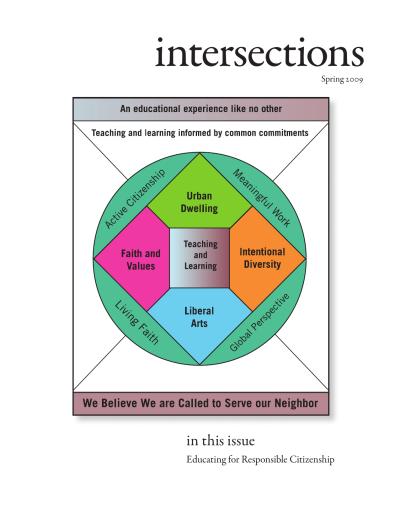
Pribbenow argues that the vocation of Augsburg College is to educate “dual citizens”—those able to live within the messiness of common work rather than resolve every tension once and for all. Drawing on John Courtney Murray on democracy as “the intersection of conspiracies,” Bill Moyers, Jean Bethke Elshtain, Stephen Carter, and the Augsburg vision statement “We believe we are called to serve our neighbor,” he names four common commitments and five principles of civic education that ground Augsburg’s incarnational mission in its city neighborhood.
-
Article
From Alien to Citizen
Arne Selbyg
Selbyg reflects on three experiences of being educated for citizenship—growing up in Norway under the legacy of Lutheran pastors and public school teachers who resisted the Nazi occupation, arriving in America as a resident alien, and becoming a naturalized American citizen—and proposes the jazz ensemble as a better metaphor for American society than the melting pot, one in which different citizens learn skills, study other instruments, and dialog with one another in service to the common music.
-
Article
Seeking the Common Good: Lutheran Contributions to Global Citizenship
Wanda Deifelt
Deifelt draws on Luther’s account of neighborly love in “The Freedom of a Christian” and on his Two Kingdoms theology to argue that a Lutheran ethics of care fosters a sense of responsibility, accountability, and compassion that broadens citizenship beyond rights and virtues. Engaging William Galston’s typology of civic virtues, Sylvia Walby on women’s citizenship, Serene Jones on communitarianism, and Manuel Castells on globalization, she proposes that Lutheran theology equips the church to educate for transformative participation in world affairs.
-
 Article
The Critical Role of Lutheran Higher Education in the Age of Artificial Intelligence
Jose Marichal, Maya Goehner, Tyler Haug
No. 59 · Spring 2024
A Cal Lutheran political science professor and two of his students draw on Rooted and Open to argue that Lutheran higher education is uniquely positioned to stake out a middle path between AI utopianism and AI doom — cultivating a “healthy sense of human limit,” resisting data colonialism, and forming students to see the neighbor rather than the enemy as the world becomes increasingly synthetic.
-
 Article
Why Diversity and Civic Engagement Don't Talk to Each Other on College Campuses: The Need for Public Work
Jose Marichal
No. 25 · Spring 2007
Marichal opens with Thurgood Marshall’s line from Milliken v. Bradley and traces the “decoupling” of campus diversity and civic engagement initiatives back to their shared grounding in Benjamin Barber’s “thin” or pluralist democracy. Reviewing CIRCLE data on youth political disengagement, the limits of mandatory volunteerism, and persistent residential segregation, and drawing on Mary Ann Glendon, Lani Guinier, Caryn McTighe Musil, and Richard Rorty, he argues that only Harry Boyte’s notion of “public work” can bind diversity and civic engagement together—and contends that Lutheran colleges, with their understanding of vocation as call into the world, are uniquely positioned to build that infrastructure.
-
 Article
ELCA Social Teaching for the Classroom?
Roger A. Willer
No. 51 · Spring 2020
Willer argues that the body of ELCA social teaching, taken as a whole, constitutes an actual social ethic — relatively comprehensive, responsibly consistent, and remarkably cogent — whose mode of responsibility ethics commends it as a classroom resource for any discipline that wrestles with moral questions.
-
 Reflection
Fumbling Toward Integrity: A Sermon on Mark 8:34-38, Pastor Kaj Munk, and Father Maximilian Kolbe
Darrell Jodock
No. 34 · Fall 2011
Preached at the 2007 ELCA Convocation of Teaching Theologians at Lenoir-Rhyne College, Jodock holds up two World War II martyrs—Polish Franciscan Father Maximilian Kolbe, who took the place of a condemned father in Auschwitz’s starvation bunker, and Danish pastor-playwright Kaj Munk, who was shot by the Nazis after helping save 97 percent of Denmark’s Jews—as mirrors for our own priorities. Drawing on the rescuer characteristics identified by Samuel and Pearl Oliner (agency, moral independence, universalistic caring, a history of care-giving) and on Jesus’s words in Mark 8:34-38, Jodock asks how we who routinely opt out at the first sign of opposition might fumble toward integrity in our own time.
-
 Book Review
Types, Methods, and Sagas in Lutheran Higher Education: Learning from Childers
Lake Lambert
No. 39 · Spring 2014
Lambert situates Eric Childers’ College Identity Sagas within the older tradition of the 1977 Association of Lutheran College Faculties volume The Church-Related College in an Age of Pluralism, working through Burton Clark’s “saga” and Robert Benne’s typology of church-related colleges. He commends Childers’ socio-scientific approach while questioning whether a typology can do justice to institutions that resist easy classification.
-
 Article
"We're Looking for a College—Not a Vocation": Articulating Lutheran Higher Education to Prospective Students and Parents Seeking Relevance
Karl Stumo, Tom Crady
No. 38 · Fall 2013
Drawing on Sallie Mae and UCLA enrollment data, the websites of competitor institutions, and candid voices from the field, Crady and Stumo describe a recruitment landscape in which yield rates have collapsed, discount rates have soared, and the word “Lutheran” often presents an obstacle until it is patiently unpacked. They survey mission language at Augsburg, PLU, Gustavus, and Wartburg and argue that strategic message development is the only way for ELCA schools to make vocation and Lutheran identity “credible, relevant, differentiating, and compelling” to prospective families.
-
 Article
Negotiating Legitimate and Conflicting Values
Eboo Patel, Katie Bringman Baxter, Mark S. Hanson
No. 44 · Fall 2016
In a closing-day conversation at the 2016 Vocation of a Lutheran College Conference, Mark Hanson and Eboo Patel — moderated by Katie Bringman Baxter of Interfaith Youth Core — share case studies in which legitimate religious values come into tension with one another, and make the case that Lutheran colleges should teach interfaith leadership through the hard cases rather than the easy ones.
-
 Article
Liberal Arts and Professional Education: A Call for Philosopher-Servants
Steven C. Bahls
No. 24 · Fall 2006
Bahls, President of Augustana College (Rock Island), calls for a renewed commitment at Lutheran colleges to form “philosopher-servants” — graduates whose grounding in the liberal arts and the liberating gospel equips them for thoughtful service in business, education, nursing, and the other professions. Their impact, he argues, is “a good thing and a fact that we can be proud of as those who labor in Lutheran higher education.”