In this essay, I am going to address something that is absolutely vital to the well-being of faculty members at Lutheran Colleges: securing the resources to support your work, including the work of environmental sustainability. Securing such resources is absolutely vital, yet usually looked down upon. When I was having breakfast last week with a retired faculty member at the Lutheran Theological Seminary at Gettysburg, I mentioned that most faculty members I knew—at both colleges and seminaries—considered the people who garner resources for our colleges somewhat unclean, analogous to the people who clean latrines. Someone has to do it, but they’re mighty glad it isn’t them. He didn’t disagree.
As a former president of one Lutheran college and former provost of another, writing to members of Lutheran colleges, I decided that this essay should begin with a scriptural text. So I chose Romans 12:2. In the words of the Authorized Version of 1611, that passage reads: “And be not conformed to this world: but be ye transformed by the renewing of your mind, that ye may prove what is that good, and acceptable, and perfect, will of God.” College presidents are perpetually interacting with this world, and in my fifteen years in the job, I rarely had the luxury of avoiding the challenges of this text.
Victor Ferrall, the former President of Beloit College, wrote a book that I suspect all the presidents and many of the trustees of your colleges are reading: Liberal Arts at the Brink. I won’t go into the depressing details; suffice it to say that colleges like ours are having a hard time. They’re spending more money than they’re taking in. I think most of you are aware of the way Lutheran colleges used to operate, or at least liked to imagine that they could operate. Faithful Lutheran parents believed that Lutheran colleges provided the best academic and social environment for their children, so that a good percentage of Lutheran children went to Lutheran colleges. Local congregations were generous with financial support, and so were the local synod and the national church. A good deal of the president’s job involved visits to congregations; he often preached or spoke to Sunday School groups. Ethnicity had a good deal to do with this: Danish-American, Swedish-American, Norwegian-American, even once upon a time German-American families tried to keep members of the next generation in the ethnic family by sending them to colleges that would preserve their ethnic heritage.
If they ever existed in quite this idealized way, those days are gone forever. Local congregations, synods, and the ELCA continue to cut, if not entirely eliminate, support for our colleges. Lutheran parents and their college-bound children are more likely to look to U. S. News and World Report than they are to the Bible or the national anthem from the old country. So where do we get the means to stay open, let alone to support initiatives in environmental sustainability?
I here describe three projects that foster an academic environment for sustainability and explain how the resources were secured to make them possible. Because they are all from the institution where I most recently worked, Washington College, they are “secular,” but since Washington College is a small, not enormously well-endowed liberal arts college like most of yours, I think these examples are apposite. Each of them relied on a different means of support. And each of them raised issues about conformity to the world. To protect the privacy of the individuals and organizations with whom we worked, I’m going to be vague about names and details, but that shouldn’t impair your ability to understand the ways resources for the projects were acquired.
All three of these projects are part of the Washington College’s Center for the Environment and Society. Because it sits on a relatively unspoiled river in a rural county on the Eastern Shore of Maryland, Washington College chose some years ago to emphasize the study of the environment and the effects of human interaction with the environment. The center’s mission is to foster this work. So I will describe first the center’s partnership with Chino Farms, second the development of what came to be known as the Chesapeake Semester, and third the acquisition of a work boat, the Callinectes.
Decidedly "In the World"
The college’s Field Research Center sits within Chino Farms, a remarkable combination of Audubon bird sanctuary, working farm, and research center on 5000 acres along the other side of the Chester River from the college. Over the years, several Washington College faculty had done research on Chino Farms, but although they had coexisted for decades, there was no formal relationship between the farms and the college. The owner of Chino Farms lived in another state but frequently visited Chestertown, and the director of our center began having lunch with him. It became clear that he was concerned for the long-term sustainability of Chino Farms. (We fund-raisers have our own vocabulary for donors, drawn mostly from agriculture; we “cultivate” donors; we “harvest” gifts. Donors generally don’t like to think too much about their own demise, so in our language “long-term sustainability” generally means what happens after the donor dies.) Was the college really as serious about its commitment to the environment as it professed to be? It was time for the president to get involved.
As I got to know this potential partner, it became clear to me that our interests were not identical. Some of his interests—for example, providing a test site to burn switch grass as fuel—were beyond the college’s present capacity. But there was a lot of overlap. As he and the college got to know one another better, due largely to the efforts of the center’s remarkable director, we began talking about a formal agreement. That agreement was finalized just about the time of my retirement, and now students and faculty at the college have unparalleled opportunities for senior projects, internships, and significant research. Since my retirement, the owner has come onto the college’s Board of Visitors and Governors. Initially, the college had no connection to this donor other than his geographic proximity; it was the college’s commitment to serious engagement with environmental issues that gradually pulled him in.
Another of our director’s dreams was the creation of a unique academic experience for a small group of seriously committed students. For an entire semester, these students would devote all their academic work to a comprehensive study of the Chesapeake Bay watershed. They would learn to understand the natural ecology of the bay: what kinds of animal and plant species thrived in the bay; how water quality affected populations of grasses, finfish, and shellfish; what effects climate change was beginning to have. But they would also study the human ecology of the bay: how human beings—past and present—exploited the bay’s resources to support themselves; who ultimately made decisions about those resources; how writing about the Chesapeake Bay—literary imaginings of the bay going all the way back to John Smith—shaped attitudes toward it. In the event, they even spent a weekend in the woods building temporary shelters and foraging for food, just as bay inhabitants had done before the arrival of Europeans.
Such a semester involved a good deal of travel to places like Richmond, Annapolis, and Washington where political decisions were being made, as well as to many locations on and around the Chesapeake Bay. It ultimately came to include a trip to another major estuary. We first planned to take students to Baja California, but drug cartel violence caused us to think again, and we ultimately established a fruitful relationship with an estuary system in Peru. Obviously, such a semester could not be sustained with tuition money alone.
By envisioning summer workshops for teachers and income-generating summer activities for adults, our director produced a model that promised to become self-sustaining in a few years. But where to get start-up costs? We turned to a national foundation with whom we had a long-established relationship, and after a good deal of back-and-forth, including writing and rewriting our proposal, we received the needed funding.
Why was our grant proposal successful when many others had failed? First, we had an excellent long-term relationship with this foundation, a healthy “track record.” Just as my predecessors had done, I made a point of visiting their offices in New York and staying on good terms with the grant officers who would decide on our proposal. Second, our commitment to the liberal arts—which this particular foundation cherishes—had been unwavering for more than two hundred and twenty-five years. But third, and most important, our proposal was sound, carefully-thought out, and unique in integrating many of the liberal arts into the study of something the college was clearly in a position to do, namely, provide students with the opportunity to learn in great depth about a topic right at our doorstep: the Chesapeake Bay. Our demonstrated commitment to academic excellence and the academic rigor of this proposal led the foundation to grant us the resources needed to get it off the ground. In other words, we met the world’s terms.
Risking Conformity to the World
My third example ended up supporting both of the first two. The Director of Washington College’s Center for the Environment and Society is by training an underwater archaeologist, and he recognized the importance of getting access for our students and faculty to a state-of-the-art workboat. The center had some makeshift vessels such as pontoon boats and small motorboats that could go out on the Chester River and take water and bottom samples, but we clearly needed something that could transport larger numbers of students farther down the river and out into the Chesapeake Bay, something equipped with serious scientific equipment for twenty-first century research. He dreamed of a vessel of about forty or fifty feet, with a powerful engine that could move everything quickly down the twenty miles river from Chestertown to the bay.
There was obviously no way buying and operating this kind of boat was going to come out of the college’s operating budget. But wait: If we had such a workboat, it could be made available to local teachers, who could in turn bring high-school science classes for an opportunity on the river. Local farmers and watermen would profit from our research. This would benefit our entire region. So I approached our congressman, at that time a wonderful representative named Wayne Gilchrest who had been a former high school civics teacher at Kent County High School. How did he feel about an earmark for a workboat?
I don’t know how you feel about earmarks. However you feel, I suspect you wouldn’t have any trouble fitting this kind of request into the category of “conforming to this world.” Fortunately, Congressman Gilchrest was a committed environmentalist who had worked for years to preserve a natural flyway down the entire eastern shore. He understood why it was important for watermen and farmers to learn everything they could about Chesapeake Bay ecology—he was intimately involved, for example, in efforts to rebuild the oyster population in the bay—and how the present generation of high school students will be called upon to make important decisions that pit environmental preservation against other pressing social needs. The college had made a point of keeping him involved in our environmental affairs and had previously hosted a workshop where he brought together farmers, watermen, and environmentalists to address challenges to the river and to the bay.
Working with a congress person fits somewhere between working with an individual donor and working with a foundation. For one thing, the college is likely to have a more intimate understanding of the particular federal program into which an earmark can fit than is the congressman himself. We worked with someone who specialized in finding niches in federal programs, crafted our request appropriately, and then helped the congressman and his staff understand exactly how we were asking them to proceed. We also had to get our two senators on board. Neither was unsympathetic, but both had many other priorities that must have seemed more pressing than environmental education in Maryland’s most rural county. And then our congressman had to insert his bill into the long list of similar requests from his colleagues. It’s entirely possible to go all the way through such a process only to fail at the end because the congressional leadership has decided to limit earmarks in that particular appropriations cycle.
We didn’t fail, and my wife Sarah got to christen the workboat Callinectes. The name is Greek for beautiful swimmer, and callinectes sapidus—the “savory beautiful swimmer”—is the Chesapeake blue crab. Actually, my wife tried to christen the Callinectes; the champagne bottle wouldn’t break on the fiberglass bow and had to be smashed in another manner.
Of course, once you have a workboat, you’re still faced with the challenge of operating it. Large boats have often been called holes in the water into which you throw money. When the college is not in session, various plans are afoot to take paying passengers out on the river and the bay, and grants that include using the boat will have to request money for its operation. By the way, where the foundation expected a detailed, academically respectable, thirty page proposal, the congressman needed only a paragraph. It was up to me to make the case in person that carried that paragraph along.
From Conformity to Covenant
I know I’ve only scratched the surface, but I would suggest that in all three situations, which I think are representative, the college is “conforming” to the world, and that the question of how far to conform poses interesting ethical issues. To use another biblical concept, the college, represented by the president or another fund-raiser, creates a kind of “covenant” with the donor, one ideally governed not by strict legal constraints but by mutuality of interest. Although it may appear to you that the college is simply approaching donors with its hands out, my experience has convinced me that each party to the covenant gains important benefits. Our individual donor gained the satisfaction that comes from having contributed voluntarily to something that mattered deeply to him; having seen the pleasure donors derive from such gifts, I would never underestimate that satisfaction. Most of us have made such contributions, however modest, to our churches, our undergraduate alma mater, or some other institution that is important to us. The donor’s generosity also gave him confidence that the important work he had overseen during his lifetime would continue after he was no longer around to supervise it. More commonly, this happens when a donor endows a scholarship or a faculty chair, thereby making certain that a student or faculty member in an area of importance to him or her will continue to benefit from her or his generosity forever. Pragmatically, there are also tax benefits involved for the donor, and those of you with an arithmetic bent would probably find the study of the various kinds of possible annuities and trusts of more than passing interest.
The foundation gains the satisfaction of forwarding its own mission and of taking significant credit for the success of what it funds. If, as is true in this case, your mission is to advance excellence in liberal arts education, you take pride in working with an institution to achieve results that confirm the importance of what you are up to.
And the congressman? Not only has he advanced something important on his own agenda, but he has directed federal dollars to his district. We made sure he was present at the christening so his staff could take publicity photos, and in retirement he serves on Washington’s Center for the Environment and Society advisory board.
I close with two requests for faculty teaching at our institutions. I hope I’ve given you a sense of how some environmentally-focused problems can be both funded and sustained, and how this process involves a certain conformity to the ways of the world. It’s very likely that colleges like ours will sustain—or fail to sustain—themselves through the next several decades based on their success at raising money largely from individual donors. And the individuals most likely to support you will be your alumni, in other words the very students you will be teaching this coming fall. Those of us who write compelling essays and score well on tests like to believe that our best students will be our most successful graduates. But that is often not the case. I work out during the week at the newly-remodeled Gettysburg College athletic facility, and I’m told that some of the most visible names on the wall, the donors to the facility, were not particularly good students. Let’s be realistic. There are many kinds of intelligence, and the one most likely to earn A’s in class is not necessarily the one most likely to succeed in the marketplace. So first, do your best to inspire all your students; you never know which one might strike it rich someday and endow a chair in your honor. Seriously, the more you can show your students, by your example, the extraordinary benefits of attending a Lutheran college, the more likely they are to want to make sure those benefits are available for their children and grandchildren.
Second, I suggest that faculty consider, at some point in their careers, getting involved in academic administration. Those who are in the formative years of a faculty career can put this off; they need to concentrate on teaching and on research. But at some stage, I hope all faculty will consider how to contribute to the kind of enterprise I have been describing. Initially that might involve writing and administering a grant. Some dean’s offices provide for faculty members to rotate in and out as assistant or associate deans. Serving as a department chair or the chair of an important faculty committee can also be a springboard to a stint in administration.
I say this because I see a disturbing tendency for boards of trustees to look beyond college walls for their leaders. Even after the meltdown of our financial system, outsiders still imagine that “colleges need to be run more like businesses.” Desperate for money, trustees may also be tempted to look for experienced fundraisers who may have little direct experience of academic life. Of course, some experienced fundraisers such as Randy Helm of Muhlenberg College (formerly Vice President for Development at Colby College) who holds a Ph. D. in ancient history from the University of Pennsylvania, or Lex McMillan of Albright College, (formerly Vice President for Development at Gettysburg College) who wrote his English literature Ph.D. thesis at the University of Virginia on C. S. Lewis, have made excellent college presidents. But I believe that our colleges need as large a pool as possible of dedicated faculty members, teacher-scholars who love to breathe academic air, who have also taken a turn in administration.
I am all too aware that faculty culture disparages administration and that faculty members condescend to those of us who have, as my nephew once put it, “turned to the dark side.” But if you want administrators who are sympathetic to your concerns, be those administrators.
I want the person who meets with individual donors, congress people, and foundations not only to be passionate about teaching and scholarship but also to have done it. I want that person to know just what it is that may have to be conformed a little to this world, and I want them to be skilled at creating an outcome that includes a good measure of what the Hebrew Bible calls chesed—covenant faithfulness—to both parties.
Works Cited
Ferrall, Victor E., Jr. Liberal Arts at the Brink. Cambridge, MA: Presidents and Fellows of Harvard College, 2011.
-
 Editorial
From the Publisher
Mark Wilhelm
Wilhelm argues that the rhetoric framing ELCA higher education as a binary between “secular” and “religious” is “hokum”: there is a third way of doing higher education from a Christian perspective that is religious in motivation and practice but on the ground looks secular. After more than half a century of debates, he calls on ELCA presidents to “do something” in 2013 to move forward in shared mission and vocation.
-
Editorial
From the Editor
Jason A. Mahn
Mahn introduces the issue through Norman Wirzba’s The Paradise of God and the Genesis 2 vocation given to Adam to care for adamah—arguing that “vocation” is the Lutheran name for an incarnational, creation-centric theology of kenosis and that Lutherans bring distinctive theological gifts to environmental work even if no absolutely unique perspective on caring for creation.
-
Institutional Focus
Vocation for Life: A Report on a New Initiative for Alumni
A report on “Vocation for Life,” a collaborative initiative of ELCA-related colleges and universities to make vocational exploration available to alumni across the country regardless of which school they attended. The first pilot retreat—“Explore Your Life’s Calling,” in Rochester, Minnesota in November 2011, facilitated by Tom Morgan of Augsburg, Chris Johnson of Gustavus, and Tom Scholtterback of Concordia using the Circles of Trust approach—is described.
-
Article
A Traveler's Manifesto for Navigating the Creation
Ann Pederson
Pederson asks who we are, where we are, and how then we shall live within the Epic of Evolution and the doctrines of creation, incarnation, and imago dei. Drawing on John 3:16 (“For God so loved the cosmos…”), Luther on God’s presence “in the veins of a leaf,” Augustine’s City of God, Phil Hefner’s “created co-creator,” Joseph Sittler’s “Called to Unity,” and Norman Maclean’s Young Men and Fire, she argues for a cosmic reading of incarnation in which all of creation—not only the human—bears the image of God.
-
Institutional Focus
Facing Tornados and Climate Change: An Interview with Jim Dontje about Environmental Innovation at Gustavus
Jim Dontje
Dontje, director of the Johnson Center for Environmental Innovation at Gustavus Adolphus College, describes the Center’s work with solar thermal and photovoltaic systems, LEED certification of Beck Hall, recycling and conservation initiatives, the Linnaeus Arboretum, and the difficult work of building consensus around climate response—reflecting on how Gustavus’s 1998 tornado recovery shaped a community capable of collective action, and on how the “Lutheran identity” both restrains and energizes the college’s environmental ethos.
-
Article
A Lutheran Ethic of Environmental Stewardship
Jim Martin-Schramm
Martin-Schramm sketches a Lutheran ethic of environmental stewardship organized around four moral norms inherited from World Council of Churches discussions and developed by Presbyterian and ELCA social statements: sustainability, sufficiency, participation, and solidarity. He grounds each norm in scripture and the Lutheran tradition—the theocentric doctrine of creation against rampant anthropocentrism, the incarnation against destructive dualisms, Christ in community against modern individualism, and accountability to God for future generations—arguing that this “ethic of ecological justice” offers a common moral vocabulary for engaging environmental policy debates that would otherwise collapse into cost-benefit analysis.
-
Institutional Focus
Putting Principles into Practice: An Interview with Kenneth Foster about Concordia's Sustainability Council
Kenneth Foster
Foster, chair of Concordia College’s President’s Sustainability Council, describes the Council’s formation under President William Craft in 2011 as a re-energization of stalled task-force work, its coordination with grass-roots campus initiatives, and its strategy of moving from principles to practice in stewardship of natural resources at a Lutheran liberal arts college.
-
Article
Climate Justice, Environmental Racism, and a Lutheran Moral Vision
Cynthia Moe-Lobeda
Moe-Lobeda argues that the vocation of a Lutheran college is to prepare students for Thomas Berry’s “great work”: forging a sustainable relationship between the human species and the planet while diminishing the gap between those who have too much and those who have not enough. She develops a three-fold “moral vision” rooted in Luther’s theology of the cross—seeing what is (climate injustice and environmental racism for what they are), seeing more just and sustainable alternatives, and seeing God’s saving presence at work—and offers it as a distinctive Lutheran contribution to the panhuman and interfaith challenge of our day.
-
Institutional Focus
Farming and Eating Locally: An Interview with Garry Griffith about Augustana's Farm2Fork Program
Garry Griffith
Griffith, Director of Dining at Augustana College (Rock Island), describes the Farm2Fork program’s shift from pre-packaged food to fresh produce sourced from local farms (beginning with Jim Johansen of Wesley Acres in Moline), the Augie Acres campus garden tended by students in learning-community courses, the bio-diesel conversion of used fryer oil for greenhouse heat and farm equipment, and the stewardship calling that grounds these efforts in Augustana’s Lutheran identity.
-
Institutional Focus
Health Food in the Inner City: An Interview with Brian Noy about Augsburg's Campus Kitchen
Brian Noy
Noy, Director of Campus Kitchen at Augsburg College in Minneapolis, describes the Kitchen’s four-fold program—Food to Share (2,000 meals per month from surplus dining-services food and Campus Cooking Classes), Food to Grow (an 80-plot community garden), Food to Buy (two farmers markets that accept EBT/food stamps), and Food to Know (educational programming)—and the deep history of Augsburg’s service to the immigrant communities of the Cedar Riverside neighborhood, now Somali and Mexican as well as historically Norwegian.
-
 Response
Response to Robert Benne
Baird Tipson
No. 17 · Summer 2003
Tipson responds to Robert Benne’s comments in the previous issue about his review essay of The Future of Religious Colleges, affirming their fundamental agreement that the Enlightenment epistemology dominant in higher education poses the most serious threat to the vitality of Lutheran colleges. Using the example of lecturing on early Mormon history and the Book of Mormon, he concedes that the methodological “solvent” of Enlightenment historiography acts on Christian as well as Mormon faith claims, and concludes that while H. Richard Niebuhr’s “inner” and “outer” history and Walter Brueggemann’s approach in The Theology of the Old Testament are comforting to believers, they do not offer an epistemology that can stand alongside the Enlightenment model in evaluating truth claims in the academy.
-
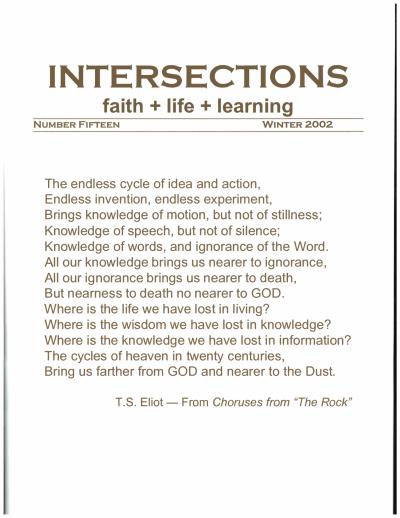 Book Review
Paul Dovre, ed.: The Future of Religious Colleges
Baird Tipson
No. 15 · Winter 2002
Tipson, president of Wittenberg University, reviews Paul Dovre’s edited proceedings of the October 2000 Harvard Conference on the Future of Religious Colleges (Eerdmans, 2002), summarizing essays by Douglas Sloan on the failure of the “two-realm theory of truth,” George Marsden on faith-shaped scholarship, DeAne Lagerquist, Father David O’Connell, Mark Noll, Robert Benne, Mark Roche on Notre Dame, Joel Carpenter on neo-Calvinist Kuyperianism, and Mark Schwehn on a Lutheran “college-related church” and the centrality of vocation. Against Benne’s suggestion that only two or three robustly Lutheran colleges can be sustained, Tipson defends a less robust but still authentically Lutheran model embodied at places like Wittenberg, Gettysburg, and Roanoke, arguing for the enlightenment commitment to subjecting all truth claims to rigorous criticism and for hiring Marsden-style faith-shaped scholars rather than counting Lutheran heads.
-
 Institutional Focus
Embodying the Tradition: The Case of Wittenberg University
Baird Tipson
No. 2 · Winter 1997
Tipson, President of Wittenberg University, locates Wittenberg in the “American” strain of Ohio Lutheranism founded in 1845 under Ezra Keller (a Pennsylvania College and Gettysburg Seminary graduate and disciple of Samuel Simon Schmucker), with English-language preaching, financial support from the pan-Protestant New England Society, Presbyterians on the Board, and an Episcopalian teaching Latin. He names two ongoing challenges—remaining authentically Lutheran while welcoming a pluralistic student body (just under a quarter are Lutheran in a primary service area that is 5% Lutheran), and making the tradition clear and compelling to non-Lutheran or lukewarm Lutheran students—and presents the five things every Wittenberg graduate should be able to do (respond to the human condition; recognize, define, and solve problems; develop a sense of vocation; assume servant-leadership; take moral responsibility) as authentic expressions of the Gospel and of the university’s ELCA relationship.
-
 Reflection
On the Power of Transformation and Becoming Human
Ken Yanai Flores
No. 59 · Spring 2024
Flores, a Cal Lutheran sophomore, reflects on personal and institutional transformation as the slow work of shedding the armor of trauma responses, engaging discomfort rather than turning away, and trusting that the work of becoming more human — more empathetic, knowledgeable, and free — will be reflected in our institutions as well.
-
 Article
Creation, Justice, and Communio: Lutheran Insights Empowering Educational Access
Mary Elise Lowe
No. 60 · Fall 2024
In her VLHE keynote, Lowe names three Lutheran commitments — continuing creation, neighbor justice, and communio — as the “why” that empowers ELCA colleges and universities to pursue equitable access for students often left behind by persistence and graduation gaps.
-
 Editorial
From the Publisher
Arne Selbyg
No. 7 · Summer 1999
Selbyg celebrates the popularity of the previous issue—the first to draw on papers from the annual “Vocation of a Lutheran College” conference—and announces a new Lutheran Brotherhood Foundation grant that will fund the inaugural Lutheran Academy of Scholars in Higher Education, a two-week seminar at Harvard led by Ronald Thiemann on “Finding Our Voice: Christian Faith and Critical Vision.”
-
 Editorial
From the Editor
Jason A. Mahn
No. 46 · Fall 2017
Mahn returns to Luther’s opening thesis on whole-life repentance to argue that the deepest critique of the indulgence economy — and of our own American meritocracy — is the very assumption that grace and human striving can be measured, exchanged, and earned.
-
 Editorial
From the Publisher
Arne Selbyg
No. 23 · Summer 2006
Selbyg features articles based on presentations at the 2005 Vocation of a Lutheran College conference focused on the upcoming ELCA Social Statement on Education, and urges members of the ELCA higher-education community to download the first draft (“Our Calling in Education”) from the ELCA website and submit feedback to the Task Force on Education before the October 15 deadline. He worries that the sexuality social statement on a 2009 timeline will draw more attention than the education statement, but reminds readers that, for Martin Luther and for those who work in Lutheran higher education, education is as important as sex.
-
Article
Making Dry Bones Stand: Lutheran Higher Education at Century's End
Diane Scholl
No. 17 · Summer 2003
Scholl reads John Winthrop’s “A Model of Christian Charity,” the banishment of Anne Hutchinson, de Crevecoeur’s American farmer, Olaudah Equiano, Phyllis Wheatley, and Hawthorne’s The Scarlet Letter alongside Ezekiel’s vision of the dry bones to ask how a Lutheran college can be a community that holds difference and commonality together. Drawing on Ernest Simmons’s warning against collapsing into either dogmatic absolutism or thoroughgoing relativism and Bruce Reichenbach’s companion essay in this issue, she identifies five features of shared life at a Lutheran college—the liberal arts, political process, the arts, the community of caring, and the recognition of difference and the right to dissent—and argues that the necessary tension between individualism and corporate identity, framed by theological vision, is “our best legacy and our best hope for the future.”