Sojourners in a Pluralistic Land: The Promise and Peril of Christian Higher Education
Intersections No. 25 · Spring 2007
I am certain to make some enemies here before the evening is over, so I might as well get started. Despite my respect for church-related schools, including Lutheran schools, the schools of the Christian Reformed Church, and even the parochial school system mandated by the Third Plenary Council of 1884, and despite my strong conviction that parents have every right to educate their children anywhere they please (including at home), I am—and I have been for nearly half a century—a passionate advocate for public education at the elementary, junior high, and high school level. Public schools, originally known as “common schools” in the nineteenth century, may be the only place in our society where children from various racial, ethnic, and religious backgrounds can come together and, in the context of both the classroom and the playground, learn to get along with one another in at least a measure of comity. That sounds to me like a recipe for democracy, and it is one that has served us well for most of American history.
Although I acknowledge that what I have just described is an ideal view, and that public education is in real trouble today, I prefer to view the glass as half full rather than half empty. We need a place in America where children drawn from different backgrounds can meet on a more-or-less equal footing and learn the rudiments of democracy. Public schools, for all their faults, provide that space. I worry very much that sending Jewish children to Jewish schools, Catholic kids to parochial schools, evangelical kids to Christian schools (or home schooling), and the children of affluent parents to elite private schools leads inevitably to a further Balkanization of American society, which cannot help but have deleterious effects. I believe that if we, as a society, care anything about the future of democracy, especially in a pluralistic context, we cannot afford to give up on public education.
I realize full well the implications of what I am saying for people of faith. It means, at the very least, that parents and churches have to bear more of the responsibility for the religious formation of their children. That’s not a simple task, especially in the context of a media-saturated, peer-driven society. And I also recognize the ways in which religious schools—whether they be Jewish, Lutheran, Catholic, or Christian Reformed—have safeguarded the ethnic identity and particularity of specific populations. That is not a negligible consideration, and I acknowledge its importance. I first became aware of this when I studied the religious dynamics in colonial New York City. The Collegiate School, which is still in operation on the upper west side of Manhattan, was founded by the Dutch Reformed Church in 1628. Shortly after the English Conquest of 1664, Trinity Church, a congregation of the Church of England, established Trinity School. The fortunes of the Collegiate School suffered thereafter so that by the middle of the eighteenth century, the Dutch congregation appealed to the ecclesiastical authorities in the Netherlands for an English-speaking minister; the younger generation, educated at Trinity School, could no longer understand the Dutch language.
“Parents and churches have to bear more of the responsibility for the religious formation of their children.”
Such is the power of education in transmitting both faith and culture. I acknowledge that, and I honor its importance. Still, despite these considerations, I stand by my defense of public education, while, at the same time, I support the prerogative of parents to educate their children in any venue they see fit.
Having said that, and although it may sound counterintuitive, I am equally committed to the importance of Christian higher education. Some of this, I realize, is autobiographical. I grew up in parsonages in rural Minnesota, Michigan, and Iowa, where I attended public schools—and I happen to think that I am none the worse for wear. For college, however, I went to a Christian liberal arts college and had there (on balance) a wonderful experience, and it is on that experience that I should like to focus the balance of my remarks this evening.
A few more autobiographical details—of necessity, I’m afraid. I very nearly didn’t attend college at all; I had started a small business as a teenager, and I was convinced at the time that this was what I wanted to pursue as a career. My father, however, urged me to think about higher education. Finally I agreed, first, to attend a state university within commuting distance so that I could continue operating my business. Then, succumbing to a bit more pressure, I relented and submitted a last-minute application to Trinity College in the North Shore suburbs of Chicago.
The decision to attend college was, I see now, the first of many Robert Frost moments in my life, where I stood at the fork in the yellow woods and contemplated two pathways, both of which seemed agreeable at the time. I have occasionally reflected on “The Road Not Taken,” and I imagine that, all things considered, I probably chose the better route. And what if I had chosen the state university? All of this is speculation, of course, but I suspect that, given my rootedness in evangelicalism, I would have burrowed deeper into the subculture, this vast and interlocking network of congregations, denominations, Bible camps, Bible institutes, mission societies, and publishing houses that was constructed in earnest during the middle decades of the twentieth century to protect innocents like me from the depredations of the larger world, a world that my parents believed was both corrupt and corrupting.
There is safety within the evangelical subculture, I’ll not deny it—or any religious subculture, for that matter. My religious upbringing—in the home, at church and youth group and Sunday school, at vacation Bible school, and Bible camp—had provided me with a firm grounding in the faith, and I might very comfortably have remained safely within the bosom of the subculture.
Instead, I attended a Christian liberal arts college, one supported by my own denomination. Like many such institutions, it began as a Bible institute, but it evolved, as these schools often do, into an accredited four-year college. (It now bears the rather grand moniker of Trinity International University—having passed, apparently, on Trinity Intergalactic University!)
Soon after I shambled onto campus in early September 1972, I recognized that Trinity was an unusual place, at least by the standards of Christian higher education. A wise and forward-looking dean had hired a cohort of young, energetic, newly-minted PhDs who challenged the presuppositions of their students, most of whom hailed from politically and theologically conservative households. But they did so not as provocateurs but as fellow-travelers, and they did so not with the intention of robbing us of our faith altogether. As a student, as someone whose notion of rebellion was to wear blue jeans to the Sunday-evening service, the experience of probing the parameters of the faith and questioning the shibboleths of the subculture was unsettling. But it was also bracing, and it changed me in ways that even now, in late middle age, I appreciate only in part.
Beginning with the publication of the first edition of Mine Eyes Have Seen the Glory: A Journey into the Evangelical Subculture in America (1989), I’ve heard from dozens of people over the years who were reared evangelical but who left the faith, many of them in late adolescence. Their letters are poignant, even plaintive. They reminisce, page after single-spaced page, about their religious background—Sunday school and singing songs around the campfire. They express appreciation for their upbringing and sadness for having left the faith. Some left because of intellectual doubts or because of sexual orientation or because of what they perceived as hypocrisy in the ranks of the religious leadership. More recently, I hear utter disgust at the ways in which the leaders of the Religious Right have delivered the faith captive to right-wing politics.
Finally, these correspondents express a kind of envy of someone who has been able to retain his faith. For some, those who perceive me as an intellectual, the fact that I teach at a prestigious university deepens the conundrum because they assume, I guess, that no one with academic credentials can simultaneously be an advocate for the faith.
I respond carefully to these letters, and I acknowledge that even a college sophomore can explain faith away as hysteria or delusion or the search for a father figure. Then I generally explain my decision years ago that I would not allow the canons of Enlightenment rationalism be the final arbiter of truth. I elect to inhabit an enchanted universe where there are forces at work beyond my understanding or control. I wouldn’t live anywhere else.
I don’t know whether or not my testimony is compelling, but I’ve come to reflect on why it is that I’ve been able to retain the faith when so many of my contemporaries have lost or discarded theirs. I suspect that, as with all such matters, a variety of factors come into play, but I have to believe that my formation at a Christian liberal arts college was crucial. Trinity College was far from perfect, but I think the place struck the right balance in a number of ways.
First, I think that any such institution faces the challenge of navigating between the Scylla of secularism and the Charybdis of sectarianism—although I think that channel is wider than is commonly believed. I heard a lot of rhetoric about “the integration of faith and learning” when I was an undergraduate—a lot of rhetoric. It was an effective mantra, a comforting piety, but I was never exactly sure what it meant, nor do I know today.
The dangers inherent in such pieties are obvious, and they have been amply illustrated in recent years in the calls for a kind of repristinization of America’s educational institutions. Yale is no longer a safe haven for Congregationalists, the lament goes, or Princeton for Presbyterians. No one will argue that many of the nation’s élite institutions of higher education are still the “nurseries of piety” that their founders intended. But the accompanying argument that people of faith should be granted special pleading in the academy is, to say the least, suspect. I will never contend that the academy is a perfect meritocrary—I have my own quiver of anecdotes and more than a few bruises to refute that—but people of faith need to play by the same rules and abide by the same standards of academic scholarship as everyone else.
For example, as a person of faith and as a historian of religion in America, I believe that the hand of God was present in the event historians call the Great Awakening, a revival of piety that swept along the Atlantic seaboard in the 1730s and 1740s. When I teach the Great Awakening, however, or when I write about the topic, I describe the historical, social, and cultural circumstances that gave rise to the Great Awakening, and I quote the perceptions of contemporaries that it was an event of supernatural inspiration. But for me to attribute the revival solely to divine providence would be to default on my responsibilities as a historian.
Or, to take another recent example, consider the case for intelligent design, a topic I cover extensively in Thy Kingdom Come. For that chapter, I framed the issue by describing a debate at Princeton University between Lee Silver, a molecular biologist at Princeton, and William Dembski, a kind of high priest of intelligent design and the chief evangelist for the intelligent design movement. I made it clear in my narrative that, as a person of faith, I happen to believe in intelligent design (or something very close to it), although I confess that I’ve grown accustomed over the years to referring to the “intelligent designer” simply as “God.” I rehearsed Dembski’s very impressive academic credentials and suggested that, although I laid no claims to being a theologian or a philosopher, he struck me as a very competent theologian and philosopher. But the issue is the validity of Dembski’s assertion that intelligent design is science and therefore should be taught in the science classroom.
If he means to be a scientist, Dembski should be prepared to make his case as a scientist and not angle for special pleading, as he did in the debate at Princeton. He argued, in effect, that because he is a person of faith he should therefore be exempted from the mores of inquiry peculiar to the discipline he claims as his own. As I emphasized in the chapter, I have no objections whatsoever to the teaching of intelligent design in colleges or universities; in fact, one of my PhD students, with my blessing, taught a course in intelligent design at Columbia this past summer. But the appropriate venue for such inquiry is the religion classroom or the philosophy seminar—at least until Dembski or someone can make a case that intelligent design is science. (Even the judge in the Dover, Pennsylvania, intelligent design case, a George W. Bush appointee, found this claim ludicrous. By peddling their theological claims as science, Dembski and the intelligent design advocates seek a double standard: “Hey look, I’m a scientist! I don’t do any of the things that other scientists do, I refuse to submit my work for peer review, I don’t ask the same questions that other scientists ask, and I don’t want to play by the rules of scientific inquiry, but, trust me, I’m a scientist!”
That, I submit, is no way to integrate faith and learning. It fails to abide by the professional standards of the academy, and, more important, it demeans the faith because it suggests that faith needs the imprimatur of science in order to be valid. I emphatically reject that notion.
If that sort of intellectual dishonesty represents the Charybdis of sectarianism, the Scylla of secularism at institutions of Christian higher education is a kind of intellectual arrogance that is allergic to expressions of piety. I understand this aversion, especially because I grew up within evangelicalism, where piety tends too often toward the rote and formulaic. I too participated in this cult of intellectualism, especially in graduate school—a reaction, no doubt, to my upbringing.
Engendering spirituality and encouraging piety is a tricky business, and I’ve never trusted institutions with this task. Institutions, in fact, are remarkably poor vessels of piety, in my experience; they tend to quash it more often than abet it, so the programmatic approach of chapels, chaplains, and spiritual emphasis weeks—commendable and important though they may be—falls short, in my judgment.
I turn instead to the incarnational expressions of faith and piety. What I found most effective during my intellectual and spiritual development in college was the example of my mentors. These were women and men of deep and abiding faith who were also manifestly human. They were unafraid to question their faith or to express their doubts, but the best of them also modeled for me a piety that found expression not only in declarations of belief but in sincere intellectual engagement and lives of integrity. They were my teachers in the fullest sense of the word. Their example impressed me deeply and affected me profoundly, and I maintain my friendships with many of these mentors to this day, thirty years after graduation.
Aside from the twin perils of secularity, which manifests itself in intellectualism, and sectarianism, which posits a kind of alternate academic universe, the final peril of Christian higher education is insularity. Shirley Nelson’s troubling novel, The Last Year of the War, a thinly fictionalized account of student life at Moody Bible Institute, illustrates this copiously, and although I’m certainly aware of the differences between Bible schools and Christian liberal arts colleges, I think Nelson’s novel is certainly worth reading. I recall that I seldom read a newspaper while I was in college, and I had little interaction with the larger world during the academic year, aside from my jobs in the community. Add to that the homogeneity that tends very often to afflict these schools, and the problem of insularity becomes acute.
“The final peril of Christian higher education is insularity.”
I ran across an extreme example of this during my visit to Patrick Henry College last December. Patrick Henry was founded in 2000 by Michael Farris to provide a place where parents who home-schooled their children could secure a college education free from such alien influences as feminism or Darwinism, a place where, in effect, parents could rest assured that their children would never encounter an idea that the parents would find objectionable or even questionable. The school’s website (www.phc.edu), for example, informs parents that all “biology, Bible or other courses at PHC dealing with creation will teach creation from the understanding of Scripture that God’s creative work, as described in Genesis 1:1-31, was completed in six twenty-four hour days.” Students who attend Patrick Henry College, moreover, pledge to “reserve sexual activity for the sanctity of marriage” and promise to “seek and obtain parental permission when pursuing a romantic relationship.”
Patrick Henry, as I said, is an extreme example of insularity, but the unfortunate corollary is that Patrick Henry College also aspires to train America’s leaders for the twenty-first century. Michael Farris, the founder and now the chancellor of the school, told the New York Times that the sentiment he hears most often from parents is that I want my kid to be on the Supreme Court someday. Farris added that, if we get enough kids into the “farm system,” that will happen. Since 2002, Patrick Henry College, a school with an enrollment of only two hundred, has placed twenty-four of its students as White House interns; a larger number have served internships in other governmental agencies and on the Congressional staffs of elected officials sympathetic to the Religious Right.
These are the people who aspire to lead the United States, this gorgeously pluralistic nation, in the twenty-first century. Because of their home-schooling and their experience at Patrick Henry College, these students most likely have never had any sustained or significant interaction with anyone outside of their own cohort of white, middle-class evangelicals. Because of the insular nature of their upbringing and their undergraduate education, they have never encountered an idea or an argument—feminism, for instance, or civil rights for lesbians and gays or Darwinism or environmentalism—except in caricature. As I ask in Thy Kingdom Come, I wonder how many graduates of Patrick Henry College have ever read Das Kapital or The Feminine Mystique or Fast Food Nation or Catcher in the Rye or The Autobiography of Malcolm X. How many of them have watched the “Eyes on the Prize” documentary or “The Future of Food” or “What Happened to the Electric Car?” What goes on at Patrick Henry is not so much education as indoctrination.
I emphasize (a second time) that Patrick Henry College is an extreme example of insularity, but it points to a real danger faced by institutions of Christian higher education. Instead of a hot house, I prefer to think of Christian liberal arts colleges as halfway houses, a place where students reared in a religious subculture can begin to interact with the wider world. They experiment with new ideas and try on new personas (which, of course, is the task of every adolescent). They interact with the larger culture not by plunging directly into the sea of pluralism and secularity, but by means of tentative forays—dipping a toe in the water, teasing the waves, and then maybe a few dog paddles into the current, but never far from a mentor navigating the same waters.
This is my vision for Christian higher education, a venue where students thoroughly grounded in the religion of their parents can begin to interact with the world outside of their own subculture—not from a posture of fear or defensiveness, though some of that is inevitable, but from a position of strength and curiosity and engagement. Are there risks inherent in such a strategy? Of course there are, and we all have stories of those who have lost their faith in the process. But my experience, not to mention my theology, tells me that we have to trust the process and, more important, trust that Jesus will ultimately gather his children unto himself.
“This is my vision for Christian higher education…”
If I am right that Christian liberal arts colleges represent a good place to make an effective transition from the subculture to the larger world, one key component for that transition is exposure to pluralism and the avoidance of insularity. How to do that? Admissions officers, in my experience, make a good-faith effort to recruit students beyond the usual cohort, but the competition for qualified students of color is often fierce. But there are other ways to combat insularity and to expose students to the universe beyond their subculture.
In a perfect world, one with unlimited resources, I’d start by providing every student with a daily subscription to the New York Times—not because the New York Times is perfect or inerrant, but because it opens a window to the larger world and it instills the importance of becoming conversant with developments beyond the campus. I’d encourage faculty to expose students to ideas other than those sanctioned by the religious subculture—and to do so with primary sources rather than through the lens of secondary treatments. Internships are also effective (Patrick Henry College is right about that), but let’s encourage students to think creatively about their activities outside of campus. Non-profit (and non-religious) agencies, environmental networks, political campaigns, local government, hospice, councils of churches, interfaith agencies—all of these expose students to people and ideas beyond their own subculture.
And it’s time also to think more creatively about the meaning of pluralism. Not only African Americans, for example, but Hispanic Americans and Native Americans and South Asians and people of different ethnic backgrounds. Diversity comes in many colors, creeds, and ages. I would love to see Christian liberal arts colleges construct condominiums and townhouses for retirees on or adjacent to their campuses. Invite seniors to participate fully in campus life, to attend classes and athletic and cultural events, and interact with students in the dining halls. And can you imagine the volunteer work force they would contribute to the campus? One of the real scandals of American society is the way we warehouse the elderly in nursing homes and neglect them, rather than draw on their experience and wisdom. And, who knows, maybe one of the students will one day point us to a better way of treating our elders.
I have no regrets whatsoever for choosing the path that led me to a Christian liberal arts college all those years ago. My undergraduate education shaped me in important ways by exposing me gradually to a larger world that I never would have encountered had I remained sequestered in my religious subculture—or certainly would have encountered on very different terms. I’m grateful for that. I’m grateful for the example of my mentors, fellow-travelers in the enterprise of sustaining the faith in an environment that all too frequently is hostile to faith. The whole experience of baccalaureate studies made my faith stronger and more resilient, but it also ensured that I could never again hide my light under a bushel or burrow back into the insularity of the subculture.
I function today as a person of faith in a pluralistic context. As such, I simultaneously inhabit two worlds, and I embrace them both—sometimes with fear and trembling, but more often with gusto and enthusiasm. I wouldn’t have it any other way.
Works Cited
Balmer, Randall H. Mine Eyes Have Seen the Glory: A Journey into the Evangelical Subculture in America. New York: Oxford UP, 1989.
Balmer, Randall H. Thy Kingdom Come: How the Religious Right Distorts the Faith and Threatens America, An Evangelical’s Lament. New York: Basic Books, 2006.
Nelson, Shirley. The Last Year of the War. New York: Harper, 1978.
-
 Editorial
From the Publisher
Arne Selbyg
Selbyg notes that most papers in this issue grew out of a pan-Lutheran conference organized by the Association of Lutheran College Faculties in fall 2006 rather than the annual Vocation of a Lutheran College conference, and argues that the ELCA’s ecumenical posture—truthful but open to learning from others—is a good foundation for institutions of higher education whose faculty likewise profess while remaining subject to change based on new research and insights.
-
Editorial
From the Editor
Robert D. Haak
Haak frames the issue around the question of what holds the twenty-eight ELCA colleges together amid their geographic, economic, and theological diversity, introducing Mark Hanson’s address to the assembled college presidents, Randall Balmer’s outsider perspective on the commonalities of Christian liberal arts, José Marichal and Pamela Brubaker on diversity rooted in community and globe, Storm Bailey’s argument that being Lutheran is precisely what makes us embrace diversity, and Jaime Schillinger’s St. Olaf chapel reflection on the formative power of worship and liturgy.
-
Article
Reflections on Our Shared Commitments
Mark S. Hanson
Originally delivered to the Lutheran Educational Conference of North America in March 2007, Hanson’s address describes the ELCA as “an ecology of interdependent ecosystems” and locates the church’s relationship to its twenty-eight colleges and universities in a shared mission rather than in older anxieties about church-relatedness. Drawing on Wittenberg’s Lutheran Identity Study, Augustana’s “Five Faith Commitments,” Pamela Jolicoeur’s Concordia address, W. Robert Connor on “big questions,” Joseph Sittler on grace, Walter Brueggemann on fear, Jonathan Strandjord on being “other-wise,” and Cynthia Moe-Lobeda’s Public Church for the Life of the World, he names four marks of shared mission: communities of free inquiry, encouragement of religious expression in a diverse society, education for the common good, and the formation of leaders for church and religious communities worldwide.
-
Reflection
Currents
Jaime Schillinger
Preached in St. Olaf chapel on March 29, 2005, Schillinger reads three “currents” pulling on her hearers—Minnesota spring, the academic year’s final stretch, and Holy Week’s passion and resurrection—against poetic voices from ee cummings, Gerard Manley Hopkins, and Edna St. Vincent Millay, before turning to the Song of Songs to suggest that this nexus calls students into the rhythms of love, awakened desire, and an elusive, unresolved promise that animates academic, spiritual, and vocational search alike.
-
Editorial
Guest Editor
Madeleine Forell Marshall
Marshall introduces the four papers in this issue from the 70th annual meeting of the Association of Lutheran College Faculties, held at California Lutheran University in October 2006 on the theme “Identity and Diversity in the Lutheran College.” She notes a geographic pattern—the two East Coast contributors (Balmer and Bailey) defend Christian liberal arts against perceived suspicion, while the two Westerners (Marichal and Brubaker) treat Lutheran identity as advantage and diversity as a Lutheran given—and announces the 2007 ALCF meeting at Newberry College on “Beyond ‘Whatever’: Values Based Learning in Lutheran Higher Education.”
-
Article
Lutheran Identity, Academic Integrity, and Religious Diversity
Storm Bailey
Bailey argues that one might rightly say of a college “that’s a pretty good school because it’s religious,” defending the proposition under three headings: academic and curricular virtues, free inquiry, and religious diversity. Drawing on Mark Schwehn’s Exiles from Eden, Richard Hughes on the Lutheran tradition’s “most potent theological resources” for the life of the mind, Parker Palmer, Lendol Calder, Mill’s On Liberty, Newman’s Idea of a University, and the AAUP’s 1940 Statement, he proposes a “critical mass” alternative in which the Lutheran commitment to truth-seeking and self-critique itself requires—rather than tolerates—a religiously diverse faculty whose opposing voices are needed for the mission to flourish.
-
Article
Why Diversity and Civic Engagement Don't Talk to Each Other on College Campuses: The Need for Public Work
Jose Marichal
Marichal opens with Thurgood Marshall’s line from Milliken v. Bradley and traces the “decoupling” of campus diversity and civic engagement initiatives back to their shared grounding in Benjamin Barber’s “thin” or pluralist democracy. Reviewing CIRCLE data on youth political disengagement, the limits of mandatory volunteerism, and persistent residential segregation, and drawing on Mary Ann Glendon, Lani Guinier, Caryn McTighe Musil, and Richard Rorty, he argues that only Harry Boyte’s notion of “public work” can bind diversity and civic engagement together—and contends that Lutheran colleges, with their understanding of vocation as call into the world, are uniquely positioned to build that infrastructure.
-
Article
Rich and Poor in an Era of Globalized Religion and Economies: Challenges to Lutheran Colleges
Pamela K. Brubaker
Brubaker opens with two World Council of Churches communion stories—a generous Aymara potato meal in Bolivia and a gated invitation-only lunch at a prosperous immigrant German Lutheran church in Brazil—to frame the question of which stance Lutheran colleges will adopt toward diversity. Drawing on Richard Hughes and Ernest Simmons on Lutheran “ecumenical confessionalism,” Linell Cady, Ulrich Beck, Held and McGrew, the World Bank’s 2006 Equity and Development report, Mark Juergensmeyer’s Global Religions, Harvey Cox on the Market as God, the WCC’s “economy of life” / AGAPE document, and Larry Rasmussen on universal human rights, she argues that part of the academic work of Lutheran colleges is to educate for critical citizenship by questioning neo-liberal assumptions and equipping students to claim social, economic, cultural, civil, and political rights for the whole human family.
-
 Article
“A Decolonizing Conversation”: Indigenous Engagement at Luther College at the University of Regina
Marc Jerry, Sarah Dymund
No. 58 · Fall 2023
Jerry and Dymund describe Luther College at the University of Regina’s response to Canada’s Truth and Reconciliation Commission — Land Acknowledgments, a Starblanket ceremony, the Project of Heart, an Elder in Residence, and the unedited video conversation with Elder Lorna Standingready that anchored their 2023 VLHE keynote.
-
 Article
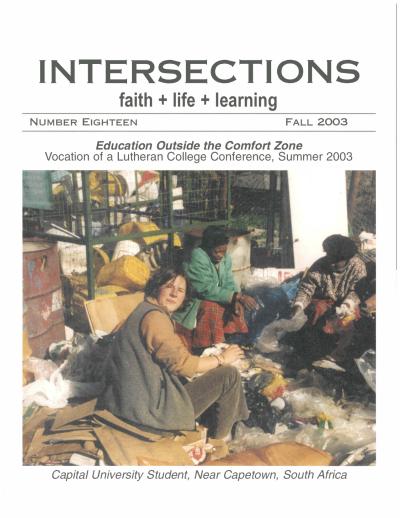
Service Beyond the Comfort Zone
Kathryn Wolford
No. 18 · Fall 2003
Wolford names economic globalization and the growth of civil society as the two issues shaping Lutheran World Relief’s mission, illustrating with the Guatemalan storekeeper undercut by subsidized “gringo” chickens, fair-trade coffee and chocolate campaigns, and Charles Onyango-Obbo’s warning about anti-terrorism laws in fragile African democracies. Drawing on Darrell Jodock, Art Simon, and the Good Samaritan, she frames the global vocation of Lutheran colleges as inviting students past comfort zones of race, class, ethnicity, and ideas through service-learning that links mercy and justice, and closes with a concrete LWR partnership invitation including site visits, internships, fair-trade campus campaigns, and the “A Place for Peace in Colombia” advocacy program.
-
 Article
What Does Ethical Leadership in a Changing World Require?
Kristina Frugé
No. 62 · Fall 2025
5 min audio
Frugé argues that ethical leadership in a changing — perhaps ending — world means cultivating trustworthy communities through patient, co-created relationship work, drawing on her experience stewarding the writing community behind Hungry for Hope: Letters to the Church from Young Adults.
-
 Reflection
Shelter in Place: Reflections from March 22, 2020
Jason A. Mahn
No. 53 · Spring 2021
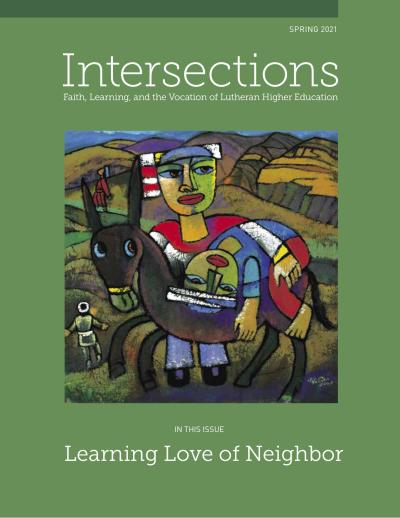
On the fourth Sunday of Lent in 2020, Mahn meditates on the etymology of “shelter” (from shield) and on an email from a former student in Boston whose mutual-aid organizing models a Lutheran understanding of vocation: the upending of ego by divine love that frees us, finally, to see and serve the neighbor.
-
 Article
Polarization, Incivility, and a Need for "Change"
Guy Nave
No. 48 · Fall 2018
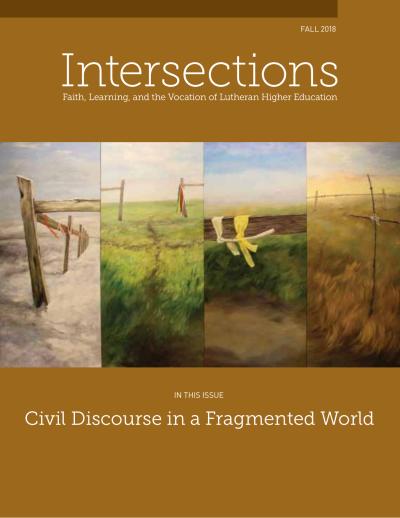
Nave argues that when Americans demand “change,” they usually mean that “others” need to see things their way — and that meaningful transformative change requires acknowledging the provisional nature of our perspectives, seeking to understand as much as to be understood, and bursting the ideological echo chambers of social media through projects like Clamoring for Change.
-
 Book Review
Richard T. Hughes: How Christian Faith Can Sustain the Life of the Mind
Tom Christenson
No. 13 · Winter 2002
Christenson reviews Richard Hughes’s How Christian Faith Can Sustain the Life of the Mind (Eerdmans, 2001), which argues, drawing on Tillich’s notion of “religion breaking through its own particularity,” that faith is a means to the open pursuit of truth rather than its enemy. Christenson reads the argument as a natural fit for a Lutheran tradition of semper reformanda but notes Luther’s own dogmatism toward fellow reformers, and wishes Hughes had drawn a sharper line between an absolute truth that relativizes all human truths and a postmodern abandonment of truth altogether. The book was the most-cited title at the November meeting of North American Lutheran academic officers.