Rich and Poor in an Era of Globalized Religion and Economies: Challenges to Lutheran Colleges
Intersections No. 25 · Spring 2007
Aruna, a World Council of Churches staff member, tells of worshipping with a poor Aymara (Indian) Lutheran community high in the Andes Mountains in Bolivia. After worship she and those with her were invited to participate in a community lunch with the congregation, but she saw no signs of cooking or food. Then a long piece of cloth was placed on the ground in front of the church and the community sat down on either side of the cloth. “The women unloosened the shawls wrapped around their waists and poured onto the cloth, many kinds of potatoes. … We ate our fill and I wondered what would happen to the remaining potatoes—the surplus of which there was plenty. On a quiet signal from the elder, everyone took a share of the potatoes … Everyone, even those who had brought no food with them, took a share of the potatoes. … We were told that all congregations do the same thing every Sunday!” (Gnanadason “All are invited”)
Christine, a German Lutheran delegate to the recent Assembly of the World Council in Brazil, tells about attending worship at a prosperous immigrant (German) Lutheran church along with several other delegates. During the service the pastor announced that those who had received invitations ahead of time would join the congregation for lunch afterwards, others would need to have lunch elsewhere. Christine was rather surprised about this and wondered if the pastor feared there would not be enough food for everyone who had come. Still, it seemed a breach of hospitality, especially since one of the delegates who had not received an invitation ahead of time was a Lutheran bishop from Asia. (Personal communication February 2006)
I retell these two stories of rich and poor not to make a point about “spiritual” poverty and wealth, although one might do so. Rather I tell them to illustrate two seemingly different attitudes—one open, generous and sharing, the other controlling and protective. When we think about identity and diversity in Lutheran colleges, which will be our stance?
Identity and Diversity in the Lutheran College
In his study of models of church-related colleges, Richard Hughes states that in the Lutheran approach, “the task of the Christian scholar … is not to impose on the world—or on the material that he or she studies—a distinctly ‘Christian worldview,’” as in the Reformed model. “Rather, the Christian scholar’s task is to study the world as it is and then to bring that world into dialogue with the Christian vision of redemption and grace.” Hughes believes that “this theological vision is the great strength of Lutheran higher education for it enables Lutherans to take religious and cultural pluralism with a seriousness that often escapes other Christian traditions” (6-7).
In his introduction to Lutheran higher education, Ernest Simmons claims that “Lutheran identity is forged … in the dialectical tension” of what he calls “ecumenical confessionalism.” The ecumenical side can discourage “denominational ideology” by keeping the community mindful of the presence and value of other theological and denominational perspectives, “affirming diversity on our campuses.” The confessionalism side maintains the value of affiliation “by affirming that in the intellectual arena it is preferable to be self-conscious about one’s commitments, not assume such discussion is value-free.” He insists that “confessionalism as a dynamic theological expression does not seek imposed doctrinal uniformity but rather a lively and healthy confessional dialogue between traditions” (23).
This understanding of identity and diversity resonates with that of Linell Cady. In her discussion of Religion, Theology, and American Public Life, she suggests that “commitment to a global community” requires an identity for both individuals and societies that reflects “a dual allegiance to both a particular history within which identity and meaning have been rooted and the global order which remains to be fully actualized” (160). Cady insists that “the impossible pretensions to neutrality and universality that underlie the Enlightenment understanding of public, and the public exercise of reason” must be unmasked (64). This caution is particularly relevant when we think about rich and poor—social class—in an era of globalized economies and religion.
Part One: Globalized Economies
We—and most all of the world’s peoples—are aware of living in an age of globalization. In some ways, this is not a new phenomenon. Martin Luther King wrote in 1967 that “We are everlasting debtors to known and unknown men and women … At the table we drink coffee which is provided for us by a South American, or tea by a Chinese or cocoa by a west African.” Today we could add to King’s list the clothes we wear—underwear and shoes from China, outerwear from Guatemala, Mexico, and India. King concluded that “Before we leave for our jobs we are already beholden to more than half the world.” Ulrich Beck calls this “globality”—this sense of living in a world society, without closed spaces. He distinguishes this from “globalism”—the ideology of neoliberalism—or rule by the world market (Held and McGrew 100-102).
The term “globalization” was first used in the late 1960s or early 1970s to refer to “rapidly expanding political and economic interdependence.” In their introduction to the globalization debate, David Held and Anthony McGrew define globalization as “the expanding scale, growing magnitude, speeding up and deepening impact of interregional flows and patterns of social interaction.” They note that the process of globalization is “deeply divisive” and “vigorously contested” because a significant portion of the world’s population is largely excluded from its benefits (3-4). This continues to be the case, in spite of Thomas Friedman’s assertions to the contrary in The World is Flat.
The World Development Report 2006: Equity and Development from the World Bank admits as much. This report first notes that inequality between countries was relatively small in the early nineteenth century, but had come to account for a larger part of inequality (as contrasted to inequality within countries) toward the end of the twentieth century. It then states, “If China and India are excluded, global inequalities continue to rise, owing to the continuing divergence between most other low-income countries and rich countries” (7). Indeed, China and India have benefited from integration into the global economy. Two qualifications are necessary. First, India and China did not follow all the policy prescriptions of the dominant neo-liberal model; second, inequality has increased rather dramatically within these two countries. The Lutheran World Federation sums this up succinctly, in its “Call to Participate in Transforming Economic Globalization”—“globalization is not global in its benefits” (LWF 115).
The Dominant Paradigm
Globalization, for some, is another name for transnational capitalism. That certainly is the dominant form of economic globalization. It is also called neo-liberalism, because it advocates opening markets (liberalization), promoting exports and foreign trade, deregulation including labor and environmental standards, and privatization of public owned enterprises. This is what Ulrich Beck referred to as “globalism” or the rule of the world market. These policies have been imposed by the International Monetary Fund and World Bank as part of structural adjustment programs in one hundred or so countries as conditions for restructuring loans. Neo-liberalism has also been called the Washington consensus, since the policies are advocated by the US Treasury, which plays a leading role in these international financial institutions. The World Trade Organization and transnational corporations are also key actors in the development of neo-liberal globalization. Two-thirds of world trade is accounted for by transnational corporations, who also control about one-third of the world’s productive assets. Of the top one-hundred economies in the world, only forty-nine are countries; fifty-one are corporations.
Held and McGrew conclude that neoliberal economic globalization has not transcended the old North-South division of the world but superimposed on it new kinds of divisions along gender, ethnic, and ecological lines. Those who have studied its impact on women claim that it is “both liberating and exploitative.” For instance, Altha Cravey and Patricia Fernandez-Kelly concluded in their separate studies of women who do factory work in Mexico and Central America that even low paid jobs give women “a modicum of independence.” But at the same time there have been “devastating assaults on workers of both sexes” (Brubaker 60-61).
In a special issue of the journal Feminist Economics focused on gender and globalization, the editors point to the negative impact of globalization on non-market goods and services, including reproductive work. Values and social relationships that do not adhere to market norms of self-interest and profit maximization are demeaned. “Thus, a significant proportion of women’s contribution to the economy is relegated little or no importance, as symbolized by the underestimation of unpaid work in national and international statistics” (Beneria, et al. xiii).
Economist Dianne Elson notes that economic globalization impacts processes of both production and social reproduction, although little attention is given to the latter in the globalization literature. “What is left out of account is the process of social reproduction in which women invest time and money in the education and socialization of children; and in nutrition and healthcare for children and adults.” There is an assumption that “social reproduction will always accommodate itself to savings and investment decisions made in the public sphere.” But Elson notes that this can only be taken for granted “if people can live on fresh air or women’s unpaid work is available in unlimited supplies” (164). Serious crises in social reproduction continue in many parts of the world. The impact of these crises differ by class, race/ethnicity, and region—but women bear the brunt. Sociologist Saskia Sassen calls this “the feminization of survival.”
Part Two: Globalized Religion
In his book Global Religions, sociologist Mark Juergensmeyer points out that “Although there are regions of the world that serve as dense centers of gravity for certain religious traditions, much of the world is less certain as to its religious identity, and always has been” (3). He thinks about religion in terms of culture, which I have long found to be a fruitful approach. “It is understandable that these cultural elements would move as people have moved,” Juergensmeyer suggests, “if one thinks of religion as the cultural expression of people’s sense of ultimate significance.” It also is understandable, then, “that they would interact and change over time just as people have.” He asserts that although most all religious traditions claim some unchangeable “ultimate anchors of truth,” it is irrefutable that every tradition also contains within it “an enormous diversity of characteristics and myriad cultural elements gleaned from its neighbors.” All of this is part of the “globalization of religion” (5).
Juergensmeyer identifies three types of global religions. The first is global diasporas—religion is global in that it is related to the global transportation of peoples. Judaism and Hinduism are his examples. These are not generally universal religions, open to converts, but the religious expression of particular peoples. The second type is transnational religions such as Buddhism, Christianity, and Islam. These religions are open to converts and spread with the transnational acceptance of their religious ideas. The third type is the religion of globalization—new religions that emerge as expressions of new interactive societies. This type is also the religion of plural societies. Interestingly, he gives Christianity during its origins in the Roman Empire as an example of the religion of plural societies. Finally, Juergensmeyer suggests, it is possible that a global civilization with its own global religion is evolving (5).
Juergensmeyer examines the relationship of religion and the state. He suggests that “The same Christianity, Buddhism, and Islam that provide for some rulers a supportive ideology have been for others a basis for rebellion” (8). A rather crude religious legitimation of transnational capitalism links the market to God. Before his downfall, Enron CEO Ken Lay told a reporter that he believed in God and he believed in the market. Theologian Harvey Cox has written that the Market now is God—it is seen as omniscient, omnipresent, and all powerful—what some call “market fundamentalism.” Buddhist author David Loy thinks that the religion of the market is the primary competitor to more traditional religions.
Some adherents of these “traditional” religions are searching for and finding common ground to resist neo-liberal economic globalization. For instance, all the world’s religions share the belief that one is responsible for meeting another’s needs. Religious and secular groups are forming coalitions to advocate for alternative forms of economic globalization. The World Council of Churches, a fellowship of over three-hundred Christian Protestant and Orthodox denominations from over one-hundred countries, is an example of a “transnational religion” engaged in resistance to neo-liberal economic globalization. The WCC is an official observer at and participant in the work of the United Nations and its various agencies (as is the Lutheran World Federation). It has participated in the meetings of the World Social Forum, which brings together thousands of people and groups committed to social and economic justice. The WCC engaged in encounters with the World Bank and IMF at their invitation. It understands its role to be “bringing the cries of the people.”
The WCC was urged by delegates to its 1998 Assembly to challenge economic dynamics which were causing so much suffering to peoples in the South. Since then the WCC has held several regional consultations on economic globalization, in conjunction with the World Alliance of Reformed Churches and Lutheran World Federation. This work resulted in a common critique of neo-liberal globalization and development of an alternative paradigm, “economy of life.” An economy of life calls for a world of just, participatory, and sustainable communities. A full description of the vision can be found in “Alternative Globalization Addressing Peoples and Earth (AGAPE),” a background document for the Ninth Assembly of the WCC in February, 2006. A crucial element of this alternative paradigm is to make “people’s work, knowledge and creativity” the driving forces of economic activity, rather than capital owned and controlled by a small, extremely wealthy elite. There is a place for markets in this alternative, but they are not the final arbiter of value. Water, for example, is a basic need and public good which should not be reduced to a commodity to be bought and sold for profit. An economy of life seeks to promote cooperation between individuals, communities, and nations, rather than competition. This paradigm gives greater material and moral value to care work, and addresses the gender imbalances associated with care work.
It is important to know that there are already many alternatives in place in different parts of the world. The work of the indigenous community in Orissa, India, is one inspiring example. Under the leadership of William Stanley (an Indian Lutheran) and Sasi Prabha, the village of Putsil converted an existing small dam into a small scale hydro-electric project. It produces just enough electricity for the needs of the village, and a battery charging facility for a neighboring village. The villagers contributed their labor. Two young people have been trained to run the power plant, completely managed and supported by the people. Besides providing electricity for home use, it also runs a grinding and milling machine. This saves the village women, who were leaders in the movement, many hours of grinding grain by hand (Gnanadason Listen to the Women 18-19).
Finance and trade are also addressed in an economy of life. The purpose of an international financial system should be to enhance justice, poverty eradication and environmental sustainability. Trade should aim to serve just ends—“ethical, sustainable and equitable production, exchange and consumption of goods and services to meet the needs of all humankind and the earth.” It argues for trade that protects human rights and the earth through effective labor and environmental regulations (WCC 14-22). The WCC, LWF and other ecumenical bodies have sent petitions to the World Trade Organization asserting the importance of recognition of human rights in trade negotiations. After the failure of the most recent round of trade negotiations (summer of 2006), the director of the WTO asked to meet with the WCC and other bodies to discuss their concerns.
Conclusion
How is all this a challenge to the colleges? Part of our task as college and university professors, I have claimed elsewhere, is to educate for critical citizenship, or, to use the words of Darrell Jodock, “to enable young men and women to discern what makes for justice and what preserves and enhances human dignity” (18). Given the hegemony of the neo-liberal model, it is crucial that students are encouraged to question its underlying assumptions, for instance, that growth and profit are the primary ends of economic activity or that the market should be the primary arbiter of value. The Lutheran World Federation and the WCC offer useful resources for this task.
Raising awareness of global issues, including wealth and poverty, is an appropriate task for liberal arts colleges. Exposure trips, study abroad, speakers—all are useful approaches. Adding a unit on an aspect of globalization—one or two weeks long—can be a good way to incorporate such concerns in humanities and social science classes. Films and/or case studies are helpful in making the topic and issues come alive for students. I supplement these with background material on key actors, their values and assumptions, and relevant policies and dynamics.
Since students can feel overwhelmed with the suffering and injustices they are exposed to in films, I include a few specific policies and proposals that address these problems. For instance, I introduce students to the Millenium Development Goals, which aim to reduce poverty and improve education and health. Target rates and deadlines are an important part of the plan. We read a brief article by a staff person at the IMF discussing actions, such as increasing trade and aid, necessary to meet these goals, and an article from Jubilee USA claiming that these are not adequate without cancellation of the external debt of low-income countries. (Most of these materials are available on websites.) Students write a short essay discussing the importance of a few of the goals and comparing the approaches to meeting the goals. I have also focused on global issues that are closer at hand—migrant workers in the garment industry in the Los Angeles area and/or migrant farm workers in the fields of our county. Sometimes we have formal debates on topics such as debt cancellation, with teams of students representing different positions.
Teaching students about universal human rights—social, economic and cultural as well as civil and political—is also a useful strategy for addressing issues of religion, globalization and economic change. Theologian and ethicist Larry Rasmussen contends that the church’s universal vision and conviction is of “the necessary, full inclusion of the excluded, on egalitarian terms.” Universalism and egalitarianism are both “assertions of faith itself, whether or not they also have secular grounds.” These assertions are “the converging Christian ground for one of the lasting moral achievements of modernity itself—universal human rights” (148-9). Rasmussen’s stance is not an endorsement of unreconstructed liberalism, with its pretensions to neutrality and universality. Rather, it is a reaffirmation “of the valuable parts of the liberal Protestant heritage” too often rejected by postmoderns and communitarians: “commitments to public participation, justice, and critical reflection on inherited traditions” (Bounds 118).
At its best, this open, generous stance comes out of the shared life and struggle of peoples struggling against “the all-pervasive neo-liberal logic that undergirds and directs economic globalization as a totalizing system” (Bloomquist 494). It is an affirmation of justice and human dignity. Part of our academic work, I contend, is to develop a richer understanding of rights, particularly universal human rights. Our aim is, as Peter Prove (LWF staff for international affairs and human rights) eloquently charges, for “all people of faith and goodwill…to claim and use them on behalf of our communities and on behalf of the whole human family, in order to restore right purposes to the process of globalization” (258).
Works Cited
Beck, Ulrich. “What is Globalization?” Global Transformations Reader: An Introduction to the Globalization Debate. Ed. David Held and Anthony McGrew, eds. Cambridge: Polity, 2000.
Beneria, Lourdes, et al. ”Introduction: Globalization and Gender.” Feminist Economics 6.3 (November 2000): vii-xvii.
Bloomquist, Karen. “Engaging Economic Globalization as Churches.” The Ecumenical Review 53.4 (October 2001): 493-500.
Bounds, Elizabeth M. Coming Together/Coming Apart: Religion, Community and Modernity. New York: Routledge, 1997.
Brubaker, Pamela K. Globalization at What Price? Economic Change and Daily Life. Cleveland, OH: Pilgrim, 2001.
Cady, Linell Elizabeth. Religion, Theology, and American Public Life. Albany: State U of New York P, 1993.
Cox, Harvey. “The Market as God.” The Atlantic Monthly 283.3 (March 1999): 18-23.
Elson, Diane. “Talking to the Boys: Gender and Economic Growth Models.” Feminist Visions of Development. London: Routledge, 1998. 155-70.
Friedman, Thomas. The World is Flat: A Brief History of the Twenty-first Century. New York: Farrar, Straus and Giroux, 2005.
Gnanadason, Aruna. “All Are Invited to the Fiesta of God.” Unpublished sermon. World Council of Churches, 12 September, 2003.
———. Listen to the Women! Listen to the Earth! Geneva: WCC Publications, 2005.
Held, David and Anthony McGrew, eds. Global Transformations Reader: An Introduction to the Globalization Debate. Cambridge: Polity, 2000.
Hughes, Richard T. and William B. Adrian, eds. Models for Christian Higher Education: Strategies for Success in the Twenty-first Century. Grand Rapids, MI.: Eerdmans, 1997.
Jodock, Darrell. “The Lutheran Tradition and the Liberal Arts College.” Called to Serve: St. Olaf and the Vocation of a Church College. Ed. Pamela Schwandt. Northfield, MN: St. Olaf College, 1999. 13-36.
Juergensmeyer, Mark. Global Religions: An Introduction. Oxford: Oxford UP, 2003.
King, Martin Luther. Where Do We Go From Here: Chaos or Community. New York: Harper, 1967.
Loy, David. “The Religion of the Market.” Visions of a New Earth: Religious Perspectives on Population, Consumption, and Ecology. Ed. Howard Coward and Daniel Maguire. Albany: State U of New York, 2000. 15-28.
Lutheran World Federation. Communion, Responsibility, Accountability: Responding as a Lutheran Communion to Neoliberal Globalization. Documentation No. 50, Dec 2004.
Prove, Peter, N. “Economic Globalization and Human Rights.” Communion, Responsibility, Accountability: Responding as a Lutheran Communion to Neoliberal Globalization. Documentation No. 50, Dec 2004. 251-59.
Rasmussen, Larry L. Moral Fragments & Moral Community: A Proposal for Church in Society. Minneapolis: Fortress, 1993.
Sassen, Saskia. ”Women’s Burdens: Counter Geographies of Globalization and the Feminization of Survival.” Journal of International Affairs 53.2 (Spring 2000): 503-24.
Simmons, Ernest. Lutheran Higher Education: An Introduction for Faculty. Minneapolis: Augsburg Fortress, 1998.
World Bank. The World Development Report 2006: Equity and Development. Washington, DC: World Bank Group, 2005.
World Council of Churches. Alternative Globalization Addressing Peoples and Earth (AGAPE): A Background Document, 2005.
-
 Editorial
From the Publisher
Arne Selbyg
Selbyg notes that most papers in this issue grew out of a pan-Lutheran conference organized by the Association of Lutheran College Faculties in fall 2006 rather than the annual Vocation of a Lutheran College conference, and argues that the ELCA’s ecumenical posture—truthful but open to learning from others—is a good foundation for institutions of higher education whose faculty likewise profess while remaining subject to change based on new research and insights.
-
Editorial
From the Editor
Robert D. Haak
Haak frames the issue around the question of what holds the twenty-eight ELCA colleges together amid their geographic, economic, and theological diversity, introducing Mark Hanson’s address to the assembled college presidents, Randall Balmer’s outsider perspective on the commonalities of Christian liberal arts, José Marichal and Pamela Brubaker on diversity rooted in community and globe, Storm Bailey’s argument that being Lutheran is precisely what makes us embrace diversity, and Jaime Schillinger’s St. Olaf chapel reflection on the formative power of worship and liturgy.
-
Article
Reflections on Our Shared Commitments
Mark S. Hanson
Originally delivered to the Lutheran Educational Conference of North America in March 2007, Hanson’s address describes the ELCA as “an ecology of interdependent ecosystems” and locates the church’s relationship to its twenty-eight colleges and universities in a shared mission rather than in older anxieties about church-relatedness. Drawing on Wittenberg’s Lutheran Identity Study, Augustana’s “Five Faith Commitments,” Pamela Jolicoeur’s Concordia address, W. Robert Connor on “big questions,” Joseph Sittler on grace, Walter Brueggemann on fear, Jonathan Strandjord on being “other-wise,” and Cynthia Moe-Lobeda’s Public Church for the Life of the World, he names four marks of shared mission: communities of free inquiry, encouragement of religious expression in a diverse society, education for the common good, and the formation of leaders for church and religious communities worldwide.
-
Reflection
Currents
Jaime Schillinger
Preached in St. Olaf chapel on March 29, 2005, Schillinger reads three “currents” pulling on her hearers—Minnesota spring, the academic year’s final stretch, and Holy Week’s passion and resurrection—against poetic voices from ee cummings, Gerard Manley Hopkins, and Edna St. Vincent Millay, before turning to the Song of Songs to suggest that this nexus calls students into the rhythms of love, awakened desire, and an elusive, unresolved promise that animates academic, spiritual, and vocational search alike.
-
Editorial
Guest Editor
Madeleine Forell Marshall
Marshall introduces the four papers in this issue from the 70th annual meeting of the Association of Lutheran College Faculties, held at California Lutheran University in October 2006 on the theme “Identity and Diversity in the Lutheran College.” She notes a geographic pattern—the two East Coast contributors (Balmer and Bailey) defend Christian liberal arts against perceived suspicion, while the two Westerners (Marichal and Brubaker) treat Lutheran identity as advantage and diversity as a Lutheran given—and announces the 2007 ALCF meeting at Newberry College on “Beyond ‘Whatever’: Values Based Learning in Lutheran Higher Education.”
-
Article
Sojourners in a Pluralistic Land: The Promise and Peril of Christian Higher Education
Randall Balmer
Balmer, a Barnard scholar of American evangelicalism reared in evangelical parsonages and formed at Trinity College in the Chicago suburbs, defends public education even as he champions Christian higher education as a “halfway house” for students moving from religious subculture into a pluralistic world. Drawing on his own undergraduate experience, his books Mine Eyes Have Seen the Glory and Thy Kingdom Come, and a chastening visit to Patrick Henry College, he names three perils of Christian higher education—the Scylla of secularism (intellectual arrogance allergic to piety), the Charybdis of sectarianism (intellectual dishonesty as exemplified by intelligent design’s special pleading), and insularity—and prescribes mentors, primary sources, internships outside the subculture, and a broader, intergenerational pluralism on campus.
-
Article
Lutheran Identity, Academic Integrity, and Religious Diversity
Storm Bailey
Bailey argues that one might rightly say of a college “that’s a pretty good school because it’s religious,” defending the proposition under three headings: academic and curricular virtues, free inquiry, and religious diversity. Drawing on Mark Schwehn’s Exiles from Eden, Richard Hughes on the Lutheran tradition’s “most potent theological resources” for the life of the mind, Parker Palmer, Lendol Calder, Mill’s On Liberty, Newman’s Idea of a University, and the AAUP’s 1940 Statement, he proposes a “critical mass” alternative in which the Lutheran commitment to truth-seeking and self-critique itself requires—rather than tolerates—a religiously diverse faculty whose opposing voices are needed for the mission to flourish.
-
Article
Why Diversity and Civic Engagement Don't Talk to Each Other on College Campuses: The Need for Public Work
Jose Marichal
Marichal opens with Thurgood Marshall’s line from Milliken v. Bradley and traces the “decoupling” of campus diversity and civic engagement initiatives back to their shared grounding in Benjamin Barber’s “thin” or pluralist democracy. Reviewing CIRCLE data on youth political disengagement, the limits of mandatory volunteerism, and persistent residential segregation, and drawing on Mary Ann Glendon, Lani Guinier, Caryn McTighe Musil, and Richard Rorty, he argues that only Harry Boyte’s notion of “public work” can bind diversity and civic engagement together—and contends that Lutheran colleges, with their understanding of vocation as call into the world, are uniquely positioned to build that infrastructure.
-
 Article
Money, Sex and Power: An Exploration of Some Controversial Issues in the Public Witness of the Church
Pamela K. Brubaker
No. 21 · Summer 2005
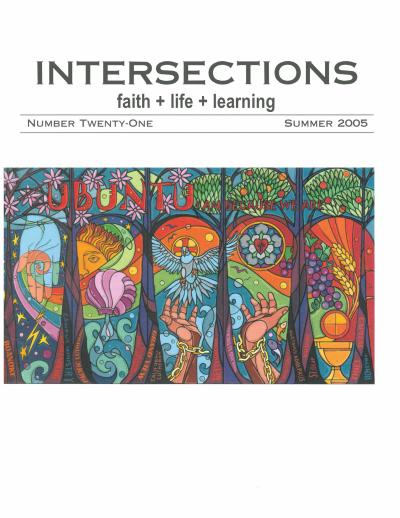
Brubaker explores two controversial issues in the church’s public witness—homosexuality and economic life—and the challenges they present for both church and college. Drawing on Beverly Harrison, Elizabeth Bounds, Ron Thiemann, Linell Cady, Marcia Bunge, Richard Hughes, Darrell Jodock, Ernest Simmons, Karen Bloomquist, Garth Kasimu Baker-Fletcher, and Larry Rasmussen, and on episodes at California Lutheran University around “Harmony Week” and Bishop Paul Egertson’s participation in Anita Hill’s ordination, she argues that colleges related to the ELCA are called to educate for “critical citizenship” by hosting rigorous, bold, and unfettered debate—including debate over the neo-liberal globalism that she names a form of economic fundamentalism.
-
 Article
'In, With, and Under:' The Tradition and the Teaching of Christian Ethics
Pamela K. Brubaker
No. 17 · Summer 2003
Brubaker describes how she teaches Introduction to Christian Ethics at California Lutheran University—a religiously diverse classroom where about 30% of students are Lutheran, 30% Roman Catholic, and many are “unchurched”—as a community of moral discourse rooted in the Lutheran dialectic of faith and reason. Drawing on Larry Rasmussen and Bruce Birch, Elizabeth Bettenhausen, Roger Crook, and Robert Benne’s typology of “Hot and Cool Connections” between church and politics, she walks through her course’s units on human sexuality, economic life, and war and peace—including the Bomb Shelter simulation, a mock Disney stockholders meeting on sweatshops, and a Congressional hearing on the School of the Americas—to show how ELCA social statements function as case studies in critical inquiry and education for citizenship.
-
 Response
Renewing Our Journey: Some Thoughts on Pursuing the Truth
John Rehl
No. 1 · Summer 1996
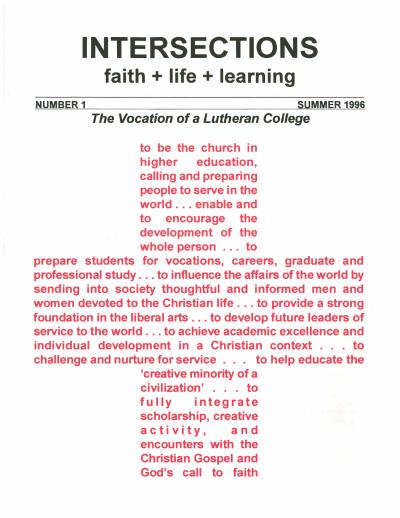
Rehl, a Capital University graduate pursuing doctorates in theology at Chicago and in economics at Wisconsin, takes up Schwehn’s invitation to think again on the nature of truth. He sets aside truth as information, as object, and as mere words; recasts the church-related college’s task as a renewed emphasis on classroom teaching (Kierkegaard’s teacher as midwife) and on brave, articulate professors. He calls for moral education in courage, discipline, patience, and love, illustrates the costs of the fact-value split with examples from economics, and argues that we honor Lutheran heritage not by preserving it as a museum piece but by testing it—Luther’s theology of the cross over a theology of glory—and by preparing students for a world of Untruth, strengthened (with Julian of Norwich) by the promise that they will not be overwhelmed.
-
 Editorial
From the Publisher
Arne Selbyg
No. 15 · Winter 2002
Selbyg announces that the 2001 ELCA Churchwide Assembly has commissioned a new social statement on education, placing it alongside the economy, the environment, abortion, sexuality, health, and peace, and invites Intersections readers to submit input on which topics within the field of education the statement should address.
-
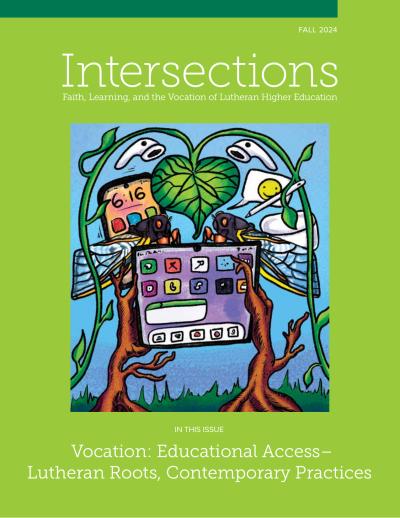 Article
Affirming, Entrusting, and Acting: A Baptismal Grounding of Affirmative Action in Lutheran Higher Education
Peter Carlson Schattauer
No. 60 · Fall 2024
Schattauer draws on the Lutheran baptism liturgy — where the gathered assembly publicly affirms what it is for and is entrusted with responsibilities for justice and peace — to argue that NECU institutions create truly inclusive communities by affirming commitments, naming responsibilities, and acting in ways that embody both.
-
Editorial
From the Editor
Tom Christenson
No. 21 · Summer 2005
In his valedictory letter as outgoing editor, Christenson recounts the 1994 origins of Intersections, when he took the idea to Naomi Linnell and Jim Unglaube at DHES and persuaded the council of presidents to launch the journal on a shoestring with printing paid by DHES and everything else by Capital University. He summarizes the issue’s contents—papers from the 2004 Vocation of a Lutheran College Conference plus two commissioned pieces from former DHES directors Bob Sorensen and Leonard Schulze—and thanks the student copy editors and Capital’s presidents and provosts who sustained the publication.
-
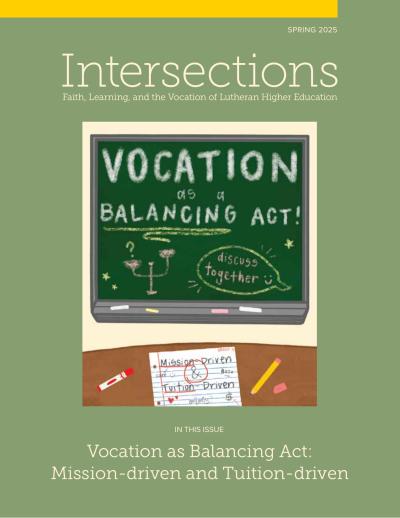 Editorial
From the Editor
Colleen Windham-Hughes
No. 61 · Spring 2025
5 min audio
Windham-Hughes uses Fred Rogers’ neighborhood as a living embodiment of a Lutheran understanding of vocation — seeing dignity in each person, offering one’s gifts generously, and trusting that the well-being of the neighborhood is intrinsically connected to the well-being of every neighbor.
-
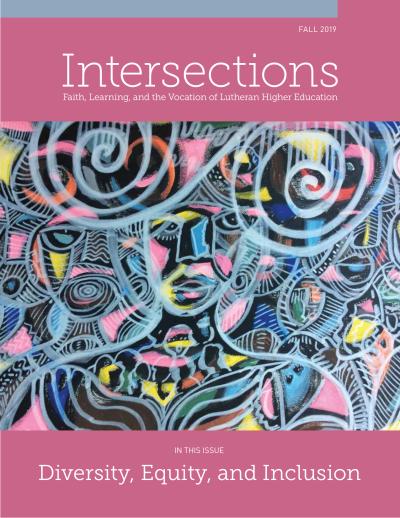 Editorial
From the Publisher
Mark Wilhelm
No. 50 · Fall 2019
Wilhelm frames the issue by noting that a federal court’s vindication of Harvard’s race-conscious admissions process is a win for higher education’s commitments to diversity, equity, and inclusion — and argues that for Lutheran higher education, the commitment to diversity is an old and foundational claim, rooted in Christianity’s openness to all and reflected in the four diverse gospels of the New Testament.