I left for college on my eighteenth birthday. It was a Sunday afternoon in mid-September. After church and a quick lunch with my family, I changed into the stripped shirt and bell bottom jeans I had saved all summer to wear on my first day at college. While the table was being cleared and the dishes washed, I carried my college things out to the car: a stereo, a typewriter, a waste basket, a tennis racket, a trunk of clothing, a suitcase filled with linens and towels and the new Indian-print spread for my dorm bed, and a box of books including the Webster’s dictionary I had received as an award at my high school graduation.
When I had loaded everything into the car, I sat in the backseat with the door swung open, waiting for my family to come out for the drive to the College of Wooster. I wasn’t about to re-enter the house with my dream of going to college so near at hand. My widowed mother and my oldest sister, Jean, who had come home from her job in Cleveland to “get her baby sister off to college,” may have remembered the day differently, but I marvel that so many of the details are still stunningly clear in my mind. Even at the time, that day—that beginning—meant so much to me that I knew I would measure my life by everything before and after that 82 mile drive.
In fairness, I should say that my sister Kathy was just a year ahead of me at that same college and I knew a week later she’d be a daily part of my life all over again. But still, leaving for college was a big deal. My family both cheered and wept that day. My church prayed for me and the many others leaving “to go off to school.” The hometown community rejoiced that another generation was launched on its way into higher education.
For all I could tell at the time, my college received me and 500 or so other entering students with joy and respect. They rolled out a royal welcome that day. Every faculty member and senior administrator showed up to greet us; older undergraduates returned early to serve as our RA’s and team captains; even the housekeeping and custodial staff stood by lest we need anything on our move-in day. That evening the president welcomed us at a reception in his home, greeting us individually at the door.
But forty-some years later I can guess a whole lot more about what was going on behind-the-scenes at that college. It was the summer after the shootings just up the road at Kent State. The faculty and returning students would long remember the agitation that had marked the close of the last academic year. The admissions yield was higher than anticipated, which was great for the budget, but meant that lounges had to be turned into dorm rooms over the summer and additional classes added to the Fall offerings. Someone spent their August vacation making that happen.
I work occasionally as an enrollment consultant these days and know the thin margin by which most Lutheran colleges and universities—not to mention Lutheran seminaries—must navigate the treacherous waters of change and the demanding financial models for sustainability. In hindsight I can calculate the tuition discount that allowed me to be in college.
Back in the 1970s someone was surely watching the Return-on-Investments and noting the “butts in seats,” as enrollment is so inelegantly called these days, but little of that leaked out into public awareness. No one ever hinted to the two daughters of a widow living on less than $5,000 a year that her children were anything less than smart kids, working their way through college with work-study earnings and well deserved scholarships. In those days students were anything but commodities; they were young participants in the college’s ambitious mission and life, welcomed to campus with joy and eager anticipation.
“In those days students were anything but commodities; they were young participants in the college’s ambitious mission and life, welcomed to campus with joy and eager anticipation.”
No lectionary text is exactly scripted for this conference theme. But hearing the words “vocation” and “commodification” in the title, this preacher’s imagination turned to these half dozen verses from Matthew 10, a chapter which is all about vocation. Most have heard these verses before but we can hear them anew as God’s message about what matters in a world of collegiate worry and woe. Jesus teaches:
So have no fear of them; for nothing is covered up that will not be uncovered, and nothing secret that will not become known. What I say to you in the dark, tell in the light; and what you hear whispered, proclaim from the housetops. Do not fear those who kill the body but cannot kill the soul; rather fear him who can destroy both soul and body in hell. Are not two sparrows sold for a penny? Yet not one of them will fall to the ground apart from your Father. And even the hairs of your head are all counted. So do not be afraid; you are of more value than many sparrows. (Matt. 10: 26-31)
If you read the whole tenth chapter of Matthew, you’ll note the realism with which the tough challenges of discipleship are named. This is the unabridged version of what will happen to those who dare to follow the way of Christ. Though written to such followers near the end of the first century, it still holds true for those of us—and the institutions in which we serve—who truly aspire to the subversive and counter-cultural “way of the cross” in the twenty-first century. It’s a text that addresses both the certainty of suffering and the possibility of endurance, which as far as I can see, are pretty good themes for Lutheran Higher Education these days.
Those sparrows in this gospel text were dinner for some poor family. They were, in fact, a commodity—an item to be bought and sold. But Matthew assures us that even those humble sparrows, offered at bargain price on the dollar menu, are regarded by the Creator God as creatures with value and worth.
“Don’t be afraid,” Jesus whispered to his followers. “No matter what happens, you are of more value than many sparrows.”
There’s a lot that could make us fearful today. There’s a lot of grim news about higher education in the air these days: Debates about student loan rates. Enrollment challenges. Competition between the institutions where we work and even greater competition with public universities and community colleges. It’s hard to say with certainty which of our Lutheran schools will even be around in 5 or 10 years. So it is right and wise that this conference be grounded in the unfailing promises of Holy Scripture.
And what exactly are those promises? I’ve looked from Genesis to Revelation and I can’t find the text that assures us that our Lutheran institutions will be exempt from the turmoil and financial challenges facing almost every other business and non-profit in this country.
The concept of “vocation” is not a guarantee that we will face fewer challenges. If anything, daring to speak of institutional mission as “vocation” likely guarantees that we will have to wrestle even harder to turn our values into real opportunities. Opportunities for slow-paced learning to thrive. Opportunities for ideas to be refined in the rough-and-tumble of genuine debate. Opportunities for students to earn a degree—especially students who cannot pay the full cost of attending our colleges and universities.
These may not sound like high-risk ventures, but such scholarship and learning take time and much careful, human interaction. In an age of huge anxiety about profit and loss, holding fast to these commitments may indeed involve a threat to body and soul.
And in that regard I love the candor of Matthew’s gospel. It promises not the easy path but the way that leads us with Christ into Christ-like service and sacrifice, not for our gain but for the benefit of others. It promises that God’s way of justice will indeed prevail in the end. It whispers in our ear that God’s mercy and investment in this whole creation is even more durable than our beloved alma maters. Most of all, it promises that this trust in Jesus Christ and the way of the cross is the easy yoke, the lightest burden of all.
Thanks be to God.
-
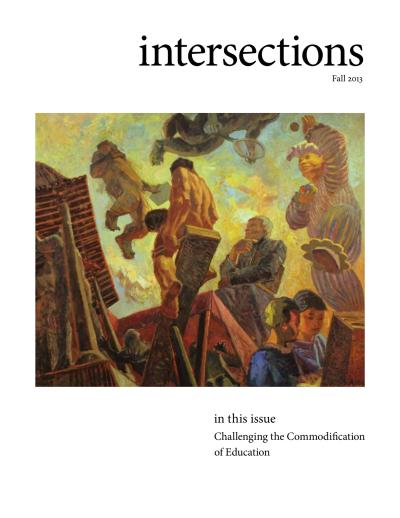 Editorial
From the Publisher: Staying Connected
Mark Wilhelm
Wilhelm frames Intersections as a tool for maintaining relationships among leaders in ELCA higher education, welcomes the journal’s new editorial advisory board, and points readers toward the 2014 Vocation of a Lutheran College conference at Augsburg and a special interfaith understanding conference at Augustana with Eboo Patel and Presiding Bishop Elizabeth Eaton.
-
Editorial
From the Editor
Jason A. Mahn
Mahn reads Michael Sandel’s What Money Can’t Buy alongside Larry Rasmussen and Martha Nussbaum to ask how Lutheran schools can articulate the “value added” of vocation without commodifying it, and previews the 2013 Vocation of a Lutheran College conference papers, Patricia Lull’s sermon, and Ann Hill Duin and Eric Childers’ Project DAVID essay that make up the issue.
-
Article
Welfare of the City and Why Lutherans Care about Education
L. DeAne Lagerquist
Lagerquist takes readers on a historical tour from sixteenth-century Saxony through the founding decades of Lutheran higher education in the United States to the present day, recovering Luther’s “gift economy” alongside Lewis Hyde and Oswald Bayer as a counter to the market logic that increasingly governs American higher education. She offers four propositions on vocation and commodification and proposes that Lutheran institutional vocation is to accept and pass along the gifts that come to our schools for the well-being of students, neighbors, and the world.
-
Article
The Value of Evoking Vocation and the Vocation of Evoking Value
Mark Schwehn
Schwehn answers Michael Staton’s call to “disaggregate” the components of a college degree by insisting that Lutheran education is integral and whole. Working through Bruce Kimball’s history of liberal education, Cardinal Newman, and Leon Kass on Athens and Jerusalem, he argues that Lutherans should defend liberal learning on instrumental grounds and offers the figure of the “local genius”—exemplified by his Valparaiso colleague John Strietelmeier—as the form of human excellence that Lutheran colleges uniquely cultivate.
-
Article
"We're Looking for a College—Not a Vocation": Articulating Lutheran Higher Education to Prospective Students and Parents Seeking Relevance
Karl Stumo, Tom Crady
Drawing on Sallie Mae and UCLA enrollment data, the websites of competitor institutions, and candid voices from the field, Crady and Stumo describe a recruitment landscape in which yield rates have collapsed, discount rates have soared, and the word “Lutheran” often presents an obstacle until it is patiently unpacked. They survey mission language at Augsburg, PLU, Gustavus, and Wartburg and argue that strategic message development is the only way for ELCA schools to make vocation and Lutheran identity “credible, relevant, differentiating, and compelling” to prospective families.
-
Article
Reinventing Lutheran Liberal Arts: A Preliminary Report on Project DAVID
Ann Hill Duin, Eric Childers
Duin and Childers introduce Project DAVID—Distinction, Analytics, Value, Innovation, Digital opportunity—as a framework for showcasing strategic reinvention across ELCA liberal arts institutions. Building on Childers’ College Identity Sagas and reading Selingo, Norris, and Popenici alongside the AAC&U, Adrian College, NITLE, and the Delta Cost Project, they pose framing questions about distinction, vocation, affordability, value propositions, two-track innovation, and BYOE technology that ELCA campuses can use to face their own “Goliath” moments.
-
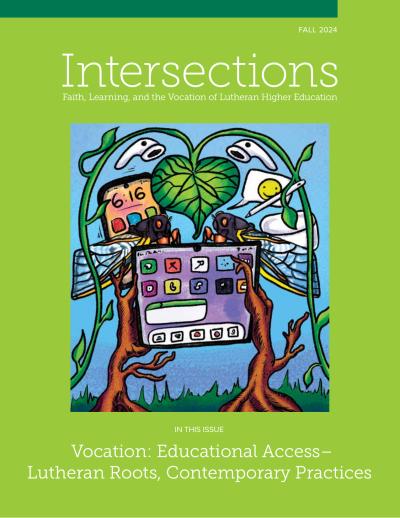 Article
2024 VHLE Conference: "Rooting Access" Panel Talking Points
Guy Nave
No. 60 · Fall 2024
Nave reads “access” across Deuteronomy 23, Ruth, Isaiah 56, Acts 10, and Matthew 15:21-28 as an ongoing biblical conversation that evolves from exclusion to ever-widening welcome — and presses ELCA institutions to shift their focus from “student readiness” to “institutional readiness.”
-
 Editorial
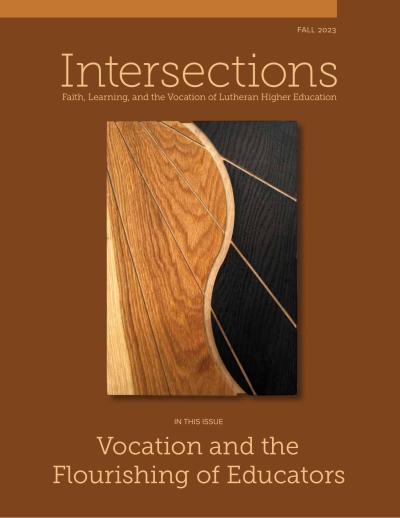
From the Editor: So That We, Too, May Flourish
Colleen Windham-Hughes
No. 58 · Fall 2023
Windham-Hughes introduces the 2023 VLHE conference theme of educator flourishing, drawing on Dr. Monica Smith’s plenary challenge — “How can we flourish if only some are centered and others are at the margins?” — and invites readers to ground themselves in Us/We, the cover art by Augustana graduate William Hatchet, and join the conversation.
-
 Article
Toward an Adequate Theology of Christian Higher Education
Robert Benne
No. 10 · Fall 2000
Drawing on his forthcoming Eerdmans volume Quality With Soul—Thriving Ventures in Christian Higher Education, which studies St. Olaf, Valparaiso, Notre Dame, Baylor, Wheaton, and Calvin, Benne argues that these schools have kept their souls because a critical mass of boards, administrators, faculty, and students treat the Christian account as comprehensive, unsurpassable, and central. He critiques four inadequate theologies of Christian higher education—pietism, liberal theology (Whitehead, Henry Nelson Weiman, the “values” turn, and accommodation to diversity and multiculturalism), “First Article” approaches (including Merrill Cunninggim’s Methodist version and a Lutheran two-kingdoms quietism), and reactionary/triumphalist theology—and contrasts the Catholic (Notre Dame), Reformed (Calvin, Wheaton, Baylor), and Lutheran (St. Olaf, Valpo) ways of relating faith and learning, calling Lutherans to recover “Christ and culture in paradox” as serious extended conversation rather than as a lazy excuse.
-
 Article
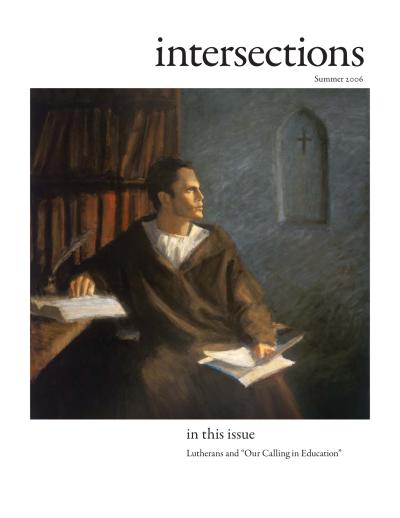
The Lutheran Calling in Education: Context and Prospect
Paul J. Dovre
No. 23 · Summer 2006
Dovre, President Emeritus of Concordia College and co-chair of the ELCA Task Force on Education, undertakes three tasks: focusing on the current social context (young people’s spiritual lives, the state of mainline denominations, the family map, schools, communities, and higher education); reflecting on why Lutherans care about education (creation in God’s image, vocation, Luther’s legacy, the priesthood of all believers, civic righteousness, and hope); and considering the prospects and possibilities for addressing the calling (biblical, confessional, theological, and pedagogical legacies; the renewal of apostolic ministry, the Christian-college renaissance, K–12 reform, and the congregational education explosion).
-
 Article
Redemption Through Imperfection
Kyoko Mori
No. 5 · Summer 1998
Mori, drawing on a visit to the Philadelphia Museum of Art with a friend, contrasts Marcel Duchamp’s Étant donnés—a peephole work whose mysterious motion sweeps every viewer into a shared, perpetual performance—with the static, glass-encased Liberty Bell as parody of spiritual experience. She extends the contrast into a meditation on rituals (comfort and consolation) versus art (truth, however painful), and on writing as a redemptive process that moves from orderly first drafts toward chaos and deeper, frightening truth—closing with master potters who skewed each finished vessel slightly so that art and decoration could be told apart. Parts are excerpted from Polite Lies (Holt 1997).
-
 Institutional Focus
Sharing the Gift of Vocation at (and beyond) Augsburg University
Paul C. Pribbenow
No. 55 · Spring 2022
Pribbenow, drawing on a 2022 NetVUE panel with Dorothy Bass and Jodi Porter, considers how the gift of vocation forged with undergraduates can be extended — beyond undergraduate campuses to graduate students, faculty, and staff; across the vocational lifespan from high schoolers to alumni navigating the “gig economy”; and into accompaniment of faith communities through Augsburg’s Riverside Innovation Hub.