AS I WRITE, the campus is beginning to stir from its summer dormancy. Faculty members have been trickling back from around the country and around the world. Football players are back in the dorms. Student workers are arriving for beginning-of-the-year planning. It’s about to begin again.
This is what we are about—the education of young people in each of our places with all that entails. If anyone should be interested in the topic of the church’s understanding of Lutheran education, it should be us. As we define our place in the academic world for our selves and our institutions, to one degree or another we look to the resources that our Lutheran heritage provides. We look for the guidance of the church, not to dictate who we are and what we do, but to inform the sorts of conversations that might take place on our campuses. This guidance will be forthcoming in the social statement on Lutheran education which is being prepared for dissemination and vote by the Churchwide Assembly in 2007. In order to facilitate the preparation of this statement, the Task Force on Education has prepared two documents, “Our Calling in Education: A Lutheran Study” and “Our Calling in Education: A First Draft of a Social Statement.” These documents are designed to begin and carry forward the conversation about “a Lutheran vision of education and its meaning for our church and society” (Task Force on Education 2004: 3).
The papers in this issue were presented at the Vocation of a Lutheran College conference held at Capital University in the summer of 2005. Each of them is intended to encourage and to be part of these conversations. Marcia Bunge correctly observes that no social statement can say everything about everything. Choices will have to be made about what issues are addressed and what elements of the issues will take priority. She makes specific suggestions of elements she believes must be included in a Lutheran statement. Paul Dovre reminds us of the context in which this statement will be received and points to important parts of the theological tradition that may provide resources for the statement. Samuel Torvend reminds us that this statement will not only speak at those in Minneapolis and Chicago but must be able to speak to a diverse community that wasn’t raised within the cultural and theological traditions of ELCA Lutheranism. Cheryl Budlong points us to the ever-growing literature concerned with how young people learn. She asks us to reexamine our ‘mental models’ of what education itself means.
It is evident to those reading these papers: that, in good Lutheran fashion, the authors are more interested in raising the important questions than in proposing a single, definitive answer. It seems to me this is exactly the right thing for Lutheran educators to be doing—raising proper questions. I am confident that reading the following papers will make the issue of a Lutheran vision of education more complex, and therefore more truthful.
As educators at Lutheran colleges and universities, we are not only called on to hear the comments of our colleagues, but also called upon to bring our own voices into the conversation. As professional educators at Lutheran institutions, we have distinctive voices to add to the conversation, and areas of expertise that are needed by the Task Force and by the church. Several of the authors and Arne Selbyg, the publisher of Intersections, remind us that comments for the Task Force in Education must reach them by October 15. This deadline is fast approaching. Each of us is challenged to become familiar with the proposals and formulate our contributions by this deadline. In the onslaught of work that faces us each day in the arrival of real, live students in our offices and committee work on our calendars, each of us is challenged to take the time to consider the issues and make our views known. The full documents under discussion may be accessed at www.elca.org/socialstatements/education. Comments may be emailed to Ronald.Duty@elca.org.
If you have made it this far in the Editorial, you have proven that you are very concerned and involved in the question of the vocation of Lutheran colleges and universities. I would invite you to consider submission of materials that speak to the concerns voiced in the Purpose Statement at the front of this issue. Please submit your work (preferably in electronic MLA format) to me at BobHaak@augustana.edu.
The vast majority of copies of Intersections are distributed through an office on your campus (different on each college campus). If you find this forum valuable—and want to ensure that you receive your own copy and not be at the mercy of whomever distributes the newsletter at your institution—please send a note indicating your interest to LauraOMelia@augustana.edu. You will be added to our direct mailing list so that you may receive each issue in a timely manner.
Works Cited
Task Force on Education, Evangelical Lutheran Church in America. “Our Calling in Education: A Lutheran Study.” 2004. http://www.elca.org/socialstatements/education/involved/study.pdf
Task Force on Education. Evangelical Lutheran Church in America. “Our Calling in Education: A First Draft of a Social Statement.” 2006. http://www.elca.org/socialstatements/education/CallingInEd.pdf
-
 Editorial
From the Publisher
Arne Selbyg
Selbyg features articles based on presentations at the 2005 Vocation of a Lutheran College conference focused on the upcoming ELCA Social Statement on Education, and urges members of the ELCA higher-education community to download the first draft (“Our Calling in Education”) from the ELCA website and submit feedback to the Task Force on Education before the October 15 deadline. He worries that the sexuality social statement on a 2009 timeline will draw more attention than the education statement, but reminds readers that, for Martin Luther and for those who work in Lutheran higher education, education is as important as sex.
-
Article
"Our Calling in Education": Working Together to Generate a Strong Social Statement on Public Schools, Lutheran Schools and Colleges, and the Faith Formation of Children and Young People
Marcia Bunge
Bunge, Professor of Theology and Humanities at Christ College, Valparaiso University, makes two claims about the ELCA’s forthcoming social statement on education: first, that it should be built on a robust Lutheran understanding of vocation, addressing four common misconceptions (vocation as occupation, as self-fulfillment, as ordained ministry, and as “vo-tech”) and recovering the breadth of Luther’s teaching; and second, that the statement should narrow its focus to three urgent areas affecting children and young people — public schools, Lutheran schools and colleges, and faith formation — rather than addressing the full lifespan of education in equal depth.
-
Article
The Lutheran Calling in Education: Context and Prospect
Paul J. Dovre
Dovre, President Emeritus of Concordia College and co-chair of the ELCA Task Force on Education, undertakes three tasks: focusing on the current social context (young people’s spiritual lives, the state of mainline denominations, the family map, schools, communities, and higher education); reflecting on why Lutherans care about education (creation in God’s image, vocation, Luther’s legacy, the priesthood of all believers, civic righteousness, and hope); and considering the prospects and possibilities for addressing the calling (biblical, confessional, theological, and pedagogical legacies; the renewal of apostolic ministry, the Christian-college renaissance, K–12 reform, and the congregational education explosion).
-
Article
Lutheran Education in the None Zone
Samuel Torvend
Torvend, Associate Professor of Religion at Pacific Lutheran University, argues that any ELCA social statement on education must speak not only to those raised within the cultural and theological traditions of ELCA Lutheranism but also to the diverse communities of the “none zone” — the Pacific Northwest and other regions where religious affiliation is increasingly unaffiliated. The statement must therefore equip Lutheran colleges, congregations, and schools for engagement with religious pluralism and cultural diversity rather than presuming a Lutheran cultural baseline.
-
Article
"Our Calling in Education": An Educator's Perspective
Cheryl Budlong
Budlong, Professor of Education at Wartburg College, asks educators to reexamine their ‘mental models’ of what education itself means in light of the rapidly expanding literature on how young people learn. Drawing on Malcolm Gladwell, Eric Jensen, Ruby Payne, Judith Harris, Robert Slavin, and the AACTE’s Leading a Profession retrospective on the AACTE agenda 1980–2005, she calls on Lutheran educators to articulate vocation intentionally in their classrooms and to ground curricular and pedagogical reform in Wartburg’s focus on Discovering our Calling.
-
 Book Review
Assessing the Value of Liberal Arts: A Review of The Evidence Liberal Arts Needs, by Richard A. Detweiler
Robert D. Haak
No. 55 · Spring 2022
Haak reviews Richard A. Detweiler’s The Evidence Liberal Arts Needs, in which the former president of the Great Lakes Colleges Association analyzes 240 college mission statements and interviews more than 1,000 graduates to argue that liberal arts educational experiences have a measurable impact on adult lives of consequence, inquiry, and accomplishment — and invites NECU institutions into a further conversation about how Detweiler’s methodology applies to Lutheran higher education.
-
 Article
The Vocation of Intersections on its Twentieth Birthday
Jason A. Mahn, Robert D. Haak, Tom Christenson
No. 43 · Spring 2016
The three editors of Intersections — Bob Haak, Jason Mahn, and Tom Christenson (in spirit, following his death in 2013) — trace the twenty-year vocation of the journal itself: its 1996 birth at Capital University; its coming-of-age years of debate over institutional markers, two-kingdoms theology, and Lutheran identity; the ascendancy of “education for vocation” as the central marker of Lutheran higher education; and its ongoing identity in relation to a changing ELCA and to the broader cultural conversation about purpose, wholeness, and the vocation of higher education.
-
 Editorial
From the Outgoing and Incoming Editors
Jason A. Mahn, Robert D. Haak
No. 34 · Fall 2011
Outgoing editor Robert D. Haak reflects on a six-year run inheriting Intersections from founder Tom Christenson, the “powerful voices” that have driven the conversation (Dovre, Jodock, Christenson, Simmons, Morgan, Olsen, Wilhelm) and the newer ones now entering (Mahn, Bussie); incoming editor Jason A. Mahn, picked up from the airport in Bob’s pickup truck five years ago, names central issues that “Lutherans on Faith and Learning” engages and previews essays by Dovre, Jodock, McDonald, Hill, Turnbull, and Jodock again.
-
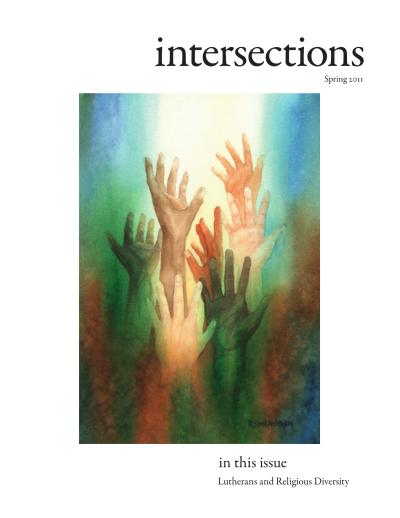 Editorial
From the Editor
Robert D. Haak
No. 33 · Spring 2011
Haak frames the issue by asking how Lutheran colleges and universities understand the changing landscape of religious identification on their campuses, and argues that Lutheran theological commitments — including the work of the Spirit and the Incarnation — call institutions to create places where the voice of “the other” is heard and valued.
-
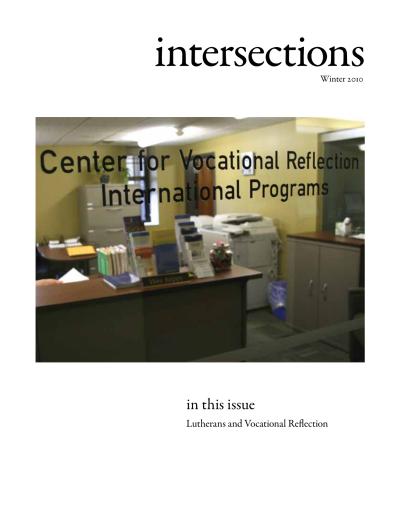 Article
Called to Serve
Robert D. Haak
No. 31 · Winter 2010
Haak describes Augustana’s Center for Vocational Reflection (CVR) and its threefold framework of skills/gifts/talents, passions/values, and needs of the community. He surveys the CVR’s Working with Faith group, seminary visits, spiritual companioning, Servant Leader Internships, international travel reflection, and the major Senior Inquiry curriculum revision—then reports the lessons learned at Augustana: that multiple exposures matter more than any single program, that the language of vocation works even for non-religious students, that student-initiated ideas (like Erin Blecha’s Athletes Giving Back) often succeed most, and that the CVR will soon merge into a new Community Engagement Center.
-
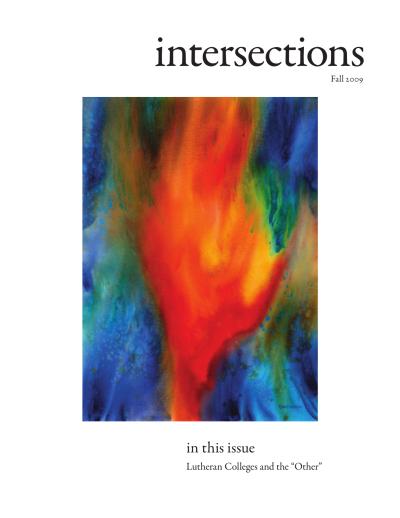 Editorial
From the Editor
Robert D. Haak
No. 30 · Fall 2009
Haak frames the issue around the question of Lutheran college identity as formed in distinction from some “other,” introducing essays by Witherup on the Joint Declaration, Reuther on Holden Village, Afzaal on Christian-Muslim dialogue, Dovre on the history of Midwestern Lutheran colleges, Radecke on service-learning, and Ratke on Wilhelm Löhe — each making the claim that the “other” is an essential partner in conversation who helps us know who we are and shape who we will become.
-
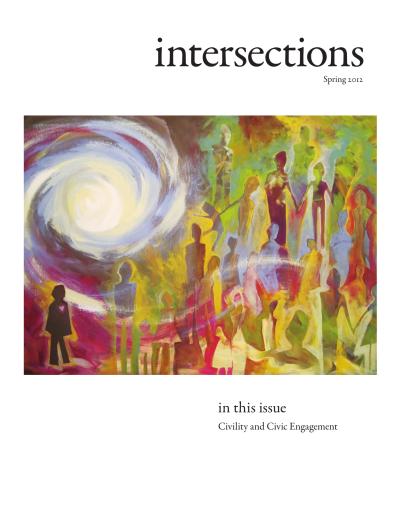 Article
Why Lutheran Colleges Need to Engage Civil Society
Ann M. Svennungsen
No. 35 · Spring 2012
Svennungsen makes the case that Lutheran colleges must engage the larger civil sphere, drawing on her work with The Presidents’ Pledge Against Global Poverty, Darrell Jodock’s seven fundamental experiences for vocational discernment, David Brooks on civility and modesty, and Michael Sandel’s argument that the affluent are seceding from public life. She urges Lutheran educators to invest in the infrastructure of civic renewal so that service-learning and civic engagement remain central to the Lutheran college curriculum.
-
 Article
Building a Third Space in the Age of AI: A Conversation with Dr. Walter Earl Fluker
Elizabeth Kubek
No. 62 · Fall 2025
11 min audio
Prompted by AI chatbots being marketed to students as a safer alternative to messy human relationships, Kubek interviews Fluker on how Howard Thurman’s vision of common consciousness, somaesthetics, and nature-rooted learning offers educators a “third space” alternative to AI’s hall of mirrors.
-
Article
Called for Life
Brian Pittman, Ellen Shelton, Greg Owen
No. 31 · Winter 2010
Owen, Shelton, and Pittman of Wilder Research present the key findings of the Called for Life study, comparing the class of 2007 “Lilly graduates” from Luther, Augsburg, and Augustana to a pre-Lilly cohort from the class of 2001. They report that Lilly graduates were more than twice as likely to associate vocation with “calling” rather than “just a job,” and they identify four common ingredients of effective programming: relationships with caring adults, experiential learning outside the classroom, vocation-infused courses, and peer relationships within a pervasive campus culture of vocational exploration.
-
 Article
Cultivating Staff Flourishing in Lutheran Higher Education: A Framework for Advocacy and Engagement
Laree Winer
No. 58 · Fall 2023
Winer narrates her own “love affair” with Lutheran Higher Education to argue that the heart of the tradition — vocation, de-emphasized hierarchy, and shared humanity — equips NECU institutions to advocate for staff flourishing through data collection, professional development, and ongoing relational commitment.
-
 Article
Vocation Outside of Career: Discovering Purpose through Comics
María Evelia Emerson
No. 53 · Spring 2021
Emerson recounts building an Augustana Vocational Discernment course around G. Willow Wilson’s Ms. Marvel series, using Kamala Khan’s juggling of family, friendship, faith, and superhero identity to help sophomores see vocation as not what they do for a living but how they want to live.
-
 Article
Lutheran Identity, Academic Integrity, and Religious Diversity
Storm Bailey
No. 25 · Spring 2007
Bailey argues that one might rightly say of a college “that’s a pretty good school because it’s religious,” defending the proposition under three headings: academic and curricular virtues, free inquiry, and religious diversity. Drawing on Mark Schwehn’s Exiles from Eden, Richard Hughes on the Lutheran tradition’s “most potent theological resources” for the life of the mind, Parker Palmer, Lendol Calder, Mill’s On Liberty, Newman’s Idea of a University, and the AAUP’s 1940 Statement, he proposes a “critical mass” alternative in which the Lutheran commitment to truth-seeking and self-critique itself requires—rather than tolerates—a religiously diverse faculty whose opposing voices are needed for the mission to flourish.