Before I begin, a disclaimer. I am talking today about being a creative writer at a Lutheran college, but I probably have fewer creative writing credentials than those who teach writing at your institutions. I think Arne Selbyg allowed me to masquerade as a “creative writer” today because for the Lutheran Academy at Harvard last summer—on “The Lutheran Public Intellectual and the Arts”—I proposed a project of “creative” writing rather than of scholarly research. But I do consider writing my vocation as much as teaching and scholarship—my way, to quote Darrell Jodock’s definition of vocation, of seeing my “life and work as avenues of service to God, the community, and the work, not merely as ways to pursue [my] own goals” (19).
My title is “Honoring the Word.” Lutheran theology is grounded in the Word, and since we are Lutheran colleges, we should also be grounded in the Word. I am not a theologian, but, as one of my students once said, “Hey, my misunderstandings work for me!” In the first place, “Word” means the Logos, the primordial ordering principle that moved over the face of the waters and declared “Light” and “Land and Sea” and eventually “Creeping Things” and “Humans”: “In the beginning was the Word, and the Word was with God, and the Word was God” (John 1:1). This elemental naming becomes the labeling power humans are gifted with: Adam and Eve name each species of the Garden’s flora and fauna, and the biblical Word is filled with subsequent namings all the way down to the Father’s baptismal blessing, “This is my Son, my Beloved, with whom I am well pleased” (I Peter 1:17), and Simon Peter’s witness, “You are the Messiah, the Son of the living God” (Mt. 16:16); from the awe-inspiring “I am who I am,” down to Revelations’ “I am the Alpha and the Omega, the beginning and the end” (21:6).
Martin Luther used the term “the Word” (with a capital W), in the most specific sense referring to the Scripture, God’s Word: the Old Testament precepts, the law we humans can never fulfill; and the New Testament gospel, God’s promise of salvation in the face of that human inadequacy. Luther’s central privileging of God’s Word led him to popularize the Bible by translating it into German, and to establish schools so that lay people could learn to read it. It also led him to write his theological pamphlets in a simple and direct style and to use homely, colorful images in order, as he says, “That I may open then an easier way for the ignorant” (“Concerning Christian Liberty”).
Luther expanded his notion of the Word to include what is spoken, with the Holy Spirit sifting into people’s hearts through oral language. This is why Lutherans emphasize the sermon and, to insure that preachers preach the gospel, emphasize that sermons be grounded in scriptural readings, and be based in knowledgeable exegesis. The priesthood of all, in a sense, made scriptural interpretation another vehicle of God’s Word. A germ of the Word could sprout in more informal settings too, when the gospel was spoken, or the spirit found its way into human language while the speaker was unaware.
For me, a corollary to this enlarged definition of the Word is the sacred power of human language as God’s gift. In Real Presences, George Steiner takes this spiritual sense of human discourse to one logical and essentialist extreme, arguing that language is only capable of meaning because of God’s absolute reality: “any coherent account of the capacity of human speech to communicate meaning and feeling is, in the final analysis, underwritten by the assumption of God’s presence.” (3-4). I am not sure I would go so far as Steiner does, but I am talking about ways that our communal language in Lutheran colleges can have holy uses.
If language is a treasured gift, then, we need to be careful not to spend it profligately. We needn’t hoard it, of course—saving up thoughts phrased in beautiful, unspoken words. Muteness does not work to link the Body’s limbs. Jodock says that a Lutheran college organizes “itself as a community of discourse” (16). Valuing words means that, as community members, we exercise care in speaking and writing. We need to build comfortable verbal rooms to live in, but also to describe the room’s furnishings as precisely as possible. We need to clarify together what we mean by “faith and learning,” by “teaching values,” by the sometimes loosely-used words “diversity” and “identity.”
A. The Chapel Word. Our communities have different institutional architectures, to continue my metaphor, so the literal places where our communal spiritual discourse takes place differ, and some worship traditions are livelier than others. For some of us, faith and learning come together most palpably at chapel, where a community gathers to listen to worshipful music, to declare our faith in carefully-crafted creedal statements, to pray, to sing, and to hear Scripture.
In some campuses, we also gather to hear the spoken Word—musings by staff or faculty speakers who respond to the biblical text from the perspective of their disciplinary expertise. Here too, speakers need to exercise care. Communal words are strong medicine: they can be bitter and make us weep; they can heal or make us laugh, and they can illuminate. The chapel talk—a genre that includes personal stories, scriptural interpretation, theological reasoning, and personal witness—is produced for worship. A message is spoken, but these chapel words are themselves the shaped utterance, like a poem’s language. And they are particularly poignant because spoken by someone people know, someone who laughs over coffee and who has a distinct professional role at the institution. Locating this discourse within a community of faith and learning means that a chapel message is not a disciplinary lecture, a diatribe on political ills, or even a simple appeal for service project volunteers. We must underwrite our words with theology and biblical texts, because articulating the Word’s philosophical implications teaches us (and students) to exercise our intellects in faith matters. In chapel we take a moment together to meditate, to probe, to question, and in doing so, to hold up that Word as a shared gift.
One of my former students, now an English professor, recently wrote to me about her college experience. She said she was turned off by fellow students who used literature for classroom “testimony or proselytizing,” which made her carefully avoid “letting personal faith” influence her literary interpretation. But she went on to say:
being at an ELCA college did make a difference, and this was largely because of chapel. I think I had an unconscious sense that chapel talks were a different kind of discourse [than the classroom]. I remember, for instance, a chapel talk you gave during my freshman year. In your drama class, we had recently read [John Webster’s Jacobean tragedy] The Duchess of Malfi, and you used that play to illustrate something you were saying. Shamefully, the particulars escape me, but I do remember the moment: it was one of the first times I started to think that literature could enhance, enrich, and complicate the way I thought about religious or moral questions.
Chapel talks sometimes need to explore the implications of our culture’s public discourse; we need to encounter Luther’s other Kingdom. Here’s a section of one of my recent chapel messages, which some of you may have read in Luther College’s faculty journal Agora:
In Martin Scorsese’s 1976 film “Taxi-Driver,” the lead character, played by Robert DeNiro, is a Vietnam veteran disgusted by the decadent lives his yellow cab ferries at night through the steamy Manhattan streets. When he encounters the waiflike child-prostitute played by Jodi Foster, he is horrified at her victimization by abusive pimps and customers. His disgust rises through the film until he is so repulsed by the social garbage of his environment that he purchases a high-tech gun, stalks a group of pimps to their flophouse, and blasts them away in a bloody apocalypse. The film doesn’t intend us to applaud the violence, but we are drawn into the psyche of this disturbed—but oddly puritanical—character, and we too want the world to be somehow rid of such evil characters.
In some deep way, I think we all understand this impulse not only to clean up our immediate surroundings but also to clean up the world, to get rid of all the unsavory dirt that pollutes human life. Consider Timothy McVeigh’s drive to blow to smithereens the Oklahoma City Federal Building, the government storming of the Waco Branch Davidian cult headquarters, the disgruntled postal workers who have blown away their former co-workers, and, of course, the terrorists who masterminded the September 11 disaster.
But this urge to cleanse the world is not limited to psychotic misfits and misguided religious fanatics. President Bush has used this clean-sweep rhetoric in order to build support for the War on Terrorism, and all of us at some level would like to wipe out those who commit terrible acts. These purifying impulses—though not parallel—share a similar psychology and rhetoric. And the Old Testament prophets use just such apocalyptic images and violent rhetoric. From the third chapter of Malachi:
But who can endure the day of his coming,
and who can stand when he appears?
For he is like a refiner’s fire and like fullers’ soap; he will sit as a refiner and purifier of silver, and he will purify the descendants of Levi and refine them like gold and silver. (3:1-3)A kind of Gothic shiver runs down our spine as we read such passages, but the unsettling problem is that we aren’t really sure that the evildoers aren’t us. The idea that we—or those we know and love—might be burned off the earth’s face by this avenging God is unpalatable to our grace-loving faith. But is it possible that the dramatic triumph of God’s gentleness can only be articulated within the rhetorical context of hyperbolic judgment? We need to hear that we are lost and blind wretches in order to be found, to really see, to understand being embraced by amazing grace, to internalize that even pathetic, wretched old me—not dramatic enough to be really evil—can be made marvelously, dramatically new.
Malachi’s God says, “You have turned aside from my statutes.” And then he makes it sound ever so simple: “Return to me.” And if you do return, you will experience something that can only be articulated with the same hyperbole as the heavy judgment language: THEN, says God, “see if I will not open the windows of heaven for you and pour down for you an overflowing blessing” (3:10-12).
God’s Malachi judgment is a set of binary oppositions—a person is either righteous or an evildoer. But this God knows human moral ambiguities and does not encourage our absolute judgments. Those who seek to wipe clean the world’s evil are not God’s instruments, though they may think so. Instead, we need God’s wrathful world-purification as an image of judgment that we ourselves should never carry out. Be wary, Malachi implies, of attempting to clear-cut the forests of the world’s evil; leave the rough stuff to God. On the “day when I will act,” the Lord says, “Then you shall see the difference between the righteous and the wicked, between one who serves God and one who does not” (3:17-18). In other words, God does the judging, and only then will we—with our myopic mortal vision—see which is which.
So finally, Malachi’s prophecy is not about judgment; it’s about coming home. And it includes a splashy passage about this return, which is filled with wonderfully hyperbolic mixed metaphors:
You shall go out leaping like calves from the stall.
And you shall tread down the wicked, for they will be ashes under the soles of your feet, on the day when I act. (4:2-3)As you return to God, beware of the mud and shake the ashes from your feet, but remember that we all emerge out of ash and finally enfold ourselves in dust. Only a hair separates us from evildoing—where we walk, there is a great chasm on either side, “the valley of the shadow of death,” and we must keep peering down—but grace allows us to tread that narrow path and if we follow it, we will find ourselves—at some point—leaping like calves from the dark stall into the healing wings of the sun.
B. Classroom Wonder. I am quite sure that something one might label “spiritual” happens in other contexts besides chapel: intimate conversations, moments of public eloquence. But I’d like to talk about the classroom. I think we as teachers can honor the Word by bringing to our classes a sense of wonder, modeling inquiry as God’s delightful gift. Jodock explains that the Lutheran legacy is “free inquiry” (23), the rigorous pursuit of truth with no fear of shattering faith or offending God. I don’t mean we should be teaching “Christian” economics and physics; I don’t mean we should begin our classes with prayer, or bring a personal faith witness to the classroom. The classroom should not be a religious place, but I do think it is a place where the sacred can be implicitly revealed.
Part of this wonder is an appreciation for different avenues to the holy. One of our academic goals ought to be to teach students to be religiously imaginative. In another context, Martha Nussbaum argues for developing a moral imagination, demonstrating how novels, in particular, elicit a way of seeing which develops “[H]abits of empathy” and a “sympathetic responsiveness to another’s needs” by helping us to “define the other person as spacious and deep” (88). But she steps delicately around wonder about transcendence, and she neglects religious dimensions of human experience which are crucial to many people’s “rich inner life.”
Nussbaum’s argument can be extended to a call for developing the religious imagination. At many of our colleges, we require students to take religion classes to develop their biblical and theological sophistication, but we need to also help them expand their religious imaginations. The most religiously narrow-minded people I know are individuals who cannot imagine their way into someone else’s spiritual psyche. Developing our religious sensitivity may not be essential to good citizenship, as Nussbaum argues the moral imagination is, but it is essential to a working church—the Body of Christ—and, I would argue, it is essential to a constructive religious climate in the larger commonwealth.
Teaching wonder might seem more natural to literature classrooms than to other subjects, though I think we’ve neglected it in many academic disciplines. One feels a sacred moment when the minds in the classroom are coming alive together; when the participants feel the synchrony of voicing shared ideas, feel their almost palpable progress towards truth. In literature classrooms, this feeling is heightened by the aesthetic pleasure of the very medium being discussed: the class may be silently awed at a poem’s words or deeply moved at a character’s speech. But a chemistry class might be similarly stunned by an electron microscope’s portrait of vibrantly-colored crystals, a math class by the eloquence of a particularly intricate equation (so I suppose my definition of “word” would include, at times, numbers).
C. Wording the Sacred in Poetry. Finally, I want to talk about how deeply our campuses need poetry as a distinctive way of honoring the Word. Poetry is dead, some say: it is an esoteric medium which only literary aficionados can read with understanding and pleasure. The popular perception is that poetry usually speaks about love or death and is constructed of short stanzas of regular, “sing-songy” meter, and true rhymes—this after nearly two centuries of free verse poetry in conversational language about all subjects. In new biblical translations, poetic language is replaced by prosy, contemporary wording with no cadence. Sales of poetry books suffer, and huge bookstores have one or two small shelves devoted to serious poetry. Teachers often convey to the students that they themselves feel that poetry is incomprehensible, even that they openly dislike poems. We are quietly producing a people who are unaware of this major spiritual resource, who feel that it does not speak to their experience.
Despite this public neglect, poems continue to quietly and profoundly affect people. Former Poet Laureate Robert Pinsky’s Favorite Poem Project revealed dynamic interest in some poems. At celebrations and times of crisis, people turn to poets to capture, in language of beauty and power, the communal emotion. Some newspapers reported that after the September 11th attack, people in Manhattan offices viewing the disaster, and others across the country watching it on television, turned to the Internet in search of poems—a secular but spiritual scripture to sustain them in the midst of confusion, terror, and grief. Singer-songwriters travel the country, singing their original pieces, and many are fine poetic work. A very few popular films nod toward poetry as a powerful voice (Dead Poets’ Society, the grieving lover reading Auden’s “Stop all the clocks” in Four Weddings and a Funeral, and the various re-makings of Shakespearean drama on film). And a good share of students privately use poetry to express their thoughts.
Still, poetry suffers in our college curricula. Even English faculty sometimes prefer teaching fiction, and recent emphases on the politics and economics of literary production sometimes render poetry irrelevant. Other faculty use novels to teach religion, political science, and economics, but rarely choose a poem to deepen students’ understanding. Our current emphasis on global issues has called again for relevance and utility, and many faculty would see poetry as one of the least pressing of students’ academic needs. Yet poetry is the most interdisciplinary of disciplines, written about all ways of knowing, regularly using prominent images and technical terms from across the academic spectrum to reflect on a historical event, chemical element, athletic move, or anthropological discovery. As Luther’s Dennis Jones Teaching Professor in the Humanities for the next two years, I’ve designed a project to bring such relevant poems to each discipline for student-faculty discussion, and to build an audience for poetry.
By shaping these issues into poetic form, poets help those of us deeply entrenched in our disciplinary thinking, to re-conceive and re-envision. Thus I would argue that poetry is a crucial part of both the spiritual dimension and the intellectual content of our faith and learning dialogue. Poetry deepens our understanding of human experience, transforms sense impressions into imaginative vision, makes daily language speak lived truths in radically new ways. A poet particularizes a speaker’s pain or joy and yet elevates and universalizes it. In a brief white space, poets voice our humanness. If the novel, as Nussbaum argues, helps us to be morally imaginative, poetry, it seems to me, leads us to be spiritually imaginative. The concrete images and fleshy language of poetry incarnate the unseen sacred.
Thus it is that I see writing as a Christian vocation. We Lutheran college writers need to write for our communities as well as for a wider audience; our role is to commemorate our shared sorrows and joys—to inscribe our community’s significance, to demonstrate how the Word conveys the flashes of holiness within our mundane lives. And the colleges, in turn, need to recognize and celebrate poetry’s rich potency in the same way that they have celebrated the range and power of music.
Let me try to illustrate by reading some of my own poems. (As I wrote this, I kept thinking that I was being mercilessly self-indulgent by making a presentation in which I read my own work when I suddenly thought, “Well, if I wrote a lecture and then read that, I’d still be reading my own work!”).
In late June a year ago, I sat on a limestone patio step and looked at my shriveled and dry flower garden. I particularly noted the poppies, which had been intensely red-orange but had now dropped their petals. I felt worn-out by the heat, and the summer was careening to a close. So I wrote the following rather depressed opening lines:
Late June
Sometimes, in late June,
when the irises tighten into purple fists
and poppy stalks bend toward bare knobs,
the mind, like the sun on the grass,
stares at the bare blades of a life,
and time seems a thin stem
growing toward a past
when blooms stood fast in the wind.
Now, a whispered breeze is too intense,
and the petals are too thin
to remember.
It’s important to remind our students that life experiences sometimes end merely in resignation or even depression, rather than affirmation. The novelist John Updike talks about his Lutheran upbringing and the way that sometimes the church tries to make God the “God of the dead”:
Having accepted that [God was a “God of the living”], I have felt free to describe life as accurately as I could, with especial attention to human erosions and betrayals. What small faith I have has given me what artistic courage I have. My theory was that God already knows everything and cannot be shocked. And only truth is useful. Only truth can be built upon. (qtd. in Jodock 23)
When I wrote the “Late June” lines, I felt I was speaking a truth. But, interestingly, in this case I suddenly, months later, found my way toward a final affirmation, and I wrote an ending for the poem that also seemed to speak a truth:
Yet at my back a choir
of lilies quietly unfolds their yellow robes,
preparing alleluias for a still July,
when they will bare their flame-tipped throats.
The hope is enough.
This year I wrote some poems that honestly began as celebration: I don’t know if it was the newly empty nest, or that, after four years, I was no longer department head. I wrote another poem this June, this time about that month’s lushness. This poem begins indoors, looking out at the same patio scene:
Early June
Even from the window
through the cold rain
the colors astound: blooming bugleweed
splashed like a pink and purple shawl
with fringes of white alyssum,
daisies opening their eyes with tiny white lashes,
irises the color of pale skies and deep, bloody earth,
peach and red hibiscus trumpeting,
sharp pink fuchsia blossoms
splayed by purple tongues.
Again, I felt the grass’s presence in the scene:
Around this display,
the grass deepens
its green and knowing gaze…
But where did I want the poem to go? I had a grandly regal imagery going in the first part, as well as a sense of observers: me at the window, the grass around the flower garden. Suddenly, I remembered an amazing figure from African history: Mansa Musa, a great, wealthy 14th-century ruler of the West African empire of Mali, who made a famous pilgrimage to Mecca in 1325; he brought with him 60,000 slaves dressed in silk who dropped so much gold dust to the crowds along the way that it actually caused a twelve-year devaluation of gold in Cairo! Suddenly I had my poem’s conclusion:
the grass deepens
its green and knowing gaze
as stalks of regal poppies
drop their extravagant flakes
like Mansa Musa in procession,
grandly gesturing
to silk-robed servants
sowing gold
to awe-struck Cairo crowds.
I just returned from a wonderfully cozy family vacation at our cabin in Montana where I wrote several poems. In this poem, I begin with the actual details of our daily vacation life—in this case, my own culinary mistakes inside the small cabin:
Sweet July
At the cabin making cookies,
I leave out the spices,
and then, the next day,
I promise a coffee cake,
but I forget the sugar.
Suddenly, the poem takes me outside to our stunning surroundings and then to some small incidents of the previous days, which in my mind have become epiphany moments:
The lake is clean blue,
the water cool, and the pine resin
sings its honey song.
Mock orange in full bloom.
A fox and then a bear cross the road
like old friends from town,
and the bald eagle sits
high in our ponderosa, looking.
Then I return the poem to the cabin interior, to our little family’s life together:
We eat ripe plums
and read a book aloud,
and the words make
us laugh and talk.
And finally, thinking back on my cooking mistakes—forgetting the sweetening in my recipes—I end the poem with the question this reverie left me with:
How can we
add any more sweetness
to our lives?
The poet celebrates God’s creation, but not always by naming God. Why is that? I don’t know if I can answer. My first draft ending to that “Sweet July” poem was something like, “Surely God wonders / at our need / to add more sweetness / to our lives.” Since the poem’s still in process, God could still make it in, but so far it doesn’t quite work. The poet tries to make the scales fall from our eyes, so traditional language often fails. We need fresh language to voice life’s incarnational dimensions. This is a hard thing to do. On Good Friday this year, I tried to write a poem using images from Christ’s life and passion but without directly naming them; instead, I used contemporary images from my world on that day:
Good Friday
Last Sunday, the world hailed the spring sun.
Town kids drove loud cars down the streets,
and people shouted yard to yard.
But now we’ve lived through the week’s hard work,
reading in the news the parables about despair,
hoping for miracles at our work desks and shops,
fixing early suppers of day-old bread
and perhaps a glass of inexpensive wine.
Weeds and plastic grocery bags now lodge
in the windblown stalks of our sleepy gardens.
Cross pieces on porch rails sag from weather,
and drifted leaves entomb the whitened shrubs.
Again, I wasn’t sure where to go from here, but I knew I didn’t feel the despair of that scene. My hope in writing the poem had been that new language for a spiritual message might evoke in my readers some almost-forgotten memories and faint spiritual sensibilities. Finally, an ending came to me:
Yet today some crocuses push brilliant blooms
through the grass straw and stiff stems.
A child, red jacket tied around her waist,
skips down the sidewalk pulled by a small white dog.
A man we know knocks gently at a nearby door.
Thank God it’s Friday. Sunday will come again,
and once again, our withered, lonely death
will seem to be no more.
I’ve also attempted some more explicitly religious poems. I’ve recently tried to stretch my poetic range by writing hymn texts, which must declare the faith but must also use fresh words and images. This spring Wartburg College composer Karen Black and I wrote a hymn emerging out of our Lutheran Academy experience together, “The Word First Gathered Chaos Up” [which the Vocation Conference sang at its closing Eucharist]. I also recently wrote a poem about the Annunciation, which appeared in The Cresset. One of my favorite iconic images from a medieval illuminated manuscript depicts the Annunciation, where Gabriel’s words are projected onto a stylized scroll that ribbons out toward Mary and enters her ear: the Word impregnates her womb. I knew that the Latin word textus means “woven thing”—and I was fascinated with the way it suggests both text and textile. And along the way, the fairy tale image of spinning straw into gold intervened. All these connections were a gift—what has been called the poet’s “muse”—the notion of the transcendent as it comes to the artist in the creative act. Here’s the poem:
Pondering These Things
“But Mary kept all these things, and pondered them in her heart.” Luke 2:19The words he dropped into her ear
threaded down into her womb
to gather fibers up and spin out filaments.
In secret shuttle, the woof of flesh
wove deftly through a spirit warp,
and text became a textile.
It was a new synthetic,
finely wrought.
And when this subtle weaving filled its loom,
her body labored in a stable through the night,
and in the morning saw the handiwork laid out,
and straw piles all around seemed spun to gold.
The shepherds ambled in with skeins of wool,
and kings rode in on stars
to kneel and say this new material
had unraveled all the fabric
of the world.
Writing incarnationally means to put transcendent spirit into art’s physicality, to bring the body into the spiritual dimension. Part of the poet’s job is to make even suffering significant and beautiful and perhaps bearable. I buried my mother two years ago, after she had spent years moving down the dark corridor of Alzheimer’s syndrome, and several months later wrote a therapeutic chapel talk in which I worked through my grief and found my way to a Word of consolation and hope. Here’s my ending:
In the end, all that was left of her vibrant presence was a thin, silent form. And yet even that shriveled body with its fragile pulse beat was a naked verification of our grounding in love—that this incomprehensible God still quietly loves even so slight and frail and quiet a thing. This message was my mother’s final ministry to me before she died serenely last April, just as the dawn turned the sky a brilliant rose.
That was my later word of hope, but in earlier months before her death, I had felt differently. I remember how difficult it was when my Mother could no longer mentally locate the names of things—she who had spoken four languages, having grown up the daughter of Norwegian-American missionaries in French-colonized Madagascar. It seemed to me the loss of a crucial bond with the phenomenal world, the human loss of the metaphorical embrace of her language. Here’s the poem’s opening:
The Limbs of Words
Yesterday, as I drove, the fields unfolded
from the gray road like bolts of green corduroy.
At the base of a hill, a small tree struggled to leaf,
and farther down in the valley,
a sudden bush rose into bloom,
astonished like a white balloon.
On a nearer rise, three cows, the color of pecans,
nuzzled the grass in slow, parallel lines.
A spaniel barked at a pickup’s gravel dust
near a farmhouse with a leaning screen porch.
I hold the world’s things in the arms
of my words. They are grounded
in the thingness of what they name,
sure and solid, and when I speak,
objects stand in the mind and take notice:
road, field, tree, cow, house.
I arrange them like apples in a china bowl:
spaniel, corduroy, balloon, pecans.
Today I go to the nursing home to see my mother,
who once spoke surefire words and polyglot:
My ear still hears her singing “Jeg er sa glad,” her
blue eyes clear;
I hear the French r low in her throat,
the Malagasy proverbs she had from childhood.
I hear the secret tremble in her public voice,
her whispered language of faith or failure.
Her bedtime calls still echo through the summer stars.
But how to capture the emotional trauma of my mother’s language loss? I had heard a colleague in psychology talk about semantic trees in the brain, with the most general categories of words being the trunks, then the more specific limbs, which finally move down into the end branches and leaves of the most specific species names. So I had that image in mind—by that time, my mother was lying still in bed unable to speak at all. I wanted—for me and for others—to capture in words the deep gash to one’s humanity of that language loss, and a loved one’s frustration in witnessing it:
But then some years ago, she looked at things and spoke,
and the words shriveled on the tongue into hollow seedpods,
or fell from her lips like early fruit from frostbitten trees.
Names for things broke into particles of sound,
and her words, like her twig arms,
could not embrace the world she saw.
Labels moldered on the brain’s dusty shelves.
Thoughts inched up semantic trees
and lodged in stunted branches.
Sentences wandered the gray roads of the mind,
lost their way, and left phrases lurking
low in the throat like gravel dust.
My mother lives in a bed with wheels,
but she lies still like a bolt of cloth.
My mother, I say,
but that round belly of a word
sags in my mind like her aged breast,
a flat skinflap, milkless.
I considered ending the poem with that sharp image of personal loss, but I wanted to convey the enormity of this dehumanization’s effect—a kind of cosmic echo. So I decided to use two different kinds of images which would end the poem: 1) the earth-shattering, conceptual shift from a geocentric to a heliocentric worldview; and 2) the moment when God flashed a laser-slice of light—the Logos, the Word—into the dark chaos, and all creation took shape: “In the beginning was the Word, and the Word was with God, and the Word was God” (John 1:1). Here’s the poem’s conclusion:
Here where she lies,
hazy-eyed and thin-throated,
the universe hangs like a clock
that wheels away the heavy hours.
But here the Word does not bring light,
and the fruitless earth
is no longer at the center.
The semester my mother was dying, my Introduction to Poetry class for two weeks heard me repeatedly say that she was in a coma and I didn’t know whether I would be in class or not each new day. When she died, the class created a card for me, using phrases from elegies we had discussed, and I was very moved. After the funeral, I returned to the class and—not really knowing how to talk about the experience and how to capsulate my grief—I read this last poem. The following year, when my colleague asked his “English Teaching Methods” class to write about their most meaningful experience with poetry, one student described that day when I returned to class after a week away and read that poem. She was stunned by how the poem captured a poignant moment in the life of someone she knew so well, but in a different way. That was a moment of classroom wonder, but more than that too.
I’ve already read you my July benediction poem, but my summer was full of such moments of blessing. After a couple of beautiful evenings watching western North Dakota sunsets, I wrote a poem called “Night Rising”:
Night
We call it nightfall,
as if someone in an overhead lightbooth
suddenly dimmed the stage spots,
and darkness fell from the sky
like a velvet proscenium curtain,
as if the sun dropped her heavy skirt
over sunburned thighs after a hard day.
The poem talks about how night does seem to descend in the city where
The sun slips behind a wall of brick,
and heavy shadows slide down the sides of buildings,
hanging black triangles under balconies…
falls softly into the creases of hooded blankets
on the heads of men huddled at store entries….
The compass of the night leans down
and draws its dark rings under the streetlights.
“Night falls in the mountains too,” the poem goes on,
where the ridge
Pulls up to hide the sunset and casts a cool shadow
On the valley, dropping blue depth into the lake.
The poem sets up this opening in order to lead into the sharply contrasting description of dusk on the plains:
But on the plains darkness rises from the long land.
You can feel the soil slowly cooling underfoot,
releasing its blackness from under the green quack grass,
under the stalks of big bluestem and crested wheatgrass
and poison ivy leaves. The evening spreads upward
under the rows of hanging sunflower heads.
It deepens the blue undersides of the flowering flax,
the purple berries of the buck brush. It moves up the cornstalk
and traces a sharp line under each arched leaf blade…
Finally, the rising darkness renders its peaceful benediction:
Trees rise up from vast plains like black ghosts
to jag the flat horizon. The owl rides
on the rising night. Large-eared deer
lift up their antlered silhouettes
against the last blossom of sky
as the dark earth reaches up
to push the crescent moon
into its dim position.
I ended my chapel talk about my mother with lines from T. S. Eliot’s poem The Dry Salvages, and they will also serve as my ending today:
… These are only hints and guesses,
Hints followed by guesses; and the rest
Is prayer, observance, discipline, thought and action.
The hint half guessed, the gift half understood, is Incarnation.
(The Dry Salvages 212-15)
Works Cited
Eliot, T. S. “The Dry Salvages.” From The Four Quartets. The Complete Poems and Plays 1909-1950. New York: Harcourt, Brace and World, 1971.
Jodock, Darrell. “The Lutheran Tradition and the Liberal Arts College: How Are They Related?” Called to Serve: St. Olaf and the Vocation of a Church College. Ed. Pamela Schwandt, co-eds. Gary De Krey and L. DeAne Lagerquist. Northfield, MN: St. Olaf College, 1999. 13-36.
Luther, Martin. Concerning Christian Liberty. The Harvard Classics. Ed. Charles W. Eliot. New York: P. F. Collier and Son, 1909-14. Vol. 35, Part 6.
Nussbaum, Martha. Cultivating Humanity: A Classical Defense of Reform in Liberal Education. Cambridge, MA: Harvard UP, 1997. 83-110. See also Nussbaum’s Poetic Justice: The Literary Imagination and Public Life. Boston: Beacon Press, 1997.
Steiner, George. Real Presences. Chicago: U of Chicago P, 1989.
Taxi Driver. Dir. Martin Scorsese. Screenplay Paul Schrader. Columbia Pictures, 1976.
Acknowledgements: “The Refiner’s Fire and Leaping Calves” was first published in Agora: Luther College in Conversation 14.3 (Spring 2002): 27-29; “Pondering These Things” was first published in The Cresset LXIV, 2 & 3 (Christmas/Epiphany 2000-2001): 38.
-
 Editorial
From the Publisher
Arne Selbyg
Selbyg reports that “vocation” is surely among the top three words in Intersections’s history and congratulates nine ELCA institutions—Augsburg, Augustana (Rock Island), Concordia (Moorhead), Gustavus Adolphus, Luther, Pacific Lutheran, St. Olaf, Valparaiso, and Wartburg—on receiving roughly two-million-dollar Lilly Endowment grants for the “Programs for the Theological Exploration of Vocation,” while reminding readers that for Lutherans the priesthood of all believers means callings to be accountants, nurses, police officers, and home makers count as fully as callings into ministry.
-
Editorial
From the Editor
Tom Christenson
Christenson previews this issue’s papers from the Vocation of a Lutheran College Conference—Curt Thompson on “the Lutheran knot,” Carol Gilbertson on the creative dimensions of language, Bruce Heggen on theological vocabulary in the state university, Susan Poppe on the boundaries of campus freedom, and Sig Royspern’s oracular gems—welcomes Robert Benne’s response to the previous issue as a sign that Intersections is becoming a locus of continuing conversation, and confesses his reluctant consent to appear on the cover.
-
Article
Do You Teach in a Different Manner at a Lutheran College? Unraveling the Lutheran Knot and Highlighting the Glory in the Theology of the Cross
Curtis L. Thompson
Thompson argues that being Lutheran means having a “knot in the stomach”—a dialectical “Yes and No” tension between law and gospel, two kingdoms, Word and world—and that this knot is held together by Luther’s theology of the cross supplemented by an under-appreciated theology of glory in which God shines through human beings and creation. He then traces how the Lutheran knot shapes his teaching at Thiel College in the Religion department, the first-year team-taught “History of Western Humanities,” the second-year “Science and Our Global Heritage,” and his work as Co-Director of Thiel’s Global Institute, concluding that only such “dialectical doublespeak” leaves him with the “at-once dreaded and delightful dis-ease of the Lutheran knot.”
-
Article
Writing Toward the Night Complete: Teaching and Working at the Public, Secular Institution
Bruce Allen Heggen
Heggen, Lutheran Campus Ministry pastor and adjunct English professor at the University of Delaware, builds on a freshman’s essay closing line—“All in all our night was complete”—to argue that even in the secular public university one can “teach hope” as a critical principle by drawing on Douglas John Hall’s Heideggerian distinction between calculative and meditative thought, the Frankfurt School’s instrumental versus substantialist reason, Luther’s theology of the cross, Parker Palmer’s “obedience to truth,” bell hooks, Lionel Basney, Shelley Shaver, and Donald Sheehan’s Frost Place “principle of compassion.” The classroom and Lutheran campus ministry together can become “communities of memory and hope” that, like the artist student’s Fourth of July, hold together danger, people getting together, explosions, and lots of fun.
-
Article
The Impropriety of Jesus' Teaching: The Woman at the Well and The Vagina Monologues
Susan M. O'Shaughnessy
O’Shaughnessy Poppe dedicates her message to those who worked to put on Eve Ensler’s The Vagina Monologues against administrative resistance and reads the Samaritan woman at Jacob’s well alongside the testimony of a Bosnian rape survivor whose story Ensler asked to tell, arguing that the “impropriety” of Jesus—his scandalous recognition of those silenced by sexism, racism, war, custom, and the church—is the model for the mission of a college of the church to defend academic freedom and to break the chains of oppression by inflicting discomfort on the proper and pure.
-
Poem
A Rainfall of Questions Collected in the Form of a Poem
Sig Royspern
Royspern offers fourteen oracular questions on aging, addiction to possessions, water striders, magnolias, slippery fish, moths and the moon, priests and leaf-rakers, weeds and flowers, the price of education, abandoned groceries, spiritual pilgrimage, melons and oats, similes, and the impossibility of finding a store that sells a spring wind.
-
Response
Response to Bishop Olson and President Tipson
Robert Benne
Benne responds to two articles in the Winter 2002 Intersections: former Bishop Stanley Olson’s “The Marks of an ELCA College,” whose narrow reading of the two kingdoms cedes all epistemological claims to secular knowledge, and President Tipson’s engagement with The Future of Religious Colleges, whose “rather unchastened Enlightenment spirit” underestimates how loaded the social sciences and humanities are with their own philosophical and religious assumptions. Drawing on Reinhold Niebuhr, John Milbank, and William Buckley, Benne defends a “critical mass” of pervasively Lutheran colleges and calls on bishops and pastors to take the schools seriously lest they drift from their religious heritage.
-
 Reflection
Walls: Talk At Gustavus Adolphus College
Elizabeth Baer
No. 5 · Summer 1998
Baer’s September 11, 1997 Gustavus Adolphus chapel homily on Joshua 6 turns from the trumpets to the walls—Robert Frost’s “Mending Walls,” the walls of the Warsaw ghetto in Vladka Meed’s On Both Sides of the Wall and Margaret Zassenhaus’s Walls, the Berlin Wall coming down in 1989—and then to the autobiographical, intertextual discourse of Gustavus chapel itself as a place where misunderstandings come down. An author’s note added after the March 29 F3 tornado reports the closing line (“LET’S MAKE THOSE WALLS COME TUMBLING DOWN”) as eerily prescient: roofs, windows, and 90% of campus trees were lost, but the Chapel walls and the eternal flame in the red glass lantern stood firm.
-
 Article
An Ecosystem of Democracy
David Thomason
No. 63 · Spring 2026
6 min audio
Thomason argues that faith-based institutions should equip students not to dominate the public sphere with their convictions but to cultivate an “ecosystem of democracy” — pursuing universal values with virtue and tolerance while acknowledging humanity’s incomplete grasp of truth.
-
 Article
(Re)Defining Vocation: Gladly Challenging a Vocational Giant
Andrew Tucker
No. 53 · Spring 2021
Tucker challenges Frederick Buechner’s famous definition of vocation as “where your deep gladness and the world’s deep hunger meet,” arguing that gladness reflects a privileged perspective and proposing instead that vocation be defined as “any meaningful, life-giving work you do for the world.”
-
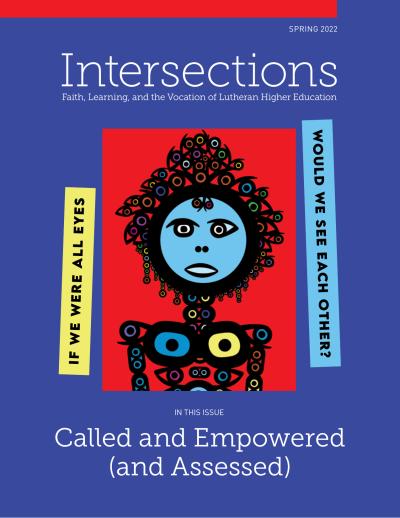 Book Review
Assessing the Value of Liberal Arts: A Review of The Evidence Liberal Arts Needs, by Richard A. Detweiler
Robert D. Haak
No. 55 · Spring 2022
Haak reviews Richard A. Detweiler’s The Evidence Liberal Arts Needs, in which the former president of the Great Lakes Colleges Association analyzes 240 college mission statements and interviews more than 1,000 graduates to argue that liberal arts educational experiences have a measurable impact on adult lives of consequence, inquiry, and accomplishment — and invites NECU institutions into a further conversation about how Detweiler’s methodology applies to Lutheran higher education.
-
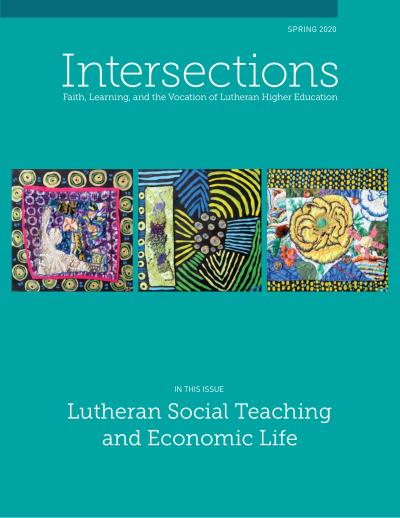 Article
Business as Usual? Marketing, God, and the Limits of Christian Callings
Emily Beth Hill
No. 51 · Spring 2020
Hill, a former corporate marketing consultant turned theologian, returns to Luther’s claim that no vocation is more holy than another — and uses Luther’s Large Catechism definition of God to argue that the modern practice of branding intentionally redirects the love and worship of human beings toward capital, raising the question of whether Christian neighbor-love places limits on what professions Christians should pursue.
-
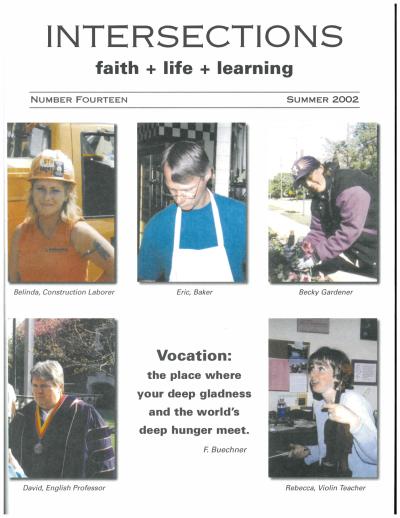 Book Review
Alister McGrath: Glimpsing the Divine: The Search for Meaning in the Universe
Don Braxton
No. 14 · Summer 2002
Braxton reviews Alister McGrath’s Glimpsing the Divine (Eerdmans, 2002), commending its twelve articulate, lavishly photographed meditations as a fine introduction to Western spirituality but criticizing its conservative neo-Barthian confessionalism, its Eurocentric treatment of non-Western traditions as “taillights” to Christianity’s “headlights,” its one-sided host-guest engagement with the natural sciences, and its metaphysical dualism. In a section added for ministerial readers, he contrasts McGrath’s self-contained confessionalism with H. Richard Niebuhr’s call to respond to all things as if to God’s actions upon us, and argues that in an era of rival fundamentalisms exclusivity must become a thing of the past.